Gorgeous German actress and sex symbol Elke Sommer (1940-2026)) made 99 film and television appearances between 1959 and 2005. With her trademark pouty lips, high cheekbones and sky-high bouffant hairdos, Sommer conquered Hollywood in the early 1960s. She was also one of the most popular pin-up girls of the sixties, posed twice for Playboy and had a long-running feud with Zsa Zsa Gabor.
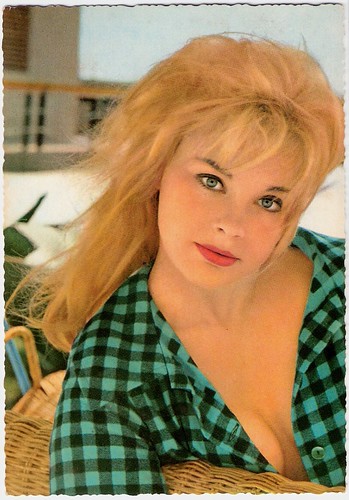
German postcard by Krüger, no. 902/157. Photo: UFA.
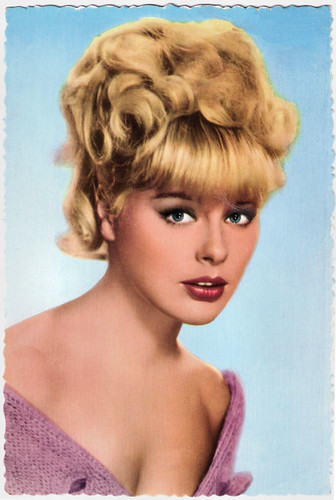
Spanish postcard by Archivo Bermejo, offered by Korès Carboplan, no. C-157, 1964. Photo: M.G.M. Publicity still for The Prize (Mark Robson, 1963).
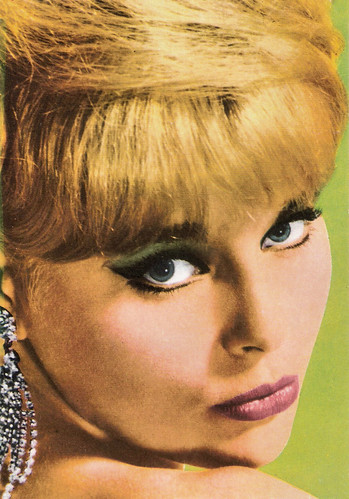
Spanish postcard by Ediciones Tarjefher, no. 5.008, 1964.
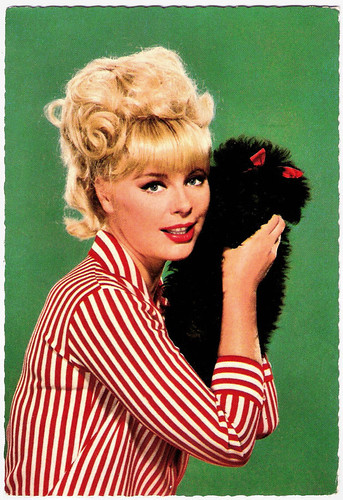
German postcard by ISV, no. T-8.

Belgian postcard by S. Best, Antwerp, for Victoria chocolates, no. 29.
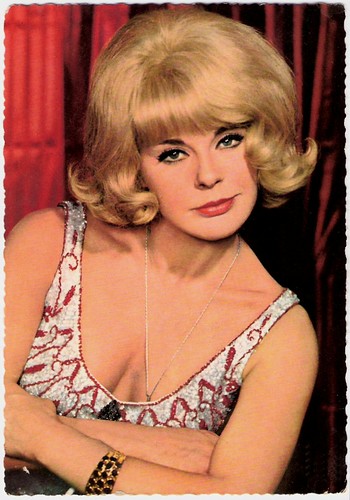
German postcard by Krüger, no. 902/347. Photo: Bernard of Hollywood.
Elke Sommer was born Elke Schletz in 1940 in Berlin to a Lutheran Minister, Baron Peter von Schletz, and his wife, Renata Topp. In 1942, the family was forced to evacuate to Niederndorf, a village near Erlangen, a small university town in southern Germany.
Her father's death in 1955, when she was only 14, interrupted her education at the local Gymnasium (high school). In 1957, she graduated high school and moved to England. There she worked as an au pair in Chigwell and Hampstead, two expensive residential areas of London. She entertained plans to become a diplomatic translator for the United Nations, but instead decided to try modelling.
After winning the title 'Miss Viareggio Turistica' in 1958 while in Italy with her mother, she caught the attention of renowned film actor/director Vittorio De Sica and began performing on screen. Her debut film was in the Italian feature Uomini e nobiluomini / Men and Noblemen (Giorgio Bianchi, 1959), starring De Sica. Elke changed her surname from 'Schletz' to 'Sommer', easier for a non-German audience. A few more Italian pictures followed, including her first starring role in Femmine di lusso / Love, the Italian Way (Giorgio Bianchi, 1960) with Ugo Tognazzi and Walter Chiari.
Within two years, Elke made five films in Italy and also two in West Germany. Her German films were the adventure Das Totenschiff / Ship of the Dead (Georg Tressler, 1959) with Horst Buchholz, and the interesting Film Noir Am Tag, als der Regen kam / The Day It Rained (Gerd Oswald, 1959) starring Mario Adorf. Her status gradually upgraded to a European sex symbol in films such as the sexy De quoi tu te mêles Daniela! / Daniella by Night (Max Pécas, 1961) with Ivan Desny, Douce violence / Sweet Ecstasy (Max Pécas, 1962) opposite Pierre Brice, and the drama Das Mädchen und der Staatsanwalt / The Girl and the Prosecutor (Jürgen Goslar, 1962).
Her first English-language picture was Don't Bother to Knock (Cyril Frankel, 1961) with Richard Todd and Nicole Maurey. Most publicity photographs for Don't Bother to Knock showed her in a bikini. These revealed that although she was nothing like as buxom as Sophia Loren or Jayne Mansfield, Elke had a flat stomach and superb legs.
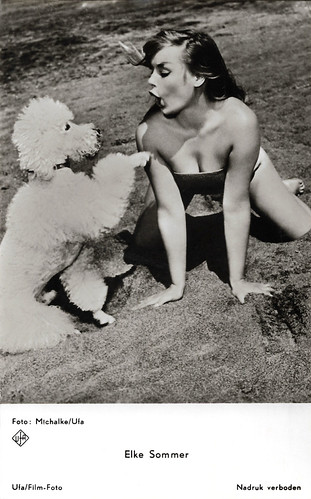
Dutch postcard by Gebr. Spanjersberg N.V., Rotterdam, no. 4626. Gebr. Spanjersberg was the Dutch licensee for the Ufa/Film-Fotopostcards. Photo: Georg Michalke / Ufa.

West German postcard by Rüdel-Verlag, Hamburg-Bergedorf, no. 4116. Photo: Rialto / Constantin / Reiter.

Dutch postcard by Uitg. Takken, Utrecht, no. AX 4982. Collection: Geoffrey Donaldson Institute.
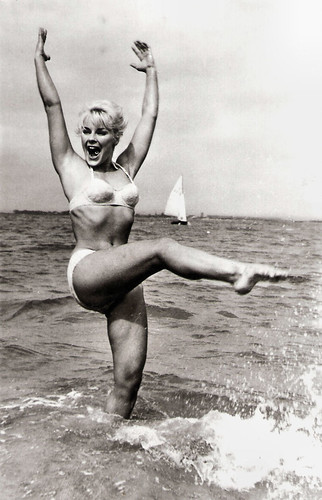
Romanian postcard by Casa Filmului Acin, no. 502.
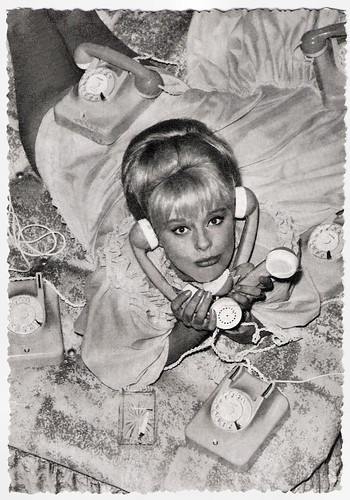
German postcard by Filmbilder-Vertrieb Ernst Freihoff, Essen, no. 789. Photo: Lothar Winkler.
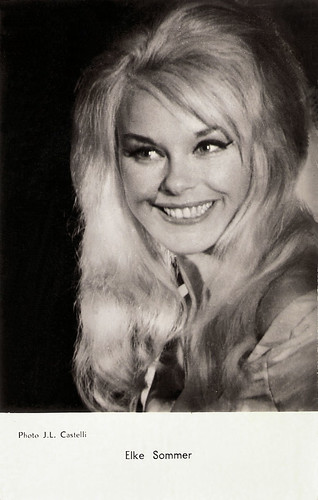
French postcard by Editions P.I., Paris, offered by Les Carbones Korès 'Carboplane', no. 1127 A. Photo: J.L. Castelli.
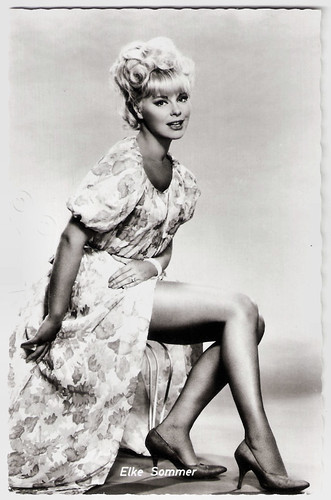
West-German postcard by Kolibri (Friedrich W. Sander-Verlag), Minden/Westf., no. 2352.
Elke Sommer moved to Hollywood in the early 1960s to try and tap into the foreign-born market. Her sexy innocence made a vivid impression in the all-star, war-themed drama The Victors (Carl Foreman, 1963) with Vince Edwards and Albert Finney.
She received considerable publicity when she filmed her scenes twice, with a sexier version made for the European market. Elke played a German girl who sexually gratifies her American boyfriend (George Hamilton) with the full knowledge of her parents because he brings chocolate to the family home.
In 1964 she won the Golden Globe as Most Promising Female Newcomer for The Prize (Mark Robson, 1963), an espionage thriller with Paul Newman and Edward G. Robinson.
In the classic, bumbling comedy A Shot in the Dark (Blake Edwards, 1964), the second entry in the hilarious Pink Panther series, she proved a shady and sexy foil to Peter Sellers' Inspector Clouseau. A scene with Sellers and Elke in a nudist camp received enormous publicity, and the film was a huge hit.
Besides becoming one of the top film stars of the mid-1960s, Sommer was also one of the most popular pin-up girls of the time. She posed for two spreads in Playboy: in the September 1964 issue and in the December 1967 issue.
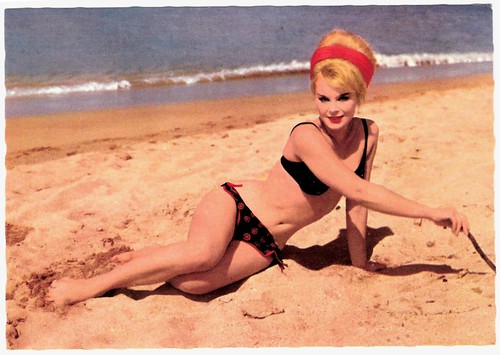
German postcard by ISV, no. Sort 8/6.
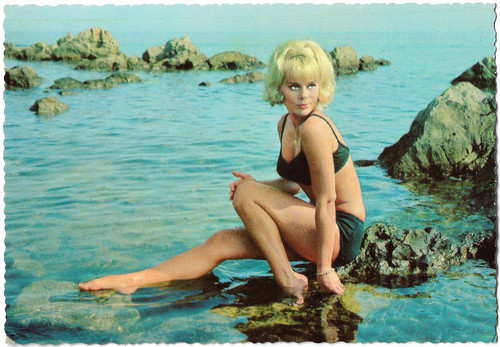
German postcard by ISV, no. Sort 16/6.
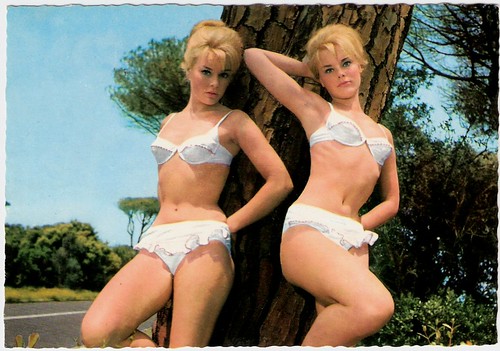
German postcard by Krüger, no. 900/300. Photo: Georg Michalke.
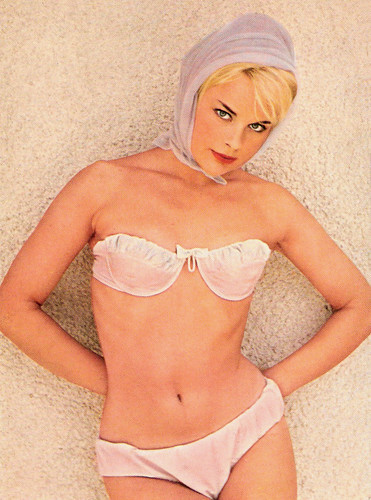
German postcard by UFA (Universum-Film Aktiengesellschaft), Berlin-Tempelhof, no. CK 438. Photo: Herbert Fried / UFA.
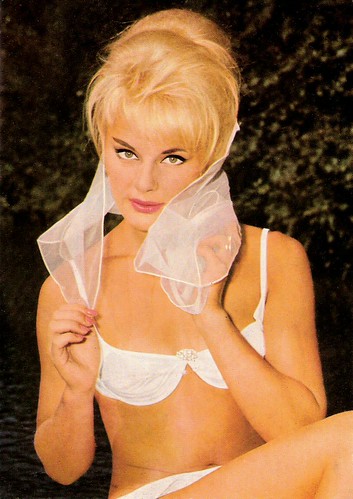
German postcard by UFA (Universum-Film Aktiengesellschaft), Berlin-Tempelhof, no. CK 407. Photo: Georg Michalke / UFA.

Vintage collector card, no. 24.
Elke Sommer was the leading lady opposite hunky sixties stars like James Garner, Robert Vaughn and Dean Martin in Hollywood productions such as the crime melodrama The Art of Love (Norman Jewison, 1965), The Money Trap (Burt Kennedy, 1965), The Oscar (Russell Rouse, 1966), The Venetian Affair (Jerry Thorpe, 1967), and the Matt Helm spy spoof The Wrecking Crew (Phil Karlson, 1969).
The blonde and beautiful Sommer proved irresistible to American audiences whether adorned in lace or leather, donning lingerie or lederhosen. She also continued to make films in Europe.
The Euro-Western Unter Geiern / Among Vultures (Alfred Vohrer, 1964) was based on one of the Winnetou novels by Karl May. Her co-stars were Stewart Granger as Old Surehand, Götz George and Pierre Brice as Winnetou.
In 1966 she returned to England to work on the Bulldog Drummond extravaganza Deadlier Than the Male (Ralph Thomas, 1968). The film has minor cult status, mainly because Richard Johnson gives a superb James Bond-like performance, but also because Elke and Sylva Koscina were so eye-catching as two sexually-charged assassins.
Always a diverting attraction in spy intrigue or breezy comedy, she was too often misused. Setbacks started when the quality of her films began to deteriorate. Examples were the tacky Hollywood entry, The Oscar (Russell Rouse, 1966) with Stephen Boyd, and the Bob Hope misfire, Boy, Did I Get a Wrong Number! (George Marshall, 1966). Her title role in the tasteless Cold War comedy The Wicked Dreams of Paula Schultz (George Marshall, 1968) proved her undoing.
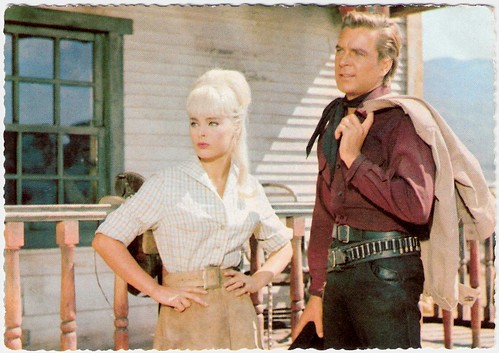
German postcard by ISV, no. C 13. Photo: Constantin. Publicity still for Unter Geiern / Among Vultures (Alfred Vohrer, 1964) with Götz George.
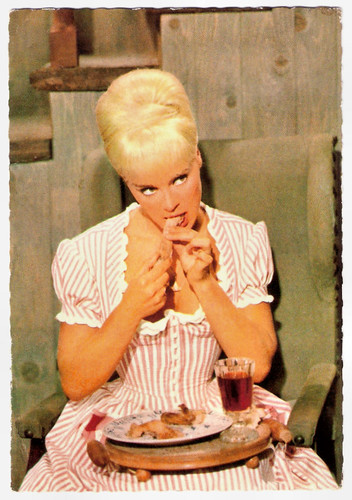
German postcard, no. 13. Photo: Constantin. Publicity still for Unter Geiern / Among Vultures (Alfred Vohrer, 1964) with Elke Sommer as Annie Dillman. Caption: The watchful Annie secretly observes the vulture Weller, who has crept as a Mormon preacher onto Baumann's farm. Allegedly, he is supposed to look after the diamond trek to Arizona. By a flippant remark from Old Wabble, he learns of Annie's treasure.

German postcard, no. 20. Photo: Constantin. Publicity still for Unter Geiern / Among Vultures (Alfred Vohrer, 1964). Caption: The adventurous Annie would have liked to be there. While Martin is at work, two vultures are chasing in a wild gallop. Annie still does not know what will be imminent in the next few minutes.
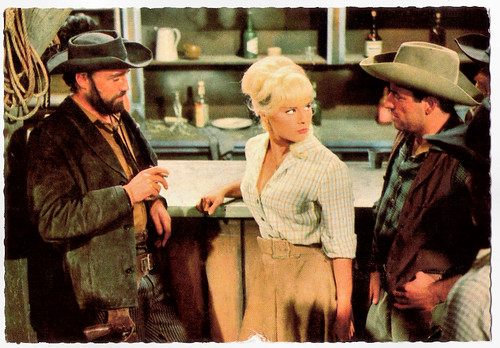
German postcard, no. 23. Photo: Constantin. Publicity still for Unter Geiern / Among Vultures (Alfred Vohrer, 1964) with Elke Sommer as Annie Dillman. Caption: Bravely, Annie defends herself against the bandits who surround her on all sides. She is locked up in a room on the first floor. In vain she tries to explain to the vultures that she does not carry the money at all.
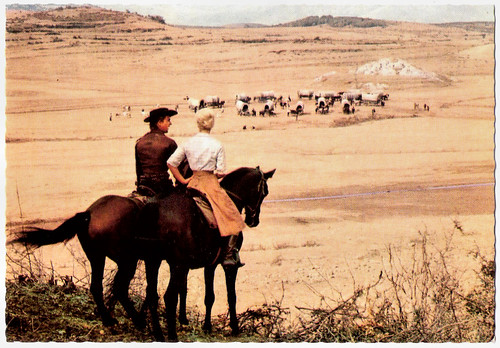
German postcard, no. 41. Photo: Constantin. Publicity still for Unter Geiern / Among Vultures (Alfred Vohrer, 1964) with Elke Sommer as Annie Dillman and Götz George as Martin Bauman Jr. Caption: From a hill, Annie and Martin watch the settlers' camp. They do not know yet that several members of the vulture gang have crept unnoticed into the trek.

West German postcard, no. 63. Photo: Rialto / Constantin. Götz George and Elke Sommer in Unter Geiern / Among Vultures (Alfred Vohrer, 1964). Caption: Martin has realised that Annie is more than just a pretty girl. They have both decided to start a new life together, because Baumann’s ranch needs a new mistress.
Elke Sommer spoke seven languages fluently, and her career took her to scores of countries over time. Her films during the 1970s included the British World War I action-drama Zeppelin (Étienne Périer, 1971) in which she co-starred with Michael York and Anton Diffring, and a remake of Agatha Christie's oft-filmed murder mystery 'Ten Little Indians', And Then There Were None (Peter Collinson, 1974) with Richard Attenborough and Oliver Reed.
In 1972, she starred in two low-budget Italian Horror films directed by Mario Bava, which became cult classics. Gli orrori del castello di Norimberga / Baron Blood (Mario Bava, 1972) with Joseph Cotten turned out to be an international box office success, particularly in the U.S. Producer Alfredo Leone offered Bava a contract for another film, Lisa e il diavolo / Lisa and the Devil (Mario Bava, 1973) with Telly Savalas, and granted Bava total artistic control on it.
Lisa e il diavolo was later re-edited into a very different film called Casa dell'esorcismo / House of Exorcism, a rip-off of The Exorcist. In 1975, Elke returned to Italy for additional scenes, which the producer inserted against the director's wishes. In those scenes, a demonic Elke swears obscenities at her exorcist, and in typical Linda Blair style spits out pea soup and actually vomits live frogs and insects.
In England, she good-naturedly appeared in the ‘comedy’ films Percy (Ralph Thomas, 1971) and its equally cheeky sequel Percy's Progress (Ralph Thomas, 1974), which starred Hywel Bennett (later Leigh Lawson) as the first man to have a penis transplant. She also showed up in a ‘Carry On’ farce, Carry on Behind (Gerald Thomas, 1975) as the Russian Professor Anna Vrooshka.
In Germany, Elke Sommer appeared in Edgar Reitz’s Die Reise nach Wien / The Trip to Vienna (1973) with Hannelore Elsner, and in Wolfgang Petersen’s thriller Einer von uns beiden / One or the Other (1974) opposite Klaus Schwarzkopf and Jürgen Prochnow.
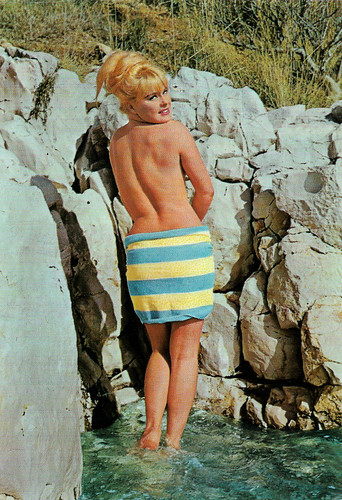
Italian postcard by Rotalfoto, Milano, no. R 259.
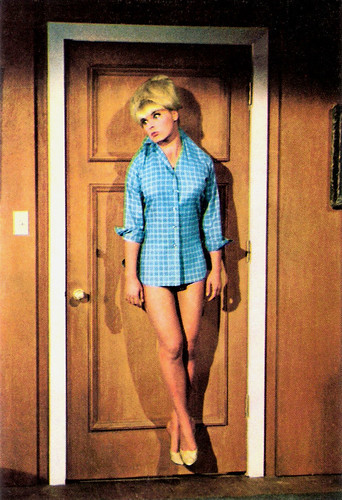
Italian postcard. Photo: DEAR Film. Publicity still for Boy, Did I Get a Wrong Number! (George Marshall, 1966).
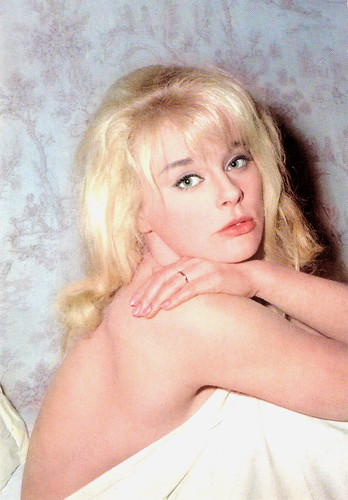
French postcard by Editions P.I., Paris, no. 1091. Photo: Anders.
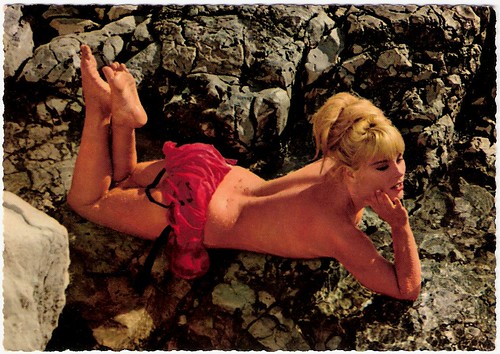
German postcard by Krüger, no. 902/269.
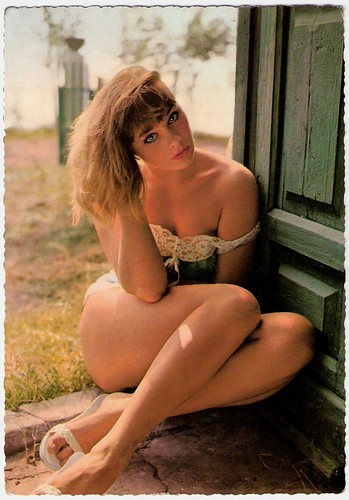
German postcard by Krüger, no. 902/169. Photo: Fried Agency.
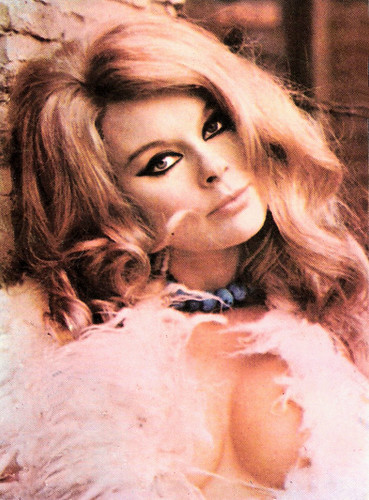
Yugoslavian postcard by Cik Razglednica.
From the mid-1970s, Elke Sommer worked more for TV. She appeared as a guest star in popular series such as The Six Million Dollar Man (1976), Fantasy Island (1981) and The Love Boat (1981, 1984). She played in the Mini-Series Inside the Third Reich (Marvin J. Chomsky, 1982), Jenny's War (Steve Gethers, 1985), Anastasia: The Mystery of Anna (Marvin J. Chomsky, 1986) and Peter the Great (Marvin J. Chomsky, Lawrence Schiller, 1986).
Sommer had a long-running feud with Zsa Zsa Gabor that began in 1984 when both appeared on Circus of the Stars and escalated into a multi-million dollar libel suit by 1993. Gabor and her husband made disparaging remarks about Sommer to several German publications. The jury ruled in favour of Sommer, and Gabor and her husband were sentenced to pay $2 million. Sommer also appeared as a cabaret singer and released several albums. She found a creative outlet on stage too with such vehicles as 'Irma la Douce' and 'Born Yesterday', eventually becoming a director. Sadly, while performing in 'Chicago', she lost twins in her sixth month of pregnancy.
Since the 1990s, she has concentrated more on writing and painting than on acting. Her artwork shows a strong influence from Marc Chagall. She even hosted a TV series on painting. Nevertheless, she tackled an acting role occasionally. Out of the blue, she was cast in a Fangoria magazine production, the Horror picture Severed Ties (1992). In her native Germany, she played in the TV film Ewig rauschen die Gelder / Eternally Rustling Funds (Rene Heinersdorff, 2005) and the comedy Das Leben ist zu lang (Dani Levy, 2010) with Markus Hering and Meret Becker.
Divorced from writer and journalist Joe Hyams, she married hotelier Wolf Walther in 1993. In a 2014 interview, Sommer described how she met him: "I was in New York City starring in 'Tamara' and had to stay there for four months. So, I had to find an apartment, but they were excruciatingly expensive, tiny and loud. I knew the managing director of the Essex House and wanted to talk to him about renting a room, but the hotel had a new managing director, a man called Wolf Walther. So we met. For him, it was love at first sight. For me, it took a little longer, but not much longer. As you may know, 'Tamara' is a play in which the audience follows the actor of their choice, and as you may also know, my husband is 6'5" and hard to miss. I saw him every night in the audience, following me. Every night. And that was the beginning of the greatest love story of my life, still unfolding and getting better by the day."
Elke Sommer died in 2026 of heart failure at her home in Bel Air, near Los Angeles, a few months after the death of her husband, Wolf Walther. Looking back, Sommer felt she had had a wonderful career, in which “I played all sorts of roles, from a prostitute to a nun”. She was satisfied with how she had developed as an actress. “I’ve become quite good, thanks to my stage work, by taking my work seriously and simply by living long enough.”

Vintage photo. Mario Adorf and Elke Sommer in Am Tag als der Regen kam / The Day It Rained (Gerd Oswald, 1959).
American trailer De quoi tu te mêles, Daniela! / Daniella by Night (1961). Source: Deathtrap Trailers (YouTube).
Trailer The Prize (1963). Source: InnuMaccaband (YouTube).
Trailer A Shot in the Dark (1964). Source: Movieclips Classic Trailers (YouTube).
Scene from Deadlier Than The Male (1968). Source: Fan90042 (YouTube).
Trailer Casa dell'esorcismo / House of Exorcism (1975). Source: trailersdaculto (YouTube).
Sources: Gary Brumburgh (IMDb), NOS (Dutch), Cult Sirens (Now defunct), Brian’s Drive-in Theatre, Wikipedia, and IMDb.
German postcard by Krüger, no. 902/157. Photo: UFA.
Spanish postcard by Archivo Bermejo, offered by Korès Carboplan, no. C-157, 1964. Photo: M.G.M. Publicity still for The Prize (Mark Robson, 1963).
Spanish postcard by Ediciones Tarjefher, no. 5.008, 1964.
German postcard by ISV, no. T-8.
Belgian postcard by S. Best, Antwerp, for Victoria chocolates, no. 29.
German postcard by Krüger, no. 902/347. Photo: Bernard of Hollywood.
Miss Viareggio Turistica
Elke Sommer was born Elke Schletz in 1940 in Berlin to a Lutheran Minister, Baron Peter von Schletz, and his wife, Renata Topp. In 1942, the family was forced to evacuate to Niederndorf, a village near Erlangen, a small university town in southern Germany.
Her father's death in 1955, when she was only 14, interrupted her education at the local Gymnasium (high school). In 1957, she graduated high school and moved to England. There she worked as an au pair in Chigwell and Hampstead, two expensive residential areas of London. She entertained plans to become a diplomatic translator for the United Nations, but instead decided to try modelling.
After winning the title 'Miss Viareggio Turistica' in 1958 while in Italy with her mother, she caught the attention of renowned film actor/director Vittorio De Sica and began performing on screen. Her debut film was in the Italian feature Uomini e nobiluomini / Men and Noblemen (Giorgio Bianchi, 1959), starring De Sica. Elke changed her surname from 'Schletz' to 'Sommer', easier for a non-German audience. A few more Italian pictures followed, including her first starring role in Femmine di lusso / Love, the Italian Way (Giorgio Bianchi, 1960) with Ugo Tognazzi and Walter Chiari.
Within two years, Elke made five films in Italy and also two in West Germany. Her German films were the adventure Das Totenschiff / Ship of the Dead (Georg Tressler, 1959) with Horst Buchholz, and the interesting Film Noir Am Tag, als der Regen kam / The Day It Rained (Gerd Oswald, 1959) starring Mario Adorf. Her status gradually upgraded to a European sex symbol in films such as the sexy De quoi tu te mêles Daniela! / Daniella by Night (Max Pécas, 1961) with Ivan Desny, Douce violence / Sweet Ecstasy (Max Pécas, 1962) opposite Pierre Brice, and the drama Das Mädchen und der Staatsanwalt / The Girl and the Prosecutor (Jürgen Goslar, 1962).
Her first English-language picture was Don't Bother to Knock (Cyril Frankel, 1961) with Richard Todd and Nicole Maurey. Most publicity photographs for Don't Bother to Knock showed her in a bikini. These revealed that although she was nothing like as buxom as Sophia Loren or Jayne Mansfield, Elke had a flat stomach and superb legs.
Dutch postcard by Gebr. Spanjersberg N.V., Rotterdam, no. 4626. Gebr. Spanjersberg was the Dutch licensee for the Ufa/Film-Fotopostcards. Photo: Georg Michalke / Ufa.
West German postcard by Rüdel-Verlag, Hamburg-Bergedorf, no. 4116. Photo: Rialto / Constantin / Reiter.
Dutch postcard by Uitg. Takken, Utrecht, no. AX 4982. Collection: Geoffrey Donaldson Institute.
Romanian postcard by Casa Filmului Acin, no. 502.
German postcard by Filmbilder-Vertrieb Ernst Freihoff, Essen, no. 789. Photo: Lothar Winkler.
French postcard by Editions P.I., Paris, offered by Les Carbones Korès 'Carboplane', no. 1127 A. Photo: J.L. Castelli.
West-German postcard by Kolibri (Friedrich W. Sander-Verlag), Minden/Westf., no. 2352.
With Peter Sellers in a nudist camp
Elke Sommer moved to Hollywood in the early 1960s to try and tap into the foreign-born market. Her sexy innocence made a vivid impression in the all-star, war-themed drama The Victors (Carl Foreman, 1963) with Vince Edwards and Albert Finney.
She received considerable publicity when she filmed her scenes twice, with a sexier version made for the European market. Elke played a German girl who sexually gratifies her American boyfriend (George Hamilton) with the full knowledge of her parents because he brings chocolate to the family home.
In 1964 she won the Golden Globe as Most Promising Female Newcomer for The Prize (Mark Robson, 1963), an espionage thriller with Paul Newman and Edward G. Robinson.
In the classic, bumbling comedy A Shot in the Dark (Blake Edwards, 1964), the second entry in the hilarious Pink Panther series, she proved a shady and sexy foil to Peter Sellers' Inspector Clouseau. A scene with Sellers and Elke in a nudist camp received enormous publicity, and the film was a huge hit.
Besides becoming one of the top film stars of the mid-1960s, Sommer was also one of the most popular pin-up girls of the time. She posed for two spreads in Playboy: in the September 1964 issue and in the December 1967 issue.
German postcard by ISV, no. Sort 8/6.
German postcard by ISV, no. Sort 16/6.
German postcard by Krüger, no. 900/300. Photo: Georg Michalke.
German postcard by UFA (Universum-Film Aktiengesellschaft), Berlin-Tempelhof, no. CK 438. Photo: Herbert Fried / UFA.
German postcard by UFA (Universum-Film Aktiengesellschaft), Berlin-Tempelhof, no. CK 407. Photo: Georg Michalke / UFA.
Vintage collector card, no. 24.
Lingerie or lederhosen
Elke Sommer was the leading lady opposite hunky sixties stars like James Garner, Robert Vaughn and Dean Martin in Hollywood productions such as the crime melodrama The Art of Love (Norman Jewison, 1965), The Money Trap (Burt Kennedy, 1965), The Oscar (Russell Rouse, 1966), The Venetian Affair (Jerry Thorpe, 1967), and the Matt Helm spy spoof The Wrecking Crew (Phil Karlson, 1969).
The blonde and beautiful Sommer proved irresistible to American audiences whether adorned in lace or leather, donning lingerie or lederhosen. She also continued to make films in Europe.
The Euro-Western Unter Geiern / Among Vultures (Alfred Vohrer, 1964) was based on one of the Winnetou novels by Karl May. Her co-stars were Stewart Granger as Old Surehand, Götz George and Pierre Brice as Winnetou.
In 1966 she returned to England to work on the Bulldog Drummond extravaganza Deadlier Than the Male (Ralph Thomas, 1968). The film has minor cult status, mainly because Richard Johnson gives a superb James Bond-like performance, but also because Elke and Sylva Koscina were so eye-catching as two sexually-charged assassins.
Always a diverting attraction in spy intrigue or breezy comedy, she was too often misused. Setbacks started when the quality of her films began to deteriorate. Examples were the tacky Hollywood entry, The Oscar (Russell Rouse, 1966) with Stephen Boyd, and the Bob Hope misfire, Boy, Did I Get a Wrong Number! (George Marshall, 1966). Her title role in the tasteless Cold War comedy The Wicked Dreams of Paula Schultz (George Marshall, 1968) proved her undoing.
German postcard by ISV, no. C 13. Photo: Constantin. Publicity still for Unter Geiern / Among Vultures (Alfred Vohrer, 1964) with Götz George.
German postcard, no. 13. Photo: Constantin. Publicity still for Unter Geiern / Among Vultures (Alfred Vohrer, 1964) with Elke Sommer as Annie Dillman. Caption: The watchful Annie secretly observes the vulture Weller, who has crept as a Mormon preacher onto Baumann's farm. Allegedly, he is supposed to look after the diamond trek to Arizona. By a flippant remark from Old Wabble, he learns of Annie's treasure.
German postcard, no. 20. Photo: Constantin. Publicity still for Unter Geiern / Among Vultures (Alfred Vohrer, 1964). Caption: The adventurous Annie would have liked to be there. While Martin is at work, two vultures are chasing in a wild gallop. Annie still does not know what will be imminent in the next few minutes.
German postcard, no. 23. Photo: Constantin. Publicity still for Unter Geiern / Among Vultures (Alfred Vohrer, 1964) with Elke Sommer as Annie Dillman. Caption: Bravely, Annie defends herself against the bandits who surround her on all sides. She is locked up in a room on the first floor. In vain she tries to explain to the vultures that she does not carry the money at all.
German postcard, no. 41. Photo: Constantin. Publicity still for Unter Geiern / Among Vultures (Alfred Vohrer, 1964) with Elke Sommer as Annie Dillman and Götz George as Martin Bauman Jr. Caption: From a hill, Annie and Martin watch the settlers' camp. They do not know yet that several members of the vulture gang have crept unnoticed into the trek.
West German postcard, no. 63. Photo: Rialto / Constantin. Götz George and Elke Sommer in Unter Geiern / Among Vultures (Alfred Vohrer, 1964). Caption: Martin has realised that Annie is more than just a pretty girl. They have both decided to start a new life together, because Baumann’s ranch needs a new mistress.
Vomiting live frogs and insects.
Elke Sommer spoke seven languages fluently, and her career took her to scores of countries over time. Her films during the 1970s included the British World War I action-drama Zeppelin (Étienne Périer, 1971) in which she co-starred with Michael York and Anton Diffring, and a remake of Agatha Christie's oft-filmed murder mystery 'Ten Little Indians', And Then There Were None (Peter Collinson, 1974) with Richard Attenborough and Oliver Reed.
In 1972, she starred in two low-budget Italian Horror films directed by Mario Bava, which became cult classics. Gli orrori del castello di Norimberga / Baron Blood (Mario Bava, 1972) with Joseph Cotten turned out to be an international box office success, particularly in the U.S. Producer Alfredo Leone offered Bava a contract for another film, Lisa e il diavolo / Lisa and the Devil (Mario Bava, 1973) with Telly Savalas, and granted Bava total artistic control on it.
Lisa e il diavolo was later re-edited into a very different film called Casa dell'esorcismo / House of Exorcism, a rip-off of The Exorcist. In 1975, Elke returned to Italy for additional scenes, which the producer inserted against the director's wishes. In those scenes, a demonic Elke swears obscenities at her exorcist, and in typical Linda Blair style spits out pea soup and actually vomits live frogs and insects.
In England, she good-naturedly appeared in the ‘comedy’ films Percy (Ralph Thomas, 1971) and its equally cheeky sequel Percy's Progress (Ralph Thomas, 1974), which starred Hywel Bennett (later Leigh Lawson) as the first man to have a penis transplant. She also showed up in a ‘Carry On’ farce, Carry on Behind (Gerald Thomas, 1975) as the Russian Professor Anna Vrooshka.
In Germany, Elke Sommer appeared in Edgar Reitz’s Die Reise nach Wien / The Trip to Vienna (1973) with Hannelore Elsner, and in Wolfgang Petersen’s thriller Einer von uns beiden / One or the Other (1974) opposite Klaus Schwarzkopf and Jürgen Prochnow.
Italian postcard by Rotalfoto, Milano, no. R 259.
Italian postcard. Photo: DEAR Film. Publicity still for Boy, Did I Get a Wrong Number! (George Marshall, 1966).
French postcard by Editions P.I., Paris, no. 1091. Photo: Anders.
German postcard by Krüger, no. 902/269.
German postcard by Krüger, no. 902/169. Photo: Fried Agency.
Yugoslavian postcard by Cik Razglednica.
Long-running feud
From the mid-1970s, Elke Sommer worked more for TV. She appeared as a guest star in popular series such as The Six Million Dollar Man (1976), Fantasy Island (1981) and The Love Boat (1981, 1984). She played in the Mini-Series Inside the Third Reich (Marvin J. Chomsky, 1982), Jenny's War (Steve Gethers, 1985), Anastasia: The Mystery of Anna (Marvin J. Chomsky, 1986) and Peter the Great (Marvin J. Chomsky, Lawrence Schiller, 1986).
Sommer had a long-running feud with Zsa Zsa Gabor that began in 1984 when both appeared on Circus of the Stars and escalated into a multi-million dollar libel suit by 1993. Gabor and her husband made disparaging remarks about Sommer to several German publications. The jury ruled in favour of Sommer, and Gabor and her husband were sentenced to pay $2 million. Sommer also appeared as a cabaret singer and released several albums. She found a creative outlet on stage too with such vehicles as 'Irma la Douce' and 'Born Yesterday', eventually becoming a director. Sadly, while performing in 'Chicago', she lost twins in her sixth month of pregnancy.
Since the 1990s, she has concentrated more on writing and painting than on acting. Her artwork shows a strong influence from Marc Chagall. She even hosted a TV series on painting. Nevertheless, she tackled an acting role occasionally. Out of the blue, she was cast in a Fangoria magazine production, the Horror picture Severed Ties (1992). In her native Germany, she played in the TV film Ewig rauschen die Gelder / Eternally Rustling Funds (Rene Heinersdorff, 2005) and the comedy Das Leben ist zu lang (Dani Levy, 2010) with Markus Hering and Meret Becker.
Divorced from writer and journalist Joe Hyams, she married hotelier Wolf Walther in 1993. In a 2014 interview, Sommer described how she met him: "I was in New York City starring in 'Tamara' and had to stay there for four months. So, I had to find an apartment, but they were excruciatingly expensive, tiny and loud. I knew the managing director of the Essex House and wanted to talk to him about renting a room, but the hotel had a new managing director, a man called Wolf Walther. So we met. For him, it was love at first sight. For me, it took a little longer, but not much longer. As you may know, 'Tamara' is a play in which the audience follows the actor of their choice, and as you may also know, my husband is 6'5" and hard to miss. I saw him every night in the audience, following me. Every night. And that was the beginning of the greatest love story of my life, still unfolding and getting better by the day."
Elke Sommer died in 2026 of heart failure at her home in Bel Air, near Los Angeles, a few months after the death of her husband, Wolf Walther. Looking back, Sommer felt she had had a wonderful career, in which “I played all sorts of roles, from a prostitute to a nun”. She was satisfied with how she had developed as an actress. “I’ve become quite good, thanks to my stage work, by taking my work seriously and simply by living long enough.”
Vintage photo. Mario Adorf and Elke Sommer in Am Tag als der Regen kam / The Day It Rained (Gerd Oswald, 1959).
American trailer De quoi tu te mêles, Daniela! / Daniella by Night (1961). Source: Deathtrap Trailers (YouTube).
Trailer The Prize (1963). Source: InnuMaccaband (YouTube).
Trailer A Shot in the Dark (1964). Source: Movieclips Classic Trailers (YouTube).
Scene from Deadlier Than The Male (1968). Source: Fan90042 (YouTube).
Trailer Casa dell'esorcismo / House of Exorcism (1975). Source: trailersdaculto (YouTube).
Sources: Gary Brumburgh (IMDb), NOS (Dutch), Cult Sirens (Now defunct), Brian’s Drive-in Theatre, Wikipedia, and IMDb.

2 comments:
Wonderful post Bob, I had almost forgot about Elke, thanks for sharing.
debby
"The Hong Kong Connection" is a legal thriller about a gutsy female attorney who takes on high ranking International officials. It's a taut, rollercoaster of a ride from New York to Palm Beach to Washington D.C. to Hong Kong. The plot is expertly woven, the characters persuasive, and the dialogue snappy and spot on.
www.StrategicBookPublishing.com/TheHongKongConnection.html
Post a Comment