
French postcard by S.I.P. (Société Industrielle de Photographie). Photo: Waléry, Paris. Collection: Marlène Pilaete.
Dutch-born exotic dancer and executed spy Mata Hari (1876-1917) was an international society figure between 1905 and the First World War. She never appeared in a film, but her life was filmed several times.

French postcard by S.I.P., series 34, no. 9. Photo: Reutlinger, Paris.
Gabrielle Réjane (1856-1920) was a successful French stage actress and early silent film actress. She is most famous for her role of Catherine in Victorien Sardou's play 'Madame Sans-Gene' (1893), which she filmed twice.

French postcard by S.I.P, series 52, no. 12. Photo: Reutlinger, Paris. Sent by mail in 1902.
Around 1900, Italian soprano Lina Cavalieri (1874-1944) was considered the most beautiful woman on earth. She was famous for her hourglass-like corsets, visible in photographs and portraits by Cesare Tallone and Giovanni Boldini. Between 1914 and 1919, she starred in several American and Italian silent films.
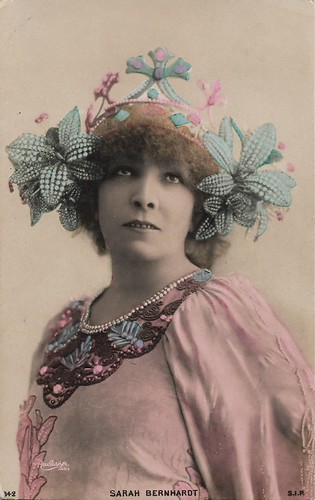
French postcard by S.I.P., no. 342. Photo: Reutlinger, Paris. Sarah Bernhardt in 'La princesse lointaine' by Edmond Rostand, which she played for the first time in 1895, at the Renaissance Theatre in Paris. The 'Lilies' diadem for 'La Princesse lointaine' (c. 1895) was designed by Alphonse Mucha and created by René Lalique.
French vedette Sarah Bernhardt (1844-1923) has been referred to as 'the most famous actress in the history of the world'. She developed a reputation as a serious dramatic actress, earning her the nickname 'The Divine Sarah'. Bernhardt made her fame on the stages of Europe in the 1870s and was soon in high demand in both the Americas. And she was one of the first film stars. What a woman!

French postcard by S.I.P., no. 1537. Photo: Stebbing, Paris. Sent by mail in 1906.
French dancer and actress Gaby Deslys (1881-1920) (aka Gaby Delys) was an internationally celebrated - and notorious - star of the early 20th Century. She was famous for her extravagant clothes, jewels, and millinery. She had many admirers, most notably King Manuel II of Portugal, and during World War I, she reportedly worked as a spy for the French government. Before her tragic early death, she also made a series of silent films.

French postcard by S.I.P., no. 1975. Photo: Paul Boyer, Paris.
Yvette Guilbert (1865-1944) was a French cabaret singer and actress of the Belle Époque. In 1888, Guilbert debuted at the Varieté Theatre. In 1890, she sang at the popular Eldorado club, then at the Jardin de Paris before headlining in Montmartre at the Moulin Rouge. She stayed there for a long time and later succeeded at the Folies-Bergère for nine years. Her ingenious delivery of songs charged with risqué meaning made her famous. She also appeared in some classic silent films, including the successful serial Les deux gosses / The two kids (1924) and Friedrich Wilhelm Murnau's classic Faust (1926).

French postcard by S.I.P., no. 2500. Photo: Reutlinger, Paris. Sent by mail in 1909.
Miss Campton, aka Emily Campton or Aimée Campton (1882-1930), was a British-born French stage and screen actress between 1900 and 1930. Miss Campton was a fashion icon in ladies’ magazines of the Belle Epoque and was photographed as a vaudeville star by Valery, Sazerac, Cautin & Berger, Reutlinger, and Stebbing.
Popular stage performers, as well as other prominent social figures
The Société Industrielle de Photographie (S.I.P.) was a major French company engaged in the photographic and paper industry during the late 19th and early 20th centuries. The company issued countless high-quality portrait postcards of stage and musical personalities. Its main office and factory were located in Rueil in the Seine-et-Oise section of Paris and had a store in Paris at 37, Rue des Mathurins. The company published various artists' collections under the trademark S.I.P. and sold equipment, including stereoscopic systems.
The Société Industrielle de Photographie was founded in December 1898. The company published stereographs of the Exposition Universelle Paris 1900 and cards in the undivided era. The Société is first listed as a postcard publisher in the 1900 issue of the Didot-Bottin Annuaire-Almanach du Commerce de l'Industrie. The 1903 issue of the same directory pairs the registered trademark, 'S.I.P.', with the company.
Much of the Société's postcard production during the first years of the 20th century reproduced the photos of the Reutlinger studio in Paris. Reutlinger was one of the premier portrait studios of the Belle Époque, known for capturing glamorous and artistic images of actors, actresses, dancers, and opera stars. At the time of the postcards' production, the studio was run by Léopold-Émile Reutlinger, a French photographer born to a German-Jewish family of successful photographers. His uncle, Charles Reutlinger, had founded the studio in Paris circa 1850. Charles passed the studio to his brother, Émile Reutlinger, Léopold's father, in 1880. Around 1890, Léopold assumed the studio. Léopold's son, Jean, started work in the studio at an early age, around 1910; however, he died in battle during WWI in 1914. Léopold continued to run the studio until he died in 1937.
Another photographer who often worked for S.I.P. was Edouard Stebbing, who was active in Paris between 1890 and 1910. Stebbing taught at a University in Paris and invented the Stebbing camera, and was known for his work with emulsions. Stebbing was a prolific photographer in Paris during the Belle Epoque. Stebbing photographed many theatrical stars. It is reported that he was friends with Auguste Monet, the famous French painter and the founder of Impressionism. He appears to have been an expatriate from England. He published many articles in British Photographic journals. Edouard Stebbing died in 1914.
Before early 1906, the S.I.P. logo changed from the straight letters to the roundel between cards 1347 and 1372. S.I.P. was dissolved in 1913. By 1914, the trademark had been taken over by J. Courcier (trademark JC) in Nanterre. Ross Postcards has catalogued hundreds of series of S.I.P. postcards with popular stage performers as well as other prominent social figures photographed by Reutlinger. The catalogue entries are presented by series number, where the series was predominantly comprised of Reutlinger's photos. Not all S.I.P. series featured photos by Reutlinger, and those that did not are not reproduced in the Ross catalogue. However, the highest series number of the impressive Ross Postcards catalogue is 2150!
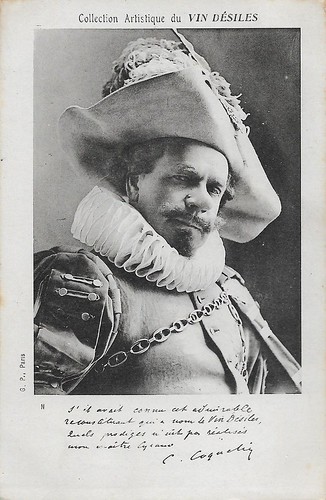
French postcard in the Collection Artistique du Vin Désiles by S.I.P. Photo: G.P., Paris. Caption: If only he had known that marvellous tonic known as Vin Désiles, what wonders might my master Cyrano not have achieved?
French actor Benoît-Constant Coquelin (1841-1909), known as Coquelin aîné (Coquelin the Elder), was known as one of the greatest theatrical figures of his age. He entered the Comédie-Française in 1860. Coquelin had a triumph in 1897 with Edmond Rostand's 'Cyrano de Bergerac' and would play it many times. In 1900, when he was almost sixty, Coquelin toured in America with Sarah Bernhardt and appeared on Broadway in 'Cyrano de Bergerac' with Bernhardt as Roxane.
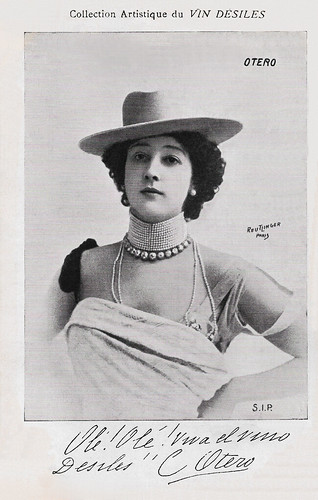
French postcard in the Collection Artistique du Vin Désiles by S.I.P. Photo: Reutlinger, Paris. Caption: Olé! Olé! Viva el vino Desilés, C. Otero.
Carolina 'La Belle' Otéro (1868–1965) was a Spanish-born dancer, actress and courtesan. She had a reputation for great beauty and was famous for her numerous lovers. In 1898, she became 'the first star in the history of cinema'. Countless postcards with her circulated.

French postcard in the Collection Artistique du Vin Désiles by S.I.P. Photo: Bonfort. Caption: Whenever I drink Vin Désiles, my voice is flexible and easy.
Félix Mayol (1872-1941) was a popular French singer of the Belle Époque. In 1905, he performed at Gaumont in 14 phonoscènes under the direction of Alice Guy, such as La Paimpolaise. These were short sound films using a sound-on-disc system. Several still exist. Mayol later acted in five more films.

French postcard in the Collection Artistique du Vin Désiles by S.I.P. Photo: P. Berger. Caption: During my long tours across France, it is your wonderful Vin Désiles that supports me and gives me strength.
French comedian Polin (1863-1927) was one of the greatest stars of the café-concerts of Paris. His interpretations were sober and had nuance and finesse, which were rare in the café-concerts. From 1910 on, he also appeared in film and theatre, including Sacha Guitry's play 'Le Grand Duc/The Grand Duke' (1921) with Lucien and Sacha Guitry and Yvonne Printemps.
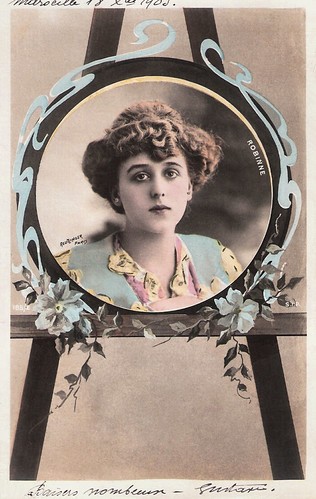
French postcard by S.I.P. no. 185/2. Photo: Reutlinger. Sent by mail in 1905.
Gabrielle Robinne (1886-1980) was a French stage and film actress who had the peak of her film career in the 1910s.

French postcard by Ed. S.I.P., Paris, no. 918/5. Photo: Reutlinger, Paris.
Suzanne Miéris (?-?) was a French stage actress who peaked in the early 1900s at the Théâtre Antoine and the Théâtre de la Gaité, but her breakthrough part was that of Eunice in the 1901 staging of 'Quo vadis?' at the Théâtre de la Porte Saint-Martin.

French postcard by S.I.P., no. 941. Photo: Reutlinger, Paris. Sent by mail in 1904. The S.I.P. company produced this series of photomontages showing actresses adorning a fan. In Anna Held's case, they even went so far as to choose a portrait of her holding a fan herself, a kind of 'mise en abyme', we could say. Collection: Marlene Pilaete.
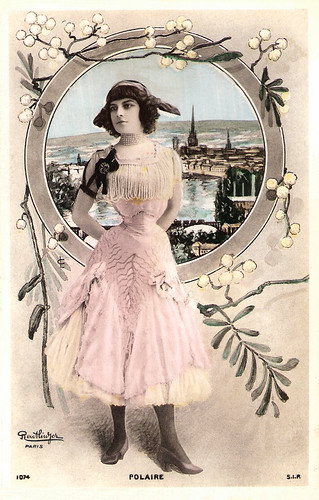
French postcard by S.I.P., Paris, no. 1074. Photo: Reutlinger, Paris.
French singer and actress Polaire (1874-1939) had a career in the entertainment industry which stretched from the early 1890s to the mid-1930s, and encompassed the range from music-hall singer to stage and film actress. Her most successful period professionally was from the mid-1890s to the beginning of the First World War.

French postcard by S.I.P. no. 1239. Photo: Reutlinger, Paris.
Jeanne Delvair (1877-1943) was an acclaimed French stage actress of the Comédie-Française. She also had a rich career in French silent cinema, mainly at Pathé Frères. She is the sister of actress Germaine Dermoz (1888-1966) and of animal painter Henri Deluermoz (1876-1943).

French postcard by Ed. S.I.P., no. 1461. Photo: Reutlinger, Paris. Sent by mail in 1908.
Around 1900, Italian soprano Lina Cavalieri (1874-1944) was considered the most beautiful woman on earth. As a young girl, she ran from the orphanage with a theatre group and made a career as a Vaudeville singer first in Paris and soon all around Europe. In 1900, she debuted as an opera singer, soon conquering the opera houses of Monte-Carlo, Paris and New York.

French postcard by Ed. S.I.P., no. 1591. Photo: Reutlinger, Paris.
We could not find any information about Beauregard, but we suspect she was an opera or operetta singer.
Gabrielle Robinne (1886-1980) was a French stage and film actress who had the peak of her film career in the 1910s.

French postcard by Ed. S.I.P., no. 1442. Photo: Reutlinger, Paris.
Natalia/ Natasha Trouhanova (1885-1956) was a Franco-Russian dancer and silent film actress. From 1904, she lived in France, where she soon became a great master of dance. She worked with Sergei Diaghilev, Fyodor Chaliapin, Richard Strauss, and Isadora Duncan. Trouhanova appeared in several French silent films between 1909 and 1916.

French postcard by S.I.P. Photo: scene of the French stage play 'Les deux gosses', at the Théâtre de l'Ambigu in Paris. Tableau 4. Caption: Maison la Limage. Zéphirine & C.ie. (The Slug's house, Zephirine & company).
'Les deux gosses' was a melodramatic tale, published first as a novel in 1880 by French author Pierre Decourcelle. In 1896, the first stage adaptation of the novel premiered at the Théâtre de l’Ambigu in Paris. The characters of the two boys were performed by two young female actresses, with Fanfan played by Mlle. Mélo and Claudinet by Mlle. Reyé. This postcard may depict this production. The novel and play were extremely popular and led to various film adaptations by Louis Feuillade (1906), Adrien Caillard (1912), Albert Capellani (1914), Louis Mercanton (1924), and Fernand Rivers (1936).

French postcard by S.I.P. Photo: scene of the French stage play 'Les deux gosses', at the Théâtre de l'Ambigu in Paris. Tableau 7. Caption: L'écluse du Pont d'Austerlitz (The Lock of the Pont Austerlitz). Fanfan opens the lock, causing the drowning of The Slug. Originally, the highlight of the play was the drowning of The Slug at the lock, but creating water on stage was considered too difficult for some theatres.

French postcard by Ed. S.I.P., no. 361. Painting 'Héliogabale et ses convives' by Henri(-Paul) Motte, exhibited at the Paris Salon of 1909.

French postcard by S.I.P. Photo: Reutlinger, Paris. Caption: Otéro, A. Held (Anna Held), C. de Mérode (Cléo de Mérode).

French postcard by Ed. S.I.P. Photo: Paul Boyer, Paris. Caption: Martha.
Sources: RTH Cards, The Cabinet Card Gallery, Turkish Postcards, Wikimedia and Ross Postcards.

No comments:
Post a Comment