
German postcard by Photochemie, Berlin, no. K. 220. Photo: A. Binder, Berlin. Richard Oswald (1880-1963) is considered the founder of the so-called 'Aufklärungsfilme' (enlightenment films). With the participation of the sex researcher Magnus Hirschfeld, he devoted himself towards the end of the First World War to taboo subjects and punishable acts in the four-part film cycle Es werde Licht! / Let There Be Light (Richard Oswald, 1916-1918). The films were a protest against Germany's anti-abortion law and also touched on the dangers of syphilis and other venereal diseases. Es werde Licht! is considered the forefather of all sex education films.
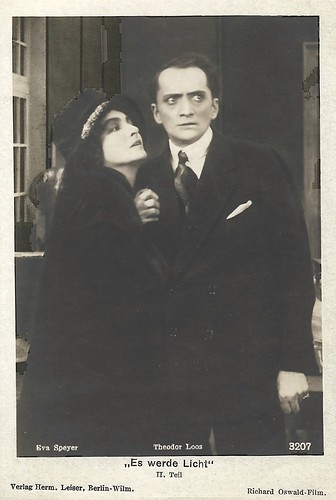
German postcard by Verlag Hermann Leiser, Berlin, no. 3207. Photo: Richard Oswald-Film. Theodor Loos and Eva Speyer in Es werde Licht II / Let There Be Light!, Part II (Richard Oswald, 1918).

German postcard by Verlag Hermann Leiser, Berlin, no. 3208. Photo: Richard Oswald-Film. Bernd Aldor and Paul Hartmann in the Aufklärungsfilm Es werde Licht! II / Let There Be Light, part II (Richard Oswald, 1918). Part II was shot in 1917 and premiered in Berlin in January 1918. Part II of this four-part film on syphilis raises a moral question: namely, to what extent should the disease be regarded as a human disgrace? The protagonist, a young doctor (Theodor Loos), believes that only people of poor character can fall prey to the disease through reprehensible acts. At a gathering in honour of a venereologist, a heated dispute erupts between the doctor, who applies moral judgments, and a colleague who argues on a more objective basis [Aldor?]. Two events cause the dogmatic young doctor to reflect: his sister (Rita Clermont) marries a man with syphilis who has not yet fully recovered [Hartmann?], and he himself contracts the disease after being kissed by a young woman who also suffers from syphilis. However, the doctor is cured and reevaluates his previous stance.

German postcard in the Film-Sterne series by Rotophot, no. 555/3. Photo: Decla. Charlotte Böcklin (far right) in Der Weg, der zur Verdammnis führt, I. Das Schicksal der Anne Wolter / The Fate of Anne Wolter (Otto Rippert, 1918). Der Weg, der zur Verdammnis führt / The Road to Damnation (1918) was a two-part ' Sittenfilm ', an exploitation film about white slavery. Both parts were directed by Rippert, and the second part was called Hyänen der Lust / Hyenas of Lust (1919). They were both box-office hits.

German postcard by Rotophot in the Film-Sterne series, no. 555/7. Photo: Decla. Charlotte Böcklin in Der Weg, der zur Verdammnis führt, I. Das Schicksal der Anne Wolter / The Fate of Anne Wolter (Otto Rippert, 1918). Anne Wolter (Charlotte Böcklin) falls into the hands of scheming white slave traders. She is taken to a bordello in Cairo, where she does not survive her tortures. In name, the film was made by the Gesellschaft zur Bekämpfung des Mädchenhandels (Society for the Struggle Against White Slavery) to inform the public about the trafficking of European girls and their impressment into prostitution, often in South America.

German postcard by Ross Verlag, Berlin, no. 616/2. Photo: Richard-Oswald-Film. Reinhold Schünzel and Ilka Grüning in Die sich verkaufen, part 2 of the series Prostitution (Richard Oswald, 1919).
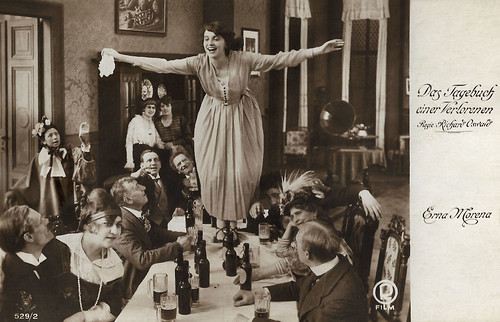
German postcard by Rotophot in the Film Sterne series, no. 529/2. Photo: Richard Oswald-Film. Erna Morena in Das Tagebuch einer Verlorenen / The Diary of a Lost Woman (Richard Oswald, 1918). The pharmacist's daughter Thymian Gotteball (Morena) is seduced and made pregnant by Provisor Meinert (Werner Krauss), an employee of her father (Paul Rehkopf). After the birth of her child, she is rejected by her own family and sent to an educational institution. As a result, she is becoming increasingly marginalised. The film was offered to the German censor in July 1918, but despite many cuts, it was forbidden for the remainder of the war. Still, one month before the armistice ended the First World War, in October 1918, the film premiered in Berlin.
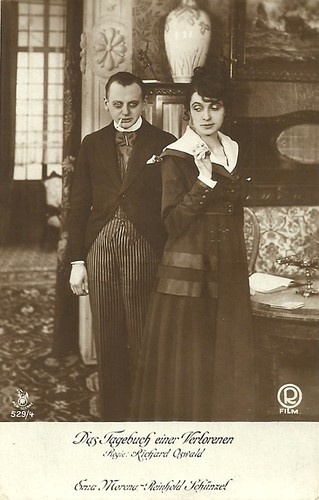
German postcard in the Film Sterne series by Rotophot, no. 529/4. Photo: Richard Oswald-Film. Erna Morena and Reinhold Schünzel in Das Tagebuch einer Verlorenen / The Diary of a Lost Woman (Richard Oswald, 1918), based on the homonymous novel (1905) by Margarete Böhme. Among Oswald's Aufklärungsfilme are Das Tagebuch einer Verlorenen / The Diary of a Lost Woman (Richard Oswald, 1918) and the sadomasochistic case study Dida Ibsens Geschichte / Dida Ibsen's Story (Richard Oswald, 1918), starring Oswald's star Anita Berber. In 1929, G.W. Pabst would film another adaptation of Das Tagebuch einer Verlorenen / The Diary of a Lost Woman, starring Louise Brooks, while already in 1912 an earlier adaptation by Fritz Bernhardt had taken place.

German postcard by Verlag Ross, Berlin, no. 279/1. Photo: Becker & Maass. Expressionistic dancer and film actress Anita Berber (1899–1928) challenged many taboos during the Weimar period. With her drug and booze addiction and her bisexual affairs, she epitomised the decadence of 1920s Berlin. Her charcoaled eyes, black lipstick and bright red, bobbed hair featured in her famous portrait by Otto Dix and in silent films by Richard Oswald and Fritz Lang.

German postcard by Verlag Hermann Leiser, Berlin, no. 3151. Photo: Richard-Oswald-Produktion. Bernd Aldor as Dorian Gray in Das Bildnis des Dorian Gray (Richard Oswald, 1917), an adaptation of Oscar Wilde's 'The Picture of Dorian Gray'. In Victorian England, Lord Henry Wotton observes his friend, artist Basil Hallward, painting the portrait of Dorian Gray, a wealthy young man who is Basil's ultimate muse. The hedonistic Lord Henry thinks that beauty is the only aspect of life worth pursuing, prompting Dorian to wish that his portrait would age instead of himself.
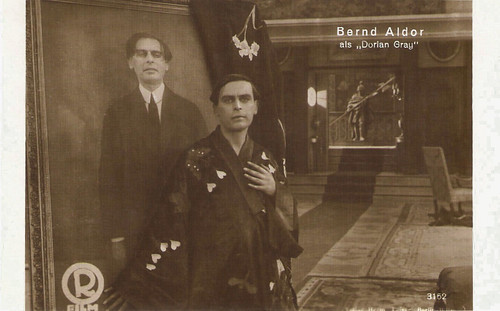
German postcard by Hermann Leiser Verlag, Berlin, no. 3152. Photo: Richard-Oswald-Produktion. Bernd Aldor in Das Bildnis des Dorian Gray / The Picture of Dorian Gray (Richard Oswald, 1917). The novel's representation of homoeroticism is subtle yet present by manifesting itself through interactions between male characters in a way that challenges the strict social norms of Victorian England.

German postcard by Ross Verlag, no. 501/1, 1919-1924. Photo: Curt Meyer, Berlin. Conrad Veidt (1893–1943) was the most highly strung and romantically handsome of the German expressionist actors. He was the star of one of the most high-profile Aufklärungsfilm was Anders als die Andern / Different from the others (Richard Oswald, 1919), with Conrad Veidt and Reinhold Schünzel. The film was intended as a polemic against the then-current laws under Germany's Paragraph 175, which made homosexuality a criminal offence. Anders als die Andern is one of the first sympathetic portrayals of homosexuals in cinema. Censorship laws were enacted in reaction to films like Anders als die Andern, and by October 1920 only doctors and medical researchers could view it. Prints of the film were among the many "decadent" works burned by the Nazis after they came to power in 1933.

Yugoslav postcard by Jos. Caklovic Bromografia, Zagreb, no. 3. Photo: Pan-Film, Zagreb. Ellen Kurty in Mädchen, die man nicht heiratet / Girls You Don't Marry (Géza von Bolváry, 1924).

German postcard by Ross Verlag, no. 1020/1. Photo: Curt Oertel, Berlin. Asta Nielsen in Die freudlose Gasse / Joyless Street (G.W. Pabst, 1925). In 1929, Dutch painter Pyke Koch painted Nielsen's portrait, using one of Oertel's photos. The painting is now at the Centraal Museum, Utrecht.
Source: Wikipedia (German and English) and IMDb.

1 comment:
What a fascinating post this was. I will link back to it at my blog. Many thanks.
Post a Comment