
Spanish collector card by Chocolate Amatller, Barcelona, in the series Los artistas cinematográficos en la intimidad, series A, no. 29. In between filming, here is the cast of Marshall Neilan's film having fun, with Neilan on the piano, Ronald Colman on the banjo, Paul Ellis on the violin, Lew Cody on the cello, and Neilan's then-wife Blanche Sweet singing. This may have been during the making of The Sporting Venus (1925), in which Sweet, Colman and Cody had the leads.

Italian postcard by Ballerini & Fratini. Photo: United Artists. Mary Pickford and Allan Forrest in Dorothy Vernon of Haddon Hall (Marshall Neilan, 1924).

British postcard by J.D. Walker World's Films Ltd. Caption: Jesse Lasky's Leading Star Artiste. In the 1920s Blanche Sweet (1896-1986) acted at Lasky and Paramount, became a highly paid star, and was married to Marshall Neilan. For his Tess of the D'Urbervilles (Marshall Neilan, 1924), Sweet received raving reviews.
Mary Pickford's favourite director
Marshall Ambrose Neilan was born in 1891 in San Bernardino, California. Following the death of his father, the eleven-year-old Mickey Neilan had to give up on school to work at whatever he could find to help support his mother. As a teenager, he began acting in bit parts in live theatre, and in 1910 he got a job as a chauffeur, driving Biograph Studios executives around Los Angeles to determine the suitability of the West Coast as a place for a permanent studio.
In 1912, Neilan worked as a car salesman at a dealership in La Mesa when he was instructed to deliver a car to a nearby film location, whose director had just purchased it. Neilan delivered the car to the director, Allan Dwan, and since Dwan didn't know how to drive, Neilan took him out and taught him. The two hit it off, and Dwan asked Neilan if he wanted to be an actor in his film The Stranger at Coyote (Allan Dwan, 1912), starring J. Warren Kerrigan and Pauline Bush.
When Neilan discovered that the job would pay twice as much as his car salesman job, he took it, beginning his long career as an actor, writer, and director. Hired by Kalem Studios for their Western film production facility in Santa Monica, Neilan was first cast opposite Ruth Roland. Described as confident but egotistical at times, Neilan's talent saw him directing films within a year of joining Kalem.
After acting in more than seventy silent film shorts for Kalem and directing more than thirty others, Neilan was hired by the Selig Polyscope Company, then Bison Motion Pictures and Famous Players-Lasky Corporation. At the end of 1916, Neilan was hired by Mary Pickford Films, where he directed Pickford in Rebecca of Sunnybrook Farm (1917) and The Little Princess (1917). From then on, he focused on directing.
Neilan became Mary Pickford's favourite director and directed her in seven of her biggest hits, also including Stella Maris (1918), Amarilly of Clothes-Line Alley, M'Liss (1918), and Daddy-Long-Legs (1919). In 1915 (or 1919 - the sources differ), Neilan was a co-founder of the Motion Picture Directors Association (Associated Producers, Inc.) with directors such as Cecil B. DeMille, Allan Dwan, and William Desmond Taylor.

American postcard by Flying A, no. 16. Photo: Flying A.

British postcard by Scala favourites. Marshall Neilan, written as Nielan.

Spanish card by La Novela Semanal Cinematográfica, no. 90. In the comedy A Girl of Yesterday (Allan Dwan, 1915), Mary Pickford starred fot the first time as an older woman. The film costarred Pickford's younger brother Jack Pickford and Marshall Neilan. The three were dear friends and Neilan directed Jack in the comedy Freckles (Marshall Neilan, 1917).
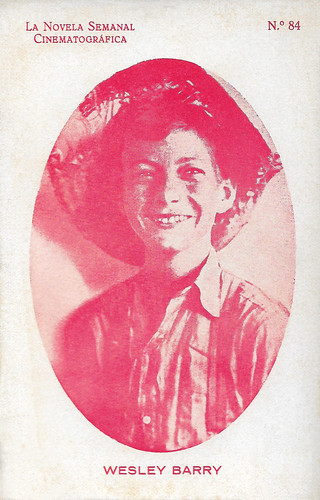
Spanish card by La Novela Semanal Cinematográfica, no. 84. Wesley Barry (1907-1994) was an adorable child actor in silent films who was known for his face full of freckles. Marshall Neilan cast him in Rebecca of Sunnybrook Farm (1917), starring Mary Pickford. It was the first time that his freckles were uncovered. Earlier producers had insisted that all subjects cover facial blemishes with grease paint. Neilan also let the boy's naturally wild hair grow out instead of being slicked down. Wesley also appeared as one of the orphans opposite Mary Pickford in the orphanage scenes in the beginning of Daddy-Long-Legs (Marshall Neilan, 1919).

American postcard by Kline Poster Co., Philadelphia. Image: Lasky / Paramount. Blanche Sweet.
A mutual dislike between Louis B Mayer and Neilan
In 1921, Marshall Neilan formed the production company Marshall Neilan Productions. Till 1926, Marshall Neilan Productions made eleven feature-length films, almost all of which were distributed through First National Pictures. He received critical acclaim for directing and producing such films as Bits of Life (James Flood, Marshall Neilan, William J. Scully, 1921) with Lon Chaney, and The Lotus Eater (Marshall Neilan, 1921) with John Barrymore and Colleen Moore.
He was a top director for Goldwyn Pictures and also directed a small number of Louis B. Mayer's independently produced melodramas. However, there was a mutual dislike between Mayer and Neilan. Jack Backstreet at IMDb: "During the festivities inaugurating the merger of Metro and Goldwyn Pictures on 26 April 26 1924, Neilan grew disgusted at the prospect of listening to Mayer's speech and interrupted everything by ordering his cast and crew back to the set of Tess of the D'Urbervilles (1924). Mayer later viewed the picture and ordered the downbeat ending re-shot over Neilan's loud protests. Mayer, wanting to instil his absolute authority over all production matters, held firm."
The prospect of working for Mayer in the new Metro-Goldwyn super-studio was unbearable, and Neilan quit. His was the first outright desertion from the studio that others over the next three decades would aspire to be a part of. A talented screenwriter, in 1927 he wrote the original story for the Howard Hughes film, Hell's Angels. Initially, he had also been hired as the film's director, back when it was still silent, but Hughes' overbearing style forced him to drop out, and he was replaced a few weeks into production by a more pliable director, Edmund Goulding; due to massive reshoots (as well as the recasting of the lead role with Jean Harlow), none of the footage Neilan shot made it into the final film.
In 1929, he was hired by RKO Radio Pictures. Although he reputedly had difficulty adapting to directing the new talkies, that year he successfully directed Rudy Vallee and Marie Dressler in the "all-talking" The Vagabond Lover (1929). Contrary to the legend that the film was a commercial and critical failure (except for Dressler's highly praised performance), the film was a hit, making a profit of $335,000, and was one of four top hits for RKO in 1929. He was then hired by Hal Roach Studios, for whom he directed a few films in 1930, and he made his final directorial effort in 1937. A major director during the silent era, Neilan's career in the sound era was very adversely affected due to a serious drinking problem.
In recognition of his contribution to the motion picture industry, in 1940 the Directors Guild of America conferred on him an "Honorary Life Member Award." In 1955, Neilan was awarded the George Eastman Award, given by George Eastman House for distinguished contribution to the art of film. Twenty years after he made his last film, Neilan returned to acting on the screen in a small role portraying an ageing and less than enlightened United States Senator in A Face in the Crowd (Elia Kazan, 1957). He later received a star on the Hollywood Walk of Fame at 6233 Hollywood Blvd. Marshall Neilan died in 1958 in Los Angeles of throat cancer. He was married to actress Gertrude Bambrick from 1913 till 1921. After their divorce, he married actress Blanche Sweet in 1922. They divorced in 1929. With Bambrick, he had a son, screenwriter Marshall Ambrose Neilan Jr., born in 1915. Marshall Neilan is interred in Los Angeles in Angelus-Rosedale Cemetery.
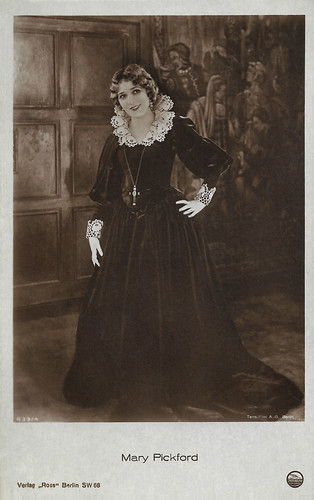
German postcard by Ross Verlag, no. 839/4. Photo: Terra Film A.G., Berlin. Mary Pickford in Dorothy Vernon of Haddon Hall (Marshall Neilan, 1924).

German postcard by Ross Verlag, no. 839/3. Photo: Terra Film A.G., Berlin. Mary Pickford in Dorothy Vernon of Haddon Hall (Marshall Neilan, 1924).
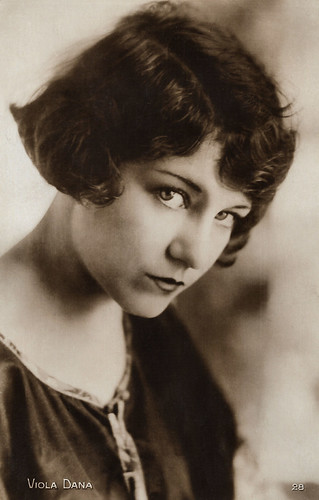
French postcard by Cinémagazine-Edition, Paris, no. 28. Viola Dana starred in Marshall Neilan's now-lost comedy The Great Love (1925) based upon his own story, and in his also-lost drama Wild Oats Lane (1926). In both films, Roger Agnew was the male lead.

German postcard by Ross Verlag, no. 1871/1, 1927-1928. Photo: First National Pictures / Fanamet. When Colleen Moore (1899-1988) starred in Her Wild Oat (Marshall Neilan, 1927), she was the top box-office draw in the US, making $12,500 a week.

German postcard by Ross Verlag, no. 3474/1, 1927-1928. Photo: Defina / First National. In the silent romantic comedy Venus of Venice (Marshall Neilan, 1927), Constance Talmadge and Antonio Moreno were the stars. Talmadge's own production unit produced with distribution through First National Pictures.
Sources: Jack Backstreet (IMDb), Wikipedia, and IMDb.

No comments:
Post a Comment