
Vintage card by Gerimp Corp. Int.-Collection, no. FN 199. Peter Cushing in Twins of Evil (John Hough, 1971).

British postcard by R.C. Maule, 1984. Photo: Hammer Film Productions. Peter Cushing as the famous detective Sherlock Holmes in The Hound of the Baskervilles (Terence Fisher, 1959).
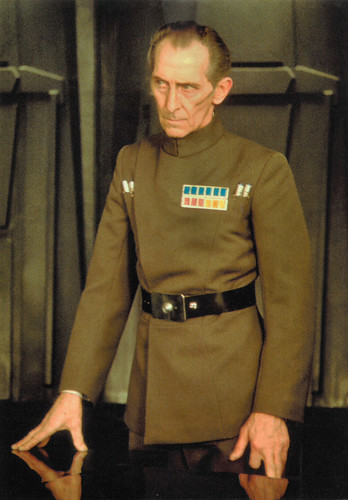
German postcard by Filmwelt Berlin, Bad Münder, no SW 4.081. Photo: Lucasfilm Ltd. Peter Cushing in Star Wars - Episode IV - A New Hope (George Lucas, 1977).
A one-way ticket to Hollywood
Peter Wilton Cushing was born in 1913 in Kenley (now in Croydon, London), Surrey, England, to Nellie Maria (King) and George Edward Cushing, a quantity surveyor. He and his older brother David were raised first in Dulwich Village, a south London suburb, and then later back in Surrey. His mother had so hoped for a daughter that for the first few years of his life, she dressed Peter in girls' frocks, let his hair grow in long curls and tied them in bows of pink ribbon, so others often mistook him for a girl.
At an early age, Cushing was drawn to acting, inspired by his favourite aunt, a stage actress. As a child, having a strong cockney accent, he felt ashamed of the way he spoke in general and took to having elocution lessons. While at school, Cushing pursued his interests in acting and drawing, a talent he later put to good use in his first job as a government surveyor's assistant in Surrey. At this time, he also dabbled in local amateur theatre until moving to London to attend the Guildhall School of Music and Drama on scholarship. He then performed in repertory theatre in Worthing.
In 1939, his father bought him a one-way ticket to Hollywood, where he moved with only £50 to his name. Cushing met a Columbia Pictures employee named Larry Goodkind, who wrote him a letter of recommendation and directed him to acquaintances Goodkind knew at Edward Small Productions. There he made his film debut in The Man in the Iron Mask (James Whale, 1939), starring Louis Hayward and Joan Bennett. It was an adaptation of the Alexandre Dumas tale based on the French legend of a prisoner during the reign of Louis XIV of France. He also had small roles in such Hollywood films as A Chump at Oxford (Alfred J. Goulding, 1939) with Stan Laurel and Oliver Hardy, Vigil in the Night (George Stevens, 1940) with Carole Lombard, and They Dare Not Love (James Whale, 1941).
After this short stay, he returned to England by way of New York (making brief appearances on Broadway) and Canada. Back in his homeland, he contributed to the war effort during World War II by joining the Entertainment National Services Association. After the war, Peter Cushing performed in the West End. He had his big break appearing with Laurence Olivier in Hamlet (Laurence Olivier, 1948), in which Cushing's future partner-in-Horror, Christopher Lee, had a bit part. Both actors also appeared in Moulin Rouge (John Huston, 1952), but did not meet until their later Horror films.
His career was revitalised once he started to work in live television plays, and he soon became one of the most recognisable faces in British television. During the 1950s, Cushing appeared in numerous teleplays, such as George Orwell's Nineteen Eighty-Four (1954) and Beau Brummell (1954). In the two years following Nineteen Eighty-Four, Cushing appeared in thirty-one television plays and two serials and won Best Television Actor of the Year from the Evening Chronicle. He also won the Best Actor awards from the Guild of Television Producers in 1955 and from the British Academy of Film and Television Arts in 1956. Among the plays he appeared in during this time were Terence Rattigan's 'The Browning Version' and Gordon Daviot's 'Richard of Bordeaux'.

Poster postcard by Clasicos Cinema, no. 274. Image: Hammer / Universal. French poster for The Evil of Frankenstein (Freddie Francis, 1964) with Peter Cushing and Peter Woodthorpe. The French title was L'empreinte de Frankenstein.

British poster postcard in the Hammer 40 Years series by London Postcard Company, no HA 1516. Poster: Hammer Film Productions / British Film Institute. Poster for Frankenstein Must Be Destroyed (Terence Fisher, 1969) with Peter Cushing.

British Poster postcard in the Hammer 40 Years series by London Postcard Company, no HA 5121. Poster: Hammer Film Productions / British Film Institute. Poster for Frankenstein and the Monster From Hell (Terence Fisher, 1974) with Peter Cushing.
A low-budget production company called Hammer
During a brief quiet period following his television work, Peter Cushing read in trade publications about Hammer, a low-budget production company seeking to adapt Mary Shelley's Horror novel, 'Frankenstein', into a new film. Cushing, who enjoyed the tale as a child, had his agent John Redway inform the company of Cushing's interest in playing the protagonist, Baron Victor Frankenstein. The studio executives were anxious to have Cushing play Dr. Frankenstein in Frankenstein (Terence Fisher, 1957) opposite Hazel Court and Christopher Lee as the Monster.
Wikipedia: "Unlike Frankenstein (1931) produced by Universal, the Hammer films revolved mainly around Victor Frankenstein, rather than his monster. Screenwriter Jimmy Sangster wrote the protagonist as an ambitious, egotistical and coldly intellectual scientist who despised his contemporaries. Unlike the character from the novel and past film versions, Cushing's Baron Frankenstein commits vicious crimes to attain his goals, including the murder of a colleague to obtain a brain for his creature." Frankenstein was an overnight success and brought Cushing worldwide fame.
Over the next 20 years, Peter Cushing starred in 22 Horror films from the Hammer studio. His next roles included Dr. Van Helsing in Dracula (Terence Fisher, 1958) opposite Lee as the count, and Sherlock Holmes in The Hound of the Baskervilles (Terence Fisher, 1959). He played Baron Frankenstein in six of their seven Frankenstein films, and Doctor Van Helsing in five Dracula films. Cushing often appeared alongside Christopher Lee, who became one of his closest friends, and occasionally with the American Horror star Vincent Price.
He also appeared in films for the other major Horror producer of the time, Amicus Productions, including Dr. Terror's House of Horrors (Freddie Francis, 1965), Dr. Who and the Daleks (Gordon Flemyng, 1965), Daleks' Invasion Earth 2150 A.D. (Gordon Flemyng, 1966), and I, Monster (Stephen Weeks, 1971). By the mid-1970s, these companies had stopped production, but Cushing, firmly established as a Horror star, continued in the genre for some time thereafter.
Perhaps his best-known appearance outside of Horror films was as Grand Moff Tarkin in George Lucas' phenomenally successful Science Fiction film Star Wars: Episode IV - A New Hope (1977). He had been married to Violet Helene Beck from 1943 till her death in 1971. Following the passing of his wife, Cushing didn't make any public appearances from 1971 to 1982. During this period, his workload increased considerably, appearing in about 32 films, numerous TV appearances and recording audiobooks for blind people. Biggles (John Hough, 1986) was Cushing's last film before his retirement, during which he made a few television appearances, wrote two autobiographies and pursued his hobbies of birdwatching and painting. In 1989, he was awarded the OBE (Officer of the Order of the British Empire) for his services to drama. In 1994, Peter Cushing died at age 81 of prostate cancer.

English poster postcard by Moviedrome, no. M28. Design: Hammer. Poster for The Abominable Snowman / The Abominable Snowman of the Himalayas (Val Guest, 1957) with Forrest Tucker and Peter Cushing. Caption: 'We dare you see it alone! Each chilling moment a shock-test for your scare-endurance.' This was Peter Cushing's first of 23 Hammer films. However, the second Hammer film that he made, The Curse of Frankenstein (Terence Fisher, 1957), was released first.

Vintage card by Gerimp Corp. Int.-Collection, no. FN 163.

Vintage card.
Sources: Lyn Hammond (IMDb), Wikipedia (Dutch and English) and IMDb.

No comments:
Post a Comment