05 October 2026

L'arzigogolo (1924)

Le Giornate del Cinema Muto is the world’s leading international silent film festival. From 4 to 11 July 2025, EFSP contributor Ivo Blom is in Pordenone in Northern Italy to attend the 44th edition of the festival. And like Ivo, the festival is still going strong. It presents many rediscoveries and highlights. One programme is dedicated to Italian diva Italia Almirante Manzini and includes the wonderful costume drama L'arzigogolo / The Court Jester (Mario Almirante, 1924), which co-starred Annibale Betrone and Oreste Bilancia.

Italia Almirante in L'arzigogolo
Italian postcard by Ed. Ballerini & Fratini, Firenze, no. 526. Photo: Scoffone. Italia Almirante Manzini as Monna Violante in L'arzigogolo (Mario Almirante, 1924).

Italia Almirante in L'arzigogolo
Italian postcard by Ballerini & Fratini, Firenze, no. 528. Photo: Scoffone. Publicity still for L'arzigogolo (Mario Almirante, 1924), with Italia Almirante.
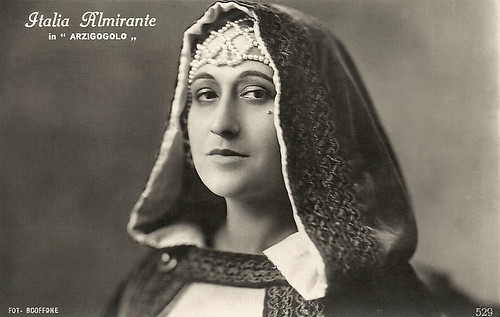
Italia Almirante
Italian postcard by Ballerini & Fratini, Firenze, no. 529. Photo: Scoffone. Italia Almirante in L'Arzigogolo (Mario Almirante, 1924).

Annibale Betrone in L'arzigogolo
Italian postcard by Ed. G.B. Falci, Milano. Photo: Annibale Betrone in L'arzigogolo (Mario Almirante, 1924).

Italia Almirante and Oreste Bilancia in L'arzigogolo
Italian postcard by Ed. G.B. Falci, Milano, no. 197. Photo: publicity still for L'arzigogolo (Mario Almirante, 1924) with Oreste Bilancia and Italia Almirante
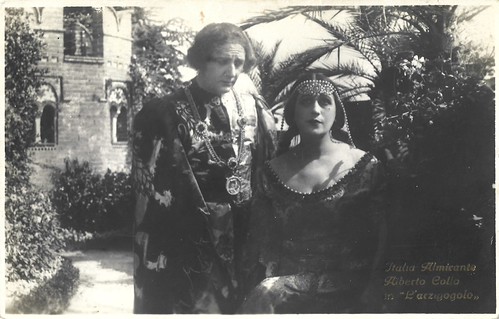
Italia Almirante and Alberto Collo in L'arzigogolo, G.B. Falci
Italian postcard by Ed. G.B. Falci, Milano, no. 198. Italia Almirante Manzini as Monna Violante and Alberto Collo as Count Giano in L'arzigogolo (Mario Almirante, 1924).

Oreste Bilancia in L'arzigogolo (1924)
Italian postcard by Ed. G.B. Falci, no. 202. Photo: Alba Film. Oreste Bilancia in L'arzigogolo (Mario Almirante, 1924).
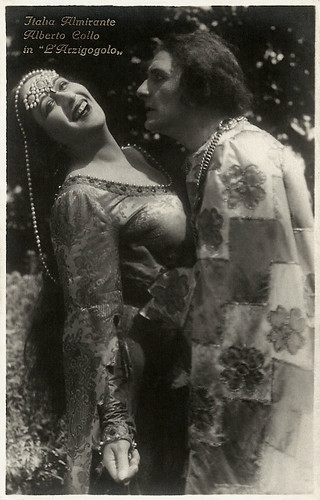
Italia Almirante
Italian postcard by Ed. G.B. Falci, Milano, no. 203. Photo: publicity still for L'arzigogolo (Mario Almirante, 1924) with Italia Almirante and Alberto Collo.
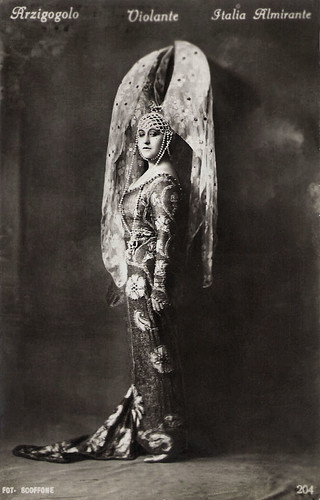
Italia Almirante in L'Arzigogolo
Italian postcard by Ed. G.B. Falci, Milano, no. 204. Photo: publicity still for L'arzigogolo (Mario Almirante, 1924) with Italia Almirante.

Italia Almirante and Alberto Collo in L'arzigogolo
Italian postcard by G.B. Falci, Milano, no. 209. Photo: Italia Almirante and Alberto Collo in L'arzigogolo (Mario Almirante, 1924).

An attractive cast


L'arzigogolo/The Court Jester (Mario Almirante, 1924) has an attractive cast. The leading lady is Italia Almirante Manzini (1890-1941), the cousin of director Mario Almirante. After she had starred in the classic epic Cabiria (1914), Almirante had become one of the divas of the Italian silent cinema.

Her co-star was Annibale Betrone (1883-1950), an important figure in the Italian theatre of the first half of the 20th century. Betrone also appeared in several silent and sound films. Oreste Bilancia (1881-1945) was another well-known face of the Italian silent cinema. As in L'arzigogolo, he mostly worked as a supporting actor, but occasionally played the main character.

Almirante plays Monna Violante, daughter of the Prince of Carpi. Her father forces her to find a husband from among her suitors, or he will lock her up in a convent. Violante chooses Floridoro (Oreste Bilancia), a fat and rich merchant, self-confident and convinced that he is protected by good fortune.

Even after the wedding, however, Violante does not abandon her goal of finding the man of her dreams. On a visit to the castles of the Principality, she meets Count Giano (Alberto Collo), one of her former suitors. Cruelly, she pretends to be willing to give him up. So Giano orders Spallatonda (Annibale Betrone), his court jester and servant, to bring her to him, or Giano will chop his head off.

Spallatonda attempts, but with such vehemence that Violante is sensually disturbed. She even allows herself to be seduced by the jester, who then no longer wants to take her to his master. So Giano will carry out his terrible threat. Violante, however, offers herself for the jester's life, and Giano accepts. Spallatonda will be beheaded in mockery. The jester feigns unconsciousness and hides in Violante's room. When Giano arrives, Spallatonda kills him, and then Monna Violante and Spallatonda flee together.

Arzigogolo
Italian postcard by Ballerini & Fratini, Firenze, no. 205. Photo: Alba Film. An ensemble shot from the opening scene of L'arzigogolo (Mario Almirante, 1924). Caption: The tournament in honour of Violante.

Arzigogolo
Italian postcard by Ballerini & Fratini, Firenze, no. 206. Photo: Alba Film. Italia Almirante as Monna Violante in L'arzigogolo (Mario Almirante, 1924). Caption: Violante leaves for the hunt.

Arzigogolo
Italian postcard by Ballerini & Fratini, Firenze, no. 20?. Photo: Alba Film. Italia Almirante as Monna Violante and Alberto Collo as Count Giano in L'arzigogolo (Mario Almirante, 1924). Caption: Giano tries in vain to conquer Violante's coldness.

Arzigogolo
Italian postcard by Ballerini & Fratini, Firenze, no. 209. Photo: Alba Film. Annibale Betrone as The Jester in L'arzigogolo (Mario Almirante, 1924). Caption: Spallatonda chased from the village.

Arzigogolo 210
Italian postcard by Ballerini & Fratini, Firenze, no. 210. Photo: Alba Film. In the back, Italia Amirante as Monna Violante and Alberto Collo as Count Giano in L'arzigogolo (Mario Almirante, 1924). Caption: The dinner in the house of Count Giano.

Annibale Betrone in L'arzigogolo
Italian postcard by Ballerini & Fratini, Firenze, no. 211. Photo: Alba Film. Publicity still for L'arzigogolo (Mario Almirante, 1924). Caption: The arrival of the buffoon at the castle of Giano.

Arzigogolo
Italian postcard by Ballerini & Fratini, Firenze, no. 214. Photo: Alba Film. Annibale Betrone as The Jester and Alberto Collo as Giano in L'arzigogolo (Mario Almirante, 1924). Caption: Giano to the Jester: ... if you don't manage to convince Violante of my love, I will have your head chopped off!

Italia Almirante and Annibale Betrone in L'arzigogolo
Italian postcard by Ballerini & Fratini, Firenze, no. 216. Photo: Alba Film. Italia Almirante and Annibale Betrone in L'arzigogolo (Mario Almirante, 1924). Caption: In the calm moonlight, the buffoon sees Violante and declares her his love.

Classic love story


L'arzigogolo is a classic love story in the vein of William Shakespeare's 'Romeo and Juliet'. Director Mario Almirante wrote the script originally in French. Almirante directed such films as Il fornaretto di Venezia / The Baker Boy of Venice (1923) and L'ombra / The Shadow (1923). He wrote a liberal adaptation of a popular 1922 Sem Benelli's 'comic poem in four acts'. The Italian playwright, essayist and librettist Benelli provided the texts for several noted Italian operas, including Italo Montemezzi's 'L'amore dei tre re' and 'L'incantesimo', and Umberto Giordano's 'La cena delle beffe', based on Benelli's own play of the same title.

The sets for L'arzigogolo were designed by Luigi Sapelli, better known as Caramba, who specialised in costume dramas. The Director of photography was Ubaldo Arata, who was one of Italy's most famous cinematographers.

After the premiere, the critic of Il Roma della Domenica wrote: "L'arzigogolo did not delude the high expectations, because it is the result on the screen of an original and interesting work. Therefore the poet (Sem Benelli) can be satisfied."

The critic of La Vita Cinematografica adds: "We never saw Italia Almirante so perfect in place. She exquisitely figures as an intelligent woman. Her plastic beauty, preserved by exuberant costumes, makes the complex and enigmatic character of Violante more fascinating and suggestive."

Società Anonima Stefano Pittaluga distributed the film. L'arzigogolo became one of the most successful films in Italy in 1924. The most popular film that year was Die Nibelungen, a two-part German fantasy film by Fritz Lang. L'arzigogolo is now in the public domain.
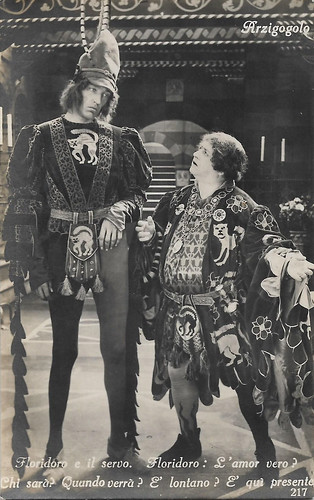
Arzigogolo
Italian postcard by Ballerini & Fratini, Firenze, no. 217. Photo: Alba Film. Oreste Bilancia as Floridoro in L'arzigogolo (Mario Almirante, 1924). Caption: Floridoro and the servant. Floridoro: Her true love? Who is it? When will he come? Is he far away? Is he here?
Arzigogolo
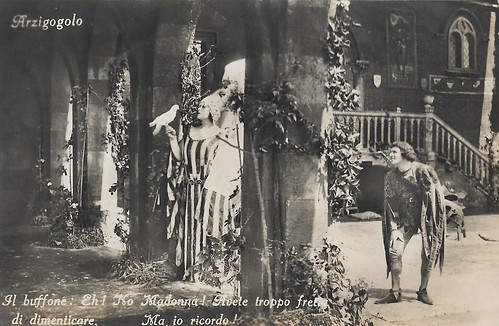
Italian postcard by Ballerini & Fratini, Firenze, no. 218 or 219. Photo: Alba Film. Annibale Betrone as The Jester and Italia Almirante Manzini as Monna Violante in L'arzigogolo (Mario Almirante, 1924). Caption: The Jester: What! No Milady! You have too great haste to forget. But I remember!
Arzigogolo
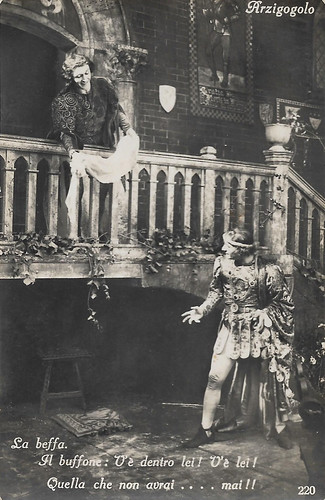
Italian postcard by Ballerini & Fratini, Firenze, no. 220. Photo: Alba Film. Annibale Betrone as The Jester and Alberto Collo as Giano in L'arzigogolo (Mario Almirante, 1924). Caption: The mockery. The Jester: She is in this, it is hers. She whom you'll never have... never!

Arzigogolo
Italian postcard by Ballerini & Fratini, Firenze, no. 221. Photo: Alba Film. Italia Almirante as Monna Violante, Annibale Betrone as The Jester, Oreste Bilancia as Floridoro, and Alberto Collo as Giano in L'arzigogolo (Mario Almirante, 1924). Caption: The Jester rebels against Giano and defies death out of love for Violante.

Arzigogolo
Italian postcard by Ballerini & Fratini, Firenze, no. 222. Photo: Alba Film. Annibale Betrone as The Jester in L'arzigogolo (Mario Almirante, 1924). Caption: The Jester in prison.
Arzigogolo
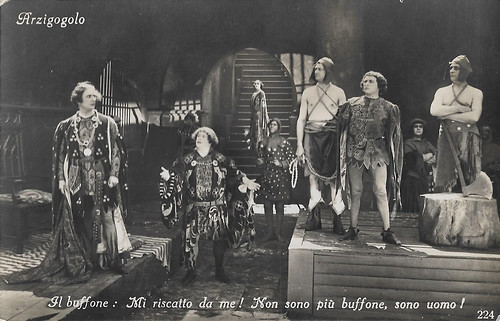
Italian postcard by Ballerini & Fratini, Firenze, no. 224. Photo: Alba Film. Annibale Betrone as The Jester, Oreste Bilancia as Floridoro, and Alberto Collo as Giano in L'arzigogolo (Mario Almirante, 1924). Caption: The Jester: I redeem myself! I am no longer a jester, but a man!

Arzigogolo
Italian postcard by Ballerini & Fratini, Firenze, no. 226. Photo: Alba Film. Annibale Betrone as The Jester, Oreste Bilancia as Floridoro, and Alberto Collo as Giano in L'arzigogolo (Mario Almirante, 1924). Caption: Dead!

Italia Almirante in L'arzigogolo
Italian postcard by Ballerini & Fratini, Firenze, no. 227. Photo: Alba Film. Annibale Betrone and Italia Almirante in L'arzigogolo (Mario Almirante, 1924). Caption: True love...attained in vain... He is dead!

Annibale Betrone and Oreste Bilancia in L'arzigogolo
Italian postcard by Ballerini & Fratini, Firenze, no. 228. Photo: Alba Film. Annibale Betrone and Oreste Bilancia in L'arzigogolo (Mario Almirante, 1924). Caption: The buffoon resurrected to the great terror of Floridoro.

Arzigogolo
Italian postcard by Ballerini & Fratini, Firenze, no. 229. Photo: Alba Film. Oreste Bilancia as Floridoro, and Alberto Collo as Giano in L'arzigogolo (Mario Almirante, 1924). Caption: The Death of Giano.
Arzigogolo
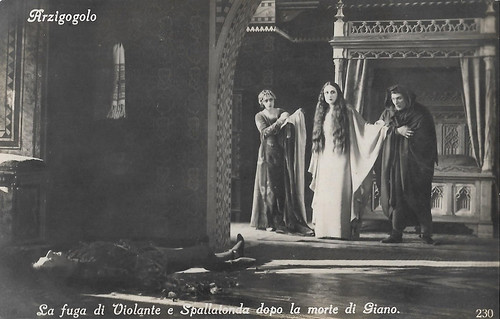
Italian postcard by Ballerini & Fratini, Firenze, no. 230. Photo: Alba Film. Italia Almirante Manzini as Monna Violante, Annibale Betrone as The Jester, and Alberto Collo as Giano in L'arzigogolo (Mario Almirante, 1924). Caption: The flight of Violante and Spallatonda after Giano's death.

Sources: Vittorio Martinelli (Il Cinema Muto Italiano 1923-1931 - Italian), Wikipedia (Italian and Cymraeg) and IMDb.

04 October 2026

Directed by Marshall Neilan

In the early days of silent pictures, Marshall Neilan (1891-1958) was a top director for Goldwyn Pictures. He started his career as an actor. He also directed a small number of Louis B. Mayer's independently produced melodramas. One of this year's sections of Le Giornate del Cinema Muto in Pordenone is dedicated to Neilan.

Marshall Neilan and his stars making music
Spanish collector card by Chocolate Amatller, Barcelona, in the series Los artistas cinematográficos en la intimidad, series A, no. 29. In between filming, here is the cast of Marshall Neilan's film having fun, with Neilan on the piano, Ronald Colman on the banjo, Paul Ellis on the violin, Lew Cody on the cello, and Neilan's then-wife Blanche Sweet singing. This may have been during the making of The Sporting Venus (1925), in which Sweet, Colman and Cody had the leads.

Mary Pickford and Allan Forrest in Dorothy Vernon of Haddon Hall (1924)
Italian postcard by Ballerini & Fratini. Photo: United Artists. Mary Pickford and Allan Forrest in Dorothy Vernon of Haddon Hall (Marshall Neilan, 1924).

Blanche Sweet
British postcard by J.D. Walker World's Films Ltd. Caption: Jesse Lasky's Leading Star Artiste. In the 1920s Blanche Sweet (1896-1986) acted at Lasky and Paramount, became a highly paid star, and was married to Marshall Neilan. For his Tess of the D'Urbervilles (Marshall Neilan, 1924), Sweet received raving reviews.

Mary Pickford's favourite director


Marshall Ambrose Neilan was born in 1891 in San Bernardino, California. Following the death of his father, the eleven-year-old Mickey Neilan had to give up on school to work at whatever he could find to help support his mother. As a teenager, he began acting in bit parts in live theatre, and in 1910 he got a job as a chauffeur, driving Biograph Studios executives around Los Angeles to determine the suitability of the West Coast as a place for a permanent studio.

In 1912, Neilan worked as a car salesman at a dealership in La Mesa when he was instructed to deliver a car to a nearby film location, whose director had just purchased it. Neilan delivered the car to the director, Allan Dwan, and since Dwan didn't know how to drive, Neilan took him out and taught him. The two hit it off, and Dwan asked Neilan if he wanted to be an actor in his film The Stranger at Coyote (Allan Dwan, 1912), starring J. Warren Kerrigan and Pauline Bush.

When Neilan discovered that the job would pay twice as much as his car salesman job, he took it, beginning his long career as an actor, writer, and director. Hired by Kalem Studios for their Western film production facility in Santa Monica, Neilan was first cast opposite Ruth Roland. Described as confident but egotistical at times, Neilan's talent saw him directing films within a year of joining Kalem.

After acting in more than seventy silent film shorts for Kalem and directing more than thirty others, Neilan was hired by the Selig Polyscope Company, then Bison Motion Pictures and Famous Players-Lasky Corporation. At the end of 1916, Neilan was hired by Mary Pickford Films, where he directed Pickford in Rebecca of Sunnybrook Farm (1917) and The Little Princess (1917). From then on, he focused on directing.

Neilan became Mary Pickford's favourite director and directed her in seven of her biggest hits, also including Stella Maris (1918), Amarilly of Clothes-Line Alley, M'Liss (1918), and Daddy-Long-Legs (1919). In 1915 (or 1919 - the sources differ), Neilan was a co-founder of the Motion Picture Directors Association (Associated Producers, Inc.) with directors such as Cecil B. DeMille, Allan Dwan, and William Desmond Taylor.

Marshall Neilan
American postcard by Flying A, no. 16. Photo: Flying A.

Marshall Neilan
British postcard by Scala favourites. Marshall Neilan, written as Nielan.

Jack Pickford
Spanish card by La Novela Semanal Cinematográfica, no. 90. In the comedy A Girl of Yesterday (Allan Dwan, 1915), Mary Pickford starred fot the first time as an older woman. The film costarred Pickford's younger brother Jack Pickford and Marshall Neilan. The three were dear friends and Neilan directed Jack in the comedy Freckles (Marshall Neilan, 1917).

Wesley Barry
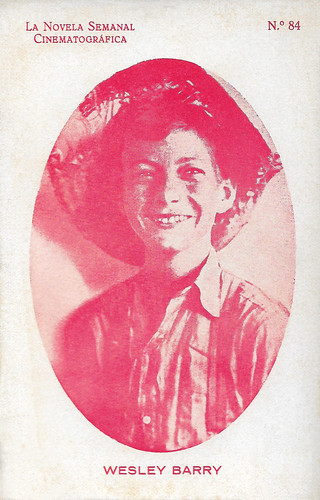
Spanish card by La Novela Semanal Cinematográfica, no. 84. Wesley Barry (1907-1994) was an adorable child actor in silent films who was known for his face full of freckles. Marshall Neilan cast him in Rebecca of Sunnybrook Farm (1917), starring Mary Pickford. It was the first time that his freckles were uncovered. Earlier producers had insisted that all subjects cover facial blemishes with grease paint. Neilan also let the boy's naturally wild hair grow out instead of being slicked down. Wesley also appeared as one of the orphans opposite Mary Pickford in the orphanage scenes in the beginning of Daddy-Long-Legs (Marshall Neilan, 1919).

Blanche Sweet
American postcard by Kline Poster Co., Philadelphia. Image: Lasky / Paramount. Blanche Sweet.

A mutual dislike between Louis B Mayer and Neilan


In 1921, Marshall Neilan formed the production company Marshall Neilan Productions. Till 1926, Marshall Neilan Productions made eleven feature-length films, almost all of which were distributed through First National Pictures. He received critical acclaim for directing and producing such films as Bits of Life (James Flood, Marshall Neilan, William J. Scully, 1921) with Lon Chaney, and The Lotus Eater (Marshall Neilan, 1921) with John Barrymore and Colleen Moore.

He was a top director for Goldwyn Pictures and also directed a small number of Louis B. Mayer's independently produced melodramas. However, there was a mutual dislike between Mayer and Neilan. Jack Backstreet at IMDb: "During the festivities inaugurating the merger of Metro and Goldwyn Pictures on 26 April 26 1924, Neilan grew disgusted at the prospect of listening to Mayer's speech and interrupted everything by ordering his cast and crew back to the set of Tess of the D'Urbervilles (1924). Mayer later viewed the picture and ordered the downbeat ending re-shot over Neilan's loud protests. Mayer, wanting to instil his absolute authority over all production matters, held firm."

The prospect of working for Mayer in the new Metro-Goldwyn super-studio was unbearable, and Neilan quit. His was the first outright desertion from the studio that others over the next three decades would aspire to be a part of. A talented screenwriter, in 1927 he wrote the original story for the Howard Hughes film, Hell's Angels. Initially, he had also been hired as the film's director, back when it was still silent, but Hughes' overbearing style forced him to drop out, and he was replaced a few weeks into production by a more pliable director, Edmund Goulding; due to massive reshoots (as well as the recasting of the lead role with Jean Harlow), none of the footage Neilan shot made it into the final film.

In 1929, he was hired by RKO Radio Pictures. Although he reputedly had difficulty adapting to directing the new talkies, that year he successfully directed Rudy Vallee and Marie Dressler in the "all-talking" The Vagabond Lover (1929). Contrary to the legend that the film was a commercial and critical failure (except for Dressler's highly praised performance), the film was a hit, making a profit of $335,000, and was one of four top hits for RKO in 1929. He was then hired by Hal Roach Studios, for whom he directed a few films in 1930, and he made his final directorial effort in 1937. A major director during the silent era, Neilan's career in the sound era was very adversely affected due to a serious drinking problem.

In recognition of his contribution to the motion picture industry, in 1940 the Directors Guild of America conferred on him an "Honorary Life Member Award." In 1955, Neilan was awarded the George Eastman Award, given by George Eastman House for distinguished contribution to the art of film. Twenty years after he made his last film, Neilan returned to acting on the screen in a small role portraying an ageing and less than enlightened United States Senator in A Face in the Crowd (Elia Kazan, 1957). He later received a star on the Hollywood Walk of Fame at 6233 Hollywood Blvd. Marshall Neilan died in 1958 in Los Angeles of throat cancer. He was married to actress Gertrude Bambrick from 1913 till 1921. After their divorce, he married actress Blanche Sweet in 1922. They divorced in 1929. With Bambrick, he had a son, screenwriter Marshall Ambrose Neilan Jr., born in 1915. Marshall Neilan is interred in Los Angeles in Angelus-Rosedale Cemetery.

Mary Pickford in Dorothy Vernon of Haddon Hall (1924)
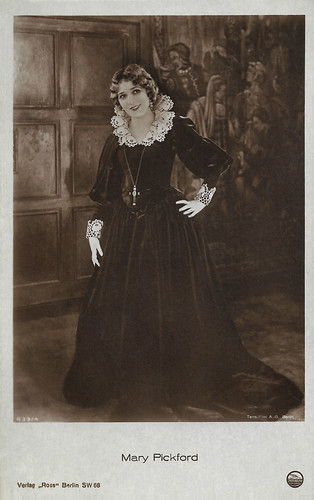
German postcard by Ross Verlag, no. 839/4. Photo: Terra Film A.G., Berlin. Mary Pickford in Dorothy Vernon of Haddon Hall (Marshall Neilan, 1924).

Mary Pickford in Dorothy Vernon of Haddon Hall (1924)
German postcard by Ross Verlag, no. 839/3. Photo: Terra Film A.G., Berlin. Mary Pickford in Dorothy Vernon of Haddon Hall (Marshall Neilan, 1924).

Viola Dana
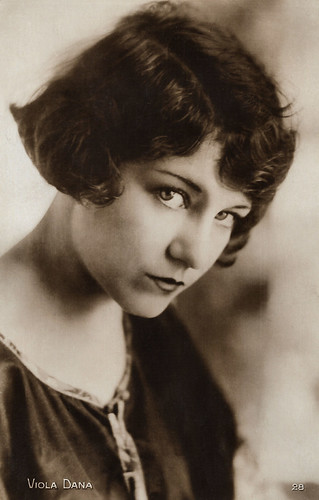
French postcard by Cinémagazine-Edition, Paris, no. 28. Viola Dana starred in Marshall Neilan's now-lost comedy The Great Love (1925) based upon his own story, and in his also-lost drama Wild Oats Lane (1926). In both films, Roger Agnew was the male lead.

Colleen Moore
German postcard by Ross Verlag, no. 1871/1, 1927-1928. Photo: First National Pictures / Fanamet. When Colleen Moore (1899-1988) starred in Her Wild Oat (Marshall Neilan, 1927), she was the top box-office draw in the US, making $12,500 a week.

Constance Talmadge
German postcard by Ross Verlag, no. 3474/1, 1927-1928. Photo: Defina / First National. In the silent romantic comedy Venus of Venice (Marshall Neilan, 1927), Constance Talmadge and Antonio Moreno were the stars. Talmadge's own production unit produced with distribution through First National Pictures.

Sources: Jack Backstreet (IMDb), Wikipedia, and IMDb.

03 October 2026

Albert Rueprecht (1929-2026)

On 3 October 2026, Austrian actor Albert Rueprecht (1929) passed away in Baden, Austria. He was a member of the Burgtheater and Theater in der Josefstadt in Vienna. The blond actor made over 50 feature films, including many Heimatfilms in which he often played the handsome jeune premier. He was 97.

Albert Rueprecht (1929-2026)
West German postcard by Kolibri Verlag G.m.b.H., Minden/Westf., no. 285. Photo: Kolibri / Entwieser.

Renate Mannheim, Thomas Reyer, Albert Rueprecht and Hanna Hutten in Das Sündige Dorf (1954)
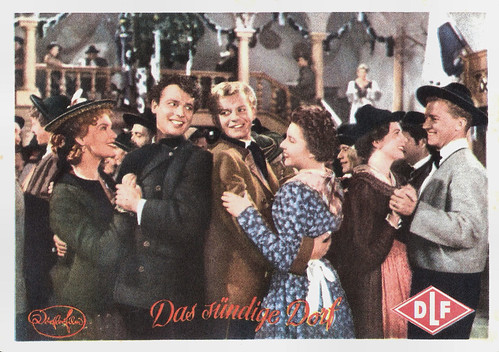
West German postcard by DLF. Photo: Dörfler-Filmproduktion. Publicity still for Das sündige Dorf / The Village of Sin (Ferdinand Dörfler, 1954) with Renate Mannheim, Thomas Reyer, Albert Rueprecht and Hanna Hutten.

Albert Rueprecht (1929-2026)
West German postcard by Kolibri Verlag G.m.b.H., Minden/Westf., no. 606. Photo: Kolibri / Entwieser.

Romeo


Albert Rueprecht was born in 1929 in Vienna, the capital of Austria. He had his first stage experiences at the Akademisches Gymnasium when he played in Ferdinand Raimund’s 'Alpenkönig und Menschenfeind' (King of the Alps and Enemy of the People).

From 1949 to 1951, he took acting classes with Zdenko Kestranek, Helmuth Krauss and Edward Wolters, teachers of the Max Reinhardt Seminar in Vienna. He had his first engagements as an actor at the Theater der Courage and the Theater am Parkring.

At the Wiener Volkstheater he played in 1953 Ferdinand in 'Kabale und Liebe' (Intrigue and Love) by Friedrich Schiller. After appearances at Theater in der Josefstadt, he came in 1954 to the prestigious Burgtheater.

There he played, among others, Romeo in 'Romeo and Juliet', Don Juan in 'Dame Kobold' by Calderón de la Barca and Gottfried in 'Das Käthchen von Heilbronn' (Cathy of Heilbronn) by Heinrich von Kleist.

In 1955, he was in the cast of the historic production with which the Burgtheater reopened: 'König Ottokars Glück und Ende' (King Ottokar's Fortune and End) on the stage. For almost ten years, he remained at the Burgtheater. From 1958 to 2004 he was an ensemble member at the Theater in der Josefstadt. There he played a total of over 80 roles.

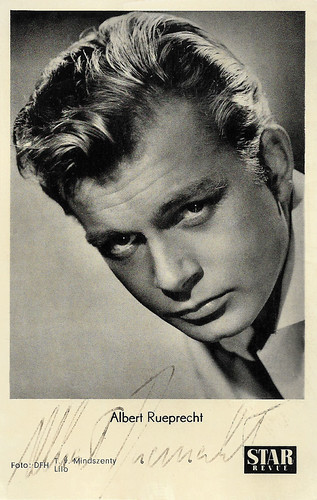
Albert Rueprecht (1929-2026)
West German collector card by Star Revue. Photo: DFH / T. v. Mindszenty / Lilo.

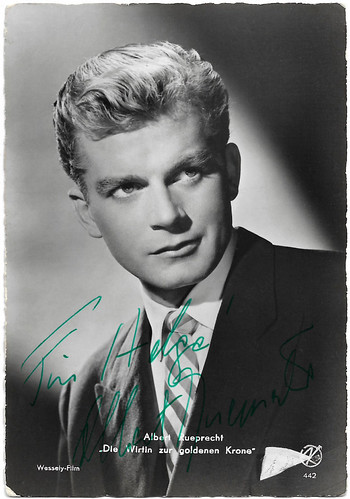
Albert Rueprecht (1929-2026)
Austrian postcard by Kellner Postkarten, Wien (Vienna), no. 442. Photo: Wessely-Film. Albert Rueprecht in Die Wirtin zur goldenen Krone / The Innkeeper of the Golden Crown (Theo Lingen, 1955).

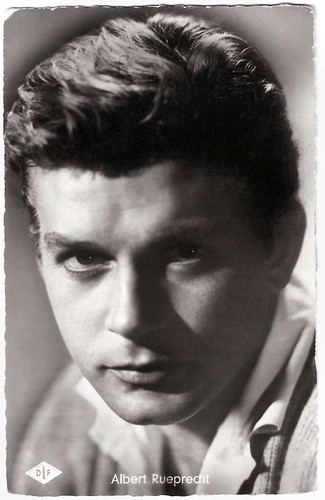
Albert Rueprecht
West German postcard by Kolibri-Verlag, Minden/Westf., no. 2102. Photo: H.P. / Deutsche London / Schwennecke. Publicity still for Wo der Wildbach rauscht / Where the Wildbach rushes (Heinz Paul, 1956).

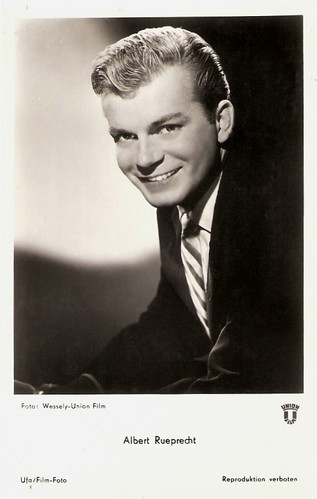
Albert Rueprecht
West German postcard by Ufa, no. 6309/2. Photo: Wessely / Union-Film.

A classic of the Heimatfilm


In 1954, Albert Rueprecht had a role in Echo der Berge / Echo of the Mountains (Alfons Stummer, 1954), an Austrian Heimatfilm classic and one of the most popular German-language films ever. He would play in many Heimatfilms of the 1950s, including Die Wirtin zur Goldenen Krone / The Innkeeper of the Golden Crown (Theo Lingen, 1955), Dort wo die Alpen glühen / Where the Alpine Glow (Otto Meyer, 1956), and Im Prater blüh’n wieder die Bäume / Trees Are Blooming in Vienna (Hans Wolff, 1958) with Johanna Matz.

Often, he was the good-looking jeune premier, which made him quite popular. His roles ranged from a young officer to a peasant in love, from the ‘elegant man of the world’ to the emperor. In the last part of the Sissi trilogy, Sissi – Schicksalsjahre einer Kaiserin / Sissi - Fateful Years of an Empress (Ernst Marischka, 1957), he played the Archduke Ferdinand Max opposite Romy Schneider.

In total, Rueprecht made over 50 feature films, including the melodrama Das Licht der Liebe / The Light of Love (Robert Adolf Stemmle, 1954) with Paula Wessely as his mother, and Der Vogelhändler / The Bird Seller (Géza von Cziffra, 1962) with Conny Froboess. After the end of the Heimatfilm wave, Rueprecht only got small roles, including a few parts in international productions, such as Song Without End (Charles Walters, 1960) starring Dirk Bogarde. He participated in TV series and intensified his theatrical work, especially at the Theater in der Josefstadt.

In 2008, he played Emperor Franz Joseph at the Mörbischer Seefestspiele in the operetta 'Im weißen Rößl' (The White Horse Inn). His later films include Duett zu dritt / Tea for Three (Gerhard Janda, 1976) with Iris Berben, The Fifth Musketeer (Ken Annakin, 1979) and Ein Herz wird wieder jung / A Heart Becomes Young Again (Heide Pils, 1999).

Albert Rueprecht died on 3 October 2026, at the age of 97. He was married to the actresses Ellen Umlauf and Ann Millar (Elisabeth Rueprecht, born Millar), who died in 2010. His son is Alexander Rueprecht, from his marriage with Ellen Umlauf.

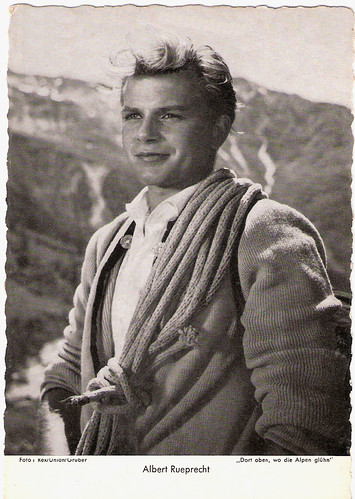
Albert Rueprecht in Dort oben, wo die Alpen glühen (1956)
German postcard by WS-Druck, Wanne-Eickel, no. 144. Photo: Rex / Union / Gruber. Publicity still for Dort oben, wo die Alpen glühen / Where the Alpine Glow (Otto Meyer, 1956).

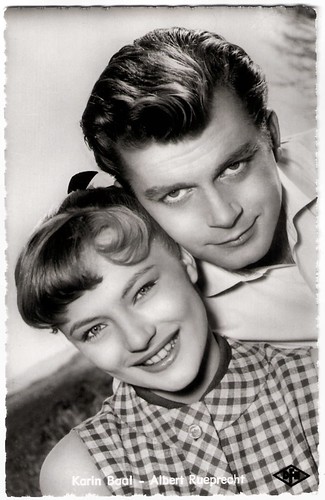
Karin Baal and Albert Rueprecht in Der müde Theodor (1957)
German postcard by Kolibri-Verlag, Minden/Westf., no. 2507. Photo: DFH / Lilo. Publicity still for Der müde Theodor / Tired Theodore (Géza von Cziffra, 1957) with Karin Baal.

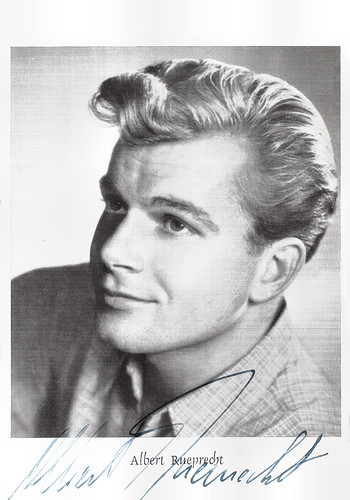
Albert Rueprecht
Vintage autograph card.

Albert Rueprecht (1929-2026)
Vintage autograph card.

Sources: Wikipedia (German) and IMDb.

This post was last updated on 6 October 2026.