
German postcard. Photo: Moscow Art Theatre. Vasili Kachalov as Baron in 'The Lower Depths' by Maxim Gorky.
Russian film and stage actor Vasily Kachalov (1875-1948) was one of Konstantin Stanislavski's best-known performers. He led the so-called Kachalov Group within the Moscow Art Theatre. He also appeared in four films.

German postcard. Maria Germanova as Olga in 'Three Sisters' by Anton Chekhov. Caption: Guest performances by the Moscow Art Theatre (in Germany, 1920s).
Maria Germanova (1884–1940) was a Russian stage and screen actress. In 1901, she enrolled in the just-opened Moscow Art Theatre Drama School and a year later joined the Moscow Art Theatre. She debuted in Shakespeare's 'Julius Caesar' in 1903, and received positive reviews in Maxim Gorky's 'Children of the Sun' (1905), in Griboyedov's 'Woe from Wit' (1906) and in Henrik Ibsen's 'Brand' (1906). In 1914-1924, Germanova starred in five Russian silent films, starting with Anna Karenina in 1914, directed by Vladimir Gardin and produced by Paul-Ernst Timan for Thiemann & Reinhardt. In 1919, she joined the Kachalov Troupe and toured outside Soviet Russia from 1919 to 1922. In Germany, she acted in the classic German Expressionist film Raskolnikow (Robert Wiene, 1923), based on Fyodor Dostoevsky's classic novel 'Crime and Punishment', and in Conrad Wiene's Die Macht der Finsternis (1924), based on Tolstoy's play. In 1922, along with several of her colleagues, Germanova refused to return to Moscow. She co-founded and became the director of what soon came to be known as the Prague Moscow Art Theatre Troupe. In 1929, she went to the US and succeeded Richard Boleslawski as the head of the American Laboratory Theatre, where she produced Chekhov's 'Three Sisters'. The Lab disbanded in 1933, but proved to be an important link between Stanislavski and the Group Theatre in New York.

German postcard by Ross Verlag, no. 937/2, 1925-1926. Vladimir Gajdarov and Olga Gzovskaya in 'Schuld und Sühne', an adaptation of Dostojevski's 'Crime and Punishment' (Raskolnikov). Unclear is which stage production this is.
Olga Gzovskaya (1883-1962) became a pupil of Konstantin Stanislavski in 1907. She joined the Moscow Art Theatre in 1910, where she played Ophelia in 'Hamlet'(1911-1912), and also met her husband, Vladimir Gajdarov. From 1915, Gzovskaya also acted in films, first in Mara Kramskaya (V. Izouroudov-Garlitski, 1915) in which Gajdarov had his first bit part in film. Later, she played leads in seven films by Yakov Protazanov, including Zhenshchina s kinzhalom / The Dagger Woman (1916), co-starring Ivan Mozzhukhin and Yeyo zhertva / Her Sacrifice (Cheslav Sabinsky 1917) costarring Vladimir Gajdarov. During the Civil War, they left Russia and wandered around through the Baltic states to Germany, where they acted in many German films.

French postcard, no. 5 C. Photo: Moscow Art Theatre. Konstantin Stanislavski as Gaiev in 'The Cherry Orchard' by Anton Chekhov. Collection: Didier Hanson.
On the cultural map for Western Europe
The Moscow Art Theatre production of 'Hamlet' (1911–1912), produced by Konstantin Stanislavski and Edward Gordon Craig, received hostile reviews from the Russian press. The overall opinion of the Russian critics was that Craig's modern concept distracted from the play itself. While Olga Knipper (Gertrude), Nikolai Massalitinov (Claudius) and Olga Gzovskaia (Ophelia) received poor reviews in the Russian press, Vasili Kachalov's performance as Hamlet was praised as a genuine achievement. The international public thought otherwise. The production attracted enthusiastic and unprecedented worldwide attention for the theatre, with reviews in Britain's The Times and in the French press that praised its unqualified success. Rumours spread very quickly through Western Europe of the great triumph of Craig's vision, despite the production in actuality being a complete failure in Moscow. The production became one of the most famous and passionately discussed productions in the history of the modern stage and placed the Moscow Art Theatre on the cultural map for Western Europe.
Stanislavski kept seeking new paths as a director. He sought contact with avant-garde painters and entrusted Alexandre Benois, the leading stage and costume designer of Diaghilev's Ballets Russes, with the direction of the set design. In 1916, however, he parted ways with Benois because he feared that the theatre's work could suffer from an ‘overemphasis on the decorative’. Immediately after the October Revolution of 1917, the ensemble embarked on an extensive tour abroad. The guest performances of the Moscow Art Theatre had a significant impact on the development of European drama and theatre at the beginning of the 20th century. Already in 1906, Stanislavski's ensemble gave a three-week guest performance in Berlin. The highlight of the guest performance was Chekhov's 'Uncle Vanya'. Audiences and critics alike were delighted. The intensity of the performance and the direction, which brought together all the elements of theatre, amazed and delighted Berliners. The guest performance was a first-class social event, attended not only by German directors, actors, playwrights, academics and critics, but even by the Kaiser. The playwright Gerhart Hauptmann said of 'Uncle Vanya': ‘This is the most powerful of my theatrical impressions. It is not people who are acting, but artistic gods.’ Hauptmann stated that he had always wanted this style of performance for his plays.
After their return, Stanislavski worked primarily as an opera director. The MAT was elevated to the status of an academic state theatre (Московский художественный академический театр – MChAT), thus placing it on a par with the former imperial theatres. It continued to thrive with an extensive repertoire of leading Russian and Western playwrights. Although several revolutionary groups saw it as an irrelevant marker of pre-revolutionary culture, the theatre was initially granted support by Vladimir Lenin, a frequent patron of the Art Theatre himself. Mikhail Bulgakov wrote several plays for the MAT and satirised the organisation mercilessly in his 'Theatrical Novel'. Isaac Babel's 'Sunset' was also performed there during the 1920s. A significant number of Moscow Art Theatre's actors were awarded the prestigious title of People's Artist of the USSR. Many actors became nationally known and admired thanks to their film roles. However, the Civil War saw many of the theatre's actors being cut off from Moscow, and the support it received from the government diminished under Lenin's New Economic Policy. The subsidies it had come to rely on were withdrawn, and the theatre was forced to survive on its own profits.
In the wake of the temporary withdrawal of the state subsidy to the MAT that came with the New Economic Policy in 1921, Stanislavski and Nemirovich planned a tour to Europe and the US to augment the company's finances. The tour began in Berlin, where Stanislavski arrived on 18 September 1922, and proceeded to Prague, Zagreb, and Paris, where he was welcomed at the station by Jacques Hébertot, Aurélien Lugné-Poë, and Jacques Copeau. In Paris, he also met André Antoine, Louis Jouvet, Isadora Duncan, Firmin Gémier, and Harley Granville-Barker. He discussed with Copeau the possibility of establishing an international theatre studio and attended performances by Ermete Zacconi, whose control of his performance, economic expressivity, and ability both to 'experience' and 'represent' the role impressed him.
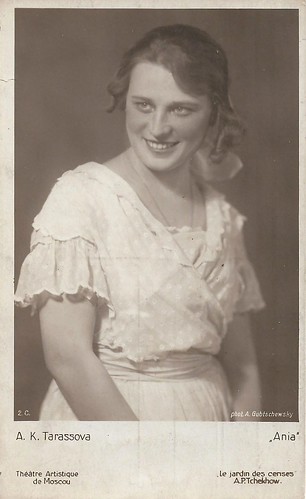
French postcard, no. 2 C. Photo: A. Gubtschewsky / Moscow Art Theatre. Alla Tarassova as Anya in 'The Cherry Orchard' by Anton Chekhov.
From 1916, Alla Tarassova (1898-1973) played in performances of the Moscow Art Theatre. That year, she already made a mark as a Boyar woman in 'Tsar Fedor Ioannovich' by Alexander Tolstoy. During the Civil War, she toured from 1919 to 1922 with the Kachalov Group. It was here she broke through as Anya in 'The Cherry Orchard'.

French postcard, no. 6 C. Photo: Moscow Art Theatre. Leonid Leonidov as Lopakhin in 'The Cherry Orchard' by Anton Chekhov.
Leonid Leonidov (1873-1941) worked at the Moscow Art Theatre from 1903. His roles included Dmitri Karamazov, Othello, Cassius in 'Julius Caesar', and Lopakhin in 'The Cherry Orchard'. In the late 1910s, 1920s, and 1930s, Leonidov also appeared in several films. He started in the propaganda film Khleb / Bread (Richard Boleslawski, Boris Sushkevich, 1918) with Olga Baclanova and Boleslawski himself, followed by Zheleznaya pyata / The Iron Heel (Vladimir Gardin, 1919) based on a Jack London novel, and Pyotr i Alexei (Yuri Zhelyabuzhsky, 1919) in which he had the lead as Tsar Peter the Great.

French postcard, no. 8 C. Photo: Moscow Art Theatre. Vladimir Gribunin as Simeonov-Pishchik in 'The Cherry Orchard' by Anton Chekhov.
Vladimir Fyodorovich Gribunin (1873-1933) joined the Moscow Art Theatre in 1898 and stayed until his death in 1933. Critically lauded were his performances as Nikita in Leo Tolstoy's 'Power of Darkness', Simeonov-Pishchik in 'The Cherry Orchard' and Kuroslepov in the 1926 production of Alexander Ostrovsky's 'An Ardent Heart', the high point of his career. He was cast in three early Soviet films: Алёши'на дудка / Alyosha's Pipe (Vladimir Kasyanov, 1919), Трое / Threesome (Michael Narokov, 1919) and Хромой барин / Limping Landlord (Vladimir Kasyanov, 1920).
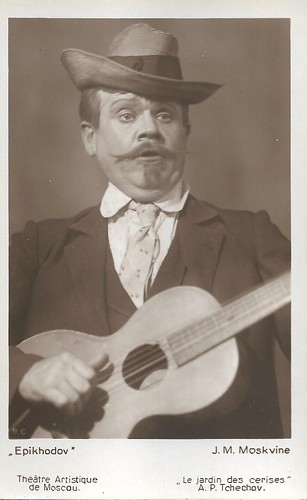
French postcard, no. 9 C. Photo: Moscow Art Theatre. Ivan Moskvin as Yepikhodov in 'The Cherry Orchard' by Anton Chekhov.
The career of Ivan Moskvin (1874-1946) is closely identified with the Moscow Art Theatre, of which he became director in 1943. In 1898, he was invited by Vladimir Nemirovich-Danchenko to join the newly formed Moscow Art Theatre, and he appeared opposite Olga Knipper in the title role of the theatre’s first production, 'Czar Fyodor Ioannovich' (1898), by Aleksey Tolstoy. He went on to create the role of Luka in Maxim Gorky’s 'The Lower Depths' (1902) and Epikhodoff in Anton Chekhov’s 'The Cherry Orchard' (1904). The international acclaim Moskvin won when touring Europe and the United States (1919–1924) was reinforced in later years by his work in Soviet motion pictures that were distributed worldwide.

French postcard, no. 7 N. Photo: Moscow Art Theatre. Vasily Kachalov as The Baron 'The Lower Depths' by Maxim Gorky. Collection: Didier Hanson.

French postcard, no 9 N. Photo: Moscow Art Theatre. Ivan Moskvin as Luka in 'The Lower Depths' by Maxim Gorky.

French postcard, no. 12 N. Photo: Moscow Art Theatre. Alexander Leonid Vishnevsky as A Tartar in 'The Lower Depths' by Maxim Gorky.
Aleksandr Vishnevsky (1861-1943) was one of the founding members of the Moscow Art Theatre. On the opening night of the MAT, Vishnevsky played the part of Boris Godunov in the play 'Tsar Fiodor Ioannovich' by Alexei Tolstoy. In 1899, he played Godunov again in Tolstoy's 'The Death of Ivan the Terrible'. Vishnevsky was the first to play the title role in Chekhov's play 'Uncle Vanya' at the MAT. Vishnevsky acted in three films: Cagliostro (Wladyslaw Starewicz, 1918), Pobeda zhenshchiny (Yuri Zhelyabuzhsky, 1927), and the comedy Prazdnik svyatogo / Holiday of St. Jorgen Yorgena (Yakov Protazanov, Porfiri Podobed, 1930)
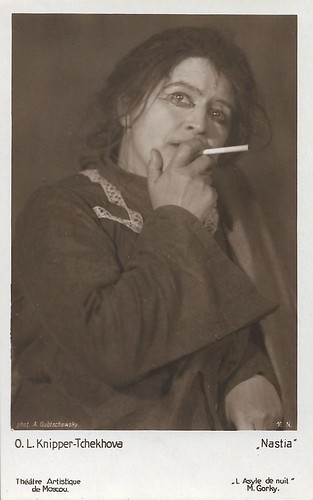
French postcard, no. 16 N. Photo: A. Gubtschewsky, Berlin / Moscow Art Theatre. Olga Knipper-Chekhova as Nastia in 'The Lower Depths' by Maxim Gorky.
Olga Leonardovna Knipper-Chekhova (1868-1959) was among the 39 original members of the Moscow Art Theatre when it was formed by Konstantin Stanislavski in 1898. She played Arkadina in 'The Seagull' (1898), played Elena in the Moscow premiere of 'Uncle Vanya' (1899), and was the first to play Masha in 'Three Sisters' (1901) and Madame Ranevskaya in 'The Cherry Orchard' (1904). She married Anton Chekhov, the author of these plays, in 1901, but her husband already died in 1904 of tuberculosis. Olga Knipper-Chekhova worked with the Moscow Art Theatre for the remainder of her life. Her niece was the film actress Olga Tschechowa.

French postcard, no. 19 N. Photo: Moscow Art Theatre. Barbara Bulgakova as Natasha in 'The Lower Depths' by Maxim Gorky.
Barbara Bulgakova (c. 1898-1977) was the wife of actor, stage and film director Leo Bulgakov. Both were regulars from the Moscow Art Theatre (MAT) from an early date. As Varvara Bulgakova, she had her first film part in Polikushka (1922), starring Moscow Art Theatre actor Ivan Moskvin. The Bulgakovs were part of the MAT troupe that officially toured Europe and the United States in the early 1920s. When the troupe returned to Russia, Bulgakov and his wife remained in the US and started to act in shows on Broadway, which Leo Bulgakov partly also produced himself, including classic Russian plays such as 'The Seagull' and 'The Lower Depths'. Barbara acted with her husband in Song of Russia (Gregory Ratoff, Laslo Benedek, 1944).

French postcard, no. 9 S. Photo: A. Gubtschewsky / Moscow Art Theatre. Konstantin Stanislavsky as Verchinine in 'Three Sisters' by Anton Chekhov. Collection: Didier Hanson.
On tour in the USA
The Moscow Art Theatre company sailed to New York City and arrived on 4 January 1923. When reporters asked about their repertoire, Konstantin Stanislavski explained that "America wants to see what Europe already knows." David Belasco, Sergei Rachmaninoff, and Feodor Chaliapin attended the opening night performance. Thanks in part to a vigorous publicity campaign that the American producer, Morris Gest, orchestrated, the tour garnered substantial critical praise, although it was not a financial success.
As actors, among whom was the young Lee Strasberg, flocked to the performances to learn from the company, the tour made a substantial contribution to the development of American acting. Richard Boleslawski presented a series of lectures on Stanislavski's system (which were eventually published as 'Acting: The First Six Lessons' (1933). A performance of 'Three Sisters' on 31 March 1923 concluded the season in New York, after which the company travelled to Chicago, Philadelphia, and Boston.
At the request of an American publisher, Stanislavski reluctantly agreed to write his autobiography, 'My Life in Art', since his proposals for an account of the system or a history of the MAT and its approach had been rejected. He returned to Europe during the summer, where he worked on the book and, in September, began rehearsals for a second tour. The company returned to New York on 7 November and went on to perform in Philadelphia, Boston, New Haven, Hartford, Washington, D.C., Brooklyn, Newark, Pittsburgh, Chicago, and Detroit. On 20 March 1924, Stanislavski met President Calvin Coolidge at the White House. They were introduced by a translator, Elizabeth Hapgood, with whom he would later collaborate on 'An Actor Prepares', his manual for actors written in the form of a fictional student's diary. The company left the United States on 17 May 1924.
On their American tour, the Moscow Art Theatre (MAT) also presented their very first production, 'Tsar Fyodor Ioannovich' by Aleksey Tolstoy, which was first performed by MAT in 1898. The production was directed by Konstantin Stanislavski, with Ivan Moskvin in the lead role and Vsevolod Meyerhold as Prince Vasiliy Shuisky. 'Tsar Fyodor Ioannovich' (1868) is the second part of a trilogy that begins with 'The Death of Ivan the Terrible' and concludes with 'Tsar Boris'. All three plays were banned by the censor. Tsar Fyodor is written in blank verse and was influenced by the work of William Shakespeare, Casimir Delavigne, and Edward Bulwer-Lytton. It dramatises the story of Feodor I of Russia, whom the play portrays as a good man who is a weak, ineffectual ruler. The trilogy formed the core of Tolstoy's reputation as a writer in the Russia of his day and as a dramatist to this day. It has been considered Tolstoy's masterpiece. Already in 1906, MAT performed the play in Berlin. In 1922, it was performed at the Théâtre des Champs-Elysées in Paris. Between 1920 and 1930, MAT performed all over Europe, including Germany, Czechoslovakia, Poland and Bulgaria. In New York, 'Tsar Fyodor Ioannovich' was first performed by MAT at Jolson's 59th Street Theatre, in January-February 1923. It returned there the next year, after which it was performed at the Imperial Theatre.
Several members of the company decided to remain in America after the tour and went on to teach the Stanislavski method to actors such as Lee Strasberg and Stella Adler. Both took acting lessons at the American Laboratory Theatre of Richard Boleslawski and Maria Ouspenskaya where they learened the serious, emotionally grounded, ensemble style of the Moscow Art Theatre, later known as 'The Method'. In 1931, Strasberg was one of the founders of the New York Group Theatre, for which he directed several plays. In 1949, he began a long career at the Actors Studio in New York. Some of Strasberg's students there included Paul Newman, Al Pacino, Marilyn Monroe, Jane Fonda, James Dean, Dustin Hoffman, Jack Nicholson and Steve McQueen. Stella Adler founded her Conservatory of Theatre in 1949. In the following years, she taught Marlon Brando, Dolores del Río, Robert De Niro, Martin Sheen, Harvey Keitel, Melanie Griffith, Benicio del Toro, and Warren Beatty the principles of characterisation and script analysis. The Moscow Art Theatre still exists today. In 1992, it was renamed the Chekhov Moscow Art Theatre. Since 1943, it has had a renowned theatre school, which gained a foothold in the United States in 1992 with the Stanislavsky Summer School in the city of Cambridge, Massachusetts.

French postcard, no. 3 L. Photo: A. Gubtchewsky, Berlin / Moscow Art Theatre. Nikolai Alexandrov as Krassilnov in 'Tsar Fyodor Ioannovich' by Aleksey Tolstoy.
Nikolai Alexandrov (1870-1930) joined the Stanislavski troupe in 1898 and for the rest of his life worked at the Moscow Art Theatre. He was the first performer of Yasha in 'The Cherry Orchard' (1904), Pig in 'The Blue Bird (1908), Korobkin in 'Revizor' (1908) and Artemyev in 'The Living Corpse' (1911). In 1913, Alexandrov became a co-founder with Nikolai Massalitinov and Nikolai Podgorny of the private Drama School, also known as 'the School of the Three Nikolais', which in 1916 was reformed into the MAT Second Studio.

French postcard, no. 7 L. Photo: Moscow Art Theatre. Ivan Gudkov as the Streletz in 'Tsar Fyodor Ioannovich' by Alexej Tolstoy.

French postcard, no. 8 L. Photo: A. Gubtchewsky, Berlin / Moscow Art Theatre. Olga Knipper-Chekhova as the Tsarina in 'Tsar Fyodor Ioannovich' by Aleksey Tolstoy.


French postcard, no. 9 L. Photo: A. Gubtchewsky, Berlin / Moscow Art Theatre. Alexander Vishnevsky as Boris Godunov in 'Tsar Fyodor Ioannovich' by Aleksey Tolstoy.

French postcard, no. 11 L. Photo: Moscow Art Theatre. Faina Shevchenko as A Boyar Woman in 'Tsar Fyodor Ioannovich' by Aleksey Tolstoy.
Faina Vasilyevna Shevchenko (1893-1971) debuted in 1914 at the Moscow Art Theatre and stayed until 1959. Shevchenko excelled in Russian drama classics and was best remembered for her roles in the plays by Alexander Ostrovsky, including 'Enough Stupidity in Every Wise Man' (1920) and 'An Ardent Heart' (1926), and by Maxim Gorky, like 'The Lower Depths' (1916). Shevchenko was cast in seven sound films, including the Georgian spoken David Guramishvili (Nikoloz Sanishvili, Joseb Tumanishvili, 1946), where she played the Russian Empress, The Composer Glinka (Grigoriy Aleksandrov, 1952), where she was Mme Ivanovich, and The Lower Depths (Andrey Frolov, 1952). Shevchenko was said to be the artist Boris Kustodiev's favourite model and, as a 21-year-old, sat nude for his The Beauty sessions. This daring venture caused scandal and almost cost Shevchenko her place in the troupe.

French postcard, no. 12 L. Photo: A. Gubtchewsky, Berlin / Moscow Art Theatre. Vladimir Gribunin as Konziukov in 'Tsar Fyodor Ioannovich' by Aleksey Tolstoy.

French postcard, no. 14 L. Photo: A. Gubtchewsky, Berlin / Moscow Art Theatre. Boris Dobronravov as Goloub in 'Tsar Fyodor Ioannovich' by Aleksey Tolstoy.
Boris Dobronravov (1896-1949) wasassociated with the Moscow Art Theatre and is best remembered for his parts in 'An Ardent Heart' and 'The Storm' by Alexander Ostrovsky (as Narkis, Tikhon respectively), and 'The Cherry Orchard' by Anton Chekhov. Dobronravov, who always said his idea of a perfect death was the death on stage, died of heart failure after the curtain fell at the end of the second act of 'Tsar Fyodor Ioannovich', his 166th performance of the leading role, on the day of MAT's 51st anniversary.

French postcard, no. 16 L. Photo: A. Gubtchewsky, Berlin / Moscow Art Theatre. Maria Nikolaieva as a boyar woman in 'Tsar Fyodor Ioannovich' by Aleksey Tolstoy.

French postcard, no. 19 L. Photo: A. Gubtchewsky, Berlin / Moscow Art Theatre. Ivan Moskvin as Tsar Fyodor in 'Tsar Fyodor Ioannovich' by Aleksey Tolstoy.

French postcard, no. 23 L. Photo: A. Gubtchewsky, Berlin / Moscow Art Theatre. Lydia Koreneva as the princess Mstislavski (Mstislavskaia) in 'Tsar Fyodor Ioannovich' by Aleksey Tolstoy.
Lydia Koreneva (1885-1982) joined in 1907 the Stanislavski-led troupe. She had her first roles in 'Boris Godunov' (1907), 'The Blue Bird' and 'Revizor' (both 1908). Her breakthrough came in 1909 when Turgenev's 'A Month in the Country' premiered, and Koreneva's performance as Verochka was lauded. The part of Lise in 'The Karamazov Brothers' endorsed Koreneva as the star of the Moscow theatre. In 1915-1917, Koreneva was cast in five Russian films, including Yevgeni Bauer's films Zhizn za zhizn / Her Sister's Rival (1916), starring Vera Kholodnaya, and Korol Parizha / The King of Paris (1917).

French postcard, no. 26 L. Photo: A. Gubtchewsky, Berlin / Moscow Art Theatre. Rindi in 'Tsar Fyodor Ioannovich' by Aleksey Tolstoy.

French postcard, no. 28 L. Photo: A. Gubtchewsky, Berlin / Moscow Art Theatre. Leonid Leonidov as Prince Mstislavsky in 'Tsar Fyodor Ioannovich' by Aleksey Tolstoy.

French postcard. Photo: A. Gubtchewsky, Berlin / Moscow Art Theatre. Nikolai Podgorny as Andrei Schouisky in 'Tsar Fyodor Ioannovich' by Aleksey Tolstoy.
Nikolai Afanasyevich Podgorny (1879-1947) was a Moscow-born Russian, Soviet actor and later reader in drama, associated with the Moscow Art Theatre.
Sources: IBDB, Wikipedia (English, German and Dutch) and IMDb.

No comments:
Post a Comment