
Dutch freecard by Boomerang, Amsterdam, no. P23-04. Colin Firth in Bridget Jones - The Edge of Reason (Beeban Kidron, 2004). Caption: Do you fancy going to the cinema? Same Bridget. Brand new diary.
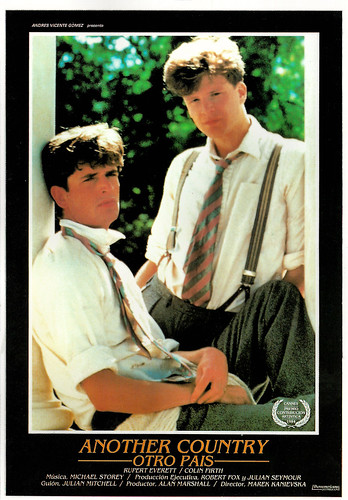
French postcard by Editions Mercuri, no. 634. Spanish poster for Another Country (Marek Kanievska, 1984).

British promotion card by Lumière for the London Film Festival. Photo: Artificial Eye. Colin Firth and Meg Tilly in Valmont (Miloš Forman, 1989).

British postcard. Photo: Universal. Colin Firth in Love Actually (Richard Curtis, 2003).

British postcard. Colin Firth in The King's Speech (Tom Hooper, 2010).
A homosexual public-schoolboy-turned-spy
Colin Andrew Firth was born in 1960 in Grayshott in the English county of Hampshire. His mother, Shirley Jean (Rolles), was a comparative religion lecturer at the Open University, and his father, David Norman Lewis Firth, lectured on history at Winchester University College (formerly King Alfred's College) in Winchester and worked on education for the Nigerian government. His sister, Katie Firth (1962) and younger brother, Jonathan Firth (1967), also became actors. As a child, Colin lived in many parts of the world due to his parents’ frequent relocations. His family lived in Nigeria, where his grandparents worked as missionaries, and for a year in the United States. Firth's first acting experience came in infant school when he played Jack Frost in a Christmas pantomime. Firth began attending drama workshops at age 10, and by 14 had decided to be a professional actor.
He took odd jobs at the National Youth Theatre and the National Theatre. After attending the Montgomery of Alamein School in Winchester and Barton Peveril College, he trained as an actor at the Drama Centre in London. There he was 'discovered' whilst playing Hamlet during his final term. His career began in 1983 when he appeared as Guy Bennett, a homosexual public-schoolboy-turned-spy in the West End production of Julian Mitchell’s play 'Another Country'. A year later, he co-starred as Judd, Bennett's Marxist best friend in the film adaptation, Another Country (Marek Kanievska, 1984), alongside Rupert Everett as Bennett. Another Country is loosely based on the life of the spy and double agent Guy Burgess, named Guy Bennett in the play and film. It explores his homosexuality and exposure to Marxism from a friend, while examining the hypocrisy and snobbery of the English public school system. Firth's almost 20-year public feud with Rupert Everett began then. Their different personas didn't get along, with Everett publicly branding Firth "boring". In Everett's autobiography, he admitted that he felt threatened by Firth's talent, but the two eventually settled their differences in 2004. Firth claims that "there's nobody I love more in the business now", and they have frequently worked together since.
After his debut, he starred with Beatie Edney and Sir Laurence Olivier in Lost Empires (Alan Grint, 1986), a TV adaptation of J.B. Priestley's novel about a travelling magic show on the eve of World War One. The series was nominated for six Television BAFTA Awards. He acted in several well-known and lesser-known films, including as a repressed cinema-owner in Buenos Aires in the homoerotic psychological thriller Apartment Zero (Martin Donovan, 1987), and the war drama A Month in the Country (Pat O' Connor, 1987). In 1987, Firth and other rising young actors such as Tim Roth, Bruce Payne and Paul McGann were dubbed the 'Brit Pack'. For his portrayal of Robert Lawrence, a terribly injured soldier returning from the Falklands War, in the TV production Tumbledown (Richard Eyre, 1988). He received the Royal Television Society Best Actor award and also a BAFTA nomination in 1989.
Colin Firth starred as the Machiavellian seducer Valmont in the prestigious box-office failure Valmont (Miloš Forman, 1989), an adaptation of Choderlos de Laclos’s epistolary novel 'Les Liaisons dangereuses' (Dangerous Liaisons). The film was pre-empted and overshadowed by Stephen Frears' rival version. After it, Firth went to live with his Valmont co-star, Meg Tilly, in rural British Columbia. Their son was born in 1990. He starred in another interesting flop, Wings of Fame (Otokar Votoček, 1991) with Peter O’Toole.
He had a spectacular comeback as the aloof, haughty aristocrat Mr. Fitzwilliam Darcy in the TV series Pride and Prejudice (Simon Langton, 1995). The series, based on the novel by Jane Austen, was a huge success and unexpectedly elevated Firth to international stardom. This was in some part due to a scene not from the novel, in which he emerges from a lake swim in a wet shirt. According to Firth, when he was first offered the role of Darcy, his brother Jonathan incredulously remarked, "Darcy? But isn't he supposed to be sexy?" Whilst filming the BBC series, he fell in love with his co-star Jennifer Ehle. He received a BAFTA nomination for his role. Then supporting roles followed in popular films such as The English Patient (Anthony Minghella, 1996) and Shakespeare in Love (John Madden, 1998). Whilst filming the television series Nostromo (Alastair Reid, 1996) in Colombia in 1996, Firth met the Italian production assistant Livia Giuggioli, whom he married in Rome in 1997. Giuggioli later became a documentary filmmaker. He next played the lead role as a school teacher and obsessed Arsenal F.C. football fan in Fever Pitch (David Evans, 1997), the adaptation of Nick Hornby’s million-selling autobiographical essay 'Fever Pitch: A Fan's Life'.

British postcard.

British postcard.

British postcard.
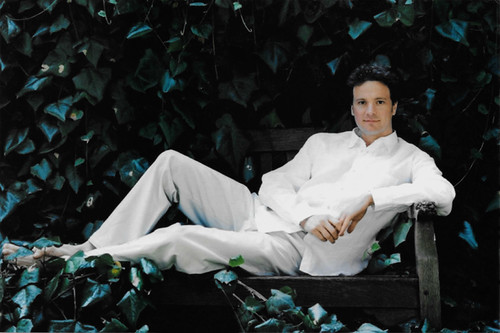
British postcard.

British postcard.

British postcard.

British postcard.
Mad about Mr. Darcy
In 2000, Colin Firth returned to the stage in 'Three Days of Rain' at the Donmar Warehouse in London. This was followed by the Bridget Jones films, in which he once again played Mr (Mark) Darcy opposite Renée Zellweger and Hugh Grant. Helen Fielding, the author of the Bridget Jones books, was mad about Pride and Prejudice, and particularly about Mr Darcy (or rather, Firth). So the fact that Firth accepted the role of Mark Darcy in Bridget Jones’s Diary (Sharon Maguire, 2001) was a nice bonus. The film was very successful, and Firth's droll performance as the stuffy human rights lawyer Mark Darcy was well-liked by critics. On TV, he had a more serious role as Dr. Wilhelm Stuckart in Conspiracy (Loring Mandel, 2001), concerning the Nazi Wannsee Conference involving the 'Final Solution of the Jewish question' during World War II. For this role, he was nominated for a Primetime Emmy Award.
He starred in The Importance of Being Earnest (Oliver Parker, 2002), based on Oscar Wilde's classic 1895 comedy of manners. The British-American co-production also starred Rupert Everett, Reese Witherspoon, and Judi Dench. He then starred in another comedy hit, Love Actually (Richard Curtis, 2003), which featured various renowned British actors such as Hugh Grant, Emma Thompson and Liam Neeson. In 2003, Firth also played the role of Dutch painter Johannes Vermeer in Girl with a Pearl Earring (Peter Webber, 2003) with a young Scarlett Johansson in the title role. The film received mostly favourable reviews, was moderately successful and earned several awards and nominations. He played the role of Mark Darcy on three further occasions in Bridget Jones: The Edge of Reason (Beeban Kidron, 2004), Bridget Jones’s Baby (Sharon Maguire, 2016) and Bridget Jones: Mad About Him (2025).
In 2005, he starred alongside Emma Thompson and Thomas Sangster in the fantasy Nanny McPhee (Kirk Jones, 2005) and played one of his darker, more intense roles in the thriller Where the Truth Lies (Atom Egoyan, 2005), which included a notorious drug-fueled bisexual orgy with Kevin Bacon and Rachel Blanchard. Firth also acted in the ABBA jukebox musical Mamma Mia! (Phyllida Lloyd, 2008) with Meryl Streep and its sequel, Mamma Mia! Here We Go Again (Ol Parker, 2018). Mamma Mia became the highest-grossing British-made film of all time, taking in over $600 million worldwide. In The Picture of Dorian Gray (Oliver Parker, 2009), he played the degenerate Lord Henry Wotton. He was George Falconer, a secretly gay college professor grappling with solitude after the death of his longtime partner, in A Single Man (Tom Ford, 2010). His role in this film adaptation of Christopher Isherwood’s novel earned him a tsunami of awards. He won the 2009 Venice Film Festival and the British BAFTA Award, and was nominated for a Golden Globe and an Oscar.
In The King’s Speech (Tom Hooper, 2010), Colin Firth starred as the British monarch George VI, who attempts to overcome his stammer as monarch of the United Kingdom at the end of 1936. For his commanding role, he won the Oscar the following year as well as the New York and Los Angeles Film Critics’ Associations, the British Independent Film Award, the European Film Award, his first Golden Globe Award and his second BAFTA Award. The film grossed $414,211,549 worldwide. In 2011, he was also appointed a Commander of the Order of the British Empire by Queen Elizabeth II. Firth appeared as senior British secret agent Bill Haydon in Tinker Tailor Soldier Spy (Tomas Alfredson, 2011), co-starring Gary Oldman, Benedict Cumberbatch, Tom Hardy, Mark Strong and John Hurt. Firth played the role of secret agent Harry Hart in Kingsman: The Secret Service (Matthew Vaughn, 2014) with Samuel L. Jackson, and Kingsman: The Golden Circle (Matthew Vaughn, 2017) with Julianne Moore. He co-starred with Rupert Everett in The Happy Prince (2018), a biographical drama about Oscar Wilde, written and directed by Everett in his directorial debut. He also appeared as William Weatherall Wilkins in the musical fantasy film Mary Poppins Returns (Rob Marshall, 2018), starring Emily Blunt in the title role. His other films include The Railway Man (Jonathan Teplitzky, 2013), Before I Go to Sleep (Rowan Joffe, 2014), both with Nicole Kidman, 1917 (Sam Mendes, 2019), and Operation Mincemeat (John Madden, 2021), recounting the British Operation Mincemeat during the Second World War.
Firth and Livia Giuggioli have two sons, Luca Firth (2001) and Matteo Firth (2003). He also has a son, actor William Joseph Firth (1990), from a previous relationship with actress Meg Tilly (1989-1995). In 2017, Colin Firth also took Italian citizenship. His two youngest sons, who were born in Rome, hold both British and Italian citizenship. In 2019, Firth and Giuggioli announced that they were ending their marriage after 22 years. He has campaigned for the rights of Indigenous peoples and is a member of Survival International. He has also campaigned on issues of asylum seekers, refugees' rights and the environment. At BFI Online, Sheila Johnston writes: "Long viewed as a master of the stiff-upper-lip, a polished light-comic leading man and - thanks to his Darcy in Pride and Prejudice (BBC, 1995) - an upper-class sex-god, Colin Firth has quietly built up a portfolio of much wider range, which finally led to definitive recognition with A Single Man (d. Tom Ford, 2009) and The King's Speech (d. Tom Hooper, 2010) as the actor turned 50." Colin Firth's films have grossed more than $3 billion from 42 releases worldwide.

French poster postcard by Editions Mercuri, no. 163. Photo: Artificial Eye. Colin Firth and Meg Tilly in Valmont (Miloš Forman, 1989).

British postcard.
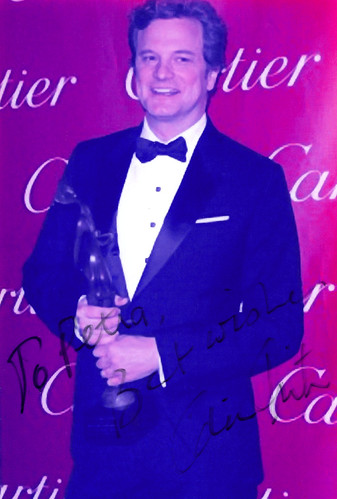
Vintage autograph card.

Dutch postcard by Universal. Meryl Streep, Pierce Brosnan, Colin Firth, Stellan Skarsgard, Dominic Cooper and Amanda Seyfried in Mama Mia! (Phyllida Lloyd, 2008). Caption: Take a trip down the aisle you'll never forget.

British postcard.

Belgian poster freecard by Boomerangjack, 2010. Image: Cinéart. Colin Firth and Julianne Moore in A Single Man (Tom Ford, 2009).

British postcard.
Sources: Sheila Johnston (BFI Online), Wikipedia (Dutch, German and English) and IMDb.

"><img src="https://live.staticflickr.com/65535/55383655309_176d8504f5.jpg" width="345" height="500" alt="Meryl Streep, Pierce Brosnan, Colin Firth, Stellan Skarsgard, Dominic Cooper and Amanda Seyfried in Mama Mia! (2008)"/></a><script async src="//embedr.flickr.com/assets/client-code.js" charset="utf-8"></script>)
No comments:
Post a Comment