
German postcard by Ross Verlag, no. 1007/1, 1927-1928. Photo: Oertel, Berlin. Asta Nielsen in Die freudlose gasse / The Joyless Street (G.W. Pabst, 1925).
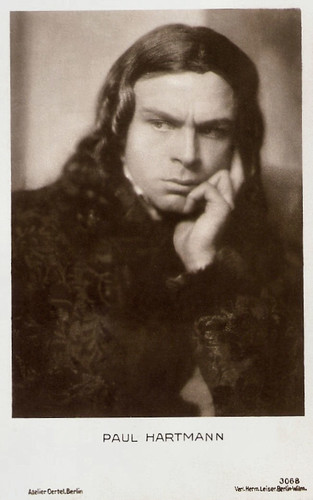
German postcard by Verl. Herm. Leiser, Berlin-Wilm., no. 3068. Photo: Atelier Oertel, Berlin. Paul Hartmann.

German postcard by Verlag Hermann Leiser, no. 3070. Photo: Atelier Oertel, Berlin. Albert Bassermann.
Eduard Oertel
Eduard Oertel was born in 1854 in Osterfeld in the Prussian province of Saxony. With brief interruptions, he lived and worked in Osterfeld until he died in 1933. He initially worked there for several years as a farrier, his trade.
His sister, Emilie Oertel, married the Berlin photographer Franz Albert. Since the 1870s, Emilie Albert owned a small shop in Berlin, located in the Kaisergalerie between Unter den Linden and Friedrichstrasse, which was expanded in the early 1880s. When Eduard Oertel visited his sister in Berlin in the 1870s, he became interested in the photographic work of his brother-in-law, Franz Albert. Albert introduced his brother-in-law to photography and put him in touch with photographers and art dealers in Berlin.
Eduard Oertel took his first photographs on the streets of Berlin. He self-published his Berlin photos as original prints, often pasted into accordion-fold books, in his sister's shop in the Kaiserpassage in Berlin. After returning to his hometown of Osterfeld in the province of Saxony, Eduard Oertel opened his own photography studio at Am Markt 11. He took over the collection of photographs from the Berlin studio of the childless Franz and Emilie Albert in the early 1920s.
Oertel's work consisted of portraits and tourist cityscapes in the standard cabinet format (approx. 10 × 15 cm), but also of stereoscopic photography. Since 1849, cameras with two lenses spaced at eye distance had been available, enabling stereoscopic recordings of moving scenes.
Eduard Oertel was among the numerous photographers who catered to the public's curiosity about foreign places through stereoscopic photography. The Berlin stereoscopic photographs depict the then-popular sights of the imperial city of Berlin—monuments, grand squares, streets, bridges, fountains, and buildings; also: bird's-eye views from the tower of the Berlin City Hall — as well as funeral processions and parades. In the immediate vicinity of his sister Emilie's shop, also located in the Kaisergalerie (Imperial Gallery), was August Fuhrmann's Kaiserpanorama (Imperial Panorama), where stereoscopic photographs from around the world were presented to paying customers.

German postcard by Verleih Hermann Leiser, Berlin-Wilm., no. 3069. Photo: Atelier Oertel, Berlin. Possibly Paul Hartmann in Katharina die Grösse / Catherine the Great (Reinhold Schünzel, 1920), in which Hartmann played Alexander Manonow opposite Lucie Englisch as the famous czarina Catherine the Great.

German postcard by Verlag Hermann Leiser, Berlin-Wilm., no. 3075. Photo: Atelier Oertel, Berlin-Wilm. Wilhelm Dieterle (later William Dieterle).

German postcard by Verlag Hermann Leiser, Berlin-Wilm., no. 3095. Photo: Atelier Oertel, Berlin Wilm. Collection: Geoffrey Donaldson Institute. Albert Bassermann.

German postcard by Ross Verlag, no. 882/2, 1925-1926. Photo: Oertel. Henny Porten.

German postcard by Ross Verlag, Berlin, no. 1005/2, 1927-1928. Photo: Oertel, Berlin. Grigori Chmara in Raskolnikow (Robert Wiene, 1923).
Curt, Franz, and Margarethe Oertel
Although Wikimedia refers to Eduard Oertel as the owner of the Atelier Oertel, Berlin, this photo studio was founded by his children. Eduard had married Anna Roßberg (1864-1951), and they had three children: Curt (1890-1960), Franz (1891-1978), and Margarethe (1893-1967). All three also learned the craft of photography. The eldest son, Curt Franz Albert Oertel, began his training at the State Teaching and Research Institute for Photography, Photogravure, and Engraving in Munich at the age of only 13. From 1907 to 1910, he worked in Berlin photography studios. Shortly thereafter, he founded his own photographic art studio in Berlin. In 1910, he founded a studio for artistic photography and film experiments in Berlin, Atelier Oertel. His business partner was his younger brother, Franz Oertel, with Curt taking on the artistic and Franz the business management of the company. Their sister, Margarethe Oertel, also lived in Berlin from 1907 to 1921. She supported her brothers in their photography studio, which she ran alone during the First World War.
During the First World War, Curt Oertel served as an aerial observer. From 1920 to 1925, he studied art history in Berlin. Then he devoted himself entirely to film, and in 1925, he was able to contribute to Georg Wilhelm Pabst's masterpiece Die freudlose gasse / The Joyless Street (G.W. Pabst, 1925) starring Werner Krauss, Asta Nielsen, and Greta Garbo. Two more films directed by Pabst followed: Geheimnisse einer Seele / Secrets of a Soul (G.W. Pabst, 1926) and Man spielt nicht mit der Liebe / One Doesn't Play with Love (G.W. Pabst, 1926), both also starring Werner Krauss. Oertel gained national and international recognition as a film director, cinematographer, and producer.
Curt Oertel's first directorial work was the film sequences in the world premiere of Ernst Toller's play 'Hoppla, wir leben / We're Alive!' (1927), produced by Erwin Piscator's Berlin theatre, with Alexander Granach in the lead role. Erwin Piscator directed the production, and Walter Ruttmann co-directed the film sequences. In the year the Nazi Party came to power, Oertel, together with Hans Deppe, directed the Frisian drama Der Schimmelreiter (1933), starring Mathias Wieman and Marianne Hoppe, a film steeped in blood-and-soil themes, based on the novella by Theodor Storm. Two years later, Oertel directed his first independent film, Pole Poppenspäler / The Puppeteer (Curt Oertel, 1935), starring Gerhard Hesselbach and Ines Campi. This film was again based on a novella by Theodor Storm, this time adapted by Kurt Rupli, who soon after distinguished himself as a politically compliant director of Nazi documentaries. Oertel himself also directed and produced a number of shorter documentaries on heroic and patriotic themes from 1932 onward. His most outstanding work is considered to be the documentary about Michelangelo, Michelangelo / Michelangelo: Life of a Titan (Curt Oertel, 1938), which was reworked by Robert J. Flaherty in 1950 and, in this version, The Titan: Story of Michelangelo (Robert J. Flaherty, Richard Lyford, Curt Oertel, 1950) even received an Academy Award.
After the end of World War II, Curt Oertel lived and worked in Wiesbaden. He founded the Curt Oertel Film-Studiengesellschaft mbH in Wiesbaden, which produced nine documentaries between 1947 and 1964 and was continued by his brother Franz Oertel after his death. Together with Erich Pommer, a US film officer and former producer for UFA, and Horst von Hartlieb, managing director of the Association of Film Distributors in Wiesbaden, Oertel conceived the Voluntary Self-Regulation of the Film Industry (FSK) in early 1948, based on the American Production Code or Hays Code of 1930/1934. Also in Wiesbaden, the German Institute for Film Studies was established in 1948. Oertel also actively supported film clubs. In 1950, he became president of the FSK but resigned after only three days following public disputes. He later became honorary president of both the FSK and the SPIO. He was only able to realise a few of his ambitious film plans, especially as interest in his favoured educational documentary films waned. He died on New Year's Eve 1959/1960 in a hospital as a result of a car accident. His brother Franz Oertel died in 1978.
Margarethe Oertel returned to Osterfeld from Berlin in 1921 to support her parents financially and with their health needs. There, she continued to run her father's photography studio and took it over afte >Eduard Oertel died in 1933. In 1967, Margarethe Oertel donated the studio's Berlin photographs to the Berlin State Archives. The authorship of these photographs is not entirely certain. They likely originated largely from Eduard Oertel and Franz Albert. The remaining image holdings of Eduard and Margarethe's photo studio were largely destroyed when the building at Am Markt No. 11 in Osterfeld was demolished in 1980.

German postcard by Ross Verlag, no. 1020/1, 1927-1928. Photo: Oertel, Berlin. Asta Nielsen in Die freudlose gasse / The Joyless Street (G.W. Pabst, 1925). Dutch artist Pyke Koch used photos like the one on this card for his portrait of Asta Nielsen (1929).

German postcard by Ross Verlag, no. 1447/3, 1926-1928. Photo: Oertel, Berlin. Signed: 'Gentile signorina Susi Schuurmann, Angelo Ferrari. 1926.'

German postcard by Ross Verlag, no. 1495/1, 1927-1928. Photo: Oertel, Berlin. Barbara von Annenkoff.

German postcard by Ross Verlag, no. 3034/1, 1928-1929. Photo: Oertel, Berlin. Carmen Boni.

German postcard by Ross Verlag, no. 3640/1, 1928-1929. Photo: Atelier Oertel, Berlin. Käthe von Nagy.

German collector card in the series 'Vom Werden deutscher Filmkunst - Der Tonfilm', album no. 11, picture no. 162. Photo: Europa / Ross Verlag. Mathias Wieman in Der Schimmelreiter / The Rider of the White Horse (Hans Deppe, Curt Oertel, 1934).
Sources: Wikipedia (German), Wikimedia and IMDb.

No comments:
Post a Comment