Czech soprano Jarmila Novotná (1907-1994) was one of the world-renowned opera luminaries of the 20th Century. Her film appearances were, unfortunately, few and far between.
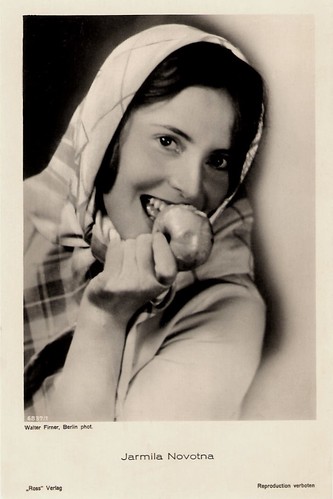
German postcard by Ross Verlag, no. 6837/1, 1931-1932. Photo: Walter Firner, Berlin.

Austrian postcard by Iris Verlag, no. 6129. Photo: Lux-Film Verleih / Aafa.

Austrian postcard by Iris Verlag, no. 6161. Photo: Tobis / Lux-Film-Verleih / Aafa. Hans Heinz Bollmann and Jarmila Novotna in Der Bettelstudent / The Beggar Student (Victor Janson, 1931).
Jarmila Novotná was born in Prague, Czech Republic, in 1907. She studied singing with Emmy Destinn. In 1925, the 17-year-old Novotná made her operatic debut at the Prague Opera House as Marenka in Bedřich Smetana's 'Prodaná nevěsta' (The Bartered Bride). Six days later, the lyric soprano sang there as Violetta in Giuseppe Verdi's 'La traviata'.
The following year, she made her film debut in the silent film Vyznavaci slunce / The Sun Disciples (Václav Binovec, 1926), starring Luigi Serventi. In 1928, she starred in Verona as Gilda opposite Giacomo Lauri-Volpi in Verdi's 'Rigoletto' and at the Teatro San Carlo in Naples as Adina opposite Tito Schipa in Gaetano Donizetti's 'L'elisir d'amore'. In 1929, she joined the Kroll Opera in Berlin, where she sang Violetta as well as the title roles of Giacomo Puccini's 'Manon Lescaut' and 'Madama Butterfly'.
When talking pictures arrived, she headlined in German films like Brand in Der Oper/ Fire in the Opera House (Carl Froelich, 1930), with Gustaf Gründgens, Der Bettelstudent / The Beggar Student (Victor Janson, 1931), and the film version of The Bartered Bride, Die Verkaufte Braut (Max Ophüls, 1932).
Hal Erickson at AllMovie on Die Verkaufte Braut (1930): “The original libretto, involving the comic misadventures of two mismatched couples, is given a respectable amount of attention, but the film's biggest selling card is the photographic dexterity of Max Ophuls, who never met a camera crane he didn't like. Since filmed opera was seldom a big box-office in 1932, Ophuls concentrates on the farcical elements of the story; especially worth noting are comic contributions by Paul Kemp and Otto Wernicke, who seldom let their German film fans down. Curiously, star Jarmila Novotna, whose ‘live’ appearances in The Bartered Bride were much prized by contemporary critics, doesn't come off all that well in this film version.”
Other films followed, such as Nacht Der Grossen Liebe / Night of the Great Love (Geza von Bolvary, 1933) with Gustav Fröhlich. In January 1933, she created the female lead in Jaromir Weinberger's new operetta 'Frühlingsstürme' (Spring Storms), opposite Richard Tauber at the Theater im Admiralspalast, Berlin. This was the last new operetta produced in the Weimar Republic, and she and Tauber were both soon forced to leave Germany by the new Nazi regime.
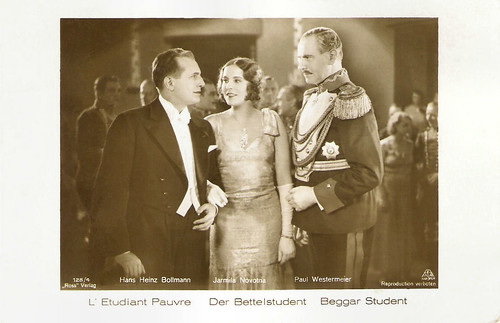
German postcard by Ross Verlag, no. 128/4. Photo: Aafa Film. Publicity still for Der Bettelstudent / The Beggar Student (Victor Janson, 1931) with Jarmila Novotna, Paul Westermeier and Hans Heinz Bollmann.
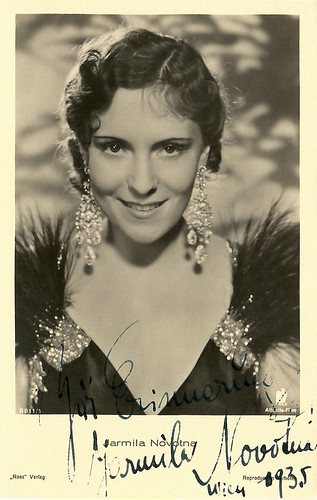
German postcard by Ross Verlag, no. 8811/1, 1933-1934. Photo: Atlantis-Film. Publicity still for Frasquita (Carl Lamac, 1934). Collection: Didier Hanson.
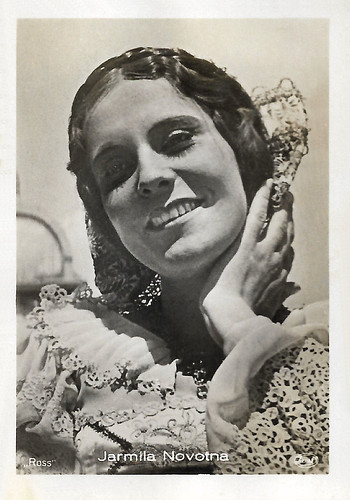
German cigarette card for Hänsom cigarettes by Jasmatzi Cigarettenfabrik G.M.b.H, Dresden / Ross Verlag, Film Series V, no. 3.
Jarmila Novotnà returned to Czechoslovakia to star in the film Skrivanci pisen / Lark's Songs (Svatopluk Innemann, 1933). In 1934, she left for Vienna, where she created the title role in Franz Lehár's operetta 'Giuditta' opposite Richard Tauber. Her immense success in that role led to a contract with the Vienna State Opera, where she was named 'Kammersängerin'. She also appeared there with Tauber in 'The Bartered Bride' and 'Madama Butterfly'.
In the cinema, she starred in the Austrian operetta film Frasquita (Karel Lamac, 1934) with Heinz Ruhmann, the Austrian romantic thriller Der Kosak und die Nachtigall / The Cossack and the Nightingale (Phil Jutzi, 1935) with Iván Petrovich, and in the French-British operetta film La dernière valse / The Last Waltz (Leo Mittler, 1935), which was made in two language versions.
She then left the film industry to concentrate on her stage work with the Viennese State Opera. After the Anschluss of Austria, she had to leave Vienna. In January 1940, she made her debut with the Metropolitan Opera in New York, as Mimí in Puccini's 'La bohème'. From 1940 to 1956, Novotná performed regularly at the Met. In 1946, she returned before the cameras in a straight dramatic role in the Hollywood production The Search (Fred Zinnemann, 1946), starring Montgomery Clift. The Search is a semi-documentary film on the plight of WWII orphans. Novotná played a Czech mother who had lost contact with her young son when they were in Auschwitz, and she now travels from one refugee camp to another in search of him.
Novotna then played turn-of-the-century diva Maria Selka in the biopic The Great Caruso (Richard Thorpe, 1951), featuring Mario Lanza. The film traces legendary tenor Enrico Caruso's ascension from adolescent choir singer in Naples to the uppermost ranks of the opera world. Mario Lanza's tenor voice made this film one of the top box-office draws of 1951, and this helped to popularise opera among the general public.
On TV, she appeared in The Great Waltz (Max Liebman, 1955), which charts the life and times of composer Johann Strauss, Jr. She also played Hans’ mother in the TV musical Hans Brinker, or the Silver Skates (Sidney Lumet, 1958), starring Tab Hunter. Her last screen appearance was as an interviewee in the documentary Toscanini: The Maestro (Peter Rosen, 1985). At 85, Jarmila Novotná passed away in New York in 1994.

German postcard by Ross Verlag, no. 8018/1, 1933-1934. Photo: Super-Film / Deutsche Universal Film. Gustav Fröhlich and Jarmila Novotna in Die Nacht der großen Liebe / Nights of Love (Géza von Bolváry, 1933).
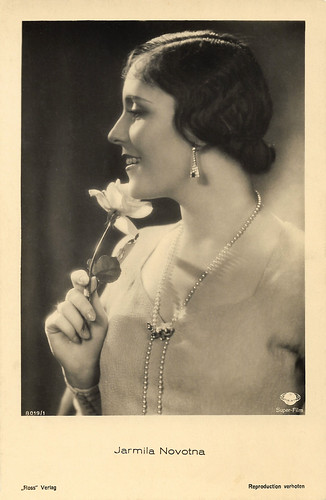
German postcard by Ross Verlag, no. 8019/1, 1933-1934. Photo: Deutsche Universal / Super-Film.
Jarmila Novotna in Skrivanci pisen / Lark's Songs (1933). Source: Radio Santos (YouTube).
Jarmila Novotna and Keith Andes in The Great Waltz (1955). Source: Vai Music (YouTube).
Sources: Hal Erickson (AllMovie - Page now defunct), Wikipedia, and IMDb.
German postcard by Ross Verlag, no. 6837/1, 1931-1932. Photo: Walter Firner, Berlin.
Austrian postcard by Iris Verlag, no. 6129. Photo: Lux-Film Verleih / Aafa.
Austrian postcard by Iris Verlag, no. 6161. Photo: Tobis / Lux-Film-Verleih / Aafa. Hans Heinz Bollmann and Jarmila Novotna in Der Bettelstudent / The Beggar Student (Victor Janson, 1931).
The bartered bride
Jarmila Novotná was born in Prague, Czech Republic, in 1907. She studied singing with Emmy Destinn. In 1925, the 17-year-old Novotná made her operatic debut at the Prague Opera House as Marenka in Bedřich Smetana's 'Prodaná nevěsta' (The Bartered Bride). Six days later, the lyric soprano sang there as Violetta in Giuseppe Verdi's 'La traviata'.
The following year, she made her film debut in the silent film Vyznavaci slunce / The Sun Disciples (Václav Binovec, 1926), starring Luigi Serventi. In 1928, she starred in Verona as Gilda opposite Giacomo Lauri-Volpi in Verdi's 'Rigoletto' and at the Teatro San Carlo in Naples as Adina opposite Tito Schipa in Gaetano Donizetti's 'L'elisir d'amore'. In 1929, she joined the Kroll Opera in Berlin, where she sang Violetta as well as the title roles of Giacomo Puccini's 'Manon Lescaut' and 'Madama Butterfly'.
When talking pictures arrived, she headlined in German films like Brand in Der Oper/ Fire in the Opera House (Carl Froelich, 1930), with Gustaf Gründgens, Der Bettelstudent / The Beggar Student (Victor Janson, 1931), and the film version of The Bartered Bride, Die Verkaufte Braut (Max Ophüls, 1932).
Hal Erickson at AllMovie on Die Verkaufte Braut (1930): “The original libretto, involving the comic misadventures of two mismatched couples, is given a respectable amount of attention, but the film's biggest selling card is the photographic dexterity of Max Ophuls, who never met a camera crane he didn't like. Since filmed opera was seldom a big box-office in 1932, Ophuls concentrates on the farcical elements of the story; especially worth noting are comic contributions by Paul Kemp and Otto Wernicke, who seldom let their German film fans down. Curiously, star Jarmila Novotna, whose ‘live’ appearances in The Bartered Bride were much prized by contemporary critics, doesn't come off all that well in this film version.”
Other films followed, such as Nacht Der Grossen Liebe / Night of the Great Love (Geza von Bolvary, 1933) with Gustav Fröhlich. In January 1933, she created the female lead in Jaromir Weinberger's new operetta 'Frühlingsstürme' (Spring Storms), opposite Richard Tauber at the Theater im Admiralspalast, Berlin. This was the last new operetta produced in the Weimar Republic, and she and Tauber were both soon forced to leave Germany by the new Nazi regime.
German postcard by Ross Verlag, no. 128/4. Photo: Aafa Film. Publicity still for Der Bettelstudent / The Beggar Student (Victor Janson, 1931) with Jarmila Novotna, Paul Westermeier and Hans Heinz Bollmann.
German postcard by Ross Verlag, no. 8811/1, 1933-1934. Photo: Atlantis-Film. Publicity still for Frasquita (Carl Lamac, 1934). Collection: Didier Hanson.
German cigarette card for Hänsom cigarettes by Jasmatzi Cigarettenfabrik G.M.b.H, Dresden / Ross Verlag, Film Series V, no. 3.
The last waltz
Jarmila Novotnà returned to Czechoslovakia to star in the film Skrivanci pisen / Lark's Songs (Svatopluk Innemann, 1933). In 1934, she left for Vienna, where she created the title role in Franz Lehár's operetta 'Giuditta' opposite Richard Tauber. Her immense success in that role led to a contract with the Vienna State Opera, where she was named 'Kammersängerin'. She also appeared there with Tauber in 'The Bartered Bride' and 'Madama Butterfly'.
In the cinema, she starred in the Austrian operetta film Frasquita (Karel Lamac, 1934) with Heinz Ruhmann, the Austrian romantic thriller Der Kosak und die Nachtigall / The Cossack and the Nightingale (Phil Jutzi, 1935) with Iván Petrovich, and in the French-British operetta film La dernière valse / The Last Waltz (Leo Mittler, 1935), which was made in two language versions.
She then left the film industry to concentrate on her stage work with the Viennese State Opera. After the Anschluss of Austria, she had to leave Vienna. In January 1940, she made her debut with the Metropolitan Opera in New York, as Mimí in Puccini's 'La bohème'. From 1940 to 1956, Novotná performed regularly at the Met. In 1946, she returned before the cameras in a straight dramatic role in the Hollywood production The Search (Fred Zinnemann, 1946), starring Montgomery Clift. The Search is a semi-documentary film on the plight of WWII orphans. Novotná played a Czech mother who had lost contact with her young son when they were in Auschwitz, and she now travels from one refugee camp to another in search of him.
Novotna then played turn-of-the-century diva Maria Selka in the biopic The Great Caruso (Richard Thorpe, 1951), featuring Mario Lanza. The film traces legendary tenor Enrico Caruso's ascension from adolescent choir singer in Naples to the uppermost ranks of the opera world. Mario Lanza's tenor voice made this film one of the top box-office draws of 1951, and this helped to popularise opera among the general public.
On TV, she appeared in The Great Waltz (Max Liebman, 1955), which charts the life and times of composer Johann Strauss, Jr. She also played Hans’ mother in the TV musical Hans Brinker, or the Silver Skates (Sidney Lumet, 1958), starring Tab Hunter. Her last screen appearance was as an interviewee in the documentary Toscanini: The Maestro (Peter Rosen, 1985). At 85, Jarmila Novotná passed away in New York in 1994.
German postcard by Ross Verlag, no. 8018/1, 1933-1934. Photo: Super-Film / Deutsche Universal Film. Gustav Fröhlich and Jarmila Novotna in Die Nacht der großen Liebe / Nights of Love (Géza von Bolváry, 1933).
German postcard by Ross Verlag, no. 8019/1, 1933-1934. Photo: Deutsche Universal / Super-Film.
Jarmila Novotna in Skrivanci pisen / Lark's Songs (1933). Source: Radio Santos (YouTube).
Jarmila Novotna and Keith Andes in The Great Waltz (1955). Source: Vai Music (YouTube).
Sources: Hal Erickson (AllMovie - Page now defunct), Wikipedia, and IMDb.
