
French postcard. Photo: Film du Synchronisme Cinématique. Fritz Kortner in Das Leben des Beethoven / The Life of Beethoven / Beethoven (Hans Otto, 1927). Caption: Ludwig von Beethoven (16 December 1770 - 26 March 1927).

Cover of a French postcard booklet by Film du Synchronisme Cinématique, Paris. The booklet contained 15 postcards of Das Leben des Beethoven / The Life of Beethoven / Beethoven (Hans Otto, 1927) starring Fritz Kortner.

Programme text of a 1927 film gala in a French postcard booklet by Film du Synchronisme Cinématique, Paris. The booklet contained 15 postcards of the film Das Leben des Beethoven / The Life of Beethoven / Beethoven (Hans Otto, 1927). The film gala was organised on 27 April 1927 at the Théatre du Trocadéro to commemorate the centenary of Ludwig van Beethoven's death.

Bio of Ludwig van Beethoven in a French postcard booklet by Film du Synchronisme Cinématique. The booklet contained 15 postcards of Das Leben des Beethoven / The Life of Beethoven / Beethoven (Hans Otto, 1927).

French postcard. Photo: Film du Synchronisme Cinématique. Publicity still for Das Leben des Beethoven / The Life of Beethoven / Beethoven (Hans Otto, 1927), starring Fritz Kortner. Caption: Beethoven’s childhood in Bonn.

French postcard. Photo: Film du Synchronisme Cinématique. Fritz Kortner as Ludwig van Beethoven and Ernst Baumeister as his teacher Joseph Haydn in Das Leben des Beethoven / The Life of Beethoven / Beethoven (Hans Otto, 1927).
Leaving a lasting musical legacy for posterity
Das Leben des Beethoven / The Life of Beethoven / Beethoven (Hans Otto, 1927) was filmed in Austria for the hundredth anniversary of Beethoven's death. This silent film, written by Emil Kolberg and Raymond Berner, tells the story of the German genius' eventful emotional life. The film traces the various stages of Ludwig van Beethoven’s life: from his childhood in Bonn, where the elderly Joseph Haydn overhears him playing the organ, through his greatest triumphs as a composer, to the final and most dramatic period of his life, when deafness robbed him of his creativity. Beethoven’s private moments, such as his ill-fated romance with a pupil, Countess Giulietta Guicciardi, are included.
Filming began in the summer of 1926 at the Listo-Film studios in Vienna-Schönbrunn. Ernst Richter designed the film sets. The film comprised five acts or approximately 2,200 metres. Das Leben des Beethoven / The Life of Beethoven / Beethoven premiered in January 1927 and was released on 18 February 1927. The impetus for this Beethoven film was the approaching 100th anniversary of the exceptional composer’s death on 26 March 1827. For Fritz Kortner, this was already his second film appearance as Beethoven. Ten years earlier, he had already played the composer in the Austrian production Der Märtyrer seines Herzens / Martyr of His Heart (Emil Justitz, 1917).
The first Beethoven film was the French short Beethoven (Victorine-Hippolyte Jasset, 1909). Many biopics of the composer followed. Harry Baur played the composer in Un grand amour de Beethoven / Beethoven's Great Love (Abel Gance, 1936). Ewald Balser played him in Eroica (Walter Kolm-Veltée, 1949) and Karlheinz Böhm in Schicksals-Sinfonie / The Magnificent Rebel (Georg Tressler, 1962). Lithuanian actor Donatas Banionis appeared as Beethoven in the DEFA production Beethoven – Tage aus einem Leben / Beethoven: Days from a Life (Horst Seemann, 1976). Paul Morrissey directed Le neveu de Beethoven / Beethoven's Nephew (1985) with Wolfgang Reichmann, and Agnieszka Holland made Copying Beethoven (2006) with Ed Harris.
In between, Gary Oldman played Beethoven in Immortal Beloved (Bernard Rose, 1994). In flashbacks, the film follows Beethoven's secretary and first biographer Anton Schindler's (Jeroen Krabbé) quest to ascertain the true identity of the 'Unsterbliche Geliebte'. Beethoven addressed this 'Immortal Beloved' in three letters found in the late composer's private papers. Schindler journeys throughout the Austrian Empire, interviewing women who might be candidates, and through Beethoven's own tumultuous life.
Whilst other composers often put their works down on paper quickly, Beethoven wrestled with every note. He repeatedly revised and improved his works. Beethoven composed 9 symphonies, 32 piano sonatas, piano variations, 5 piano concertos, a violin concerto, 16 string quartets and the Great Fugue, as well as other chamber music such as the piano trios, violin and cello sonatas. Important vocal and stage works include the song cycle 'To the Distant Beloved', his only opera 'Fidelio', and the 'Missa solemnis'. Beethoven lived up to his ambition of leaving a lasting musical legacy for posterity. His popularity remains undiminished, and today he is one of the most frequently performed composers in the world.

French postcard. Photo: Film du Synchronisme Cinématique. Fritz Kortner in Das Leben des Beethoven / The Life of Beethoven / Beethoven (Hans Otto, 1927). Caption: First performance of Beethoven's works in Vienna in the salons of Prince Lichnowsky.
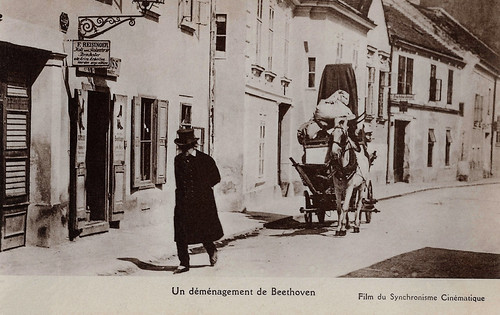
French postcard. Photo: Film du Synchronisme Cinématique. Fritz Kortner in Das Leben des Beethoven / The Life of Beethoven / Beethoven (Hans Otto, 1927). Caption: A house move of Beethoven.

French postcard. Photo: Film du Synchronisme Cinématique. Fritz Kortner and Lilian Gray in Das Leben des Beethoven / The Life of Beethoven / Beethoven (Hans Otto, 1927). Caption: The love story of Beethoven and Countess Guicciardi.

French postcard. Photo: Film du Synchronisme Cinématique. Publicity still for Das Leben des Beethoven / The Life of Beethoven / Beethoven (Hans Otto, 1927), starring Fritz Kortner. Caption: Beethoven composing.
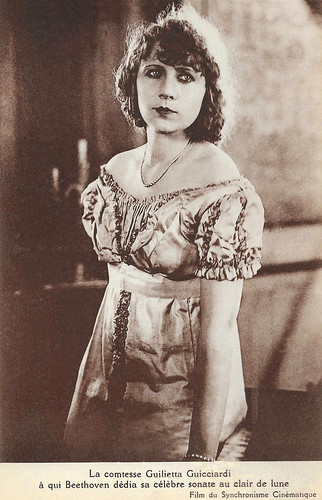
French postcard. Photo: Film du Synchronisme Cinématique. Lilian Gray in Das Leben des Beethoven / The Life of Beethoven / Beethoven (Hans Otto, 1927). Caption: The Countess Giulietta Guicciardi to whom Beethoven dedicated his famous ‘Moonlight’ Sonata.

French postcard. Photo: Film du Synchronisme Cinématique. Publicity still for Das Leben des Beethoven / The Life of Beethoven / Beethoven (Hans Otto, 1927), starring Fritz Kortner. Caption: Beethoven composing his Ninth Symphony.
A passionate letter to an anonymous woman
Ludwig van Beethoven (1770-1827) is regarded as one of the most influential composers. In his early period, his style closely aligned with Wolfgang Amadeus Mozart and Joseph Haydn, the First Viennese School. He brought Classicism to its full fruition and, in his late period, ushered in the Romantic era. He was the son of Johan van Beethoven, a Rhineland singer, and his wife Magdalena Keverich. His grandfather, Lodewijck (Ludwig) van Beethoven, came from Mechelen in Austrian Netherlands (now Belgium). Ludwig Sr. was employed as a bass singer at the court of Clemens August, Archbishop-Elector of Cologne, eventually rising to become, in 1761, Kapellmeister (music director) and hence a preeminent musician in Bonn. This ancestry explains the Dutch prefix ‘van’ in his name.
As a boy, Ludwig van Beethoven already displayed great musical talent. His father was his first music teacher. Following in Leopold Mozart's footsteps, Johan van Beethoven tried to turn his son into a child prodigy. His father claimed that Ludwig was six (he was seven) on the posters for his first public performance in March 1778. His difficult childhood was marked by poverty, coupled with a father who was regularly drunk. At night, his father would force his son out of bed to play the piano for his company. It turned Ludwig into a sombre and distrustful boy who could also be boisterously cheerful. Later, as an adult, he was quick to fall out with people and could be unreasonable, even towards his closest friends. He would also go to great lengths to repair a friendship if it had broken down through his own fault. Christian Gottlob Neefe later taught Beethoven. He found relief from a dysfunctional home life with Helene von Breuning's family, whose children he loved, befriended, and taught piano.
At the start of his musical career, Beethoven first made a name for himself as a piano virtuoso. He could improvise and fantasise freely on the instrument. Between 1792 and 1794, Joseph Haydn gave him lessons in Vienna. The two did not get on very well. Haydn was surprised by the ‘rage’ in Beethoven’s music and even attempted to prevent the publication of one of his early piano trios. Beethoven secretly took lessons from composer Johann Baptist Schenk, who proved to be a better teacher. He corrected errors in Beethoven’s work that Haydn – possibly due to a lack of interest – had overlooked. On 29 March 1795, Beethoven gave his first public concert in Vienna, at the Burgtheater. There he probably performed his First Piano Concerto for the first time. Later that year, his first published work appeared: the Piano Trios, Opus 1. His talent soon took him into the highest social circles of the Habsburg metropolis. He met Countess Giulietta Guicciardi around 1801/1802, and fell in love with her. In 1802, Beethoven dedicated the 'Sonata quasi una Fantasia, op. 27 no. 2' – known as the ‘Moonlight Sonata’ – to her. Marriage was out of the question because of the difference in social standing.
A hearing impairment, which over time worsened into almost complete deafness, brought his career as a pianist to a premature end. The illness triggered a crisis, which Beethoven documented in his Heiligenstadt Testament (1802). In 1803, Beethoven composed the ‘Eroica’, his Third Symphony, which he dedicated to Napoleon. When Beethoven heard in 1804 that Napoleon had had himself proclaimed Emperor, he scratched Napoleon’s name out. In 1809, Beethoven received a contract in Vienna with an annual salary of 4,000 florins (30,000 euros). With a steady income, the 39-year-old Beethoven began taking steps towards marriage. He proposed to Therese Malfatti. In 1812, Beethoven wrote a passionate letter to an anonymous woman: the ‘Unsterbliche Geliebte’ (Immortal Beloved). Many scholars assume the letter was addressed to Antonie Brentano. Others maintain that it was intended for Josephine Deym-Brunsvik. Beethoven’s brother Carl had severe tuberculosis, and in 1813, he asked Beethoven to act as guardian to his son Karl. Beethoven borrowed money from the music publisher Steiner to support his ailing brother and his wife Johanna. In early 1818, his cousin came to live with Beethoven.
By around 1819, Beethoven was completely deaf. In the following period, his ailments worsened, and the rise of Gioachino Rossini and Italian opera – which Beethoven regarded as superficial – pushed him into the background. The quantity of his musical output declined sharply, but he worked on some of his greatest works, such as the 'Missa solemnis' and the first two of his late piano sonatas. In 1824, he completed his Ninth Symphony. At its premiere, one of the soloists, the contralto Caroline Unger, had to turn him towards the audience afterwards so that he could see them applauding him. Deeply moved, he accepted the tributes, which led to even more enthusiastic cheers. In 1826, Beethoven contracted severe pneumonia after spending the night in a freezing cold village inn. He composed his last completed work: 'Wir irren allesamt'. Then, his health took a final, serious turn for the worse. In 1927, Ludwig van Beethoven died in Vienna. He was 56.

French postcard. Photo: Film du Synchronisme Cinématique. Publicity still for Das Leben des Beethoven / The Life of Beethoven / Beethoven (Hans Otto, 1927), starring Fritz Kortner. Caption: Having become deaf, Beethoven hands his baton to another conductor (1806).

French postcard. Photo: Film du Synchronisme Cinématique. Publicity still for Das Leben des Beethoven / The Life of Beethoven / Beethoven (Hans Otto, 1927), starring Fritz Kortner. Caption: Beethoven and his nephew, whom he adopted.
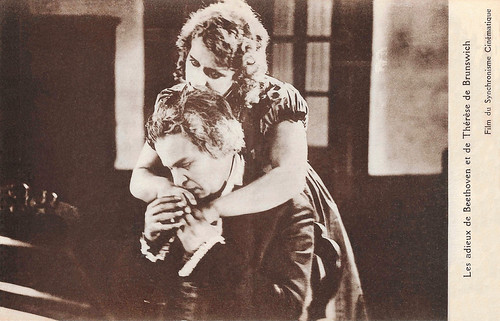
French postcard. Photo: Film du Synchronisme Cinématique. Fritz Kortner and Dely Drexner in Das Leben des Beethoven / The Life of Beethoven / Beethoven (Hans Otto, 1927). Caption: Beethoven and Thérèse of Brunswick’s farewell.

French postcard. Photo: Film du Synchronisme Cinématique. Fritz Kortner in Das Leben des Beethoven / The Life of Beethoven / Beethoven (Hans Otto, 1927). Caption: A rehearsal of 'Fidelio' at the Vienna State Opera.

French postcard. Photo: Film du Synchronisme Cinématique. Fritz Kortner in Das Leben des Beethoven / The Life of Beethoven / Beethoven (Hans Otto, 1927). Caption: Beethoven met Thérèse de Brunswick at the convent where she had taken refuge.

French postcard. Photo: Film du Synchronisme Cinématique. Fritz Kortner in Das Leben des Beethoven / The Life of Beethoven / Beethoven (Hans Otto, 1927). Caption: Death of Beethoven (26 March 1827).
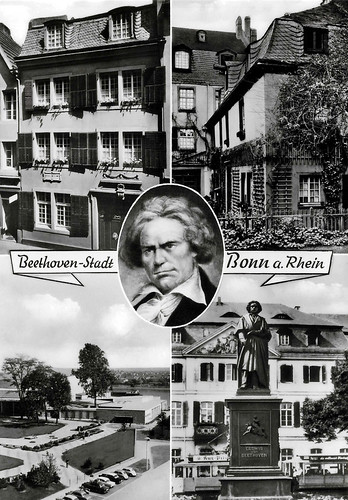
West German postcard. Caption: Beethoven-Stadt, Bonn a. Rhein.
Sources: Wikipedia (Dutch, German and English) and IMDb.

No comments:
Post a Comment