Eleuterio Rodolfi (1876-1933) was an Italian actor, director, and scriptwriter who was highly active in the Italian silent cinema.

Italian postcard.
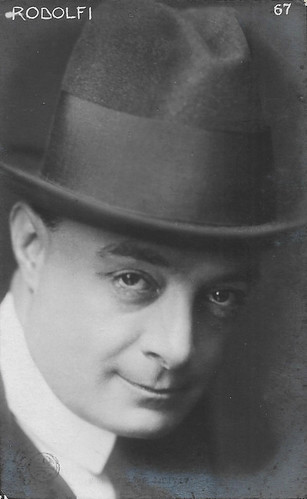
Italian postcard, no. 67. Photo: G. Vettori, Bologna.

Italian postcard.
Eleuterio Rodolfi, aka Rodolfo Rodolfi, was born in Bologna in 1876. He was the son of Giuseppe Rodolfi, a famous stage actor in the 19th century. He debuted on stage as 'generico giovane' (generic young actor) with the company of Francesco Garzes. He then moved to other important theatre companies, such as the one of Ermete Novelli. There he met Adele Mosso, who worked as 'seconda donna' (second woman) in the company. They married in 1895.
In 1911 he moved over to the cinema and was hired by the Ambrosio film company of Turin, where he became both actor and director. For Ambrosio, Rodolfi acted in 95 films, of which some 80 were directed and scripted by himself.
Many of these were comedies interpreted by Rodolfi together with actress Gigetta Morano. The two became known as ‘Gigetta’ and ‘Rodolfi’. In contrast to the previous anarchist farces by Cretinetti and others focused on speed and havoc, entitled as ‘comiche’ in Italian, the comedies with Gigetta and Rodolfi were true ‘commedie’. They are more situational, boulevardier, less speedy, and often hinting at forbidden fruits and voyeurism.
In the risqué comedy L'acqua miracolosa / The miraculous water (Eleuterio Rodolfi, 1914), Gigetta’s husband deplores that in their flat he hears children everywhere (the set is built up like a doll’s house) but he cannot get any. The family doctor (Rodolfi) has a secret affair with Gigetta. He advises the wife to go to the wondrous wells – where she meets no other than the doctor. In the end, everybody is happy: the husband has become the father of twins, and the wife lifts a glass in which we see a little doctor.
Often in their comedies, Morano and Rodolfi played together with a third actor, the portly little bourgeois Camillo De Riso. He frequently played Morano’s father, as in Un successo diplomatico / A diplomatic success (1913) and L’oca alla Colbert / Duck à la Colbert (1913).

Italian postcard, no. Ch. IX. Photo: Ambrosio. Publicity still for the Italian silent film I promessi sposi / The Betrothed (Eleuterio Rodolfi, 1913), adapted from Alessandro Manzoni's classic novel. Eugenia Tettoni as the Nun of Monza, and behind the grill, Gigetta Morano as Lucia. Caption: Her looks, which seemed to indicate she was about 25 years old, gave an impression of beauty at first sight, though a shattered, faded beauty.

British postcard by J.F. Grimm & Co., London. Photo: Ambrosio. Publicity still for the Italian silent epic Gli ultimi giorni di Pompei / The Last Days of Pompeii (Eleuterio Rodolfi, 1913). Caption: Arbaces, the priest of Isis, denounced in the temple. Left: Arbaces' pupil and brother of Jone, Apecides (Cesare Gani Carini) and right: Arbaces (Antonio Grisanti). Arbaces will take revenge on Apecides himself and put the blame on Glaucus, Jone's lover.

British postcard. Photo: Ambrosio. The elegant Glaucus is courted by women at the Via Domizia, the main street of Ancient Pompeii, in Gli ultimi giorni di Pompei (Eleuterio Rodolfi, 1913). The caption mentions Glaucus' beloved Ione, but she isn't in this scene in the film. This is from the opening scene of the film.

Publicity still for Le Giornate del Cinema Muto 2025. Credit: Fototeca - Museo Nazionale del Cinema di Torino. Eugenia Tettoni Fior als Jone in Gli ultimi giorni di Pompei / The Last Days of Pompei (Eleuterio Rodolfi, 1913).
Eleuterio Rodolfi also acted in and directed historical films, such as the super-production Gli ultimi giorni di Pompei / The Last Days of Pompeii (Eleuterio Rodolfi, 1913), based on Edward Bulwer-Lytton’s famous novel and a worldwide success.
The film starred Fernanda Negri Pouget as the blind girl Nydia, Ubaldo Stefani as Glaucus, and Antonio Crisanti as Arbaces. Despite what IMDb writes, Mario Caserini had nothing to do with the film.
The Turinese company Pasquali made a competing version at the same time, so the competition was fierce. Moreover, in recent times the Ambrosio version is often confused with the later silent version of 1926, directed by Carmine Gallone and Amleto Palermi, and starring Victor Varconi, Maria Corda, and Bernhard Goetzke, as respectively Glaucus, Nydia, and Arbaces.
Among Rodolfi's films in the mid-1910s for Ambrosio were a few with the Polish actress turned Italian diva Elena/ Helena Makowska, such as Eva nemica (Giuseppe Pinto, Eleuterio Rodolfi, 1916), and the D’Annunzio adaptations La Gioconda (Eleuterio Rodolfi, 1916) and Fiaccola sotto il moggio / Light under a bushel (Eleuterio Rodolfi, 1916).

Helena Makowska in La Gioconda (1916). Italian postcard by IPA CT, no. 3654, Censura S. Prefetti, Terni, 18-4-1917. Photo: Ambrosio. Caption: 'The model Gioconda Danti.'

Mercedes Brignone in La Gioconda (1916). Italian postcard by IPA CT, no. 3660, Censura S. Prefetti, Terni, 18-4-1917. Photo: Ambrosio.
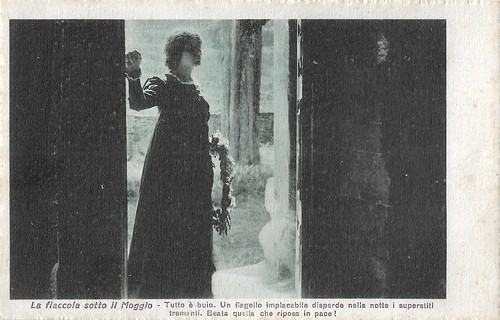
Italian postcard. Photo: Ambrosio. Anna De Marco as Gigliola in La fiaccola sotto il moggio (Eleuterio Rodolfi, 1916), an adaptation of the play by Gabriele D'Annunzio. Caption: "All was dark. An unrelenting scourge scatters in the night the trembling survivors. Blessed is the one who rests in peace!" The vengeful Gigliola visits the grave of her mother in the family chapel, one year after the murder. She holds a wrath in her hands.
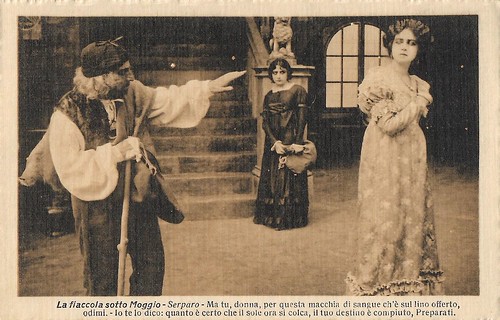
Italian postcard.Photo: Ambrosio. Helena Makowska as Angizia in the Italian silent film La fiaccola sotto il moggio / The Torch under the Bushel (Eleuterio Rodolfi, 1916), an adaptation of the play by Gabriele D'Annunzio. The Serparo (snake conjurer), played by Filippo Butera, curses his daughter Angizia (Helena Makowska): "You, woman, for this blood stain, which is on the offered linen, you may hate me. But I am telling you: as sure as the sun is now pouring, your destiny is fulfilled. Prepare yourself!" In the back, Angizia's stepdaughter Gigliola (Anna De Marco), who suspects her stepmother has killed her mother to marry her father.
In 1916, Eleuterio Rodolfi also started at Jupiter Film, where he shot some seven dramas – of which just one survives: Ah! Le donne! / Ah! Women! (Eleuterio Rodolfi, 1916), with Rodolfi, Armand Pouget and Mercedes Brignone.
In 1917 he founded his own film company, Rodolfi Film, with which he made films like the Shakespeare adaptation Amleto / Hamlet (Eleuterio Rodolfi, 1917), starring Ruggero Ruggeri, ‘monstre sacré’ of the Italian Belle Epoque, and also with Elena / Helena Makowska as Ofelia, Pouget as the King, and Mercedes Brignone as the Queen.
In the early 1920s, Rodolfi did various films with Mercedes Brignone, Lola Visconti Brignone and Armand Pouget.
Rodolfi’s company ceased activity around 1922, after which he did one last production for the Fert Pittaluga company: Maciste e il nipote d’America / Maciste and the grandson of America (Eleuterio Rodolfi, 1924), a film in a completely different genre, and starring Bartolomeo Pagano and Diomira Jacobini, plus Pauline Polaire, Alberto Collo, Oreste Bilancia, and Mercedes Brignone.
After that, he withdrew from the set and returned to the stage. In the late 1920s, he withdrew from the stage as well. In the last years of his life, Eleuterio Rodolfi lived in the city of Brescia, where he committed suicide in 1933.

Italian postcard. Ruggero Ruggeri in Amleto / Hamlet (Eleuterio Rodolfi, 1917). Caption: Horatio and Marcellus tell Hamlet of their vision of the ghost. Hamlet responds (Shakespeare's words): 'Upon the platform, 'twixt eleven and twelve, I'll visit you.'

Italian postcard Mercedes Brignone in Amleto / Hamlet (1917). Caption: Polonius says to Queen Gertrude (Mercedes Brignone) and King Claudius (Armand Pouget): 'Your noble son is mad. Mad call I it' (Shakespeare).

Italian postcard, no. 8067. Photo: Ruggero Ruggeri as Hamlet, either on stage or in the film Amleto / Hamlet (Eleuterio Rodolfi, 1917).
Sources: Aldo Bernardini / Vittorio Martinelli (Il cinema muto italiano), Marianne Lewinsky / Chiara Caranti (Rodolfi e Gigetta: coppia in commedia), Wikipedia (Italian), and IMDb.
This post was last updated on 28 August 2026.
Italian postcard.
Italian postcard, no. 67. Photo: G. Vettori, Bologna.
Italian postcard.
Often hinting at forbidden fruits and voyeurism
Eleuterio Rodolfi, aka Rodolfo Rodolfi, was born in Bologna in 1876. He was the son of Giuseppe Rodolfi, a famous stage actor in the 19th century. He debuted on stage as 'generico giovane' (generic young actor) with the company of Francesco Garzes. He then moved to other important theatre companies, such as the one of Ermete Novelli. There he met Adele Mosso, who worked as 'seconda donna' (second woman) in the company. They married in 1895.
In 1911 he moved over to the cinema and was hired by the Ambrosio film company of Turin, where he became both actor and director. For Ambrosio, Rodolfi acted in 95 films, of which some 80 were directed and scripted by himself.
Many of these were comedies interpreted by Rodolfi together with actress Gigetta Morano. The two became known as ‘Gigetta’ and ‘Rodolfi’. In contrast to the previous anarchist farces by Cretinetti and others focused on speed and havoc, entitled as ‘comiche’ in Italian, the comedies with Gigetta and Rodolfi were true ‘commedie’. They are more situational, boulevardier, less speedy, and often hinting at forbidden fruits and voyeurism.
In the risqué comedy L'acqua miracolosa / The miraculous water (Eleuterio Rodolfi, 1914), Gigetta’s husband deplores that in their flat he hears children everywhere (the set is built up like a doll’s house) but he cannot get any. The family doctor (Rodolfi) has a secret affair with Gigetta. He advises the wife to go to the wondrous wells – where she meets no other than the doctor. In the end, everybody is happy: the husband has become the father of twins, and the wife lifts a glass in which we see a little doctor.
Often in their comedies, Morano and Rodolfi played together with a third actor, the portly little bourgeois Camillo De Riso. He frequently played Morano’s father, as in Un successo diplomatico / A diplomatic success (1913) and L’oca alla Colbert / Duck à la Colbert (1913).
Italian postcard, no. Ch. IX. Photo: Ambrosio. Publicity still for the Italian silent film I promessi sposi / The Betrothed (Eleuterio Rodolfi, 1913), adapted from Alessandro Manzoni's classic novel. Eugenia Tettoni as the Nun of Monza, and behind the grill, Gigetta Morano as Lucia. Caption: Her looks, which seemed to indicate she was about 25 years old, gave an impression of beauty at first sight, though a shattered, faded beauty.
British postcard by J.F. Grimm & Co., London. Photo: Ambrosio. Publicity still for the Italian silent epic Gli ultimi giorni di Pompei / The Last Days of Pompeii (Eleuterio Rodolfi, 1913). Caption: Arbaces, the priest of Isis, denounced in the temple. Left: Arbaces' pupil and brother of Jone, Apecides (Cesare Gani Carini) and right: Arbaces (Antonio Grisanti). Arbaces will take revenge on Apecides himself and put the blame on Glaucus, Jone's lover.
British postcard. Photo: Ambrosio. The elegant Glaucus is courted by women at the Via Domizia, the main street of Ancient Pompeii, in Gli ultimi giorni di Pompei (Eleuterio Rodolfi, 1913). The caption mentions Glaucus' beloved Ione, but she isn't in this scene in the film. This is from the opening scene of the film.
Publicity still for Le Giornate del Cinema Muto 2025. Credit: Fototeca - Museo Nazionale del Cinema di Torino. Eugenia Tettoni Fior als Jone in Gli ultimi giorni di Pompei / The Last Days of Pompei (Eleuterio Rodolfi, 1913).
The Last Days of Pompeii
Eleuterio Rodolfi also acted in and directed historical films, such as the super-production Gli ultimi giorni di Pompei / The Last Days of Pompeii (Eleuterio Rodolfi, 1913), based on Edward Bulwer-Lytton’s famous novel and a worldwide success.
The film starred Fernanda Negri Pouget as the blind girl Nydia, Ubaldo Stefani as Glaucus, and Antonio Crisanti as Arbaces. Despite what IMDb writes, Mario Caserini had nothing to do with the film.
The Turinese company Pasquali made a competing version at the same time, so the competition was fierce. Moreover, in recent times the Ambrosio version is often confused with the later silent version of 1926, directed by Carmine Gallone and Amleto Palermi, and starring Victor Varconi, Maria Corda, and Bernhard Goetzke, as respectively Glaucus, Nydia, and Arbaces.
Among Rodolfi's films in the mid-1910s for Ambrosio were a few with the Polish actress turned Italian diva Elena/ Helena Makowska, such as Eva nemica (Giuseppe Pinto, Eleuterio Rodolfi, 1916), and the D’Annunzio adaptations La Gioconda (Eleuterio Rodolfi, 1916) and Fiaccola sotto il moggio / Light under a bushel (Eleuterio Rodolfi, 1916).
Helena Makowska in La Gioconda (1916). Italian postcard by IPA CT, no. 3654, Censura S. Prefetti, Terni, 18-4-1917. Photo: Ambrosio. Caption: 'The model Gioconda Danti.'
Mercedes Brignone in La Gioconda (1916). Italian postcard by IPA CT, no. 3660, Censura S. Prefetti, Terni, 18-4-1917. Photo: Ambrosio.
Italian postcard. Photo: Ambrosio. Anna De Marco as Gigliola in La fiaccola sotto il moggio (Eleuterio Rodolfi, 1916), an adaptation of the play by Gabriele D'Annunzio. Caption: "All was dark. An unrelenting scourge scatters in the night the trembling survivors. Blessed is the one who rests in peace!" The vengeful Gigliola visits the grave of her mother in the family chapel, one year after the murder. She holds a wrath in her hands.
Italian postcard.Photo: Ambrosio. Helena Makowska as Angizia in the Italian silent film La fiaccola sotto il moggio / The Torch under the Bushel (Eleuterio Rodolfi, 1916), an adaptation of the play by Gabriele D'Annunzio. The Serparo (snake conjurer), played by Filippo Butera, curses his daughter Angizia (Helena Makowska): "You, woman, for this blood stain, which is on the offered linen, you may hate me. But I am telling you: as sure as the sun is now pouring, your destiny is fulfilled. Prepare yourself!" In the back, Angizia's stepdaughter Gigliola (Anna De Marco), who suspects her stepmother has killed her mother to marry her father.
Hamlet
In 1916, Eleuterio Rodolfi also started at Jupiter Film, where he shot some seven dramas – of which just one survives: Ah! Le donne! / Ah! Women! (Eleuterio Rodolfi, 1916), with Rodolfi, Armand Pouget and Mercedes Brignone.
In 1917 he founded his own film company, Rodolfi Film, with which he made films like the Shakespeare adaptation Amleto / Hamlet (Eleuterio Rodolfi, 1917), starring Ruggero Ruggeri, ‘monstre sacré’ of the Italian Belle Epoque, and also with Elena / Helena Makowska as Ofelia, Pouget as the King, and Mercedes Brignone as the Queen.
In the early 1920s, Rodolfi did various films with Mercedes Brignone, Lola Visconti Brignone and Armand Pouget.
Rodolfi’s company ceased activity around 1922, after which he did one last production for the Fert Pittaluga company: Maciste e il nipote d’America / Maciste and the grandson of America (Eleuterio Rodolfi, 1924), a film in a completely different genre, and starring Bartolomeo Pagano and Diomira Jacobini, plus Pauline Polaire, Alberto Collo, Oreste Bilancia, and Mercedes Brignone.
After that, he withdrew from the set and returned to the stage. In the late 1920s, he withdrew from the stage as well. In the last years of his life, Eleuterio Rodolfi lived in the city of Brescia, where he committed suicide in 1933.
Italian postcard. Ruggero Ruggeri in Amleto / Hamlet (Eleuterio Rodolfi, 1917). Caption: Horatio and Marcellus tell Hamlet of their vision of the ghost. Hamlet responds (Shakespeare's words): 'Upon the platform, 'twixt eleven and twelve, I'll visit you.'
Italian postcard Mercedes Brignone in Amleto / Hamlet (1917). Caption: Polonius says to Queen Gertrude (Mercedes Brignone) and King Claudius (Armand Pouget): 'Your noble son is mad. Mad call I it' (Shakespeare).
Italian postcard, no. 8067. Photo: Ruggero Ruggeri as Hamlet, either on stage or in the film Amleto / Hamlet (Eleuterio Rodolfi, 1917).
Sources: Aldo Bernardini / Vittorio Martinelli (Il cinema muto italiano), Marianne Lewinsky / Chiara Caranti (Rodolfi e Gigetta: coppia in commedia), Wikipedia (Italian), and IMDb.
This post was last updated on 28 August 2026.

No comments:
Post a Comment