Russian actress and author Lidya Ryndina (1884-1957 or 1964) was a favourite of the Russian public. With Vera Kholodnaya and Vera Karalli, she was one of the three major film divas of Russian silent cinema during the Imperial era. After the Russian Revolution, she moved to Western Europe, where she also made a few silent films during the 1920s.
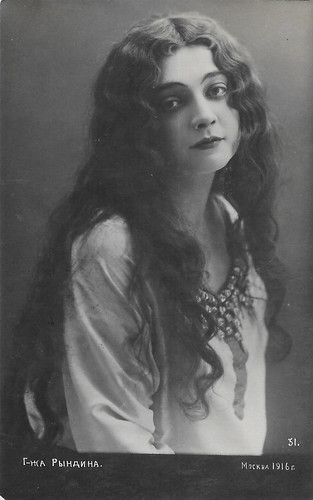
Russian Postcard. Collection: Didier Hanson.
Lidiya Dmitrievna Ryndina (Лидия Дмитриевна РЫНДИНА or Lidiya T. Ryndina according to IMDb) was born in 1884. She was the daughter of a Russian General. Lydia Dmitrievna was not only an actress, but also a writer and journalist. While still in Moscow, she published her own play.
Ryndina started her career as a stage actress in Kyiv (Kiev) with the Sinelnikov troupe. She then performed for two years at the Korsh Theatre in Moscow, followed by eight years with the Nezlobin troupe. She appeared in plays such as 'Psisha' by Yuri Belyaev, 'Le Bon Roi Dagobert' (Good King Dagobert) by André Rivoire, and 'L'Aiglon' and 'La Princesse Lointaine' by Edmond Rostand. She also performed at the Alexandrinsky Theatre in Saint Petersburg. The poet Igor Severyanin dedicated several poems to her, including 'The Daydreamer’s Rocking Chair' (1911) and 'Rondo' (1914).
In 1913, Lidya Ryndina appeared in films for producer Iosif N. Ermoliev, also written as Iosif Yermolyev or Joseph N. Ermolieff. Ermoliev (1889-1962) was a prominent pioneer of the Russian film industry who began in 1907 as a technician for Pathé. At twenty-two, he already operated a studio in Moscow. During the 1917 Revolution, he escaped to France, where he worked for Pathé. He produced over two hundred films in Europe before moving to the U.S. in 1937.
Later, Ryndina worked at the Khanzhonkov studio, where she appeared in pictures alongside Vitold Polonsky. Ryndina became known for silent films such as Peterburgskiye trushchobi / The Lower Depths of St. Petersburg (Pyotr Chardynin, Vladimir Gardin, Yakov Protazanov, 1915) with Vladimir Maksimov and Ivan Mozzhukhin, and Nikolay Stavrogin (Yakov Protazanov, 1915) with Ivan Mozzhukhin and Nathalie Lissenko. The latter was based on Fyodor Dostoevsky’s story 'Devils'.
Ryndina worked several times with the most important Russian director, Yevgeni Bauer. Their films include Lulia Bek (Yevgeni Bauer, 1914), Vozmezdie / Retribution (Yevgeni Bauer, 1916) with Vitold Polonsky and Vera Karalli, and Lozh / Lie (Yevgeni Bauer, 1916). She also co-starred with Vladimir Strizhevsky in Zhizn trekh dney / A Life of Three Days (Gromov, 1917).
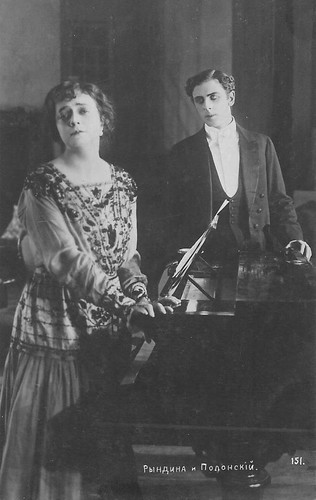
Russian Postcard, no. 151. Collection: Didier Hanson. Photo: publicity still for Vozmezdie / Retribution (Yevgeni Bauer, 1916) with Vitold Polonsky.
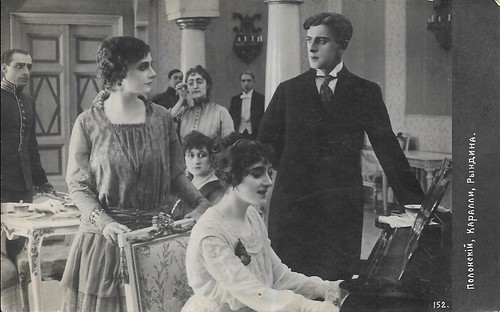
Russian Postcard, no. 152. Collection: Didier Hanson. Photo: publicity still for Vozmezdie / Retribution (Yevgeni Bauer, 1916) with Vera Karalli and Vitold Polonsky.
Lidiya Ryndina left Russia because of the Bolshevik revolution and its subsequent civil war and terror. In 1917, several revolutions dismantled Russia's Tsarist autocracy and led to the Soviet Union. She emigrated with her second husband, the Russian poet and publisher Sergei Krechetov (S.A. Sokolov), owner of the Grif publishing house in Moscow. In 1919, Ryndina and her husband went to the Crimea (Krim), where she acted in a film produced by the Khanzhonkov studio. From there, they travelled to Constantinople and then to Vienna, where she appeared in two films, before moving to Berlin in 1922. The couple also engaged in publishing activities.
In Berlin, she found a new role, performing at the artistic Russian-German cabaret 'Der Blaue Vogel' (The Blue Bird). Der Blaue Vogel was a literary and folkloric cabaret composed of Russian emigrants, founded in 1921 by J. Duvan-Torzoff. The style was strongly influenced by the Letuchaya Mysh (The Bat), the first Russian cabaret, created by Nikita Baliev in 1908 at the Moscow Art Theatre. All elements of the cabaret were stylised: sets, costumes, sounds, music, and the actor's movements. This was combined with a mixture of Russian, French, English and German.
The productions of Der Blaue Vogel were often literary parodies, including Maurice Maeterlinck's plays ('L'Oiseau bleu' was one of his plays), but also folkloristic in Russian style, with elements of social criticism. Lydia Ryndina played various beauties in musical productions such as 'The Princess Who Never Smiled', 'The King Ordered the Drum Be Beaten', and 'Three Young Soldiers Went to War'. Under director J.D. Jushnij, Der Blaue Vogel became popular. The company toured around the world. The project ended in 1931, after more than 3000 performances.
In 1922, Ryndina appeared in the film Der Unbekannte aus Russland / The Unknown from Russia (Hans Otto, 1922), based on a script by Béla Balázs. She also played a supporting role in Der Mann auf dem Kometen / The Man on the Comet (Alfred Halm, 1925) with Luciano Albertini and Maly Delschaft. During World War II, she fled burning Berlin for the resort town of Karlovy Vary.
After the war, Lidiya Ryndina returned to Germany and toured extensively with her troupe through prisoner-of-war camps. Later, she moved to Paris, where she performed several plays, including Henrik Ibsen’s 'Ghosts'. In 1957, Lidya Ryndina passed away in Paris at 73 (source: Find A Grave; according to Russian Wikipedia, she died in 1964). She was interred at the Cimetière de Sainte-Geneviève-des-Bois in Île-de-France. She married twice, first to Brylkin and later to Sergey Alexeevich Sokolov-Krechetov.
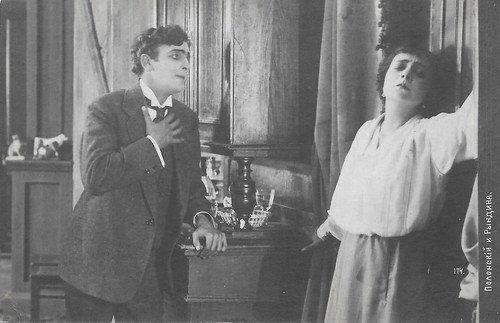
With Vitold Polonsky. Russian postcard, no. 174. Collection Didier Hanson.
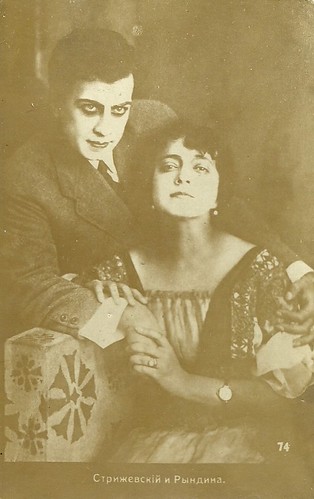
Vladimir Strizhevsky and Lidiya Ryndina. Russian postcard, no. 74. Collection: Didier Hanson.
Source: Weimar Berlin, Čiurlionis (Page now defunct), Find A Grave, Ciné-Phil-Azr (French - Now defunct), Wikipedia (Russian) and IMDb. This post was last updated on 2 October 2026.
Russian Postcard. Collection: Didier Hanson.
Yevgeni Bauer
Lidiya Dmitrievna Ryndina (Лидия Дмитриевна РЫНДИНА or Lidiya T. Ryndina according to IMDb) was born in 1884. She was the daughter of a Russian General. Lydia Dmitrievna was not only an actress, but also a writer and journalist. While still in Moscow, she published her own play.
Ryndina started her career as a stage actress in Kyiv (Kiev) with the Sinelnikov troupe. She then performed for two years at the Korsh Theatre in Moscow, followed by eight years with the Nezlobin troupe. She appeared in plays such as 'Psisha' by Yuri Belyaev, 'Le Bon Roi Dagobert' (Good King Dagobert) by André Rivoire, and 'L'Aiglon' and 'La Princesse Lointaine' by Edmond Rostand. She also performed at the Alexandrinsky Theatre in Saint Petersburg. The poet Igor Severyanin dedicated several poems to her, including 'The Daydreamer’s Rocking Chair' (1911) and 'Rondo' (1914).
In 1913, Lidya Ryndina appeared in films for producer Iosif N. Ermoliev, also written as Iosif Yermolyev or Joseph N. Ermolieff. Ermoliev (1889-1962) was a prominent pioneer of the Russian film industry who began in 1907 as a technician for Pathé. At twenty-two, he already operated a studio in Moscow. During the 1917 Revolution, he escaped to France, where he worked for Pathé. He produced over two hundred films in Europe before moving to the U.S. in 1937.
Later, Ryndina worked at the Khanzhonkov studio, where she appeared in pictures alongside Vitold Polonsky. Ryndina became known for silent films such as Peterburgskiye trushchobi / The Lower Depths of St. Petersburg (Pyotr Chardynin, Vladimir Gardin, Yakov Protazanov, 1915) with Vladimir Maksimov and Ivan Mozzhukhin, and Nikolay Stavrogin (Yakov Protazanov, 1915) with Ivan Mozzhukhin and Nathalie Lissenko. The latter was based on Fyodor Dostoevsky’s story 'Devils'.
Ryndina worked several times with the most important Russian director, Yevgeni Bauer. Their films include Lulia Bek (Yevgeni Bauer, 1914), Vozmezdie / Retribution (Yevgeni Bauer, 1916) with Vitold Polonsky and Vera Karalli, and Lozh / Lie (Yevgeni Bauer, 1916). She also co-starred with Vladimir Strizhevsky in Zhizn trekh dney / A Life of Three Days (Gromov, 1917).
Russian Postcard, no. 151. Collection: Didier Hanson. Photo: publicity still for Vozmezdie / Retribution (Yevgeni Bauer, 1916) with Vitold Polonsky.
Russian Postcard, no. 152. Collection: Didier Hanson. Photo: publicity still for Vozmezdie / Retribution (Yevgeni Bauer, 1916) with Vera Karalli and Vitold Polonsky.
The unknown from Russia
Lidiya Ryndina left Russia because of the Bolshevik revolution and its subsequent civil war and terror. In 1917, several revolutions dismantled Russia's Tsarist autocracy and led to the Soviet Union. She emigrated with her second husband, the Russian poet and publisher Sergei Krechetov (S.A. Sokolov), owner of the Grif publishing house in Moscow. In 1919, Ryndina and her husband went to the Crimea (Krim), where she acted in a film produced by the Khanzhonkov studio. From there, they travelled to Constantinople and then to Vienna, where she appeared in two films, before moving to Berlin in 1922. The couple also engaged in publishing activities.
In Berlin, she found a new role, performing at the artistic Russian-German cabaret 'Der Blaue Vogel' (The Blue Bird). Der Blaue Vogel was a literary and folkloric cabaret composed of Russian emigrants, founded in 1921 by J. Duvan-Torzoff. The style was strongly influenced by the Letuchaya Mysh (The Bat), the first Russian cabaret, created by Nikita Baliev in 1908 at the Moscow Art Theatre. All elements of the cabaret were stylised: sets, costumes, sounds, music, and the actor's movements. This was combined with a mixture of Russian, French, English and German.
The productions of Der Blaue Vogel were often literary parodies, including Maurice Maeterlinck's plays ('L'Oiseau bleu' was one of his plays), but also folkloristic in Russian style, with elements of social criticism. Lydia Ryndina played various beauties in musical productions such as 'The Princess Who Never Smiled', 'The King Ordered the Drum Be Beaten', and 'Three Young Soldiers Went to War'. Under director J.D. Jushnij, Der Blaue Vogel became popular. The company toured around the world. The project ended in 1931, after more than 3000 performances.
In 1922, Ryndina appeared in the film Der Unbekannte aus Russland / The Unknown from Russia (Hans Otto, 1922), based on a script by Béla Balázs. She also played a supporting role in Der Mann auf dem Kometen / The Man on the Comet (Alfred Halm, 1925) with Luciano Albertini and Maly Delschaft. During World War II, she fled burning Berlin for the resort town of Karlovy Vary.
After the war, Lidiya Ryndina returned to Germany and toured extensively with her troupe through prisoner-of-war camps. Later, she moved to Paris, where she performed several plays, including Henrik Ibsen’s 'Ghosts'. In 1957, Lidya Ryndina passed away in Paris at 73 (source: Find A Grave; according to Russian Wikipedia, she died in 1964). She was interred at the Cimetière de Sainte-Geneviève-des-Bois in Île-de-France. She married twice, first to Brylkin and later to Sergey Alexeevich Sokolov-Krechetov.
With Vitold Polonsky. Russian postcard, no. 174. Collection Didier Hanson.
Vladimir Strizhevsky and Lidiya Ryndina. Russian postcard, no. 74. Collection: Didier Hanson.
Source: Weimar Berlin, Čiurlionis (Page now defunct), Find A Grave, Ciné-Phil-Azr (French - Now defunct), Wikipedia (Russian) and IMDb. This post was last updated on 2 October 2026.

No comments:
Post a Comment