
German postcard by Ross Verlag, no. 5032/1, 1930-1931. Photo: Atelier Manassé, Wien.

Austrian postcard by Iris Verlag, no. 5391. Photo: Atelier Böhm / Hegewald-Film / Distr. Lux-Film.
Dark-haired beauty
Agnes Petersen was born in 1906 in København (Copenhagen), Denmark. She was the daughter of town hall official Fritz Petersen and his wife Thora Christensen. She was the sister of Fanny Petersen, who was married to the painter Henrik Nielsen. Agnes joined the theatre as a teenager and initially appeared in comedies, with which she also toured the Danish provinces. In the early 1920s, the Danish stage actor Hilmar Clausen brought her to the Bonbonieren cabaret theatre.
In 1924, Petersen started her film career in the Danish comedies Raske Riviera Rejsende / Healthy Riviera Travellers (Lau Lauritzen, 1924) and Ole Opfinders offer / Inventor Ole’s Sacrifice (Lau Lauritzen, 1924), both starring the duo Harald Madsen and Carl Schenstrøm a.k.a. Fy og Bi or Long and Short.
For the Nordisk studio, she appeared in the drama Den store Magt / The Great Power (August Blom, 1925) with Lili Beck. The Danish film industry imploded, and Harald Madsen, Carl Schenstrøm and Petersen were invited by Hans Steinhoff to come to ienna in 1926, where all three Danes shot their first German-language silent film, the comedy Schwiegersöhne / Sons-in-law (Hans Steinhoff, 1926).
By the following year, Agnes Petersen had moved to Berlin, where she continued to play leading roles in German silent films. In the drama Die Gefangene von Shanghai / The Prisoner of Shanghai (Géza von Bolváry, Augusto Genina, 1927), she played the Chinese Li. The other main roles were played by Italian Carmen Boni and British Jack Trevor.
Other German films with Petersen were Dr. Bessels Verwandlung / Dr. Bessel‘s Transformation (Richard Oswald, 1927) with Hans Stüwe, Frauenarzt Dr. Schäfer / Gynaecologist Dr. Schäfer (Jacob and Luise Fleck, 1928) featuring Iván Petrovich.

Austrian postcard by Iris-Verlag, no. 5500. Collection: Didier Hanson.
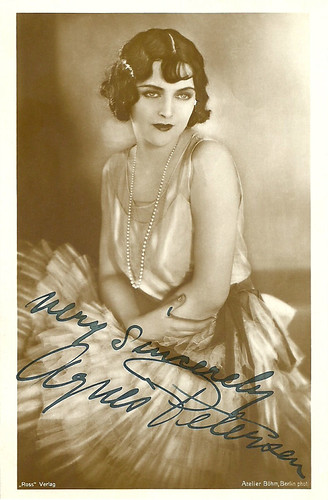
German postcard by Ross Verlag. Photo: Atelier Böhm, Berlin. Collection: Didier Hanson.
The laughing lady
At the Terra film studio in Berlin, Agnes Petersen met the famous Russian actor and film charmer Ivan Mozzhukhin, whom she married in the Greek Catholic church in Nice on 12 March 1928. She started to use the name Agnes Petersen-Mozzhukhinova. With her husband, she travelled to Hollywood, but their American adventure was not a success. Soon they were back in Berlin. The couple lived alternately in a luxury mansion on Kurfürstendamm and in their own villa near Paris.
For the Ufa, she appeared in the drama Geheimnisse des Orients / Secrets of the Orient (Alexandre Volkoff, 1928) again with Iván Petrovich and with Nicolas Koline. In Der geheime Kurier / The Secret Courier (Gennaro Righelli, 1928), she co-starred with Lil Dagover and Mozzhukhin.
With the rise of the sound film, she could no longer continue her film career in Germany. In Czechoslovakia, she played the lead role in the drama Hrích / Sin (Carl Lamac, 1929) and in Poland in Kult ciala / The Cult of the Body (Michal Waszynski, 1930) with Victor Varconi.
She followed her husband to Paris, where in 1930 she made her first and only sound film at the local Paramount Studios: the Swedish Den farliga leken (Gustaf Bergman, 1931) starring Jenny Hasselqvist. This Paramount production was an alternative language production of The Laughing Lady (Victor Schertzinger, 1929).
Little is known about her further life. In 1939, her husband Ivan Mozzhukin died from a severe form of tuberculosis. According to Poul at NitrateVille, she died in 1973 in Denmark. Agnes Petersen-Mozzhukhinova was buried at Bispebjerg Kirkegård in Copenhagen. During her career, she was also sometimes credited as Agnes Peterson.

German postcard by Ross Verlag, no. 3761/1, 1928-1929. Photo: Alex Binder, Berlin.

Polish postcard, no. 1244. Photo: Agnes Petersen and Victor Varconi in Kult ciala / The Cult of the Body (Michal Waszynski, 1930).
Sources: Poul (NitrateVille), Thomas Staedeli (Cyranos), Danske Film (Danish), Wikipedia (Polish) and IMDb.
This post was last updated on 18 March 2026.

No comments:
Post a Comment