Ermete Novelli (1851-1919) was a legendary monstre sacré of the Italian theatre. When the famous actor and playwright appeared in films of the Film d'Arte Italiana, the press condemned his theatrical performances on screen. But with later films, he got even.

Italian postcard by Alterocca, Terni, no. 513. Virgilio Alterocca (1853-1910) founded the first company for illustrated and photographic cards in Italy. He already started a typographic company in 1877, working for newspapers and producing posters, but around 1896, thanks to modernising techniques in phototypography from Germany and Switzerland, he was able to make photographic cards a booming business.

Italian postcard. Sent by mail in 1902. Photo: Sciotto. Ermete Novelli as/in Burbero Benefico.
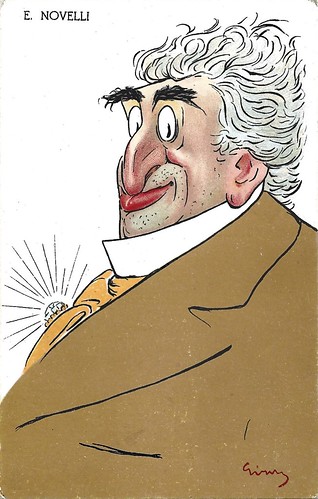
Italian postcard by CCM (Cesare Capello, Milano). Caricature by Girus (Giuseppe Russo, 1888-1960).

Italian postcard by Ed. Vettori, Bologna. Ermete Novelli and Ferruccio Benini collaborated on the Propaganda Film project Per la patria! (Ugo Falena, 1915), which combined nonfiction footage of the battlefields with footage of stage actors filmed in their famous roles. It was Benini's sole film part, who died soon after the film was made.
Ermete Novelli was born in 1851 in Lucca, Tuscany. His father was a prompter, and he came from a noble and ancient family from Bertinoro.
Already at an early age, in 1866, he started to act on stage, and soon he became one of the 'monstres sacrés' of the Italian stage of the 1870s and 1880s.
In 1885, he founded his own company and had triumphs in Paris in 1898 and 1902. He also performed in New York in 1907 as Antony Novelli.
Inspired by the Comédie Française, he founded in 1900 his own 'teatro stabile', Casa Goldoni, at the Teatro Valle in Rome. In the 1910s, he led the company Fert, to which such actors as Lyda Borelli were attached. Together they did a.o. Sem Benelli's play 'Le nozze dei centauri' (1915) at the Teatro Manzoni in Milan and elsewhere.
On his own or in collaboration, Novelli also wrote several comedies and monologues. Rimini has a Teatro Ermete Novelli, and Italy has known since 2002 the Premio Ermete Novelli for the best stage actor.
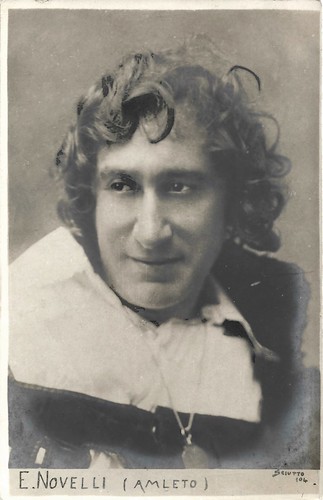
Italian postcard, no. 104. Photo: Sciutto, Genoa. Ermete Novelli as Hamlet.
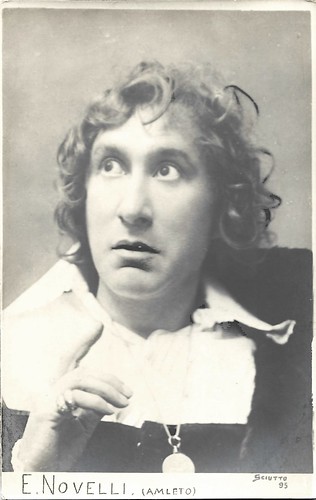
Italian postcard, no. 95. Photo: Sciutto, Genoa. Ermete Novelli as Hamlet.
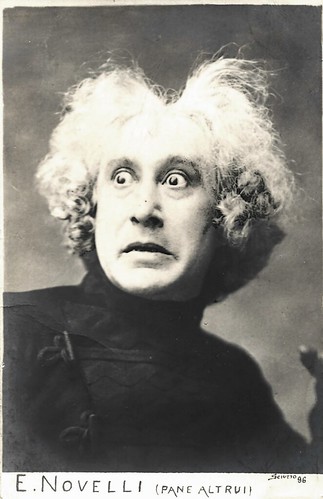
Italian postcard, no. 96. Photo: Sciutto, Genoa. Ermete Novelli in the play 'Pane altrui' (Fortune's Fool) by Ivan Turgenev.
Just a few years after the film d'art phenomenon had spread in France, Ermete Novelli started to act in film too, from Shakespearian costume dramas as Re Lear / King Lear (Gerolamo Lo Savio, 1910) and Il Mercante di Venezia / The Merchant of Venice (Gerolamo Lo Savio, 1910) to La Morte Civile / The Civil Death (Gerolamo Lo Savio, 1910), based on the Italian play by Paolo Giacometti.
These short, silent films were directed by Gerolamo Lo Savio for the Film d'Arte Italiana, a subsidiary of Pathé Frères. All the films were shot in Rimini, where Novelli had his villa, and partly in Venice (The Merchant of Venice).
There were high expectations about seeing Novelli on screen, but the film press condemned the films, because of Novelli's theatrical performance. He neglected the new medium and did not take film seriously at all.
A few years later, another star of the Italian stage, Eleonora Duse, better understood that cinema was a different medium.
In the films by Lo Savio, a new young actress performed opposite Novelli: Francesca Bertini. Though she had had some stage training, she was a real film actress, and soon she would become one of the divas of the Italian cinema. A greater contrast to Novelli was unimaginable.

Italian postcard by Fototipia G. Modiano & C., Milano.

Italian postcard in the Series Artisti italiani, by Stab. Lit. Armanino, no. 520, XXVII-VII. Photo: Sciutto, Genua. Ermete Novelli as Shylock in the play 'The Merchant of Venice' by William Shakespeare.

Italian postcard. Photo: Brizzi. Ermete Novelli and Emilio Zago.

Italian postcard by Alterocca Terni, no. 3077, mailed in 1899. Ermete Novelli and Emilio Zago.
A few years later, Ermete Novelli tried his luck in the cinema again. He returned to the screen, now for the production company Ambrosio.
The films were based on French 'pochades' which Novelli had successfully performed on stage: Michele Perrin / Michael Perrine (Eleuterio Rodolfi, 1913) and La gerla di Papa Martin / Honour Thy Father (Eleuterio Rodolfi, 1914), both opposite Gigetta Morano, the regular Ambrosio comedienne.
This time, the press was much more favourable. In 1915, Novelli acted in - unsuccessful and hardly noticed - films by his son, writer-director Enrico Novelli: the comedy Fiorenza mia! / My Florence! and the drama Il più grande amore / The Greatest Love.
They were followed by the War Propaganda film Per la Patria! / For the Motherland! (Ugo Falena, 1915).
Towards the end of the war, Novelli played in two remarkable films, Automartirio / Selfmartyrdom (Ivo Illuminati, 1917) and La morte che assolve / The Death That Performs (Alberto Carlo Lolli, 1918), both starring the Milanese star Elettra Raggio, who was also the producer of these two films.
A copy of the latter film has been found and restored, so we can admire both Novelli and Raggio as the father and daughter of the story. Of the former film, only the beautiful posters exist.
In 1919, Ermete Novelli died in Naples, Italy (according to Wikipedia) or Paris, France (according to IMDb). Wikipedia adds that he was "survived by at least one child, his son, Enrico 'Yambo' Novelli." He was 67.

Italian postcard. Photo: Ambrosio-Film.

Italian postcard by Tensi.

Italian postcard by Ed. Vettori, Bologna, no. 46. Photo: Trevisani, Bologna.

Italian postcard by La Colomba, Torino, 1947. Photo: Bosco di Bricca, 1900s.
Sources: Wikipedia, ErmetoNovelli (Italian), and IMDb
This post was last updated on 4 January 2026.
Italian postcard by Alterocca, Terni, no. 513. Virgilio Alterocca (1853-1910) founded the first company for illustrated and photographic cards in Italy. He already started a typographic company in 1877, working for newspapers and producing posters, but around 1896, thanks to modernising techniques in phototypography from Germany and Switzerland, he was able to make photographic cards a booming business.
Italian postcard. Sent by mail in 1902. Photo: Sciotto. Ermete Novelli as/in Burbero Benefico.
Italian postcard by CCM (Cesare Capello, Milano). Caricature by Girus (Giuseppe Russo, 1888-1960).
Italian postcard by Ed. Vettori, Bologna. Ermete Novelli and Ferruccio Benini collaborated on the Propaganda Film project Per la patria! (Ugo Falena, 1915), which combined nonfiction footage of the battlefields with footage of stage actors filmed in their famous roles. It was Benini's sole film part, who died soon after the film was made.
Monstre sacré
Ermete Novelli was born in 1851 in Lucca, Tuscany. His father was a prompter, and he came from a noble and ancient family from Bertinoro.
Already at an early age, in 1866, he started to act on stage, and soon he became one of the 'monstres sacrés' of the Italian stage of the 1870s and 1880s.
In 1885, he founded his own company and had triumphs in Paris in 1898 and 1902. He also performed in New York in 1907 as Antony Novelli.
Inspired by the Comédie Française, he founded in 1900 his own 'teatro stabile', Casa Goldoni, at the Teatro Valle in Rome. In the 1910s, he led the company Fert, to which such actors as Lyda Borelli were attached. Together they did a.o. Sem Benelli's play 'Le nozze dei centauri' (1915) at the Teatro Manzoni in Milan and elsewhere.
On his own or in collaboration, Novelli also wrote several comedies and monologues. Rimini has a Teatro Ermete Novelli, and Italy has known since 2002 the Premio Ermete Novelli for the best stage actor.
Italian postcard, no. 104. Photo: Sciutto, Genoa. Ermete Novelli as Hamlet.
Italian postcard, no. 95. Photo: Sciutto, Genoa. Ermete Novelli as Hamlet.
Italian postcard, no. 96. Photo: Sciutto, Genoa. Ermete Novelli in the play 'Pane altrui' (Fortune's Fool) by Ivan Turgenev.
Film d'arte italiana
Just a few years after the film d'art phenomenon had spread in France, Ermete Novelli started to act in film too, from Shakespearian costume dramas as Re Lear / King Lear (Gerolamo Lo Savio, 1910) and Il Mercante di Venezia / The Merchant of Venice (Gerolamo Lo Savio, 1910) to La Morte Civile / The Civil Death (Gerolamo Lo Savio, 1910), based on the Italian play by Paolo Giacometti.
These short, silent films were directed by Gerolamo Lo Savio for the Film d'Arte Italiana, a subsidiary of Pathé Frères. All the films were shot in Rimini, where Novelli had his villa, and partly in Venice (The Merchant of Venice).
There were high expectations about seeing Novelli on screen, but the film press condemned the films, because of Novelli's theatrical performance. He neglected the new medium and did not take film seriously at all.
A few years later, another star of the Italian stage, Eleonora Duse, better understood that cinema was a different medium.
In the films by Lo Savio, a new young actress performed opposite Novelli: Francesca Bertini. Though she had had some stage training, she was a real film actress, and soon she would become one of the divas of the Italian cinema. A greater contrast to Novelli was unimaginable.
Italian postcard by Fototipia G. Modiano & C., Milano.
Italian postcard in the Series Artisti italiani, by Stab. Lit. Armanino, no. 520, XXVII-VII. Photo: Sciutto, Genua. Ermete Novelli as Shylock in the play 'The Merchant of Venice' by William Shakespeare.
Italian postcard. Photo: Brizzi. Ermete Novelli and Emilio Zago.
Italian postcard by Alterocca Terni, no. 3077, mailed in 1899. Ermete Novelli and Emilio Zago.
Elettra Raggio
A few years later, Ermete Novelli tried his luck in the cinema again. He returned to the screen, now for the production company Ambrosio.
The films were based on French 'pochades' which Novelli had successfully performed on stage: Michele Perrin / Michael Perrine (Eleuterio Rodolfi, 1913) and La gerla di Papa Martin / Honour Thy Father (Eleuterio Rodolfi, 1914), both opposite Gigetta Morano, the regular Ambrosio comedienne.
This time, the press was much more favourable. In 1915, Novelli acted in - unsuccessful and hardly noticed - films by his son, writer-director Enrico Novelli: the comedy Fiorenza mia! / My Florence! and the drama Il più grande amore / The Greatest Love.
They were followed by the War Propaganda film Per la Patria! / For the Motherland! (Ugo Falena, 1915).
Towards the end of the war, Novelli played in two remarkable films, Automartirio / Selfmartyrdom (Ivo Illuminati, 1917) and La morte che assolve / The Death That Performs (Alberto Carlo Lolli, 1918), both starring the Milanese star Elettra Raggio, who was also the producer of these two films.
A copy of the latter film has been found and restored, so we can admire both Novelli and Raggio as the father and daughter of the story. Of the former film, only the beautiful posters exist.
In 1919, Ermete Novelli died in Naples, Italy (according to Wikipedia) or Paris, France (according to IMDb). Wikipedia adds that he was "survived by at least one child, his son, Enrico 'Yambo' Novelli." He was 67.
Italian postcard. Photo: Ambrosio-Film.
Italian postcard by Tensi.
Italian postcard by Ed. Vettori, Bologna, no. 46. Photo: Trevisani, Bologna.
Italian postcard by La Colomba, Torino, 1947. Photo: Bosco di Bricca, 1900s.
Sources: Wikipedia, ErmetoNovelli (Italian), and IMDb
This post was last updated on 4 January 2026.

3 comments:
Yes, I see that there is MUCH more than Hollywood...Never heard of Ermete -a hermetic subject to me. :)
Great cards, I'm never really familiar with your stars, so thank you for illuminating us. Happy PFF
Very interesting!
Post a Comment