French actor and singer Albert Préjean (1894-1979) was a former WWI flying ace. He is best known for playing heroes in the films of René Clair and for playing Georges Simenon's detective Maigret.
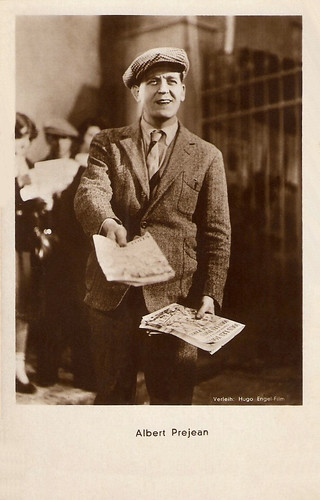
German postcard. Photo: Verleih Hugo Engel-Film. Publicity still for Sous les Toits de Paris / Under the Roofs of Paris (1930).

French postcard by Editions Cinémagazine, no. 547. Photo: Albert Préjean as the symbolic figure of Le Soldat Français (The French soldier) in Verdun, visions d'histoire / Verdun, Visions of History (Léon Poirier, 1928).
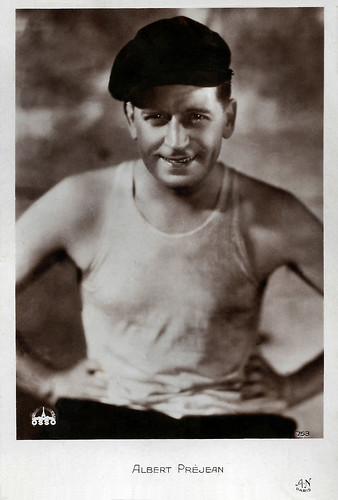
French postcard by A.N. Paris, no. 753. Photo: Osso. Albert Préjean in Un Soir De Rafle / Night Raid (Carmine Gallone, 1931).

French postcard, no. 664. Photo: Film Sonor.

German Postcard by Ross Verlag, no. 6201/1, 1931-1932. Photo: Paramount.
Albert Préjean was born in 1893 or 1894 (the sources differ) in Paris. Before entering the military, he worked as a boxer, nightclub entertainer and acrobat. During the First World War, he became a flying ace of the French army.
After the war, he decided to become an actor. His film debut was a bit part in the serial Les Trois mousquetaires / The Three Musketeers (Henri Diamant-Berger, 1921). His breakthrough was ironically a role as a pilot in the surrealistic Sci-Fi film Paris qui dort / Paris Asleep (René Clair, 1925).
Hal Erickson at AllMovie: "The Crazy Ray (Paris qui Dort) was a wild René Clair daydream which he deftly translated into his very first directorial effort. Deliberately invoking the early 'chase' films which distinguished the French cinema, Clair weaves an improbable tale of a genially loony scientist who utilises a magic ray (an effect created with stop-motion photography) on the unsuspecting citizens of Paris. The ray causes its victims to freeze in bizarre and often embarrassing positions. Those not affected by the ray take the opportunity to lift everything that isn't nailed down."
The cooperation with René Clair obviously went so well that it was continued in Le Fantôme du Moulin-Rouge / The Phantom of the Moulin-Rouge (1925), Le Voyage imaginaire / The Imaginary Voyage (1926) and Un chapeau de paille d'Italie / The Italian Straw Hat (1928).
In their first sound feature, Sous les Toits de Paris / Under the Roofs of Paris (1930), Préjean played the street performer Albert who leads the assembly line in singing the film's title song. Craig Butler at AllMovie: "From the moment Roofs opens, with a tracking shot that takes the audience from above the roofs of Paris and down into a working-class district of the city, it's clear that the film is in the hands of a master, and Clair has plenty of other tricks up his sleeve to keep the viewer engaged. Case in point: a wordless sequence that concentrates solely on the feet of two characters and tells more about where they are in their relationship than many pages of dialogue could."
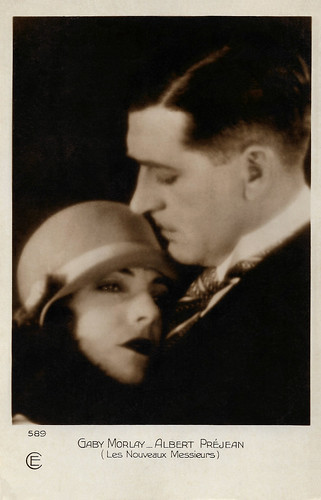
French postcard by Cinémagazine-Edition, Paris, no. 589. Albert Préjean and Gaby Morlay in Les nouveaux messieurs / The New Gentlemen (Jacques Feyder, 1928).

French promotion postcard for Clacquesin, Extrait de Pins. Caption: "Under the Roofs of Paris, with gaiety and spirit I drink Clacquesin." 'Sous les toits de Paris' refers to one of Préjean's most popular films (René Clair, 1930).

French publicity still by Films Osso. Albert Préjean and Constant Rémy in Un soir de rafle / Night Raid (Carmine Gallone, 1930). Statens Filmcensur refers to the Danish Film censorship institution that took its final form with the Danish Cinema Act of 1938.

French postcard by Cinémagazine-Edition, Paris, no. 929. Photo: Les Films Osso. Albert Préjean and Annabella in Un soir de rafle / Dragnet Night (Carmine Gallone, 1931).

French postcard by P.C., Paris, no. 14. Photo: Films Osso. Albert Préjean sang the Slow-Fox 'Si l'on ne s'était pas connu' in Un soir de rafle (Carmine Gallone, 1931). Text by Léo Lelièvre fils, and music by Ph. Parès and G. van Parys. Copyright: Ed. Salabert, Paris, 1931.
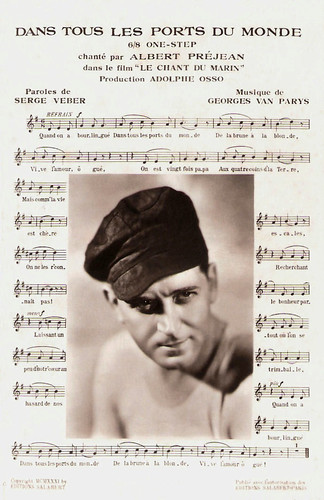
French postcard by P.C., Paris, no. 13. Publicity card for Le chant du marin / Sailor's Song (Carmine Gallone, 1932).

German postcard by Ross Verlag, no. 5304/1, 1930-1931. Photo: Frhr. von Gudenberg, Berlin.
Albert Préjean went on to play jeune premiers in L'Opéra de Quat'Sous / The Threepenny Opera (G.W. Pabst, 1931), Un soir de rafle / Dragnet Night (Carmine Gallone, 1931), the Operetta Dédé (René Guissart, 1934), L'Or dans la rue / The Gold in the Street (Curtis Bernhardt, 1934) and with Joséphine Baker in Princesse Tam-Tam / Princess Tam-Tam (Edmond T. Gréville, 1935).
Hal Erickson at AllMovie: "Princesse Tam-Tam is a satirical spin on the 'Pygamalion' concept: An uninhibited African girl (Baker) poses as a serene Indian princess, through the auspices of author Albert Prejean. A romance develops between the two (a plot device expressly forbidden by Hollywood's rules against miscegenation on screen), while Prejean's unfaithful wife fumes. Written by Josephine Baker's then-husband Pepito Abatino, the French/Tunisian Princesse Tam-Tam was banned outright in the States."
Préjean played Georges Simenon’s Maigret in Picpus (Richard Pottier, 1943), Cecile est morte! / Cecile Is Dead (Maurice Tourneur, 1944) and Les caves du 'Majestic' / Majestic Hotel Cellars (Richard Pottier, 1945). James Travers at Films de France: "It is hard to dispute that Albert Préjean is one of France’s most important film actors, but he is clearly miscast in the role of Maigret. His portrayal of the famed Gallic detective is about as bland and anaemic as it could be, with none of the character fashioned by Simenon in his novels."
His popularity in the cinema waned after WWII, and he spent the rest of his career as a chanson singer and actor on stage and in average-quality mainstream films. With his final film, Bonne chance, Charlie / Good Luck, Charlie (Jean-Louis Richard, 1962), he had appeared in a total of 88 films. Albert Préjean was married to actress Lysiane Rey. They had one child, actor Patrick Préjean.
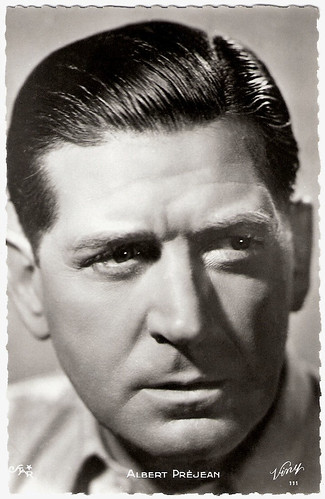
French postcard by Viny, no. 111. Photo: Star.
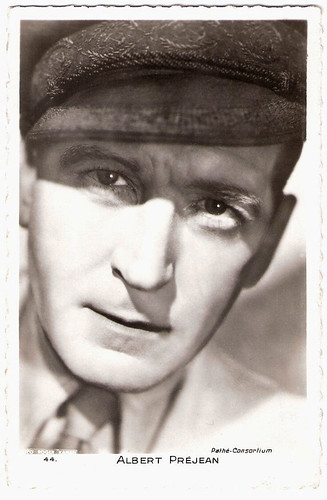
French postcard by Pathé Consortium, no. 44. Photo: Roger Karan.
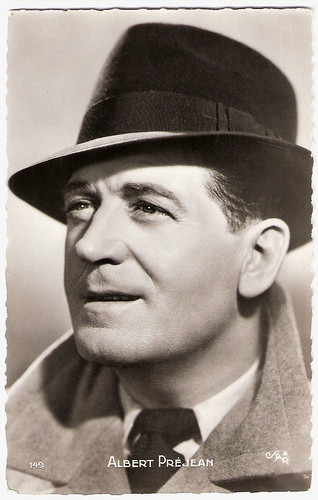
French postcard by Editions P.I., no. 149, offered by Victoria, Brussels, no. 639. Photo: Star.
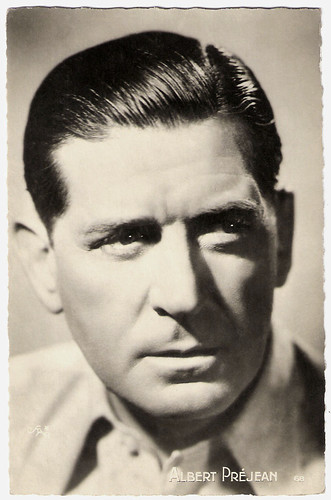
French postcard by Editions O.P., Paris, no. 68. Photo: Star.
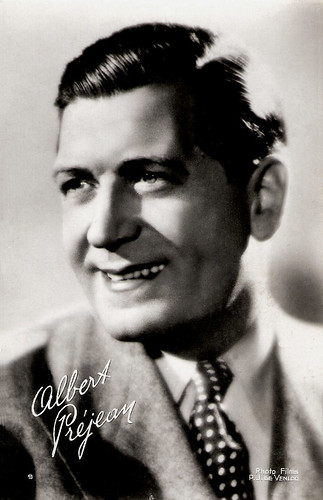
French postcard by Éditions et Publications cinématographiques, no. 9. Photo: Films P.J. de Venloo.
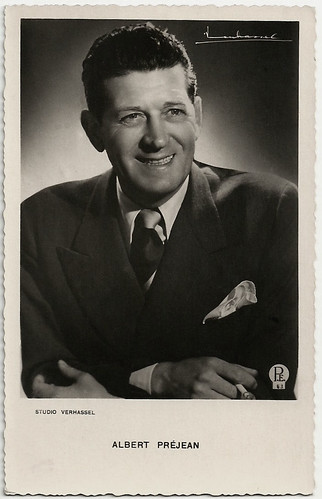
Belgian postcard by Photo Editions, Brussels, no. 63. Photo: Studio Verhassel, Brussels. This still-existing studio was founded in 1861.
Albert Préjean sings the title song of Sous les Toits de Paris (1930). Source: ghbook (YouTube).
Sources: Hal Erickson (AllMovie - Page now defunct), Craig Butler (AllMovie - Page now defunct), James Travers (Films de France - Now defunct), Hall de la Chanson (French - Page now defunct), AllMovie, PopMatters (Page now defunct) and IMDb.
This page was last updated on 17 May 2026.
German postcard. Photo: Verleih Hugo Engel-Film. Publicity still for Sous les Toits de Paris / Under the Roofs of Paris (1930).
French postcard by Editions Cinémagazine, no. 547. Photo: Albert Préjean as the symbolic figure of Le Soldat Français (The French soldier) in Verdun, visions d'histoire / Verdun, Visions of History (Léon Poirier, 1928).
French postcard by A.N. Paris, no. 753. Photo: Osso. Albert Préjean in Un Soir De Rafle / Night Raid (Carmine Gallone, 1931).
French postcard, no. 664. Photo: Film Sonor.
German Postcard by Ross Verlag, no. 6201/1, 1931-1932. Photo: Paramount.
René Clair's wild daydream
Albert Préjean was born in 1893 or 1894 (the sources differ) in Paris. Before entering the military, he worked as a boxer, nightclub entertainer and acrobat. During the First World War, he became a flying ace of the French army.
After the war, he decided to become an actor. His film debut was a bit part in the serial Les Trois mousquetaires / The Three Musketeers (Henri Diamant-Berger, 1921). His breakthrough was ironically a role as a pilot in the surrealistic Sci-Fi film Paris qui dort / Paris Asleep (René Clair, 1925).
Hal Erickson at AllMovie: "The Crazy Ray (Paris qui Dort) was a wild René Clair daydream which he deftly translated into his very first directorial effort. Deliberately invoking the early 'chase' films which distinguished the French cinema, Clair weaves an improbable tale of a genially loony scientist who utilises a magic ray (an effect created with stop-motion photography) on the unsuspecting citizens of Paris. The ray causes its victims to freeze in bizarre and often embarrassing positions. Those not affected by the ray take the opportunity to lift everything that isn't nailed down."
The cooperation with René Clair obviously went so well that it was continued in Le Fantôme du Moulin-Rouge / The Phantom of the Moulin-Rouge (1925), Le Voyage imaginaire / The Imaginary Voyage (1926) and Un chapeau de paille d'Italie / The Italian Straw Hat (1928).
In their first sound feature, Sous les Toits de Paris / Under the Roofs of Paris (1930), Préjean played the street performer Albert who leads the assembly line in singing the film's title song. Craig Butler at AllMovie: "From the moment Roofs opens, with a tracking shot that takes the audience from above the roofs of Paris and down into a working-class district of the city, it's clear that the film is in the hands of a master, and Clair has plenty of other tricks up his sleeve to keep the viewer engaged. Case in point: a wordless sequence that concentrates solely on the feet of two characters and tells more about where they are in their relationship than many pages of dialogue could."
French postcard by Cinémagazine-Edition, Paris, no. 589. Albert Préjean and Gaby Morlay in Les nouveaux messieurs / The New Gentlemen (Jacques Feyder, 1928).
French promotion postcard for Clacquesin, Extrait de Pins. Caption: "Under the Roofs of Paris, with gaiety and spirit I drink Clacquesin." 'Sous les toits de Paris' refers to one of Préjean's most popular films (René Clair, 1930).
French publicity still by Films Osso. Albert Préjean and Constant Rémy in Un soir de rafle / Night Raid (Carmine Gallone, 1930). Statens Filmcensur refers to the Danish Film censorship institution that took its final form with the Danish Cinema Act of 1938.
French postcard by Cinémagazine-Edition, Paris, no. 929. Photo: Les Films Osso. Albert Préjean and Annabella in Un soir de rafle / Dragnet Night (Carmine Gallone, 1931).
French postcard by P.C., Paris, no. 14. Photo: Films Osso. Albert Préjean sang the Slow-Fox 'Si l'on ne s'était pas connu' in Un soir de rafle (Carmine Gallone, 1931). Text by Léo Lelièvre fils, and music by Ph. Parès and G. van Parys. Copyright: Ed. Salabert, Paris, 1931.
French postcard by P.C., Paris, no. 13. Publicity card for Le chant du marin / Sailor's Song (Carmine Gallone, 1932).
German postcard by Ross Verlag, no. 5304/1, 1930-1931. Photo: Frhr. von Gudenberg, Berlin.
Princess Tam-Tam
Albert Préjean went on to play jeune premiers in L'Opéra de Quat'Sous / The Threepenny Opera (G.W. Pabst, 1931), Un soir de rafle / Dragnet Night (Carmine Gallone, 1931), the Operetta Dédé (René Guissart, 1934), L'Or dans la rue / The Gold in the Street (Curtis Bernhardt, 1934) and with Joséphine Baker in Princesse Tam-Tam / Princess Tam-Tam (Edmond T. Gréville, 1935).
Hal Erickson at AllMovie: "Princesse Tam-Tam is a satirical spin on the 'Pygamalion' concept: An uninhibited African girl (Baker) poses as a serene Indian princess, through the auspices of author Albert Prejean. A romance develops between the two (a plot device expressly forbidden by Hollywood's rules against miscegenation on screen), while Prejean's unfaithful wife fumes. Written by Josephine Baker's then-husband Pepito Abatino, the French/Tunisian Princesse Tam-Tam was banned outright in the States."
Préjean played Georges Simenon’s Maigret in Picpus (Richard Pottier, 1943), Cecile est morte! / Cecile Is Dead (Maurice Tourneur, 1944) and Les caves du 'Majestic' / Majestic Hotel Cellars (Richard Pottier, 1945). James Travers at Films de France: "It is hard to dispute that Albert Préjean is one of France’s most important film actors, but he is clearly miscast in the role of Maigret. His portrayal of the famed Gallic detective is about as bland and anaemic as it could be, with none of the character fashioned by Simenon in his novels."
His popularity in the cinema waned after WWII, and he spent the rest of his career as a chanson singer and actor on stage and in average-quality mainstream films. With his final film, Bonne chance, Charlie / Good Luck, Charlie (Jean-Louis Richard, 1962), he had appeared in a total of 88 films. Albert Préjean was married to actress Lysiane Rey. They had one child, actor Patrick Préjean.
French postcard by Viny, no. 111. Photo: Star.
French postcard by Pathé Consortium, no. 44. Photo: Roger Karan.
French postcard by Editions P.I., no. 149, offered by Victoria, Brussels, no. 639. Photo: Star.
French postcard by Editions O.P., Paris, no. 68. Photo: Star.
French postcard by Éditions et Publications cinématographiques, no. 9. Photo: Films P.J. de Venloo.
Belgian postcard by Photo Editions, Brussels, no. 63. Photo: Studio Verhassel, Brussels. This still-existing studio was founded in 1861.
Albert Préjean sings the title song of Sous les Toits de Paris (1930). Source: ghbook (YouTube).
Sources: Hal Erickson (AllMovie - Page now defunct), Craig Butler (AllMovie - Page now defunct), James Travers (Films de France - Now defunct), Hall de la Chanson (French - Page now defunct), AllMovie, PopMatters (Page now defunct) and IMDb.
This page was last updated on 17 May 2026.

No comments:
Post a Comment