German actress Barbara Frey (1941) was as a 16-year-old chosen to play the lead opposite Horst Buchholz in the romantic teenage drama Endstation Liebe/Last Stop Love (1958). After her debut, she took acting classes and played in more similar films. During the 1960s she also appeared in Italian films.

German postcard by Ufa, Berlin-Tempelhof, no. B.F. 1. Photo: Nora Filmverleih.

German postcard by Ufa, Berlin-Tempelhof, no. FK 3943. Retail price: 25 Pfg. Photo: Interwest / Gloria Film / Grimm. Publicity still for Endstation Liebe/Last Stop Love (Georg Tressler, 1958).
Barbara Frey was born Barbara Freyde in Berlin in 1941. She completed an apprenticeship as a tailor before she turned to acting.
By chance, the sixteen-year-old Frey came to the attention of director Georg Tressler who promptly cast her in the leading female role in the romantic teenage drama Endstation Liebe/Last Stop Love (Georg Tressler, 1958). Her co-star was teen idol Horst Buchholz who owed his big breakthrough to Tressler's film Die Halbstarken (Georg Tressler, 1956). In the romantic drama Endstation Liebe/Last Stop Love, Buchholz played a womaniser who unexpectedly falls in love with his latest conquest (Frey).
Frey's voice had to be dubbed by Johanna von Koczian. The film's screenwriter, Will Tremper, recalled in his book 'Meine wilden Jahre' (My Wild Years): "Jürgl (Georg Tressler) found a lovely girl of perhaps 17, who seemed all too harmless to me, called Barbara Freyte in a clothing factory on Fehrbelliner Platz - my only contribution to his discovery was an eraser, with which I immediately rubbed out the last two letters of her name." Endstation Liebe received good reviews but could not match the box office success of Die Halbstarken as hoped. Nevertheless, it established Frey as a promising talent.
After her debut, Barbara took acting classes from Marlise Ludwig. She initially appeared mainly in youth and romantic dramas. Examples were ...und noch frech dazu!/And Saucy at That (Rolf von Sydow, 1959) and Mit 17 weint man nicht/17 Year Olds Don't Cry (Alfred Vohrer, 1960) with Matthias Fuchs. In Georg Tressler's social melodrama Geständnis einer Sechzehnjährigen/Confession of a Sixteen-year-old (1960), she played a teenager who wants to prevent her parents from divorcing. In the social drama Ich kann nicht länger schweigen/The Tragedy of Silence (Wolfgang Bellenbaum, 1961), she played a sixteen-year-old who undergoes an illegal abortion out of desperation and dies in the process. The film deals with the §218 of German law that forbade doctors to perform abortions in the 1960s.
Marcel Ophüls cast Frey as a pregnant woman in his German episode München/Munich of the much-praised anthology film Liebe mit zwanzig/L’amour à vingt ans/Love at Twenty (Francois Truffaut, Renzo Rossellini, Shintaro Ishihara, Marcel Ophüls, Andrzej Wajda, 1962). The French-produced omnibus project of Pierre Roustang consisted of five little 'cinemanecdotes' about the working of young love, each with a different director from a separate country. The episodes are held together by a series of still photographs of young lovers by Henri Cartier-Bresson. The film was entered into the 12th Berlin International Film Festival. Critic Bosley Crowther wrote in The New York Times that the "German episode, directed by Marcel Ophuls, son of Max, gives a rather dubious notion of love in Germany. It tells how an unwed mother finally hooks the casual father of her child. It is charming but somewhat sentimental for the bitter story it tells."

German postcard by Kolibri-Verlag, Minden/Westf., no. 2826. Retail price: 25 Pfg. Photo: Interwest / Gloria Film / Grimm. Barbara Frey and Horst Buchholz in Endstation Liebe/Last Stop Love (Georg Tressler, 1958).

German postcard by Kolibri-Verlag, Minden/Westf., no. 113. Retail price: 25 Pfg. Photo: Interwest / Gloria Film / Schlawe. Publicity still for Endstation Liebe/Last Stop Love (Georg Tressler, 1958).
In the early 1960s, Barbara Frey appeared mainly in lighter fare. She acted in the crime thriller Mann im Schatten/Man in the Shadows (Arthur Maria Rabenalt, 1961) with Helmut Qualtinger and Ellen Schwiers and the Schlager comedies Was macht Papa denn in Italien?/What Is Father Doing in Italy? (Hans Dieter Schwarze, 1961) starring Willy Fritsch and Muss i denn zum Städtele hinaus/I Must Go to the City (Hans Deppe, 1962) starring singer Vico Torriani. In Austria, she made the cross-dressing farce Unsere tollen Tanten in der Südsee/Our Crazy Aunts in the South Seas (Rolf Olsen, 1964), as the girlfriend of Udo Jürgens.
From 1963, Frey also took on several television roles for example in the crime thriller Nachtzug D 106/Night Train D 106 (Helmuth Ashley, 1963) and the comedy Brave Diebe/Brave Thieves (Frank Scharf, 1965). In the cinema, she appeared in crime films such as the Austrian-French co-production Das Haus auf dem Hügel/The House on the Hill (Werner Klingler, 1964) and the Eurospy film Kommissar X: In den Klauen des goldenen Drachen/So Darling So Deadly (Gianfranco Parolini, 1966) starring Tony Kendall and Brad Harris. However, offers in Germany and Austria became rarer.
Instead, Frey appeared in several Italian (co-)productions. In the Italian-Spanish-German historical adventure film I Cento cavalieri/100 Horsemen (Vittorio Cottafavi, 1964), she played a Spanish mayor's daughter who falls in love with the son of a hostile sheikh. While shooting this film, Frey met the American actor Mark Damon, who worked almost exclusively in Europe. Later, the two became a couple. Frey also shot the Spaghetti Westerns Uno straniero a Sacramento/ Bounty for Ringo (Sergio Bergonzelli, 1965) starring bodybuilder Mickey Hargitey, and Pistoleros de Arizona/The Hunted of the Sierra Nevada (Alfonso Balcázar, 1965) in a cameo as a saloon girl.
With Mark Damon, she also starred in the realistic Italian-German Western Requiescant/Mögen sie in Frieden ruh'n/Kill and Pray (Carlo Lizzani, 1967), with Lou Castel as the hero and director Pier Paolo Pasolini as a priest. Frey played the hero's kidnapped stepsister and Mark Damon played against his image the vampire-like villain. The film was praised by critics and grossed almost half a billion Lire in Italy.
A short time later, Barbara Frey retired from acting. It is unknown whether the reason was a lack of role offers or her relationship with Mark Damon. She played her last role on German television in the Francis Durbridge Mini-series Ein Mann namens Harry Brent/A Man Called Harry Brent (1967) with Günther Ungeheuer. She married Mark Damon in 1971, but the marriage only lasted two years. During this time, Frey only made an uncredited appearance as a nurse in the American film Slaughterhouse-Five (George Roy Hill, 1972). After that, she no longer appeared as an actress.

German Postcard by Kolibri-Verlag G.m.b.h., Minden-Westf, no. 1285. Photo: Ultrafilm / Lilo. Publicity card for Mit 17 weint man nicht! (Alfred Vohrer, 1960).
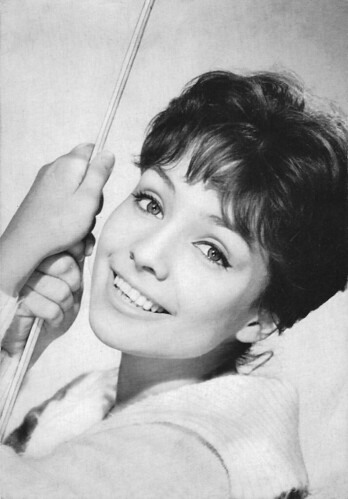
German postcard by WS-Druck, Wanne-Eickel, no. 563. Photo: Lilo / Europa.
Sources: Bosley Crowther (The New York Times), Filmportal (German), AllMovie, Wikipedia (German, French and English) and IMDb.
This post was last updated on 14 April 2024.
German postcard by Ufa, Berlin-Tempelhof, no. B.F. 1. Photo: Nora Filmverleih.
German postcard by Ufa, Berlin-Tempelhof, no. FK 3943. Retail price: 25 Pfg. Photo: Interwest / Gloria Film / Grimm. Publicity still for Endstation Liebe/Last Stop Love (Georg Tressler, 1958).
Romantic Teenage Dramas
Barbara Frey was born Barbara Freyde in Berlin in 1941. She completed an apprenticeship as a tailor before she turned to acting.
By chance, the sixteen-year-old Frey came to the attention of director Georg Tressler who promptly cast her in the leading female role in the romantic teenage drama Endstation Liebe/Last Stop Love (Georg Tressler, 1958). Her co-star was teen idol Horst Buchholz who owed his big breakthrough to Tressler's film Die Halbstarken (Georg Tressler, 1956). In the romantic drama Endstation Liebe/Last Stop Love, Buchholz played a womaniser who unexpectedly falls in love with his latest conquest (Frey).
Frey's voice had to be dubbed by Johanna von Koczian. The film's screenwriter, Will Tremper, recalled in his book 'Meine wilden Jahre' (My Wild Years): "Jürgl (Georg Tressler) found a lovely girl of perhaps 17, who seemed all too harmless to me, called Barbara Freyte in a clothing factory on Fehrbelliner Platz - my only contribution to his discovery was an eraser, with which I immediately rubbed out the last two letters of her name." Endstation Liebe received good reviews but could not match the box office success of Die Halbstarken as hoped. Nevertheless, it established Frey as a promising talent.
After her debut, Barbara took acting classes from Marlise Ludwig. She initially appeared mainly in youth and romantic dramas. Examples were ...und noch frech dazu!/And Saucy at That (Rolf von Sydow, 1959) and Mit 17 weint man nicht/17 Year Olds Don't Cry (Alfred Vohrer, 1960) with Matthias Fuchs. In Georg Tressler's social melodrama Geständnis einer Sechzehnjährigen/Confession of a Sixteen-year-old (1960), she played a teenager who wants to prevent her parents from divorcing. In the social drama Ich kann nicht länger schweigen/The Tragedy of Silence (Wolfgang Bellenbaum, 1961), she played a sixteen-year-old who undergoes an illegal abortion out of desperation and dies in the process. The film deals with the §218 of German law that forbade doctors to perform abortions in the 1960s.
Marcel Ophüls cast Frey as a pregnant woman in his German episode München/Munich of the much-praised anthology film Liebe mit zwanzig/L’amour à vingt ans/Love at Twenty (Francois Truffaut, Renzo Rossellini, Shintaro Ishihara, Marcel Ophüls, Andrzej Wajda, 1962). The French-produced omnibus project of Pierre Roustang consisted of five little 'cinemanecdotes' about the working of young love, each with a different director from a separate country. The episodes are held together by a series of still photographs of young lovers by Henri Cartier-Bresson. The film was entered into the 12th Berlin International Film Festival. Critic Bosley Crowther wrote in The New York Times that the "German episode, directed by Marcel Ophuls, son of Max, gives a rather dubious notion of love in Germany. It tells how an unwed mother finally hooks the casual father of her child. It is charming but somewhat sentimental for the bitter story it tells."
German postcard by Kolibri-Verlag, Minden/Westf., no. 2826. Retail price: 25 Pfg. Photo: Interwest / Gloria Film / Grimm. Barbara Frey and Horst Buchholz in Endstation Liebe/Last Stop Love (Georg Tressler, 1958).
German postcard by Kolibri-Verlag, Minden/Westf., no. 113. Retail price: 25 Pfg. Photo: Interwest / Gloria Film / Schlawe. Publicity still for Endstation Liebe/Last Stop Love (Georg Tressler, 1958).
Spaghetti Westerns
In the early 1960s, Barbara Frey appeared mainly in lighter fare. She acted in the crime thriller Mann im Schatten/Man in the Shadows (Arthur Maria Rabenalt, 1961) with Helmut Qualtinger and Ellen Schwiers and the Schlager comedies Was macht Papa denn in Italien?/What Is Father Doing in Italy? (Hans Dieter Schwarze, 1961) starring Willy Fritsch and Muss i denn zum Städtele hinaus/I Must Go to the City (Hans Deppe, 1962) starring singer Vico Torriani. In Austria, she made the cross-dressing farce Unsere tollen Tanten in der Südsee/Our Crazy Aunts in the South Seas (Rolf Olsen, 1964), as the girlfriend of Udo Jürgens.
From 1963, Frey also took on several television roles for example in the crime thriller Nachtzug D 106/Night Train D 106 (Helmuth Ashley, 1963) and the comedy Brave Diebe/Brave Thieves (Frank Scharf, 1965). In the cinema, she appeared in crime films such as the Austrian-French co-production Das Haus auf dem Hügel/The House on the Hill (Werner Klingler, 1964) and the Eurospy film Kommissar X: In den Klauen des goldenen Drachen/So Darling So Deadly (Gianfranco Parolini, 1966) starring Tony Kendall and Brad Harris. However, offers in Germany and Austria became rarer.
Instead, Frey appeared in several Italian (co-)productions. In the Italian-Spanish-German historical adventure film I Cento cavalieri/100 Horsemen (Vittorio Cottafavi, 1964), she played a Spanish mayor's daughter who falls in love with the son of a hostile sheikh. While shooting this film, Frey met the American actor Mark Damon, who worked almost exclusively in Europe. Later, the two became a couple. Frey also shot the Spaghetti Westerns Uno straniero a Sacramento/ Bounty for Ringo (Sergio Bergonzelli, 1965) starring bodybuilder Mickey Hargitey, and Pistoleros de Arizona/The Hunted of the Sierra Nevada (Alfonso Balcázar, 1965) in a cameo as a saloon girl.
With Mark Damon, she also starred in the realistic Italian-German Western Requiescant/Mögen sie in Frieden ruh'n/Kill and Pray (Carlo Lizzani, 1967), with Lou Castel as the hero and director Pier Paolo Pasolini as a priest. Frey played the hero's kidnapped stepsister and Mark Damon played against his image the vampire-like villain. The film was praised by critics and grossed almost half a billion Lire in Italy.
A short time later, Barbara Frey retired from acting. It is unknown whether the reason was a lack of role offers or her relationship with Mark Damon. She played her last role on German television in the Francis Durbridge Mini-series Ein Mann namens Harry Brent/A Man Called Harry Brent (1967) with Günther Ungeheuer. She married Mark Damon in 1971, but the marriage only lasted two years. During this time, Frey only made an uncredited appearance as a nurse in the American film Slaughterhouse-Five (George Roy Hill, 1972). After that, she no longer appeared as an actress.
German Postcard by Kolibri-Verlag G.m.b.h., Minden-Westf, no. 1285. Photo: Ultrafilm / Lilo. Publicity card for Mit 17 weint man nicht! (Alfred Vohrer, 1960).
German postcard by WS-Druck, Wanne-Eickel, no. 563. Photo: Lilo / Europa.
Sources: Bosley Crowther (The New York Times), Filmportal (German), AllMovie, Wikipedia (German, French and English) and IMDb.
This post was last updated on 14 April 2024.