
British postcard in the "Pictures" Portrait Gallery, no. 137.
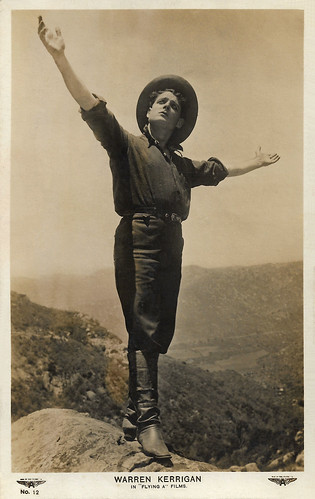
American postcard by Flying A, no. 12. Photo: Flying A.
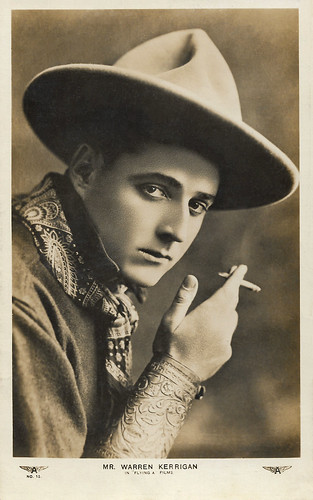
American postcard by Flying A, no. 15. Photo: Flying A.

French postcard by Cinémagazine-Edition, Paris, no. 150.
The Gibson Man
J. (Jack) Warren Kerrigan was born in New Albany, Indiana, in 1879. He worked as a warehouse clerk in his teens until a chance arrived to appear in a vaudeville production. He continued to act in travelling stock productions, though he took a brief time away from the stage to attend the University of Illinois.
By the time he was 30 years old, he started to act as a leading man in short films for Essanay Studios from 1910 onwards. In 1910, he already acted in some 20 short films at Essanay: Westerns, comedies, etc. Quite a few were directed by Gilbert ‘Broncho Billy' M. Anderson.
In the very same year, Kerrigan shifted to the American Film Corporation, where Kerrigan was often cast as a modern man of the age. His nickname was 'The Gibson Man'. Allan Dwan directed some of his films for American. The production at the studio must have had killing time schedules, as according to IMDb, some 90 short films were produced in 1911, almost 100 in 1912, and some 75 in 1913. So basically, two films were produced every week.
In 1913, both Dwan and Kerrigan shifted to the Victor company. In 1914, some 35 films were made at |Victor. Kerrigan made his first feature-length films that year as well, such as the six-reeler Samson (J. Farrell MacDonald, 1914), with Kerrigan’s sister Kathleen co-acting as Delilah, and he himself in the title role. The choreography, sets (based on Gustave Doré), and costumes were praised in The Moving Picture World, while the plot was criticised as ‘spineless’. About Kerrigan: “It would be hard to find a finer Samson than is Warren Kerrigan, who is more than the average in size, is perfect physically and is youthful and graceful.”
Far into 1916, Kerrigan would continue, however, to act mainly in shorts by Victor. In 1916, he officially went over to Universal - even if Victor, by 1913, had been bought by Universal - and started to appear in features regularly. Titles were a.o. The Silent Battle (Jack Conway, 1916) with Lois Wilson, The Beckoning Trail (Jack Conway, 1916), The Social Buccaneer (Jack Conway, 1916), and The Measure of Man (Jack Conway, 1916). Kerrigan continued to make shorts as well, at Mutual, but also at American, often with Allan Dwan as director.

American postcard by Ladies' World.

American postcard by Krauss Mfg. Co. New York. Photo: American Film Corporation.

British postcard, 1915. Photo: The Trans-Atlantic Film Co. / Victor / Universal. Publicity still for Value Received (dir. unknown, 1914).

French postcard by Editions Cinémagazine, no. 150.
A slump in popularity
In May 1917, J. Warren Kerrigan was nearing the end of a four-month-long personal appearance publicity tour that had taken him across the United States and into Canada. At one of the final stops, a reporter for The Denver Times asked Kerrigan if he would be joining the (First World) war. Kerrigan replied: 'I am not going to war. I will go, of course, if my country needs me, but I think that first, they should take the great mass of men who aren't good for anything else or are only good for the lower grades of work. Actors, musicians, great writers, artists of every kind—isn't it a pity when people are sacrificed who are capable of such things, of adding to the beauty of the world.'
Picked up and reprinted in newspapers across the country, this statement stunned his fans, and his popularity plummeted, never to fully recover. Family members later reported in 'Behind the Screen' (2001) by William J. Mann that his slump in popularity was more due to his living with his mother and his partner, silent movie actor James Vincent, in the same house, not wanting to marry, and not having a business manager to overcome the negative publicity, in contrast to the later protection of stars tied to the Hollywood majors.
What partly contradicts this controversy of 1917 is that Kerrigan had a relatively steady production up to 1920: six features in 1918, seven in 1919, seven in 1920. Only then, a gap in his career came in 1921-1922. However, when director James Cruze cast him as the rugged lead in The Covered Wagon (1923), Kerrigan found himself back on top. He aced in six more features the same year.
In the spring of 1924, after John Barrymore bowed out, Kerrigan was assigned the starring role in the Vitagraph production of Captain Blood. While the film was a moderate success, critics were unmoved. In December 1924, Kerrigan was injured in an automobile accident in Illinois. According to the Des Moines Tribune, his face was so badly scarred that he would not star in films again. Whatever happened, Captain Blood was Kerrigan’s last substantial film.
All in all, he had starred in over 300 films up to 1924. James Warren Kerrigan was homosexual, never married, and lived with his lover James Carroll Vincent from about 1914 to Kerrigan's death in 1947. After Kerrigan had died of pneumonia, Vincent married, but after nine months committed suicide. Both men were buried at the Forest Lawn Memorial Park in Glendale, California.

Spanish card by La Novela Semanal Cinematográfica, no. 136.

Spanish collector card by Chocolate Amatller, Series G, Artist 10, no. 32.

British postcard.

British postcard in the Picturegoer Series, London, no. 147a.
Sources: Jim Beaver (IMDb), Wikipedia (English and German) and IMDb.

No comments:
Post a Comment