
West German postcard by Gebr. König Postkartenverlag, Köln, in the series Die Leidenschaften des Rosa von Praunheim, no. 10/1. Photo: Till Leeser. Rosa von Praunheim and Milli Molton in Monolog eines Stars / Monologue of a Star (Rosa von Praunheim, 1974).

West German postcard by Gebr. König Postkartenverlag, Köln, in the series Die Leidenschaften des Rosa von Praunheim, no. Luzi Kryn and Lou van Burg in Die Berliner Bettwurst (Rosa von Praunheim, 1973).

West German postcard by Gebr. König Postkartenverlag, Köln, in the series Die Leidenschaften des Rosa von Praunheim, no. Rosa von Praunheim in Ein Virus kennt keine Moral / A Virus Knows No Morals (Rosa von Praunheim, 1986).
Catalysing the modern LGBTQ+ rights movement in Germany
Rosa von Praunheim was born Holger Radtke in 1942 in Riga Central Prison in Nazi-occupied Latvia during World War II. His biological mother, Edith Radtke, died in 1946 in the Wittenauer Heilstätten, a psychiatric hospital in Berlin.
After his birth, Holger Radtke was adopted and spent his early years in East Berlin. After his adoption, he went through life as Holger Mischwitzky. Growing up in East Berlin, von Praunheim and his family fled to West Germany in 1953. They settled first in the Rhineland and later in Frankfurt am Main. It was not until 2000 that Von Praunheim learned the circumstances of his birth, when his adoptive mother, Gertrud Mischwitzky, told him that she was not his biological mother and that he had been adopted from an orphanage in Latvia.
He discovered the fate of his biological mother in 2006 after a lengthy investigation. He documented his quest in his film Meine Mütter - Spurensuche in Riga / Two Mothers (Rosa von Praunheim, 2007), which was shown at the Tribeca Film Festival. His pseudonym is a double tribute: 'Rosa' references the pink triangle worn by homosexuals in concentration camps, and 'Praunheim' the Frankfurt district where he was raised after being adopted by the Mischwitzky family.
Von Praunheims career exploded with the release of the seminal documentary Nicht der Homosexuelle ist pervers, sondern die Situation, in der er lebt / It Is Not the Homosexual Who Is Perverse, But the Society in Which He Lives (Rosa von Praunheim, 1971). This film did more than depict gay life. Nicht der Homosexuelle ist pervers, sondern die Situation, in der er lebt / It Is Not the Homosexual Who Is Perverse, But the Society in Which He Lives actively catalysed the modern LGBTQ+ rights movement in West Germany and led to the formation of over 50 political groups.
In the early 1970s, he lived for some time in the United States where he made a series of documentaries about the post-Stonewall American gay scene. In Armee der Liebenden oder Aufstand der Perversen / Army of Lovers or Revolt of the Perverts (Rosa von Praunheim, 1979) he took on the American gay and lesbian movement from the 1950s until the late 1970s. The film features interviews, photo montages, and footage of marches and rallies. Among those interviewed and who offered commentary include gay porn director Fred Halsted, American cleric Troy Perry, Mexican novelist John Rechy and Grace Jones.

West German postcard by Gebr. König Postkartenverlag, Köln, in the series Die Leidenschaften des Rosa von Praunheim, no. 10/6. Lutzi Kryn in Die Bettwurst / The Bed Sausage (Rosa von Praunheim, 1970).

German postcard in the series Die Leidenschaften des Rosa von Praumheim by Gebr. König Postkartenverlag, Köln (Cologne), no. 10/10. Photo: Michael Oblowitz. Divine and Tally Brown in Tally Brown, New York (Rosa von Praunheim, 1979).
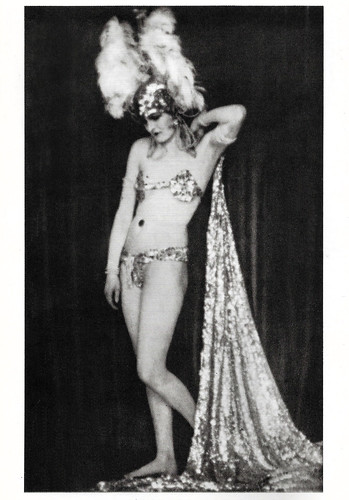
West German postcard by Gebr. König Postkartenverlag, Köln (Cologne), Serie 103, no. 3 of 10. Photo: Dora Kalmus (d'Ora). Anita Berber in dance costume 'Hellogabal', 1922. Rosa von Praunheim’s film Anita - Tänze des Lasters / Anita: Dances of Vice (Rosa von Praunheim, 1987) centres around the life of Anita Berber.
Mentoring a new generation of filmmakers
Rosa von Praunheim's filmography exceeded 150 productions. His work is characterised by a campy, avant-garde style that frequently centres on strong female characters and queer subcultures.
His major works include Die Bettwurst / The Bed Sausage (Rosa von Praunheim, 1971), a cult parody of bourgeois marriage, Stadt der verlorenen Seelen / City of Lost Souls (Rosa von Praunheim, 1983), a queer-punk musical that remains a cornerstone of transgender cinema, and Der Einstein des Sex / The Einstein of Sex (Rosa von Praunheim, 1999), a biopic of the pioneering sexologist Magnus Hirschfeld. Anita - Tänze des Lasters / Anita: Dances of Vice (Rosa von Praunheim, 1987), the life story of Anita Berber, a scandalous nude dancer in Berlin in the 1920s, attracted international attention.
Never one to shy away from scandal, von Praunheim famously caused a national uproar in 1991 when he outed German talkshow host Alfred Biolek and comedian Hape Kerkeling on the talk-show Explosiv - der heiße Stuhl to demand solidarity during the AIDS crisis. Despite such polarising tactics, his influence on the industry is undeniable. He served as a professor of directing at the Hochschule für Film und Fernsehen in Potsdam, the Film University of Babelsberg (1999–2006). There, he mentored a new generation of filmmakers, known as 'Rosa’s Children,' including Tom Tykwer.
Till his death, von Praunheim remained remarkably active. His last project, Satanische Sau / Satanic Sow (Rosa von Praunheim, 2025), won the Teddy Award for Best Documentary / Essay Film at the 2025 Berlin International Film Festival. Other recent contributions include the documentary Dreißig Jahre an der Peitsche / Thirty Years with the Whip (Rosa von Praunheim, 2024) and the docudrama Rex Gildo – Der letzte Tanz / Rex Gildo - Der letzte Tanz (Rosa von Praunheim, 2022).
Rosa von Paunheim died in Berlin, where he resided with his longtime partner and collaborator, Oliver Sechting. They married on 12 December 2025. From 1969 to 1971, he was married to actress Carla Egerer, with whom he made several films. In 2018, he told the German magazine Schwulissimo that it was a marriage of convenience. "We had been given a marriage loan that we used for filming: that was the whole reason we got married."

West German postcard by Gebr. König Postkartenverlag, Köln, in the series Die Leidenschaften des Rosa von Praunheim, no. 10/3. Photo: Meysenburg. Carla Egerer in the performance 'Aulaulu' (1968).

West German postcard by Gebr. König Postkartenverlag, Köln, in the series Die Leidenschaften des Rosa von Praunheim, no. 10/4. Image: Cover of the magazine Death, August 1978, from the book Gibt es Sex nach dem Tode by Rosa von Praunheim, 1981.

German postcard by L.M. Kartenvertrieb, Berlin, no. 01916. Photo: Wilhelm L. Reinke. Lotti Huber (1912-1998) was a German actress, singer, dancer and avant-garde artist. Her breakthrough came late in the 1980s in films by Rosa von Praunheim, like Unsere Leichen leben noch / Our Corpses Still Live (Rosa von Praunheim, 1981) and Anita - Tänze des Lasters / Anita: Dances of Vice (Rosa von Praunheim, 1987). Lotti became the star of the Berlin Underground of the 1990s and called her autobiography ‘Diese Zitrone hat noch viel Saft!’ (This lemon still has a lot of juice!).
Sources: Geertruid Peene (NOS - Dutch), Wikipedia (German and English) and IMDb.

No comments:
Post a Comment