
British postcard by Pyramid Posters, Leicester, no. PC 9651. Image: Touchstone Pictures / Disney. Sandyclaws in The Nightmare Before Christmas (Henry Selick, 1993).

British postcard by Pyramid Posters, Leicester, no. PC 9652. Image: Touchstone Pictures / Disney. Sally in The Nightmare Before Christmas (Henry Selick, 1993).

Italian poster postcard by CIAK. Image: Touchstone Pictures / Disney. Poster for The Nightmare Before Christmas (Henry Selick, 1993).
Santa Claus in the lair of Oogie Boogie
The Nightmare Before Christmas (1993), also known as Tim Burton's The Nightmare Before Christmas, was directed by Henry Selick in his feature directorial debut, and produced and based on a story and characters conceived by Tim Burton. Burton situated the film in Halloween Town, a town in the holiday world that is part of the realm of dreams. The town is completely dedicated to the organisation of the Halloween celebrations all year round. In that same holiday world, Christmas Town and Easter Town also exist, accessible through a kind of 'interdimensional' portal.
The local hero in Halloween Town is the bone man, Jack Skellington. He's known as the Pumpkin King because he's a master at scaring people, the main purpose of Halloween. However, Skellington has simply grown bored after all those years of Halloween and longs for something new in his life. Lost in his thoughts, he takes a walk through the woods and encounters places he's never been before. Shortly after, his dream comes true. By opening a Christmas tree-shaped door in a tree trunk, Skellington is drawn into Christmas Town. There, after his initial confusion, he immediately feels the cosy and peaceful atmosphere.
He wants this too and decides that Christmas should become his celebration instead of Halloween. Full of ideas, he returns to Halloween Town. Sally, a piece of rag-stitched Sally, doesn't feel good about it, but the rest of the town enthusiastically supports Skellington's plan. Everyone gets to work preparing for the upcoming Christmas. The townspeople, however, have very different ideas about what's cosy and what constitutes a nice gift. For example, they see monstrous toys as the ideal Christmas gift. Sally admires Jack but has a bad feeling. She tells him as much, but he's dismissive and makes plans to take Santa's place on December 25th.
To carry out this plan, he has Santa Claus (Sandy Claws) captured by three monstrous children named Lock, Shock, and Barrel. They take him to the lair of Oogie Boogie, a gambling ogre. Meanwhile, Jack Skellington heads to town to deliver the Christmas presents in his newly built sleigh, consisting of a coffin, skeleton reindeer, and his ghost dog, Zero, with a red, glowing nose.
This is the beginning of what will become the most horrific Christmas Day ever. Before Jack realises what he's done, his sleigh is shot out of the sky by soldiers. He rushes back to Halloween Town and frees the real Santa Claus and the now-captive Sally from Oogie Boogie's lair, who was about to murder them. Santa Claus, it turns out, can still save the day. Skellington discovers that what he's been missing from his life isn't Christmas, but love. He and Sally fall in love. Moreover, Jack's performance as Santa has given him inspiration and a wealth of new ideas for the next Halloween celebration.
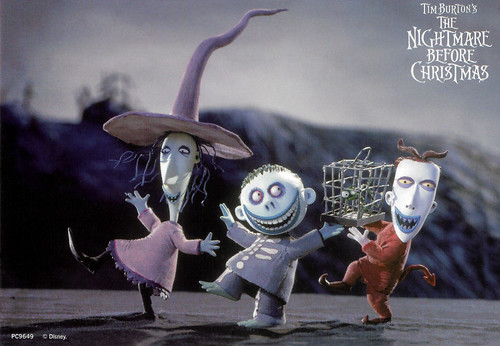
British postcard by Pyramid Posters, Leicester, no. PC 9649. Image: Disney. Spooky kids in The Nightmare Before Christmas (Henry Selick, 1993).

British postcard by Pyramid Posters, Leicester, no. PC 9650. Image: Touchstone Pictures / Disney. Scene from The Nightmare Before Christmas (Henry Selick, 1993).
400 heads were needed for the various facial expressions
In 1982, while still working as an animator at Walt Disney Productions, Tim Burton wrote a three-page poem called 'The Nightmare Before Christmas'. He drew inspiration from the television specia Rudolph the Red-Nosed Reindeer (Larry Roemer, 1964), the animated TV film How the Grinch Stole Christmas (Chuck Jones, Ben Washam, 1966), and the 1823 poem 'A Visit from St. Nicholas ('Twas The Night Before Christmas)' by Clement Clarke Moore. After the success of Burton's stop-motion short Vincent (Tim Burton, 1982), Disney began making plans to adapt Burton's poem into a short film.
Rick Heinrichs and Burton drafted a preliminary script and developed several characters. The short film never materialised, but over the years, Burton lingered on the idea of a film. In 1990, he discovered that Disney still held the film rights to the story and made a development deal with Walt Disney Studios. He made plans to produce a feature film instead of a short film and received the green light from Disney.
The Nightmare Before Christmas (1993) was Burton's third consecutive Christmas-themed film. He was unable to direct the film himself due to his work directing Batman Returns (Tim Burton, 1992), so Henry Selick took over. Burton approached Michael McDowell, with whom he had previously collaborated on Beetlejuice, to complete the film's script. However, Burton insisted that it be a musical. He hired his longtime collaborator Danny Elfman to compose the film's songs. Elfman later revealed that writing the film's 10 songs was one of his easiest tasks ever.
Production began in July 1991 with a crew of 200. For the sets, the filmmakers drew heavily from the work of artists from various disciplines: Ray Harryhausen, Ladislas Starevich, Edward Gorey, Charles Addams, Jan Lenica, Francis Bacon, and Wassily Kandinsky. It was the first film made entirely with the stop-motion technique that Tim Burton used in several of his films for its surreal quality. 227 puppets were created for the characters. For the main character, Jack, alone, 400 heads were needed for the various facial expressions. The character Sally had 10 faces, each with 11 different emotions and expressions. In the final stages of production, Disney added to the film by having some of the backgrounds drawn using traditional animation.
Disney initially released the film through the Touchstone Pictures label because the studio believed the film's gothic tone would be "too dark and scary for kids". The Nightmare Before Christmas (1993) was well to very well-received by critics. However, many critics noted that the film's story strongly resembled 'Dr. Seuss's How the Grinch Stole Christmas'. Bethany Cox at IMDb: "Is it an animated classic. Yes, I think it is! It is wonderfully weird yet lots of fun as well. Visually and technically, the film looks absolutely amazing, with wonderful Gothic backgrounds and detailed colouring. Skellington silhouetted against the moonlight is quite possibly the film's most haunting image. The story is great, about Jack Skellington discovering Christmas Town, but he doesn't understand the concept, so he kidnaps Santa Claus. And the characters are endearing and weird, ranging from jazz-playing zombies, four-tenor-like vampires to a wolf man." Wikipedia: "While initially a modest box-office hit, it has since garnered a large cult following and is widely regarded as one of the greatest animated films of all time."

American postcard by Walt Disney Art Classics, no. 1217555. Image: Touchstone Pictures / Disney. The Pumpkin King in The Nightmare Before Christmas (Henry Selick, 1993).

Dutch poster postcard by Boomerang Freecards. Image: Touchstone Pictures / Disney. Poster for The Nightmare Before Christmas (Henry Selick, 1993). Captions: Get ready for the weirdest Christmas ever. An inventive, funny, brilliantly designed, bizarre fairy tale, using the latest stop-motion animation techniques.
Sources: Bethany Cox (IMDb), Wikipedia (Dutch and English) and IMDb.

No comments:
Post a Comment