
Spanish postcard by Productos Compactos, no. 44523. Ray Milland and Jean Arthur in Easy Living (Mitchell Leisen, 1937).

French postcard by EC, no. 561. Photo: Paramount Pictures. Fredric March in Death Takes a Holiday (Mitchell Leisen, 1934).

Dutch postcard. Dorothy Lamour in Swing High, Swing Low (Mitchell Leisen, 1937). Costume by Travis Banton. Collection: Marlene Pilaete.

German collector card by Ross Verlag. Photo: Paramount. Don Ameche and Claudette Colbert in Midnight (Mitchell Leisen, 1939).
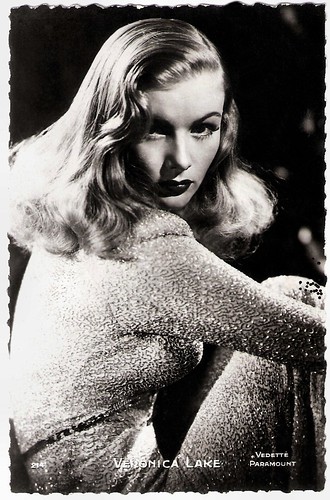
French postcard by Editions P.I., Paris, no. 214. Photo: Eugene Robert Richee / Paramount. Veronica Lake in I Wanted Wings (Mitchell Leisen, 1941).

French postcard by Editions P.I., Paris, no. 204. Photo: Paramount. Ginger Rogers in Lady in the Dark (Mitchell Leisen, 1944).
The women in Leisen’s films are front and centre
James Mitchell Leisen was born in 1898 in Menominee, Michigan. Leisen grew up in St. Louis with his mother, following her divorce from his father, a partner in a brewery company. From an early age, 'Mitch' suffered the effects of a poorly performed foot operation, which left him with a permanent limp. This condition had a lasting impact on his life. His stepfather sent him to military school because he and his mother were concerned about what they perceived to be his lack of masculinity. Leisen later attended Washington University in St. Louis, where he studied architecture. After his studies, he moved to Chicago to work in the advertising section of the art department for the Chicago Tribune. He held a second job with the architectural firm Marshall & Fox, while acting in his spare time.
Leisen moved to Los Angeles in an effort to enter the film industry. Although he had little success as an actor, he found work designing sets for community theatre. He was soon hired as a costume designer by Cecil B. DeMille, beginning with Male and Female (Cecil B. DeMille, 1919). He became a production designer for Don’t Change Your Husband (Cecil B. DeMille, 1919). DeMille was known for his despotic nature, but Leisen was one of his few colleagues at Paramount with whom he got along. We worked for DeMille until 1922, then moved on to United Artists to design costumes for Douglas Fairbanks, such as Robin Hood (Allan Dwan, 1922) and The Thief of Bagdad (Raoul Walsh, 1924). Leisen later also did the production design for De Mille's films The King of Kings (1927), Dynamite (1929), Madam Satan (1930) and The Sign of the Cross (1932), for which he worked both as a production designer and assistant director.
At the Academy Awards ceremony in April 1930, Mitchell Leisen was nominated for an Oscar in the Best Production Design category for his work on the film Dynamite (Cecil B. DeMille, 1929). He worked in the dual capacity of costume designer and art director at MGM (1929-1931) and at Paramount (1932-1933). Then he became Paramount's most reliable contract director (1933-1951), noted for visual elegance and for his ability to direct actresses. He continued to design costumes for many of his cast members well into his later directing career. After serving as the assistant director to Stuart Walker on two films in 1933, Leisen was given his chance to solo direct Cradle Song (1933). Then he directed the elegantly made allegory Death Takes a Holiday (1934). Fredric March played Death incarnate, who visits an Italian villa to observe humanity in action and then falls in love with a woman (Evelyn Venable) who gives up her life to be with him.
In 1935, Leisen had his breakthrough. Britannica: "Hands Across the Table (1935) established a template Leisen would use repeatedly in other romantic comedies: a strong independent woman cannot prevent herself from falling in love with a man who is undeniably charming but does not bring much else to the table. This time, an effervescent Carole Lombard played a manicurist who gives up her fortune-hunting ways after becoming smitten with a stone-broke playboy (Fred MacMurray)." The Screwball Comedy made Lombard one of Paramount's great female stars alongside Claudette Colbert, and established Lombard and MacMurray as a screen couple. Leisen got along particularly well with Colbert, who delivered one of her finest performances in his witty Screwball Comedy Midnight (1939), scripted by Charles Brackett and Billy Wilder. Colbert starred as a showgirl in Paris who is hired by a millionaire (John Barrymore) to impersonate a Hungarian countess as part of a plan to forestall the potential infidelity of his wife (Mary Astor). Colbert, known to be extremely concerned with her appearance and for her neurosis of only showing the left side of her profile, was always directed by Leisen on aesthetic matters, but otherwise needed almost no direction.
In many of his films at Paramount Pictures, female characters were central to the narrative, and their perspectives shaped the story. He was a typical 'woman’s director' also because of his close working relationships with actresses. Britannica: "[His films] were often dominated by strong female leads such as Barbara Stanwyck, Paulette Goddard, Olivia de Havilland, Claudette Colbert, and Carole Lombard, who were rarely paired with a male actor of equal stature or presence. The women in Leisen’s films were front and centre; their stories were the story." Leisen also got along well with Jean Arthur, another strong actress with a very particular 'good side' (this time her right side). She delivered one of her best performances in Easy Living (1937). The film itself is a classic Screwball Comedy with mistaken identity, misapprehensions, and serendipity at the centre of the story. Arthur plays an office worker who becomes the accidental owner of a valuable fur coat thrown out by a wealthy banking tycoon (Edward Arnold). Later, she is involved with a bumbling waiter (Ray Milland) who, unbeknownst to her, is the banker’s slumming scion.

German postcard by Ross Verlag, Berlin, no. 40/1. Photo: IFA / United Artists. Douglas Fairbanks in The Thief of Bagdad (Raoul Walsh, 1924). Production design: Mitchell Leisen.

German postcard by Ross Verlag, no. 86/2. Photo: National Film. Postcard for the American silent epic The King of Kings (Cecil B. DeMille, 1927). Production design: Mitchell Leisen. Caption: Mary Magdalene. The charioteer was played by Noble Johnson, while Jacqueline Logan played Mary Magdalene.

German postcard by Ross Verlag, no. 86/6. Photo: National-Film. Victor Varconi, H.B. Warner, and Rudolph Schildkraut in King of Kings (Cecil B. De Mille, 1927). Production design: Mitchell Leisen. Caption: Caiaphas accuses Jesus before Pontius Pilate.
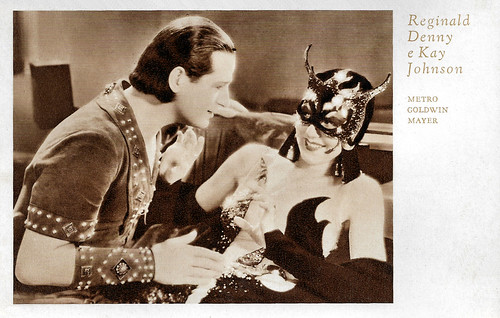
Italian postcard by Cinema-Illustrazione, Milano, Serie 2, no. 30. Photo: Metro-Goldwyn-Mayer. Kay Johnson and Reginald Denny in Madam Satan (Cecil B. DeMille, 1930). Production design: Mitchell Leisen.

German postcard by Ross Verlag, no. 176/12. Photo: Paramount. Elissa Landi in the American epic The Sign of the Cross (Cecil B. DeMille, 1932), based on the original 1895 play by Wilson Barrett. Production design: Mitchell Leisen.
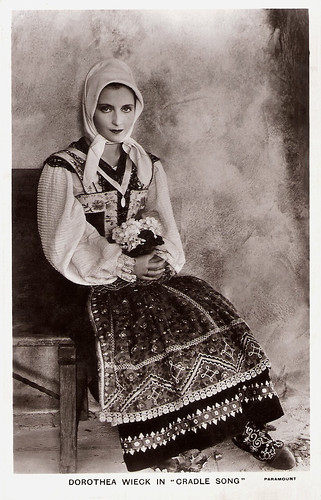
Dutch postcard by M. Bonnist & Zonen, Amsterdam-Z., no. B 299. Photo: Paramount. Dorothea Wieck in Cradle Song (Mitchell Leisen, 1933).
A bold and flamboyant exploration of the world of dreams
Mitchell Leisen's forte were comedies and romances. Leisen’s first film of the 1940s, Remember the Night (1940), featured a funny script by Preston Sturges and starred Fred MacMurray again, this time opposite Barbara Stanwyck. She played a recidivist shoplifter who gets caught at Christmastime. A softhearted prosecutor (MacMurray) takes her home during the court’s holiday recess to his family in Indiana, where they fall in love. Quite dark is Hold Back the Dawn, the third and last of the Wilder films, which lacks the sparkling surface of farce. Stuck in a grim Mexican border town, a Romanian gigolo (Charles Boyer) marries a virginal schoolteacher (Olivia de Havilland) purely to immigrate to the United States. Leisen's best films were often scripted by Preston Sturges or Billy Wilder. In the space of three years, he directed three hugely successful films based on screenplays by Wilder and Charles Brackett. Although their success was very important in helping Wilder move into directing himself, Wilder never had a good word to say about Leisen or his abilities as a filmmaker. At Senses of Cinema, David Melville defends Leisen: "Midnight (1939) – a frothy romantic farce directed by Leisen from a Wilder script – is a sharper and more stylish satire than Wilder’s own Sabrina (1954) or Love in the Afternoon (1957). A socially-conscious soap opera, Hold Back the Dawn (1941) – again, written by Wilder but directed by Leisen – packs a far greater punch than Wilder’s own Ace in the Hole (1951). Lacking Wilder’s pervasive sourness and contempt, Hold Back the Dawn views its hicks and whores and schemers through a veil of sympathy, suggesting they might have reasons to act as they do" Some critics assigned the lion’s share of the credit for Easy Living (1937), to Preston Sturges’s clever screenplay, whereas others praised Leisen for deftly preventing that script from being overly talky. In either case, Sturges was unhappy with the handling of his material by Leisen. Sturges accused him of being more interested in the set design than the story and claimed that his disappointment led him to become a director.
When Sturges and Wilder turned to directing their own films from the early 1940s, Leisen's own career began to decline. In the mid-1940s, he directed two opulent costume dramas: Frenchman’s Creek (1944), based on a novel by Daphne du Maurier. Joan Fontaine starred as an English noblewoman who becomes a dashing French pirate's (Arturo de Córdova) bride by night. Such melodramas were very popular in England at the time. The sly social comedy Kitty (1945) was a Cinderella tale set in 18th-century London that Paulette Goddard brought to life. For two years, Leisen studied the painting techniques of Thomas Gainsborough – copying the wigs, breeches, hats and fans of Georgian England to the last detail. Lady in the Dark (1944) was Leisen's version of the inventive Broadway musical of the same name by Moss Hart, Kurt Weill, and Ira Gershwin. Ginger Rogers plays a fashion magazine editor plagued by indecision over men (Ray Milland, Warner Baxter and Jon Hall). She seeks help in psychoanalysis, and Leisen visualises her erotic longings in dreams. The ambitious effort received mixed reviews from critics, despite a high budget. Comparisons with the Broadway show, in which Gertrude Lawrence and Danny Kaye had important roles, were mostly negative. However, the film had some well-staged numbers, and in particular, the heroine's dream sequences in Technicolor were spectacular. Leisen supervised and contributed his creative, imaginative set and costume ideas, and made suggestions in the creation of the scenery and costume applications. He was also instrumental in creating the mink-fur skirted gown lined in jewels for Ginger Rogers' musical circus sequence.
In 1946, he helped Olivia de Havilland win the Academy Award for Best Actress for her portrayal of a single mother in the drama To Each His Own (1946), which won her the 1947 Academy Award for Best Actress. The film was de Havilland's first release after she had taken her long-running legal battle with Warner Brothers all the way to the U.S. Supreme Court. The actress won the case. De Havilland continually cited Leisen as the favourite among her directors. Britannica: "To Each His Own (1946), one of Leisen’s most highly regarded films, earned the respect of critics who praised his deft, sensitive handling of a story that might have easily descended into maudlin melodrama in another director’s hands." Toward the end of the decade, Leisen experienced a creative slump, and except for No Man of Her Own (1950), his films were less successful at the box office. No Man of Her Own features Barbara Stanwyck in a typical Joan Crawford role: a young woman with a shady past leaves her abusive lover, assumes the identity of a rich, dead woman after a train wreck, and experiences moments of happiness until the truth comes out.
At the 1951 Berlin International Film Festival, his Screwball Comedy The Mating Season (1951), starring Gene Tierney, won a Bronze Bear. It was his last big film success. It is a tart comedy, co-scripted by Charles Brackett, grounded in American class distinctions. Thelma Ritter plays a working-class woman who moves in with her ambitious yuppie son (John Lund) and his high-toned wife (Gene Tierney). She hides her identity by posing as their servant. It earned Ritter an Academy Award nomination for Best Actress. In 1951, Mitchell Leisen left Paramount to freelance, believing that the studio was giving him inferior scripts to force him to relinquish his remunerative contract. His final feature film was the musical The Girl Most Likely (1957), starring Jane Powell. As his film work ebbed away, Leisen continued to design gowns, stage nightclub acts, and decorate luxury homes. He co-directed two documentaries, Here’s Las Vegas (1964) and Spree (Walon Green, Mitchell Leisen, 1967) on the nightlife of Las Vegas. He also directed various episodes of series such as The Twilight Zone (1959-1960), Wagon Train (1961) and The Girl from U.N.C.L.E. (1966-1967).
Mitchell Leisen married opera singer Stella Yeager, known professionally as Sandra Gahle, in 1927, though the couple lived separately for much of their marriage and remained in contact over the years. Leisen had long-term relationships with both women and men, reflecting a bisexual orientation that was largely private during his lifetime. One of his most significant relationships was with costume designer Natalie Visart, with whom he shared a close personal and professional bond. He also had a very long relationship with dancer/actor/choreographer Billy Daniel until the 1950s. In 1960, Leisen was honoured with a star on the Hollywood Walk of Fame. He died of heart disease in 1972 in Woodland Hills, California, aged 74. His grave is located in the Chapel of the Pines Crematory. David Melville at Senses of Cinema: "When Mitchell Leisen died at the Motion Picture Country Home in 1972, both he and his films were largely forgotten. One of a host of old-style Hollywood directors who had not been rediscovered, re-interpreted or (in some cases) recreated as an auteur by Cahiers du cinéma, Leisen was remembered – grudgingly – as a minor artisan. A dress-designer who turned director, fashioning a string of campy gossamer romances for the lesser Great Ladies of Tinsel Town." This section at Il Cinema Ritrovato offers a new chance to rediscover his work. Melville: "Such re-evaluation is long overdue, yet it still falls short of the whole story. It overlooks, for a start, Leisen’s bold and flamboyant exploration of the world of dreams. A homosexual artist in a homophobic era and industry, Leisen sought solace (and perhaps a cure) in the arms of Freudian psychoanalysis. As his profile rose – and his relationship with dancer-choreographer Billy Daniels became an open secret – Leisen put his psychoanalytical quest onto film. His wild dream sequences in No Time for Love (1943), Lady in the Dark (1944), and Dream Girl (1948) are as close to the avant-garde as 1940s Hollywood could allow."

British postcard in the Film Partners Series, London, no. P 134. Photo: Paramount. Sylvia Sidney and Gene Raymond in Behold My Wife! (Mitchell Leisen, 1934).
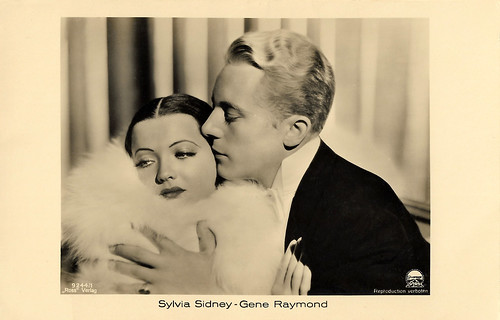
German postcard by Ross Verlag, no. 9244/1, 1935-1936. Photo: Paramount. Sylvia Sidney and Gene Raymond in Behold My Wife! (Mitchell Leisen, 1934).
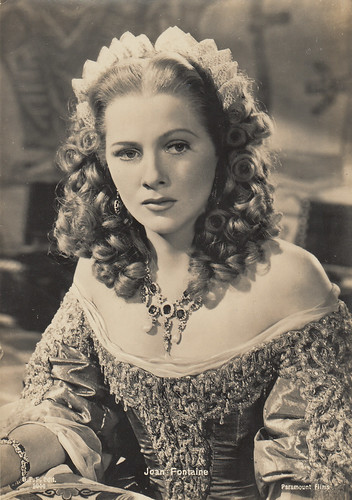
Italian postcard by B.F.F., Firenze, no. 2044. Photo: Paramount Films. Joan Fontaine in Frenchman’s Creek (Mitchell Leisen, 1944). Collection: Marlene Pilaete.

Belgian postcard, no. 980. Photo: Paramount. Paulette Goddard in Kitty (Mitchell Leisen, 1945).

Spanish card by I.P. y papeleria Machi Benifayo. Photo: Paramount. Marlene Dietrich and Ray Milland in Golden Earrings (Mitchell Leisen, 1947). Spanish title: En las rayas de la mano. Collection: Marlene Pilaete.

British postcard in the Picturegoer Series, London, no. W 252. Photo: Paramount. Betty Hutton in Dream Girl (Mitchell Leisen, 1948).
Sources: David Melville (Senses of Cinema), Britannica, Wikipedia (German and English) and IMDb.

No comments:
Post a Comment