30 October 2012

Kirsten Heiberg

Beautiful Norwegian actress and singer Kirsten Heiberg (1907-1976) was the femme fatale of the German cinema of the Third Reich. The Ufa considered her as a replacement for Marlene Dietrich after the latter left for Hollywood. ‘Die Heiberg’ was one of the most interesting and talented Ufa stars, but unfortunately, she stayed somewhat in the shadow of Zarah Leander.
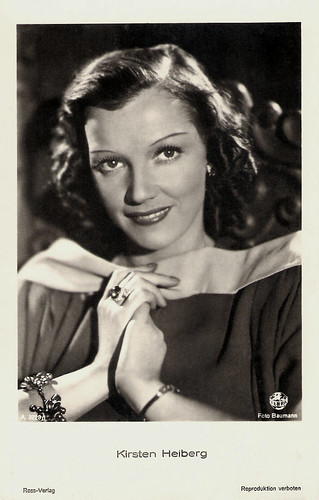
Kirsten Heiberg
German postcard by Ross Verlag, no. A 3228/1, 1939-1940. Photo: Baumann / Terra.
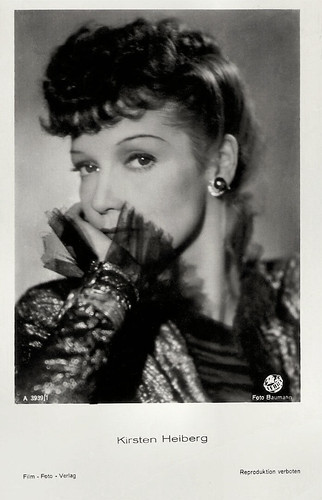
Kirsten Heiberg
German postcard by Film-Foto-Verlag, no. A 3939/1, 1941-1944. Photo: Baumann / Terra. Kirsten Heiberg in Die goldene Spinne/The Golden Spider (Erich Engels, 1943)
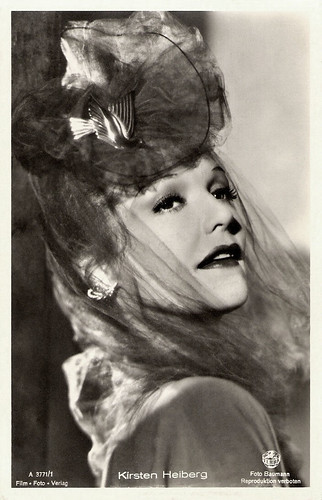
Kirsten Heiberg
German Postcard by Film Foto Verlag, no. A 3371/1, 1941-1944. Photo: Baumann / Terra. Kirsten Heiberg in Liebespremiere/Love premiere (Arthur Maria Rabenalt, 1943).

Sinners in summertime


Kirsten Heiberg was born in Kragerö, Norway, in 1907. Her father was a rich wood merchant. According to Wikipedia, she grew up in an artistic family, and her younger sister Else Heiberg later also became an actress.

She went to boarding schools in Lausanne, Dijon, and Paris. Later, she studied English in Oxford, England. Heiberg began her theatre career in her home country at Den Nationale Scene in 1929, and in the 1930s she appeared at the Carl Johan-Teatret and Scala Revyteater in Oslo. She made her cinema debut in 1934 with the Norwegian film Syndere i sommersol/Sinners in Summertime (Einar Sissener, 1934). This was followed by more Norwegian productions and some Swedish films.

In 1937 she went to Austria where she appeared on stage in the operetta revue 'Pam-Pam' at Theater an der Wien. There she met German film composer Franz Grothe. They married in 1938 and moved to Berlin. Grothe wrote numerous songs for his wife that suited her impressive alt. Curt Goetz engaged her for the film Napoleon ist an allem schuld/Blame it on Napoleon(Curt Goetz, 1938) starring Goetz and his wife Valerie von Martens.

This highly entertaining comedy marked Kirsten Heiberg's breakthrough. After the film, Goetz and Von Mertens fled Germany and moved to Hollywood. There Goetz was hired to work on various scripts at M.G.M. and given a 5-year contract. But Goetz and Von Martens chose to momentarily retire and became chicken farmers! During the war, he worked on his plays in the United States. Goetz's plays 'The House on Montevideo' and 'People Will Talk' were later filmed.

The Ufa presented Kirsten Heiberg as their new diva in Frauen für Golden Hill/Women for Golden Hill (Erich Waschneck, 1938) opposite Viktor Staal, and in the next years she played femme fatales in adventure and spy films like Alarm auf Station III/Alarm at Station 3 (Philipp Lothar Mayring, 1939) starring Gustav Fröhlich and Achtung! Feind hört mit!/Beware! The Enemy Is Listening! (Arthur Maria Rabenalt, 1940) with René Deltgen. In 1940 her career was halted when she refused to become a member of the Nazi party and didn't want to perform in her native Norway during the German occupation.

Kirsten Heiberg
German postcard by Das Programm von Heute / Ross Verlag, Berlin. Photo: Terra / Quick.

Kirsten Heiberg, Viktor Staal
Big card by Ross Verlag. Photo: Hämmerer / Ufa. Kirsten Heiberg in Frauen für Golden Hill/Women for Golden Hill (Erich Waschneck, 1938) with Viktor Staal
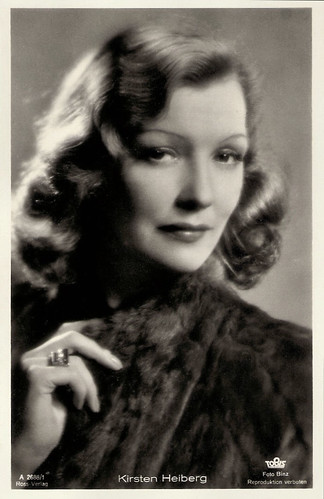
Kirsten Heiberg
German postcard by Ross Verlag, no. A 2688/1, 1939-1940. Photo: Binz, Berlin / Tobis.
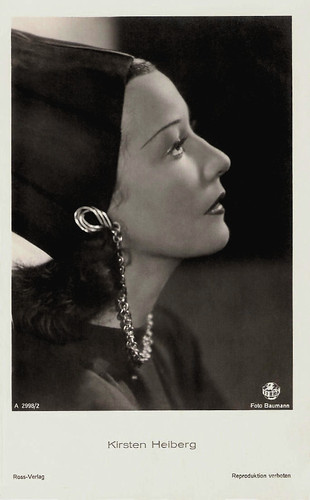
Kirsten Heiberg
German postcard by Ross Verlag, no. A 2998/2, 1939-1940. Photo: Baumann / Terra.

Disaster


Kirsten Heiberg returned in front of the cameras in 1942. Nowadays her best-remembered films are the Operetta Liebespremiere/Love Premiere (Arthur Maria Rabenalt, 1943) with Hans Söhnker and the historical disaster film Titanic (Herbert Selpin, Werner Klingler, 1943), about the sinking of the British luxury liner in 1912. At IMDb, Ralph Michael Stein writes: "It's not that common in movie history that a director angers the producer/distributor of his movie so much that the latter has the former murdered. That's what happened to co-director Herbert Selpin in 1942 before the release of Germany's film contribution to the Titanic saga. Dr. Josef Goebbels, Hitler's propaganda minister and self-anointed arbiter of culture in the Third Reich, had the Gestapo arrest Selpin who was reported dead in his cell the day after. Suicide? Ridiculous. (...)

Selpin (with co-director Werner Klingler) turned out a sumptuous, ornate and dramatically compelling movie. Largely using the known facts, Titanic tells the well-worn tale of a ship driven to unreasonable and dangerous speeds to set a record. There are some significant deviations. Here, the English first officer - seized with some malady - is replaced by a German seaman named Petersen, a model of experience and rectitude. J. Bruce Ismay, whose social life was justifiably ruined because he escaped the sinking behemoth, is unrealistically portrayed as a grasping cad whose crudity was not found in the self-absorbed, rich and supinely confident real shipping magnate. The vessel's master, Captain Smith, is overly subservient to Ismay but he responds well to the disaster. This movie wasn't made on the cheap. Given the deteriorating wartime situation, a lot of marks were expended on terrific sets and fine attire. There's no real Nazi propaganda. The movie ends with a comment that English greed occasioned the loss of so many lives but very many books and articles from Old Blighty and the U.S. echo that view. Because of its anti-British utterances, the Allies banned the movie in their sectors in Germany at first while it was freely available in the Soviet zone. Hardly a surprise-that movie maven, Stalin, probably loved this capitalist-bashing film."

Other well-known films were Die goldene Spinne/The Golden Spider (Erich Engels, 1943) and Philharmoniker/Philharmonic (Paul Verhoeven, 1944). With her dark timbre and her erotic appeal, she also became a popular singer. Many of her film songs were written by her husband, Franz Grothe, such as 'Ich bin wie ich bin' (I Am Like I Am) and 'Ich bin heut' frei meine Herrn' (Tonight I'm Free, Gentlemen).

After the war, a difficult time began for Kirsten Heiberg. Her marriage with Grothe went on the rocks and they divorced in 1951. Back in Oslo, she got no film offers because of her career in Nazi Germany. However, she was not arrested by the Norwegians since she was a German citizen at that time. She continued to work on stage and between 1952 and 1960 she worked for the Trøndelag Teater in Trondheim, acting in operettas, comedies, and serious classics and modern dramas.

Sometimes she returned to Germany to make a film, but she wasn't able to continue her earlier successes. Her later films are Hafenmelodie/Harbour Melody (Hans Müller, 1949) opposite Paul Henckels, Bei Dir war es immer so schön/It Was Always So Nice with You (Hans Wolff, 1954) with Heinz Drache, and the Norwegian drama Broder Gabrielsen/Brother Bill (Nils R. Müller, 1966). Shortly before her death, she made a cameo appearance in the German-Norwegian production Eiszeit/Ice Age (Peter Zadek, 1975) with O.E. Hasse. Kirsten Heiberg died in 1976 in Oslo, Norway. Among the few attending her funeral were her ex-husband Franz Grothe and his second wife Gerda. They always remained good friends and took her now orphaned dog Truks with them to Germany.
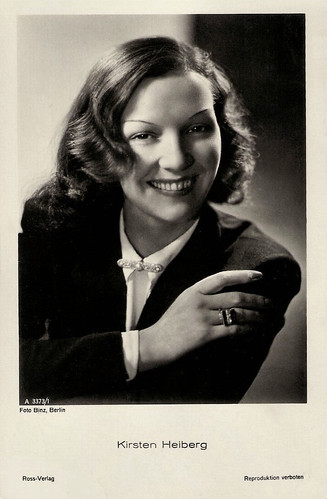
Kirsten Heiberg
German postcard by Ross Verlag, no. A 3373/1, 1941-1944. Photo: Binz, Berlin.
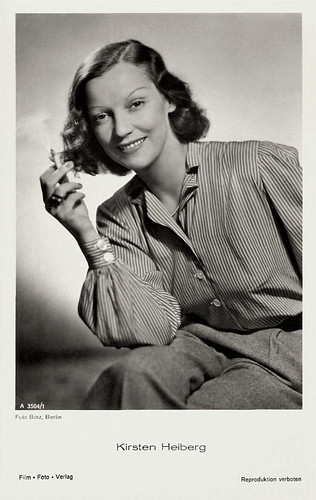
Kirsten Heiberg
German postcard by Film-Foto-Verlag, no. A 3504/1, 1941-1944. Photo: Binz, Berlin.
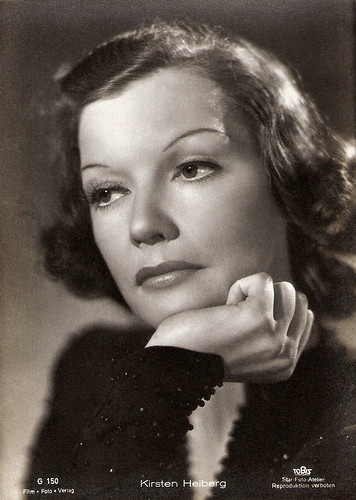
Kirsten Heiberg
German postcard by Film-Foto-Verlag, no. G 150, 1941-1944. Photo: Star-Foto-Atelier / Tobis.


Scene from the operetta Liebespremiere/Love Premiere (1943) with Kirsten Heiberg singing 'Komm, Zauber der Nacht' (Come, Magic of the Night). Source: Alparfan (YouTube).

Sources: Thomas Staedeli (Cyranos), Ralph Michael Stein (IMDb - page now defunct), j-r årsheim (IMDb - page now defunct), Guy Bellinger (IMDb), Kirsten Heiberg Biographie Seite (German), Wikipedia (English and German) and IMDb.

This post was last updated on 2 September 2024.

28 October 2012

A.W. Baskcomb

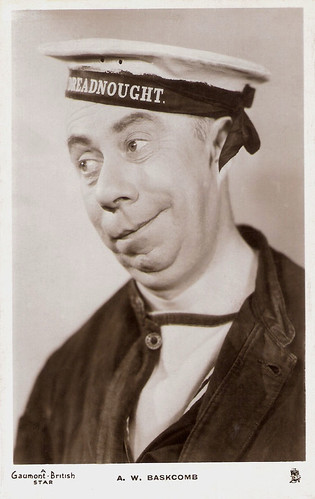
A.W. Baskcomb (1880-1939) is best remembered for his creation of the part of ‘Slightly’ in the very first stage production of J.M. Barrie's Peter Pan (1904). He created a major character out of an underwritten part and went on to play it for seven years. At the end of his career he became briefly a popular film star.

A.W. Baskcomb
British postcard by Raphael Tuck & Sons' Real Photograph, no. 20-S. Photo: Gaumont-British. Publicity shot for The Midshipmaid (1932).

Peter Pan


A.W. ‘Archie’ Baskcomb was born in London, UK, in 1880. His father had been chief clerk to King Edward, when he was Prince of Wales. His brother was the actor Laurence Baskcomb.

Archie began his stage career as a dumb negro in 'The Octoroon' in 1890. His appearances since then were many and varied. He played in comedies, musicals, revues and pantomime.

His most famous part was ‘Slightly’ in the very first stage production of J.M.Barrie's 'Peter Pan' in 1904. He created a major character out of an underwritten part and went on to play it for seven years.

In 1913 he made his film debut for the Urban Trading Company in The Staff Dinner. In this short silent comedy he played a clerk who gets drunk at the annual office dinner and comes home late. The wife was played by his real wife, Ninon Dudley. Baskcomb is also credited as the writer of the film.

Among his later West End productions were 'Mayfair and Montmartre' (1922) by John Hastings Turner at the New Oxford Theatre, the musical 'Lilac Time' (1922-1923) at the Lyric Theatre, 'The Street Singer' (1924) with Phyllis Dare at the Lyric Theatre, and the musical 'Queen High' (1926) with Sonnie Hale at the Queen's Theatre.

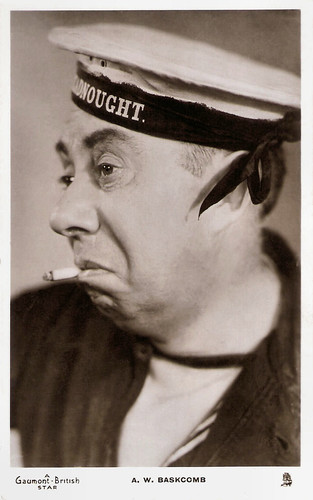
A.W. Baskcomb
British postcard by Raphael Tuck & Sons' Real Photograph, no. 29-S. Photo: Gaumont-British.

The Lodger


After the introduction of sound film, A.W. Baskcomb made his come-back in the cinema. First he played the lead in the short comedy A Safe Proposition (Leslie S. Hiscott, 1932).

Then he supported Ivor Novello and Elizabeth Allan in The Lodger (Maurice Elvey, 1932). This was the first sound remake of the silent classic of 1926 directed by Alfred Hitchcock, which was inspired by the Jack the Ripper legend.

Novello, who played the title role and headed the team writing the script, was in the original as well. He plays Michael Angeloff, a Hungarian musician, who takes lodgings with the Bunting family. Baskcomb played the head of the family. A romance develops between his daughter Daisy (Allen) and Angeloff. In the meanwhile a maniac stalks and murders street-women at night and circumstances gradually point the finger of suspicion at Angeloff, as the only clue the police have is that the killer is a foreign musician.

Hal Erickson at AllMovie: “In Belloc-Lowndes' original novel 'The Lodger', the reclusive young man suspected of being Jack the Ripper turns out to be exactly who he's assumed to be. When Alfred Hitchcock directed the 1926 film version of The Lodger, he was advised that the public would never accept the popular star Ivo Novello as a serial killer, thus the film was given a happy ending.

Novello himself wrote the screenplay for the 1932 non-Hitchcock talkie version of The Lodger, which, though updated from the novel's 19th century setting, retains its original shocker climax. Well received at the time of its release but rarely seen in recent years, the 1932 Lodger can be regarded as a serviceable bridge between the 1926 Hitchcock silent and the definitive 1944 20th Century-Fox remake starring Laird Cregar.”

A.W. Baskcomb
British postcard by Raphael Tuck & Sons' Real Photograph, no. 42-S. Photo: Gaumont-British. Publicity shot for The Midshipmaid (1932).

The Good Companions


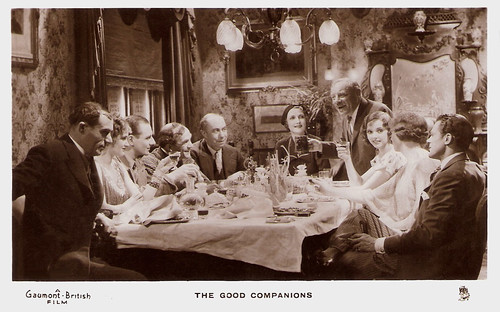
Next A.W. Baskcomb played in the comedy The Midshipmaid (Albert de Courville, 1932) starring Jessie Matthews. The following year, he supported Matthews again in the charming musical The Good Companions (Victor Saville, 1933). The story was taken from J.B. Priestley's novel about three musicians joining together to save a failing concert party, the Dinky Doos.

Craig Butler reviews at AllMovie: “Although a big success when originally released (and remade several times), The Good Companions has not held up particularly well over the years and is of primary interest for its cast. One of the cinema's many backstage musicals, Companions has a plot the elements that have been used time and again, from a chorus girl determined to be a star to a nascent songwriter who falls for her.

The screenplay does win a few points, however, for the manner in which it introduces its characters, and the result is that the true star of the picture is not obvious for quite some time. The musical numbers (...) are pleasant and diverting, but hardly striking or original. Fortunately, Jessie Matthews figures prominently in many of the songs, giving them a great boost.

Although never a great star abroad, Matthews was beloved by the British public, and it's easy to see why. She positively sparkles, and even when her acting comes across as rather broad, she manages to be appealing. The chance to see a very young John Gielgud in a musical is another drawing card; although he's not exactly at ease in the role, he actually handles it quite well. Even better is the delightful Edmund Gwenn, whose gentle portrayal gathers in strength and helps to anchor the film. These and the other members of the cast make Companions worth catching.”

The Good Companions was a smash hit and it made Baskcomb a star. The postcards in this post and other collector’s cards were produced at the time. However, it was to be his last film. A.W. Baskcomb died in 1939 in London.

A.W. Baskcomb, John Gielgud, Jessie Matthews, The Good Companions
British postcard by Raphael Tuck & Sons in the Real Photograph Series, no. 27-B. Photo: Gaumont-British. Publicity still for The Good Companions (Victor Saville, 1933) with a.o. John Gielgud (third from left), A.W. Baskcomb (fifth from left) and Jessie Matthews (third from right).

Sources: Hal Erickson (AllMovie), Craig Butler (AllMovie), Collector’s Card (NYPL Digital Gallery), Charles Lee (IMDb) and IMDb.

This post was last updated on 4 May 2023.

27 October 2012

Marianne Hold

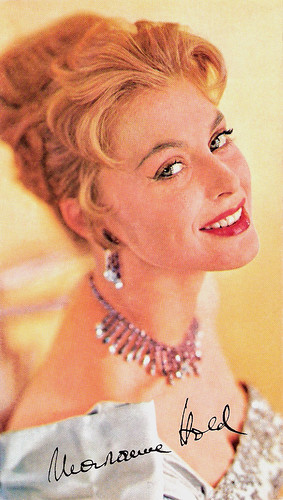
In the 1950s and 1960s attractive actress Marianne Hold (1933-1994) became the queen of the Heimatfilm - the romantic German film genre set in rural, especially Alpine, areas.

Marianne Hold
German collectors card by Lux.

Marianne Hold
German postcard by WS-Druck, Wanne-Eickel, no. F 35. Photo: Niczky.

Marianne Hold
German postcard by UFA, Berlin-Tempelhof, no. CK-34. Retail price: 30 Pfg. Photo: Arthur Grimm / Constantin Film.

Cinecittà


Marianne Hold was born Marianne Weiss in Johannisburg, East Prussia, in 1933. In the last days of the Second World War, her father went missing.

At age 15, she ran away from home because she couldn’t stand her stepfather. She went to Rome where she started working in the kitchen of a Protestant convent and later worked as a cutter at the Cinecittà film studio.

She was spotted by director Gabriel Pascal, who offered her a scholarship at the Cinecittà acting school.

In 1950 she was offered her first role by mountaineer-turned-director Luis Trenker in Barriera a Settentrione/Mountain Smugglers (Luis Trenker, 1950) starring Amedeo Nazzari.

This was followed up by a small role in the Italian production Benvenuto, reverendo!/Welcome Reverend (Aldo Fabrizi, 1950) and bigger roles in German films like Ave Maria (Alfred Braun, 1953) with Zarah Leander.

Marianne Hold
German postcard by ISV, no. H 1. Photo: Sahm.

Marianne Hold
German-Dutch postcard, no. 1259.

Marianne Hold
German postcard by WS-Druck, Wanne-Eickel, no. F 58. Photo: Theo Huster.

Heimatfilms


Soon Marianne Hold became a popular actress in Heimatfilms like Hochzeitsglocken/Marriage Bells (Georg Wildhagen, 1954), Wenn die Alpenrosen blüh'n/When the alpine roses blossom (Hans Deppe a.o., 1955) and Heimatland/Homeland (Franz Antel, 1955) with Rudolf Prack and Adrian Hoven.

Her breakthrough role was as a fishergirl in Die Fischerin vom Bodensee/The Fisher-girl from Lake Bodensee (Harald Reinl, 1956). She proved her versatility as an actress in the poetic Marianne de ma jeunesse/Marianne, meine Jugendliebe/Marianne of My Youth (Julien Duvivier, 1955).

She co-starred with Gerhard Riedmann in Die Prinzessin von St. Wolfgang/The Princess of Saint Wolfgang (Harald Reinl, 1957), Bei der blonden Kathrein/At Blonde Kathrein's (Hans Quest, 1959) and Waldrausch/Forest Flush (Paul May, 1962).

With her discoverer Luis Trenker she made Prigioniero della montagna/Prisoner of the Mountains (Luis Trenker, 1955), Von der Liebe besiegt/Conquered by Love (Luis Trenker, 1956) and Wetterleuchten um Maria/Lightning Around Maria (Luis Trenker, 1957).

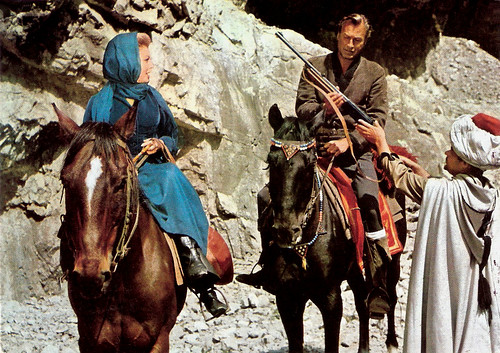
While filming Die Diamantenhölle am Mekong/Mission to Hell (Gianfranco Parolini, 1964), she met Czech-born actor Frederick Stafford and married him. Their son, Roderick Stafford, was born in the same year. She then retired from the film business to take care of her son. Her last film was the Karl May adaptation Der Schut/The Yellow One (Robert Siodmak, 1964) starring Lex Barker. In 1994 Marianne Hold died of a heart attack in her house in Lugano, Switzerland.

Marianne Hold and Lex Barker in Der Schut (1964)
German postcard by Heinerle Karl-May-Postkarten, no. 29. Photo: CCC / Gloria. Lex Barker as Kara Ben Nemsi and Marianne Hold as Madame Galingré in Der Schut/The Yellow One (Robert Siodmak, 1964). Caption: "How glad I am that nothing happened to you, Mister Kara. I heard the shots ...." - "As you can see, everything went well with this Mübarek, Madame Galingré. Fine that you brought the horses. Omar, Halef and I can immediately do on with the persecution of The Yellow One."

Der Schut (1964) with Lex Barker, Ralf Wolter and Marianne Hold
German postcard by Heinerle Karl-May-Postkarten, no. 31. Photo: CCC / Gloria. Lex Barker as Kara Ben Nemsi, Ralf Wolter as Halef and Marianne Hold as Madame Galingré in Der Schut/The Yellow One (Robert Siodmak, 1964). Caption: The fully loaded raft. A good target for the bandits, who are hiding between the rocks.

Der Schut (1964) with Ralf Wolter and Marianne Hold
German postcard by Heinerle Karl-May-Postkarten, no. 46. Photo: CCC / Gloria. Ralf Wolter as Halef and Marianne Hold as Madame Galingré in Der Schut/The Yellow One (Robert Siodmak, 1964). Caption: By a ruse and with the help of Turkish soldiers, the faithful servant Halef can free his beloved Lord, Kara Ben Nemsi, from the hands of the Yellow One, who has imprisoned him.

Sources: Stephanie D'heil (Steffi-line.de), Wikipedia, Glamour Girls of the Silver Screen and IMDb.

This post was last updated on 12 October 2024.

23 October 2012

Jan Hendriks

Dark-haired German actor Jan Hendriks (1928-1991) was one of the most promising newcomers to German cinema in the 1950s. Accidents and a homosexual scandal interrupted the career of the handsome actor. However, he still appeared in more than 80 films on screen and TV between 1950 and 1990. Tragically, he starved to death in self-imposed isolation.

Jan Hendriks
German postcard by ISV, no. M 6. Photo: Europa Film / Czerwonski.

Riveting performance


Jan Hendriks was born as Heinz Joachim Hinz in Berlin, Germany in 1928. In the late 1940s, he attended the drama school of the Hebbel Theater in Berlin. He started his career in 1950 at the Schlosspark-Theater under Boleslaw Barlog. From then on he played in various theatres in Berlin, Hamburg and Munich.

Film director Robert A. Stemmle discovered him for the cinema. For his debut in Sündige Grenze/Illegal Border (Robert A. Stemmle, 1951) opposite Dieter Borsche, he won the German Film Award as Best Newcomer.

Hal Erickson at AllMovie: "Much of the film is corny and contrived, save for the riveting performance by Jan Hendricks as the unregenerate teenage leader of the smuggling ring."

Then he played opposite Johanna Matz in the literary adaptation Der große Zapfenstreich/The Sergeant's Daughter (George Hurdalek, 1952). In 1953 his career was briefly interrupted. He received a prison sentence for a traffic accident caused by him under the influence of alcohol. After his sentence, other lead and supporting roles followed.

In 1958 he played a foolish officer in the multi-award-winning and Oscar-nominated comedy Helden/Arms and the Man (Franz Peter Wirth, 1958) with O. W. Fischer. The following year he made more headlines when he was charged based on § 175 for homosexual acts in a toilet. He was sentenced to a fine.

Jan Hendriks
East-German postcard by VEB Progress Film-Vertrieb, Berlin, no. 274/334, 1957. Photo: DEFA / Kilian. Publicity still for Spielbank-Affäre (Arthur Pohl, 1957).

Jan Hendriks, Gertrud Kückelmann
East-German postcard by VEB DEFA-Studio für Spielfilme, Potsdam-Babelsberg, no. 78, 1957, retail price: 0,15 DM. Photo: DEFA / Kilian. Publicity still for Spielbank-Affäre (Arthur Pohl, 1957) with Gertrud Kückelmann.

Jan Hendriks, Gertrud Kuckelmann
East-German postcard by VEB DEFA-Studio für Spielfilme, Potsdam-Babelsberg, no. , 1957, retail price: 0,15 DM. Photo: DEFA / Kilian. Publicity still for Spielbank-Affäre (Arthur Pohl, 1957).

Starved to death


In the 1960s, Jan Hendriks starred in some very successful Edgar Wallace films, including Das Gasthaus an der Themse/The Inn on the River (Alfred Vohrer, 1962) with Joachim Fuchsberger, and Der Zinker/The Squeaker (Alfred Vohrer, 1963) with Heinz Drache.

After a serious motorcycle accident in 1963, he was in a coma for several months, but there was no permanent damage. He worked as a voice actor and dubbed Humphrey Bogart in The Petrified Forest (Archie Mayo, 1936) and Anthony Quinn in Guadalcanal Diary (Lewis Seiler, 1943).

He continued to appear in mediocre films but he would never fulfill his early promise in the 1950s. Some sources suggest that homophobia was the reason that his career seemed to go nowhere. After the 1960s, he appeared only incidentally in films but was successful on television.

From 1977 to 1986, he co-starred with Siegfried Lowitz in 86 episodes of the Krimi series Der Alte/The Old Fox as assistant Martin Brenner. Occasionally, he was also committed to touring theatres. He had his last stage role in 1988.

Jan Hendriks died in 1991 in Berlin, Germany, aged 63. The police found him dead in his apartment after they had been informed by neighbours. He died alone on his birthday and only days later, he was discovered. The tabloids wrote that the cause of his death was AIDS. In addition, he has also suffered from diabetes for years. After months of self-imposed isolation, Hendriks had starved to death in his apartment. The tabloid rumour that he was impoverished, was refuted by a six-figure sum of money in his estate.


Scene from Sündige Grenze/Illegal Border (1951). Source: LadyViolet7 (YouTube).


Trailer Das Gasthaus an der Themse/The Inn on the River (1962). Source: RialtoFilm (YouTube).

Sources: Hal Erickson (AllMovie - page now defunct), Filmportal.de, Wikipedia (German and English) and IMDb.

This post was last updated on 5 September 2024.
21 October 2012

The Choice of Miss Mertens

At Flicker, one of our dearest contacts is Miss Mertens. She often writes comments about her memories of the German cinema. At her own Flickr site, she has hundreds and hundreds of vintage postcards and photos of European royals. There are even nearly 300 vintage pictures of the Dutch Royal family at her site. For EFSP, Miss Mertens selected her favorite German and Austrian film star postcards from Truus, Bob and Jan Too!.
Here's the Choice of Miss Mertens:

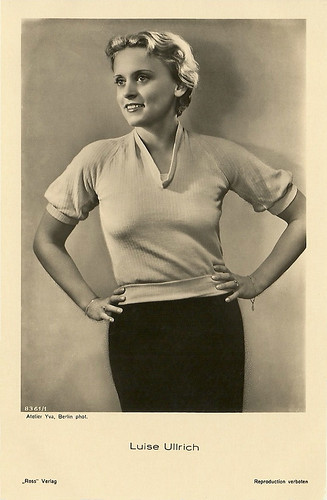
Luise Ullrich
Luise Ullrich. German postcard by 'Das Ross Verlag, no. 8361, 1933-1934. Photo: Yva, Berlin. Collection: Didier Hanson.
Miss Mertens: "The young Luise Ullrich! How pretty she was! I remember that when I was a child, I saw a series with her, in which she played the mother!"

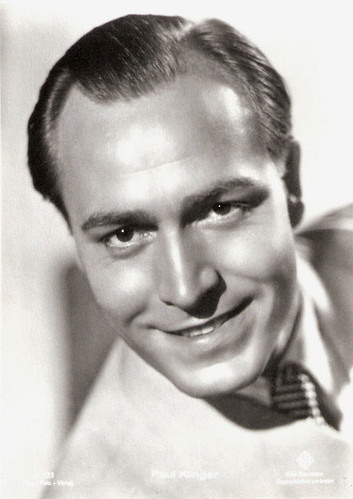
Paul Klinger
Paul Klinger. German postcard by Film-Foto-Verlag, no. G 123, 1941-1944. Photo: Baumann / Ufa.
"One of the most popular figures of the post-war film! On the card in a typical pose: personable and friendly! The buddy-type!"

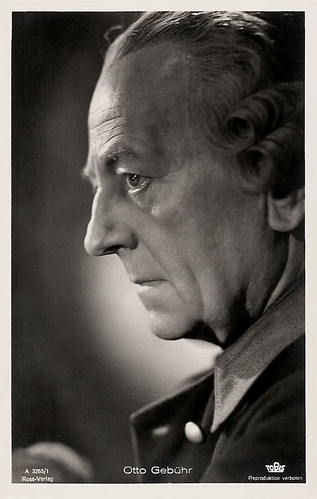
Otto Gebühr
Otto Gebühr. German postcard by Ross Verlag, no. A 3265/1, 1941-1944. Photo: Tobis. Looks like a card for Der grosse König/The Great King (1942, Veit Harlan), one of the Frederick the Great films.
"The card shows the actor Otto Gebühr in his signature role as the 'old Fritz'. Like it!"

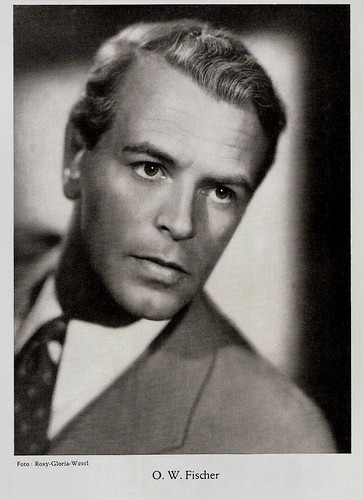
O.W. Fischer
O.W. Fischer. German collector's card. Photo: Roxy-Gloria-Wesel.
"O.W. More you don't say! The great Austrian actor! On the photo you can see what a good-looking man he was."

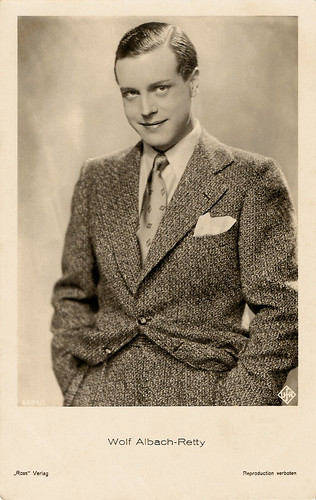
Wolf Albach-Retty
Wolf Albach-Retty. German postcard by Ross Verlag, no. 6884/1, 1931-1932. Photo: Ufa.
"Father of Romy Schneider, a very handsome Austrian actor, what you see on the postcard!"

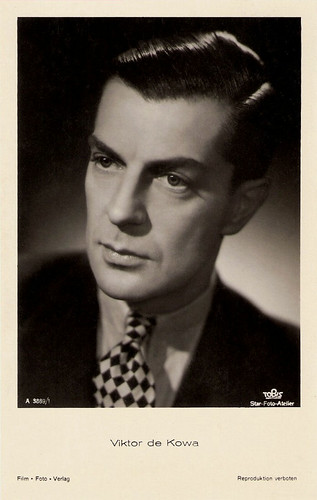
Viktor de Kowa
Viktor de Kowa. German postcard by Film-Foto-Verlag, no. 3809/1, 1941-1944. Photo: Tobis/Star-Foto-Atelier.
"Viktor de Kowa was the 'jeune premier' type, the young handsome man, in the film Wir machen Musik/We make music. Later he moved on to character roles. The card is from the time of Wir machen Musik and to this day I think it is one of the best German musicals."

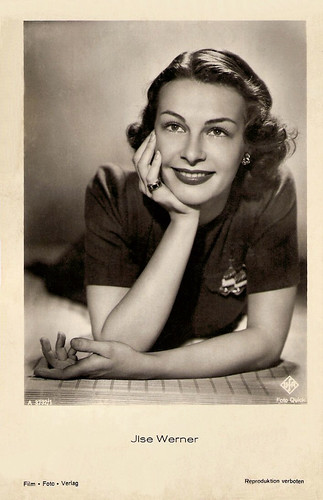
Ilse Werner
Ilse Werner. German postcard by Film-Foto-Verlag, no. A 3732/1, 1941-1944. Photo: Quick / Ufa.
"Ilse Werner was the nice girl next door. She was not a diva like Zarah Leander or Marika Rokk! On the card she looks so natural."

Hans Holt
Hans Holt. German postcard by Ross Verlag, no. A 2021/1, 1941 - 1944. Photo: Cine-Allianz.
"A popular figure. Even as an old man he still retained the youthful appearance he had on this photo!"

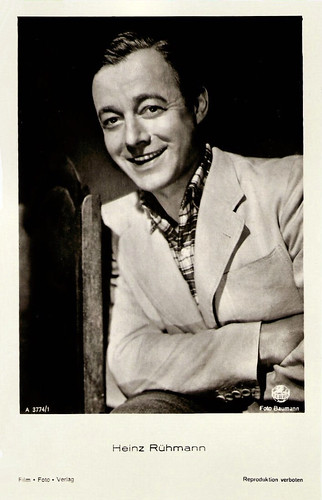
Heinz Rühmann
Heinz Rühmann. German postcard by Film-Foto-Verlag, no. A 3774/1, 1941-1944. Photo: Baumann / Ufa.
"Also on this card: Heinz Rühmann and his grin. His trademark!"

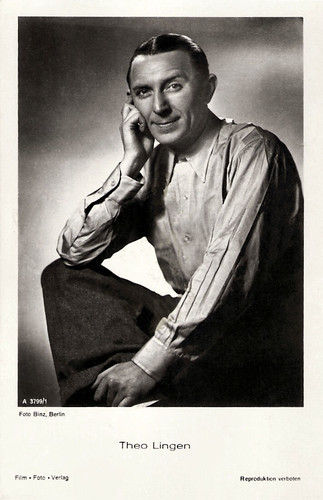
Theo Lingen
Theo Lingen. German Postcard by Film-Foto-Verlag, no. A 3799/1. Photo: Binz, Berlin.
"One of the best German comedians! A great card from his early years, but even when he was very old, he was still on TV".

"So, Here are the 10 postcards, which I like. I really like so many of these cards, but you can not take them all!"

Danke schön, Miss Mertens!

The Choice of... is an irregularly appearing series. Earlier guests were Egbert Barten, Véronique3, Didier Hanson, Asa and Bunched Undies.

20 October 2012

Raymond Pellegrin

French actor Raymond Pellegrin (1925 – 2007) had the most beautiful voice of the French cinema. He appeared in more than 120 European films, both as good and as bad guys.

Raymond Pellegrin
French postcard. Photo Sam Lévin.

Multiple TransformationsRaymond Pellegrin was born Raymond Louis Pilade Pellegrini in Nice in 1925. In his films, he is sometimes credited as Raymond Pellegrini. His parents came from Tuscany and his father Attilius worked in Nice as a restaurateur. When Raymond was 14, his father died. He had to finish school and to find work to support his mother. His dream of becoming a marine officer evaporated. He did all kind of odd jobs, but he found his true vocation when he attended a dramatic course by Pierrette Caillol. In Nice were many artists who had fled occupied Paris. Caillol’s husband, film director Yvan Noë gave the 16-years-old a part in his film Six petites filles en blanc/Six little girls in white (1941) with Jean Murat and Janine Darcey. The film was produced in the famous Victorine studios. A year later, the then 17-years-old made his stage debut at the Palais de la Méditerranée in Nice in Le président Haudecoeur (President Haudecoeur) by Roger Ferdinand. In 1943, he appeared at the Théâtre de Monaco in the play C'était en juillet (It was July), in which he made multiple transformations. In the audience was famous author-director Marcel Pagnol who thought he was a passionate and promising talent. Pagnol hired him in 1945 for a resumption of his play Topaz at the Théâtre Pigalle in Paris. The following year Pagnol offered him a role in César at the Théâtre des Variétés. Pellegrin played a convincing Césariot opposite Henry Vilbert as César (Raimu had died three months earlier) and Orane Demazis as Fanny.

Raymond Pellegrin
French postcard by Editions P.I., Paris, no. 532, offered by Les carbones Korès 'Carboplane'. Photo: Sam Lévin.

Raymond Pellegrin
East-German postcard by VEB Progress Filmvertrieb, Berlin, no. 817, 1958. Retail price: 0,20 DM.

A JanusRaymond Pellegrin was discovered by film producers, but he also continued to be active on stage. He made his real second screen debut in Naïs (1945, Raymond Leboursier) starring Fernandel. The film was supervised by Marcel Pagnol. At Les gens du Cinema, Yvan Foucart compares Pellegrin with a Janus: he had a double profile and was asked to play both ‘good guys’ and - more often – ‘bad guys’. His film roles included pimps, cops and gangsters. His breakthrough role was Gino, the young Corsican condemned to death for having avenged the family honour in Nous sommes tous des assassins/We are all murderers (1952, André Cayatte) opposite Mouloudji. His performance was awarded the Prix du Meilleur acteur français (Prize for Best French actor) and the film won a special jury prize at the Cannes Film Festival. He played the tender teacher of the beautiful savage Manon in Manon des sources/Manon of the Spring (1952, Marcel Pagnol), and then easily changed the register as the infamous pimp of Françoise Arnoul in Les compagnes de la nuit/Companions of the night (1953, Ralph Habib). In Le grand jeu/The Great Game (1954, Robert Siodmak), the jealous Jean-Claude Pascal killed him because of the ravishing Gina Lollobrigida. In 1948, Pellegrin had married actress Dora Doll. They divorced in 1955, and later that year he married actress/socialite Gisèle Pascal. He had co-starred with Pascal in Le feu dans la peau/Fire Under Her Skin (1954, Marcel Blistène) a drama about passionate and tortured love. A highlight of this period is his interpretation of the older Napoleon in the mega production Napoléon (1955, Sacha Guitry). Yvan Foucart: “He fills his role with conviction and perfect credibility.” For this portrayal, he won the Prix Triomphe du Cinéma français. At Films de France, James Travers writes about the film: “The scope of this film and its scale are breathtaking – but the end result is only partially successful. (...) Instead of creating a genuinely great piece of cinema, he (Guitry) offers a film that is little more than a colourful historical text book.”

Raymond Pellegrin
East-German postcard by VEB Progress Film-Vertrieb, Berlin, no. 1923, 1963. Retail price: 0,20 DM. Photo: Sam Lévin.

Raymond Pellegrin
French postcard by Editions P.I., Paris, no. 532. Photo: Sam Lévin.

Sumptuous And SilkyRaymond Pellegrin had ‘the most beautiful voice of the French cinema’, according to French actor Dominique Zardi. Yvan Foucart compared his voice to that of Charles Boyer: sumptuous and silky. In the 1960’s, he became known for dubbing Jean Marais for the voice of Fantômas in the film trilogy Fantômas (1964, André Hunebelle), Fantômas se déchaîne/Fantomas Strikes Back (1965, André Hunebelle), and Fantômas contre Scotland Yard/Fantomas Against Scotland Yard (1967, André Hunebelle). He could also be seen in the cinema, like in Carillons sans joie/Bells without joy (1961, Charles Brabant) with Paul Meurisse and Dany Carrel. Another highlight is the policier Le deuxième soufflé/Second Breath (1966, Jean-Pierre Melville) based on a novel by José Giovanni. He played a gangster from Marseilles, who is associated with Lino Ventura for a bloody holdup. The directors of the Nouvelle Vague showed no interest in him, but he found work in the Italian cinema, and also appeared in German and British films. He can be seen in interesting Italian films by Pasquale Squitieri. He also appeared in Maigret/Maigret at the Pigalle (1966, Mario Landi) with Gino Cervi, and the Spaghetti Western Quanto costa morire/Cost of dying (1968, Sergio Merolle) with John Ireland. He was also engaged by American filmmakers like Nicholas Ray for the war drama Bitter Victory (1957) starring Richard Burton, by Sidney Lumet for Vu du pont/A View from the Bridge (1962) based on the play by Arthur Miller, and by Fred Zinnemann for Behold a Pale Horse (1964) with Gregory Peck. In 1981 he returned to France and appeared in Claude Lelouch’s great fresco Les uns et les autres/Bolero (1981, Claude Lelouch). He played a director of a Parisian music hall, the father of Francis Huster. Two years later he reunited with Lelouch for the less successful Viva la vie!/Long Live Life (1984, Claude Lelouch) starring Charlotte Rampling. Since then he often worked for television. His last appearance was in the TV film Notes sur le rire/Notes on laughter (2002, Daniel Losset), an adaptation of a story by his old master Marcel Pagnol. Raymond Pellegrin died in 2007 in Garons, France. He was 82, and passed away eight months after the death of his wife Gisèle. He had two daughters. With Dora Doll, he had a daughter named Danielle. With Gisèle Pascal, he also had a daughter, actress Pascale Pellegrin (1962).


Scenes from Manon des sources/Manon of the Spring (1952). Source: MarcelPagnolOfficiel (YouTube).


Jeanne Moreau and Raymond Pellegrin in Les intrigantes (1954). Source: Tarlait (YouTube).


Raymond Pellegrin and Brigitte Bardot in La lumière d'en face (1955)> Source: Tarlait (YouTube).

Sources: Yvan Foucart (Les gens du cinema) (French), Caroline Hanotte (CinéArtistes) (French), James Travers (Films de France), Hal Erickson (AllMovie), Tom B. (Westerns... All’Italiana), Wikipedia (French and English) and IMDb.

18 October 2012

René Lefèvre

French actor René Lefèvre (1898-1991) became a star as the working class hero of the classics Le Million (1931) and Le Crime de Monsieur Lange (1936). He was a ‘quadruple threat’ man: he was also active as a writer, producer and director.

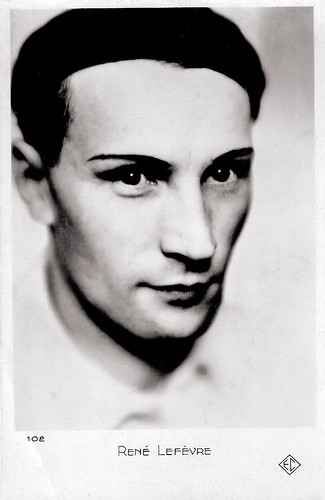
René Lefevre
French postcard by Éditions Chantal (EC), Paris, no. 102.

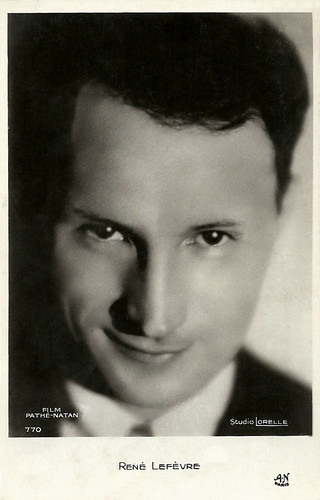
René Lefevre
French postcard by Editions A.N., Paris, no. 770. Photo: Studio Lorelle / Film Pathé-Natan.

The bon garçon


René Lefèvre was born as René Paul Louis Lefèbvre in Nice, France, in 1898. He started his career on the stage of the Comédie des Champs-Élysées in Paris in plays by Marcel Achard and Prosper De Mérimée.

His mentor was the famous actor Louis Jouvet. The stage success of 'Knock', the play by Jules Romains, led to his film debut in the film adaptation Knock, ou le triomphe de la médecine/Knock or the Triumph of Medicine (René Hervil, 1925).

He often played the ‘bon garçon’, the naive but spirited guy, sometimes melancholical, but also good-hearted, gay and generous. In the following years, he developed this character in films like Le tourbillon de Paris/The Maelstrom of Paris (Julien Duvivier, 1928) and Le chemin du paradis/The Road to Paradise (Wilhelm Thiele, Max de Vaucorbeil, 1930).

Lefèvre perfected it in the successful musical comedy Le Million/My Friend Victor (René Clair, 1931), about a missing winning lottery ticket and a long line of people trying to get it.

He was also seen to good advantage in the title role of another classic, Le Crime de Monsieur Lange/The Crime of Monsieur Lange (Jean Renoir, 1936), based on a script by Jacques Prevert. Lefèvre plays a 'nebbish' who clerks for a penny-press publisher (Jules Berry) by day and writes feverish potboilers about a Western hero named Arizona Jim by night. His boss discovers his secret and immediately starts exploiting it. Life sublimely imitates pulp fiction and vice versa.

René Lefèvre
French postcard by P.C., Paris, no. 73. Photo: G.L. Manuel Frères, 63. René Lefèvre wearing the outfit from Le crime de M. Lange/The Crime of Monsieur Lange (Jean Renoir, 1936).

René Lefèvre
French postcard by Editions P.I., Paris, no. 63.

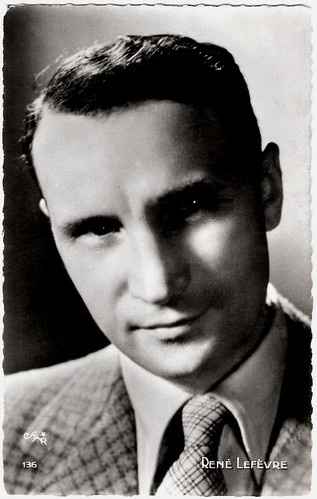
René Lefèvre
French postcard by Editions P.I., Paris, no. 136. Photo: Star.

Other pursuits


As a director, René Lefèvre started as an assistant to Julien Duvivier. Lefèvre directed himself the musical Opéra-Musette (1942), co-directed by Claude Renoir. For this film, he also wrote the dialogues as he did for more films, including La carcasse et le tord-cou/The Carcass and the Weithing Neck (René Chanas, 1948), starring Michel Simon, and Sous le ciel de Paris/Under the Paris Sky (Julien Duvivier, 1951).

In 1952, he left films cold to concentrate on other pursuits. Five years later, he returned before the cameras as a character actor in the excellent war drama Celui qui doit mourir/He Who Must Die (Jules Dassin, 1957).

He remained active for the next two decades. Lefèvre was also the author of several novels, some of which were adapted for the screen, including Rue des Prairies/Rue de Paris (Denys de La Patellière, 1959), starring Jean Gabin.

His later films as an actor include the thriller Le Doulos/The Finger Man (Jean-Pierre Melville, 1962) starring Jean-Paul Belmondo, the historical romance Angélique et le roy/Angelique and the King (Bernard Borderie, 1966), and the war thriller Un homme de trop/Shock Troops (Costa Gravas, 1967).

In the 1970s and the early 1980s, he also worked for TV. His last film was the comedy Un oursin dans la poche/A Sea Urchin in the Pocket (Pascal Thomas, 1977) with Darry Cowl. René Lefèvre died in his birthplace, Nice, in 1991.

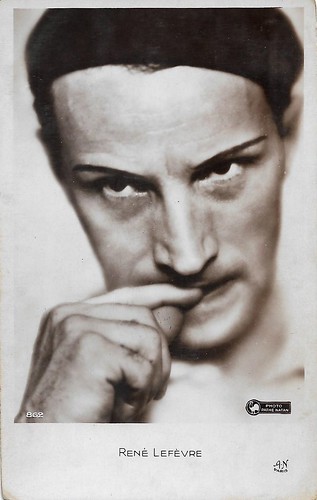
René Lefèvre
French postcard by A.N., Paris, no. 862. Photo: Pathé Natan.

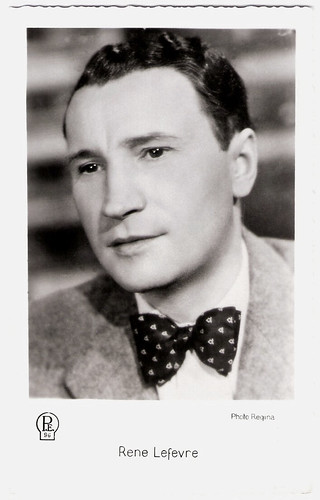
René Lefevre
French postcard by Photo Edition, no. 96. Photo: Photo Regina.

Sources: Hal Erickson (AllMovie - Page now defunct), Yves Laframboise (Pensée de la semaine - French), Richard T. Jameson (Amazon.com - Page now defunct), Wikipedia (French) and IMDb.

This post was last updated on 14 March 2025.

17 October 2012

Claus Holm

German actor Claus Holm (1918-1996) was a star of Heimatfilms in the 1950s. Later he was seen in three Edgar Wallace detectives as well as in films by Rainer Werner Fassbinder. He appeared in 50 films between 1943 and 1979.

Claus Holm
German postcard by UFA (Universum-Film Aktiengesellschaft), Berlin-Tempelhof, no. CK-89. Retail price: 30 Pfg. Photo: Ufa.

Miner and boxer


Claus Holm was born as Helmut Gerhard Ozygus in Bochum-Werne, Germany in 1918.

He started out as a miner and by 1937 he was a boxer. In the mid-1940s he became an actor in Berlin.

He played supporting parts in films like Das Bad auf der Tenne/The Bath in the Barn (Volker von Collande, 1943) with Heli Finkenzeller. The comedy was shot in Agfacolor, one of only a few German films made in colour during the war years. 

After the war, Claus Holm was responsible for the Kurmärkische Theater in Salzwedel.

He made 18 films for the East-German film company DEFA, among them Ehe in Schatten/Marriage in the Shadows (Kurt Maetzig, 1947) with Paul Klinger, and Die Lustigen Weiber von Windsor/The Merry Wives of Windsor (Georg Wildhagen, 1950) with Sonja Ziemann.

Claus Holm
German postcard by Kolibri-Verloag G.m.b.H., Minden/Westf., no. D 24. Photo: Real-Film / Haenchen.
Claus Holm
German postcard by Filmbilder-Vertrieb Ernst Freihoff, Essen, no. 160. Retail price: 10 Pfg. Photo: Dührkoop.

Heimatfilms


In 1953 Claus Holm fled from the DDR to West Berlin, where he was engaged at the Schillertheater and the Schlosspark-Theater.

He starred in the Heimatfilms Der Pfarrer von Kirchfeld/The Priest from Kirchfeld (Hans Deppe, 1955) with Ulla Jacobsson, Wenn die Alpenrosen blüh'n/When the Alpine Roses Blossom (Hans Deppe, Richard Häussler, 1955) with Hertha Feiler, and Zwei blaue Augen/Two Blue Eyes (Gustav Ucicky, 1955) with Marianne Koch.

He appeared next opposite Adrian Hoven and Marianne Hold in ...wie einst Lili Marleen/As Once Lili Marleen (Paul Verhoeven, 1956). The title refers to the popular wartime song 'Lili Marleen' popularised by Lale Anderson, who performs it at a concert at the end of the film.

In 1957 he played commissionary Axel Kersten in the Oscar-nominated thriller Nachts, wenn der Teufel kam/The Devil Strikes at Night (Robert Siodmak, 1957). It was the true story of Bruno Luebke who raped and strangled several young women in Hamburg during the last months of WW II.

Holm also appeared in the remake of Der Tiger von Eschnapur/The Tiger of Bengal (Fritz Lang, 1959) and its sequel Das Indische Grabmal/The Indian Tomb (Fritz Lang, 1959) with Debra Paget and Paul Hubschmid. In the USA the films were shown together in an edited version as Journey to the Lost City (1960).

Claus Holm
German postcard by WS-Druck, Wanne-Eickel, no. F 111. Photo: Ringpress / Vogelmann.

Edgar Wallace thrillers


In the 1960s, Claus Holm played in three popular Edgar Wallace thrillers: Der Fluch der gelben Schlange/The Curse of the Yellow Snake (Franz Josef Gottlieb, 1963), Der Mönch mit der Peitsche/The Monk With the Whip (Alfred Vohrer, 1967), and Der Gorilla von Soho/Gorilla Gang (Alfred Vohrer, 1968).

Holm also appeared in the thriller Dynamit in grüner Seide/Death and Diamonds (Harald Reinl, 1968), starring American actor George Nader. It was part of a series of eight films about FBI agent Jerry Cotton, the titular character of a series of German pulp magazine-type crime novels. 

Holm was well known to TV audiences as Commandor Hasso Sigbjörnsen in the cult SF-series Raumpatrouille Orion/Space Patrol (1966). It was the first German science fiction TV series. Being a huge success with several reruns, audience ratings went up to 56%. Over the years, the series acquired a distinct cult status in Germany.

From the late 1960s onwards he could mainly be seen in the theatre, but in 1978 he returned to the screen in Rainer Werner Fassbinder's hit film Die Ehe der Maria Braun/The Marriage of Maria Braun (1979) starring Hanna Schygulla. This was followed by parts in Die Dritte Generation/The Third Generation (Rainer Werner Fassbinder, 1979) and Berlin Alexanderplatz (Rainer Werner Fassbinder, 1980), the sweeping 16-hour-long TV drama based on the novel by Alfred Döblin.

In 1996, Claus Holm died in Berlin at 78. He was interred at the Friedhof Heerstrasse in Berlin, next to his wife, the singer Dagmar Holm.


Scene from Raumpatrouille Orion/Space Patrol (1966). Source: Permafrost38 (YouTube).

Sources: Stephanie d'Heil (Steffi-line - German), Androom, Wikipedia (German), and IMDb.

This post was last updated on 15 October 2024.