Italian actress Maria Roasio (?-?) appeared as a star of the Italian silent cinema of the late 1910s and early 1920s, in particular at the Ambrosio studio. But very little was known about her, so we decided to research her films. And yes, Ivo Blom also dug up some new information on her life.
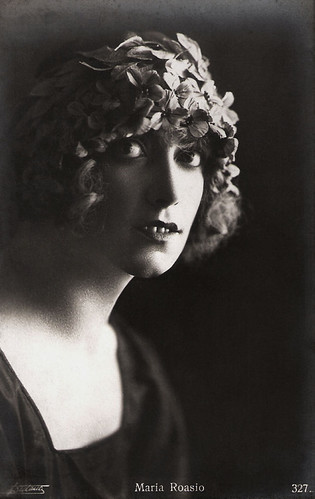
Italian postcard by Edizioni A. Traldi, Milano, no. 327. Photo: Fontana.
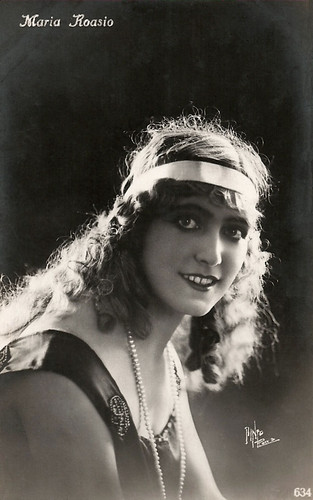
Italian postcard by Ed. A. Traldi, Milano, no. 634. Photo: Pinto, Roma.

Italian postcard by Ed. A. Traldi, Milano, no. 635. Photo: Pinto, Roma.
Little is known about Maria Roasio, one of the minor Italian divas who starred for Ambrosio in several Italian silent films during the late 1910s and early 1920s. There are also quite a few postcards of her with beautiful portraits by photographers like Fontana and Pinto. But there is no Wikipedia page about her. And IMDb only mentions that she was born in Milan, but does not offer her birth year nor where or when she died. Furthermore is only known that she had a sister, Fernanda, who also acted in Italian silent cinema in the early 1920s. So we checked out Vittorio Martinelli's series of studies on the Italian silent cinema, 'Il Cinema Muto Italiano', for her films.
Italian postcard by Edizioni A. Traldi, Milano, no. 327. Photo: Fontana.
Italian postcard by Ed. A. Traldi, Milano, no. 634. Photo: Pinto, Roma.
Italian postcard by Ed. A. Traldi, Milano, no. 635. Photo: Pinto, Roma.
Fresh and natural acting
Little is known about Maria Roasio, one of the minor Italian divas who starred for Ambrosio in several Italian silent films during the late 1910s and early 1920s. There are also quite a few postcards of her with beautiful portraits by photographers like Fontana and Pinto. But there is no Wikipedia page about her. And IMDb only mentions that she was born in Milan, but does not offer her birth year nor where or when she died. Furthermore is only known that she had a sister, Fernanda, who also acted in Italian silent cinema in the early 1920s. So we checked out Vittorio Martinelli's series of studies on the Italian silent cinema, 'Il Cinema Muto Italiano', for her films.
Maria Roasio made her film debut in Febo Mari’s Attila (1918) with the director himself in the title role. The historical epic was produced by the Turin-based Ambrosio studio. Roasio played Onoria, a young Roman woman who is given to Attila because he spared Rome from destruction. But she kills him on their wedding night. The film premiered in Italy in February 1918, during the First World War. Pier da Castello drew in the Italian magazine La vita cinematografica a comparison between Attila the Hun and Emperor Wilhelm II, who was considered the culprit of the First World War and its massive slaughter. Da Castello indicated that Mari’s film appealed to the call of the government to make patriotic films. These must show audiences why the bloodshed was necessary. He forgave Mari’s ‘playing’ with history. The British magazine Bioscope showed the same permissiveness in their 1918 review of Attila, justifying Mari’s spectacle but also its ideological warning against ‘barbarians’ then and now. Bioscope also praised the beauty of the two leading actresses, newcomer Roasio and Ileana Leonidoff, as the sensual Bulgarian dancer Ildico – who, according to Bioscope, had been the real assassin of Attila.
From that moment on, Roasio became producer Arturo Ambrosio’s star performer. Rumour is that she also became his mistress. In La cantoniera n. 13 / Roadhouse no. 13 (Luigi Maggi, 1919), she played an ex-circus girl who becomes a signalman and prevents a train crash. One of the survivors is a sculptor, who takes her to the city, where she starts to blossom, causing the jealousy of the sculptor’s lover. In Champagne Caprice (Achille Consalvi, 1919), the script was quite silly – about an orphan girl who proves to be a princess's daughter and is abducted by a rich gypsy violin player who proves to be her father. The Italian press nevertheless praised the fresh and natural acting by Roasio, so contrasting with the Italian divas.
Less fortunate was La Gibigianna (Luigi Maggi, 1919), in which all actors, excluding the star Lucy Di San Germano, were considered artificial and grotesque. Roasio played a supporting part in the film. Also Zavorra umana / Human Ballast (Gustavo Zaremba de Jaracewsky, 1919), in which Roasio had the female lead opposite René Maupré, was condemned by the press because of its banal script and unfitting action scenes. Cuor di ferro e cuor d’oro / Heart of Iron and Heart of Gold (Luigi Maggi, Dante Capelli, 1919) was a classic sentimental story about two aristocratic families reconciling because of the love between two members of their families (Roasio and Angelo Vianello). In La farfalla della morte / The Butterfly of Death (F.G. Viancini, Arturo Ambrosio Jr., 1920), Roasio is the rich bride of an entomologist who owns a poisonous exotic butterfly. Under the spell of an adventuress, her husband humiliates her in the presence of his lover. The wife tries to commit suicide with the butterfly, but her sister saves the situation.
In Sillabe ardenti / Burning Syllables (Achille Consalvi, 1920), an ex-prostitute marries and has a child, but her husband is informed about her past. When she swears on the head of her gravely ill child that he may die if she betrays her husband, the child seems to die for real, but resuscitates, of course. In the social drama Gens nova (Luigi Maggi, 1920), an aristocratic family unites with that of a farmer. After conflicts because of the pride and stiffness of the aristocracy and feelings of revolt and revenge by the farmers, the story ends with weddings and the message that nobility of labour counts more than aristocracy of the blood. The topic was quite sensitive for 1919, a year full of political upheaval in Italy, so e.g. a scene with stones thrown through the window of the count’s villa was eliminated. In another social drama, Terra / Earth (Eugenio Testa, 1920), a poor farmer’s family moves to town in the hope of better gain, but misery strikes them, and the family falls apart. The protagonist, Viola (Roasio), is the only one to return to the countryside. The press was split: some thought it unfit for the cinema and wooden, others called it a genuine social drama, while one source remarked the film had been made quite incomprehensible because of the heavy cuts by the censor.

Italian postcard for Attila / Attila, the Scourge of God (Febo Mari 1918), with Febo Mari in the title role. Caption: Young Onoria (Maria Roasio) incites the people of Aquileia to resist Attila. Indeed in the film, she corrects the pope who wants just peace, but she incites the populace to resist and fight back, if necessary even with the rocks of their ruins.

Italian postcard by G.B. Falci, Milano, no. 239.

Italian postcard.
Ideology in silent film
In 1921, Maria Roasio continued to act in social dramas such as Angeli e demoni / Angels and Demons (Luigi Maggi, 1921), a miner’s drama about the daughter of an old miner (the angel) and an aggressive head of the miners (the demon). The film was praised for Roasio’s acting but also for the genuine images of the work in the mines. The topic, which also dealt with strikes, requests for salary raises, accidents at work and cruel industrial conditions, alarmed the censors. The whole part of a propagandist had to be eliminated from the film, plus a scene in which a miner was seen hurt by an explosion in the mines. Roasio also played that year in Il castello dei gufi / The Castle of the Owls (Max Sullivan, 1921), scripted by the future film director Augusto Genina and by Aldo De Benedetti. The story deals with a Russian scientist (Gustavo Serena), who lives in the castle of the owls. There he keeps his niece Maria, supposedly mad, but the man is mad himself. A young, courageous man liberates the girl and punishes the uncle.
Apart from a minor film, Il palazzo dei sogni / The Palace of Dreams (Alessandro Rosenfeld, 1921), released in Italy only in 1923. Roasio’s main film of 1921 was Mara West (Arturo Rosenfeld, 1921), written by Fantasio (Riccardo Artuffo). It is the by-now well-known ideology in silent cinema and beyond that women cannot have a career and a happy married life as well. Young Maria leaves home and becomes the acclaimed actress Mara West. A young actor helps her. They fall in love and have a child. When at the apex of her success, the man leaves the theatre and her, returning to a normal life. He meets Mara’s sister and marries her, while broken-hearted Mara continues her career. The press praised the script, realising it was a well-known plot, but played out with convincing emotionality. In particular, the press praised the scene in which Mara looks out and oversees the dawn of the city, with all the artificial light going out in the centre, connecting this to the end of her own relationship.
For the drama La rondine / The Swallow (1921-1922), she worked under the direction of Gabriellino D’Annunzio, the son of the famous poet Gabriele D’Annunzio and Duchess Maria Hardouin di Gallese. The film, again scripted by Fantasio, is about a girl who resembles a swallow and who warms the hearts of an old prince and three grandsons living in a cold and boring castle. In 1922, Roasio made an unsuccessful attempt to found her own studio, the company Star Film. It resulted in only one film, Manolita (Guido di Sandro, 1923), for which the press praised the setting and Roasio’s acting. The plot resembled that of Sillabe ardenti: a poor girl haunted by her dark past is on the verge of being kicked out by her husband. Their little son and this time also the man’s mother provide a reconciliation. In 1923, Roasio played in Notte di tempesta / Stormy Night (Riccardo Cassano, 1923), shot in Sardinia. Il trittico di Bonnard / Bonnard's Triptych (Mario Bonnard, 1924) was a triptych in which Roasio played in A morte / A Death, the first part set in the Middle Ages. The press praised the film for its structure – it was the first Italian episode film without a clear thread uniting the different stories. Critics appreciated the upcoming child actor Marcella Sabattini and Rina De Liguoro in the second and third episode.
In 1924, Roasio produced and starred in La bambola vivente / The Living Doll (Luigi Maggi, 1924), a film designed to establish Roasio as a star and launch a Maria Roasio film series. The press accused La bambola vivente of plagiarism, specifically of the German film Die Puppe / The Doll (1919) by Ernst Lubitsch. Her dream to become a producer was now over for good. In 1927, she made a last attempt to revamp her career in I rifuti del Tevere / The Wasted of the Tiber (G. Orlando Vassallo, 1927), in which Roasio starred with Raimondo van Riel, Franz Sala and Augusto Bandini. The title hinted at a popular section in the newspaper Il Tevere on Rome’s criminality. According to the press, the film was quite successful, even if not in the range of the Kolossal films. But Maria Roasio disappeared from the screen. What happened to her?
At the genealogy site Ancestry, Ivo Blom found her full name, Maria Margherita Francesca Roasio. She was born on 7 October 1899. This is plausible, because she was about 20 when she made her film debut in Attila (Febo Mari, 1919). Her parents were Giuseppe Roasio and Marcella Allare, and she was baptised in Turin on 11 October 1899. Ivo also found an Italian article by Sandro Galantini on GiulianovaNews, a site about the Italian coastal town in the province of Teramo, in the Abruzzo region. Galantini writes that Maria Roasio came from a family in Piedmont but was born in Nice (so not Milan, but why was she baptised in Turin?). He explains why Roasio stopped her film career. In 1927, she married Vincenzo Trifoni (1901–1985), the son of a wealthy landowner from Colleranesco and a prominent racing driver. When he went to Libya, then an Italian colony, to set up an agricultural business together with his business partner Domenico Catitti, Roasio followed him. The business was a success. Galantini also adds that Maria Roasio died in 1982 and was interred in the Trifoni family chapel at Giulianova cemetery.

Italian postcard by La Rotofotografica. Photo: Ambrosio-Film.

Italian postcard, no. 325. Photo: Fontana.

Italian postcard by Edizioni A. Traldi, Milano, no. 326. Photo: Fontana.

American Photocine-postcard by A.G.F.
Sources: Vittorio Martinelli (Il cinema muto italiano, 1918, 1919, 1920, 1921-1922, 1923-1931), Sandro Galantini (GiulianovaNews - Italian), Ancestry, Alberto Friedemann (Imprenditoria femminile nel cinema torinese), and IMDb.

No comments:
Post a Comment