
Italian postcard by Ed. G. Vettori, Bologna, no. 36. Pina Menichelli in La moglie di Claudio / Claude's Wife (Gero Zambuto, 1918).

Italian postcard. Pina Menichelli and Alberto Nepoti in La moglie di Claudio / Claude's Wife (Gero Zambuto, 1918).

Italian postcard by Vettori Bologna, no. 426. Pina Menichelli in her dress from La moglie di Claudio / Claude's Wife (Gero Zambuto, 1918).
A whirlwind of passion and death
In La moglie di Claudio / Claude's Wife (1918), Pina Menichelli stars as Cesarina, the charming but unfaithful wife of inventor Claudio Ruper (Vittorio Rossi-Pianelli). The two do not divorce because of Claudio's religious beliefs, but they live like strangers.
Her cold reaction to the death of her illegitimate son, who until then had been kept hidden by a couple of peasants, reveals her true nature to her husband. It convinces him to break off all contact with her except for the cohabitation imposed by bourgeois decorum.
From that moment on, Claudio, an inventor of war machinery, devotes himself completely to his work. While his wife lives her free life, he plans the construction of a powerful new weapon to put at the service of his homeland, France.
Antonino (Alberto Nepoti), a young man of no means whom he had brought up as his son, assists him in the undertaking. The new invention, a cannon of exceptional power, attracts the attention of a powerful secret society, which commissions a spy, Moncabrè, to seduce Cesarina into handing over her husband's documents. The spy blackmails Cesarina, threatening to reveal her affair with Antonino, Claudio's young pupil, if she does not help him steal her husband's invention.
However, the conspirators have not reckoned with the perverse allure of the woman. Claudio is warned by a loyal servant. In a whirlwind of passion and death, events precipitate towards a tragic finale.

Italian postcard by Vettori, no. 3033. Photo: Itala. Pina Menichelli and Vittorio Rossi-Pianelli in La moglie di Claudio / Claude's Wife (Gero Zambuto, 1918).

Italian postcard by Vettori, no. 3035. Photo: Itala. Pina Menichelli and Vittorio Rossi-Pianelli in La moglie di Claudio / Claude's Wife (Gero Zambuto, 1918).

Italian postcard by Vettori, Bologna, no. 461. Photo: Itala. Pina Menichelli and Alberto Nepoti in La moglie di Claudio / Claude's Wife (Gero Zambuto, 1918).
The evil female who undermines society
Fascinating and enigmatic Pina Menichelli (1890-1984) was the most bizarre Italian diva of the silent era. Some of the most significant titles in the diva film genre derive from Menichelli's encounter with film pioneer Giovanni Pastrone, the studio head of Itala Film. After the actress became successful, she tried to distance herself from the role of the femme fatale, but she revisited it in La moglie di Claudio, her final collaboration with Pastrone.
La moglie di Claudio / Claude's Wife (Gero Zambuto, 1918) was based on 'La femme de Claude' by Alexandre Dumas fils. The film begins with a quote from Dumas's preface: "The characters in La moglie di Claudio / Claude's Wife are symbols. Claudio Ruper is not only a great mechanic, an inventor, a man, but he is 'Man' in the grand sense of the word. He is the Frenchman who has suffered in his soul and in that of others, who has risen above, who has a tenacious will and goes straight to his goal: the reconstitution of his dismembered homeland."
35 years later, a clip with Pina Menichelli from the film was shown in Luigi Comencini's La valigia dei sogni / The Suitcase of Dreams (1953), but in the following decades, the film seemed lost.
In 2011, La moglie di Claudio / Claude's Wife was found and restored by Museo nazionale del cinema in Turin and Cineteca di Bologna. The restoration was carried out using a positive nitrate copy, tinted and toned, with French captions, from the Lobster Films Collection in Paris. The copy, currently the only known existing copy from that period, is a French re-release distributed by the Vitagraph branch in Paris. A digital restoration of this tinted film followed in 2017.
When the film was shown in 2018 at Il Cinema Ritrovato, Claudia Gianetto wrote in the festival catalogue: "After attempting to reconquer her husband, seducing his favourite student and stealing secret documents, Cesarina is betrayed and unmasked by the light of a ‘damned moon’; then Claudio stops her with a gunshot. Menichelli rewards us with a textbook ending: mortally wounded, she grasps the curtains sensuously before falling to the floor enveloped in their folds, as if wrapped in a funeral shroud ." Dumas: "...the evil female who undermines society, dissolves the family, dismembers the country, weakens the man, dishonours the woman whose appearance she assumes and destroys those who do not crush her".
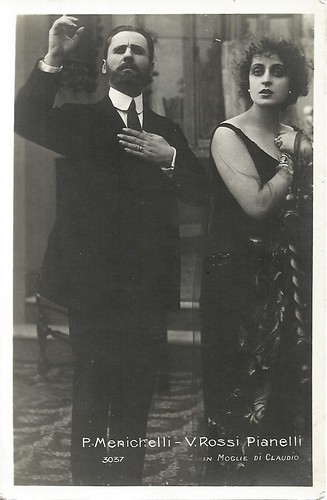
Italian postcard by Vettori, no. 3037. Photo: Itala. Pina Menichelli and Vittorio Rossi-Pianelli in La moglie di Claudio / Claude's Wife (Gero Zambuto, 1918).

Italian postcard by Vettori, no. 3039. Photo: Itala. Pina Menichelli and Vittorio Rossi-Pianelli in La moglie di Claudio / Claude's Wife (Gero Zambuto, 1918).

Italian postcard, no. 357. Photo: Itala. Pina Menichelli and Alberto Nepoti in La moglie di Claudio / Claude's Wife (Gero Zambuto, 1918). Cesarina seduces Antonino in opening her husband's safe to her...
Sources: Claudia Gianetto (Il Cinema Ritrovato), Museo Nazionale del Cinema, Torino (Italian), Portale cinema muto italiano (Italian), Film Affinity, Wikipedia (Italian) and IMDb.
You can watch the film on the website of Museo Nazionale del Cinema in Turin.

No comments:
Post a Comment