
French postcard by Bibliothéque nationale de France, 2003, no. CP 0341. Photo: Lipnitzki. Gérard Philipe in 'Les Épiphanies' (1947) by Henri Pichette at the Théâtre des Noctambules.

French postcard by Images d'Avignon, Avignon, no. 40. Photo Atzinger. Caption: Fifth Festival d'Avignon (1951). Gérard Philipe in 'Le Prince de Hombourg' (Der Prinz von Homburg, The Prince of Homburg) by Heinrich von Kleist.

French postcard by Bibliothéque nationale de France, 2003, no. CP 0344. Photo: Agnes Varda. Caption: Gérard Philipe and Jean Vilar, Suresnes, 1951.
A symbol of the new French theatre
Gérard Philipe was born in Cannes in 1922, the son of hotelier and lawyer Marcel Philip and his wife Marie Philip née Vilette. In 1941, Gérard Philip (still without the last e) began studying law in Nice, but was thinking of leaving this path to become an actor, a possibility his father opposed. That same year, filmmaker Marc Allégret met his mother, Marie, who enjoyed reading the cards for guests at her husband's hotel. Knowing that her son wanted to be an actor, she persuaded the director to audition him. He therefore auditioned Gérard for a scene from 'Étienne', a play by Jacques Deval in which a 17-year-old son sees his vocation as an actor thwarted by his father. Allégret was impressed by ‘a kind of violence that felt ready to boil over at any moment’. The filmmaker advised him to enrol at the Centre des jeunes du cinéma in Nice, then sent him to take drama classes with Jean Wall and Jean Huet in Cannes.
He finally made his theatre debut in 'Une grande fille toute simple by André Roussin, which premiered on 11 July at the Cannes Casino. The play was a great success and toured the south of France and Switzerland. His talent was already appreciated and recognised by his peers. To satisfy his mother's superstition, he added an -e to his surname, so that his first name and surname now had 13 letters. In November, the free zone was invaded by the German army. In 1943, Gérard Philipe starred in André Haguet's play 'Une Jeune Fille savait', which was a success in Paris. He confirmed his acting talents. Marc Allégret first hired him for a cameo in the film La Boîte aux rêves, directed by his brother Yves, then gave him a small role in Petites du quai aux fleurs.
The Philip family moved to Rue de Paradis in the 10th arrondissement of Paris. Gérard became financially independent and lived with Jacques Sigurd on Rue du Dragon in Saint-Germain-des-Prés. His friend, who wrote numerous screenplays and dialogues for films in which Gérard starred, introduced him to modern literature and Albert Camus' 'Caligula'. In 1943, he achieved his first success and fame at the age of twenty, in the role of the angel in Jean Giraudoux's 'Sodome et Gomorrhe'. The theatre director, Jacques Hébertot, said: "From the very first rehearsals, we realised that we had nothing to teach this young actor. He was possessed." Despite his success, Gérard Philipe enrolled at the Conservatoire National Supérieur d'Art Dramatique (the Paris Conservatory) and took classes with Denis d'Inès. The following year, he won second prize in comedy. Although he was still in his first year, he had been admitted to the competition. From October 1944 onwards, he attended Georges Le Roy's classes and discovered his passion for live theatre: "He taught me to stand tall, with my legs straight, facing life like a healthy man." In November 1944, he performed in 'Au petit bonheur', a comedy by Marc-Gilbert Sauvajon.
In March 1945, Gérard Philipe met actress Maria Casarès in March 1945 through René Laporte's play 'Fédérigo'. Philipe's fame in the theatre grew further thanks to his role in Albert Camus's Caligula, again at the Théâtre Hébertot. He received rave reviews for his performance. It was through this play that director René Clair discovered him, with whom he would collaborate for many years: "I was disconcerted by the romantic and intellectual aspect of the young actor I saw." He resigned from the conservatory in October. In the following years, he landed his first leading film roles, including L'Idiot / The Idiot (Georges Lampin, 1946) and Le Diable au corps / The Devil in the Flesh (Claude Autant-Lara, 1947), in which he co-starred with Micheline Presle. The sensational success of the latter marked a turning point in his career. He was now a film star with international acclaim.
In December 1947, Gérard Philipe performed in Henri Pichette's play 'Les Épiphanies' (The Epiphanies) at the Théâtre des Noctambules, alongside Maria Casarès. He rented the venue at his own expense after the project had fallen through at the Théâtre Hébertot. The play became a symbol of the new French theatre, both for the emergence of new actors and new venues, and for the search for a new relationship with the audience. This was also what Jean Vilar was committed to with his Avignon Art Week, which took shape in September 1947. Jean Vilar, who had been impressed by his performances in 'Caligula' and 'Les Épiphanies', invited Philipe to his house. Vilar offered him the role of Le Cid in Pierre Corneille's play for the second Avignon Festival. Reportedly, Philipe replied: "Tragedy? Tragedy? Come on, I'm not cut out for that."

French postcard by A.N., Paris, no. 1261. Photo: Raymond Voinquel.

French postcard by Images d'Avignon, Avignon, no. 5. Photo Atzinger. Caption: Fifth Festival d'Avignon (1951). Gérard Philipe in 'Le Cid' by Pierre Corneille. This postcard is a 1982 reproduction printed in a limited edition of 1000 cards, no. 760.

French postcard by Images d'Avignon, Avignon, no. 14. Photo Atzinger. Caption: Fifth Festival d'Avignon (1951). Gérard Philipe in 'Le Prince de Hombourg' (Der Prinz von Homburg, The Prince of Homburg) by Heinrich von Kleist.

French postcard by Editions La Malibran, Paris, no. T4. Jeanne Moreau and Gérard Philipe in Le Prince de Hombourg (1952), based on the play by Heinrich von Kleist and Jean Vilar.
Following Jean Vilar
After several successful films, Gérard Philipe finally visited Jean Vilar in his dressing room at the Théâtre de l'Atelier after a performance of Luigi Pirandello's Henry IV. Vilar later recounted: “While removing my makeup that evening, I glanced out of the corner of my eye at this famous young man whom I barely knew. Tall, upright, with few gestures and a clear, frank gaze, his presence was a blend of quiet strength and fragility. I told him I was preparing for Avignon 1951, that is, the fifth Festival, and that it was the only project I could guarantee him. He immediately replied that he would be at the next Avignon. Two days later, I gave him 'The Prince of Homburg'. He said yes. I added: And 'Le Cid'? He lowered his head, smiled, and then fell silent.” Two years earlier, the actor had refused the role of Rodrigue, much to the director's dismay. This encounter left a mark on Philipe: “A conversation with Vilar, his remarks about the theatre, his opinion on the plays I was eager to perform, won me over. One of Vilar’s great qualities is his patience. I, on the other hand, was always impatient. But when he had me read 'The Prince of Homburg', I no longer hesitated to follow him.”
The following year, Jean Vilar was appointed director of the Théâtre National Populaire (TNP) and led a company composed of promising young actors and actresses such as Philippe Noiret, Jeanne Moreau, and Charles Denner. Philipe declared, "For me, the TNP is my home, it's my house." Rehearsals for 'Le Cid' and 'The Prince of Homburg' began, and after a difficult start, Gérard Philipe managed to make the role of Rodrigue his own thanks to Jean Vilar: "Everything seems possible since Vilar, to my great surprise, asked me to play 'Le Cid'. He's the one who won, not me."
The premiere of 'The Prince of Homburg' took place at the 1951 Avignon Festival, in the Cour d'Honneur of the Palais des Papes. Philipe injured himself during the final rehearsal in costume, falling 2.5 meters, fortunately cushioned by his thick costume. Although he was forced to perform motionless or seated throughout the festival, considerably diminishing his acting ability, the play was nonetheless a triumph. This experience strengthened his commitment to the company and to Jean Vilar's project of making theatre accessible to all.
Gérard Philipe signed a one-year contract with the TNP, tacitly renewable. Despite his career and international renown, he reassured the new director about his salary: he was prepared to accept a lower fee than in film so as not to jeopardize the company's budget. His salary was set at 30,000 francs gross per month (€750 in 2019), plus 400 francs per rehearsal (€10 in 2019). Jean Vilar testified that in eight years, he never asked for a salary increase, preferential treatment, or any special clause. On the posters, his name appeared in its alphabetical place. Philipe was a strong believer in egalitarianism. He would also become president of the French actors' union, actively promoting the rights of actors.
In 1952, Philipe directed his first play, 'Nucléa', by Henri Pichette, a play denouncing nuclear war that divided critics. He also made his stage management debut at the TNP (Théâtre National Populaire) with Alfred de Musset's 'Lorenzaccio', a play that enjoyed great success at the Avignon Festival and then in Paris the following year. Vilar twice entrusted him with the responsibility of directing his colleagues. In 1954, he entrusted him with the title role and the direction of William Shakespeare's 'Richard II', a role he had played himself since the creation of the Avignon Art Week in 1947: “Each time, I marvel at his gifts, at this grace that knows how to remain discreet, at this pure technique. […] Yet, is there any actor performing on this monstrous stage who has ever inspired so much confidence in me? […] Gérard, playing this magnificent role in a completely different way, ultimately confounded my judgment, preventing me, by his very inventions, from any useful and serious analysis of his performance." In 1958, a year before he died, Gérard Philipe finally appeared on Broadway in the plays 'Le Cid' and Alfred de Musset's 'Lorenzaccio'.

French postcard by Editions La Malibran, Paris / Saint-Dié, no. T 1. Photo: Tom Blau.

French postcard in the Collection Cinéma by Editions Malibran, Paris / Nancy, no. CF 54. Photo: Cyril Stanborough. Gérard Philipe in Monsieur Ripois / Knave of Hearts (René Clément, 1954).
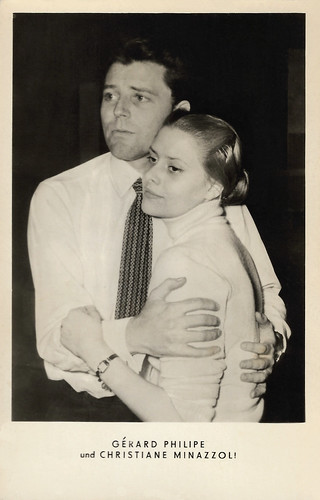
East German postcard by VEB Volkskunstverlag Reichenbach L.V., no. G 591, 1956. Photo: Zentralbild, Berlin. With Christiane Minazzoli.

East German postcard by VEB Progress Film-Vertrieb, Berlin, no. 115, 1956. Photo: Gerhard Puhlmann. Gérard Philipe and German actress Elfriede Florin.

French postcard by Editions P.I., Paris, no. 656. Photo: Sam Lévin.
More Gérard Philipe posts
Gérard Philipe in East Germany, 19 August 2023.
Gérard Philipe, 30 April 2023.
Sources: Wikipedia (French and German).

No comments:
Post a Comment