
French postcard. Photo: Nadar, Paris, 1895. Sent by mail in 1901.

French postcard by S.I.P., no. serie 51e. Photo: Reutlinger, Paris.

French postcard by S.I.P., no. serie 69e, no. 11. Photo: Reutlinger, Paris.
The talk of Parisian women
Cléo de Mérode was born in Paris, France, in 1875. She was the illegitimate daughter of Viennese Baroness Vincentia Maria Cäcilia Catharina de Mérode. Vincentia was estranged from Cléo's father, who was the Austrian judge, lawyer, and pioneer of tourism Theodor Christomannos. Cléo met her father as a young adult at a train station in Merano, and upon seeing him, jokingly exclaimed, "I really hope that you are wealthy, because I am used to luxury and the good life." Upon Christomannos' death in 1911, de Mérode left an inscription on his grave in German which reads, "The man who wanted everything for others and nothing for himself".
She was raised Catholic and affectionately called 'Lulu' by her family. At the age of eight, she was sent to study dance with the Sisters of Saint-Vincent-de-Paul, and she made her professional debut at the Paris Opéra at age eleven. De Mérode became renowned for her glamour even more than for her dancing skills. Her image began appearing on postcards and playing cards. At 16, she debuted her signature hairstyle, a 'chignon', which became the talk of Parisian women and was quickly adopted as a popular style for all. The 'Cléo de Mérode hairdo' remained popular for decades. In 1895, Henri de Toulouse-Lautrec and Edgar Degas did her portrait. She was sculpted by Alphonse Mucha. Her picture was taken by illustrious photographers of the day, including Nadar and his son and successor Paul Nadar, Léopold-Émile Reutlinger and his son Jean Reutlinger, Charles Ogerau, Henri Manuel, and Otto Sarony.
In the autumn of 1895, a rumour began that Cléo de Mérode was King Leopold II's latest mistress, and the two were dubbed 'Cléopold' by the media. De Mérode's reputation suffered, and she was labelled a 'courtesan' or 'demimondaine'. In an attempt to settle the rumours, de Mérode's mother wrote a letter to the editor of Le Figaro. De Mérode wrote in her autobiography: "I was completely bewildered by the dimensions that this story took on. The tale of my liaison with Léopold sped along, across France, throughout Europe, and around the world. Caricatures, gossip columns, songs, skits showed the king and me, snuggling, sharing a restaurant table, cracking open champagne at Maxim's, on a cruise, in a Pullman, and so on.... I did not know what to make of such inordinate publicity; it stunned me."
Michael Garval, de Mérode's biographer, said that although de Mérode posed as a courtesan to increase her fame, she never worked as one. In the spring of 1896, a second scandal erupted due to the exhibition of the sculpture 'La Danseuse' by Alexandre Falguière at the Salon des Artistes Française. The sculpture was a life-size nude in white marble that was carved from a plaster cast of de Mérode's body. Despite the grain of skin visible on the plaster, proving a live cast, de Mérode accused Falguière of having fabricated a scandalous work by moulding the body of the statue on another female model, whereas she posed only for the head. The scandal followed her throughout her career.
Despite the two scandals, de Mérode became an international star, performing across Europe and in the United States. In Germany, she danced at Hamburg's Hansa-Theater and Berlin's Wintergarten, and in France she appeared in the plays 'Les Deux Pigeons', 'La Korrigane', and 'Étoile'. Gustave Charpentier engaged her for the role of La Beauté in 'Le Couronnement de la Muse'. In 1897, she arrived in New York City, where she appeared for a month at Koster and Bial's in the play 'Faust'. During her stay in New York, she was besieged by reporters and followed down the street by girls begging for her autograph. de Mérode's performance was heavily anticipated, but was disappointing, and though the press praised her beauty, they said she could not dance.
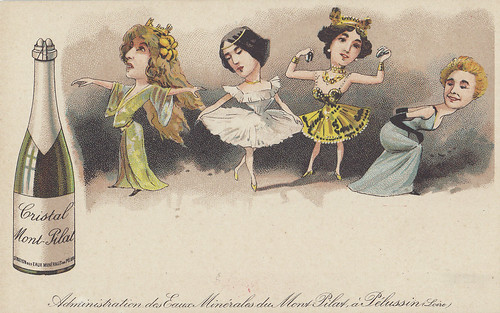
French advertising postcard for Cristal Mont-Pilat (mineral water, alas, not champagne) with caricatures of Sarah Bernhardt, Cléo de Mérode, Carolina 'la belle' Otéro, and Yvette Guilbert. The black gloves were usually a part of Guilbert’s costume. Collection: Marlene Pilaete.

French postcard by S.I.P. Photos: Reutlinger, Paris. Caption: Otéro (Caroline Otéro), A. Held (Anna Held), C. de Mérode (Cléo de Mérode).
Doing something other ballet divas had never done before
In 1900, Cléo de Mérode caused a sensation at the Exposition Universelle when she performed traditional Javanese and Khmer dances. She also appeared in two films, one of which was hand-tinted in colour. Both films showed her dancing. 50 years later, both films were included in Paris mil neuf cent (Nicole Védrès, 1947), a documentary limning the life of Paris and its citizens during 'La Belle Époque ', the years between 1900 and 1914. The film begins with the Paris Exposition of 1900. In 1901, Édouard Marchand organised for de Mérode to dance at the Folies Bergère in a three-act pantomime titled 'Lorenza'. She took a risk doing something other ballet divas had never done before. Her performance further increased her popularity. In 1904, she reprised her role as Phryne at the Olympia. That same year, she performed alongside dancer Paul Franck in 'Tanagra', a dance in Ancient Greek style.
In 1906, it was reported that 50,000,000 photographs of de Mérode had been sold and that a single Berlin firm produced 4,000,000 a year. In 1908, she portrayed Phoébe in 'Endymion et Phoébe' at the Opéra-Comique alongside Régina Badet. In 1912, de Mérode appeared in the opera 'La Danseuse de Pompeii' as part of the corps de ballet at the Opéra-Comique. The following year, she appeared in the revue 'Come Over Here' at the London Opera House. During World War I, she entertained wounded soldiers. After the war, she toured in the French provinces with Serge Peretti, reluctant to accept engagements abroad. She continued to dance until her late forties.
Throughout the early 1920s, Cléo de Mérode performed at galas and benefit concerts. The first was a fundraiser for Benoît-Constant Coquelin's old actors' home in Couilly-Pont-aux-Dames. She retired in 1924 to the seaside resort of Biarritz in the Pyrénées-Atlantiques département of France. At the request of theatre director Henri Varna, she reappeared on stage at the Alcazar in 1934 in 'Viens poupoule' alongside the dancer George Skibine and the actress and singer Cassive. She did four routines: one in a Norman peasant costume, the traditional Khmer dance she had first performed at the Exposition Universelle in 1900, a Second Empire scene, and 'la Valse 1900'.
She then taught ballet before retiring in 1965. She was 90. As a hobby, she crafted figurines of dancers, shepherds, and shepherdesses in the classical style, which she then sold. The character 'Cleo of Paris', played by Mae Murray in the American silent film Peacock Alley (Robert Z. Leonard, 1922), was a parody of her. The film was one of the biggest box office hits of 1922. De Mérode unsuccessfully sued the film owners for 100,000 francs in damages, alleging that the film injured her reputation by burlesquing incidents in her career. She was portrayed by Fern Andra in the lost German silent film Frauen der Leidenschaft / Women of Passion (Ralf Randolf, 1926). Upon learning of the film and its portrayal of her as a courtesan, she protested in an open letter in the theatrical daily Comœdia, saying, "I lead and have always led the quietest of lives, I do not seek any publicity, and I really do not wish to be given any against my will, especially that sort of publicity."
In 1950, Cléo de Mérode sued Simone de Beauvoir for libel, claiming five million francs in damages. De Beauvoir had "wrongly described her as a prostitute who came from peasant stock and had taken an aristocratic-sounding stage name as self-promotion" in her book 'The Second Sex'. De Mérode won the lawsuit, and the passage was removed from the book. However, de Mérode only received one franc in damages because "the judge found that Cléo had permitted the rumours during the course of her career for their publicity value". In 1955, she published her autobiography, 'Le Ballet de ma vie' (The Dance of My Life). She never married or had children, which has led some biographers to categorise her as a lesbian.

French postcard in the Collection artistique du Vin Désiles by S.I.P. Photo: Reutlinger. Caption: Au délicieux Vin Désiles qui donne la santé et la gaité (To the delicious Vin Désiles that gives health and cheerfulness).

French postcard, no. 1188.

German postcard by Ross Verlag, no. 825/1, 1925-1926. Photo: British-American-Films A.G. (Bafag). Mae Murray in Peacock Alley (Robert Z. Leonard, 1922).
Sources: Wikipedia and IMDb.

No comments:
Post a Comment