27 January 2015

Margit Nünke

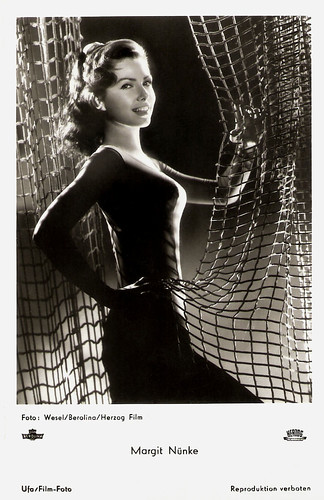
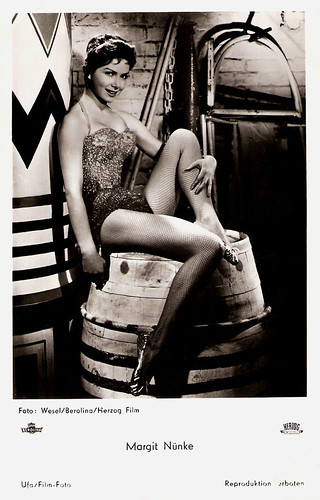
Gorgeous German actress Margit Nünke (1930-2015) started as a fashion model and beauty queen. Between 1957 and 1965, she played in nine films.

Margit Nünke
German postcard by Ufa, Berlin-Tempelhof, no. FK 3615. Photo: Wesel / Berolina / Herzog Film. Publicity still for Das haut hin / The skin-out (Géza von Cziffra, 1957).

Margit Nünke
German postcard by Ufa, Berlin-Tempelhof, no. FK 3614. Photo: Wesel / Berolina / Herzog Film.

Miss Germany


Margit Nünke was born in Stettin, Germany (now Szczecin, Poland) in 1930. She became Miss Germany in 1955 after previously being Miss North Rhine-Westphalia.

The following year, 1956, she won the Miss Europe pageant in Stockholm before 12 other candidates and in front of 5,000 spectators. Finally, she reached 4th place at the Miss Universe contest in Long Beach, USA, in 1958 (in 1955, according to Wikipedia).

From 1957 on, she appeared in feature films and TV movies. In Italy, she acted opposite Rik Battaglia and Sylva Koscina in I fidanzati della morte / Engaged to Death (Romolo Marcellini, 1957).

In the German musical comedy Das haut hin / The Skin-out (Géza von Cziffra, 1957), she appeared opposite the popular Peter Alexander. On TV she starred in the crime mini-series Gesucht wird Mörder X / Wanted murderer X (Volker von Collande, 1959).

In the Austrian film Geliebte Bestie / Arena of Fear (Arthur Maria Rabenalt, 1959), she put her dancing skills to the test. The film plays in the circus milieu, and Nünke played Beatrix, a dancer who plans to act in an animal cage and plays up to circus tiger trainer Gerhard Riedmann so that she can join his act. Nünke also seduces the sharpshooter (Willy Birgel), who becomes jealous and drugs the tigers, then kills himself when he's found out.

Rik Battaglia and Margit Nünke in I fidanzati della morte (1957)
German postcard by Kunst und Bild, Berlin-Charlottenburg, no. T 850. Photo: Deutsche Cosmopol / Ringpress / Vogelmann. Publicity still for I fidanzati della morte / Engaged to Death (Romolo Marcellini, 1957) with Rik Battaglia.

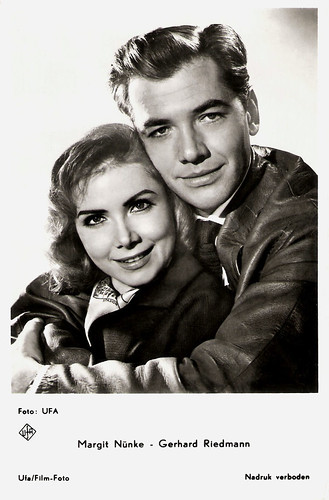
Margit Nünke, Gerhard Riedmann
Dutch postcard by DRC Holland, no. 1223. Photo: Ufa. Publicity still for Geliebte Bestie / Arena of Fear (Arthur Maria Rabenalt, 1959) with Gerhard Riedmann.

Lighter-than-light entertainment


In the next decade, Margit Nünke continued to appear in German featherlight entertainment films with such film partners as Walter Giller and Toni Sailer.

Titles include the Conny Froboess comedy Meine Nichte tut das nicht / My Niece Doesn't Do That (Franz Josef Gottlieb, 1960), and Liebesgrüße aus Tirol / With Love from Tyrol (Franz Antel, 1964) with Peter Weck and Gitte Hænning.

For TV, she worked a few times with comedian Willy Millowitsch, such as in Der kühne Schwimmer / The Bold Swimmer (Willy Millowitsch, 1960).

As a singer, she recorded several singles, including the duet 'Jede Woche, die hat 7 Tage' (Every week has 7 days) with Peter Garden. They married. Together, they performed in his TV-series Garden-Party (1969-1970).

After an interval of more than a decade, she appeared in the TV series Eine Klasse für sich - Geschichten aus einem Internat / A Class Apart (Frank Strecker, 1984) and in an episode of the comedy series Heiße Wickel - kalte Güsse / Hot Wraps - cold treatments (Franz Josef Gottlieb, 1984). These were her last screen appearances. In 2015, Margit Nünke passed away in Munich, Germany, three days after the death of her husband, Peter Garden. Nünke was 84.

Margit Nünke
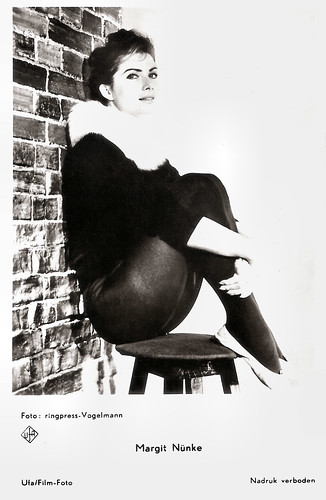
German postcard by Ufa, Berlin-Tempelhof, no. 4332. Photo: Ringpress / Vogelmann.

Margit Nünke
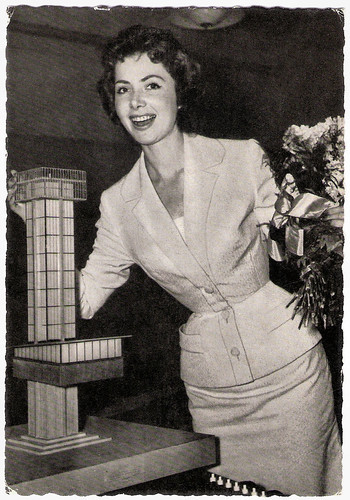
German postcard by WS-Druck, Wanne-Eickel, no. 189. Photo: dpa.

Sources: Hal Erickson (AllMovie - Page now defunct), Wikipedia (German and English) and IMDb.

This post was last updated on 11 January 2026.

26 January 2015

Noël-Noël

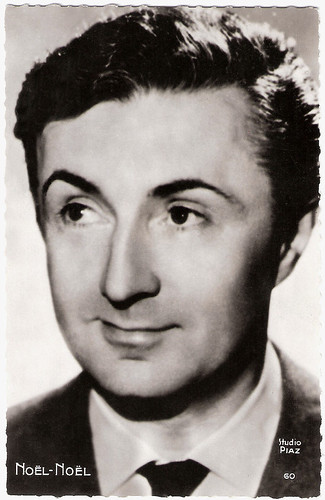
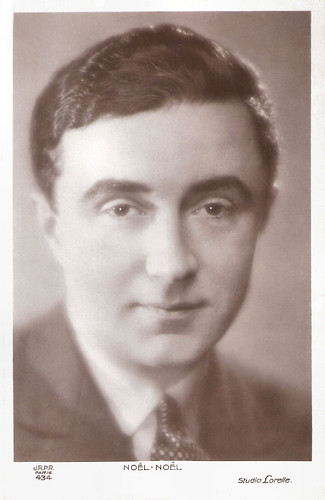
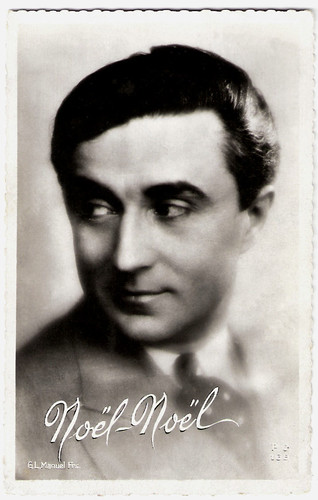
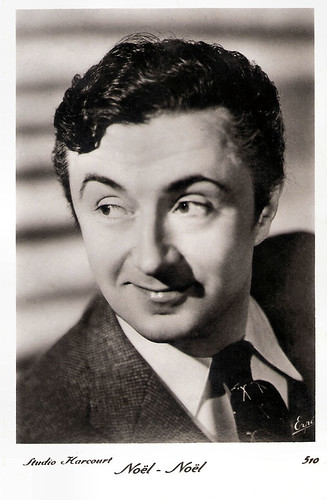
Noël-Noël (1897-1989) was a beloved French character actor and screenwriter. He appeared in 45 films between 1931 and 1966. His talents were diversified and he was known for his strong leftist political beliefs which seeped into many of his film scripts.

Noël-Noël
French postcard by Editions P.I., Paris, no. 60. Photo: Studio Piaz.

A blundering, chronically confused soldier


Noël-Noël was born Lucien Édouard Noël in Paris in 1897. He was the son of Charles Celestin Noël, a wine merchant (then employed at the Bank of France), and Marie Eugenie Mathieu. He studied at the Lycee Turgot and learned to play piano. From 1914 to 1917, he was a trainee at the Bank of France, before he left for military service and was mobilised.

After the war, he became a cartoonist for the magazine Le Canard enchaîné and the leftist newspaper l’Humanité. From 1920 on, he started to perform as a singer. He made his stage debut at the music hall Noctambules, accompanying himself at the piano. He was a skilful songwriter. He participated in the revues of the Théâtre de Dix-Heures: 'Ah! La bonne heure' (1927) and 'C'est l'heure exquise' (1928). He continued to write and to compose songs, which he recorded for Odéon.

With a lead role in the comedy La Prison en folie / Prison Madness (Henry Wulschleger, 1930), he began an acting career in film. He appeared in such films as the drama Mistigri (Harry Lachman, 1931) opposite Madeleine Renaud, the comedy Monsieur Albert / Mister Albert (Karl Anton, 1932) with Betty Stockfeld, L'Innocent / Bouquets from Nicholas (Maurice Cammage, 1937), which he also co-wrote, and Sur le Plancher des vaches / On Solid Ground (Pierre-Jean Ducis, 1940) for which he solely wrote the scenario.

Noël-Noël became a star, and he acted more rarely on stage. From October 1938 to the war, he hosted a show on Radio City with Saint-Granier. During the occupation of France, he continued to perform on stage. In 1943, he was banned by the Nazis after singing 'Vaches de boches'.

In 1926, during his years in the music halls and cabarets, he had created the comic character Adémaï, a blundering, chronically confused soldier. Adémaï became the cunning victim of countless misadventures in a series of (short) films written by singer and writer Paul Coline: Adémaï et la Nation armée / Adémaï and the armed nation (Jean de Marguenat, 1932), Adémaï Joseph à l'O.N.M. / Ademai Joseph at the Weather Tower (Jean de Marguenat, 1933), Adémaï aviateur /Skylark (Jean Tarride, 1934) with Fernandel, Adémaï au Moyen Âge / Adémaï in the Middle Ages (Jean de Marguenat, 1935) opposite Michel Simon, and Adémaï bandit d'honneur / Everything 'Appens to Me (Gilles Gragnier, 1943) with Georges Grey. In the last part of the series, Adémaï au poteau-frontière / Adémaï at the Post-border (Paul Coline, 1949), the character is played by Paul Coline himself.

Noël-Noël
French postcard by J.R.P.R., Paris, no. 434. Photo: Studio Lorelle.

Noël-Noël
French postcard by Editions P.C., Paris, no. 168. Photo: G.L. Manuel Frères.

Mr. Orchid


In 1945, the year following the Liberation of France, Noël-Noël played the role of Matt Clement in La Cage aux rossignols / A Cage of Nightingales (Jean Dréville, 1945), for which he also participated in the script. Attracting an audience of over five million, it was the most popular French film to be seen in France in 1945. It was nominated for the Academy Award for Best Story and later inspired the successful comedy-drama Les Choristes / The Chorus (Christophe Barratier, 2004). James Travers at French Films: “La Cage aux Rossignols is an engaging film that still has an impact. It effectively makes the point that children thrive better in an environment of mutual respect, where they are encouraged to develop their individual talents, rather than one in which they are brutalised and subjected to inflexible rules administered by unthinking automata with fascistic tendencies.”

Noël-Noël’s greatest role is probably the lead in the drama Le Père tranquille / Mr. Orchid (René Clément, 1946). He played an average, apparently selfish man, mainly concerned with orchids, who is the leader of a network of the French Resistance. Hal Erickson at AllMovie: “Droll French comedian Noel-Noel essays the title role in Le Pere Tranquille (The Quiet Daddy). Contrary to expectations, the star isn't a secret father, but in fact the unknown head of a WW2 resistance movement. By playing the fool whenever the Nazis are around and about, Noel-Noel is able to conceal his double life and successfully carry out his various sabotage missions. This deft combination of comedy and melodrama builds to a particularly suspenseful climax.”

This film, which was entered in the competition of the Cannes Film Festival, allowed Noël-Noël to abandon comic roles for a while, but soon he returned with Les Casse-pieds / The Spice of Life (Jean Dréville, 1948). In 1950, he directed the musical La Vie chantée / Life in a Song, in which he performs many of his hits.

Among his popular successes is also the film À Pied, à cheval et en voiture / On Foot, Horse and on Wheels (Maurice Delbez, 1957) with Denise Grey, which was followed by À Pied, à cheval et en spoutnik / Hold Tight for the Satellite (Jean Dréville, 1958), for which Noël-Noël also worked on the scenario. He played in Messieurs les ronds-de-cuir / The Bureaucrats (Henri Diamant-Berger, 1959) and in the entertaining comedy Les Vieux de la vieille / The Old Guard (Gilles Grangier, 1960) with Jean Gabin and Pierre Fresnay as a trio of irritable, temperamental, grouchy men.

From then on, he gradually abandoned the screen. With Jean Dréville, he created the Science-Fiction TV Mini-Series Le Voyageur des siècles (1971), about a journey back in time. Then, Noël-Noël retired and lived in Nice in the South of France. There he died in 1989. He was 92. He was married twice. In 1920, he married his first wife, Bertha Marie Genevieve Cornet. In 1930, he married Isabelle Jeanne Rosa Julie Lavallée.

Noël-Noël
French postcard by Erpé, no. 510. Photo: Studio Harcourt.

Noël-Noël
French postcard by S.E.R.P., Paris, no. 83. Photo: Studio Harcourt.

Sources: James Travers (French Films), Hal Erickson (AllMovie - Page now defunct), Gary Brumburgh (IMDb), Wikipedia (French and English), and IMDb.

This page was last updated on 27 December 2025.

25 January 2015

Tullio Carminati

Tullio Carminati (1892-1971) was an Italian stage and film actor with a long-standing career from the 1910s to the 1960s. He played in Italian, German, American, British and French films as well as on Italian, American and British stages.
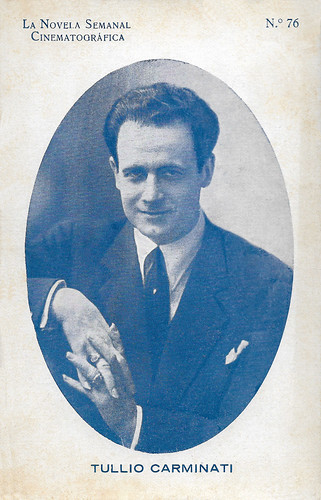
Tullio Carminati
Spanish card by La Novela Semanal Cinematográfica, no. 76. Photo: A. Badodi, Milano.
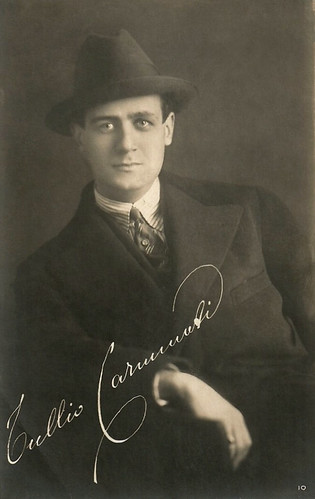
Tullio Carminati
Italian postcard. Photo: Fotocolore, Torino.

Tullio Carminati
Italian postcard by La Rotofotografica. Photo: Ambrosio Film. Tullio Carminati with the outfit and hairdo of Romanticismo (1915).
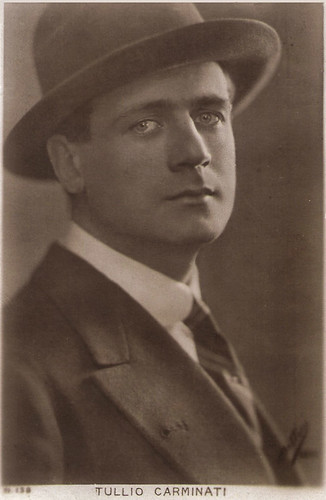
Tullio Carminati
Italian postcard by Edizione Bettini, Roma, no. 128.

Tullio Carminati
Italian postcard by Edizione Bettini, Roma, no. 199.

A modern, refined and sensible actor


Tullio Carminati was born as Count Tullio Carminati de Brambilla in Zara, Austrian-Hungarian Empire (now Zadar, Croatia) in 1892 (1894, according to IMDb and Wikipedia).

He ran away from school and joined a theatre company which soon ran into financial trouble. Disinherited and chased from the house by his father, he had to start working as an actor. He managed to get employed by Alfredo de Sanctis in 1907, during a Dalmatian tour by the latter. In 1909 Carminati arrived in Rome. By the mediation of actor Gustavo Serena, Carminati met Ferruccio Garavaglia, the first actor of the Compagnia Stabile Romana, which resided at the Teatro Argentina and which accepted him as an extra.

The company director, Ettore Paladini, was not convinced of Carminati’s talent and restricted him to modest parts. In 1910 actress Emma Gramatica discovered him while giving guest performances at the Argentina. She admired his elegance and spontaneity and convinced the management to give him Jeune premier parts.

Under this flag, star actor and director Ermete Novelli noticed him in 'La fiamma' and hired him in 1912 for his own company. Novelli became his teacher who taught him to give a balanced and natural performance and the taste for simple and touching solutions. Under the aegis of Novelli, Carminati transformed into a modern, refined and sensible actor, free of affectation.

Soon, Marco Praga hired Carminati for his Compagnia stabile of the Teatro Manzoni in Milan and let him play in various modern plays by Gabriele D’Annunzio, Dario Niccodemi, Praga himself, and others. During a tour in South America and back in Milan, the focus was more on the lighter repertory.

Tullio Carminati, Helena Makowska and Mary Cléo Tarlarini in Romanticismo (1915)
Italian postcard by IPA CT, no. 742. Photo: Ambrosio. Publicity still for Romanticismo (1915). Count Vitaliano Lamberti (Tullio Carminati) is arrested by the Austrians, while his mother (Mary Cléo Tarlarini) and his wife (Helena Makowska) cannot help. Caption: 'Lasciate almeno delle nostre donne la libertà di morire di dolore' (At least permit our women the liberty to die of sorrow!).
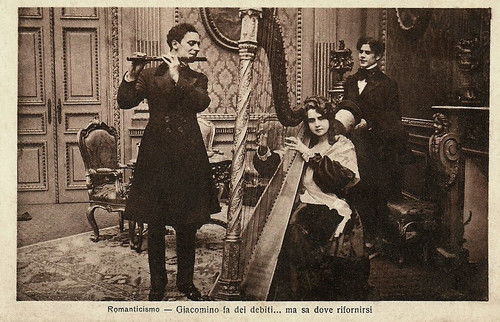
Helena Makowska in Romanticismo (1915)
Italian postcard by IPA CT, no. 747. Photo: Ambrosio. Publicity still for Romanticismo (1915). Helena Makowska (Anna Lamberti), Tullio Carminati (Count Vitaliano Lamberti) and Domenico Serra (Giacomino) in Romanticismo (Carlo Campogaliani, 1915). The caption: 'Giacomino fa dei debiti..., ma sa dove refonirsi' (Giacomino makes debts... but knows where to find funds to repay them).
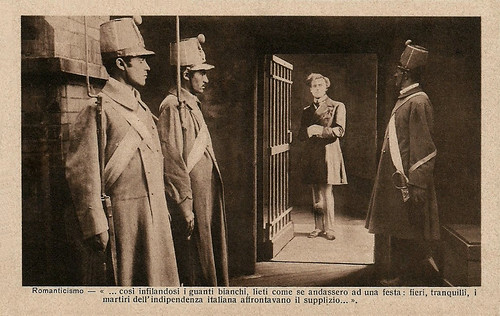
Tullio Carminati in Romanticismo (1915)
Italian postcard by IPA CT, no. 752. Photo: Ambrosio. Tullio Carminati in Romanticismo (1915).
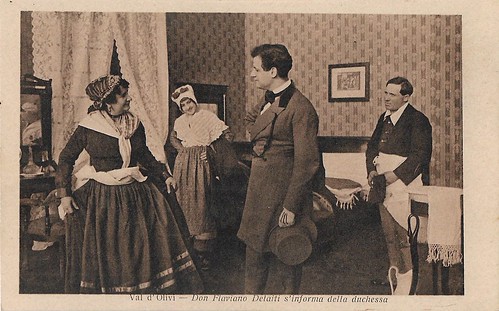
Val d'Olivi (1916)
Italian postcard by IPA CT Duplex, no. 1704. Photo: Film Società Anonima Ambrosio Torino. V. Uff. Tullio Carminati in the Italian historical propaganda film Val d'Olivi (Eleuterio Rodolfi, 1916), based on the novel by Anton Giulio Barrili (1873). Caption: Don Flaviano Delaiti (Carminati) informs himself about the duchess.
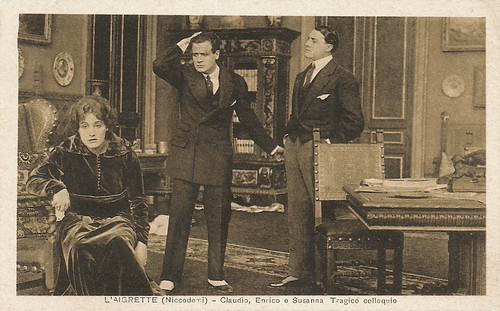
Hesperia, Carminati and Habay in L'aigrette
Italian postcard by IPA CT Duplex, no. 5108. Photo: Tiber Film. Hesperia, Tullio Carminati and André Habay in L'aigrette (Baldassarre Negroni, 1917). Caption: 'Claudio, Enrico e Susanna. Tragico colloquio' (Claudio, Enrico and Susanna. Tragic conversation). The countess of Saint-Servant (Ida Carolini Talli) has raised her son Enrico (Tullio Carminati) to be proud of his name and title, and to cherish honour and virtue, symbolised by the feather of her aigrette. In reality, the countess is hunted by creditors, and the castle is falling apart. Enrico falls in love with Susanne Leblanc (Hesperia), wife of a banker, and in return, she loads him with money in order to restore the castle. Her husband Claudio (André Habay) is not so happy with this kind of charity...
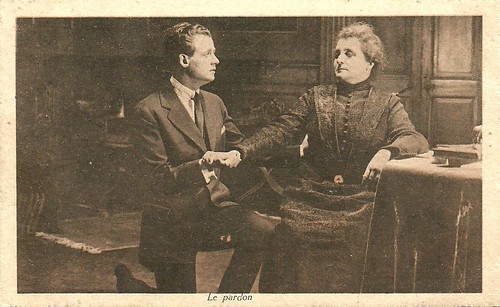
Tullio Carminati and Ida Carloni Talli in L'aigrette
French postcard. Caption: 'Le pardon' (Forgiveness). Photo: Tullio Carminati and Ida Carloni-Talli in L'aigrette/The Egret (Baldassarre Negroni, 1917).

Eye for detail, realism and style


In 1914 Tullio Carminati made his début in the Italian silent cinema. His first film appearance was in La mia vita per la tua/My life for yours (1914), starring Maria Carmi and directed by Emilio Ghione. When the Manzoni company stopped in 1915, Carminati signed a contract with the Ambrosio company of Turin, playing in the propaganda film Romanticismo/Romanticism (Carlo Campogalliani, Arrigo Frusta, 1915), in which he was the Italian aristocrat fighting the Austrians during the Risorgimento.

His co-actress was Elena Makowska who had her breakthrough in this film. Carminati would be paired with Makowska in several other Ambrosio films, as in Val d’Olivi/Val of Olives (Eleuterio Rodolfi, 1915), again set at the Risorgimento. Carminati also did a few films with actress Madeleine Céliat, such as Davanti alla legge/In Front of the Law (Carlo Campogalliani, 1916). In 1916 Carminati joined the theatre company of Lyda Borelli and Ugo Piperno. He played in 'Nozze dei Centauri' (Wedding of the Centaurs), 'La donna nuda' (The Naked Woman) and 'Amanti'(Lovers). But soon Carminati left again and focused on film acting, with titles like Tramonto triste/Sad Tramonte (Giuseppe Pinto, 1916) and L’articolo IV/The article IV (Gennaro Righelli, 1917). At Tiber Film, he played in a series of films directed by Augusto Genina in 1916-1918: Kalidaa – la storia una mummia/Kalidaa - The History of a Mummy (1917), Il trono e la seggiola/The Throne and the Chair (1918) and in particular the successful films Il presagio/The Premonition (1916) and La menzogna/The Lie (1916), both with Vera Vergani.

By now Carminati had become a real film star, his face and shape endlessly reproduced on postcards, posters and photos, in particular his kiss from Il presagio. Between 1917 and 1922 Carminati acted in twelve star vehicles with the Italian diva Hesperia, such as L’aigrette/The Egret (1917), La donna dei cuori/The Woman of the Hearts (1917) and La donna abbandonata/The Abandoned Woman (1917), all directed by her husband Baldassarre Negroni. In the late 1910s, Carminati also played with Maria Jacobini in La via più lunga/The Longest Street (Mario Caserini, 1918) and he made a few films with Gemma and Bianca Stagno Bellincioni. In 1919 Carminati founded his own film company, Carminati-Film. He produced five films with it in 1919-1920, all directed by Enrico Roma, but in the end, he was forced to dissolve the company. All in all, Carminati played in some 37 Italian silent films between 1914 and 1924.

After some failures in the cinema, Carminati was forced to return to the stage. There he became extremely successful with his own company, together with Alda Borelli, Lyda's sister, in 1920 and 1921. Carminati’s plays were known for their eye for detail, realism and style and their lack of frivolous overdoing. He played elegant and refined characters, full of spirit and wit. However, his part as Armand in Alexandre Dumas fils' 'La dame aux camélias' (Camille) was considered as too cold.

When Borelli left the company in 1921, Carminati became the director and first actor of Eleonora Duse’s company. Here he directed three dramas of which he played only in one, 'Cosí sia' (Such is) by T. Gallarati Scotti. United Artists producer Joseph Schenck spotted him and offered him to come to Hollywood to play in a series of films, but after the failure of Carminati-Film and because of his workload at the theatre, Carminati had his doubts. When Duse went on tour to the US, Carminati joined the theatre company of Lucio d’Ambra and Mario Fumagalli, appearing in plays by Luigi Pirandello, Roberto Bracco and Sem Benelli. Carminati did only a few films in those years including Mensch gegen Mensch/Person against Person (Hans Steinhoff, 1923), shot in Germany with Alfred Abel in the lead. Between 1924 and 1925 Carminati did a series of plays with Italia Almirante Manzini and Lina Tricerri, including the very successful comedy 'Le nozze di Leporello' (The Wedding of Leporello) by Luigi Almirante.
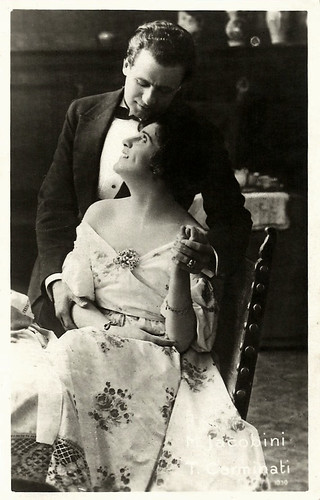
Maria Jacobini and Tullio Carminati
Italian postcard by Ed. Vettori, Bologna. Photo: probably publicity still for L'articolo IV (Gennaro Righelli, 1918) with Maria Jacobini and Tullio Carminati.
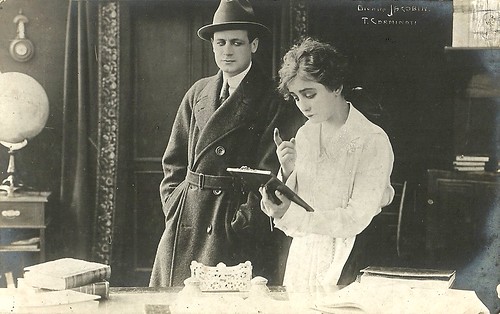
Diomira Jacobini and Tullio Carminati
Italian postcard. After they acted together in L'aigrette (1917), Diomira Jacobini and Tullio Carminati acted together a few times at Tiber Film, but with Jacobini always in supporting parts, e.g. in La via della luce (1917) and La via più lunga (1918).
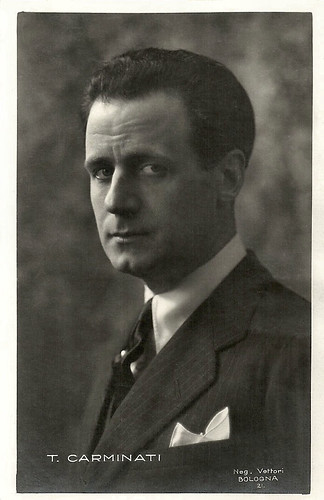
Tullio Carminati
Italian postcard by Vettori, Bologna, no. 21.
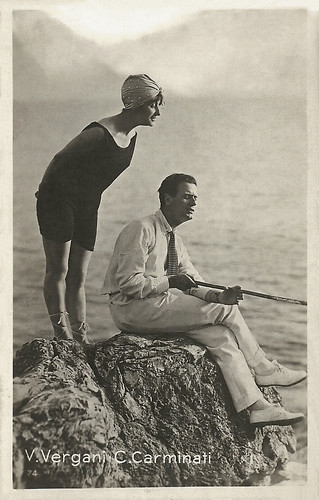
Vera Vergani and Tullio Carminati
Italian postcard, no. 74. Sent by mail in 1924. At the company Tiber Film, Carminati acted in a series of films directed by Augusto Genina in 1916-1918, in particular the successful films Il presagio (1916) and La menzogna (1916), both with Vera Vergani.

Vera Vergani and Tullio Carminati
Italian postcard, no. 86. Photo: Tullio Carminati and Vera Vergani in Il presagio/The Premonition (Augusto Genina, 1916).

Hesperia, Giovanni Schettini and Tullio Carminati in Vertigine (1919)
Spanish collectors card by Chocolat Imperial, no. 2 in a series of 6 'cromos. Photo: Verdaguer / FAI. Giovanni Schettini, Hesperia and Tullio Carminati in El Vertigo, Spanish title for the Italian silent drama Vertigine (Baldassarre Negroni, 1919).

Elegance, openness and sobriety


Fed up with the decline of the Italian film world and deluded by the collaboration with Italia Almirante Manzini and Lina Tricerri, Tullio Carminati went to the US in 1925, without any clear prospects and without speaking the language properly. After some time, he managed to get a contract with United Artists and played a detective in his first American film: The Bat (Roland West, 1926), with Jack Pickford and Louise Fazenda. This was followed by parts as the 'lover' in The Duchess of Buffalo (Sydney Franklin, 1926) with Constance Talmadge, and Stage Madness (Victor Schertzinger, 1927) with Virginia Valli. He then switched to Paramount where he reached fame with his part in Honeymoon Hate (Luther Reed, 1927) with Florence Vidor. He also acted in the Pola Negri vehicle Three Sinners (Rowland V. Lee, 1928).

With the advent of sound cinema, Carminati moved to New York and joined the company of Basil Rathbone. Critics liked his elegance, openness and sobriety, while audiences loved his foreign accent and Latin lover image. His American stage career was confirmed with Strictly Dishonorable by Preston Sturges, which ran for two years 1930-1931 in some 725 shows. The continuous success of this play reopened the doors of Hollywood for Carminati. Until 1940, he continued to play in various films, like Gallant Lady (Gregory LaCava, 1933), Moulin Rouge (Sydney Lanfield, 1934) with Constance Bennett, and One Night of Love (Victor Schertzinger, 1934) with Grace Moore.

In Europe, he played the male lead in the Franco-Italian production Marcia nuziale/The Wedding March (Mario Bonnard, 1935), starring Kiki Palmer. After another Broadway show, he acted in the romantic comedies Let’s Live Tonight (Victor Schertzinger, 1934) with Lilian Harvey, and Paris in Spring (Lewis Milestone, 1935) with Mary Ellis, establishing him as the mature Don Giovanni. In 1936 he acted in two British films by Herbert Wilcox: London Melody (1936) and The Three Maxims (1936), both starring Anna Neagle. In 1938, after a stay in Italy, he played again on Broadway in By Candle Light, and in 1939 in the comedy Stephen Jumel. In 1940 he played in Hollywood in Sunset in Vienna (Norman Walker, 1940), with Lilli Palmer, and in Safari (Edward H. Griffith, 1940), with Douglas Fairbanks Jr. and Madeleine Carroll.

In December 1941, a few days after the US declared war on Italy, Carminati was imprisoned. He was sent back to Italy in May 1942, because of anti-American activities. In the following year, he made his Italian cinema come-back in La via torna/The Street Turns (Pier Luigi Faraldo, 1943) and he joined the company of Elsa de Giorgi and Elena Zareschi, performing in various plays before and after the liberation there. In 1946 he joined the company Morelli-Stoppa, for which he played in 'Antigone' (Jean Anouilh), directed by Luchino Visconti. In 1953, after a stage absence of several years, Carminati returned to such plays as 'Il Ferro' (The Iron) by Gabriele D’Annunzio.

From the late 1940s until 1963, Carminati acted in various films in Italy, Spain, France and the US. Memorable titles are La Chartreuse de Parme/The Charterhouse of Parme (Christian Jaque, 1948) starring Gérard Philipe, La madonnina d’oro/The Golden Madonna (Ladislao Vajda, 1949) with Phyllis Calvert, La Beauté du diable/Beauty and the Devil (René Clair, 1950), the box office hit Roman Holiday (William Wyler, 1953) with Audrey Hepburn, Giovanna d’Arco al rogo/Joan of Arc at the Stake (Roberto Rossellini, 1954) with Ingrid Bergman, War and Peace (King Vidor, 1956), the epic El Cid (Anthony Mann, 1961) featuring Charlton Heston. His final film was The Cardinal (Otto Preminger, 1963). Tullio Carminati died in 1971 in Rome because of a brain haemorrhage. He was 78.
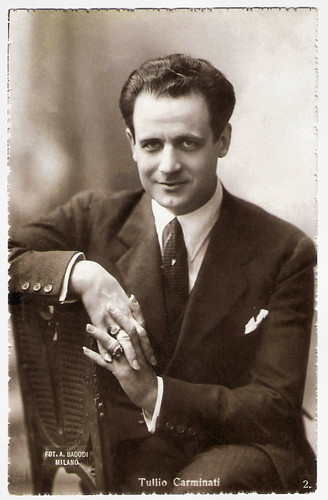
Tullio Carminati
Italian postcard by Edizioni A. Traldi, Milano, no. 2. Photo: A. Badodi, Milano.

Tullio Carminati
Italian postcard by Vettori, Bologna, no. 21.
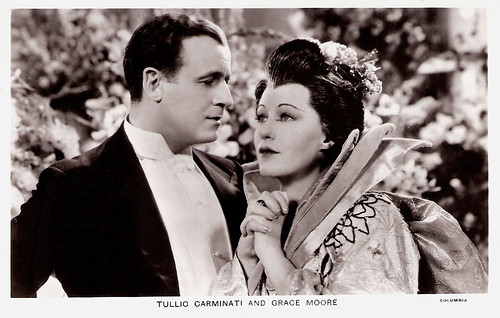
Tullio Carminati and Grace Moore in One Night of Love
British postcard in the Film Partners Series, London, no. P 151. Photo: Columbia. Publicity still for One Night of Love (Victor Schertzinger, 1934) with Grace Moore.
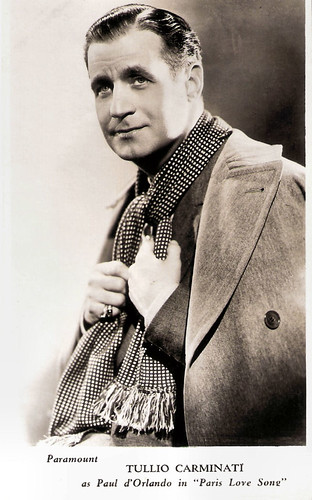
Tullio Carminati
British postcard. Photo: Paramount. Publicity still for Paris in Spring/Paris Love Song (Lewis Milestone, 1935).
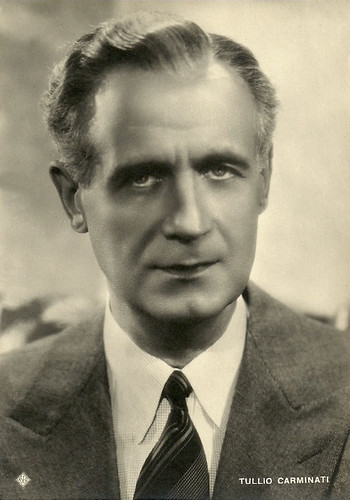
Tullio Carminati
Italian postcard. Photo: Aser, Roma. Publicity still for La vita torna (Pier Luigi Faraldo, 1943) in which Carminati had the male lead.

Sources: Roberta Ascarelli (Italian - Treccani), Vittorio Martinelli (Italian - Il cinema muto italiano), Wikipedia (Italian and English), and IMDb.

This post was last updated on 2 September 2023.
24 January 2015

Die Halbstarken (1956)

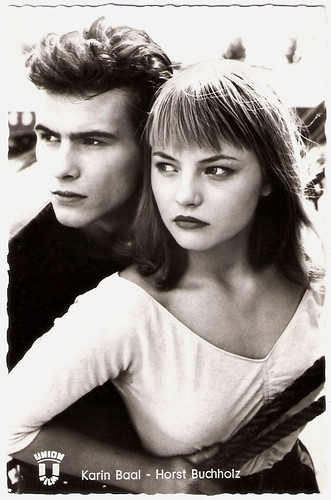
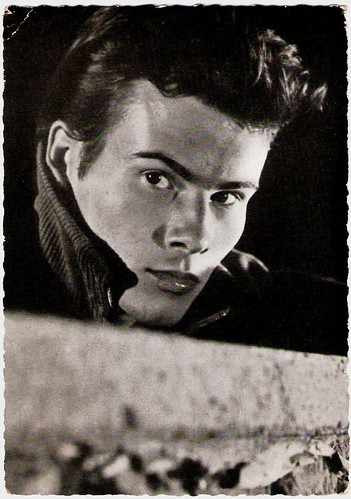
Most of the German films of the 1950s were musical comedies, sentimental dramas or Heimatfilms. An exception was the teen drama Die Halbstarken/Teenage Wolfpack (Georg Tressler, 1956) which brought dark alleys, petticoats, leather jackets, American cars, teenage sex and crime to the screen. Germany's first look on juvenile delinquency gave also a rare realistic view of life in a German city during the Wirschaftswunder era, the years of the economic miracle. The film became a cult hit all over Europe and two new stars were born, Horst Buchholz as the charismatic gang leader and Karin Baal as his 15-year old femme fatale.
Horst Buchholz, Karin Baal
German postcard by Kolibri-Verlag, Minden/Westf., no. 2329. Photo: Interwest / Union / Haenchen. Publicity still for Die Halbstarken (1956).

Karin Baal and Horst Buchholz in Die Halbstarken (1956)
Austrian postcard by Lichtbild-Vertrieb Paula Weizmann, Wien, no. F 7. Photo: Interwest / Union-Film / Haenchen. Publicity still for Die Halbstarken/Teenage Wolfpack (Georg Tressler, 1956).

Hard, raw and realistic


Young author Will Tremper did not like the sentimental films that were made in Germany and Austria during the 1950s. While German film makers produced cheesy Heimatfilms and family comedies, Hollywood presented energetic teen dramas as The Wild One (Laslo Benedek, 1953) with Marlon Brando, The Blackboard Jungle (Richard Brooks, 1955) and Rebel Without a Cause (Nicholas Ray, 1955), featuring James Dean.

In that vein, Tremper and director Georg Tressler decided to make a film that would become a classic of German post-war cinema.

With the exception of lead actor Horst Buchholz, they chose non-professionals to play the young gang members. Remarkable is also that the jukebox doesn't play the then new and hot rock & roll, but jazz music. Composer Martin Böttcher made the Soundtrack with Mister Martins Band.

The result was a sensation. According to Hal Erickson at AllMovie, the young actors are "exuding a raw energy that many 'pros' could not emulate.

For Volker Scheunert at IMDb, Die Halbstarken/Teenage Wolfpack (Georg Tressler, 1956) is his favourite German film of the 1950s: "This one is hard, raw and realistic, omitting any false sentimentality or romanticism."

Horst Buchholz
Horst Buchholz. German postcard by Kolibri-Verlag, Minden Westf., no. 2171. Photo: Interwest / Union-Film / Haenchen. Publicity still for Die Halbstarken/Teenage Wolfpack (Georg Tressler, 1956).

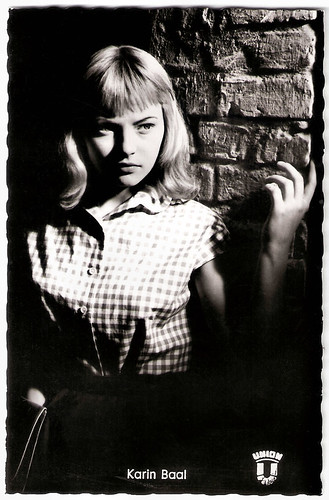
Karin Baal in Die Halbstarken (1956)
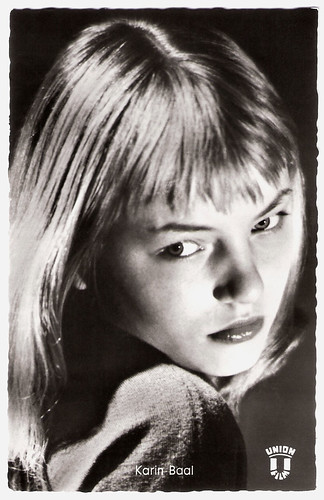
Karin Baal. German postcard by Kolibri-Verlag, Minden/Westf. Photo: Interwest / Union / Haenchen. Publicity still for Die Halbstarken (1956).

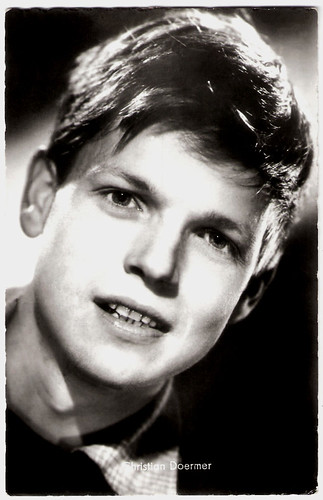
Christian Doermer
Christian Doermer. German postcard by Kolibri-Verlag, Minden-Westf., no. 140.

Dreaming of a Buick Cabriolet


Die Halbstarken - what can be translated as The Hooligans - was shot on location in West Berlin in 1955 and 1956.

Horst Buchholz plays 19-year old Freddy Borchert, who has been thrown out of his home by his overly strict father (Paul Wagner) and the charismatic but tough teenager has to survive on the streets of West-Berlin.

In an indoor swimming pool he meets his younger brother Jan (Christian Doermer). Freddy pretends to have a good job but he has risen to the head of a youth gang and leads a life of crime.

Jan knows that his parents need the huge sum of 3,000 Deutschmarks to pay their debts, and asks his brother if he could help them. Freddy says yes for his mother’s sake. He is preparing his 'biggest coup' ever: a mail car robbery that would not only allow him to help his parents but to fulfil his dream - buying a Buick Cabriolet.

But the robbery goes wrong. In order to reassert himself as the leader of the pack and to prove to his girlfriend Sissy (Karin Baal) that he is a man, Freddy breaks into the a villa of a wealthy man. Surprised by the owner, the situation escalates.

Horst Buchholz
Horst Buchholz. German postcard by Franz-Josef Rüdel, Hamburg-Bergedorf, no. 1858. Photo: Interwest / Union-Film / Haenchen. Publicity still for Die Halbstarken/Teenage Wolfpack (Georg Tressler, 1956).

Horst Buchholz
Horst Buchholz. German postcard by Kolibri-Verlag, Minden Westf., no. 2204. Photo: Interwest / Union-Film. Publicity still for Die Halbstarken/Teenage Wolfpack (Georg Tressler, 1956).

A soda-sucking Lolita


At his blog Pause Rewind Obsess, Tim Lucas writes: "in his fourth credited screen appearance, Buchholz actually pulls off something comparable to what John Travolta achieved in Saturday Night Fever. He is positively magnetic in his dramatic scenes, which lets us believe the power he exudes over his mates, but he explodes onscreen - as they say - when he jitterbugs with his girlfriend (future krimi queen Karin Baal) at a local bar."

Karin Baal was chosen out 300 girls, who had joined a talent search for the part. Tim Lucas: "Playing a 15 year old girl, she looks and acts sophisticated beyond her years, but was in fact only 15 (sic, she was 16) in real life; never was she more photogenic or captivating than she is here. A soda-sucking Lolita who matures on our watch into a manipulative, trigger-pulling femme fatale, Baal's Sissy Bohl is an unforgettable character."

For the German release some of the voices of the young and inexperienced performers had been dubbed. Brigitte Grothum for instance dubbed for Karin Baal and Lutz Moik for Kalle Gaffkus.

In 1957 Die Halbstarken could be seen in a dubbed version, titled Teenage Wolfpack - in Britain and the US as well. The tagline was "Think of a law, they've broken it. Think of a crime, they've committed it." The American distributor billed Horst Buchholz as 'Henry Bookholt', and Karin Baal as 'Karen' Baal to help disguise the foreign origin of the film.

Director Georg Tressler was awarded the Filmband in Silber (Silver Filmband) as best new director in 1957. After Die Halbstarken, he made many films and TV productions until the 1990s. Will Tremper continued as a screenwriter and director of nonconformist films. He passed away in 1998.

While Horst Buchholz became an international Star and died in 2003, Karin Baal and Christian Doermer have made their own careers in German Film and Television.

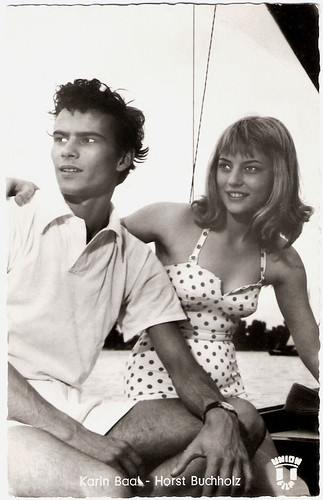
Horst Buchholz, Karin Baal
Karin Baal and Horst Buchholz. German postcard by Kolibri-Verlag, Minden/Westf., no. 2202. Photo: Interwest / Union / Haenchen. Publicity still for Die Halbstarken (1956).

Horst Buchholz
Horst Buchholz. German postcard by Filmbilder-Vertrieb Ernst Freihoff, Essen, no. 140. Photo: Union Film / Kiehl. Publicity still for Die Halbstarken/Teenage Wolfpck (1956).

Karin Baal in Die Halbstarken (1956)
Karin Baal. German postcard by Kolibri-Verlag, Minden/Westf., no. 2096. Photo: Interwest / Union. Publicity still for Die Halbstarken (1956).

Hansjoachim Ketzlin in Die Halbstarken (1956)
Hansjoachim Ketzlin. German postcard by Labaphot. Photo: Interwest / Union / Haenchen. Publicity still for Die Halbstarken (Georg Tressler, 1956). Ketzlin played Willi. During the 1970s, he returned to the cinema as an actor in soft sex films. He also produced three films, including the mediocre thriller Das Amulett des Todes/Cold Blood (Ralf Gregan, Günter Vaessen, 1975) starring Rutger Hauer before his Hollywood breakthrough.

Sources: Volker Scheunert (IMDb), Tim Lucas (Pause Rewind Obsess), Wikipedia (German), Filmportal.de, and IMDb.

23 January 2015

Marcella Albani

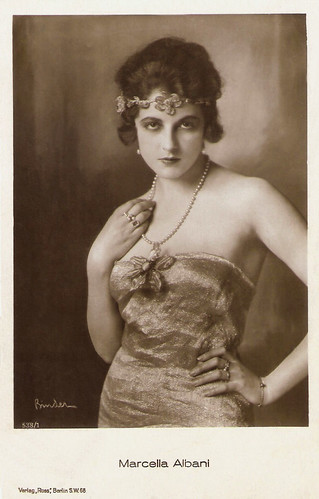
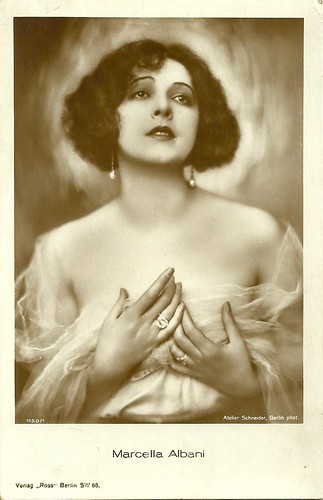
Petite Italian actress and author Marcella Albani (1899-1959) appeared in 50 films from 1919 on. She was especially successful as an elegant Latin lady in the German silent cinema.

Marcella Albani
German postcard by Ross Verlag, Berlin, no. 596/3, 1925-1926. Photo: Albani Film. Marcella Albani in Die Flucht in den Zirkus/The Circus of Life (Mario Bonnard, Guido Schamberg aka Guido Parish, 1926). Collection: Didier Hanson.

Marcella Albani
German postcard by Ross Verlag, Berlin, no. 596/4, 1919-1924. Photo: Albani-Film.

Marcella Albani
German postcard by Ross Verlag, Berlin, no. 840/1, 1925-1926. Photo: Alex Binder / Albani-Film.

Marcella Albani
German postcard by Ross Verlag, Berlin, no. 840/3, 1925-1926. Photo: Alex Binder / Albani-Film.

Marcella Albani
German postcard by Ross Verlag, Berlin, no. 1521/1, 1927-1928. Photo: Aafa Film.

Marcella Albani
German postcard by Ross Verlag, Berlin, no. 1750/3, 1926. Photo: Atelier Schneider, Berlin. Collection: Didier Hanson.

Marcella Albani in Der Kampf ums Matterhorn (1928)
German postcard by Ross Verlag, no. 3704/2. Photo: Atelier Ernst Schneider. Marcella Albani in Der Kampf ums Matterhorn/Fight for the Matterhorn (Mario Bonnard, Nunzio Malasomma, 1928) in which Albani plays the wife of the protagonist Luis Trenker and wears the same shawl.

Ambrosio


Marcella Albani was born as Ida Maranca in the village of Albano Laziale near Rome, in 1899. Her father was the owner of a popular hosteria in Trastevere.

Shortly after finishing grammar school, she met the Roman aristocrat Guido Parish. The actor-director gave her the stage name Marcella Albani and directed her in her first film, L'amplesso della morte/The Embrace of the Dead (Guido Parish, 1919).

For Ambrosio Film in Turin, they made a series of melodramas and adventure films, including Salvator (1920), La figlia delle onde/The Daughter of the Waves (1921), Amore in fuga/Love on the Run (1921), and Bufera/Buffalo (1922).

Sadly in 1922, the legendary Ambrosio film company went bankrupt, and Parish had to sell out their films.

Marcella Albani
German postcard by Ross Verlag, Berlin, no. 240/4, 1919-1924. Photo: Alex Binder / Albani Film.

Marcella Albani
German postcard by Ross Verlag, Berlin, no. 538/1, 1919-1924. Photo: Alex Binder.

Marcella Albani
German postcard by Ross Verlag, Berlin, no. 538/2, 1919-1924. Photo: Alex Binder.

Marcella Albani
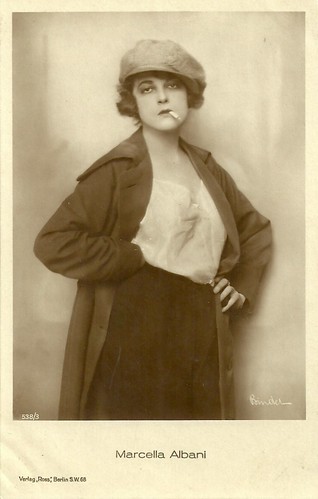
German postcard by Ross Verlag, Berlin, no. 538/3, 1919-1924. Photo: Alex Binder. Marcella Albani in Das Spiel der Liebe/The Game of Love (Guido Parish, 1924).

Marcella Albani
German postcard by Ross Verlag, Berlin, no. 892/1, 1925-1926. Photo: Alex Binder / Albani-Film.

Marcella Albani
German postcard by Ross Verlag, Berlin, no. 892/2, 1925-1926. Photo: Alex Binder / Albani Film.

Marcella Albani
German postcard by Ross Verlag, Berlin, no. 1021/1, 1927-1928. Photo: Alex Binder.

Marcella Albani
German postcard by Ross Verlag, Berlin, no. 1021/2, 1927-1928. Photo: Alex Binder.

Marcella Albani
German postcard by Ross Verlag, Berlin, no. 1150/1, 1927-1928. Photo: Atelier Schneider, Berlin.

Marcella Albani
German postcard by Ross Verlag, Berlin, no. 1150/2, 1927-1928. Photo Atelier Schneider, Berlin.

Marcella Albani,
German postcard by Ross Verlag, Berlin, no. 1150/4, 1927-1928. Photo: Atelier Schneider / Albani-Film.

Absolute Peak in Popularity


In 1923 Marcella Albani and Guido Parish went to Berlin. In 1923 she appeared in Frauenschicksal/Woman's Destiny (Guido Schamberg, 1923) and Im Rausche der Leidenschaft/In the intoxication of passion (Guido Schamberg, 1923) with Alfred Abel.

Marcella was an instant success in Germany. Other films were Das Spiel der Liebe/The Game of Love (1924) with Alfred Abel, Guillotine (1924) with Willy Fritsch, and Die Flucht in den Zirkus/The Circus of Life (1926) with Vladimir Gajdarov, which she made with her own company Marcella Albani Film GmbH, and which were directed by Guido Parish under the pseudonym Guido Schamberg.

During this period she portrayed mainly elegant Latin beauties. In 1926, her cooperation with Parish ended and she went on to make films with famous directors like Joe May and Friedrich Zelnik.

Albani experienced her absolute peak in popularity between 1927 and 1929 when she made twenty films within three years. These included Das Geheimnis des Abbe X/Behind the Altar (Julius Brandt, Wilhelm Dieterle, 1927) and Fürst oder Clown/Prince or Clown (Aleksandr Razumnyj, 1928) with Iván Petrovich.

Her engagements led her to France for L’évadée/The Escapist (Henri Ménessier, 1928), Austria for Das Weib am Kreuze/The Female at the Cross (Guido Brignone, 1929), Czechoslovakia for Hricy Lasky/The Last Mask (Carl Lamac, 1930) and to Italy for Corte d'Assise/Before the Jury (Guido Brignone, 1931).

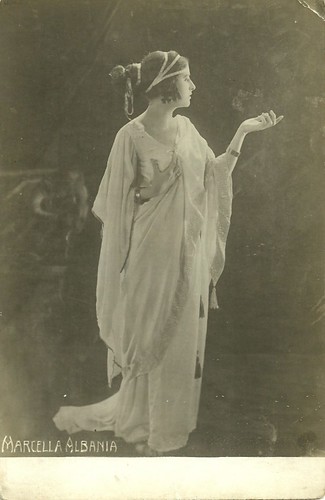
Marcella Albani
Probably a French postcard, editor unknown. Strangely enough, the name is spelled Albania here. Written on the back: Marcella Albani, 1926.

Marcella Albani
French postcard by Europe, no. 185. Marcella Albani in Die Flucht in den Zirkus/The Circus of Life (Mario Bonnard, Guido Schamberg aka Guido Parish, 1926). Albani plays a snake charmer performing in a Salome-like attire in a circus.

Marcella Albani
French postcard by Europe, no. 511. Photo: Loca Films.

Marcella Albani
French postcard by Europe, no. 575. Photo: Mercure Film.

Marcella Albani
French postcard by Europe, no. 576. Photo: Mercure Film.

Marcella Albani in Dagfin (1926)
Austrian postcard by Iris Verlag, no. 814. Photo: Sascha. Marcella Albani in Dagfin (Joe May, 1926).

Marcella Albani
Austrian postcard by Iris-Verlag, Berlin, no. 5346. Photo: Norbert & Co. / HOM. Marcella Albani in Der Kampf ums Matterhorn/Fight for the Matterhorn (Mario Bonnard, Nunzio Malasomma, 1928) in which Albani plays the wife of the protagonist Luis Trenker and wears a similar shawl.

Marcella Albani
German postcard by Ross Verlag, no. 1450/1, 1927-1928. Photo: Ernst Schneider, Berlin.

Marcella Albani
German postcard by Ross Verlag, no. 1931/1, 1927-1928. Photo: Alex Binder, Berlin.

Marcella Albani
German postcard by Ross Verlag, no. 3170/1, 1928-1929. Photo: Atelier Schneider.

Marcella Albani
German postcard by Ross Verlag, no. 3278/1, 1928-1929. Photo: Atelier Bieber, Berlin.

Coppa Volpi


After the advance of sound film, Marcella Albani turned to writing. She published novels like 'Glauca, l'amata l'innamorata' (Glauce, the Beloved Lover) and 'La Citta dell' Amore'(The City of Love). The latter was adapted for the screen with her by director Mario Franchini, La Citta dell' Amore/The City of Love (1934).

Since 1931 Franchini was also her husband, with whom she had a child. Incidentally she made films like Stradivarius (Albert Valentin, Géza von Bolváry, 1935) with Pierre Richard-Willm and Edwige Feuillère, and the German language version, Stradivari (Géza von Bolváry, 1935) with Gustav Fröhlich and Sybille Schmitz.

Her last film was the German Western Der Kaiser von Kalifornien/The Emperor of California (Luis Trenker, 1936) starring director Luis Trenker himself, with whom she had worked before at Der Kampf am Matterhorn/Fight for the Matterhorn (Mario Bonnard, Nunzio Malasomma, 1926). Der Kaiser von Kalifornien was awarded the Coppa Volpi at the Venice Film Festival in 1937.

After this, she retired from the film business and lived on the Ligurian coast. She made one last film, after the war, the Austrian production Ein bezaubernder Schwindler/A Charming Crook (Hans Wolff, 1949).

Marcella Albani died of a tumor in 1959, in Bad Goedesberg, Germany.

Marcella Albani,
German postcard by Ross Verlag, no. 3278/2, 1928-1929. Photo: Atelier Bieber, Berlin.

Marcella Albani
German postcard by Ross Verlag, no. 3704/1, 1928-1929. Photo: Ernst Schneider, Berlin.

Marcella Albani
German postcard by Ross-Verlag, Berlin, no. 4226/1, 1929-1930. Photo: Alex Binder.

Marcella Albani
German postcard by Ross Verlag, Berlin, no. 4419/1, 1929-1930. Photo: Schlosser & Wenisch, Prag (Prague).

Marcella Albani
German postcard by Ross Verlag, no. 4746/1, 1929-1930. Photo: Atelier Schneider.

Marcella Albani
German postcard by Ross Verlag, Berlin, no. 4825/1, 1929-1930. Photo: Hegewald Film.

Marcella Albani
Italian postcard by G. Vettori, Bologna, no. 585. Photo: AAFA.

Marcella Albani
Italian postcard by G.B. Falci, Milano. Photo: Cines Pittaluga, Roma. Sent by mail in 1938.

Marcella Albani in Der Kampf ums Matterhorn (1928)
Italian postcard, no. 698. Photo: San Marco Films. Marcella Albani in Der Kampf ums Matterhorn/Fight for the Matterhorn (Mario Bonnard, Nunzio Malasomma, 1928) in which Albani plays the wife of the protagonist Luis Trenker and wears a similar shawl.

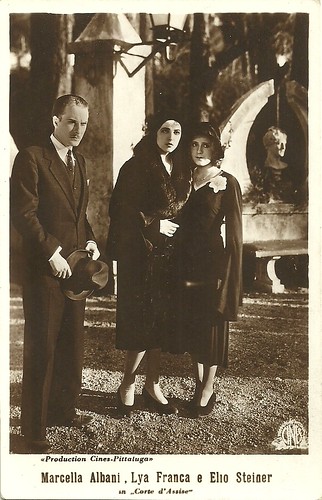
Marcella Albani, Lya Franca and Elio Steiner in Corte d'Assise
Italian postcard. Photo: Cines-Pittaluga. Marcella Albani, Lya Franca and Elio Steiner in Corte d'Assise/Before the Jury (Guido Brignone, 1930), the second Italian sound film, after La canzone dell'amore, and one the first Italian court case crime stories.

Marcella Albani in Corte d'Assise (1930)
Italian postcard. Photo: Produzione Cines-Pittaluga. From left to right: Lya Franca, Renzo Ricci, Marcella Albani, and Mercedes Brignone, and far right Elio Steiner, in the courtcase melodrama Corte d'Assise/Before the Jury (Guido Brignone, 1930), released in 1931.

Sources: Vittorio Martinelli (Le Dive del Silenzio - Italian), Stefano Cocciardi (MarcellaAlbani.eu - now defunct), Thomas Staedeli (Cyranos), Filmportal.de, Wikipedia and IMDb.

This post was last updated on 3 June 2021.