Showing posts sorted by relevance for query Mack Sennett. Sort by date Show all posts

07 January 2022

Mack Sennett's Bathing Beauties

Mack Sennett's Bathing Beauties or Sennett Bathing Beauties was a bevy of women performing in bathing costumes assembled by film producer Mack Sennett. They appeared in comedy short subjects, in promotional material, and in promotional events such as Venice Beach beauty contests from 1915 to 1928.

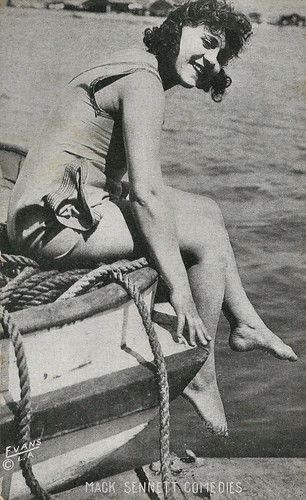
Mack Sennett Bathing Beauty
American Arcade Card. Photo: Evans, Los Angeles. Capture: Mack Sennett Comedies.
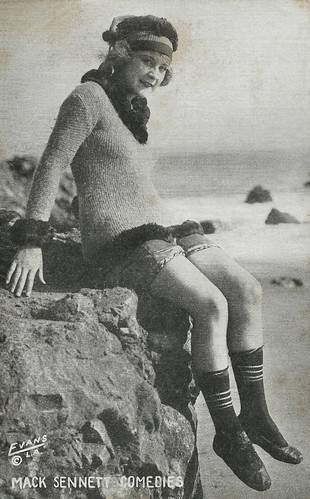
Mack Sennett Bathing Beauty
American Arcade Card. Photo: Evans, Los Angeles. Capture: Mack Sennett Comedies.

Mack Sennett Bathing Beauty
American Arcade Card. Photo: Evans, Los Angeles. Capture: Mack Sennett Comedies.

Saturating early Hollywood with slapstick


Mack Sennett was the brilliant founder of the Keystone Studios which saturated early Hollywood with slapstick. Physical comedy could more than compensate for silent films’ lack of dialogue.

Sennett gave Charlie Chaplin, Roscoe 'Fatty' Arbuckle, and Mabel Normand their first breaks, and was the originator of slapstick routines such as pie-throwing and car-chases, as seen in the Keystone Cops films. The Keystone Cops were a group of wildly incompetent policemen.

Sennett was also responsible for the concept of "Bathing Beauty". Sennett came up with the idea in 1914 when he was desperate for a way to differentiate his Keystone comedies from the rest of the oversaturated laugh market.

About his idea for the Bathing Beauties, Sennett said: "One morning as I went through the Times, in my tub, I noticed a three-column picture on Page One of a pretty girl who had been involved in a minor traffic accident. The picture made the front page for two obvious and attractive reasons. The young lady's knees were showing."

Beginning in 1915, Sennett assembled the original trio of Bathing Beauties assembled which consisted of Evelyn Lynn, Cecile Evans, and Marie Prevost. When the Bathing Beauties made their rounds in Hula-Hula Land (William Campbell, 1917), the mix of outraged letters from moral groups and massive ticket sales told Sennett that he was doing something just right. Over the next decade, hundreds of aspiring starlets paid their dues as Mack Sennett Bathing Beauties, starting at twelve dollars a week.

Mabel Normand in The Sea Nymphs (1914)
British postcard in the series "Keystone cards presented with Home Weekly". Photo: Keystone Film. Mabel Normand in The Sea Nymphs (Mack Sennett, 1914). Caption: Mabel as a sea nymph.

Bathing Beauty (Mack Sennett Comedies)
French postcard by Cinémagazine Edition. Photo: Mack Sennett Comedies.

Phyllis Haver
French postcard by Cinémagazine-Edition. Capture: Mack Sennett Comedies. With her curvy figure and blonde hair, Phyllis Haver (1899-1960) started her career as one of the most popular of Mack Sennett's bathing beauties.
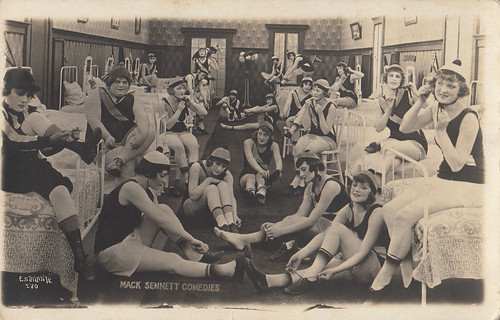
Who's that lady? Part 16
Vintage postcard by Estalante, no. 280. Photo: Mack Sennett Comedies. Collection: Marlene Pilaete. The actress on the left is Gloria Swanson.


Vehemently denying being one of the bathing beauties


Many of the Sennett Bathing Beauties remained nameless. However, not individually featured or named, others ascended to significant careers of their own, including Marie Prevost, Phyllis Haver (the original ‘Roxy’ in the first screen adaption of 'Chicago'), Juanita Hanson, Virginia Fox (wife-to-be of famed Fox producer Daryl F. Zanuck), and Carole Lombard, whom Sennett called “a scamp and a mad-cap.”

Other notable Bathing Beauties include Claire Anderson, Marion Aye, Alice Day, Polly Moran, Madeline Hurlock, Myrtle Lind, Vera Reynolds, Mary Thurman, Thelma Hill, Thelma Parr, Marvel Rea, Harriet Hammond, Evelyn Francisco, Vera Steadman, Josephine Cogdell, Elinor Field, and Ora Carew.

Two of those often named as Bathing Beauties later distanced themselves from the appellation: Mabel Normand and Gloria Swanson. Normand was already a featured player, and her 8-minute film The Water Nymph (Mack Sennett, 1912) may have been the direct inspiration for the Bathing Beauties. Although Gloria Swanson worked for Sennett in 1916 and was photographed in a bathing suit, she was also a star yet and later "vehemently denied" being one of the bathing beauties.

In the 1920s, Sennett's Bathing Beauties remained popular enough to provoke imitators such as the Christie Studios' Bathing Beauties (counting Raquel Torres and Laura La Plante as alumnae) and Fox Film Corporation's "Sunshine Girls" (counting Janet Gaynor as an alumna). Various Sennett Beauties toured the country, putting on “revues” almost wholly composed of Beauties Walking Around While Bathing-Suited, with a little “shimmy dance” to spice it up. The police shut down one Atlanta revue for obscenity.

The Sennett Bathing Beauties continued to appear through 1928. Anne Helen Peterson at Lapham's Quarterly: "As the 1920s drew to a close, the allure of the Bathing Beauty began to fade. Or, more precisely, as the masses slowly began to adopt the Beauties’ mode of dress, both on the beach and off, they became less of a novelty. From the start, the Bathing Beauties had wrapped their breasts “like mummies,” and while their bathing costumes may have shown off their knees, they all had dropped waists. Their costumes may have been for bathing, but they were clear antecedents to the flapper fashions that would soon blaze across the Western World."

Mack Sennett Comedies
American postcard. Photo: Evans, Los Angeles.

Mack Sennett Bathing Beauty
American Arcade Card. Photo: Evans. Los Angeles. Capture: Mack Sennett Comedies.
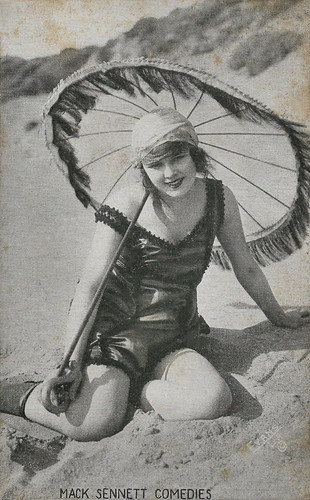
Mack Sennett Bathing Beauty
American Arcade Card. Photo: Evans. Los Angeles. Capture: Mack Sennett Comedies.

Mack Sennett Bathing Beauty
American Arcade Card. Photo: Evans, Los Angeles. Capture: Mack Sennett Comedies.

Sources: Anne Helen Petersen (Lapham's Quarterly), Wikipedia, and IMDb. And check-out 'Mack Sennetts Bathing-Beauties' at Facebook.

28 March 2021

Before Hollywood: Keystone

In the final post of our Before Hollywood series, we present the funniest of the American pioneering studios, Mack Sennett's The Keystone Film Company. In 1912, Sennett and two producers formed the company. Sennett brought Mabel Normand with him and soon hired Roscoe 'Fatty' Arbuckle, Chester Conklin, Minta Durfee, and Charles Chaplin. To the slapstick chase gags of the Keystone Cops, the Bathing Beauties and the Kid Comedies were gradually added. Sennett, D.W. Griffith, and Thomas H. Ince formed Triangle Films in 1915. Actors like Bobby Vernon and Gloria Swanson joined them. In 1917, Triangle went bankrupt and Sennett formed Mack Sennett Comedies. Keystone finally ended in 1937.

Mabel Normand in The Sea Nymphs (1914)
British postcard in the series "Keystone cards presented with Home Weekly". Photo: Keystone Film. Mabel Normand in The Sea Nymphs (Mack Sennett, 1914). Caption: Mabel as a sea nymph.

Mabel Normand (1892-1930) was a popular American silent film comedienne. In 1912, director Mack Sennett discovered her and took her to his new studio, Keystone in California. At the start, Normand was primarily portrayed in films as a beautiful woman, but soon her talent for comedy was spotted. She became a highly popular comedienne in shorts with Charlie Chaplin and Fatty Arbuckle. In 1916, Normand opened with Sennett her own company at Culver City, as a subsidiary of Triangle. When Triangle collapsed in 1918 it also took down Mabel's company and also caused Sennett to lose Keystone. In 1918 also the affair of Normand with Sennett ended.

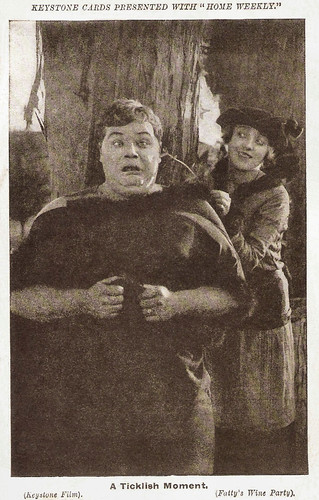
Fatty Arbuckle and Mabel Normand in Fatty's Wine Party (1914)
British postcard in the series "Keystone cards presented with Home Weekly". Photo: Keystone Film. Fatty Arbuckle and Mabel Normand in Fatty's Wine Party (Roscoe 'Fatty' Arbuckle, 1914). Caption: A Ticklish Moment.

American silent film actor, comedian Roscoe ‘Fatty’ Arbuckle (1887-1933) was one of the most popular silent stars of the 1910s. In 1913, Arbuckle went to work in producer-director Mack Sennett's Keystone Cops comedies. His character Fatty – he weighed 135 kilograms at the height of his career - usually wore bowler-hat and pants whose legs were too short. For the next 3-1/2 years, he appeared in hundreds of one-reel comedies, mostly as policemen, but he also played different parts. He would work with Mabel Normand, Ford Sterling, and others, and would learn about the process of making films from Henry Lehrman, who directed all but two of his pictures. Despite his massive physical size, Arbuckle was remarkably agile and acrobatic. His comedies are noted as rollicking and fast-paced, have many chase scenes, and feature sight gags. Arbuckle was fond of the ‘pie in the face’, a comedy cliché that has come to symbolize silent-film-era comedy itself. The earliest known custard pie thrown in a film was in the Keystone one-reeler A Noise from the Deep (Mack Sennett, 1913). The pie was thrown by Mabel Normand and Arbuckle was the recipient.

Chester Conklin and Minta Durfee in A Bird's A Bird (1915)
British postcard in the series "Keystone cards presented with Home Weekly". Photo: Keystone Film. Chester Conklin and Minta Durfee in A Bird's A Bird (Walter Wright, 1915).

American comedian Chester Conklin (1886-1971) developed for vaudeville his comedy character with a thick accent and a very bushy walrus-type mustache, which was patterned after his former boss, a German baker named Schultz. After seeing several of Mack Sennett's Keystone Cops shorts, Conklin applied for a job and stayed with Sennett for six years. Conklin became famous for his pairing with burly comic Mack Swain in a series of Ambrose and Walrus shorts. He also appeared in several of Charles Chaplin's shorts for the studio.

American comedienne Minta Durfee (1889-1975) began her career on stage in 1908 as a chorus girl in musical revues. She married comedian Roscoe 'Fatty' Arbuckle. In 1914, they entered Keystone and were soon a comedy double. Minta became Chaplin's leading lady in the two-reeler Making a Living (1914). In addition to the series of 'Fatty' featurettes, Minta also worked at Keystone in the classic madcap farce Tillie's Punctured Romance (1914) and co-starred opposite Chester Conklin, Mack Swain, and Ford Sterling in a series of outrageous daredevil comedies until 1916.

Fatty Arbuckle in Fatty's Chance Acquaintance (1915)
British postcard in the series "Keystone cards presented with Home Weekly". Photo: Keystone Film. Fatty Arbuckle and Billie Bennett in Fatty's Chance Acquaintance (Roscoe 'Fatty' Arbuckle, 1915).

The first totally enclosed film stage and studio in history


'The Keystone Pictures Studio' was founded by director Mack Sennett (1880-1960) under that name on 4 July 1912 in Edendale, California, which is now a part of Echo Park. Mack Sennett's backers were actor-writer Adam Kessel (1866–1946) and Charles O. Baumann (1874–1931), who were the owners of the New York Motion Picture Company, founded 1909.

The name Keystone was taken from the side of one of the cars of a passing Pennsylvania Railroad train (Keystone State being the nickname of the Commonwealth of Pennsylvania) during the initial meeting of Sennett, Kessel, and Baumann in New York.

The company referred to at its office as The Keystone Film Company, filmed in and around Glendale and Silver Lake, Los Angeles for several years, and its films were distributed by the Mutual Film Corporation between 1912 and 1915.

In 1912, Sennett created the slapstick antics of the Keystone Cops, and in 1915, he started the Sennett Bathing Beauties. Charlie Chaplin got his start at Keystone when Sennett hired him fresh from his Vaudeville career to make silent films. Sennett directed Chaplin in 35 comedies during 1914. He told Chaplin, "We have no scenario - we get an idea, then follow the natural sequence of events until it leads up to a chase, which is the essence of our comedy." 

Many other important actors also worked at Keystone toward the beginning of their film careers, including Marie Dressler, Harold Lloyd, Mabel Normand, Roscoe 'Fatty' Arbuckle, Gloria Swanson, Louise Fazenda, Raymond Griffith, Ford Sterling, Minta Durfee, Ben Turpin, Harry Langdon, Al St. John, and Chester Conklin.

In 1915, Keystone Studios became an autonomous production unit of the Triangle Film Corporation with D. W. Griffith and Thomas Ince. Comedy moved from improvisational slapstick to scripted situations. In 1917, Sennett, by then a celebrity, departed the studio in 1917 to produce his own independent films, which were eventually distributed through Paramount and later through Pathé.

Keystone's business decreased after Mack Sennett's departure, and the company finally closed after bankruptcy in 1935. The original main building of the studio, the first totally enclosed film stage, and studio in history, is still standing. It is located at 1712 Glendale Blvd in Echo Park, Los Angeles, and is now being used as a storage facility.

Fatty Arbuckle and Mabel Normand in Fatty and Mabel Adrift (1916)
Chinese postcard, no. 4. Photo: Hartsook Photo, S.F. - L.A. / Keystone Film. Fatty Arbuckle and Mabel Normand in Fatty and Mabel Adrift (Roscoe 'Fatty' Arbuckle, 1916).

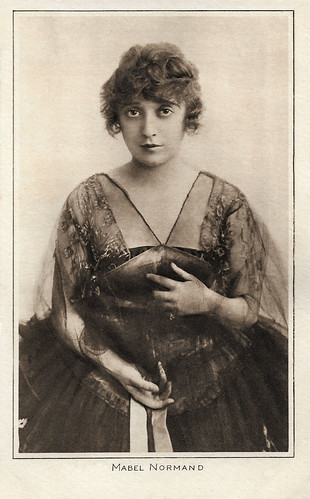
Mabel Normand
Mabel Normand. Swedish postcard by Förlag Nordisk Konst, Stockholm, no. 867. Photo: Apeda N.Y. / Triangle-Keystone Films.

Mabel Normand
Mabel Normand. British postcard in the Novelty Series, no. D6-14. Photo: Keystone Films.

Louise Fazenda
British postcard by Photochrom Co. Ltd., London no. 111. Photo: Triangle / Keystone. Collection: Marlene Pilaete.

Louise Fazenda (1895-1962) was a gawky, highly popular funny girl in slapstick comedies for Keystone Studios. She paired up well with comedian Charlie Murray. Her best-known character was her country bumpkin - complete with spit curls, multiple pigtails, and calico dresses. In the early 1920s, Louise left Sennett's company and progressed to feature films, where her eccentric talents were greatly utilised in musicals and knockabout comedies.

Who's that lady? Part 16
Vintage postcard by Estalante, no. 280. Photo: Mack Sennett Comedies. At left Gloria Swanson. Collection: Marlene Pilaete.

Mack Sennett Comedies
American postcard. Photo: Evans, Los Angeles / Mack Sennett Comedies. One of Mack Sennett's bathing beauties.

Bathing Beauty (Mack Sennett Comedies)
French postcard by Cinémagazine Edition. Photo: Mack Sennett Comedies.

Chaplin (1992)
French postcard by Editions Mercuri, no. 817. Photo: Tri-Star Pictures. Publicity still for Chaplin (Richard Attenborough, 1992) with Dan Aykroyd as Mack Sennett and Robert Downey Jr. as Charlie Chaplin between Sennett's Bathing Beauties.

Sources: Wikipedia and IMDb.

Check out our earlier Before Hollywood posts: Vitagraph, Essanay, Biograph, Lubin, Flying A, Kalem, Edison, and Selig.

06 May 2022

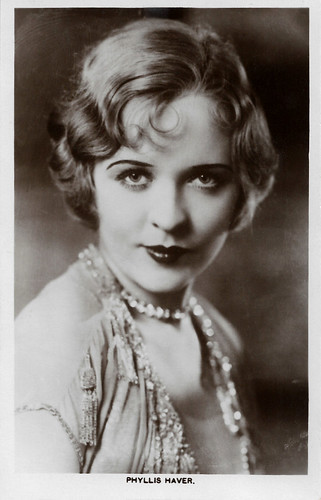
Phyllis Haver

Phyllis Haver (1899-1960) was an American actress of the silent film era. With her curvy figure and blonde hair, she started her career as one of the most popular of Mack Sennett's bathing beauties. Haver quickly worked her way up to leading roles and she was signed by Cecil B. De Mille. Among her best roles were Roxy Hart in the first film version of Chicago (1927) and Shanghai Mabel in What Price Glory? (1927).

Phyllis Haver
French postcard by Cinémagazine-Edition. Capture: Mack Sennett Comedies.

Who's this Lady? Part 11
Italian postcard by G.B. Falci, Milano, no. 271. Photo: Paramount. This is Phyllis Haver, not Belle Bennett. This portrait is from the film Nel gorgo del peccato/The Way of All Flesh (Victor Fleming, 1927) in which the two actresses starred together. Collection: Marlene Pilaete.

Phyllis Haver
British postcard in the Picturegoer Series, London, no. 322.

Astoundingly fine


Phyllis Maude Haver was born in Douglass, Kansas, in 1899 to James Hiram Haver and Minnie Shanks Malone.

When she was a child, her family moved to Los Angeles, California. Phyllis attended Los Angeles Polytechnic High. After graduating, she played piano to accompany the new silent films in local theatres.

Haver auditioned for comedy producer Mack Sennett on a whim. Sennett hired her as one of his original Sennett Bathing Beauties. Between 1916-20 she appeared in more than 35 short films. Within a few years, she appeared as a leading lady in two-reelers for Sennett Studios.

Later, she signed with DeMille-Pathé. She co-starred with George O'Brien and Olive Borden in Fig Leaves (Howard Hawks, 1926) and with Victor McLaglen and Dolores del Rio in What Price Glory (Raoul Walsh, 1926) as the no-better-than-she-ought-to-be Shanghai Mabel.

In 1927, Haver played the part of accused murderess Roxie Hart in the first film adaptation of Chicago, opposite Hungarian film actor Victor Varconi as Amos Hart. The film was produced by Cecil B. DeMille and directed by Frank Urson. Critic Mordaunt Hall called in The New York Times her performance "astoundingly fine," and added that Haver "makes this combination of tragedy and comedy a most entertaining piece of work."

Phyllis Haver
German postcard by Ross Verlag, no. 3729/1, 1928-1929. Photo: DPC.

Phyllis Haver
German postcard by Ross Verlag, no. 4158/1, 1929-1930. Photo: DPC.

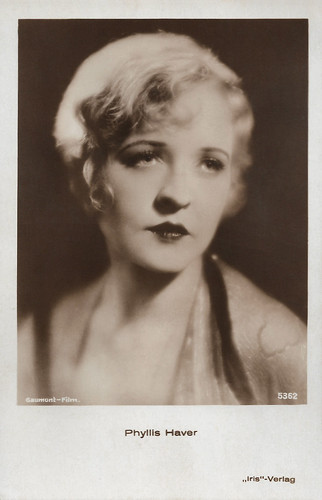
Phyllis Haver
Austrian postcard by Iris-Verlag, no. 5362. Photo: Gaumont-Films.

A vampy crook


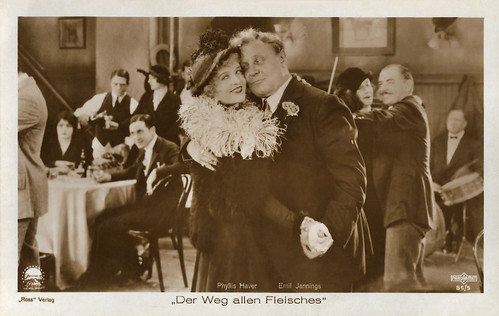
Phyllis Haver played a vampy crook opposite Emil Jannings in his first American film, The Way of All Flesh (Victor Fleming, 1927). For his role, along with his acting in The Last Command, Jannings won the Oscar for Best Actor in a Leading Role in 1929.

She was directed by the legendary director D. W. Griffith in the comedy film The Battle of the Sexes (1928), also with Jean Hersholt. She appeared with Lon Chaney in his last silent film, Thunder (William Nigh, 1929). Haver made two sound films, the drama The Office Scandal (Paul L. Stein, 1929) and She Couldn't Say No (Lloyd Bacon, 1930), and then retired from the film industry.

In 1929, she married millionaire William Seeman with a service performed by New York Mayor James J. Walker at the home of Rube Goldberg, the cartoonist. She and William moved into an 11-room penthouse in New York City. Phyllis said she loved being a wife and never wanted to return to Hollywood.

After 16 years of marriage, the couple divorced in 1945. Haver had no children. She retired in Sharon, Connecticut. As she grew older Phylis became more reclusive. She lived in a large house and rarely had visitors. Her only companion was her longtime housekeeper. She appeared one last time before the cameras during a 1954 TV testimonial to her old boss Mack Sennett.

She reportedly made several suicide attempts and was very distraught when her old friend and employer Mack Sennett died. In 1960, fourteen days after Sennett's death, Phyllis Haver took her own life with an overdose of barbiturates. She was found in her bed fully dressed and wearing make-up. Haver was 61. She was buried at Grassy Hills Cemetery in Falls Village, CT.

Emil Jannings in The Way of All Flesh
German postcard by Ross Verlag, no. 85/3. Photo: Parufamet. Emil Jannings and Phyllis Haver in The Way of All Flesh (Victor Fleming, 1927).

Emil Jannings in The Way of All Flesh
German postcard by Ross Verlag, no. 85/4. Photo: Parufamet. Emil Jannings and Phyllis Haver in The Way of All Flesh (Victor Fleming, 1927).

Emil Jannings in The Way of All Flesh
German postcard by Ross Verlag, no. 85/5. Photo: Parufamet. Emil Jannings and Phyllis Haver in The Way of All Flesh (Victor Fleming, 1927).

A blond seductress on the train


The Way of All Flesh opens in the early 1900s, Jannings plays August Schiller, a bank clerk in Milwaukee who is happy with both his job and his family. But when bank officials ask him to transport $1,000 in securities to Chicago, he meets a blond seductress on the train, who sees what he is carrying.

She flirts with him, convinces him to buy her a bottle of champagne, and takes him to a saloon run by a crook. The next morning he awakes alone in a dilapidated bedroom, without the securities. He finds the woman, and at first pleads with her, then intimidates her to return the stolen securities. He is knocked unconscious by the saloon owner and dragged to a nearby railroad track.

As the crook strips him of everything that might lead to his identification, Schiller recovers consciousness, and in a struggle, the crook is thrown into the path of an oncoming train and killed. Schiller flees, and in despair is about to take his own life, when he sees in a newspaper that he is supposedly dead, the crook's mangled body having been identified as Schiller's.

The time passes to twenty years later. Schiller is aged and unkempt, employed to pick up trash in a park. He sees his own family go to a cemetery and place a wreath on his grave. Following other scenes in a Christmas snowstorm, Schiller makes his way to his former home, where he sees that the son whom he had taught to play the violin is now a successful musician.

August Schiller walks away, carrying in his pocket a dollar that his son has given him, not recognising that the old tramp is his father.

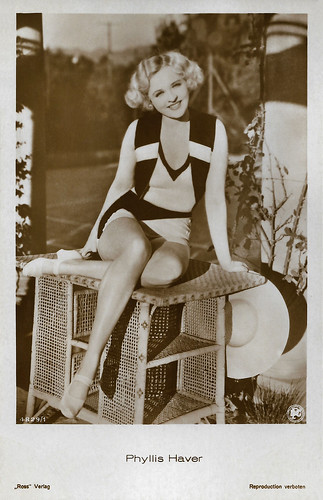
Phyllis Haver
German postcard by Ross Verlag, no. 4829/1, 1929-1930. Photo: DPG.

Sources: Hal Erickson (AllMovie - page now defunct), Mordaunt Hall (The New York Times), Find A Grave, Wikipedia, and IMDb.

This post ws last updated on 27 August 2024.

03 July 2023

Ruth Taylor

Ruth Taylor (1905-1984) was an American silent film and early talkie actress of the late 1920s. The vivacious blond Mack Sennett comedienne nabbed the most sought-after role in 1928, Lorelei Lee in the silent film version of Anita Loos' Gentleman Prefer Blondes. Her son was the writer, comic, and actor Buck Henry.

Ruth Taylor
French postcard by Cinémagazine-Edition, no. 611. Photo: Paramount Pictures.

Ruth Taylor
German postcard by Ross Verlag, no. 3388/1, 1928-1929. Photo: Paramount Pictures.

The little girl with a big personality


Ruth Alice Taylor was born in 1905 in Grand Rapids, Michigan. Her parents were Norman and Ivah (Bates) Taylor. She was only two years old when her parents decided to move to Portland, Oregon.

She graduated from the University of Oregon, where she discovered amateur theatre. In 1924, at the age of nineteen, Ruth persuaded her mother to take her to Hollywood. There the teenager spent a year working as an extra at Universal Studios.

Responding to an advertisement, the blonde, blue-eyed girl went to a casting call where she was selected by Mack Sennett out of 200 girls to play a blonde in the Harry Langdon comedy Lucky Stars (Harry Edwards, 1925).

Elizabeth Ann at IMDb: "In 1925 she signed a two-year contract with Mack Sennett and became one of his bathing beauties. With her perky smile and blonde spit curls Ruth quickly became one of Sennett's most popular actresses. She had supporting roles in several comedies including the short A Yankee Doodle Duke (Charles Lamont, 1926) and The Pride Of Pikeville (Charles Lamont, 1927) starring Ben Turpin. Ruth was nicknamed "The Little Girl With A Big Personality"."

She also appeared in such Sennett comedies as Lucky Stars with Harry Langdon and the Puppy Love series with Eddy Cline. For two years, she acted alongside Billy Bevan, Andy Clyde, Alice Day, Vernon Dent, Ralph Graves, Raymond McKee, Eddie Quillan and Ben Turpin in both leading and supporting roles.

Ruth Taylor
German postcard by Ross Verlag, no. 2991/1, 1928-1929. Photo: Paramount Pictures.

Blue-eyed, gold-digging Lorelei Lee


When her two-year contract with Mack Sennett came to an end, she went through a period of uncertainty during which, having gone freelance in the hope of playing great characters, she was turned down for all her castings. Finally, in August 1927, she unexpectedly signed with the Paramount Famous Lasky Corporation.

She played the role of blue-eyed, gold-digging Lorelei Lee opposite Alice White as Dorothy Shaw and Ford Sterling as Gus Eisman in the silent film version of Gentlemen Prefer Blondes (Malcolm St. Clair, 1928), co-written by Anita Loos based on her 1925 novel.

Her diary reveals that at this time, John Emerson, casting director and co-writer, and director Malcolm St Clair retained her after interviewing two hundred actresses and conducting as many screen tests. "All the blonde actresses of Hollywood were there", she wrote.

Anita Loos, the screenwriter and author of the novel of the same name for which they were looking for the ideal actress to play the main character, also chose Ruth Taylor, telling her at a press conference, in the form of a joke, "Your screen test was the worst, so we're choosing you."

Having become the role of the year, coveted by so many famous actresses, the "chosen one" received congratulations from all sides and went from press conference to photo shoot to photo shoot. Responding to a poll on the best actress for the role, fans sent Paramount Pictures nearly 14,000 letters supporting Ruth Taylor's candidacy. They each received a photo of the actress in return. It was the largest mailing ever recorded by Hollywood for an actress.

Ruth Taylor
German postcard by Ross Verlag, no. 3802/1, 1928-1929. Photo: Paramount Pictures.

Member of the 1928 WAMPAS Baby Stars class


That same year, following the success of Gentlemen Prefer Blondes, Ruth Taylor starred in Just Married (Frank R. Strayer, 1929), produced by B. P. Schulberg. It featured a new comedy couple, played by Ruth Taylor and James Hall.

Along with Lupe Vélez, Lina Basquette and Sue Carol, she was a member of the 1928 WAMPAS Baby Stars class.

Ruth Taylor acted in her first talkie A Hint to Brides (Leslie Pearce, 1929) for the Christie Film Company. For Paramount Studios she starred in The College Coquette (George Archainbaud, 1929) with William Collier Jr., and for Columbia Pictures Corporation in This Thing Called Love (Paul L. Stein, 1929) with Edmund Lowe and Constance Bennett.

The next year, she played for Pathé Exchange Incorporated in the short comedy Scrappily Married (Leslie Pearce, 1930) with Bert Roach. In 1930, she married retired USAF Brigadier General and New York stockbroker Paul Steinberg Zuckerman. He had served in the Lafayette Escadrille during World War I and as a senior officer in World War II. She decided to quit making films and became a housewife.

Ruth and Paul lived in Palm Springs and were happily married until he died in 1965. The couple had a son Henry Zuckerman aka Buck Henry. At age 16, he picked up his Equity card in 1946 for a role in the long-running comedy, Life With Father. Later he became the successful screenwriter behind such hits as The Graduate (Mike Nichols, 1967). Ruth Taylor died in Palm Springs in 1984 at the age of 79. She is buried at Forest Lawn Memorial Park in Hollywood Hills, California.

Tim McCoy and Ruth Taylor
German postcard by Ross Verlag, no. 5356/1, 1930-1931. Photo: Metro Goldwyn Mayer Pictures. Tim McCoy and Ruth Taylor.

Sources: Elizabeth Ann (IMDb), Find A Grave, Wikipedia (French, Spanish and English) and IMDb.

31 May 2021

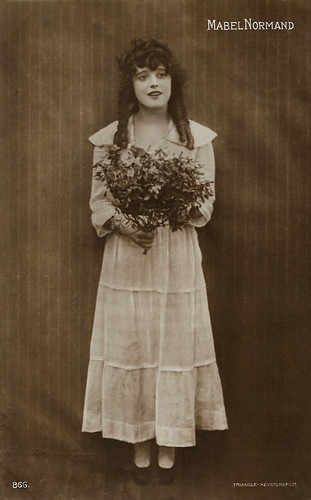
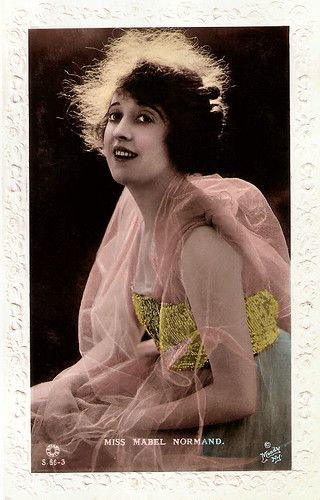
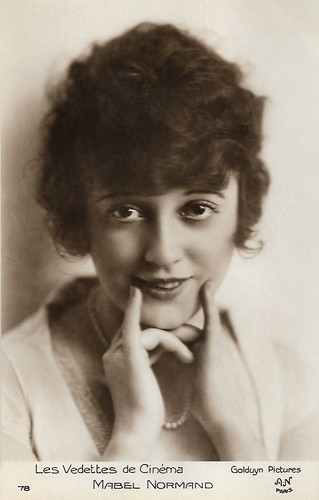
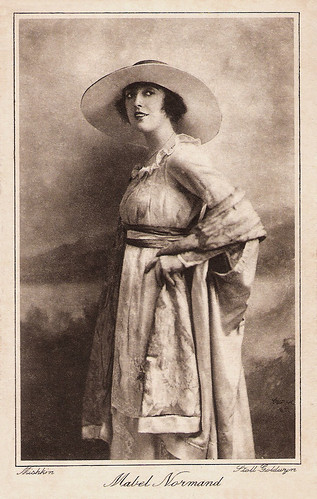
Mabel Normand

Mabel Normand (1892-1930) was a popular American silent film comedienne, in particular in her films with Charlie Chaplin. But alcohol, drugs, and scandal wrecked her career and TBC killed her at a young age.

Mabel Normand
Swedish postcard by Förlag Nordisk Konst, Stockholm, no. 866. Photo: Triangle-Keystonefilm.

Mabel Normand
Swedish postcard by Förlag Nordisk Konst, Stockholm, no. 867. Photo: Apeda N.Y. / Triangle-Keystone Films.

Mabel Normand
British Real Photograph postcard by Rotary Photo, London, no. S.66-3. Photo: Moody, N.Y.

Mabel Normand
French postcard in the Les Vedettes de Cinéma series by A.N., Paris, no. 78. Photo: Goldwyn Pictures.

A beautiful woman with a talent for comedy


Mabel Normand was born Amabel Ethelreid Normand in New Brighton, Richmond County, New York (before it was incorporated into New York City) in 1892. Her father, Clodman "Claude" George Normand was employed as a cabinetmaker and stage carpenter at Sailors' Snug Harbor home for elderly seamen. Her mother was Mary "Minne" Drury. Mabel had 5 siblings, although only two survived into adulthood, the rest succumbing to tuberculosis.

Normand was a model before her career as an actress. This included posing for postcards illustrated by Charles Dana Gibson, creator of the Gibson Girl image, as well as for Butterick's clothing pattern manufacturers in lower Manhattan. She became an actress in 1910 at the Eastcoast, at Vitagraph and Biograph.

Her intensely beguiling lead performance, directed by D. W. Griffith in the short drama Her Awakening (1911), drew attention while at the Biograph Company. She met director Mack Sennett and they embarked on a topsy-turvy relationship. In 1912, Sennett took her to his new studio, Keystone in California.

At the start, Normand was primarily portrayed in films as a beautiful woman, but soon her talent for comedy was spotted. She became a highly popular comedienne in shorts with Charlie Chaplin and Fatty Arbuckle. She is credited as being the first film star to receive a pie thrown in the face.

Normand played a key role in starting Chaplin's film career and defended Chaplin before Sennett, when the latter was initially not convinced of Chaplin's acting qualities. Mabel acted as his leading lady and mentor in a string of films in 1914, sometimes co-writing and directing or co-directing films with him.
In 1914, she starred with Marie Dressler and Chaplin in Tillie's Punctured Romance (Mack Sennett, 1914), the first feature-length comedy. Earlier that same year, Chaplin first played his Tramp character in Mabel's Strange Predicament (Mabel Normand, 1914), although it wound up being the second Tramp film released. Normand directed Chaplin and herself in the film.
In 1916, Normand opened with Sennett her own company at Culver City, as a subsidiary of Triangle. When Triangle collapsed in 1918 it also took down Mabel's company and also caused Sennett to lose Keystone. In 1918 also the affair of Normand with Sennett ended.

Mabel Normand
British postcard, no. 31. Photo: American Biograph. Mabel Normand as Muriel Fortescue, the name which was given to her for British audiences by the MPSA Motion Picture Sales Agency. Collection: Marlene Pilaete.

Mabel Normand in The Sea Nymphs (1914)
British postcard in the series "Keystone cards presented with Home Weekly". Photo: Keystone Film. Mabel Normand in The Sea Nymphs (Mack Sennett, 1914). Caption: Mabel as a sea nymph.

Fatty Arbuckle and Mabel Normand in Fatty's Wine Party (1914)
American postcard by Keystone cards, presented with Home Weekly. Photo: Keystone Film. Publicity still for Fatty's Wine Party (Roscoe 'Fatty' Arbuckle, 1914) with Fatty Arbuckle and Mabel Normand. Caption: A Ticklish Moment.

Fatty Arbuckle and Mabel Normand in Fatty and Mabel Adrift (1916)
Chinese postcard, no. 4. Photo: Hartsook Photo, S.F. - L.A. / Keystone Film. Fatty Arbuckle and Mabel Normand in Fatty and Mabel Adrift (Roscoe 'Fatty' Arbuckle, 1916).

The Murder of William Desmond Taylor


Mabel Normand got a new contract with Samuel Goldwyn. Yet her popularity and health declined. Normand became unhappy and became addicted to alcohol and drugs. Director William Desmond Taylor noticed this and tried to help her. This led to a relationship.

In 1922, William Desmond Taylor was killed, 15 minutes after Normand left the house. Since the murder was never unraveled, Normand was suspected by the police. There was also speculation that Normand's cocaine sellers may have been involved, as Taylor had repeatedly helped her to get off her drug addiction and wanted to file charges against her suppliers.

Many suspects of the murder are known but despite a confession of actress Margaret Gibson on her deathbed, the case is still open. Kevin Brownlow and John Kobal in their book 'Hollywood: The Pioneers' claim there is no real proof of Normand's drug addiction and the idea that Taylor was murdered by drug dealers was invented by the studio for publicity purposes.

Mabel Normand became involved in another scandal when her driver Joe Kelly (also an ex-criminal) shot millionaire oil broker and amateur golfer Courtland S. Dines, one of Normand's lovers with Normand's gun. Normand was hated by the media, several theatres pulled Normand's films, and her films were banned in Ohio by the state film censorship board. In 1923, she decided to end her career.

Still, she got a second chance when Hal Roach Studios offered her a contract in 1926. At Roach, she made the short comedies Raggedy Rose (Richard Wallace, 1926), The Nickel-Hopper (F. Richard Jones, Hal Yates, 1926), and One Hour Married (Jerome Strong, 1926). All were co-written by Stan Laurel. She was also directed by Leo McCarey in Should Men Walk Home? (1927) with Creighton Hale and Oliver Hardy. She received a lot of publicity, but her scandals from her past resurfaced and Normand's career was now definitively destroyed.

In 1930, Mabel Normand died of tuberculosis at the age of 37. She was married in 1926 to actor Lew Cody, with whom she had appeared in the film Mickey (F. Richard Jones, James Young, 1918). She was interred as Mabel Normand-Cody at Calvary Cemetery, Los Angeles. Cody died four years after Normand because of a heart attack.

Mabel Normand
British postcard in the Novelty Series, no. D6-14. Photo: Keystone Films.

Mabel Normand
British postcard in the Cinema Chat series. Photo: Mishkin / Stoll Goldwyn.

Mabel Normand
British postcard in the 'Pictures' Portrait Gallery by Pictures Ltd., London, no. 120.

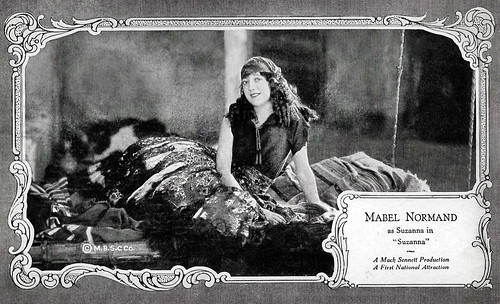
Mabel Normand in Suzanna (1923)
American postcard by Max B. Sheffer Card Co., Chicago (M.B.S.C.Co.). Photo: Mack Sennett Production / First National. Mabel Normand as Suzanna in Suzanna (F. Richard Jones, 1923).

Sources: Wikipedia (Dutch, and English), and IMDb.