Showing posts sorted by relevance for query Murnau. Sort by date Show all posts

02 July 2022

Directed by F.W. Murnau

Tonight, Il Cinema Ritrovato 2022 presents one of the first horror films, Nosferatu (1922) by Friedrich Wilhelm Murnau. The Bologna Opera House Orchestra, conducted by Timothy Brock, will accompany this masterpiece turning 100. Nosferatu is one of the cornerstones of horror and expressionist cinema, and will likely hypnotise the Piazza Maggiore audience. EFSP presents a post on the films directed by F.W. Murnau.

Max Schreck in Nosferatu (1922)
German collectors card by Ross Verlag in the series Vom Werden Deutscher Filmkunst - Der Stumme Film, no. 134. Photo: Ufa. Max Schreck in the first German horror film, Nosferatu – Eine Symphonie des Grauens/Nosferatu (Friedrich Wilhelm Murnau, 1922).
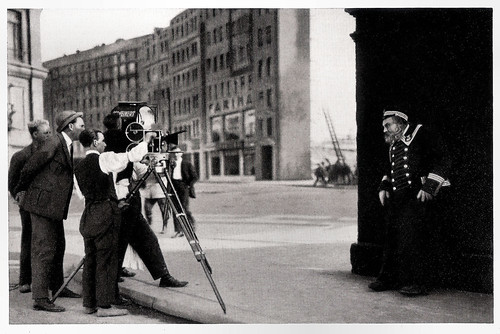
Emil Jannings during the shooting of Der letzte Mann (1924)
German collectors card by Ross Verlag in the series Vom Werden Deutscher Filmkunst - Der Stumme Film, picture, no, 160, Group 43. Photo: Ufa. Friedrich Wilhelm Murnau (left with hat) and Emil Jannings (right) at the set of Der letzte Mann/The Last Laugh (Friedrich Wilhelm Murnau, 1924). Caption: Der letzte Mann wird gefilmt, mit feststehendem Kamerastativ. (The Last Laugh is filmed, with a fixed camera).

Gösta Ekman in Faust, Eine deutsche Volkssage (1926)
German collectors card by Ross Verlag in the series Vom Werden Deutscher Filmkunst - Der Stumme Film, no. 171. Photo: Ufa. Gösta Ekman as the old Faust in Faust, Eine deutsche Volkssage/Faust (Friedrich Wilhelm Murnau, 1926).

Der brennende Acker (1922)
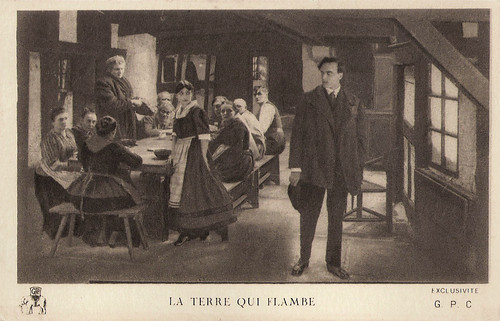

Der brennende Acker (1922)
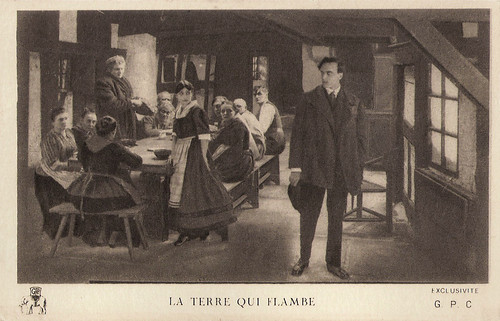
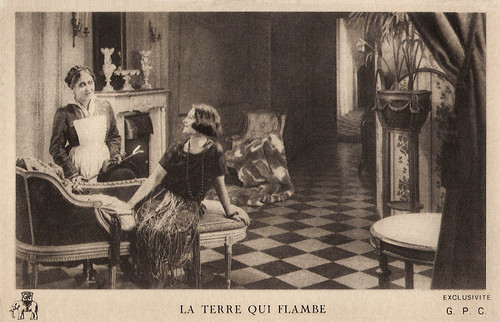
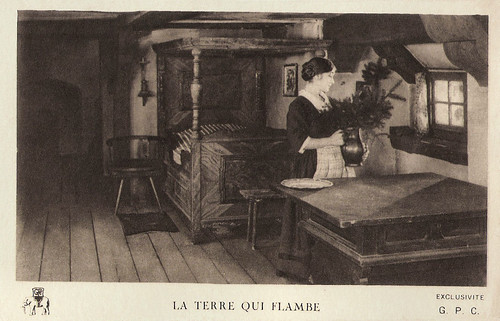
French postcard by Edition de la Cinématographie Française, Paris. Photo: G.P.C. Publicity still for Der brennende Acker/Burning Soil/La terre qui flambe (Friedrich Wilhelm Murnau, 1922). At the farm of the Rog family. The housemaid Maria (Grete Diercks) eyes Johannes Rog (Vladimir Gajdarov), but he is only interested in money.
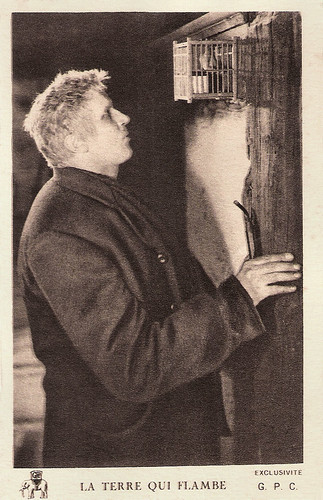
Eugen Klöpfer in Der brennende Acker (1922 )
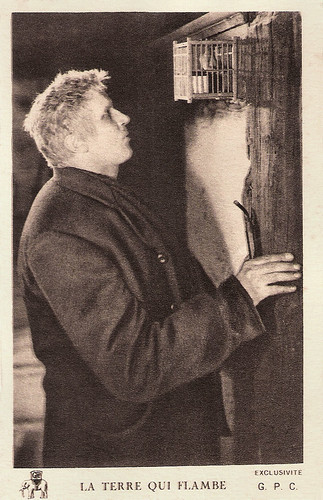
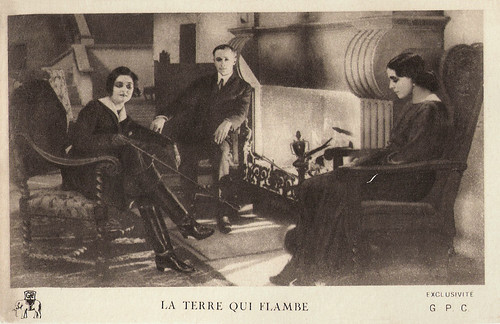
French postcard by Edition de la Cinématographie Française, Paris. Photo: G.P.C. Publicity still for Der brennende Acker/Burning Soil/La terre qui flambe (Friedrich Wilhelm Murnau, 1922) with Eugen Klöpfer. Maria works in the household of Peter Rog (Eugen Klopfer) and his father. Peter is in love with her and wants to marry her, but she instead loves his younger brother Johannes.
Der brennende Acker (1922)
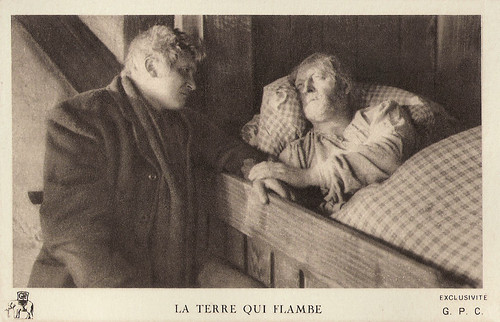
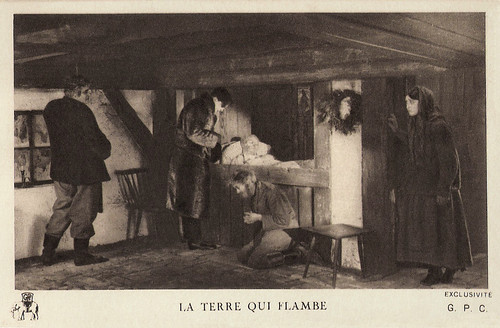
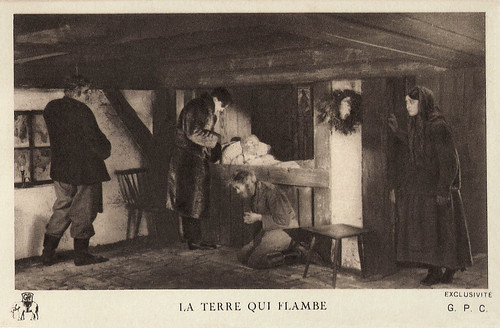
French postcard by Edition de la Cinématographie Française, Paris. Photo: G.P.C. Publicity still for Der brennende Acker/Burning Soil/La terre qui flambe (Friedrich Wilhelm Murnau, 1922). Johannes Rog (Vladimir Gajdarov) arrives too late at the deathbed of his father (Werner Krauss), while, left, his brother Peter (Eugen Klöpfer), and right, the maid Maria (Grete Diercks), look on.

In 1919, Friedrich Wilhelm Murnau began working in film. His first feature film, Der Knabe in Blau/The Boy in Blue (1919), based on motifs from the painting 'The Blue Boy' by Thomas Gainsborough, is lost, as are some of his later films. The film Der Bucklige und die Tänzerin/The Hunchback and the Dancer (1920) marked the beginning of a highly fruitful collaboration with screenwriter Carl Mayer, who subsequently wrote the scripts for six more of Murnau's films.

Until 1978, the drama Der brennende Acker/Burning Soil (1922) only survived as the three final reels. In 1978 film historian Vittorio Martinelli identified an almost complete coloured nitrate print of the film in the collection of the Cineteca Italiana in Milan. It formerly belonged to the collection of an Italian priest who had regularly screened old films in psychiatric clinics. After many years of research and restoration, the restored print was first presented in 1993.

When the old farmer Rog (Werner Krauss) dies, his son Johannes (Vladimir Gajdarov), coming from the city, does not make it to his deathbed in time. After Rog's death, his other son Peter (Eugen Klöpfer) takes over the farm.

Johannes, who does not consider himself suitable for work in the countryside, becomes a secretary to Count Rudenburg. Johannes is interested in the latter's daughter Gerda, who had arranged the job for him, but when he learns that a source of petroleum is suspected under the "Teufelsacker" (The Devil's acre) - a barren piece of land that Rudenburg had bequeathed to his second wife Helga in his will - he turns his attention to it.

Murnau's most famous film from this period is Nosferatu – Eine Symphonie des Grauens (1922) with Max Schreck in the title role, a film adaptation of Bram Stoker's 'Dracula', but which had to be renamed due to licensing problems.

Die Finanzen des Großherzogs (1924)


Alfred Abel in Die Finanzen des Großherzogs (1924)
Yugoslavian postcard by Jos. Caklovic, Zagreb, no. 37. Photo: Balkan Film, Zagreb. Alfred Abel in Die Finanzen des Großherzogs (F. W. Murnau, 1924). Collection: Didier Hanson.
Harry Liedtke in Die Finanzen des Großherzogs (1924)
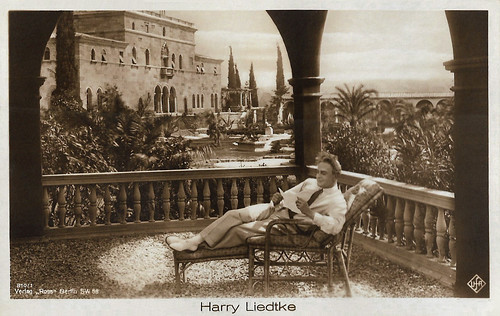
German postcard by Ross Verlag, no. 810/1. Ufa. Harry Liedtke in Die Finanzen des Großherzogs/The Grand Duke's Finances (F. W. Murnau, 1924).
Ilka Grüning  and Harry Liedtke in Die Finanzen des Grossherzogs (1924)
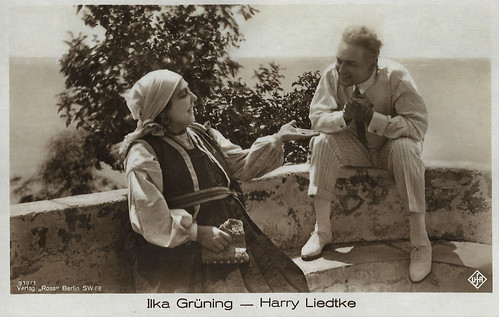
German postcard by Ross Verlag, Berlin, no. 813/1. Photo: Ufa. Ilka Grüning and Harry Liedtke in Die Finanzen des Großherzogs/The Grand Duke's Finances (F. W. Murnau, 1924).

Murnau followed with another masterpiece, the romantic fantasy Phantom (1922) starring Alfred Abel, Grete Diercks and Lil Dagover. Phantom is an example of a German Expressionist film and has a surreal, dreamlike quality.

Then followed a little gem, Die Finanzen des Großherzogs/The Grand Duke's Finances (1924). It is one of the rare comedies directed by F. W. Murnau. Harry Liedtke is the Grand Duke of Abacco who is heir to a small and heavily indebted Mediterranean island.

The Grand Duke is trying to hide from usurer Marcowitz who demands debt repayment. One hope to improve the situation would be a wedding with the Russian Grand Duchess Olga (Mady Christians) who sent him a letter saying she is determined to marry him despite not knowing him and against the opposition of her brother the Crown Prince of Russia.

Die Finanzen des Großherzogs/The Grand Duke's Finances is based on the eponymous novel by Swedish author Frank Heller adapted by Thea von Harbou. It was shot from May to August 1923 at Ufa's Tempelhof Studios in Berlin, on the sets built by Rochus Gliese and Erich Czerwonski. The on-location scenes were shot on the Adriatic coast in Split, Kotor, Zadar and Rab.


Der letzte Mann (1924)

Emil Jannings in Der letzte Mann (1924)
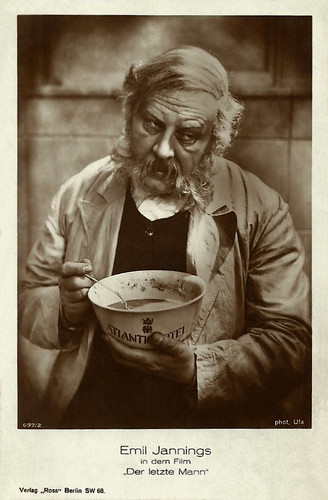
German postcard by Ross Verlag, no. 697/2. Photo: Ufa. Emil Jannings in Der letzte Mann/The Last Laugh (1924).

F.W. Murnau was now at the height of his film career in Germany and had high ambitions for his first film with Ufa. He stated that "All our efforts must be directed towards abstracting everything that isn't the true domain of the cinema. Everything that is trivial and acquired from other sources, all the tricks, devices and cliches inherited from the stage and from books."

His film, Der letzte Mann/The Last Laugh (1924) was based on a screenplay written by Carl Mayer and stars the great Emil Jannings and Maly Delschaft. Jannings plays a proud hotel doorman who loses his self-esteem and that of others when he is reduced to a toilet man, working in the basement of the hotel.

Der letzte Mann/The Last Laugh is a cinematic example of the Kammerspielfilm or "chamber-drama" genre, which follows the style of short, sparse plays of lower middle-class life that emphasized the psychology of the characters rather than the sets and action. The film famously uses no intertitles that characterize most silent films, in the belief that the visuals themselves should carry most of the meaning.

Cinematographer Karl Freund used elaborate camera movements for the film, a technique later called "entfesselte Kamera" (unchained camera). In one scene a camera was strapped to Freund's chest as he rode a bicycle into an elevator and onto the street below. In another scene, a camera is sent down a wire from a window to the street below and later reversed in editing.

The moving of the location of the camera, blurring of a part of the screen, focusing and defocusing, combined with using different angles, contributed to creating new perspectives and impressions of the viewers. The montage that was used in putting the scenes together was also pioneering: Murnau's technique was to use a smooth and rapid cutting in the initial scenes followed by jarred cutting in the scenes where the doorman becomes humiliated. A combination of distortion and overlapping images was used in the scenes illustrating the private vision of the drunk doorman. The cameramen provided enhancements to Jannings's creative use of body language by using close-ups and camera angles that encouraged the viewer to see the events from the doorman's perspective.

Tartüff (1925)


Tartüff (1925)
Dutch poster by Frans Bosen for Tartüff/Tartuffe (F.W. Murnau, 1925) starring Emil Jannings.

Friedrich Wilhelm Murnau based his drama Tartüff (1925) on the 1664 social comedy 'Tartuffe ou L'Imposteur' by Molière, but set in the present day.

A wealthy old man (Hermann Picha) is cared for by his housekeeper (Rosa Valetti). Since she is after his fortune, she persistently tries to convince him to include her in the will instead of his grandson. Through intrigue, she succeeds. In order to get her hands on the inheritance, she then begins to slowly poison the old man.

The grandson (André Mattoni) becomes suspicious but does not approach his grandfather to warn him at first. Now it turns out that his choice of profession as an actor is an advantage. He disguises himself as the operator of a travelling cinema and drives up in front of his grandfather's house. At first, the housekeeper wants to turn him away, but then she lets herself be persuaded by his charm to let him perform a film in the house.

The film shown is Tartüff, a film whose story is about a hypocrite (Emil Jannings) and the all-too-casual belief in him. The hypocrite in the film is exposed and so is the housekeeper after the screening: she is thrown out and grandfather and grandson are in each other's arms. According to the film, hypocrites can therefore also be called tartuffees.

In retrospective reviews, critics commented on the film's mise-en-scene and praised the performances. Several critics noted the rarity of a comedy directed by Murnau, who was famous for his expressionist dramas. Its humorous storyline and the happy ending have rendered it a minor work in Murnau's filmography and have led film critic Jonathan Rosenbaum to call it "underrated".

Faust (1926)


Emil Jannings and Yvette Guilbert in Faust (1926)
German postcard by Ross Verlag, no. 62/2. Photo: Parufamet / Ufa. Emil Jannings as Mephisto and Yvette Guilbert as Marthe in Faust (F.W. Murnau, 1926).
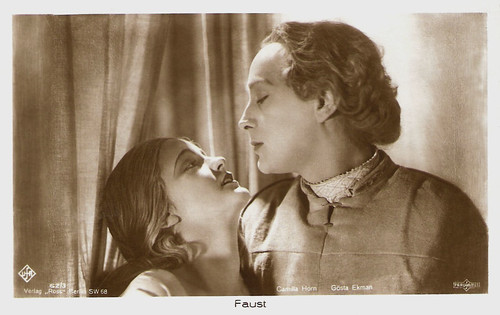
Gösta Ekman and Camilla Horn in Faust (1926)
German postcard by Ross Verlag, no. 62/3. Photo: Parufamet. Gösta Ekman and Camilla Horn in Faust (1926).

Camilla Horn and Frieda Richard in Faust (1926)
German postcard by Ross Verlag, no. 66/7. Photo: Ufa. Camilla Horn and Frieda Richard in Faust (Friedrich Wilhelm Murnau, 1926).

Faust – Eine deutsche Volkssage/Faust – A German Folktale (1926) was Murnau's final German film, produced by Ufa, and starring Gösta Ekman as Faust, Emil Jannings as Mephisto, Camilla Horn as Gretchen/Marguerite, Frida Richard as her mother, Wilhelm Dieterle as her brother and Yvette Guilbert as Marthe Schwerdtlein, her aunt.

The demon Mephisto has a bet with an Archangel that he can corrupt a righteous man's soul and destroy in him what is divine. If he succeeds, the Devil will win dominion over the earth. The Devil delivers a plague to the village where Faust, an elderly alchemist, lives. Though he prays to stop the death and starvation, nothing happens. Disheartened, Faust throws his alchemy books in the fire, and then the Bible too. One book opens, showing how to have power and glory by making a pact with the Devil. Faust then makes a deal with Mephisto, who gives Faust back his youth and offers him earthly pleasures and a kingdom, in return for his immortal soul.

Murnau's film draws on older traditions of the legendary tale of Faust as well as on Goethe's classic 1808 version. Ufa wanted Ludwig Berger to direct Faust, as Murnau was engaged with Variété/Variety. Murnau pressured producer Erich Pommer and, backed by Emil Jannings, eventually persuaded Pommer to let him direct the film.

Directly afterwards Friedrich Wilhelm Murnau moved to the US under contract to William Fox. When Faust – Eine deutsche Volkssage/Faust – A German Folktale premiered in the Ufa-Palast am Zoo in Berlin, Murnau was already shooting in Hollywood. Faust seriously affected studio shooting and special effects techniques. Murnau uses two cameras, both filming multiple shots; many scenes were filmed time and again. As an example, a short sequence of the contract being written on parchment in fire took an entire day to film.

Faust – Eine deutsche Volkssage/Faust – A German Folktale has been praised for its special effects and is regarded as an example of German Expressionist film. Murnau's Faust was the most technically elaborate and expensive production undertaken by Ufa until it was surpassed by Metropolis the following year. Filming took six months, at a cost of 2 million marks (only half was recovered at the box office). A 2006 review in The New York Times called it "one of the most astonishing visual experiences the silent cinema has to offer."

Sunrise (1927)
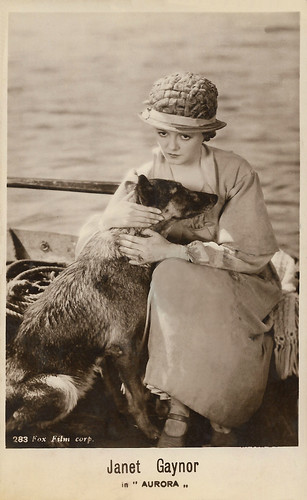

Janet Gaynor in Sunrise (1927)
Italian postcard by G. B. Falci Editore, Milano, no. 283. Photo: Fox Film. Janet Gaynor in Sunrise (F.W. Murnau, 1927).

George O'Brien in Sunrise (1927)
French postcard by CAF, Lisonne, no. 205. George O'Brien in Sunrise (F.W. Murnau, 1927).
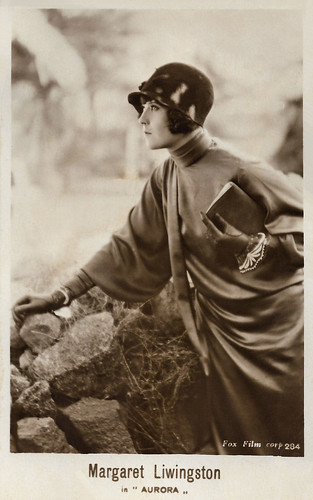
Margaret Livingston in Sunrise (1927)
Italian postcard by G. B. Falci Editore, Milano, no. 284. Photo: Fox Film. Margaret Livingston in Sunrise (F.W. Murnau, 1927). The last name is misspelt as Liwingston.

Friedrich Wilhelm Murnau's first film in the United State was the romantic drama Sunrise/Sunrise: A Song of Two Humans (1927) starring George O'Brien and Janet Gaynor. The plot is based on Hermann Sudermann's story 'Die Reise nach Tilsit' (The Journey to Tilsit).

A vacationing Woman from the City (Margaret Livingston) lingers in a lakeside town for weeks. After dark, she goes to a farmhouse where the Man (George O'Brien) and the Wife (Janet Gaynor) live with their child. She whistles from the fence outside. The Man is torn but finally departs, leaving his wife with the memories of better times when they were deeply in love.

The man and woman meet in the moonlight and kiss passionately. She wants him to sell his farm—which has not done well recently—to join her in the city. When she suggests that he solve the problem of his wife by drowning her, he throttles her violently, but even that dissolves in a passionate embrace. The Woman gathers bundles of reeds so that when the boat is overturned, the Man can stay afloat.

The Wife suspects nothing when her husband suggests going on an outing, but when they set off across the lake, she soon grows suspicious. He prepares to throw her overboard, but when she pleads for his mercy, he realizes he cannot do it. He rows frantically for shore, and when the boat reaches land, the Wife flees...

Murnau chose to use the then-new Fox Movietone sound-on-film system, making Sunrise one of the first feature films with a synchronized musical score and sound effects soundtrack. The film incorporated Charles Gounod's 1872 composition 'Funeral March of a Marionette', which was later used as the theme for the television series Alfred Hitchcock Presents (1955–1965). Frédéric Chopin's 'A minor prelude' also features prominently in orchestral arrangement.

Upon its release, the film received excellent reviews and won three Oscars. Sunrise won the Academy Award for Unique and Artistic Picture at the 1st Academy Awards in 1929. Janet Gaynor won the first Academy Award for Best Actress in a Leading Role for her performance in the film and also for her performances in 7th Heaven (1927) and Street Angel (1928). But Sunrise became a flop at the box office.

Sunrise's legacy has endured, and it is now widely considered a masterpiece and one of the greatest films ever made. In 2012, Sunrise was ranked fifth among the best films of all time in a poll of film critics by Sight & Sound magazine. The French film magazine Cahiers du cinéma listed it in fourth place in 2008.

4 Devils (1928)


Charles Morton, Janet Gaynor, Nancy Drexel and Barry Norton in 4 Devils (1928)
Italian postcard by G.B. Falci Editore, Milano, no. 711 Photo: Charles Munn Autrey / Fox. Charles Morton, Janet Gaynor, Nancy Drexel, and Barry Norton in 4 Devils (Friedrich Wilhelm Murnau, 1928). 4 Devils is one of the most famous 'lost' films.
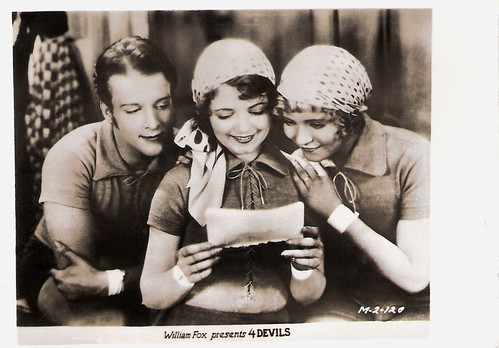
Janet Gaynor in 4 Devils
Dutch postcard. Photo: Fox. Publicity still for 4 Devils (F.W. Murnau, 1928) with Barry Norton, Janet Gaynor and Nancy Drexel.
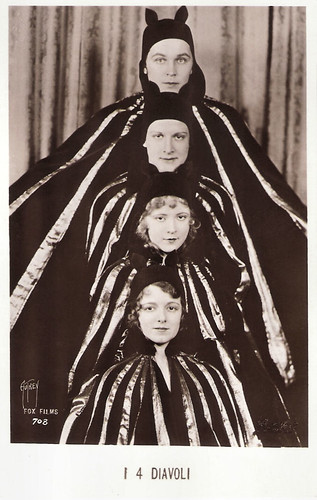
Janet Gaynor, Nancy Drexel, Barry Norton and Charles Morton in 4 Devils (1928)
Italian postcard by G.B. Falci Editore, Milano, no. 708. Photo: Max Munn Autrey / Fox. Janet Gaynor, Nancy Drexel, Barry Norton and Charles Morton in 4 Devils (Friedrich Wilhelm Murnau, 1928).

When Sunrise did not quite meet commercial expectations, and because of the increasingly difficult economic situation of the Fox company and the situation in Hollywood on the threshold of the talkies, Friedrich Wilhelm Murnau had to accept increasing interference in his artistic concept in his following films; in the case of the film City Girl, he was even replaced as director and a sound version was subsequently produced without his influence.

4 Devils/Four Devils (1928), the film Murnau made in between Sunrise and City Girl was based on the story 'De Fire Djævle' by Danish writer Herman Bang. An old clown takes in the four children Charles, Adolf, Marion and Louise to protect them from the brutal circus owner who is their guardian. He raises them and trains them to be acrobats. The years pass and they become successful trapeze artists who call themselves the "Four Devils". Charles and Marion are now a couple. But when they perform at the Cirque Olympia in Paris, Charles gets involved with a beautiful stranger.

Mordaunt Hall of the New York Times praised Murnau's work for keeping the interest in the film from the first shot to the last. Not only are the actors directed with unmatched skill, but the camera work is smooth and seductive. Today, the film is considered lost. The original negative was destroyed in a fire and Fox apparently did nothing to secure the film material that remained intact. In 1948, the last 35 mm print was handed over to actress Mary Duncan. Nothing is known about the whereabouts of the print.

Disappointed by the constraints of Hollywood, F.W. Murnau terminated his contract with Fox in 1929. After an unsuccessful attempt to do business with Ufa again in Berlin, he bought a sailing yacht, determined to make his next film on his own according to his own ideas, and went to Tahiti to shoot the film Tabu/Taboo with the director and documentary filmmaker Robert J. Flaherty.

During the shooting, there were considerable difficulties with the film company financing the shooting costs. Eventually, Murnau parted ways with Flaherty, who had stronger documentary ambitions and produced the film at his own expense. Shot on the island of Bora Bora exclusively with local amateur actors, the film became a stylistic mixture of documentary and melodrama. The distribution of the film, financed by Murnau himself, for which he had spent his entire fortune and incurred heavy debts, was taken over by the company Paramount, which was so impressed by the film that it offered Murnau a ten-year contract.

Murnau did not live to see the premiere of Tabu/Taboo. On 11 March 1931, shortly before a planned promotional tour through Europe, Murnau let his servant, the 14-year-old Filipino Garcia Stevenson, take the wheel of his rental car on the coastal road southeast of Santa Barbara (California). As a result of excessive speed, the servant lost control of the vehicle, which plunged down a ten-metre embankment, hitting the back of Murnau's head against a utility pole. While the other occupants of the vehicle - in addition to Stevenson, the actual chauffeur and Murnau's sheepdog - remained almost uninjured, Murnau died in hospital the following night. Only eleven people attended his funeral on 19 March, including Greta Garbo.

Sources: Wikipedia (German, Italian and English), and IMDb.

This post was last updated on 3 July 2022.

18 January 2017

Der brennende Acker (1922)

This week's film special is about the German silent film Der brennende Acker/Burning Soil (Friedrich Wilhelm Murnau, 1922). Murnau shot this drama right before his vampire classic Nosferatu (1922). Der brennende Acker is remarkable for its beautiful exterior shots and its all-star cast, including Vladimir Gajdarov and Lya de Putti. For many decades the film was considered lost, but in 1978 an almost complete print was found in the estate of an Italian priest. This beautiful series of postcards by Edition de la Cinématographie Française, was published for the French release of the film, in France titled La terre qui flambe.

Der brennende Acker (1922)
French postcard by Edition de la Cinématographie Française, Paris. Photo: G.P.C. Publicity still for Der brennende Acker/Burning Soil/La terre qui flambe (Friedrich Wilhelm Murnau, 1922). Maria (Grete Diercks) works in the household of Peter Rog and his father. Peter is in love with her and wants to marry her, but she instead loves his younger brother Johannes.

Eugen Klöpfer in Der brennende Acker (1922 )
French postcard by Edition de la Cinématographie Française, Paris. Photo: G.P.C. Publicity still for Der brennende Acker/Burning Soil/La terre qui flambe (Friedrich Wilhelm Murnau, 1922) with Eugen Klöpfer as Peter Rog.

Der brennende Acker (1922)
French postcard by Edition de la Cinématographie Française, Paris. Photo: G.P.C. Publicity still for Der brennende Acker/Burning Soil/La terre qui flambe (Friedrich Wilhelm Murnau, 1922). Peter Rog (Eugen Klöpfer) takes care of his dying father (Werner Krauss).

The Devil's Field


Der brennende Acker presents two households: that of the wealthy Count Josef Emmanuel of Rudenberg and the Rogs, a fairly prosperous farm family who live nearby.

When the old farmer Rog (Werner Krauss) dies, his hard-working son Peter (Eugen Klöpfer) attends him and stays at the farm after his father's death.

The other, younger son is the more worldly Johannes (Vladimir Gajdarov). He has great ambitions and he refuses the love of the servant Maria (Grete Diercks).

His ambition leads the handsome Johannes to charm Gerda (Lya de Putti), the daughter of the old Count Rudenberg (Eduard von Winterstein), who is also dying. Gerda helps Johannes to a job as the secretary of the Count.

Johannes discovers that the Count's second wife Helga (Stella Arbenina) will inherit the Devil's Field. Only he knows that the land sits on an untapped oil field worth a fortune.

Joahnnes turns his attention from Gerda to Helga. When she is widowed, he marries her. His greed leads to death and burning soil.

Der brennende Acker (1922)
French postcard by Edition de la Cinématographie Française, Paris. Photo: G.P.C. Publicity still for Der brennende Acker/Burning Soil/La terre qui flambe (Friedrich Wilhelm Murnau, 1922). At the farm of the Rog family. The housemaid Maria (Grete Diercks) eyes Johannes Rog (Vladimir Gajdarov), but he is only interested in money.

Der brennende Acker (1922)
French postcard by Edition de la Cinématographie Française, Paris. Photo: G.P.C. Publicity still for Der brennende Acker/Burning Soil/La terre qui flambe (Friedrich Wilhelm Murnau, 1922) with Grete Diercks as the housemaid Marie.

Friedrich Wilhelm Murnau


In the 1920s Friedrich Wilhelm Murnau (1888-1931) was with Fritz Lang and G. W. Pabst one of the three great German film directors. Sandra Brennan at AllMovie writes that "To this day German filmmaker F.W.Murnau remains one of the most influential directors of cinema."

He made his directorial debut in 1919, the fantasy film Der Knabe in Blau/Emerald of Death (1919). His next films were also fantasy films: The three-part Satanas/Satan (1919), Murnau's first film with cinematographer Karl Freund and leading actor Conrad Veidt, and Der Bucklige und die Tänzerin/The Hunchback and the Dancer (1920), that marked the start of Murnau's collaboration with screenplay writer Carl Mayer.

With Schloss Vogelöd/The Haunted Castle (1921), filmed in only 16 days, Murnau already proved his ability to create an atmosphere of fear and horror, an ability that he masterly refined in Der Brennende Acker (1922) and his famous vampire film Nosferatu – Eine Symphonie des Grauens/Nosferatu, a Symphony of Horror (1922).

His next film, Der letzte Mann/The Last Laugh (1924), utilized unique camera techniques that later became the basis for mise-en-scene. For this film, Karl Freund masterly operated the 'moving camera'. Besides Der letzte Mann, Murnau's literary adaptations Tartüff/Tartuffe (1925) and Faust (1925/26) also rank among the classic films of Weimar cinema produced by Erich Pommer.

In 1926, Murnau moved to Hollywood to work for Fox studios. His first American film, Sunrise: A Story of Two Humans (1927), is considered to be the apex of German silent cinema and won an Academy Award for its artistic quality. His second American film Four Devils (1928) was turned into a happy ending and was equipped with a soundtrack. The same happened to Our Daily Bread/City Girl (1929-1930).

Murnau returned to Berlin but his negotiations with Ufa did not lead to a result. In 1929, he travelled to Tahiti where he made the naïve love story Tabu (1931) at his own expense. Deep in debt, he returned to Hollywood, where Paramount offered him a ten-year contract. Tabu became a box-office hit, but the week before it opened, F.W. Murnau was killed in an auto accident. He was only 42.

Der brennende Acker (1922)
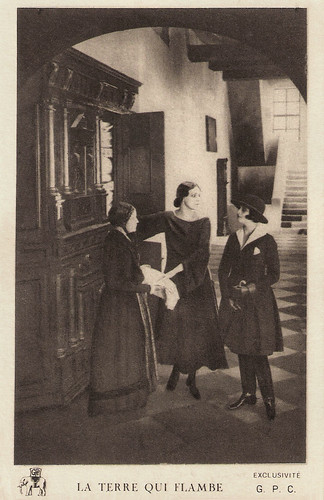
French postcard by Edition de la Cinématographie Française, Paris. Photo: G.P.C. Publicity still for Der brennende Acker/Burning Soil/La terre qui flambe (Friedrich Wilhelm Murnau, 1922). Gerda (Lya de Putti) and her maid (Leonie Taliansky).

Der brennende Acker (1922)
French postcard by Edition de la Cinématographie Française, Paris. Photo: G.P.C. Publicity still for Der brennende Acker/Burning Soil/La terre qui flambe (Friedrich Wilhelm Murnau, 1922). Count Rudenburg (Eduard von Winterstein), flanked by, left, his daughter Gerda (Lya de Putti), and right, his second wife Helga (Stella Arbenina).

Der brennende Acker


Der brennende Acker/Burning Soil or in French La terre qui flambe was considered lost for a long time. Until 1978 only the last three reels (totalling 843 meters compared to the original 2,645) of the film were known: this was the black-and-white copy preserved by the East German Cinematheque. In 1979, an almost complete copy of the film was identified only by film historian Vittorio Martinelli at the Cineteca Italiana in Milan. It was a version distributed in Italy under the title 'Il campo del diavolo' (The Devil's Field) whose opening credits and captions in Italian had certainly been made in Italy and whose images were developed in Germany. The copy belonged to a small collection of an Italian religious man who worked in institutions for the mentally ill and entertained the sick by showing old films.

Enno Patalas, director of the Münchener Filmmuseum, obtained an early black-and-white copy from a negative made in Milan: the Italian captions were replaced in Munich with new German titles from the script in the possession of F.W. Murnau's niece. From the early 1980s, this "lost" film was thus once again visible in Germany. However, a colour original still existed in Milan: with the collaboration of the Cineteca Italiana, the Bundesarchiv in Koblenz received the original material on which it was able to begin restoration work.

Having found the original censorship visa of 25 February 1922 with the text of all the captions, it was possible for the Münchener Filmmuseum to reconstruct the captions and inserts (the newspaper pages, letters, will, etc.) with the collaboration of the Pfenninger laboratory. In the absence of a model for the exact layout of the captions, inspiration was taken from other German films of the early 1920s, using dark green as the colour of the captions and light yellow as the colour of the inserts. The restored, colour version of Der brennende Acker was internationally first presented at the festival 'Il Cinema Ritrovato' in Bologna in November 1993.

Helmut Regel in the catalogue of 'Il Cinema Ritrovato', November 1993: "If the Milan copy had a length, including the Italian captions, of 2,346 meters, the new colour negative after the insertion of the new captions measures 2,325 meters. A missing sequence from a copy in the Moscow Gosfilmofond was, in addition, inserted. It is thus 320 meters short of the original footage of the copy intended by the censors (2,645 meters). In September 1993 the Bundesarchiv-Filmarchiv finished the restoration at the ABC & Taunus laboratory in Wiesbaden, resulting in a final print that comes enormously close to the original colours of the nitrate print. Finally, the long odyssey of a reconstruction had reached its end."

Der brennende Acker was acclaimed for its visual quality and the contrast between the simple rustic farm and the airy and elegant castle. Thorkell A. Ottarsson at IMDb: "The film is quite dramatic and dark, even surprisingly dark at times. A superb film from one of the best directors of all time." To achieve his visual effects, innovative camera angles, and bold lighting, Murnau had two of the most renowned cameramen photograph the film. Fritz Arno Wagner filmed the first part and Karl Freund the second part, and the sets were built by the equally renowned Rochus Gliese. Karl Freund, who began as a projectionist in Berlin and newsreel cameraman, worked for Ufa in the 1920s and gained the international reputation of being a master cameraman. His later credits include such classics as Metropolis, Der lezte Mann/The Last Laugh, Der Golem/The Golem and Variété/Variety.

W. Morrow at IMDb describes beautifully his fascination for Der brennende Acker: "a sustained mood of wintry melancholy, perked by a number of understated but impressive directorial touches. There's business involving a document torn into little pieces that is poetic. When Murnau was at his peak, in such films as Faust and Sunrise, he would stage his effects on a much grander scale, but here he manages to create a beautiful moment with a few torn pieces of paper."

Der brennende Acker (1922)
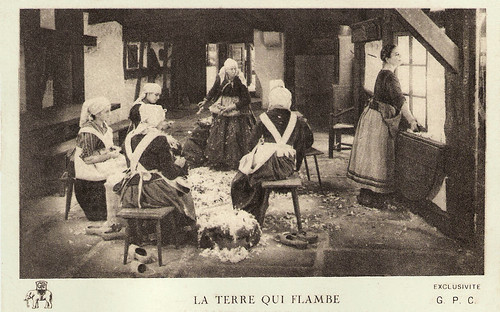
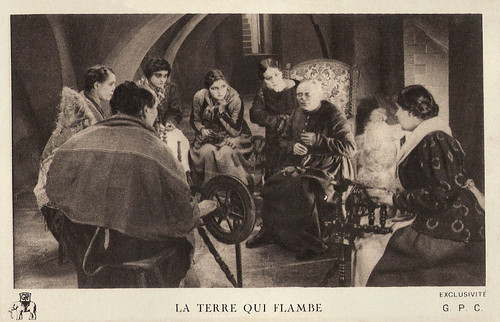
French postcard by Edition de la Cinématographie Française, Paris. Photo: G.P.C. Publicity still for Der brennende Acker/Burning Soil/La terre qui flambe (Friedrich Wilhelm Murnau, 1922). The old maid talks to the young servants about the Devil's Field.

Der brennende Acker (1922)
French postcard by Edition de la Cinématographie Française, Paris. Photo: G.P.C. Publicity still for Der brennende Acker/Burning Soil/La terre qui flambe (Friedrich Wilhelm Murnau, 1922). Helga, Count Rudenburg's second wife (Stella Arbenina), and Gerda, the Count's daughter (Lya de Putti), in a fierce get-together.

Der brennende Acker (1922) French postcard by Edition de la Cinématographie Française, Paris. Photo: G.P.C. Publicity still for Der brennende Acker/Burning Soil/La terre qui flambe (Friedrich Wilhelm Murnau, 1922). Johannes Rog (Vladimir Gajdarov) arrives too late at the deathbed of his father (Werner Krauss), while, left, his brother Peter (Eugen Klöpfer), and right, the maid Maria (Grete Diercks), look on.

Sources: Helmut Regel (article 'Der brennende Acker', in the catalogue Il Cinema Ritrovato, November 1993; text reused on Italian Wikipedia), Sandra Brennan (AllMovie), John DeBartolo (Silents are Golden), W. Morrow (IMDb), Thorkell A. Ottarsson (IMDb), Yepok (IMDb), Filmportal.de (German), Wikipedia (German) and IMDb.

This post was last updated on 3 July 2022.
10 November 2021

Die Finanzen des Großherzogs (1924)

One of my favourite silent films is Friedrich Wilhelm Murnau's satire Die Finanzen des Großherzogs/The Grand Duke's Finances (1924). It's the only comedy Murnau made, but he proved to be a master in this genre too. Harry Liedtke stars as the likeable and carefree Grand Duke Don Ramon XX of Abacco, who has run out of money to pay the national debt and whose idyllic country is threatened by revolution. His main creditor wants to take possession of the Grand Duchy. A marriage with Olga, the Grand Duchess of Russia (Mady Christians), would solve everything, but a crucial letter of hers about the engagement has been stolen. The plot is based on the novel 'The Finances of the Grand Duke' (Storhertigens Finanser) by Swedish author Frank Heller.

Alfred Abel in Die Finanzen des Großherzogs (1924)
Yugoslavian postcard by Jos. Caklovic, Zagreb, no. 37. Photo: Balkan Film, Zagreb. Alfred Abel in Die Finanzen des Großherzogs/The Grand Duke's Finances (F. W. Murnau, 1924). Collection: Didier Hanson.

Harry Liedtke and Mady Christians in Die Finanzen des Grossherzogs (1924)
German postcard by Ross Verlag, Berlin, no. 809/1. Photo: Ufa. Harry Liedtke and Mady Christians in Die Finanzen des Großherzogs/The Grand Duke's Finances (F. W. Murnau, 1924).

Mady Christians and Harry Liedtke in Die Finanzen des Großherzogs
German postcard by Ross Verlag, Berlin, no. 809/2. Photo: Ufa. Harry Liedtke and Mady Christians in Die Finanzen des Großherzogs/The Grand Duke's Finances (F. W. Murnau, 1924).


A series of frantic chases, plots, and counter-plots


Ufa producer Erich Pommer asked Thea von Harbou, Fritz Lang's wife and creative partner at the time, to adapt Frank Heller's novel for the screen. Von Harbau focused on the character of thief-detective Phillip Collin (Alfred Abel). Collin, who passes as Professor Pelotard, meets an unknown woman in a café, who asks him to help her hide from her pursuers. He willingly obliges and soon finds out that she is Grand Duchess Olga and that her pursuer is her brother.

The newspapers report on the speculation on Abacco's bonds, on the outbreak of a revolution in Abacco, and on the disappearance of the Grand Duke. All regular voyages to Abacco are interrupted but Olga, who now passes as Collins' wife, manages to charter a ship to take her to Abacco island. She accepts to take along the Grand Duke, whom she has not recognised, and who introduced himself as a supporter of the Grand Duke. In Abacco the Grand Duke and Collin overcome the self-proclaimed president and his accomplices after a short fight. However further revolutionaries overpower the Grand Duke and start preparing for his hanging. Olga now understands who he is and wants to buy him off the revolutionaries, without success. A series of frantic chases, plots, and counter-plots begins...

Die Finanzen des Großherzogs/The Grand Duke's Finances (1924) was shot from May to August 1923. Rochus Gliese and Erich Czerwonski were responsible for the sets, and Karl Freund and Franz Planer for the camera work. The shooting locations were the Messter studios in Berlin-Tempelhof and the Ufa studios in Neubabelsberg, today's Studio Babelsberg in Potsdam. The outdoor shots took place on the Adriatic in Spalato, Cattaro, Zara, on the island of Arbe, and on the outdoor areas of the Ufa studios in Neubabelsberg, where a.o. the castle was built as a large external backdrop.

The cast is interesting with some of the best character actors that Weimar cinema had to offer. Dutch actor Adolphe Engers played Don Esteban Paqueno, Ilka Grüning played the cook Augustine, Julius Falkenstein was Ernst Isaacs, Walter Rilla appeared as Luis Hernandez and Hermann Vallentin as Herr Binzer. And fans of Murnau's Nosferatu (1922) will be intrigued to see the mysterious Max Schreck here with a long straggly beard as one of a quartet of political agitators.

Die Finanzen des Großherzogs/The Grand Duke's Finances premiered on 7 January 1924 in Berlin's Ufa-Palast am Zoo. It is the only comedy among the works of the director Murnau. gavin6942 at IMDb: "The film specifically referenced paintings, which is no surprise - Murnau was an art historian. It has been said some directors view films as artists and some as cameramen. Murnau was an artist. This works well, and it is added to by the fact the sets were painted with shadows rather than using lights. "

Harry Liedtke in Die Finanzen des Großherzogs (1924)
German postcard by Ross Verlag, Berlin, no. 810/1. Ufa. Harry Liedtke in Die Finanzen des Großherzogs/The Grand Duke's Finances (F. W. Murnau, 1924).

Mady Christians in Die Finanzen des Grossherzogs (1924)
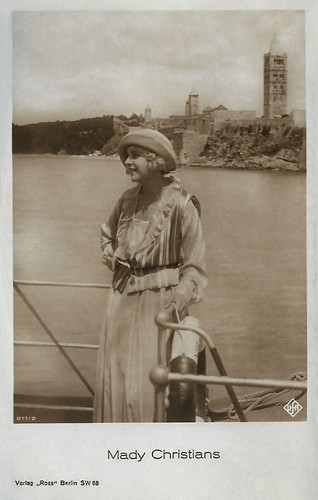
German postcard by Ross Verlag, Berlin, no. 811/2. Photo: Ufa. Mady Christians in Die Finanzen des Großherzogs/The Grand Duke's Finances (F. W. Murnau, 1924).

Ilka Grüning  and Harry Liedtke in Die Finanzen des Grossherzogs (1924)
German postcard by Ross Verlag, Berlin, no. 813/1. Photo: Ufa. Ilka Grüning and Harry Liedtke in Die Finanzen des Großherzogs/The Grand Duke's Finances (F. W. Murnau, 1924).

Sources: Nicole Gagne (AllMovie), Wikipedia (Dutch, German and English), and IMDb.

This post was last updated on 9 April 2023.

11 April 2023

Camilla Horn

Ethereally blonde Camilla Horn (1903-1996) was a German dancer and film star. Her breakthrough role was Gretchen in the silent film classic Faust (1926). She also starred in some Hollywood films of the late 1920s and from 1930 until her retirement in 1953, she remained a screen favourite in German, British, and Italian films.

Camilla Horn
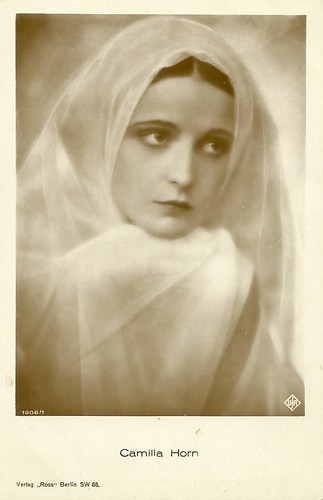
German postcard by Ross Verlag no. 1806/1, 1927-1928. Photo: Ufa.

Camilla Horn
German postcard by Ross Verlag, no. 1942/2, 1927-1928. Photo: Ufa.

Camilla Horn
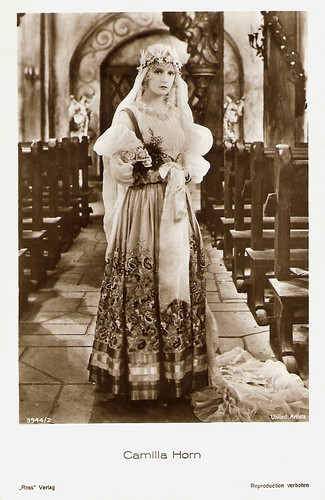
German postcard by Ross Verlag, no. 3944/2, 1928-1929. Photo: United Artists.

Camilla Horn
German postcard by Ross Verlag, no. 3154/1, 1928-1929. Photo: Atelier Binder, Berlin.

Camilla Horn
German postcard by Ross Verlag, no. 6648/1, 1931-1932. Photo: Atelier Schneider, Berlin.

Dancer in a cabaret


Camilla Martha Horn was born in Frankfurt am Main, Germany, in 1903. She was the daughter of the railway official Wilhelm Horn and his wife Martha.

After passing an examination as a seamstress, Horn initially worked in various professions to finance her acting training. She finally completed her training in Berlin with Lucie Höflich and also took dance lessons with Rudolf von Laban.

Horn made her stage debut as a dancer in a cabaret. Her film debut was in the Alexandre Dumas père adaptation Kean (Rudolph Biebrach, 1921). In the following years, she had a few appearances as an extra.

In 1925, she worked as an extra in Madame wünscht keine Kinder/Madame Doesn't Want Any Children (Alexander Korda, 1925) with Marlene Dietrich.

In Murnau's Molière adaptation Tartüff/Tartuffe (Friedrich Wilhelm Murnau, 1925), she was a double for the female star, Lil Dagover.

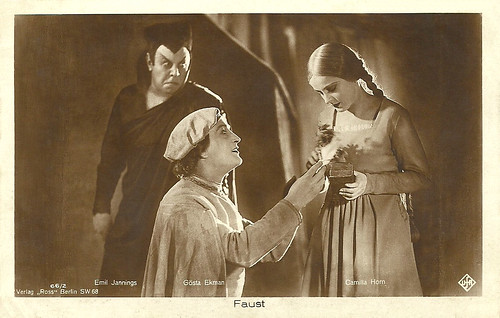
Gösta Ekman, Emil Jannings, Camilla Horn, Faust
German postcard by Ross Verlag, no. 66/2. Photo: Ufa. Gösta Ekman, Emil Jannings and Camilla Horn in Faust (1926). Collection: Didier Hanson.

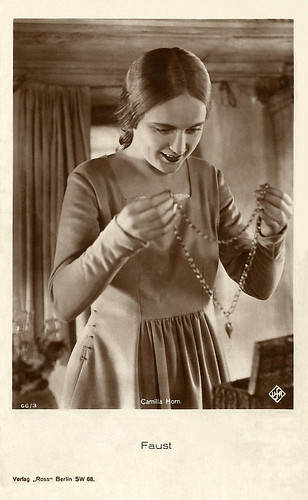
Camilla Horn in Faust
German postcard by Ross Verlag, no. 66/3. Photo: Ufa. Publicity still for Faust (Friedrich Wilhelm Murnau, 1926).

Gösta Ekman and Camilla Horn in Faust
German postcard by Ross Verlag, no. 62/3. Photo: Parufamet. Publicity still for Faust (Friedrich Wilhelm Murnau, 1926).

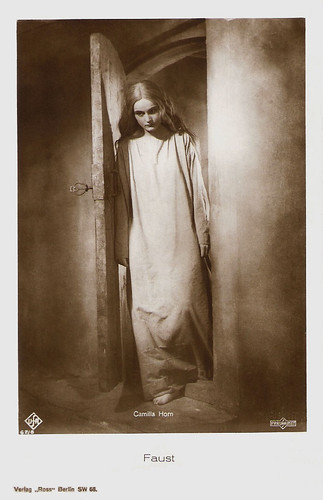
Camilla Horn, Faust
German postcard by Ross Verlag, no. 62/8. Photo: Parufamet. Publicity still for Faust (Friedrich Wilhelm Murnau, 1926).

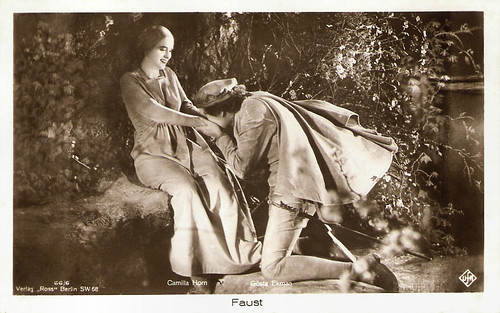
Gösta Ekman, Camilla Horn, Faust
German postcard by Ross Verlag, no. 66/6. Photo: Ufa. Publicity still for Faust (Friedrich Wilhelm Murnau, 1926).

Camilla Horn
Austrian postcard by Iris Verlag, no. 868. Photo: Kiesel, Berlin.

Ideal casting


Camilla Horn's great chance came when director Friedrich Wilhelm Murnau prepared a film version of Goethe's 'Faust'.

Murnau had asked Hollywood star Lillian Gish to play Gretchen in the lavish Ufa production, but she insisted that the film should be shot by her favourite cinematographer, Charles Rosher.

Therefore, Murnau decided to cast the newcomer he had met on the set of Tartüff/Tartuffe (Friedrich Wilhelm Murnau, 1925) would play Gretchen opposite Gösta Ekman as Faust and Emil Jannings as Mefisto.

The completely unknown Horn proved to be the ideal casting for the role of the ill-fated Gretchen and Faust (Friedrich Wilhelm Murnau, 1926) made her a star.

She signed a four-year contract with the Ufa and acted in Jugendrausch/Youth Frenzy (Georg Asagaroff, Wladyslaw Starewicz, 1927) and Der fröhliche Weinberg/The Merry Weinberg (Jacob Fleck, Luise Fleck, 1927).

Camilla Horn,
Austrian postcard by Iris Verlag, no. 5943. Photo: Distr. Allianz-Film / Excelsior-Film.

Camilla Horn
German postcard by Ross Verlag, no. 4449/1, 1929-1930. Photo: Atelier Schrecker, Berlin.

Camilla Horn
German postcard by Ross Verlag, no. 5049/1, 1930-1931. Photo: Atelier Binder, Berlin.

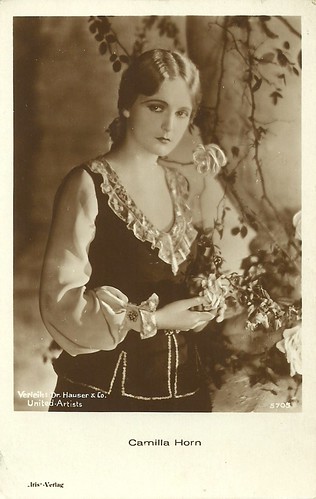
Camilla Horn
Austrian postcard by Iris Verlag, no. 3705. Photo: Verleih Dr. Hauser & Co. / United Artists.

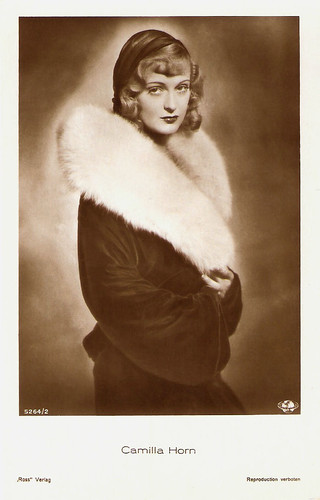
Camilla Horn
German postcard by Ross Verlag, no. 5264/2, 1930-1931. Photo: Deutsche Universal.

Camilla Horn
German postcard by Ross Verlag, no. 7916/2, 1932-1933. Photo: Gerstenberg-Dührkoop, Berlin.

Monetary offence


In 1928 Camilla Horn sailed for Hollywood where she became the mistress of producer Joseph Schenck and played in two United Artists productions. She starred in Tempest (Sam Taylor, 1928) and Eternal Love (Ernst Lubitsch, 1929) both opposite John Barrymore. Eternal Love was the last silent film of Barrymore and director Lubitsch. Filmed on location in the Canadian Rockies, Eternal Love was a most uncharacteristic venture into doom and gloom for Lubitsch

She returned to Europe and made popular films like Die grosse Sehnsucht/The Great Desire (Steve Sekely, 1930) and Hans in allen Gassen (Carl Froelich, 1930) with Hans Albers. In Great Britain, she appeared in the Comedy of Errors, The Love Nest (Thomas Bentley, 1933), set during a dark and stormy night and the murder mystery Matinee Idol (1933), directed by George King.

In Germany, Camilla Horn appeared in Moral und Liebe/Morals and Love (Georg Jacoby, 1933), Die grosse Chance/The Big Chance (Victor Janson, 1934), and Ein Walzer für dich/A Waltz for You (Georg Zoch, 1934).

In the next years, she starred in Der rote Reiter/The Red Rider (Rolf Randolf, 1935), Gauner im Frack/crook in Tails (Johannes Riemann, 1938) and Fahrendes Volk/Driving People (Jacques Feyder, 1938) again at the side to Hans Albers.

She refused to follow the official line of the Nazis and was prosecuted for a monetary offence. During the war, she got only minor parts or she acted in Italian productions like Paura d'amare/Fear of Loving (Gaetano Amata, 1942).

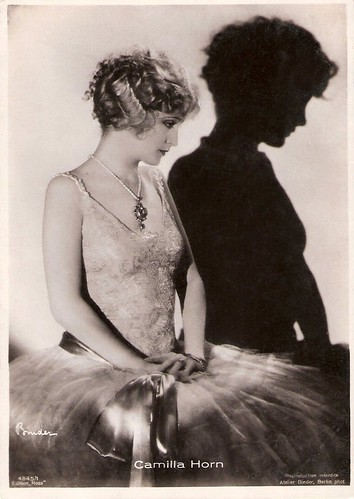
Camilla Horn
German postcard by Ross Verlag, no. 4845/1, 1929-1930. Photo: Alex Binder, Berlin.

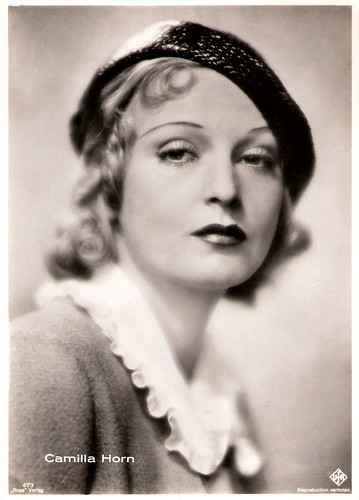
Camilla Horn
German postcard in the Ross Luxus series by Ross Verlag, Berlin, no. 673. Photo: Ufa.

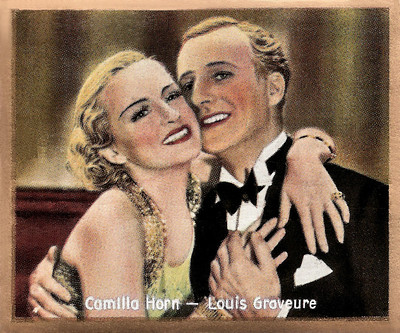
Camilla Horn and Louis Graveure in Ein Walzer für dich (1934)
German collectors card by Ross Verlag for Cigarettenfabrik Josetti, Berlin, in the series 'Unsere Bunte Filmbilder', no. 115. Photo: Badal-Film. Camilla Horn and Louis Graveure in Ein Walzer für dich/A Waltz for You (Georg Zoch, 1934).

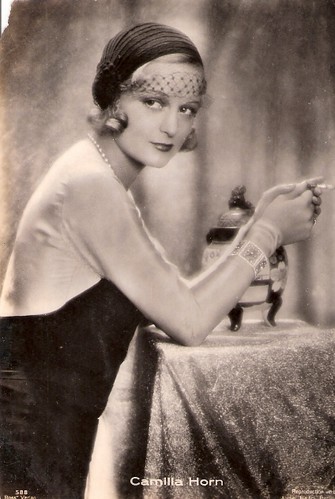
Camilla Horn
German postcard by Ross Verlag, no. 588. Photo Atelier Balazs, Berlin.

Camilla Horn and Gene Gerrard in The Love Nest
British postcard in the Filmshots series by Film Weekly. Photo: British International Pictures (BIP). Camilla Horn and Gene Gerrard in The Love Nest (Thomas Bentley, 1933).

Camilla Horn
German postcard by Ross Verlag, no. 9129/2, 1935-1936. Photo: Atelier Yva, Berlin.

Camilla Horn
German postcard by Ross Verlag, Berlin, no. 5779/1, 1930-1931. Photo: Atelier Binder.

Late comeback


After the war, the British tribunal at Delmenhorst convicted Camilla Horn for minor offences (among them travelling without permission) and she was imprisoned for three months at the women's prison in Vechta. Her knowledge of English led her to work first as an interpreter and then again as an actress on stage. The German cinema of the post-war years offered her only rare roles in films like Königin der Arena/Queen of the Arena (Rolf Meyer, 1952) and Vati macht Dummheiten/Daddy Does Dumb (Johannes Häussler, 1953).

Camilla Horn appeared only a few times on German television. An example was Mrs. Elizabeth Almond in Die Erbin (1958) based on the play 'The Heiress' by Ruth and Augustus Goetz, based on the novel 'Washington Square' by Henry James. Willy Birgel played doctor Dr. Austin Sloper and Elfriede Kuzmany was his daughter Catherine. In later years she appeared for example as Mrs. Rens, mother of Dr. Rens (Holger Petzold) in the episode 'Die Wunderquelle' (1985) from the cult series 'Die Schwarzwaldklinik'. In 1985 she wrote her memoir, 'Verliebt in die Liebe'.

In the cinema, she made a comeback in Schloss Königswald/Castle Königswald(Peter Schamoni, 1988), an hommage to former film stars like Camilla Horn, Marianne Hoppe, Carola Höhn, Marika Rökk and Rose Renée Roth. They played elderly female aristocrats who gathered at an ancient castle to live in grand style and escape the chaos of World War II. The all-star cast was awarded the Bavarian Film Award for Best Actress of 1988.

Her last appearance was in the TV drama Die Spinnen/The Spiders (Pál Erdöss, 1989) with Mark Bellinghaus. She was unable to fulfil her last commitment, to play the role of Miss Sophie in the 1992 feature film Dinner for One with Bodo Maria, due to illness. A video was made dedicated to her. She spent her old age at Herrsching, and during the last year of her life, she lived in Gilching near Starnberg, where she had lived.

Camilla Horn died in Gilching, Germany, in 1996. Her grave is in the cemetery in Herrsching am Ammersee. She was married four times: to the businessman Klaus Geerts (1927 to 1930), to the architect Kurt Kurfis (from 1938), to the Swiss Robert Schnyder and to Rudolf Mühlfenzl, the editor-in-chief of Bayerischer Rundfunk (1953 to 1963). She owned a weekend house in the 1930s in Lübben (Spreewald) on the Weinberg, which still stands today.

Camilla Horn
German postcard by Ross. Photo: Terra-Baumann.

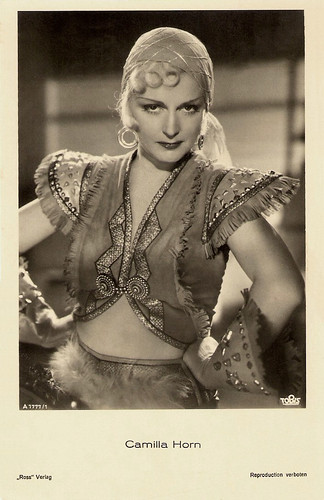
Camilla Horn
German postcard by Ross Verlag, no. A 1777/1, 1937-1938. Photo: Tobis. Camilla Horn in Fahrendes Volk/People Who Travel (Jacques Feyder, 1938).

Camilla Horn
German postcard by Ross Verlag, no. A 1961/1, 1937-1938. Photo: Haenchen / Tobis.

Camilla Horn
German postcard by Das Filmprogramm von Heute. Zeitschrift für Film und Theater. Photo: Tobis.

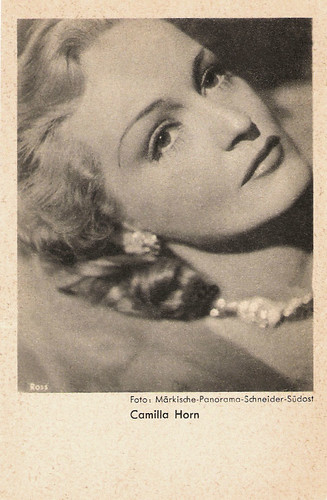
Camilla Horn
German postcard by Ross / Das Programm von Heute, Berlin. Photo: Märkische - Panorama - Schneider - Südost.

Camilla Horn in Friedemann Bach (1941)
German postcard by Ross Verlag, no. A 3317/2, 1941-1944. Photo: Baumann / Terra. Camilla Horn in Friedemann Bach (Traugott Müller, Gustaf Gründgens, 1941).

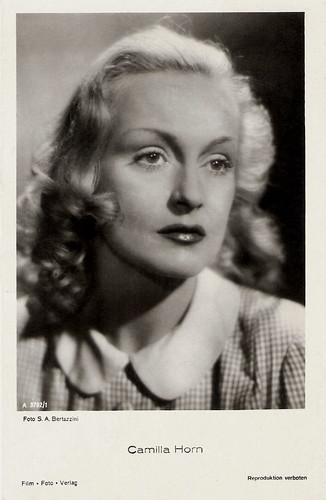
Camilla Horn
German postcard by Film-Foto-Verlag, no. A 3792/1, 1941-1944. Photo: S.A. Bertazzini.

Sources: Thomas Staedeli (Cyranos), Hal Erickson (AllMovie - page now defunct), Stephanie d'Heil (Steffi-Line - German), Wikipedia (English, and German ), IMDb.

This post was last updated on 19 October 2024.