Showing posts sorted by relevance for query Nos artistes dans leur loge. Sort by date Show all posts

21 November 2012

Nos artistes dans leur loge

One of the most fascinating and beautiful series of star postcards is Nos artistes dans leur loge. The series presents dozens of French stage and film stars of the 1920s in their dressing rooms. The postcards were all produced by the French journal Comoedia and one with Editions La Fayette.
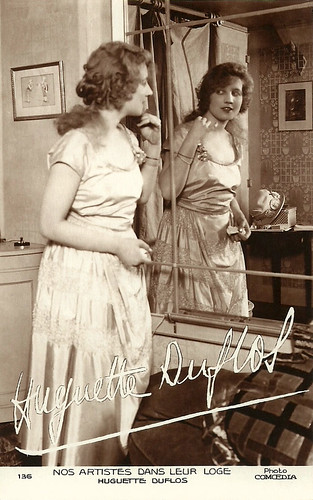
Huguette Duflos
Huguette Duflos. French postcard in the series Nos artistes dans leur loge by Editions La Fayette, Paris. Photo: Comoedia.
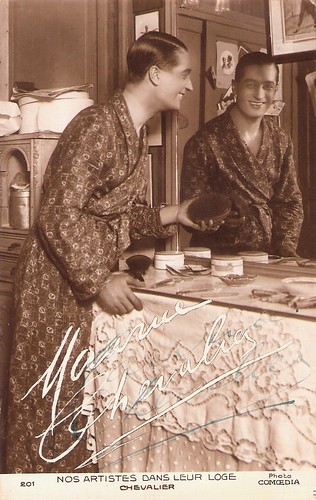
Maurice Chevalier
Maurice Chevalier. French postcard in the series Nos Artistes dans leur loge, no. 201. Photo: Comoedia.
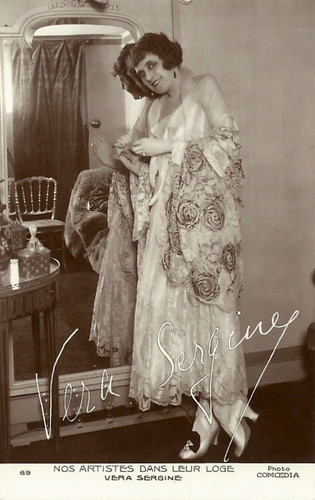
Vera Sergine
Vera Sergine. French postcard in the series Nos Artistes dans leur loge, no. 69. Photo: Comoedia.
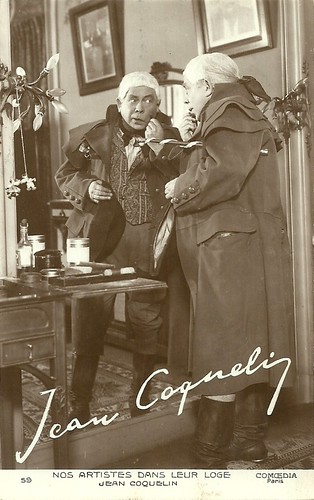
Jean Coquelin
Jean Coquelin. French postcard in the series Nos Artistes dans leur loge, no. 59. Photo: Comoedia.
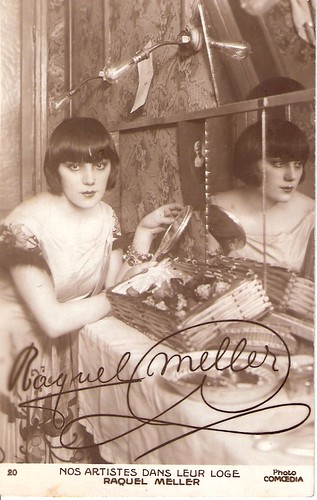
Raquel Meller
Raquel Meller. French postcard in the series Nos Artistes dans leur loge, no. 20. Photo: Comoedia.

Tour de France
Nowadays the Paris journal Comœdia is defunct. In 1907, it was founded by French bicycle racer and sports journalist Henri Desgrange (1865 – 1940), according to Wikipedia. Desgrange was also the first organizer of the Tour de France and the founder of the popular sports journal L’auto (nowadays L'Equipe). However, another source Le Guichet du Savoir cites an article by Nathalie Léger in Dictionnaire des lettres françaises: le XXe siècle, who claims that the founder was Georges de Pawlowski. The journal - or in French ‘revue’ – Comœdia appeared as a daily from 1 October 1907 to 6 August 1914. In the beginning it had four pages. Because of the First World War the publication then halted. After the war, on 1 October 1919 Comœdia returned, again as a daily. The 1920’s with its expanding rheatre and silent film industry were a golden period for Comœdia. Among its contributors were such famous authors as Francois Coppe, Tristan Bernard, Jean Richepin, Jules Renard, and Georges Courteline. They published columns, reviews and articles about actors, actresses and directors. There were two supplements. Since 1908 there was the bi-monthly art journal Comœdia illustrated. In 1926 the daily Comœdia-journal was started. In 1936 Desgrange fell ill and Comoedia disappeared. In 1941, after the death of Desgrange, the journal returned, but now as a weekly till August 1944. It reappeared between 1952 and 1954 under the name Paris-Comoedia, weekly show with journalist and scenario writer Jacques Chabannes as its director.
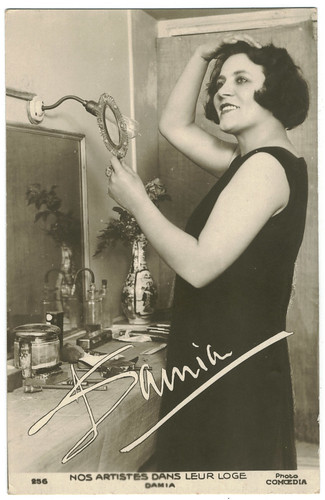
Damia_Comoedia (Nos Artistes dans leur Loge; 256)
Damia. French postcard in the series Nos Artistes dans leur loge, no. 256. Photo: Comoedia. Collection: Performing Arts / Artes Escénicas.
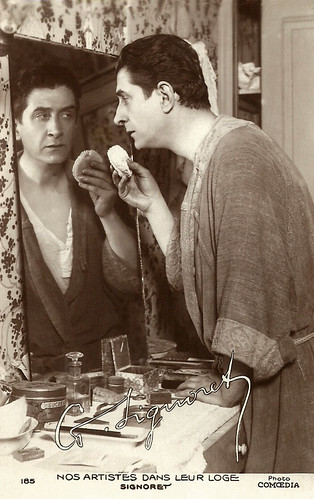
Gabriel Signoret, Nos artistes dans leur loge
Gabriel Signoret. French postcard in the series Nos Artistes dans leur loge, no. 185. Photo: Comoedia.

Maurice de Féraudy
Maurice de Féraudy. French postcard in the series Nos Artistes dans leur loge, no. 131. Photo: Comoedia.
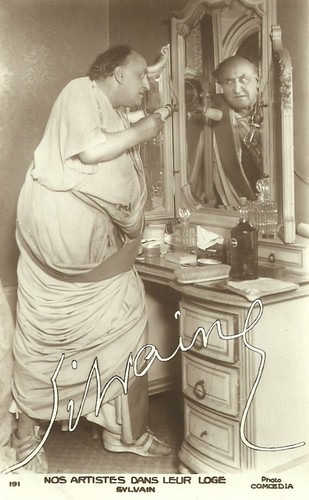
Sylvain
Eugène Silvain. French postcard in the series Nos artistes dans leur loge, no. 191. Photo: Comoedia.
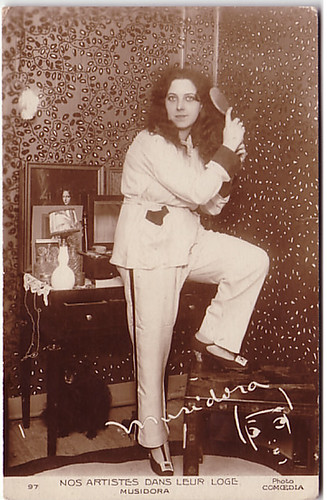
Musidora PJs1
Musidora. French postcard in the series Nos Artistes dans leur loge, no. 97. Photo: Comoedia. Collection: Beth Gallagher.

The Mirror
The series Nos artistes dans leur loge was probably published between 1922 and 1926 as a supplement for Comœdia Illustrated. The series contained portraits of famous stage actors. The stars were often only referred to by their surname like Signoret, Dranem, De Feraudy et al. Many film stars were included. The ingredients of the picture were always the same. A full shot of an artist who is preparing for the spotlights in his or her dressing room. A recurring element on the photos is the mirror. Sometimes the star is glancing into the mirror, looking at himself or at the photographer. On other postcards he is watching the photographer – and the public – directly. The dressing room is never in full view, but on the pictures you can discover details: a chair, a lamp, an artwork. And every card has a signature of the artists written over it. The result is wonderful. And my favourite dressing room is Musidora's.
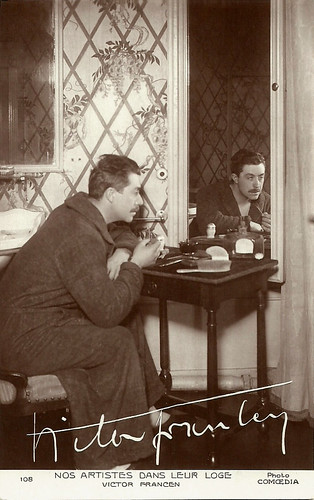
Victor Francen
Victor Francen. French postcard in the series Nos artistes dans leur loge, no. 108. Photo: Comoedia.

Max de Rieux
Max de Rieux. French postcard in the series Nos artistes dans leur loge, no. 285. Photo: Comoedia.

Harry Baur
Harry Baur. French postcard in the series Nos artistes dans leur loge, no. 202. Photo: Comoedia.
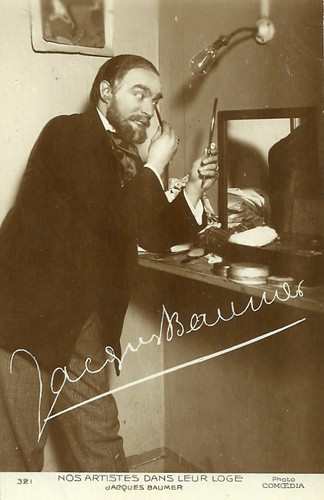
Jacques Baumer
Jacques Baumer. French postcard in the series Nos artistes dans leur loge, no. 321. Photo: Comoedia.
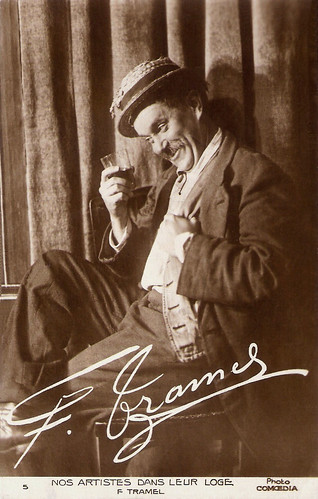
Tramel
Tramel. French postcard in the series Nos artistes dans leur loge, no. 5. Sent by mail in 1923. Photo: Comoedia.

Sources: Wikipedia (French) and Le Guichet du Savoir (French).

17 July 2021

Encore! Nos artistes dans leur loge

The French postcard series 'Nos artistes dans leur loge' presents sepia pictures of hundreds of French stage and film stars of the 1910s and 1920s in their dressing rooms. A wonderful candid series, full of mirrors, poses, and extravagant costumes. Nearly all of the postcards were produced by the French journal Comoedia. In 2012, EFSP had the first post about the series. Since then, Ivo Blom collected more and more cards of this series and we did the second post in 2019 and the third one in 2020. So it's time for another, the fourth post. Encore! Here are 28 more fascinating examples of 'Nos artistes dans leur loge', which Ivo acquired recently - and a few of my own cards are also included in the post.

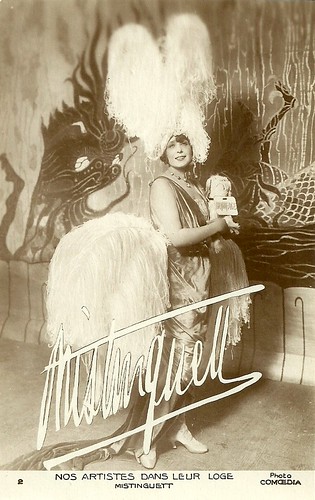
Mistinguett
French postcard in the 'Nos artistes dans leur loge' series, no. 2. Photo: Comoedia, Paris.

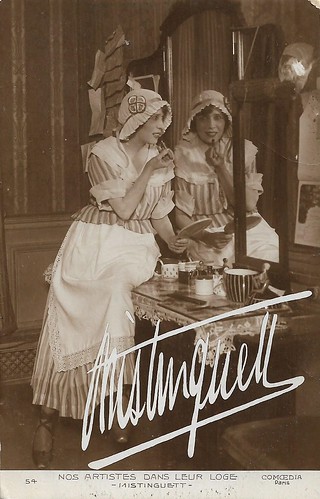
French actress and singer Mistinguett (1875-1956) captivated Paris with her risqué routines. She went on to become the most popular French entertainer of her time and the highest-paid female entertainer in the world. She appeared more than 60 times in the cinema.

Mistinguett
French postcard in the 'Nos artistes dans leur loge' series, no. 54. Photo: Comoedia, Paris. Mistinguett.

Félix Huguenet
French postcard in the 'Nos artistes dans leur loge' series, no. 58. Photo: Comoedia, Paris.

Félix Huguenet (1858-1926) only stayed two years with the Comédie Française (1906-1908) but had a rich stage career between the 1880s and the 1920s. He played in four films, including Mademoiselle de La Seiglière (André Antoine, 1921).

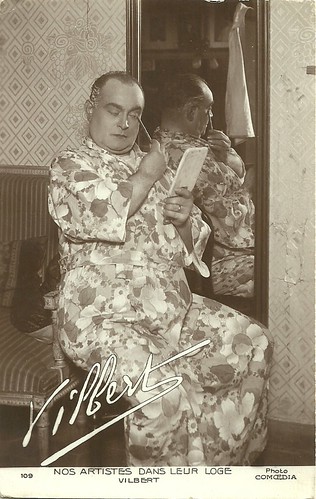
Henri Vilbert
French postcard in the 'Nos artistes dans leur loge' series, no. 109. Photo: Comoedia, Paris.

Henri Vilbert (1870-1926) was a French stage actor and singer. Until the First World War, he was a popular singer at the Paris café-concerts, singing scabrous military songs which the working class liked, thus rivaling popular singers like Polin and Dranem. When the café-concert faded during the war he focused more on theatre and operetta. Vilbert is often confused with his nephew Henri Vilbert (1904-1997) who was a stage and film actor and played with Pagnol, Clouzot, Becker, and others.

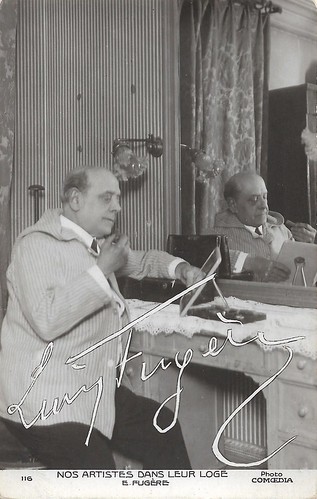
Fuguère
French postcard in the Nos artistes dans leur loge series, no. 116. Photo: Comoedia, Paris.

Probably, this is Lucien Fugère (1848-1935), who was an opera singer, bass voice, associated in particular with the roles of the French repertoire and Mozart. He enjoyed an exceptionally long career and was still singing at 85. His younger brother Paul Fugère(1851-1920) already withdrew from the stage in 1911, so it is rather unlikely this is him. As far as known, none of both brothers acted in a film.

Georges Dorival
French postcard in the Nos artistes dans leur loge series, no. 134. Photo: Comoedia.

Georges Dorival (1871–1939) was a French stage and screen actor of Norman origin, a painter, and an art collector.

Georges Colin
French postcard in the Nos artistes dans leur loge series, no. 139. Photo: Comoedia.

Georges Colin (1880-1945) was a French actor, who appeared in nearly 40 silent and sound films between 1909 and 1945.

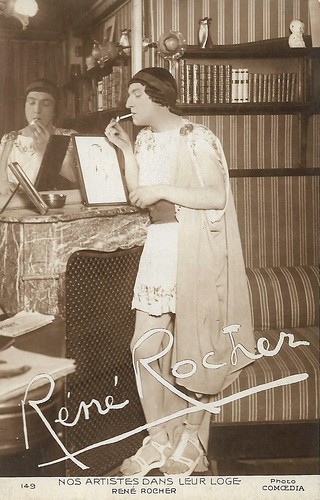
René Rocher
French postcard in the 'Nos artistes dans leur loge' series, no. 149. Photo: Comoedia, Paris.

René Rocher (1890–1970) was a France stage actor and theater director. He was managing director of the Théâtre Antoine from 1928 to 1933, then the Théâtre du Vieux-Colombier from 1935 to 1943, and the Théâtre de l'Odéon from 1940 to 1944. In the 1910s he acted in four films, a.o. Le coupable (André Antoine, 1917) and Blessée au coeur (director unknown, 1917).

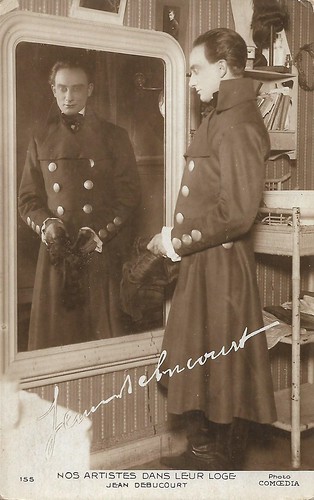
Jean Debucourt
French postcard in the 'Nos artistes dans leur loge' series, no. 155. Photo: Comoedia, Paris.

French actor and director Jean-Étienne Pelisse aka Jean Debucourt (1894-1954) was a member of the Comédie-Française. He also acted in such silent classics as La Chute de la Maison Usher (1928) by Jean Epstein and such sound films as Mayerling (1936) by Anatole Litvak.

Emile Dehelly
French postcard in the 'Nos artistes dans leur loge' series, no. 158. Photo: Comoedia, Paris.

Émile Dehelly (1871-1969) was a French stage and screen actor, who was a sociétaire of the Comédie française (1903-1928) and had a prolific career at Le Film d’Art between 1909 and 1913. He is the father of film actor Jean Dehelly.

Aimée Tessandier
French postcard in the 'Nos artistes dans leur loge' series, no. 175. Photo: Comoedia, Paris.

Aimée Tessandier (1851-1923) was a reputed French stage actress, who from 1908 till 1921 also had a career in French silent cinema.

Jane Danjou
French postcard in the 'Nos artistes dans leur loge' series, no. 176. Photo: Comoedia, Paris.

Pretty performer Jane Danjou is known for a few French silent films. She played small parts in the shorts L'auberge du tohu-bohu/The Inn of Tohu-Bohu (Georges Denola, 1912) and C'est pour les orphelins/For the Children (Louis Feuillade, 1916) with Musidora. She played Suzanne Grandais's friend in Midinettes/ (René Hervil, Louis Mercanton, 1917), and the tile role in Zon (Robert Boudrioz, 1920) opposite Jacques de Féraudy.

Louise Silvain
French postcard in the 'Nos artistes dans leur loge' series, no. 192. Photo: Comoedia, Paris.

Louise Silvain (1874-1930) entered the Comédie Française in 1901, became sociétaire in 1910 and sociétaire honoraire in 1925. She was married to Eugène Silvain, aka Sylvain. She acted in the films Une scène d'Andromaque à la Comédie Française (dir. unknown, 1909) and Molière, sa vie, son oeuvre (Jacques de Féraudy, 1922).

Thérèse Dorny
French postcard in the 'Nos artistes dans leur loge' series, no. 207. Photo: Comoedia, Paris.

French actress Thérèse Dorny (1891-1976) got great success with 'L'École des cocottes', which she performed three times in 1918, 1920, and 1923. At the start of sound cinema in France, she had a rich career in film acting, in particular in comedies such as Cognasse (Louis Mercanton, 1932).

Henri Mayer
French postcard in the 'Nos artistes dans leur loge' series, no. 231. Photo: Comoedia, Paris.

French actor Henry Mayer ( 1857-1941) was a member of the Comédie-Française. Mayer debuted at Pathé Frères as the cruel Roman emperor Caligula in L'Étoile du génie (Ferdinand Zecca, René Leprince, 1913) starring Gabriel Signoret as a composer and Stacia Napierkowska as his muse. Mayer then had the lead in two SCAGL/ Pathé productions by Georges Monca and several more films followed.

Madeleine Barjac
French postcard in the 'Nos artistes dans leur loge' series, no. 234. Photo: Comoedia, Paris. The outfit of Barjac may refer to one of her Racine plays on Antiquity, such as 'Iphigénie' (1920, 1924), 'Phèdre' (1920, 1925), or 'Andromaque' (1922, 1923).

Madeleine Barjac (1883-1974) was a French actress at the beginning of the 20th century. Between 1918 and 1938, she acted at the Comédie-Française, first often in plays by Racine, and from the early 1930s onward also in more modern dramas. Barjac's film career was modest. In 1910 she debuted at Pathé Frères and in the following years, she also played in silent shorts for Eclipse and Gaumont.

Raphaël Duflos
French postcard in the 'Nos artistes dans leur loge' series, no. 240. Photo: Comoedia, Paris.

Raphaël Duflos (1858-1946) was a French famous Comédie-Française stage actor, who also acted in a handful of French silent films.

Béatrix Dussane
French postcard in the 'Nos artistes dans leur loge' series, no. 245. Photo: Comoedia, Paris.

Béatrix Dussane (1888-1969) was a French stage actress of the Comédie-Française and a teacher at the Conservatoire d'Art dramatique de Paris. She only acted in one film: Le Franciscain de Bourges (Claude Autant-Lara, 1968) in which she had the female lead opposite Hardy Kruger in the title role. Dussane was 80 at the time.

Roseraie
French postcard in the Nos artistes dans leur loge series, no. 246. Photo: Comoedia, Paris.

Roseraie or Mademoiselle Roseraie (?-?) was an actress of the Comédie Française, where she was 'pensionnaire' between 1918 and 1925. There she was Elise in 'Esther' (1919), Zaïre in 'Bajazet' (1920), Europe in 'Vautrin' (1922), etc. On screen, she acted in Molière, sa vie, son oeuvre (Jacques de Féraudy, 1922), in which the whole troupe of the Comédie Française collaborated. Before that, she played a small, uncredited part as a condemned woman in Albert Capellani's period drama Le chevalier de Maison-Rouge (1914), an adaptation of Alexandre Dumas and evolving during the French Terror era. As "Mademoiselle Roseraie", she acted in the Spanish production Boy (Benito Perojo, 1926), playing a countess whose lavish lifestyle ruins the protagonist, played by Juan de Orduña. In the sound era, Roseraie had a minor part in Jacques Feyder's Pension Mimosas (1935), starring Françoise Rosay.

Marthe Chenal
French postcard in the Nos artistes dans leur loge series, no. 264. Photo: Comoedia.

Marthe Chenal (1881-1947) was a French opera soprano active between 1905 and 1923. Although she sang with several opera companies in France and around the world, her career was mainly centered at the Palais Garnier and the Opéra-Comique in Paris. She particularly excelled in works by Jules Massenet and Camille Erlanger. Chenal was admired for her excellent singing but also for her spectacular dramatic prowess, some critics comparing her to the actress Sarah Bernhardt. A remarkable and attractive woman, Chenal was dubbed by the international press as "the most beautiful woman in Paris". She was noted for her interpretation of La Marseillaise. Her voice is preserved on a number of recordings made with Pathé in 1915. As far as known, she never acted in films.

Marcel Vibert
French postcard in the Nos artistes dans leur loge series, no. 267. Photo: Comoedia.

French actor Marcel Vibert (1883-1959) worked primarily in the French film industry, e.g. in Les trois mousquetaires (1912-1913), Les opprimés (1923), Le bossu (1925), Nitchevo (1926), and the first French sound film Les trois masques (1929), but in the late 1920s he also appeared in several British silent films including Moulin Rouge (1928) and Champagne (1928), as well as in Rex Ingram's American film The Garden of Allah (1927).

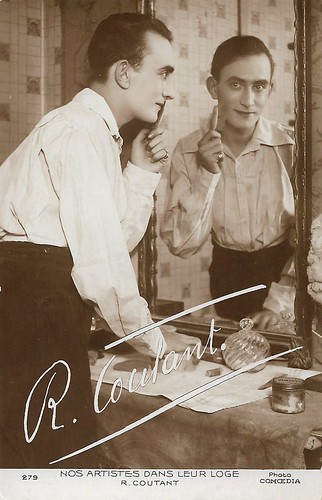
Roger Coutant
French postcard in the 'Nos artistes dans leur loge' series, no. 279. Photo: Comoedia, Paris.

Roger Coutant (?-?) acted in only three films. In 1919 he played the male lead opposite Renée Sylvaire in L'heureuse vocation (Georges Laîné, 1919). Coutant acted in the early sound film Serments (Henri Fescourt, 1931). Coutant's last film role was a small part in Cartouche (Jacques Daroy, 1934).

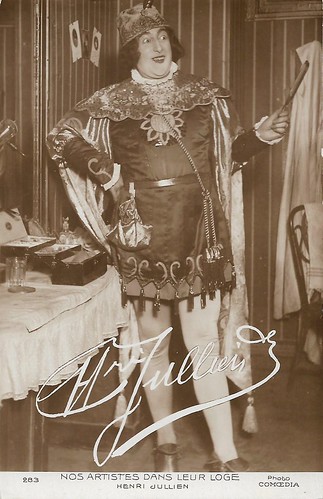
Henri Jullien
French postcard in the 'Nos artistes dans leur loge' series, no. 283. Photo: Comoedia, Paris.

Henri Jullien (1879-1961) was a French stage and screen actor. In 1912, he started to act in a series of short films at Gaumont. While absent from the sets during the First World War, he acted in three films in the early 1920s, including Pour don Carlos (1920) starring Musidora.

André Baugé
French postcard in the 'Nos artistes dans leur loge' series, no. 286. Photo: Comoedia, Paris.

André Baugé (1893-1966) was a French baritone, active in opera and operetta. He also appeared in films in the 1930s.

Fernand Rivers
French postcard in the 'Nos artistes dans leur loge' series, no. 289. Photo: Comoedia, Paris.

Fernand Rivers (1879-1960) was a French actor, screenwriter, film producer, and director. In 1935, he produced and supervised the first two feature films directed by Sacha Guitry. Rivers pursued a career as a director until 1950.

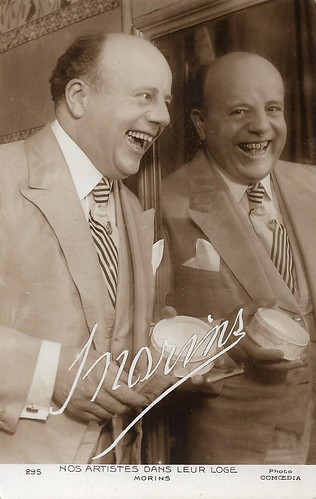
Armand Morins
French postcard in the 'Nos artistes dans leur loge' series, no. 295. Photo: Comoedia, Paris.

Armand Morins aka Morins made his film debut in 1912 repeating his stage role of the clumsy and naive servant Joseph Turlot in the first film adaptation of the military comedy Tire-au-flanc. Morins incidentally returned to the film sets in both the silent as the sound eras.

Lucien Rozenberg
French postcard in the 'Nos artistes dans leur loge' series, no. 296. Photo: Comoedia, Paris.

Lucien Rozenberg was a French actor, screenwriter, director, and stage director. During the First World War, he began a series of humorous short films for Pathé Frères. Rozenberg played by himself, using simply his first name as character name: "Lucien". He was the star and often the director too, although Édouard-Émile Violet and Paul Garbagni also directed several Lucien farces. By mid-1919, Rozenberg put an end to his film career and returned to the theatre. After French sound cinema had set in, he returned to the film sets occasionally.

Marguerite Deval
French postcard in the 'Nos artistes dans leur loge' series, no. 316. Photo: Comoedia, Paris.

Marguerite Deval (1866-1955) was a French stage and screen actress, and operetta singer. While she only acted in two silent films in the early 1910s, Deval had a rich career in French sound cinema of the 1930s and 1940s.

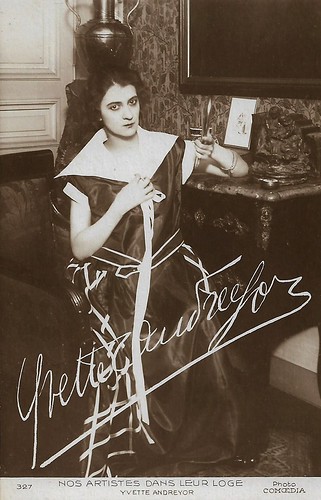
Yvette Andreyor
French postcard in the 'Nos artistes dans leur loge' series, no. 327. Photo: Comoedia, Paris.

Beautiful Yvette Andréyor (1891 –1962) was a French actress of the silent era. Her two most famous films were Louis Feuillades’ serials Fantômas (1913) and Judex (1916). She appeared in 108 films between 1910 and 1962.

30 July 2025

More Nos artistes dans leur loge

We are fans of the French postcard series 'Nos artistes dans leur loge'. These cards of French stage and film stars of the 1910s and 1920s in their dressing rooms form a unique and wonderful series. We love these intimate and candid views of legendary French artists - most are now forgotten - with their mirrors, poses, and extravagant costumes. Nearly all of the postcards were produced by the French journal Comoedia. Since 2012, EFSP has regularly posted about the series. During our visit to Noordwijk, Ivo Blom found 19 more cards from the series still missing from his collection.

Devilder
French postcard in the series Nos artistes dans leur loge by Comoedia, no. 105. Photo: Comoedia.

This could be the actress Renée Devilder (?-?). Between 1926 and 1931, she played in various operettas, such as 'No No, Nanette' (1926) and 'Brummel' (1931). In the early 1930s, she acted in seven French musical films. After debuting in a supporting part in the French alternative version Moi et l'impératrice (Friedrich Hollaender, Paul Martin, 1933) starring Lilian Harvey, Devilder had the lead opposite Jean Garat in Cent mille francs pour un baiser (Hubert Bourlon & Georges Delance, 1933). Yet, mostly she played supporting parts.

Régina Camier
French postcard in the series Nos artistes dans leur loge by Comoedia, no. 113. Photo: Comoedia.

Régina Camier (1894-?) was a French stage and screen actress, famous for her little feet. She had a rich theatre career in the 1920s and 1930s, and at one stage she even owned a theatre. She also directed two operettas in the 1920s, but it is unclear how many films she did. Cine-Ressources indicates only a small part in Par la vérité (1917) by Gaston Leprieur and Maurice de Féraudy.

Eugène Mansuelle
French postcard in the series Nos artistes dans leur loge by Comoedia, no. 117. Photo: Comoedia.

Eugène Gabriel Mansuelle (1873-1938) began his stage career in 1895, playing in local bawling halls and café-concerts. His popularity was mainly due to his physique - he was overweight, which he used to comic effect. He got into the habit of playing a trumpet solo at the end of his performance, so much so that the audience would shout out ‘Ugène! The trumpet! Mansuelle also had a modest film career. In 1909, he played Mes Bottes in the Zola adaptation L'Assommoir by Albert Capellani for Pathé Frères. In 1916, he played at Pathé Magloire in La Joueuse d'orgue by Georges Denola. In 1917, he acted in Oh! ce baiser!, by René Hervil et Louis Mercanton. In the 1930s, he acted in two French sound films, Amants et voleurs (1935) by Raymond Bernard, and Les Jumeaux de Brighton (1936) by Claude Heymann.

Dranem
French postcard in the series Nos artistes dans leur loge by Comoedia, no. 119. Photo: Comoedia.

French comic singer, music hall, stage and film actor Dranem (1869-1935) performed in 1895 with fellow newcomers Félix Mayol and Max Dearly in the 'Concert Parisien', from where he went on to become a leading music hall entertainer in his own comic absurdist genre. In 1899, he was signed to perform at the famous Eldorado Club, where he appeared regularly for the next twenty years. Dranem's comedic singing routine brought a loyal following, and his work made him a very wealthy man. Dranem also acted and sang in live theatre and in film. He already acted in 1900 at Pathé in Ma Tante / My Aunt, followed by several silent shorts by Pathé. In 1905, Dranem also performed in a series of 11 early sound films 'phonoscènes' by Gaumont and directed by Alice Guy. The advent of synchronised sound film in the late 1920s made Dranem much in demand for screen roles featuring his singing routines. In the early 1930s, he played in some 13 films, several of which featured him in the lead.

Jean Sarment
French postcard in the series Nos artistes dans leur loge by Comoedia, no. 119. Photo: Comoedia.

French stage actor Jean Sarment (1897-1976) debuted during the First World War and quickly became a beloved actor by director Jacques Copeau, who had him act in 13 of his plays in 1917-1918 at the Théâtre du Vieux-Colombier in Paris. In 1920, Sarment started stage-writing and directing himself, now at the Théâtre de l'Œuvre, and later at the Théâtre Antoine, often with himself in the male lead. In the early 1930s, he thus acted in his own plays, not only in Paris but also at the Théâtre de Monte-Carlo. In the era of French sound cinema, Sarment collaborated on film scripts or dialogues of various French films, e.g. Un carnet de bal (1937). He scripted and had the lead in the comedy Léopold le bien-aimé (1934), based on a play he had written.

Hilda Roosevelt
French postcard in the series Nos artistes dans leur loge by Comoedia, no. 122. Photo: Comoedia.

Hilda Roosevelt (1991-1965) was a Parisian opera singer. Though French-born, she was a niece of American President Theodore Roosevelt. In early 1918, she sang in Paris at the Salle Gaveau at a charity for the war effort. In 1919, she debuted as a singer in Paris at the Opéra-Comique, where she worked for years. In 1924, she sang at the Scala in London in 'The Three Musketeers' by Isidore de Lara.

Georges Saillard
French postcard in the series Nos artistes dans leur loge by Comoedia, no. 151. Photo: Comoedia.

French stage and film actor Georges Saillard (1877-1967) could be seen at the Théâtre Antoine, in plays such as 'Sherlock Holmes' (1907), 'La Femme et le pantin' (1910), and 'Hamlet' (1913). From 1909 on, he also appeared in several early silent Eclair and Pathé productions. After some 23 shorts, Saillard had the lead in the feature Le petit Jacques / Little Jack (Georges Monca, 1913) - in which he is a man unjustly arrested for murder, but trying to protect his child. Saillard returned to the sets in the 1920s, playing, e.g. the evil Thenardier in Les misérables (Henri Fescourt, 1925). Yet, particularly during the 1930s, Saillard played many supporting parts in French sound films, often playing doctors, e.g. the doctor in Yoshiwara (Max Ophüls, 1937) and in Abel Gance's own remake of J'Accuse (1938).

Lucienne Debrenne
French postcard in the series Nos artistes dans leur loge by Comoedia, no. 177. Photo: Comoedia.

Lucienne Debrenne [without -s] was a French stage actress who acted, e.g. in the comedy 'La Fleur d’oranger', performed in 1924 at the Comédie-Caumartin (Paris). According to IMDb, 'Lucienne Debrienne' acted in the French silent film comedy Bonheur conjugal (Robert Saidreau, 1923). Perhaps this is the same actress.

Guyon fils
French postcard in the series Nos artistes dans leur loge by Comoedia, no. 226. Photo: Comoedia.

Guyon fils, pseudonym of Charles-Alexandre Guyon (1854-1923), was a French stage and screen actor, born in a family of actors. He made his debut at the Eldorado in 1873. He moved to the Théâtre Beaumarchais in 1880, where he played in the revue 'Madeleine-Bastille', before moving to the Théâtre du Château-d'Eau in 1882, where he created 'Casse-museau. In 1886, he went to the Folies-Dramatiques, where he remained for eight years and created around twenty plays and operettas. Guyon also appeared in six films between 1917 and 1923: La conscience de Monsieur Cachalot (Maurice Poggi, 1917), Le Retour aux champs (Jacques de Baroncelli, 1918), Les Bleus de l'amour (Henri Desfontaines, 1918), Les Cinq gentlemen maudits (Luitz-Morat & Pierre Régnier, 1920), Petit ange (Luitz-Morat & Pierre Régnier, 1920), and Petit ange et son pantin (Luitz-Morat, 1923) - the latter two with little Régine Dumien in the lead.

Yvonne Ducos
French postcard in the series Nos artistes dans leur loge by Comoedia, no. 236. Photo: Comoedia. The open window may be at the Comédie Française.

Yvonne Ducos (1887-1946) was a French stage actress who also played in four films. Ducos acted at the Comédie Française, where she was 'pensionnaire' between 1911 and 1937, both in modern plays such as 'la Marche nuptiale' (1913) by Henri Bataille as well as classics by Racine ('Esther', 'Iphigenia in Aulis') and Shakespeare ('The Taming of the Shrew). She acted in several Greek plays or reworkings of them, such as 'Elektra', 'Orestes' and, as mentioned, 'Iphigenia in Aulis', or, again, plays set in Ancient Greece ('Psyché', 1918; 'Les Phéniciennes', 1922; 'Les Erinnyes', 1931) or Rome ('L'Hérodienne', 1919). After two shorts in the 1910s, Les Jacobites (Le Film d'Art, 1912) and Les Lettres (Louis Feuillade, Gaumont, 1914), Ducos acted in two sound films, Cognasse (Louis Mercanton, 1932) starring Tramel, and La Troisième Dalle (Michel Dulud, 1946) with Jules Berry.

Odette Darthys
French postcard in the series Nos artistes dans leur loge by Comoedia, no. 253. Photo: Comoedia.

Odette Darthys (?-?) was a French prima donna singer at the Opéra Comique in Paris. Afterwards, she married auto racer Roger Lacor.

Sonia Pavloff
French postcard in the series Nos artistes dans leur loge by Comoedia, no. 273. Photo: Comoedia.

During the 1910s and 1920s, Sonia Pavloff (1885-1938), born in Russia, was a renowned dancer at the Opéra-Comique in Paris.

R. de Boncour
French postcard in the series Nos artistes dans leur loge by Comoedia, no. 298. Photo: Comoedia.

R. de Boncour (?-?) was a French stage actor in the 1920s, initially mostly at the Théâtre de l'Odéon, and only playing supporting parts. In the press, he was always listed as "R. de Boncour". Little is known about him.

Audoin
French postcard in the series Nos artistes dans leur loge by Comoedia, no. 306. Photo: Comoedia. Audoin seems to wear a costume fit for the torero in the opera 'Carmen'.

Eric Audoin, aka Audoin (1881-?), was a French tenor. In 1904, he debuted as a singer at the Theatre of Besançon, while he sang at the opera of Nice in 1905-1906. Afterward. Albert Carré hired him for his Opéra-Comique in Paris, where Audoin's part of Don José in 'Carmen' became his most famous role. In 1906, he married the singer Hélène Lassara. In 1925, Audoin had the lead as Lohengrin in the opera by Richard Wagner, performed at the Theatre at Vichy.

Polin
French postcard in the series Nos artistes dans leur loge by Comoedia, no. 310. Photo: Comoedia.

French comedian Polin (1863-1927) was one of the greatest stars of the café-concerts of Paris. His interpretations were sober and had nuance and finesse, which were rare in the café-concerts. From 1910 on, he also appeared in film and theatre, including Sacha Guitry's play Le Grand Duc/The Grand Duke (1921) with Lucien and Sacha Guitry, and Yvonne Printemps.

Jean d'Yd
French postcard in the series Nos artistes dans leur loge by Comoedia, no. 324. Photo: Comoedia.

French stage actor Jean d’Yd (1880-1964) was active between the 1910s and the 1960s. From 1911, he acted in several plays at the Théâtre national de l'Odéon, directed by André Antoine. In the 1920s, he acted in various plays at the Théâtre des Arts, directed by Georges Pitoëff. After the Second World War, he acted in various plays at the Théâtre de l'Athénée, directed by Pierre Blanchar. He was a highly prolific character actor in French cinema. His M. Labas in Germaine Dulac's La souriante Madame Beudet (1923) was immediately followed by Dulac's episode film Gossette (1923). During the 1920s, d'Yd played La Bussière in Abel Gance's Napoléon (1927) and Guillaume Évrard in La Passion de Jeanne d'Arc (1928) by Carl Theodor Dreyer. In the 1930s, he acted in over 15 films in the 1930s, including Les Misérables (1934) by Raymond Bernard. During the war years, he acted in Les Visiteurs du soir (1942) by Marcel Carné and L'Eternel retour (1943) by Jean Delannoy. In the post-war era, he had a major part as the uncle of Marlene Dietrich in Martin Roumagnac (1946) by Georges Lacombe, while he played the father of the family in Les Dernières Vacances (1948) by Robert Leenhardt. All in all, he acted in 56 films until 1959.

Hasti
French postcard in the series Nos artistes dans leur loge by Comoedia, no. 326. Photo: Comoedia.

Robert Hista, known as Hasti, acted from 1907 at the Théâtre des Bouffes Parisiens in Paris. Hasti often acted opposite Cora Laparcerie in stage comedies at the same theatre in the pre-WWI years. After the First World War, Hasti acted at the Théâtre national de l'Odéon and other Parisian theatres. His films included L'oeil de Saint Yves (1919) and Les deux jarretières (1919), both with Julian, René Norbert, and Geneviève Félix. In 1920, Hasti acted in Luitz-Morat's comedy Rien à louer, on a modern Robinson Crusoë. In the early 1930s, Hasti returned on screen in five comedies. After the Second World War, Hasti had a last performance in another military comedy, Tire-au-flanc (Fernand Rivers, 1950), a remake of a film by Jean Renoir.

Albert Laroche
French postcard in the series Nos artistes dans leur loge by Comoedia, no. 328. Photo: Comoedia.

Albert Laroche (1862-?) was a French stage actor whose peak was during the 1890s and 1900s. Laroche acted for years at the Théâtre de la Renaissance, where he had major supporting parts in many plays starring 'la divine' Sarah Bernhardt. When Bernhardt started her own theatre, Laroche had a major part in her 'L'Aiglon' (1900) by Edmond Rostand. In 1907, he reunited with Bernhardt at her theatre for 'Les Bouffons' and 'Adrienne Lecouvreur', and again in 1913 for Jeanne Doré. Yet, at the Théâtre de la Gaîté, he acted in plays with Coquelin ainé in the lead, such as 'Cyrano de Bergerac' (1904) and 'Scarron' (1905). In 1908-1909, he also co-wrote revues for the Scala and the Eldorado in Paris. In the 1910s, Laroche acted at the Odeon theatre, and in 1927, he starred opposite Huguette Duflos in Maurice Donnay's 'Une Revue', at the Théâtre de la Porte Saint Martin. His last performance (as far as known) he gave in 1929 in John Van Druten's play 'Destinée', with Roger Gaillard.

Lucien Callamand
French postcard in the series Nos artistes dans leur loge by Comoedia, no. 330. Photo: Comoedia.

French stage and screen actor Lucien Callamand (1888-1968) had a rich stage career at various Parisian theatres in the 1920s. Yet, it was in the cinema that Callamand had his most prolific career. From 1909, he acted under the name of Paul Lack at Pathé Frères in films by Albert Capellani such as L'Assommoir (1909). Soon, he started to use his own name. In 1911, he launched at Eclipse his comical character of Agénor in Agénor, cavalier de deuxième classe. At Pathé, he played the comic type Narcisse in Narcisse a perdu son oncle (1914). After the introduction of sound film, Callamand became a regular character actor for decades. All in all, Callamand acted in some 145 films, even if some parts were uncredited.

Check out our earlier posts on Nos artistes dans leur loge


Nos artistes sans leur loge (21 November 2012).

New Acquisitions: Nos artistes dans leur loge (9 November 2019).

New Acquisitions: Nos artistes dans leur loge (18 January 2020).

Encore! Nos artistes dans leur loge (17 July 2021).

And check out our Flick Album on Nos artistes dans leur loge.