With his monocle, German film actor Ralph Arthur Roberts (1884–1940) played high-ranking gentlemen such as directors and entrepreneurs in German comedies of the 1920s and 1930s. He also worked as a film director, creative director, and screenwriter in German cinema, wrote stage plays, and was director of the Theater in der Behrenstrasse in Berlin. However, he is best known for a song he wrote, the evergreen 'Auf der Reeperbahn nachts um halb eins' (I May Never Go Home Anymore).

German postcard by Ross Verlag, no. 5673/1, 1930-1931. Photo: K. Lindner.

German postcard by Ross Verlag, no. 97/3. Photo: Alex Schmoll, Berlin / HPF (Henny Porten-Froehlich Produktion). Henny Porten, Ralph Arthur Roberts, Walter Jankuhn, and Hermann Vallentin in Lotte (Carl Froehlich, 1928).

German postcard by Ross Verlag, no. 8830/1, 1933-1934. Photo: Atelier Zander & Labisch, Berlin.
Ralph Arthur Roberts was born Robert Arthur Schönherr in Meerane, Germany, in 1884. He was the son of a baker, Carl Robert Schönherr and his wife Berta Elisabeth Schönherr-König. He grew up in Dresden.
There he already worked as an extra at the Albert-Theater during his time at the Realgymnasium. His side job promptly led to his expulsion from school for ‘unfitting’ behaviour, but he decided to follow his passion and to take acting lessons with Adolf Winds at the Theaterakademie and composition lessons with Felix Draeseke at the Dresden Conservatory.
In 1903, Roberts debuted as an actor at the Residenz-Theater Wiesbaden. Guest performances followed at the Trianon-Theater in Berlin and at the Schauspielhaus in Breslau. From 1907 he worked in Hamburg, where he became a member of the Thalia-Theater in 1909.
After war service as an officer, he continued to play at the Thalia Theater, where he also directed. Here he became a popular character comedian in productions of plays like 'Tartüff' (Tartuffe), 'Die Fledermaus' (The Bat), and other comedies.
Furthermore, Roberts directed the revue 'Bunt ist die Welt', for which he wrote the song 'Auf der Reeperbahn nachts um halb eins'. It would become a classic, and in 1954 it was used again in the film with the same name. In 1921 he became director of the Komödienhaus in Berlin, and in 1928 he opened his own theatre, Theater in der Behrenstrasse. Here Roberts presented several boulevard comedies which he had written himself.

German collector card by Ross Verlag in the series Vom Werden Deutscher Filmkunst - Der Stumme Film, picture no. 118, group 39. Photo: Ufa. Henny Porten and Ralph Arthur Roberts in Meine Tante - deine Tante (Carl Froehlich, 1927).
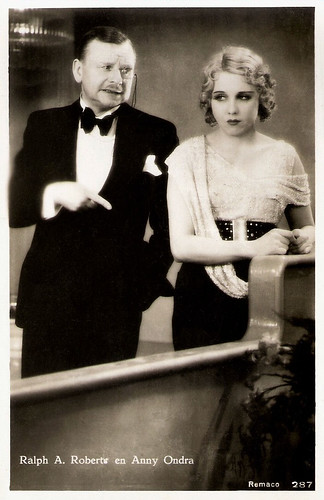
Dutch postcard by JosPe, no. 287. Photo: Remaco. Publicity still for Eine Nacht im Paradies / One Night in Paradise (Carl Lamac, 1932) with Anny Ondra.

German postcard by Ross Verlag, no. 8256/1, 1933-1934. Photo: Ideal-Film, Berlin. Publicity still for Keine Angst vor Liebe / Don't Be Afraid of Love (Hans Steinhoff, 1933) with Liane Haid.
In addition to his stage work, Ralph Arthur Roberts played supporting roles as high-ranking directors and entrepreneurs in numerous films. He started after the First World War at the Hamburg film studio Vera-Filmwerke in films like Der Tod und die Liebe / Death and Love (Paul Otto, 1919) and Erdgift / Natural Poison (Paul Otto, 1919). Roberts gave a convincing performance as the gloomy character in Erdgift.
He appeared in the Thomas Mann adaptation Buddenbrooks (Gerhard Lamprecht, 1923) with Mady Christians and Alfred Abel. However, he was best known for his comedies. He often worked with the Dutch director Jaap Speijer, such as in Elegantes Pack / Elegant Pack (1925) with Eugen Klöpfer and Mary Odette. Very successful were Moral (Willi Wolff, 1928) with Ellen Richter and Der Raub der Sabinerinnen / The Robbery of the Sabine Women (Robert Land, 1928) with Ida Wüst.
In the sound film era, his monocle soon became a permanent asset of his high-class gentleman characters. In 1930 and 1931 he appeared in more than 20 films. Filmportal.de: “All of the performances were linked by Roberts’ eccentric way of acting and his tendency to make every character seem eccentric and quirky in some way.”
He used his comic talent for the doll manufacturer in the operetta Einbrecher / Burglars (Hanns Schwarz, 1930) with Lillian Harvey and Willy Fritsch, the prosecutor in Der Maulkorb / The Muzzle (Erich Engel, 1937) and King Charles X in Tanz auf dem Vulkan / Dance on the Volcano (Hans Steinhoff, 1938). Roberts could not attend the premiere of his last film, Wie konntest Du, Veronika! / How could you, Veronica! (Milo Harbich, 1940) featuring Gusti Huber. Earlier in 1940, Ralph Arthur Roberts had died of an oyster poisoning in Berlin. He was 55.
After the war, he was soon forgotten, but his song 'Auf der Reeperbahn nachts um halb eins' proved to be an evergreen and was used again in the popular film Auf der Reeperbahn nachts um halb eins / Reeperbahn at half past midnight (Wolfgang Liebeneiner, 1954) with Hans Albers and Heinz Rühmann.

Dutch postcard by Remaco, no. 290.
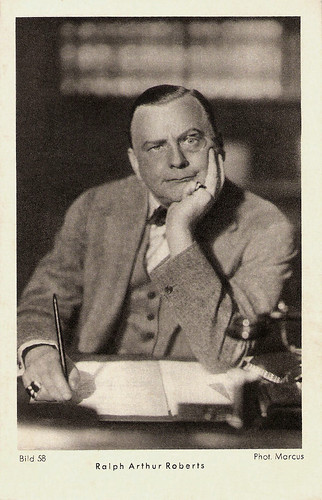
German postcard by Margarinewerk Eidelstedt Gebr. Fauser GmbH, Holstein. Serie 1, Bild 58. Photo: Marcus.

German postcard by Das Programm von Heute / Ross Verlag. Photo: Ufa.
Sources: Hansjoachim Schönherr (Neue Deutsche Biografie - German), Thomas Staedeli (Cyranos), Rudi Polt (Find A Grave), Filmportal.de, Film-Zeit.de (Now defunct), Wikipedia (German and English), and IMDb.
This post was last updated on 16 August 2026.
German postcard by Ross Verlag, no. 5673/1, 1930-1931. Photo: K. Lindner.
German postcard by Ross Verlag, no. 97/3. Photo: Alex Schmoll, Berlin / HPF (Henny Porten-Froehlich Produktion). Henny Porten, Ralph Arthur Roberts, Walter Jankuhn, and Hermann Vallentin in Lotte (Carl Froehlich, 1928).
German postcard by Ross Verlag, no. 8830/1, 1933-1934. Photo: Atelier Zander & Labisch, Berlin.
Unfitting behaviour
Ralph Arthur Roberts was born Robert Arthur Schönherr in Meerane, Germany, in 1884. He was the son of a baker, Carl Robert Schönherr and his wife Berta Elisabeth Schönherr-König. He grew up in Dresden.
There he already worked as an extra at the Albert-Theater during his time at the Realgymnasium. His side job promptly led to his expulsion from school for ‘unfitting’ behaviour, but he decided to follow his passion and to take acting lessons with Adolf Winds at the Theaterakademie and composition lessons with Felix Draeseke at the Dresden Conservatory.
In 1903, Roberts debuted as an actor at the Residenz-Theater Wiesbaden. Guest performances followed at the Trianon-Theater in Berlin and at the Schauspielhaus in Breslau. From 1907 he worked in Hamburg, where he became a member of the Thalia-Theater in 1909.
After war service as an officer, he continued to play at the Thalia Theater, where he also directed. Here he became a popular character comedian in productions of plays like 'Tartüff' (Tartuffe), 'Die Fledermaus' (The Bat), and other comedies.
Furthermore, Roberts directed the revue 'Bunt ist die Welt', for which he wrote the song 'Auf der Reeperbahn nachts um halb eins'. It would become a classic, and in 1954 it was used again in the film with the same name. In 1921 he became director of the Komödienhaus in Berlin, and in 1928 he opened his own theatre, Theater in der Behrenstrasse. Here Roberts presented several boulevard comedies which he had written himself.
German collector card by Ross Verlag in the series Vom Werden Deutscher Filmkunst - Der Stumme Film, picture no. 118, group 39. Photo: Ufa. Henny Porten and Ralph Arthur Roberts in Meine Tante - deine Tante (Carl Froehlich, 1927).
Dutch postcard by JosPe, no. 287. Photo: Remaco. Publicity still for Eine Nacht im Paradies / One Night in Paradise (Carl Lamac, 1932) with Anny Ondra.
German postcard by Ross Verlag, no. 8256/1, 1933-1934. Photo: Ideal-Film, Berlin. Publicity still for Keine Angst vor Liebe / Don't Be Afraid of Love (Hans Steinhoff, 1933) with Liane Haid.
High-class gentleman characters
In addition to his stage work, Ralph Arthur Roberts played supporting roles as high-ranking directors and entrepreneurs in numerous films. He started after the First World War at the Hamburg film studio Vera-Filmwerke in films like Der Tod und die Liebe / Death and Love (Paul Otto, 1919) and Erdgift / Natural Poison (Paul Otto, 1919). Roberts gave a convincing performance as the gloomy character in Erdgift.
He appeared in the Thomas Mann adaptation Buddenbrooks (Gerhard Lamprecht, 1923) with Mady Christians and Alfred Abel. However, he was best known for his comedies. He often worked with the Dutch director Jaap Speijer, such as in Elegantes Pack / Elegant Pack (1925) with Eugen Klöpfer and Mary Odette. Very successful were Moral (Willi Wolff, 1928) with Ellen Richter and Der Raub der Sabinerinnen / The Robbery of the Sabine Women (Robert Land, 1928) with Ida Wüst.
In the sound film era, his monocle soon became a permanent asset of his high-class gentleman characters. In 1930 and 1931 he appeared in more than 20 films. Filmportal.de: “All of the performances were linked by Roberts’ eccentric way of acting and his tendency to make every character seem eccentric and quirky in some way.”
He used his comic talent for the doll manufacturer in the operetta Einbrecher / Burglars (Hanns Schwarz, 1930) with Lillian Harvey and Willy Fritsch, the prosecutor in Der Maulkorb / The Muzzle (Erich Engel, 1937) and King Charles X in Tanz auf dem Vulkan / Dance on the Volcano (Hans Steinhoff, 1938). Roberts could not attend the premiere of his last film, Wie konntest Du, Veronika! / How could you, Veronica! (Milo Harbich, 1940) featuring Gusti Huber. Earlier in 1940, Ralph Arthur Roberts had died of an oyster poisoning in Berlin. He was 55.
After the war, he was soon forgotten, but his song 'Auf der Reeperbahn nachts um halb eins' proved to be an evergreen and was used again in the popular film Auf der Reeperbahn nachts um halb eins / Reeperbahn at half past midnight (Wolfgang Liebeneiner, 1954) with Hans Albers and Heinz Rühmann.
Dutch postcard by Remaco, no. 290.
German postcard by Margarinewerk Eidelstedt Gebr. Fauser GmbH, Holstein. Serie 1, Bild 58. Photo: Marcus.
German postcard by Das Programm von Heute / Ross Verlag. Photo: Ufa.
Sources: Hansjoachim Schönherr (Neue Deutsche Biografie - German), Thomas Staedeli (Cyranos), Rudi Polt (Find A Grave), Filmportal.de, Film-Zeit.de (Now defunct), Wikipedia (German and English), and IMDb.
This post was last updated on 16 August 2026.

No comments:
Post a Comment