30 November 2014

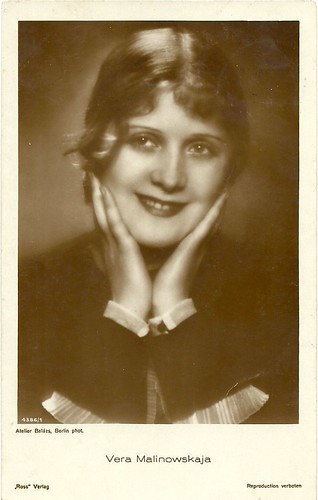
Vera Malinovskaya

Vera Malinovskaya (1900-1988) played in several Soviet films of the 1920s. Later, she also starred in a few silent films in Germany and Austria.

Vera Malinowskaja
German postcard by Ross Verlag, no. 4386/1, 1929-1930. Photo: Atelier Balázs, Berlin. Collection: Didier Hanson.

A kiss from Mary Pickford


Vera Stepanovna Malinovskaya, also written as Malinowskaya, Malinovskaja or Malinovskaia, was born in Kiev, Russian Empire (now Ukraine), in 1900. As a girl, she was trained as a ballet dancer by the great Olga Preobrazenskaya.

Malinovskaya made her film debut in Vsem na radost'/To Everyone for Luck (Aleksandr Anoshchenko, 1924). From 1925 on, she had leading roles in films by the Mezhrabpom film company, often playing innocent girls.

In 1925, she played Dunia opposite Ivan Moskvin in Kollezhskiy registrator/The Station Master (Ivan Moskvin, Yuri Zhelyabuzhsky, 1925), scripted by Fyodor Otsep (Fedor Ozep), after a novel by Alexander Pushkin. An ageing village station master (Moskvin) leaves his post to trudge through the snow after his daughter Dunia (Malinovskaya), who is seduced and abducted by an aristocratic army officer. When he finally finds her after many hardships, he dies of heart failure.

Mary Pickford, who visited the Soviet Union with Douglas Fairbanks in 1926, later recalled she was impressed by Malinovskaya's performance in The Station Master. She also described meeting Malinovskaya: "In Russia, I met a charming young, Russian 'star' - a tall girl with fair hair. She played the principal role in the best movie I saw there - The Station Keeper. By the way, this 'star' was among those who met us in Minsk. She wore a plain chiffon dress that looked as if it were four years old, but was neatly mended and washed. Probably with the assistance of Douglas and me, she will come to America."

It never happened. Footage of Pickford kissing a local actor was used - unknown to Pickford and Fairbanks - to make the comedy Potseluy Meri Pikford/A Kiss from Mary Pickford (Sergei Komarov, 1927), in which Malinovskaya played a part too.

Douglas Fairbanks and Mary Pickford
Douglas Fairbanks and Mary Pickford on a European tour. British postcard.

Vera Malinovskaya
Russian postcard.

Melodramas and historical horror


In 1925, Vera Malinovskaya played in the historical horror film Medvezhya svadba/The Marriage of the Bear (Konstantin Eggert, Vladimir Gardin, 1925), based on a play by Anatoli Lunacharsky. Konstantin Eggert specialised in melodramatic films, and Malinovskaya also appeared in his Chuzhaya/Someone Else (Konstantin Eggert, 1927), starring Peter Baksheev.

Malinovskaya had the female lead in Chelovek iz restorana/The Man from the Restaurant (Yakov Protazanov, 1927). Her male counterpart was the famous stage actor Michael Chekhov, a nephew of writer Anton Chekhov. He plays an older waiter who silently witnesses and endures the fattening rich and war profiteers, while his son is killed in the war, and his wife dies as well. His chance comes when he saves his innocent daughter (Malinovskaya) from the clutches of a fat factory owner.

Peter Bagrov at KinoKultura lists a title that IMDb ignores: Takaya zhenshchina/Such a woman (Konstantin Eggert, 1927). In this melodrama, Malinovskaya had a smaller part as the peasant wife of a soldier who had previously been cheated by his aristocratic first wife.

Next followed another Eggert melodrama, Ledyanoy dom/Ice House (Konstantin Eggert, 1928), with Peter Baksheev again in the lead and based on a story by Ivan Lazjechnikov. The film is set in the 18th century: a gypsy girl is brought to the Russian court. There, a prince falls in love with her, but the envious heiress of the throne tries to poison her.

Malinovskaya's last film in the Soviet Union was Khromoy barin/The Lame Gentleman (Konstantin Eggert, 1928), based on a story by Aleksey Tolstoy, not to be confused with the famous novelist.
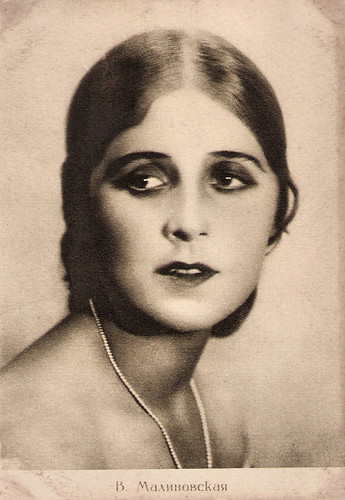
Vera Malinowskaja
Russian postcard by Roznak, Moscow, series no. 4, no. A 2400, 1927. Published in an edition of 25,000 cards.
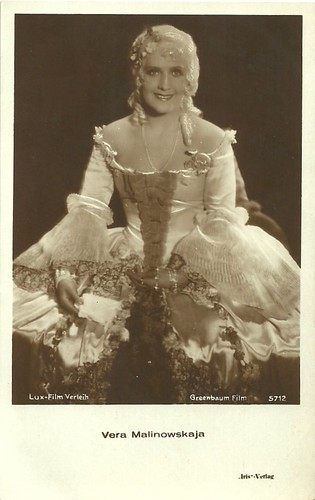
Vera Malinowskaja
Austrian postcard by Iris Verlag, no. 5712. Photo: Lux-Film-Verleih / Greenbaum-Film.

Desperate about the low wages despite her success


In 1928, Vera Malinovskaya, desperate about the low wages despite her success, emigrated to Western Europe to play in Austrian and German historical films of the late silent era.

In Berlin, she played in the Aco-Film production Der Zigeunerprimas/Sari and The Gypsy Virtuoso (Carl Wilhelm, 1928), in which she played gypsy king Racz Pali's (Raimondo van Riel) daughter Sari.

She also went to Vienna, where she played in the Sascha production Kaiserjäger (Hans Otto, 1928), opposite Mary Kid, Igo Sym and Werner Pittschau. Also in 1928, she moved to Munich to play Countess Tarnowska in the Emelka production Waterloo (Karl Grune, 1928), conceiving history from the Prussian perspective and starring Otto Gebühr as General Blücher.

Her last role was in the Greenbaum production Der Günstling von Schönbrunn/Favourite of Schonbrunn (Erich Waschneck, Max Reichmann, 1929), based on a story by Ladislaus Vajda. This historical comedy starred Lil Dagover as Empress Theresia and Iván Petrovich as Oberst Trenck; Malinovskaya was the empress' rival Countess Nostiz.

After Der Günstling von Schönbrunn, Malinovskaya stopped playing in films. The reason was probably the arrival of the sound cinema. Reportedly, she lived in Italy for a while, but according to the filmographies of Vittorio Martinelli and IMDb, she did not perform in a film there. Vera Malinovskaya died in Monaco in 1988. She was 88.

Vera Malinowskaja, Ivan Petrovich
Austrian postcard by Iris Verlag, no. 5784. Photo: Lux Film. Still for Der Günstling von Schönbrunn/Favorite of Schonbrunn (1929) with Iván Petrovich.

Sources: Peter Bagrov (Kino Kultura), Hal Erickson (AllMovie - Page now defunct), Sergei Bertensson (In Hollywood with Nemirovich-Danchenko, 1926-1927) and IMDb.

This post was last updated on 22 April 2025.

29 November 2014

Il carnevale di Venezia (1928)

Today's film special is about the Italian silent melodrama Il carnevale di Venezia/The Carnival of Venice (Mario Almirante, 1928). Star was the diva Maria Jacobini. Her co-star was the British actor Malcolm Tod. The melodrama was a great success, but nationalists took the film out of circulation.

Maria Jacobini
German postcard by Ross Verlag, no. 3953/1, 1928-1929. Photo: Terra-Film. Maria Jacobini in the Italian late silent film Il carnevale di Venezia/The Carnival of Venice (Mario Almirante 1928), a Stefano Pittaluga production. Terra-Film was the German distributor.
Maria Jacobini
German postcard by Ross Verlag, no. 3955/2, 1928-1929. Photo: Terra-Film. Maria Jacobini in the Italian late silent film Il carnevale di Venezia/ Carnival in Venice (Mario Almirante 1928).

Maria Jacobini in Carnevale di Venezia (1927)
Italian postcard. by Ed. G.B. Falci, Milano, no. 87. Photo: S.A. Stefano Pittaluga. Maria Jacobini in the late silent film Il carnevale di Venezia/The Carnival of Venice (Mario Almirante, 1927).

Maria Jacobini and Josyane in Il carnevale di Venezia
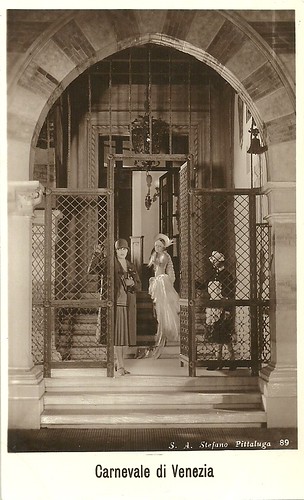
Italian postcard by Ed. G.B. Falci, Milano, no. 89. Photo: S.A. Stefano Pittaluga. Maria Jacobini and Josyane in the late silent film Il carnevale di Venezia (Mario Almirante, 1928).

Malcolm Tod in Il carnevale di Venezia
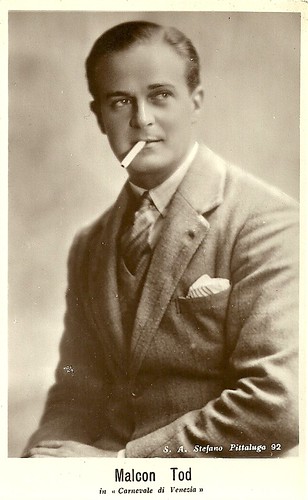
Italian postcard by Ed. G.B. Falci, Milano, no. 92. Photo: S.A. Stefano Pittaluga. Malcolm Tod in Il carnevale di Venezia (Mario Almirante, 1928).

Cheated by a ruthless, game addicted and vengeful lover


In Il carnevale di Venezia/The Carnival of Venice (Mario Almirante, 1928) the young and rich American Jefferson (Malcolm Tod) buys at an auction the ancient residence of the financially struggling Venetian nobleman, Duca (Duke) Morosin (Bonaventura Ibanez). Gabriella (Maria Jacobini), who as a child had been told about the sumptuous palace by her mother, attends the auction.

On the occasion she casually meets Germaine (Josyane), who is trying to get Jefferson to marry her, and the two young women become friends. Shortly afterwards Gabriella becomes engaged to Giorgio (Manlio Mannozzi), but he later leaves her for Aix-les-Bains. Germaine also leaves for the spa resort, again following Jefferson. She is accompanied by Gabriella, who discovers Giorgio's gambling habit. He is ruthless and vengeful. In tears, she is comforted by Jefferson who does not know her identity.

Germaine hosts the desperate Gabriella. Thus Jefferson meets again the stranger he had seen in tears. He first hires her as an assistant and then falls in love with her. Having all returned to Venice, chance has it that during Carnival, Duke Morosin recognises in Gabriella the fruit of a youthful love affair of his late son that he had opposed. Repentant, he welcomes the girl into the family and Gabriella, now Duchess Morosin, can marry Jefferson. The noble palace is also saved.

The story of Il carnevale di Venezia/The Carnival of Venice was written by Michel Linsky and Pier Angelo Mazzolotti. The film's sets were designed by the art director Giulio Lombardozzi. Il Carnevale di Venezia was one of the six films made for the 1927-1928 film season by Stefano Pittaluga's Turin-based company S.A.S.P., which at the time remained the most important Italian film production company after the profound crisis that had affected this sector in the post-war period.

The film was a success with Italian audiences when it was released in early February 1928, partly because of the scarcely clad bathers at the Lido in the film. Despite this success, nationalist Italian critics didn't like the fact that the villain was Italian and the hero American. So the film was taken from circulation and when Il carnevale di Venezia/The Carnival of Venice (1928) was re-released the roles were reversed. The American hero had become an Italian named Albani and the villain a foreigner with an English name.

Maria Jacobini and Malcolm Tod in Il carnevale di Venezia
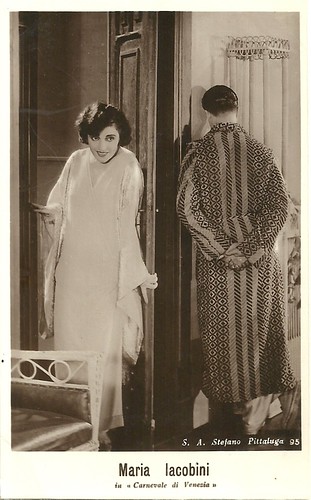
Italian postcard by Ed. G.B. Falci, Milano, no. 95. Photo: S.A. Stefano Pittaluga. Maria Jacobini and Malcolm Tod in Il carnevale di Venezia (Mario Almirante, 1928).

Josyane in Il carnevale di Venezia
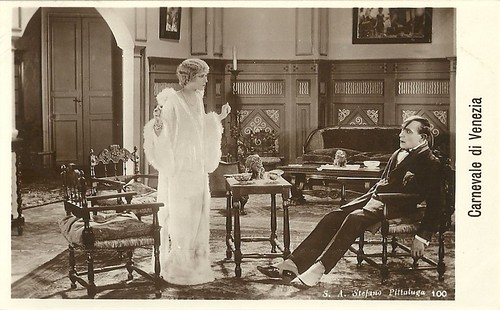
Italian postcard by Ed. G.B. Falci, Milano, no. 100. Photo: S.A. Stefano Pittaluga. Josyane in Il carnevale di Venezia (Mario Almirante, 1928).

Carnevale di Venezia (1928)
Italian postcard by Ed. G. B. Falci, Milano, no. 101. Photo: S.A. Stefano Pittaluga. Scene from Carnevale di Venezia (Mario Almirante, 1928).

Maria Jacobini and Malcolm Tod in Il carnevale di Venezia
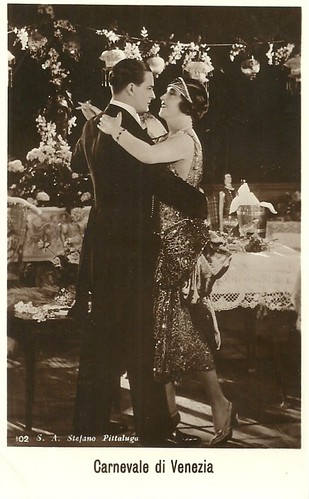
Italian postcard by Ed. G.B. Falci, Milano, no. 102. Photo: S.A. Stefano Pittaluga. Maria Jacobini and Malcolm Tod in Il carnevale di Venezia (Mario Almirante, 1928).

Who was Josyane?


Leading lady of Il carnevale di Venezia/The Carnival of Venice (1928) was Maria Jacobini, who had come back from Germany for this film. Among the Italian divas, she was an 'island of serenity', as film historian Vittorio Martinelli expressed it. She was the personification of goodness, of simple love. Her weapon was her sweet and gracious smile.

Confident of an international distribution, Pittaluga gave some other roles to foreign actors and actresses known at the time. The American Jefferson was played by Malcolm Tod (1897-?), a British actor who was a star of European silent cinema of the 1920s. Germaine was played by Josyane, but who was she?

Josyane, a.k.a. Josyane Andrei, was born as Marcelle Joséphine Renée Marguerite Leroux in Granville, Manche, Basse-Normandie. The French actress made her film debut as the leading lady in L'aube du sang/The Dawn of Blood (Giuseppe Guarino, 1924) opposite Edmond van Daële. She became a star of the French cinema of the 1920s and early 1930s and acted in 14 films.

She played the title role in Le mariage de Rosine/Rosine's Wedding (Pierre Colombier, 1925) and acted in La course du flambeau/The Torch Race (Luitz Morat, 1925). Her final French film was the comedy Coiffeur pour dames/Ladies Hairdresser (René Guissart, 1932), starring a young Fernand Gravey. In Belgium, she later appeared in the sound comedy Gardons notre sourire/Let's keep smiling (Gaston Schoukens, 1939), according to IMDb. Josyane died in 1999 in Boulogne-Billancourt, Hauts-de-Seine, Île-de-France, France. She was 97.

Il carnevale di Venezia was Josyane's sole Italian film. She played the second female role, Germaine Normand. Sadly, Il Carnevale di Venezia (Mario Almirante, 1928) is considered a lost film. Only the ‘trailer’ is now available and can be seen at the Cineteca Nazionale.

Josyanne in Il carnevale di Venezia
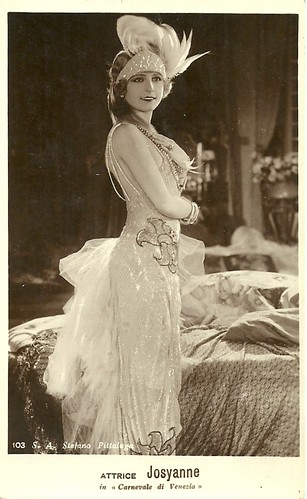
Italian postcard by Ed. G.B. Falci, Milano, no. 103. Photo: S.A. Stefano Pittaluga. Josyane in Il carnevale di Venezia (Mario Almirante, 1928).

Josyane in Carnevale di Venezia (1928)
Italian postcard by Ed. G. B. Falci, Milano, no. 105. Photo: S.A. Stefano Pittaluga. Josyane in Carnevale di Venezia (Mario Almirante, 1928).

Maria Jacobini and Malcolm Tod in Il carnevale di Venezia
Italian postcard by Ed. G.B. Falci, Milano, no. 106. Photo: S.A. Stefano Pittaluga. Maria Jacobini and Malcolm Tod in Il carnevale di Venezia (Mario Almirante, 1928).

Maria Jacobini and Malcolm Tod in Il carnevale di Venezia
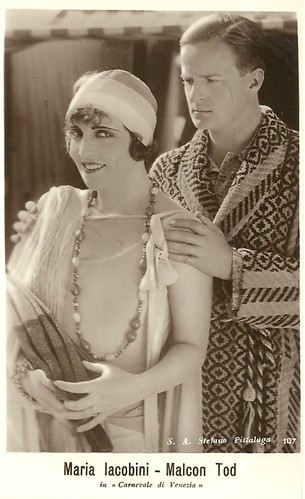
Italian postcard by Ed. G.B. Falci, Milano, no. 107. Photo: S.A. Stefano Pittaluga. Maria Jacobini and Malcolm Tod in Il carnevale di Venezia (Mario Almirante, 1928).

Sources: Vittorio Martinelli (Il cinema muto italiano: I film degli anni venti, 1921 - Italian), Wikipedia (English and Italian) and IMDb.

This post was last updated on 27 May 2024.

28 November 2014

Annemarie Düringer (1925-2014)

Swiss character actress Annemarie Düringer passed away on 26 November 2014. She starred in several German war dramas and comedies of the 1950s, and also worked with directors like Claude Goretta and Rainer Werner Fassbinder during the 1970s and 1980s. She was 89.

Annemarie Düringer (1925-2014)
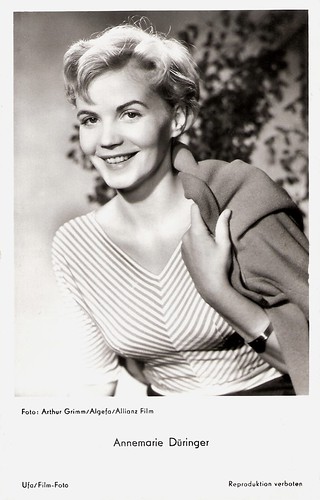
German postcard by Ufa, no. FK 1708. Photo: Arthur Grimm / Algefa / Allianz-Film.

Numerous awards


Annemarie Düringer was born in Arlesheim, Basel-Landschaft in 1925. In 1946, she graduated from the Cours Simon in Paris and the following year, she graduated from the Max Reinhardt Seminar in Vienna.
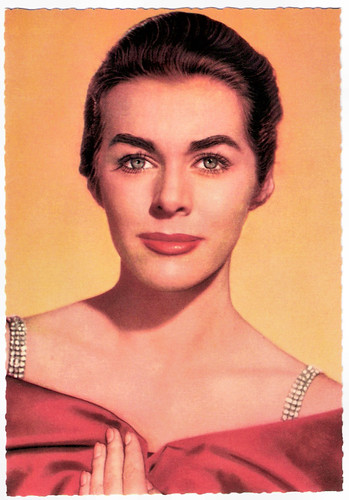
Her film debut, she made as the star in the romantic comedy Der Feldherrnhügel (Ernst Marischka, 1953) with Adrienne Gessner as her mother and Hans Holt as her handsome lieutenant.

In 1955, she starred opposite Wolfgang Preiss in Der 20. Juli/The Plot to Assassinate Hitler (Falk Harnack, 1955). It was followed by the British war drama Count Five and Die (Victor Vicas, 1957). She also played in the Heinz Rühmann comedy Der Lügner/The Liar (Ladislao Vajda, 1961).

Annemarie Düringer's later films include the Swiss crime drama Schatten der Engel/Shadow of Angels (Daniel Schmid, 1976), the French drama La Dentellière/The Lacemaker (Claude Goretta, 1977) as the mother of Pomme, played by Isabelle Huppert, and Rainer Werner Fassbinder's Sehnsucht der Veronika Voss/Veronika Voss (1982) in which she played a sinister doctor who addicts a former Ufa star (Rosa Zech) to morphine in order to gain control of the actress's money and property.

Düringer also appeared in Fassbinder's monumental TV series Berlin Alexanderplatz (Rainer Werner Fassbinder, 1980) starring Günther Lamprecht. Decades later she played the mother of Austrian artist Gustav Klimt (John Malkovich) in Klimt (Raúl Ruiz, 2006) and a nun in Vision (Margarethe von Trotta, 2009), a screen biography of 12th century Renaissance woman Hildegard von Bingen (Barbara Sukowa).

She received numerous awards, including the Decoration for Services to the Republic of Austria. Her final film was Lovely Louise (Bettina Oberli, 2013) in which she played an elderly diva who lives together with her taxi driver son (Stefan Kurt).

On 26 November 2014, Annemarie Düringer died on her 89th birthday at Baden bei Wien, Lower Austria.

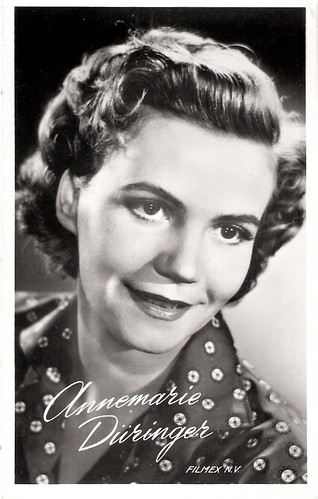
Annemarie Düringer (1925-2014)
Dutch postcard by Uitgeverij Takken, Utrecht, no. 1992. Photo: Filmex N.V.

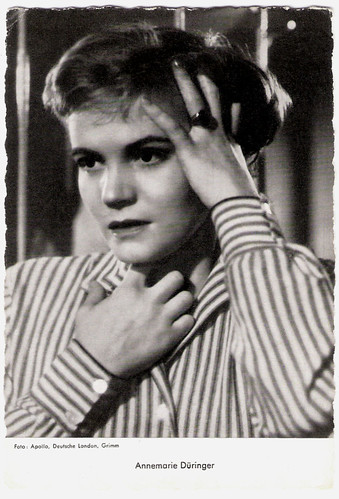
Annemarie Düringer (1925-2014)
German postcard by WS-Drück, Wanne-Eickel. Photo: Apollo / Deutsche London / Grimm.

Source: AllMovie, Wikipedia and IMDb.

26 November 2014

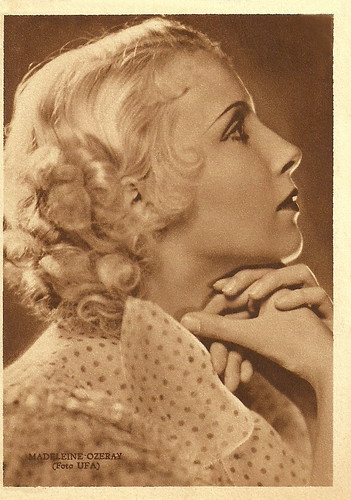
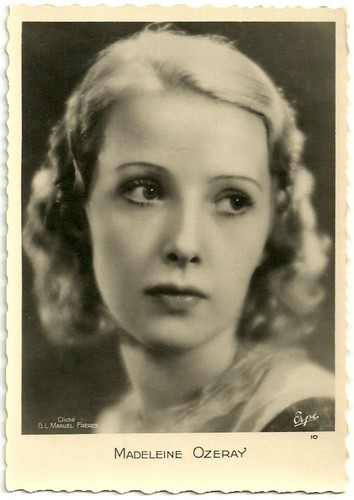
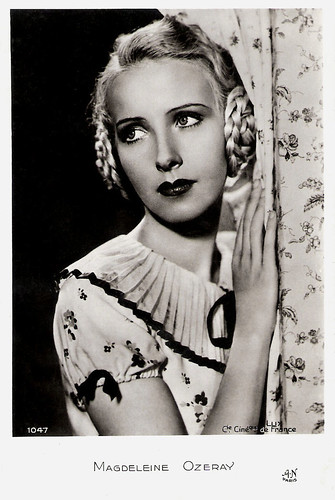
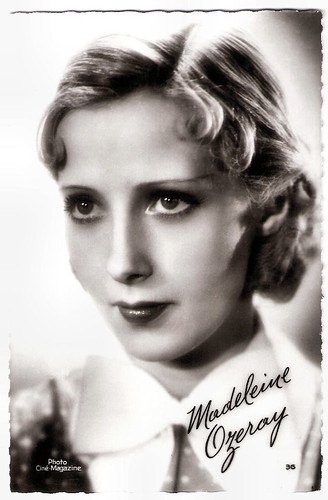
Madeleine Ozeray

Franco-Belgian stage and film actress Madeleine Ozeray (1908-1989) appeared in many films between 1932 and 1980.

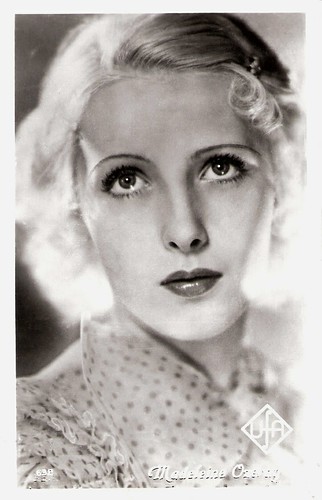
Madeleine Ozeray
French postcard by Editions Chantal, no. 632. Photo: Ufa.

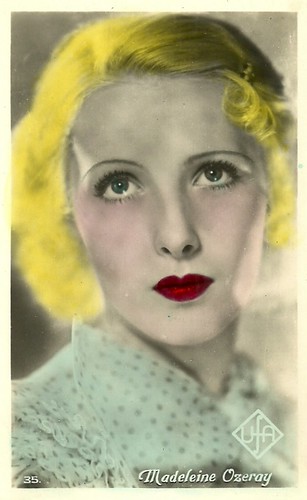
Madeleine Ozeray
French postcard, no. 35. Photo: Ufa.
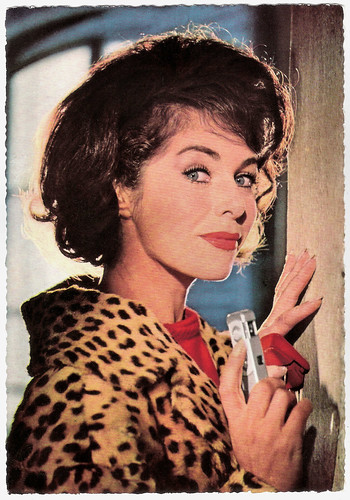
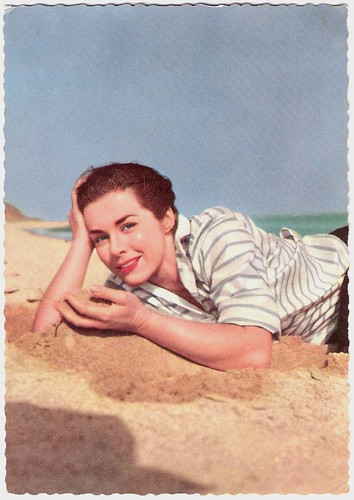
Louis Jouvet's muse


Magdeleine Marie Catherine Elisabeth Ozeray was born in Bouillon-sur-Semois in Wallonia in 1908 (some sources say 1905). Her parents were Camille Ozeray, a lawyer and Liberal member of the province of Luxembourg, and Marie Deymann. She studied at the Royal Conservatory of Brussels, where she won first prize for comedy. She joined the cast of the Brussels Theatre Marais, directed by Raymond Rouleau, and made her stage debut in April 1931 in 'The Evil of Youth' by Ferdinand Bruckner. Madeleine Ozeray and Raymond Rouleau fell in love. The play was a great success and was presented a few months later in Paris.

Her film debut was a small part in the British French-language comedy La dame de chez Maxim's / The Girl from Maxim's (Alexander Korda, 1932) starring Florelle. It was the French-language version of The Girl from Maxim's (1932) made by London Film Productions. Both films were directed by Korda and were based on the farce 'La Dame de chez Maxim' (1899) by Georges Feydeau.

She met the famous actor-director Louis Jouvet, who offered her the role of Mariette in his film adaptation of the play 'Knock' (1933) by Jules Romains. Soon, the two became lovers, and Madeleine left Raymond Rouleau. For the next ten years, she would be Jouvet’s muse and official mistress. She played the female lead of Rosalie in the romantic crime drama Dans les rues / In the Streets (Victor Trivas, 1933) opposite Jean-Pierre Aumont.

She also appeared in the fantasy Liliom (Fritz Lang, 1934), based on the Hungarian stage play of the same name by Ferenc Molnár. The film stars Charles Boyer as Liliom, a carousel barker who is fired from his job after defending the chambermaid Julie (Madeleine Ozeray) from the jealousy of Mme. Muscat, the carousel owner, is infatuated with Liliom. Liliom was one of the first French productions by producer Erich Pommer for Fox-Europa and director Fritz Lang's only French film.

Ozeray also worked on stage and was part of Charles Boyer's stage company. At twenty-seven, she joined the theatre company of Louis Jouvet, where she played the role of Helen in 'The Trojan War Will Not Take Place' by Jean Giraudoux at the Théâtre de l'Athénée. In 1939, she appeared opposite Jouvet in the film La Fin du jour / The End of the day (Julien Duvivier, 1938), in the role of young Jeannette. She played her role with a characteristic delicate grace, both fragile and fierce. In April 1939, Jean Giraudoux's play 'Ondine' opened at the Théâtre de l'Athénée in Paris with Ozeray in the title role. Louis Jouvet was once again the director and her co-star.

Madeleine Ozeray
Italian postcard by Ricordi RC, Milano, no. XVIII, 1940. Photo: Ufa.

Madeleine Ozeray
French postcard by Erpé, no. 10. Photo: G.L. Manuel Frères.

Philippe Noiret’s mother


During the war, Madeleine Ozeray refused to work under the Nazis who occupied France, and she joined Louis Jouvet on a Latin-American tour, where they performed in plays by Molière, Jean Giraudoux, Alfred de Musset and Jules Romains. In 1943 in Chile, she left Jouvet for the conductor Cesar Mendoza. After the war, her film career halted.

In the 1970s, she returned to the screen. First, she appeared on television in episodes of such series as Le tribunal de l'impossible / The Court of the Impossible (Pierre Badel, 1970) and Tang (André Michel, 1971). Later followed roles in films like the crime drama Les Anges / The Angels (Jean Desvilles, 1973) and the drama La race des 'seigneurs' / Creezy (Pierre Granier-Deferre, 1974) starring Alain Delon.

Ozeray played Philippe Noiret’s mother in the war drama Le vieux fusil / The Old Gun (Robert Enrico, 1975) with Romy Schneider.

Another interesting film was Chère inconnue / I Sent a Letter to My Love (Moshe Mizrahi, 1980), starring Simone Signoret and Jean Rochefort. Her final screen appearance was in the series Les dossiers éclatés / The Broken Records (1980).

In 1989, Madeleine Ozeray died in Paris at the age of 80 after a long battle with Alzheimer’s disease (some sources say cancer). She is buried in the cemetery of her hometown of Bouillon. She was the godmother of the theatre actor, dancer and singer Frédéric Norbert. In 2008, in celebration of the centenary of her birth, Belgian journalist Dominique Zachary devoted an entire book, now the standard reference work, tracing the life and career of this celebrated actress.

Madeleine Ozeray
French postcard by A.N., Paris, no. 1047. Photo: Lux / Cie. Ciné de France.

Madeleine Ozeray
French postcard by Editions et Publications Cinematographiques, no. 36. Photo: Ciné-Magazine.

Sources: Pascal Donald (CineArtistes – Now defunct), Cinememorial (French), Wikipedia (French and English) and IMDb.

This post was last updated on 25 January 2026.

25 November 2014

Jack Hulbert

British actor Jack Hulbert (1892-1978) was a popular comedian of the 1930s with a trademark chiselled chin. In his musicals, he often appeared with his wife Cicely Courtneidge.

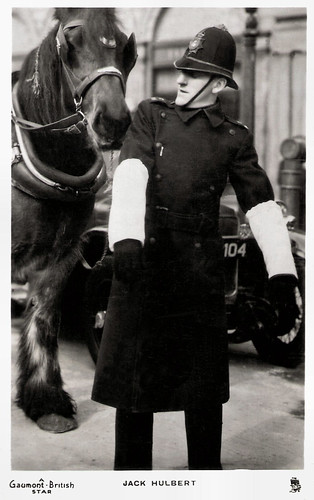
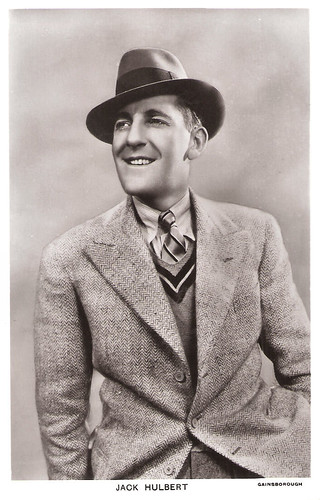
Jack Hulbert
British postcard by Raphael Tuck & Sons 'Real Photograph', no. 15. Photo: Gaumont-British.

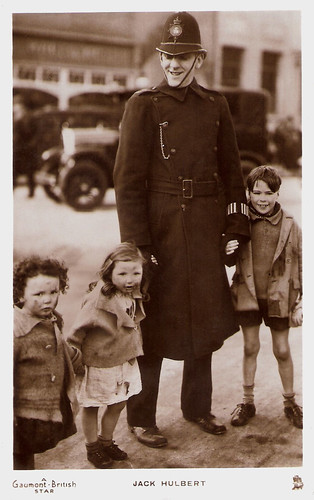
Jack Hulbert
British postcard by Raphael Tuck & Sons 'Real Photograph', no. 16-8. Photo: Gaumont-British.

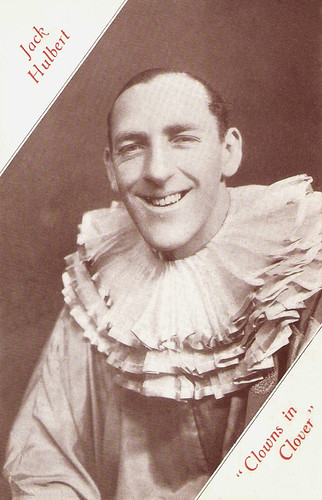
Jack Hulbert
British postcard by Henry Good & Son. Promotion card for the stage musical 'Clowns in Clover' (1927) at the Adelphi Theatre in London.

Famous alumni of the Comedy Club


John Norman ‘Jack’ Hulbert was born in Ely, Cambridgeshire, in 1892. He was the elder and more successful brother of Claude Hulbert.

Jack was educated at Cambridge and appeared in many shows and revues, mainly with the Cambridge Footlights. He was one of the earliest famous alumni of the comedy club.

After Cambridge, he earned recognition and fame performing in musicals and light comedies. He made his film debut in Elstree Calling (André Charlot, Jack Hulbert, Paul Murray, ánd Alfred Hitchcock (who directed some sketches), 1930), appearing opposite his wife and frequent stage and screen co-star Cicely Courtneidge whom he had married in 1916.

His career went through a successful period during the 1930s when he appeared in several films including The Ghost Train (Walter Forde, 1931) with Cicely Courtneidge, Love on Wheels (Victor Saville, 1932) with Edmund Gwenn, and Bulldog Jack (Walter Forde, 1935), a tongue-in-cheek homage to the popular Bulldog Drummond films in which Jack was supported by his brother Claude and King Kong’s mate Fay Wray.

He also wrote and directed some films such as Falling for You (Jack Hulbert, Robert Stevenson, 1933) with Cicely Courtneidge and Tamara Desni, the daughter of silent star Xenia Desni.

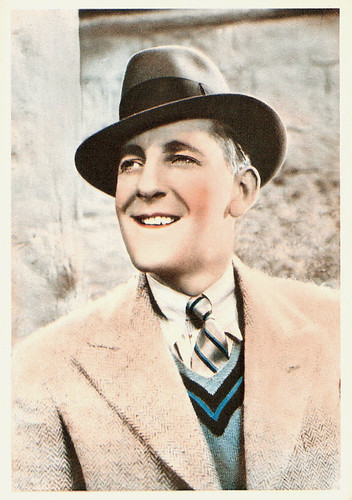
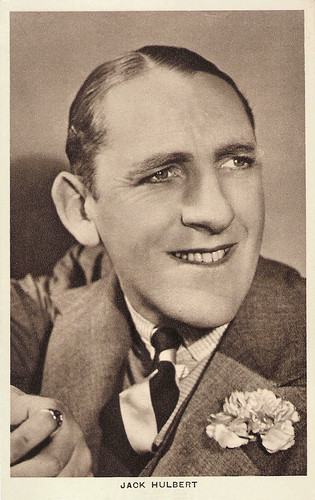
Jack Hulbert
British collectors card by De Reszke Cigarettes, no. 30. Photo: Gaumont-British.

Jack Hulbert
British postcard in the Picturegoer Series, London, no. 782. Photo: Gainsborough.

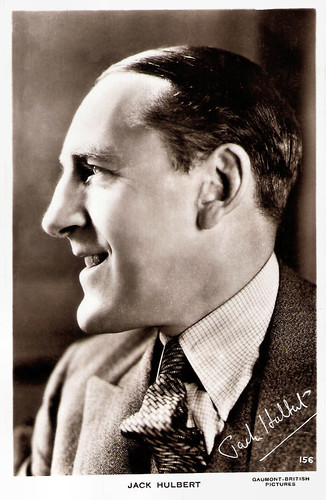
Jack Hulbert
British postcard by Real Photograph, no. 156. Photo: Gaumont-British Pictures.

Jack Hulbert
British card.

The little woman's always right


Jack Hulbert's popularity waned as the 1930s came to an end. Some of his later films were Jack of All Trades (Jack Hulbert, Robert Stevenson, 1936) and Paradise for Two (Thornton Freeland, 1938) with Patricia Ellis and Googie Withers. During the 1940s, he was a Commandant in the Metropolitan Special Constabulary, stationed at Vine Street police station in London's West End.

After the war, he and his wife continued to entertain chiefly on stage. Among his later films were Into the Blue (Herbert Wilcox, 1950) starring Michael Wilding, and the crime film Miss Tulip Stays the Night (Leslie Arliss, 1955) starring Diana Dors.

On TV he was seen in episodes of Kraft Mystery Theater (1961), Compact (1964), Theatre 625 (1968), and Father Dear Father (1972). In 1962 he, along with his wife, Cicely Courtneidge, plus Vic Oliver, appeared in the BBC radio sitcom 'Discord in Three Flats' His final film was The Cherry Picker (Peter Curran, 1974) starring Lulu.

In 1975, Hulbert's autobiography, 'The Little Woman's Always Right', was published. His marriage to Cicely Courtneidge lasted for 62 years until his death. Their relationship is mentioned in the British television series Dad's Army in the episode Ring Dem Bells when Hulbert pulls out of shooting a Home Guard training film to spend time with his wife.

Jack Hulbert died, aged 85, at his home in Westminster, London, in 1978.

Jack Hulbert, Cicely Courtneidge
With Cicely Courtneidge. British postcard in the Rotary Photographic Series, no. 11673 A. Photo: Foulsham & Banfield.

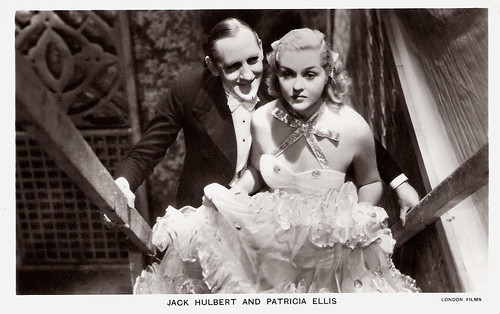
Jack Hulbert and Patricia Ellis in Paradise for Two
British postcard in the Film Partners Series, London, no. P 241. Photo: London Films. Publicity still for Paradise for Two/Gaiety Girls (Thornton Freeland, 1937) with Jack Hulbert and Patricia Ellis.

Jack Hulbert and Cicely Courtneidge in Jack's the Boy (1932)
With Cicely Courtneidge. British postcard in the Film Partners Series, no. P 42. Photo: Gainsborough Pictures.

Sources: Wikipedia, and IMDb.

This post was last updated on 31 October 2024.

23 November 2014

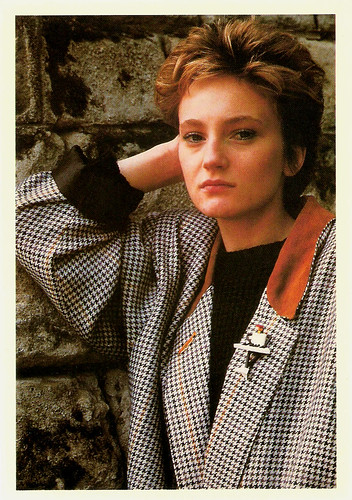
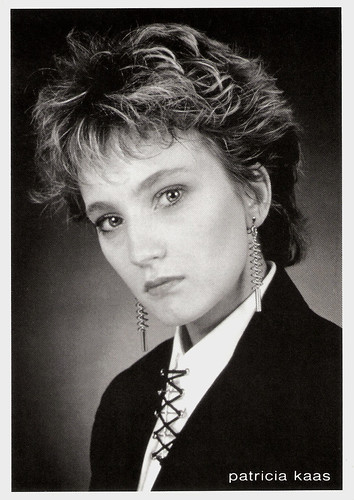
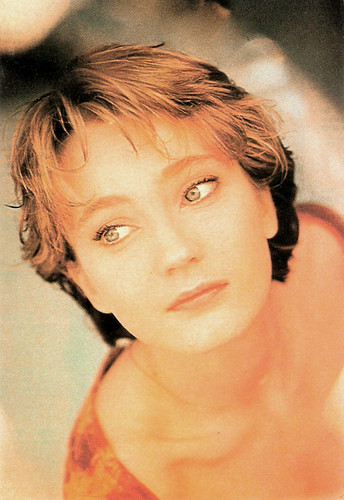
Patricia Kaas

Patricia Kaas (1966) is one of France's most successful singers with an International following. Her music updates the French chanson tradition with elements of pop, blues and jazz. In 2009, Kaas represented France in the Eurovision Song Contest 2009 in Moscow. Occasionally, she also acts in film and on TV, but with mixed success.

Patricia Kaas
British postcard by New Line, no. 115.

Throaty, smoky voice


Patricia Kaas was born in Forbach, France, in 1966, near the border of Germany. She was the youngest of seven children of miner Joseph Kaas and his wife Irmgard Kaas. Her father was a French Germanophone citizen, and her mother was a West German citizen from Saar. Until the age of six Patricia spoke only Lorraine Franconian. Her mother encouraged Kaas to become a singer at a very young age. At the age of eight Kaas already sang at various small events; among others the marriage of her brother.

Her first great success came when she received first place in a pop song contest. At her first appearances, Kaas was already displaying the throaty, smoky voice that would lead to comparisons with Édith Piaf and Marlene Dietrich. Kaas took her first step into the professional music business at the age of 13, when, with the help of her brother Egon, she signed a contract with the Saarbrücken Club Rumpelkammer. Kaas took the name Pady Pax, after the brass band Pax Majorettes, of which she and her sister Carine were members, and for seven years appeared with the band Dob's Lady Killers.

At 16 she took a placement with a model agency in Metz. Kaas' first attempts to break into the music business once and for all initially failed, however; a producer rejected her on the grounds that the world did not need a second Mireille Mathieu. Architect Bernard Schwartz introduced the 19-years-old to the songwriter François Bernheim who worked with her and convinced Gérard Depardieu to produce her music. In 1985, Depardieu produced Kaas' first single 'Jalouse' (Jealous), written by Bernheim and Depardieu's wife Elisabeth. The single was published by EMI, but was a flop. Nonetheless, her encounter with Depardieu was an important event at the beginning of Kaas' artistic career.

French songwriter Didier Barbelivien became aware of Kaas. His song 'Mademoiselle chante le blues' (Lady Sings the Blues) was the singer's first big hit. The single was published in 1987 by Polydor and reached 7th place in the French singles chart. The next year Kaas' second single 'D'Allemagne' (From Germany) was recorded, written by Barbelivien and Bernheim. Shortly afterwards Kaas' first album 'Mademoiselle chante...' was produced. It reached 2nd place in the French album charts and stayed there for two months, remaining in the Top 10 for 64 weeks and 118 weeks in the top 100. Shortly after its appearance, the album went gold in France (over 100,000 sold) and after three months it went platinum (over 350,000 sold). The album also went platinum in Belgium and Switzerland, and gold in Canada.

In the same year, Kaas won one of the most important French music awards, the Victoires de la Musique in the category of Discovery of the Year. In 1989, Kaas suffered a traumatic personal experience when her mother fell ill from cancer and died. The teddy bear Kaas sent to support her mother's convalescence today accompanies Kaas everywhere as a mascot.

Patricia Kaas
French postcard, no. 134.

I address thee as you


In 1990, Patricia Kaas began her first world tour which lasted 16 months in total. She sang in front of about 750,000 fans in over 196 concerts in 12 countries. Kaas sang daily for a week at the Olympia in Paris and gave successful concerts in New York and Washington D.C. At the end of the tour, 'Mademoiselle chante...' had sold 1 million copies in France alone. In 1990, Kaas moved from her former record company Polydor to CBS/Sony. Cyril Prieur and Richard Walter of the firm Talent Sorcier from Paris replaced Bernard Schwartz to become her managers in 1987. Prieur and Walter contributed significantly to the singer's success, in return for which Kaas referred to them as her ‘family’.

She produced 'Scène de vie' (The Stage of Life) in 1990. It reached the top of the French charts and stayed there for 10 weeks. With the song Kennedy Rose, Kaas again worked with Elisabeth Depardieu and François Bernheim. The song was dedicated to Rose Kennedy, matriarch of the Kennedy clan and mother of former U.S. president John F. Kennedy. While on the Scène de vie tour, the singer performed 210 concerts before 650,000 spectators in 13 countries, among them Japan, Canada and the USSR, where she sang in Moscow and Leningrad. At the end of 1991, her first live album 'Carnets de scène' (Stage Notebooks) appeared.

Kaas' 1993 album 'Je te dis vous' (I address thee as you, also named 'Tour de Charme') was her definitive breakthrough in the international music scene, selling 3 million copies in 47 countries. It was produced in Pete Townshend's Eel Pie Studio in London, England by Robin Millar, who had already worked for Sade and the Fine Young Cannibals. On the album Kaas sang her first song in German: Ganz und gar (Absolutely), by Marius Müller-Westernhagen. The album also featured three tracks in English, including a cover of the James Brown number 'It's A Man's World'. The British rock musician Chris Rea accompanied Kaas on the tracks 'Out Of The Rain' and 'Ceux qui n'ont rien' (Those Who Have Nothing) on guitar.

Je te dis vous was a successful album in the German-speaking world, and with the single 'Il me dit que je suis belle' (He tells me I'm beautiful) by Sam Brewski (aka Jean-Jacques Goldman) Kaas achieved her second top-five single in France. The song was used by director Bertrand Tavernier in his film L'appât/The Bait (1995). The Je te dis vous world tour covered 19 countries including Vietnam, Cambodia, Japan, Korea and Thailand. Kaas sang the title song to the film Les Misérables (Claude Lelouch, 1995), based on the novel of the same name by Victor Hugo. In the middle of the 1990s, the album 'Black Coffee' was produced, an enigma in Kaas' career. The title track of the album is a cover version of the Billie Holiday song and other cover versions on the album include classics such as Bill Withers' 'Ain't No Sunshine' and 'If You Leave Me Now' by Chicago.

In 1997 'Dans ma chair' (In My Flesh) was made. It was produced in New York by Kaas and Phil Ramone, who had previously worked with Ray Charles, Billy Joel and Paul Simon. The album marked the second time the singer officially worked with the French songwriter Jean-Jacques Goldman. The collaboration with Goldman, which continues to this day, was one of the most important of Kaas' career. Further contributors were Lyle Lovett and James Taylor. In 1999 'Le mot de passe' (The Password) was produced by Pascal Obispo, on which Kaas was accompanied by an orchestra on several tracks. Jean-Jacques Goldman again contributed songs for the studio album. In 2000, Kaas decided to live in Zürich, Switzerland from then on. This also had consequences for her management, which likewise moved from Paris to Zürich and renamed itself International Talent Consulting. Cyril Prieur and Richard Walter remained by Kaas' side.

Patricia Kaas
French postcard, no. C 139.

Strong gender


In 2001, Patricia Kaas began her acting career with And now... Ladies and Gentlemen (Claude Lelouch, 2001). She played the burned-out jazz singer Jane beside Jeremy Irons. The film was shown at the Cannes Film Festival but fared poorly at the box office. Todd Kristel at AllMovie: “There isn't a lot of heat between the two leads, the supporting characters are underdeveloped (and their storylines are distracting), the film's tone fluctuates unevenly from one scene to the next, and there's not much narrative drive to this movie. The end result is an attractive-looking motion picture that isn't fully satisfying emotionally.”

To accompany the film, the concept album 'Piano Bar By Patricia Kaas' was released in 2002. While not a soundtrack to the film, some songs performed from the film were included on the album in slightly different versions. Piano Bar... was Kaas' first album mainly in English, and is a homage to the great French chanson artists, including an English version of Jacques Brel's Ne me quitte pas, If You Go Away. The album in France reached 10th place in the charts, but it was the second most successful of Kaas' albums in Germany. In 2003, the album 'Sexe fort' (Strong Gender), reached the 9th place in France. Again Jean-Jacques Goldman and Pascal Obispo contributed songs. At the end of that year, she received the First Class Order of Merit of the Federal Republic of Germany for her contribution to friendship between France and Germany.

Until the end of 2005, Kaas was on what was now her seventh world tour for which she gave 175 concerts before more than 500,000 spectators. Despite the relative failure of 'Sexe fort', the tour was a huge success. After a long break, Kaas released in 2008 the song 'Ne pozvonish'' (You Will Not Call) with the Russian rock group Uma2rman, which was a big hit in Russia. The new double album, 'Kabaret' was released in 2009, and to support the album she went on a lengthy international tour.

In 2009, Kaas represented France in the Eurovision Song Contest 2009 in Moscow, Russia. Her song was 'Et s'il fallait le faire' (And If It Had To Be Done) and she finished in 8th place. In 2011, Kaas’ autobiography 'L’Ombre de ma Voix' (The Shadow of My Voice) was published and has since then been translated into more than 6 languages. Her next album 'Kaas chante Piaf' (Kaas Sings Piaf, 2012) with 21 Édith Piaf’s songs, was arranged by Abel Korzeniowski, who also composed the music for Madonna’s W.E..

Patricia Kaas played a woman whose daughter was murdered in the TV film Assassinée/Murdered (Thierry Binisti, 2012). The film was highly popular in France when it made its TV debut and Kaas got good reviews for her role. The documentary maker portrayed her in the German TV documentary Patricia Kaas – My Life/Ma Vie. Her tenth studio album, 'Patricia Kaas', was released in 2016. This was the singer's first album in 13 years where only new and original songs were presented. Since 1988, Patricia Kaas has sold over 16 million records worldwide. She was the companion of the cook Yannick Alléno.


Clip of Patricia Kaas' 'Il Me Dit Que Je Suis Belle'. Source: PKaasOfficiel (YouTube).


Official US trailer And now... Ladies and Gentlemen (Claude Lelouch, 2001). Source: Movieclips (YouTube).


Clip of Paricia Kaas' song 'Kabaret'. Source: PKaasOfficiel (YouTube).

Sources: Johanna Ouwerling (Patricia Kaas Forever - Now defunct), Jason Ankeny (AllMusic), Todd Kristel (AllMovie - Page now defunct), Wikipedia and IMDb.

This post was last updated on 30 November 2024.

21 November 2014

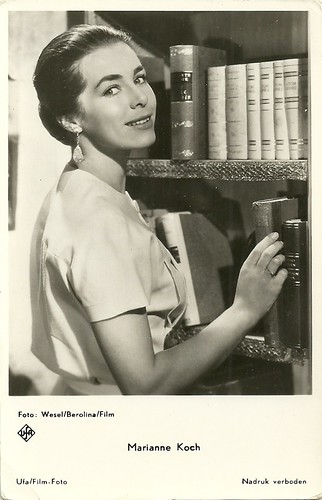
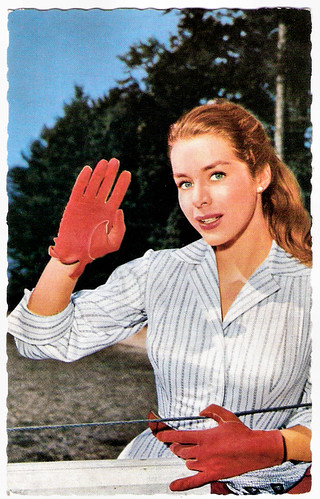
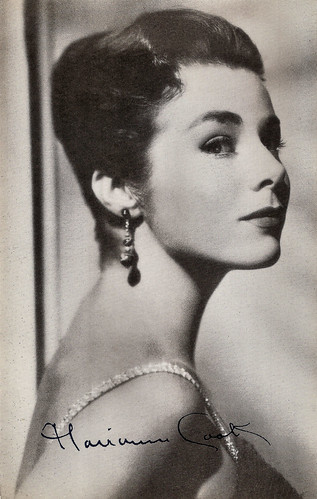
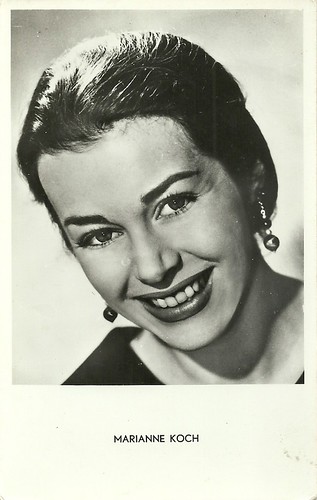
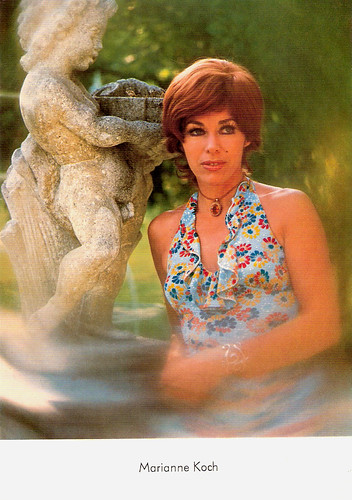
Marianne Koch

Versatile German actress Marianne Koch (1931) played in more than 65 films between 1950 and 1971. Internationally she is best known as the tormented Marisol, who is saved by Clint Eastwood in Sergio Leone's legendary Spaghetti Western A Fistful of Dollars (1964).

Marianne Koch
German postcard by ISV, no. G 1.

Marianne Koch
German postcard by Krüger, no. 902/187. Photo: Klaus Collignon.

Marianne Koch
German postcard by Universum-Film Aktiengesellschaft (Ufa), Berlin-Tempelhof, no. CK-36.

Best Supporting Actress of 1955


Marianne Koch was born in Munich, Germany, in 1931. She was the daughter of a businessman and a pianist. As a 10-year-old she already played theatre and she was a guest student at the opera school. In 1949 she started medical studies at the University of Munich. 

As a student she made her film debut next to Rudolf Forster and Olga Tschechova in the drama Der Mann, der zweimal leben wollte/The Man Who Wanted to Live Twice (Viktor Tourjansky, 1950). The following year she made a spontaneous appearance in Dr. Holl/Affairs of Dr. Holl (Rolf Hansen, 1951) with Maria Schell and Dieter Borsche, and in Mein Freund, der Dieb/My Friend, the Thief (Helmut Weiss, 1951) with Hans Söhnker and Hardy Krüger.

She broke off her studies to become an actress full-time. She played her first leading role in the melodrama Wetterleuchten am Dachstein/Storm Clouds over Dachstein (Anton Kutter, 1953). In the American Cold War drama Night People (Nunnally Johnson, 1954) she played a supporting part alongside Gregory Peck. She stayed in Germany and appeared with O. W. Fischer in Ludwig II: Glanz und Ende eines Königs/Mad Emperor: Ludwig II (Helmut Käutner, 1955). For her portrayal of Diddo Geiss in Des Teufels General/The Devil's General (Helmut Käutner, 1955), she received the Filmband in Silber (Film Strip in Silver) for the Best Supporting Actress of 1955.

As Marianne Cook, she appeared in the Hollywood productions Four Girls in Town (Jack Sher, 1957) opposite George Nader, and Interlude (Douglas Sirk, 1957) with June Allyson and Rossano Brazzi. In Germany she played in the comedy Salzburger Geschichten/Salzburg Stories (Kurt Hoffmann, 1957) based on a book by Erich Kästner, and in the war films Der Stern von Afrika/The Star of Africa (Alfred Weidenmann, 1957) with Joachim Hansen, and Der Fuchs von Paris/The Paris Fox (Paul May, 1957) with Hardy Krüger.

In the comedy Vater sein dagegen/To Be A Father On the Contrary (Kurt Meisel, 1957) she appeared as the bride of the almost 30 years older Heinz Rühmann. She also had success as a patent country doctor in Die Landärztin vom Tegernsee/The Country Doctor of Tegernsee (Paul May, 1958). In Italy she appeared in the comedy Gli italiani sono matti/The Italians They Are Crazy (Duilio Coletti, Luis María Delgado, 1958) starring Hollywood veteran Victor McLaglen.

Dieter Borsche, Marianne Koch
With Dieter Borsche. German postcard by WS-Druck, Wanne-Eickel, no. F 79. Photo: Ringpress / Vogelmann / Bavaria.

Marianne Koch, Joachim Hansen
With Joachim Hansen. German postcard by Ufa/Film-Foto, Berlin-Tempelhoff, no. FK 3658. Retail price: 25 Pfg. Photo: Brünjes / Neue Emelka / Herzog Film.

Marianne Koch
Dutch-Belgian postcard by Ufa. Photo: Wesel / Berolina Film.

Marianne Koch
German postcard by Kolibri-Verlag, Minden/Westf., no. D 17. Photo: Constantin / Bokelberg. Publicity still for Salzburger Geschichten/Salzburg Stories (Kurt Hoffmann, 1957).

A Fistful of Dollars


In the early 1960s, the decline of the German film industry increased and Marianne Koch worked more often abroad. In France, she appeared in the thriller Pleins feux sur l'assassin/Spotlight on a Murderer (Georges Franju, 1961). It was based on a screenplay by Pierre Boileau and Thomas Narcejac on whose work film classics like Diabolique (Henri-Georges Clouzot, 1955) and Vertigo (Alfred Hitchcock, 1958) were based.

Another French production was the drama Napoléon II, l'aiglon/Napoleon II, The Eaglet (Claude Boissol, 1961) with Bernard Verley and Jean Marais. In the German-British-Irish spy thriller The Devil's Agent (John Paddy Carstairs, 1962), she appeared opposite Peter van Eyck and Christopher Lee.

In 1963 Marianne Koch played the female lead in the popular TV mini-series Tim Frazer (Hans Quest, 1963) written by Francis Durbridge.

Then, Sergio Leone's classic Spaghetti Western Per un pugno di dollari/A Fistful of Dollars (Sergio Leone, 1964) showcased her alongside Clint Eastwood as Marisol, a woman tormented by ruthless local gangsters, torn between her husband and child and the villains.

After this career highlight followed many mediocre Edgar Wallace crime films, Eurospy films and Spaghetti Westerns. One of the more interesting ones was the German-Israeli action film Einer spielt falsch/Trunk to Cairo (Menahem Golan, Raphael Nussbaum, 1966), which recycled Hollywood hero Audie Murphy as a James Bond-type action hero assigned to destroy a Neo-Nazi weapons factory headed by nemesis George Sanders.

Marianne Koch
British postcard in the Celebrity Autograph Series by Celebrity Publishers Ltd., London, no. 287. Photo: Universal-International. Publicity still for Interlude (Douglas Sirk, 1957), in which she was credited as Marianne Cook.

Marianne Koch
German collectors card by Luxor.

Marianne Koch
German postcard by WS-Druck, Wanne-Eickel, no. F 10. Photo: Ringpress / Vogelmann / Bavaria.

What Am I?


In Germany, Marianne Koch was probably best loved for her many years of participation in the highly popular TV game show Was bin ich? (What Am I?) which ran from the 1950s until 1988. The show achieved ratings of up to 75% at its peak. On television, she also played a journalist in the popular TV series Die Journalistin/The Journalist (1970-1971) with Bruce Low.

By then her film career was clearly over. In 1971, she resumed her medical studies which she had broken off in 1953 to become a full-time actress. She earned her doctorate in 1978 and practised as an internist in Munich until 1997.

In the meantime, she hosted television shows and had a medical advice program on the radio. In 1976, she was one of the initial hosts of Germany's pioneering talk show 3 nach 9/Three After Nine, for which she was awarded one of the most prestigious awards of the German television industry, the Grimme Preis.

Since 1997 she has been the president of the Deutschen Schmerzliga (German Pain League). She published medical books such as 'Mein Gesundheitsbuch' (My Health Book, 1999) and 'Die Gesundheit unserer Kinder' (The Health of Our Children, 2007). In 2002, Koch was honoured for her life's work with the Bundesverdienstkreuz (Germany‘s Cross of Merit award).

In 1953, she married the physician Gerhard Freund, with whom she had two sons. The marriage ended in 1973 after Freund began an affair with Miss World 1956, Petra Schürmann, whom he later wed. Marianne Koch was in a relationship with the publicist Peter Hamm from the mid-1980s till his death in 2019. Koch lives in Tutzing, Germany.

Marianne Koch
Probably a Belgian postcard.

Marianne Koch
German postcard by Franz Josef Rüdel, Filmpostkartenverlag, Hamburg, no. F-72. Photo: G.M. Rozhek, München.


Marianne Koch and Heinz Rühmann sing Oh Bello in ...Vater sein dagegen sehr (1957). Source: Filmkiste (YouTube).

Sources: Stephanie d’Heil (Steffi-line - German), Wikipedia (German), and IMDb.

This post was last updated on 30 December 2024.