Hungarian actress Käthe von Nagy (1904-1973) started as the ‘Backfish’ of German films of the late 1920s. In the early 1930s, she became a fashionable and charming star of the German and French cinema.

German postcard by Ross Verlag, no. 4648/2, 1929-1930. Photo: Atelier Manassé, Wien.
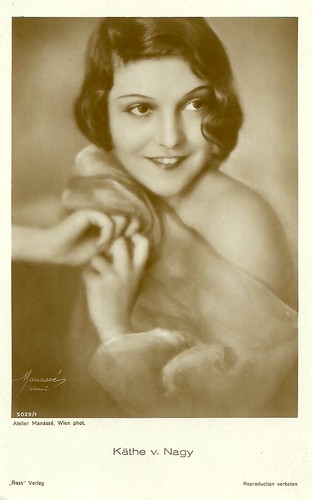
German postcard by Ross Verlag, no. 5029/1, 1930-1931. Photo: Atelier Manassé, Vienna.
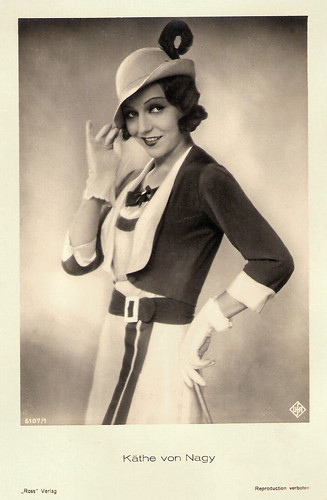
German postcard by Ross Verlag, nr. 6107/1, 1931-1932. Photo: Ufa. A publicity still for Meine Frau, die Hochstaplerin / My Wife, the Impostor (Kurt Gerron, 1931).
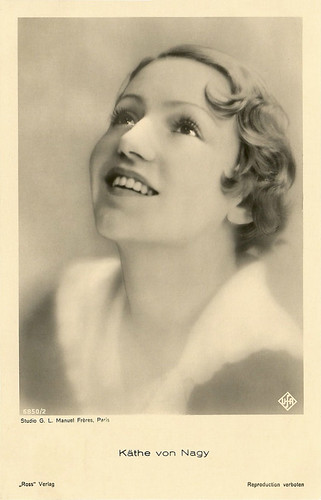
German postcard by Ross Verlag, no. 6850/2, 1931-1932. Photo: G.L. Manuel Frères, Paris / Ufa. Collection: Didier Hanson.
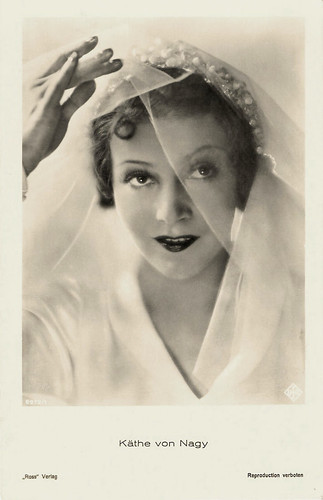
German postcard by Ross Verlag, no. 6972/1, 1931-1932. Photo: Ufa. Publicity still for Das schöne Abenteuer / Beautiful Adventure (Reinhold Schünzel, 1932).
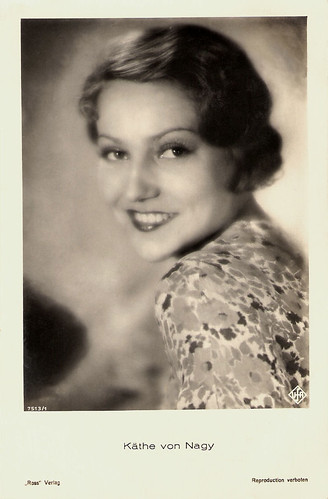
German postcard by Ross Verlag, no. 7513/1, 1932-1933. Photo: Ufa.

German postcard by Ross Verlag, no. 8097/2, 1933-1934. Photo: Ufa.

German postcard by Ross Verlag, no. 555. Photo: Ufa.
Käthe von Nagy was born Ekaterina Nagy von Cziser (Kato Nagy) in Szabadka, Austria-Hungary (now Subotica, Serbia) in 1904.
At the age of 16, she planned to get married and therefore her parents put her in the Sancta Christiana Convent near Vienna. After that, she worked in her father's bank office in Budapest and secretly started to write short stories for a newspaper. She also attended the acting school of director Béla Gáal, and in 1926, against the will of her parents, she went to Berlin to make films.
While searching for an acting job, she earned her money as a correspondent for the Hungarian newspaper Pester Hirlop. Hungarian director Alexander Korda helped her get her first film job. It was a supporting role in Männer von der Ehe / Men Before Marriage (Constantin J. David, 1927), which got her the reputation of a ‘backfisch’. The director, Constantin David, would also become her first husband.
Soon followed roles in Gustav Mond... Du gehst so stille / You Walk So Softly (Reinhold Schünzel, 1927) and Die Königin seines Herzens / Vienna, City of My Dreams (Victor Janson, 1928) starring Liane Haid.
With her first leading role in Die Durchgängerin / The Runaway Girl (Hanns Schwarz, 1928), she became the up-and-coming young actress of the European cinema of the 1920s. Next followed the Italian production Rotaie (Mario Camerini, 1929) and Mascottchen / Mascots (Felix Basch, 1929) with Jeanne Helbling.

German postcard by Verlag Hermann Leiser, Berlin-Wilm., no. 6567. Photo: Atelier Willinger, Berlin.

French postcard by Europe, no. 1. Photo: May Film. Käthe von Nagy in Ihre Majestät, die Liebe / Her Majesty Love (Joe May, 1931).

Dutch postcard, no. 662. Photo: Ufa. Käthe von Nagy and Aribert Wäscher in Ronny (Reinhold Schünzel, 1931).

German postcard by Ross Verlag, no. 3640/1, 1928-1929 Photo: Atelier Oertel, Berlin.

German postcard by Ross Verlag, no. 5711/1, 1930-1931. Photo: Ufa.
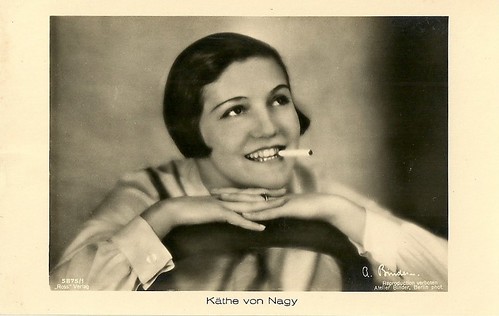
German postcard by Ross Verlag, no. 5875/1, 1930-1931. Photo: Alex Binder.
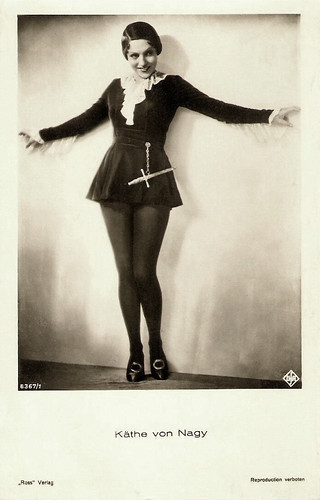
German postcard by Ross Verlag, no. 6367/1. 1931-1932. Photo: Ufa. Publicity still for Ronny (Reinhold Schünzel, 1931).
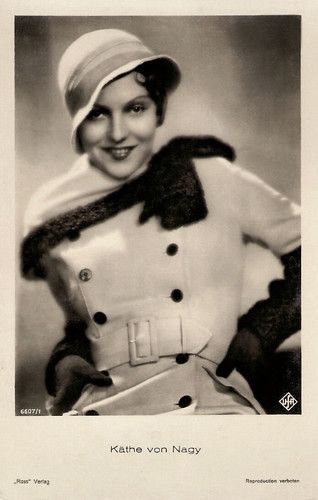
German postcard by Ross Verlag, no. 6807/1, 1931-1932. Photo: Ufa.
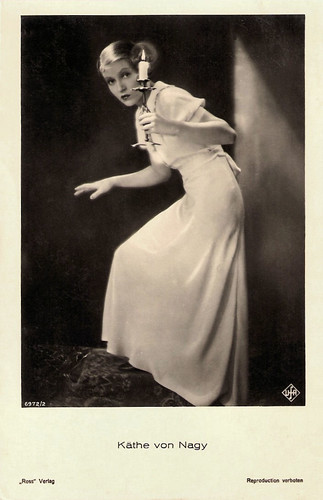
German postcard by Ross Verlag, no. 6972/2, 1931-1932. Photo: Ufa.
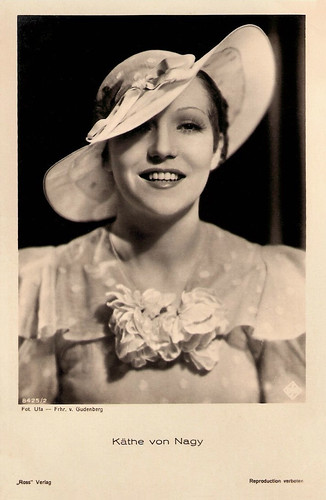
German postcard by Ross Verlag, no. 6415/2, 1931-1932. Photo: Ufa / Frhr. v. Gudenburg. Publicity still for Einmal eine große Dame sein / Once be a great lady (Gerhard Lamprecht, 1934).
In 1930, Käthe von Nagy smoothly moved into the talkies. She appeared as a resolute demimonde dame with psychotherapeutic powers in the Jekyll-and-Hyde-drama Der Andere/The Other (Robert Wiene, 1930), costarring Fritz Kortner and Heinrich George.
She said goodbye to her ‘backfisch’ image and impersonated modern women frequently on the screen. Her operettas and musical comedies were very popular and confirmed her promise of the late 1920s.
To her successes of the 1930s belong Ihre Majestät die Liebe / Her Majesty Love (Joe May, 1930) with Franz Lederer, Meine Frau, die Hochstaplerin / My Wife, the Impostor (Kurt Gerron, 1931) opposite Heinz Rühmann, and Ronny (Reinhold Schünzel, 1931).
She had famous co-stars like Willy Fritsch in the delicious comedy Ich bei Tag und Du bei Nacht / I by Day, You by Night (Ludwig Berger, 1932) and Hans Albers in Der Sieger / The Victor (Hans Hinrich, Paul Martin, 1932).
Her other notable films included Das Schöne Abenteuer / Beautiful Adventure (Reinhold Schünzel, 1932), the anti-Soviet propaganda film Flüchtlinge / Fugitives (Gustav Ucicky, 1933), Die Töchter ihrer Exzellenz / The Daughters of Her Excellency (Reinhold Schünzel, 1934) and Salonwagen E 417 / Luxury Train (Paul Verhoeven, 1939) with Paul Hörbiger.

German postcard by Ross Verlag, no. 6605/1, 1931-1932. Photo: Ufa. Publicity still for Der Sieger / The Winner (Paul Martin, Hans Hinrich, 1932) with Hans Albers.
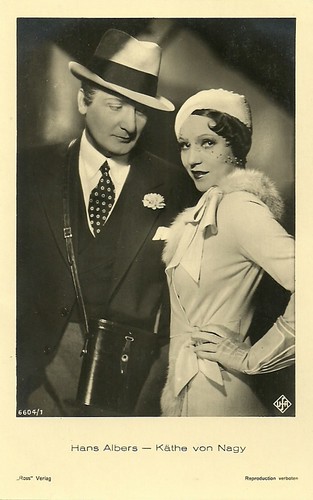
German postcard by Ross Verlag, no. 6604/1, 1931-1932. Photo: Ufa. Publicity still for Der Sieger / The Winner (Paul Martin, Hans Hinrich, 1932) with Hans Albers.
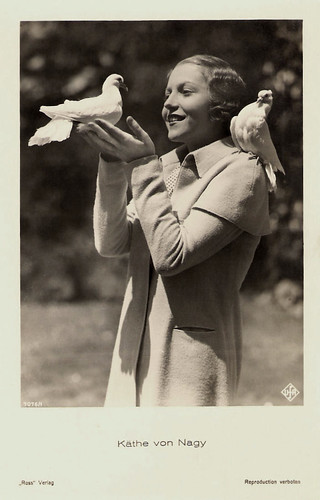
German postcard by Ross Verlag, no. 7076/1, 1932-1933. Photo: Ufa.

German postcard by Ross Verlag, no. 7131/2, 1932-1933. Photo: Ufa. Publicity still for Le capitaine Craddock / Captain Craddock (Hanns Schwarz, Max de Vaucorbeil, 1931) with Jean Murat.
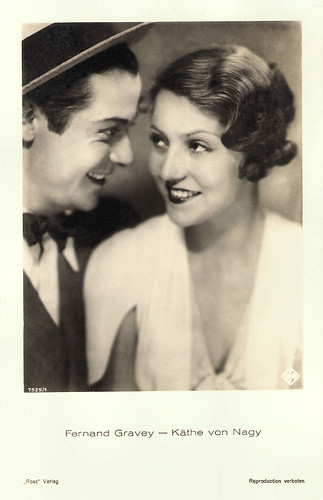
German postcard by Ross Verlag, no. 7535/1, 1932-1933. Photo: Ufa. Publicity still for À Moi le Jour, à Toi la Nuit / Day To Me, to You the Night (Ludwig Berger, Claude Heymann, 1932) with Fernand Gravey.
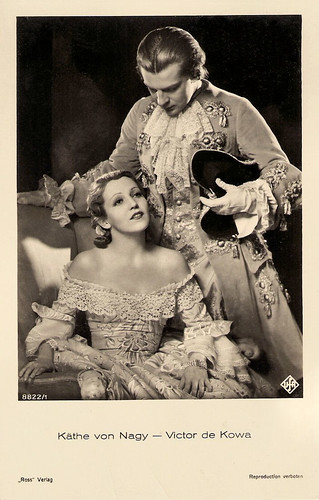
German postcard by Ross Verlag, no. 8822/1, 1933-1934. Photo: Ufa. Publicity still for Der junge Baron Neuhaus / The Young Baron Neuhaus (Gustav Ucicky, 1934) with Viktor de Kowa.
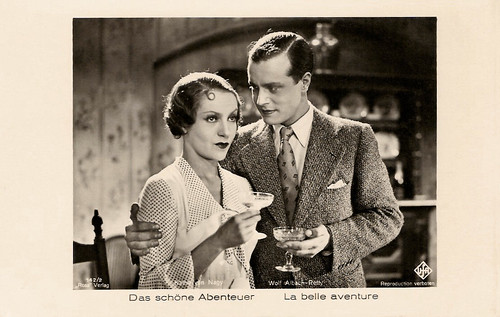
German postcard by Ross Verlag, no. 142/2. Photo: Günther Pilz / Ufa. Publicity still for Das Schöne Abenteuer / Beautiful Adventure (Reinhold Schünzel, 1932) with Wolf Albach-Retty.
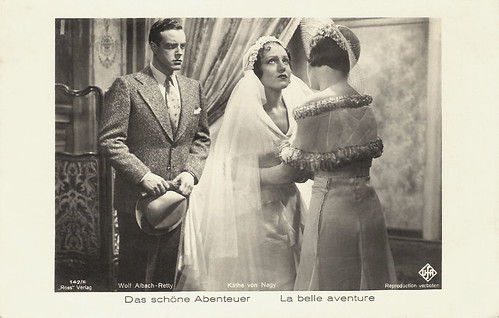
German postcard by Ross Verlag, no. 142/6. Photo: Ufa. Publicity still for Das schöne Abenteuer / Beautiful Adventure (Reinhold Schünzel, 1932) with Wolf Albach-Retty.

French postcard by P.C., Paris, no. 76. Photo: Ufa. Publicity still for La belle aventure / Beautiful Adventure (Roger Le Bon, Reinhold Schünzel, 1932), the French language version of Das schöne Abenteuer (Reinhold Schünzel, 1932).

French postcard by Cinémagazine-Edition, no. 606.
Because of her multilingual education, Käthe von Nagy was able to establish herself in the French cinema too. As Kate de Nagy, she became a star in France.
To her French productions belong La Capitaine Craddock / Captain Craddock (Hanns Schwarz, Max de Vaucorbeil, 1931) with Jean Murat, La route impériale / The Imperial Road (Marcel L’Herbier, 1935) with Pierre Richard-Willm, Cargaison blanche / Woman Racket (Robert Siodmak, 1937) opposite Jules Berry, and La bataille silencieuse / The Silent Battle (Pierre Billon, 1937) starring Pierre Fresnay.
She withdrew from the film business at the beginning of World War II. After the war, she appeared only twice on the screen, in the French drama Cargaison clandestine / Alarm in San Juano (Alfred Rode, 1948-1950) with Luis Mariano, and the German remake of Die Försterchristl / The Forester's Daughter (Arthur Maria Rabenalt, 1952), alongside Johanna Matz.
In the mid-1950s, Käthe von Nagy went to California, where she worked as a French teacher at Happy Valley School in Ojai, California.
Käthe von Nagy died of cancer in Ojai, USA, in 1973. After her marriage to Constantin J. David, she was married to the Frenchman Jacques Fattini.
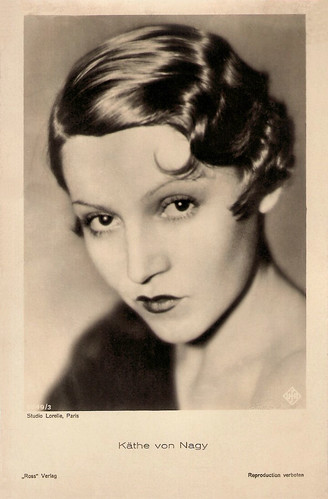
German postcard by Ross Verlag, no. 6849/3, 1931-1932. Photo: Studio Lorelle, Paris / Ufa.
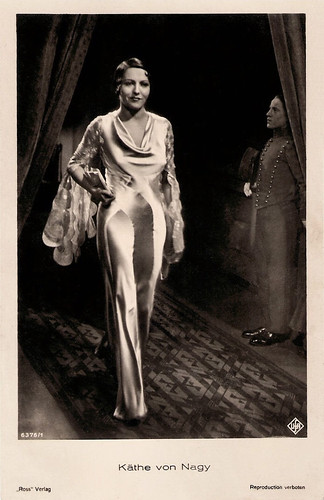
German postcard by Ross Verlag, no. 6376/1, 1931-1932. Photo: Ufa.
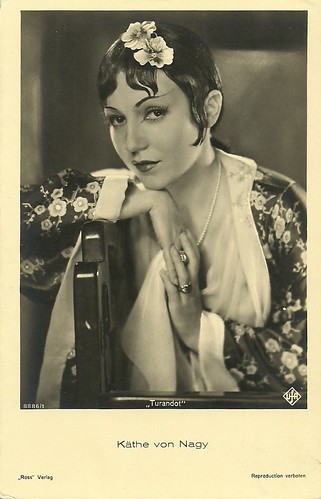
German postcard by Ross Verlag, no. 8886/1, 1933-1934. Photo: Ufa. Publicity still for Prinzessin Turandot / Princess Turandot (Gerhard Lamprecht, 1934).
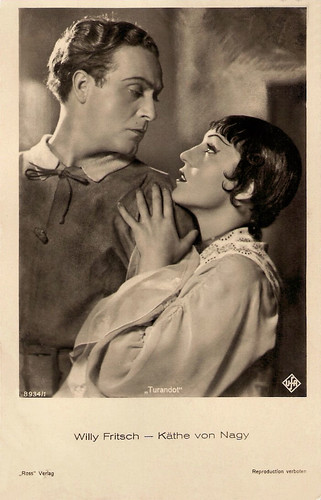
German postcard by Ross Verlag, no. 8934/1, 1933-1934. Photo: Ufa. Publicity still for Prinzessin Turandot / Princess Turandot (Gerhard Lamprecht, 1934) with Willy Fritsch.
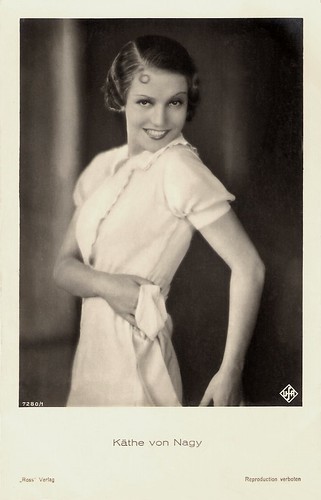
German postcard by Ross Verlag, no. 7280/1, 1932-1933. Photo: Ufa.
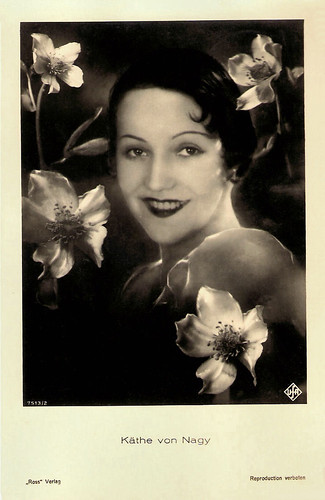
German postcard by Ross Verlag, no. 7513/2, 1932-1933. Photo: Ufa.
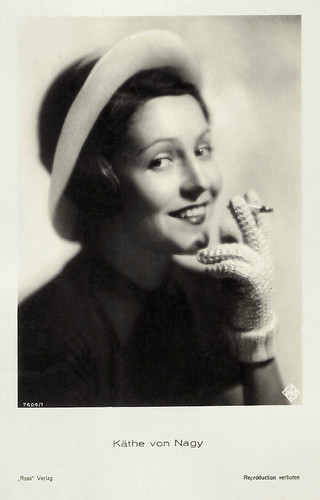
German postcard by Ross Verlag, no. 7604/1, 1932-1933. Photo: Ufa.
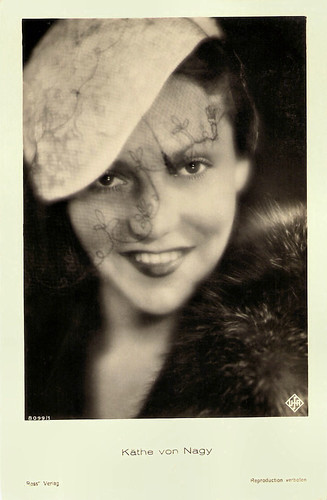
German postcard by Ross Verlag, no. 8099/1, 1933-1934. Photo: Ufa.
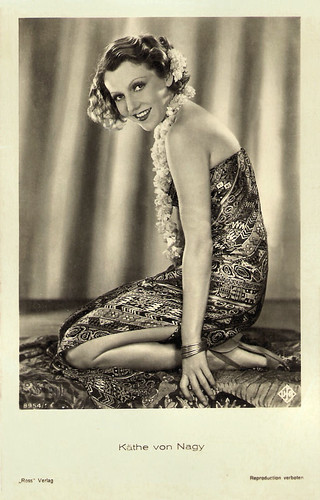
German postcard by Ross Verlag, no. 8954/1, 1933-1934. Photo: Ufa.

German postcard by Ross Verlag, no. 9057/1, 1935-1936. Photo: Ufa. Käthe von Nagy and Albin Skoda in Liebe, Tod und Teufel / Love, Death and the Devil (Heinz Hilpert, Reinhart Steinbicker, 1934).

German postcard by Ross Verlag, no. 9629/1, 1935-1936. Photo: Forum-Film. Pierre Richard Willm and Käthe von Nagy in La route impériale / The Imperial Road (Marcel L'Herbier, 1935).
Sources: Thomas Staedeli (Cyranos), Operator 99 (Allure), Filmportal (German), Wikipedia, and IMDb.
German postcard by Ross Verlag, no. 4648/2, 1929-1930. Photo: Atelier Manassé, Wien.
German postcard by Ross Verlag, no. 5029/1, 1930-1931. Photo: Atelier Manassé, Vienna.
German postcard by Ross Verlag, nr. 6107/1, 1931-1932. Photo: Ufa. A publicity still for Meine Frau, die Hochstaplerin / My Wife, the Impostor (Kurt Gerron, 1931).
German postcard by Ross Verlag, no. 6850/2, 1931-1932. Photo: G.L. Manuel Frères, Paris / Ufa. Collection: Didier Hanson.
German postcard by Ross Verlag, no. 6972/1, 1931-1932. Photo: Ufa. Publicity still for Das schöne Abenteuer / Beautiful Adventure (Reinhold Schünzel, 1932).
German postcard by Ross Verlag, no. 7513/1, 1932-1933. Photo: Ufa.
German postcard by Ross Verlag, no. 8097/2, 1933-1934. Photo: Ufa.
German postcard by Ross Verlag, no. 555. Photo: Ufa.
Backfisch
Käthe von Nagy was born Ekaterina Nagy von Cziser (Kato Nagy) in Szabadka, Austria-Hungary (now Subotica, Serbia) in 1904.
At the age of 16, she planned to get married and therefore her parents put her in the Sancta Christiana Convent near Vienna. After that, she worked in her father's bank office in Budapest and secretly started to write short stories for a newspaper. She also attended the acting school of director Béla Gáal, and in 1926, against the will of her parents, she went to Berlin to make films.
While searching for an acting job, she earned her money as a correspondent for the Hungarian newspaper Pester Hirlop. Hungarian director Alexander Korda helped her get her first film job. It was a supporting role in Männer von der Ehe / Men Before Marriage (Constantin J. David, 1927), which got her the reputation of a ‘backfisch’. The director, Constantin David, would also become her first husband.
Soon followed roles in Gustav Mond... Du gehst so stille / You Walk So Softly (Reinhold Schünzel, 1927) and Die Königin seines Herzens / Vienna, City of My Dreams (Victor Janson, 1928) starring Liane Haid.
With her first leading role in Die Durchgängerin / The Runaway Girl (Hanns Schwarz, 1928), she became the up-and-coming young actress of the European cinema of the 1920s. Next followed the Italian production Rotaie (Mario Camerini, 1929) and Mascottchen / Mascots (Felix Basch, 1929) with Jeanne Helbling.
German postcard by Verlag Hermann Leiser, Berlin-Wilm., no. 6567. Photo: Atelier Willinger, Berlin.
French postcard by Europe, no. 1. Photo: May Film. Käthe von Nagy in Ihre Majestät, die Liebe / Her Majesty Love (Joe May, 1931).
Dutch postcard, no. 662. Photo: Ufa. Käthe von Nagy and Aribert Wäscher in Ronny (Reinhold Schünzel, 1931).
German postcard by Ross Verlag, no. 3640/1, 1928-1929 Photo: Atelier Oertel, Berlin.
German postcard by Ross Verlag, no. 5711/1, 1930-1931. Photo: Ufa.
German postcard by Ross Verlag, no. 5875/1, 1930-1931. Photo: Alex Binder.
German postcard by Ross Verlag, no. 6367/1. 1931-1932. Photo: Ufa. Publicity still for Ronny (Reinhold Schünzel, 1931).
German postcard by Ross Verlag, no. 6807/1, 1931-1932. Photo: Ufa.
German postcard by Ross Verlag, no. 6972/2, 1931-1932. Photo: Ufa.
German postcard by Ross Verlag, no. 6415/2, 1931-1932. Photo: Ufa / Frhr. v. Gudenburg. Publicity still for Einmal eine große Dame sein / Once be a great lady (Gerhard Lamprecht, 1934).
The fashionable, elegant, a bit exotic type
In 1930, Käthe von Nagy smoothly moved into the talkies. She appeared as a resolute demimonde dame with psychotherapeutic powers in the Jekyll-and-Hyde-drama Der Andere/The Other (Robert Wiene, 1930), costarring Fritz Kortner and Heinrich George.
She said goodbye to her ‘backfisch’ image and impersonated modern women frequently on the screen. Her operettas and musical comedies were very popular and confirmed her promise of the late 1920s.
To her successes of the 1930s belong Ihre Majestät die Liebe / Her Majesty Love (Joe May, 1930) with Franz Lederer, Meine Frau, die Hochstaplerin / My Wife, the Impostor (Kurt Gerron, 1931) opposite Heinz Rühmann, and Ronny (Reinhold Schünzel, 1931).
She had famous co-stars like Willy Fritsch in the delicious comedy Ich bei Tag und Du bei Nacht / I by Day, You by Night (Ludwig Berger, 1932) and Hans Albers in Der Sieger / The Victor (Hans Hinrich, Paul Martin, 1932).
Her other notable films included Das Schöne Abenteuer / Beautiful Adventure (Reinhold Schünzel, 1932), the anti-Soviet propaganda film Flüchtlinge / Fugitives (Gustav Ucicky, 1933), Die Töchter ihrer Exzellenz / The Daughters of Her Excellency (Reinhold Schünzel, 1934) and Salonwagen E 417 / Luxury Train (Paul Verhoeven, 1939) with Paul Hörbiger.
German postcard by Ross Verlag, no. 6605/1, 1931-1932. Photo: Ufa. Publicity still for Der Sieger / The Winner (Paul Martin, Hans Hinrich, 1932) with Hans Albers.
German postcard by Ross Verlag, no. 6604/1, 1931-1932. Photo: Ufa. Publicity still for Der Sieger / The Winner (Paul Martin, Hans Hinrich, 1932) with Hans Albers.
German postcard by Ross Verlag, no. 7076/1, 1932-1933. Photo: Ufa.
German postcard by Ross Verlag, no. 7131/2, 1932-1933. Photo: Ufa. Publicity still for Le capitaine Craddock / Captain Craddock (Hanns Schwarz, Max de Vaucorbeil, 1931) with Jean Murat.
German postcard by Ross Verlag, no. 7535/1, 1932-1933. Photo: Ufa. Publicity still for À Moi le Jour, à Toi la Nuit / Day To Me, to You the Night (Ludwig Berger, Claude Heymann, 1932) with Fernand Gravey.
German postcard by Ross Verlag, no. 8822/1, 1933-1934. Photo: Ufa. Publicity still for Der junge Baron Neuhaus / The Young Baron Neuhaus (Gustav Ucicky, 1934) with Viktor de Kowa.
German postcard by Ross Verlag, no. 142/2. Photo: Günther Pilz / Ufa. Publicity still for Das Schöne Abenteuer / Beautiful Adventure (Reinhold Schünzel, 1932) with Wolf Albach-Retty.
German postcard by Ross Verlag, no. 142/6. Photo: Ufa. Publicity still for Das schöne Abenteuer / Beautiful Adventure (Reinhold Schünzel, 1932) with Wolf Albach-Retty.
French postcard by P.C., Paris, no. 76. Photo: Ufa. Publicity still for La belle aventure / Beautiful Adventure (Roger Le Bon, Reinhold Schünzel, 1932), the French language version of Das schöne Abenteuer (Reinhold Schünzel, 1932).
French postcard by Cinémagazine-Edition, no. 606.
France
Because of her multilingual education, Käthe von Nagy was able to establish herself in the French cinema too. As Kate de Nagy, she became a star in France.
To her French productions belong La Capitaine Craddock / Captain Craddock (Hanns Schwarz, Max de Vaucorbeil, 1931) with Jean Murat, La route impériale / The Imperial Road (Marcel L’Herbier, 1935) with Pierre Richard-Willm, Cargaison blanche / Woman Racket (Robert Siodmak, 1937) opposite Jules Berry, and La bataille silencieuse / The Silent Battle (Pierre Billon, 1937) starring Pierre Fresnay.
She withdrew from the film business at the beginning of World War II. After the war, she appeared only twice on the screen, in the French drama Cargaison clandestine / Alarm in San Juano (Alfred Rode, 1948-1950) with Luis Mariano, and the German remake of Die Försterchristl / The Forester's Daughter (Arthur Maria Rabenalt, 1952), alongside Johanna Matz.
In the mid-1950s, Käthe von Nagy went to California, where she worked as a French teacher at Happy Valley School in Ojai, California.
Käthe von Nagy died of cancer in Ojai, USA, in 1973. After her marriage to Constantin J. David, she was married to the Frenchman Jacques Fattini.
German postcard by Ross Verlag, no. 6849/3, 1931-1932. Photo: Studio Lorelle, Paris / Ufa.
German postcard by Ross Verlag, no. 6376/1, 1931-1932. Photo: Ufa.
German postcard by Ross Verlag, no. 8886/1, 1933-1934. Photo: Ufa. Publicity still for Prinzessin Turandot / Princess Turandot (Gerhard Lamprecht, 1934).
German postcard by Ross Verlag, no. 8934/1, 1933-1934. Photo: Ufa. Publicity still for Prinzessin Turandot / Princess Turandot (Gerhard Lamprecht, 1934) with Willy Fritsch.
German postcard by Ross Verlag, no. 7280/1, 1932-1933. Photo: Ufa.
German postcard by Ross Verlag, no. 7513/2, 1932-1933. Photo: Ufa.
German postcard by Ross Verlag, no. 7604/1, 1932-1933. Photo: Ufa.
German postcard by Ross Verlag, no. 8099/1, 1933-1934. Photo: Ufa.
German postcard by Ross Verlag, no. 8954/1, 1933-1934. Photo: Ufa.
German postcard by Ross Verlag, no. 9057/1, 1935-1936. Photo: Ufa. Käthe von Nagy and Albin Skoda in Liebe, Tod und Teufel / Love, Death and the Devil (Heinz Hilpert, Reinhart Steinbicker, 1934).
German postcard by Ross Verlag, no. 9629/1, 1935-1936. Photo: Forum-Film. Pierre Richard Willm and Käthe von Nagy in La route impériale / The Imperial Road (Marcel L'Herbier, 1935).
Sources: Thomas Staedeli (Cyranos), Operator 99 (Allure), Filmportal (German), Wikipedia, and IMDb.

4 comments:
Howdy
Happy PFF to you.
My what an amazing talent and accomplished woman ! It makes you wonder where are these type of determined individuals today ?
She is so beautiful .
This was once again a truly fascinating post.
I am off to the internet now to read more thanks to you :)
Thank you for sharing .
Until next time
Happy Trails
I wonder what do you think about the actors of today, and those of tomorrow.
How do they differ from those from "yesterday"? :)
Thanks Terry. You´re a sweetheart.
Dorin, your question made me think very hard. Let me be clear, I like today´s actors as much as those of the past, and I love to see new films. What fascinates me about these old postcards is that these European stars of yesterday are mostly forgotten, while they made great films and were once very, very popular and all these postcards are prove for that.
Film historians tend to focus on the directors, the auteurs. The stars are mostly overlooked, while the public then went to films beecause of these stars. And on TV you can seldom see anything else but Hollywood films.
Through these forgotten stars you can get glimpses of the history and the great tragedies of Europe. Through particular live stories you can follow how communism and fascism destroyed people´s lives and careers but also destroyed complete film cultures. You also witness how the arrival of the sound film broke some people´s careers, but also stimulated local European film industries. How women were popular as divas or as brave mothers, or as sex pots. How their fashion styles changed. How the ideas of smoking and sex appeal changed. And how the European film culture often inspired the Hollywood industry.
Does this answer your question?
See you next week at PFF.
She sounds like a very gifted and determined young woman. I found your answer to Dorin very interesting. It's so true that there is a whole view of history to be found in these cards.
Post a Comment