German actress Maria Paudler (1903-1990) was a popular star of the late silent cinema. She also played the leading role in the first German TV-film.

French postcard by Cinémagazine-Edition, Paris, no. 852. Photo: Manassé, Wien.
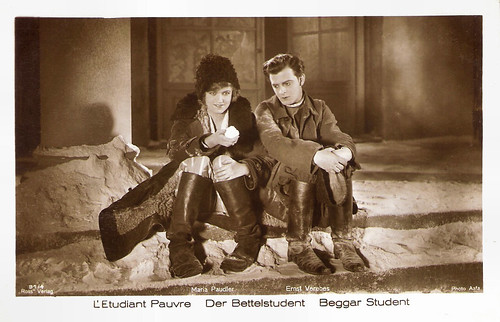
German postcard by Ross Verlag, no. 91/4. Photo: Aafa Film. Publicity still for Der Bettelstudent / The Beggar Student (Jacob Fleck, Luise Fleck, 1927) with Ernst Verebes.

Austrian postcard by Iris-Verlag, no. 5011. Photo: AAFA Film / Lux Film-Verleih. Maria Paudler and Fritz Kampers in Heiratsfieber / Marriage Fever (Rudolf Walther-Fein, 1928).

German postcard by Ross Verlag, no. 3583/1, 1928-1929. Photo: Manassé, Wien. Caption: Doppelbildnis (double portrait).

German postcard by Ross Verlag, no. 3583/3, 1928-1929. Photo: Atelier Manassé, Wien. Collection: Geoffrey Donaldson Institute.

German postcard by Ross Verlag, no. 3593/1, 1928-1929. Photo: Aafa Film. Possibly referring to the film Mein Freund Harry / My Friend Harry (Max Obal, Rudolf Walther-Fein, 1928) starring Maria Paudler and Harry Liedtke.
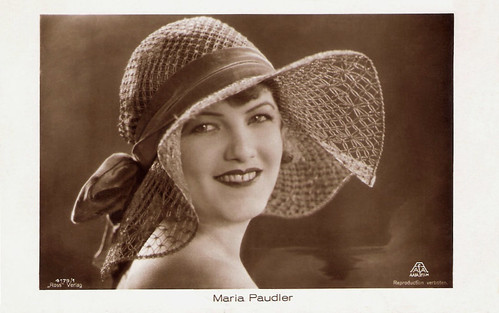
German postcard by Ross Verlag, no. 4179/1, 1929-1930. Photo: Aafa Film.
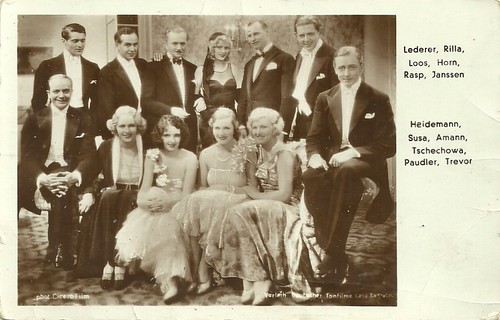
German postcard by Cicero Film. Distribution Deutsche Tonfilme.
The 'fine fleur' of late silent German cinema stars, united for a photo for an early sound film company. Standing left to right: Francis/Franz Lederer, Walter Rilla, Theodor Loos, Camilla Horn, Fritz Rasp and Walter Janssen. Sitting left to right: Paul Heidemann, Charlotte Susa, Betty Amann, Olga Tschechova, Maria Paudler and Jack Trevor. Might be publicity for the early sound comedy Die grosse Sehnsucht / The Great Longing (Stefan Szekely/Steve Sekely, 1930), in which all acted, mostly as themselves - only Loos and Horn played characters. The plot was an excuse for 35 stars to debut in a talking picture.
Maria Paudler was born in Bodenbach, Austria-Hungary (now Podmokly, Czech Republic) in 1903. She was the daughter of an architect. She studied at the Academy of Music and Performing Arts in Prague. At the age of 17, she began her theatre career as Gretchen in 'Faust'. In 1923, Leopold Jessner invited her to Berlin to be the partner of matinee idol Alexander Moissi at the Preußische Staatstheater.
From 1925 on, she appeared in her first films, such as Der Jüngling aus der Konfektion / The Lad From Manufacture (Richard Löwenbein, 1926) with Curt Bois, Madame wünscht keine Kinder / Madame Doesn't Want Children (Alexander Korda, 1926) with Harry Liedtke, and Der Veilchenfresser / The Violet Eater (Friedrich Zelnik/Frederic Zelnik, 1926) starring Lil Dagover.
She then starred opposite Harry Liedtke in Der Bettelstudent / The Beggar Student (Jakob Fleck, Luise Fleck, 1927). Other silent films were Die weisse Spinne / The White Spider (Carl Boese, 1927), Orientexpress / Orient Express (Wilhelm Thiele, 1927), and Das letzte Fort / The Last Fort (Kurt Bernhardt/Curtis Bernhardt, 1928).
Maria Paudler was married to the actor Georg Czimag. After the separation, she was engaged to her frequent co-star Harry Liedtke.
In the 1930s, she concentrated on her stage work in Berlin and Vienna. She only played secondary parts in films like Zwei Welten / Two Worlds (Ewald André Dupont, 1930), Der falsche Ehemann / The Wrong Husband(Johannes Guter, 1931), and Junges Blut / Young Blood (Johannes Guter, 1936). She also played the leading role in the first German TV film Adrian, der Tulpendieb / Adrian, the Thief of Tulips in 1938.

German postcard by Ross Verlag, no. 91/2. Photo: Aafa. Maria Paudler and Agnes Esterhazy in Der Bettelstudent / The Beggar Student (Jacob & Luise Fleck, 1927).

German postcard by Ross Verlag, no. 91/6. Photo: Aafa-Film. Maria Paudler in Der Bettelstudent / The Beggar Student (Jacob Fleck, Luise Fleck, 1927).

Austrian postcard by Iris-Verlag, no. 5012. Photo: Phoebus Film / Verleih: Philipp & Co. Maria Paudler and Walter Rilla in Die weiße Spinne / The White Spider (Carl Boese, 1927).

German postcard by Ross Verlag, no. 1777/3, 1927-1928. Photo: Filmhaus Bruckmann.
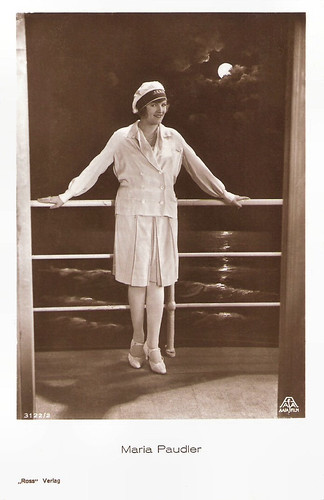
German postcard by Ross-Verlag, no. 3122/2, 1928-1929. Photo: Aafa Film.

German postcard by Ross Verlag, no. 3122/3, 1928-1929. Photo: Aafa-Film. Maria Paudler in Heiratsfieber / Marriage Fever (Rudolf Walther-Fein, 1928).
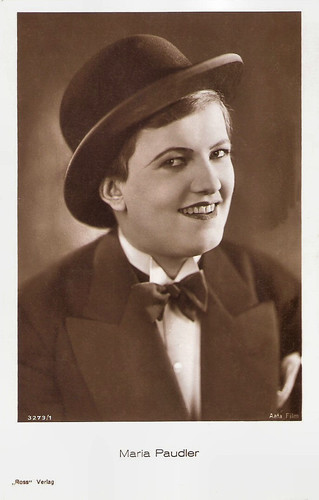
German postcard by Ross Verlag, no. 3273/1, 1928-1929. Photo: Aafa Film.

German postcard by Ross Verlag, no. 3604/1, 1928-1929. Photo: Aafa Film.
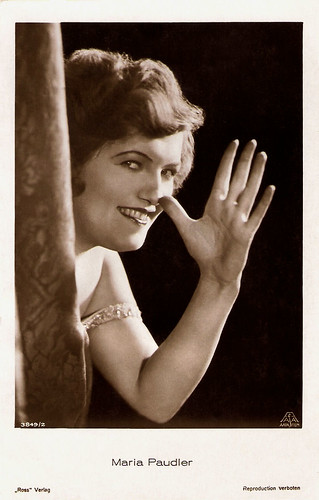
German postcard by Ross Verlag, no. 3849/2, 1928-1929. Photo: Aafa Film.
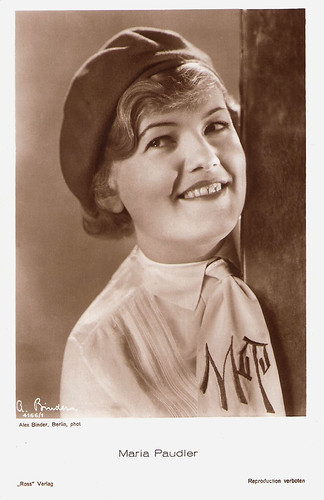
German postcard by Ross Verlag, no. 4166/1, 1929-1930. Photo: Alex Binder.
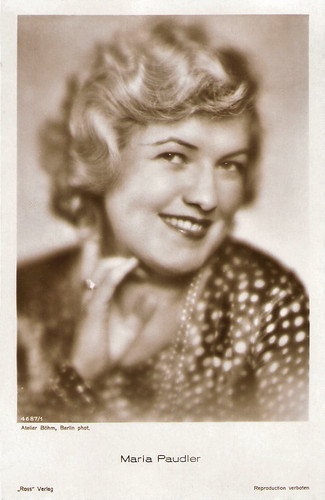
German postcard by Ross Verlag, no. 4687/1, 1929-1930. Photo: Atelier Böhm, Berlin.

German postcard by Ross Verlag, no. 5371/1, 1930-1931. Photo: Deutsche Universal-Film. Maria Paudler and Walter Rilla in Die große Sehnsucht / The Great Desire (Steve Sekely, 1930).
After the war, Maria Paudler was kept prisoner in the Czech Republic and was only set free after an order of the Red Army. She worked for a few years in Dresden as an actress and a director.
From 1949 to 1951, she had to recover from a serious car accident. She continued her film career in Berlin, and acted in supporting parts in such films as Einmal am Rhein / Once at the Rhine (Helmut Weiss, 1952), the Heinz Rühmann comedy Keine Angst vor grossen Tieren / No Fear For Big Animals (Ulrich Erfurth, 1953), and Ferien auf Immenhof / Holiday at Immenhof (Hermann Leitner, 1957).
French postcard by Cinémagazine-Edition, Paris, no. 852. Photo: Manassé, Wien.
German postcard by Ross Verlag, no. 91/4. Photo: Aafa Film. Publicity still for Der Bettelstudent / The Beggar Student (Jacob Fleck, Luise Fleck, 1927) with Ernst Verebes.
Austrian postcard by Iris-Verlag, no. 5011. Photo: AAFA Film / Lux Film-Verleih. Maria Paudler and Fritz Kampers in Heiratsfieber / Marriage Fever (Rudolf Walther-Fein, 1928).
German postcard by Ross Verlag, no. 3583/1, 1928-1929. Photo: Manassé, Wien. Caption: Doppelbildnis (double portrait).
German postcard by Ross Verlag, no. 3583/3, 1928-1929. Photo: Atelier Manassé, Wien. Collection: Geoffrey Donaldson Institute.
German postcard by Ross Verlag, no. 3593/1, 1928-1929. Photo: Aafa Film. Possibly referring to the film Mein Freund Harry / My Friend Harry (Max Obal, Rudolf Walther-Fein, 1928) starring Maria Paudler and Harry Liedtke.
German postcard by Ross Verlag, no. 4179/1, 1929-1930. Photo: Aafa Film.
German postcard by Cicero Film. Distribution Deutsche Tonfilme.
The 'fine fleur' of late silent German cinema stars, united for a photo for an early sound film company. Standing left to right: Francis/Franz Lederer, Walter Rilla, Theodor Loos, Camilla Horn, Fritz Rasp and Walter Janssen. Sitting left to right: Paul Heidemann, Charlotte Susa, Betty Amann, Olga Tschechova, Maria Paudler and Jack Trevor. Might be publicity for the early sound comedy Die grosse Sehnsucht / The Great Longing (Stefan Szekely/Steve Sekely, 1930), in which all acted, mostly as themselves - only Loos and Horn played characters. The plot was an excuse for 35 stars to debut in a talking picture.
Harry Liedtke
Maria Paudler was born in Bodenbach, Austria-Hungary (now Podmokly, Czech Republic) in 1903. She was the daughter of an architect. She studied at the Academy of Music and Performing Arts in Prague. At the age of 17, she began her theatre career as Gretchen in 'Faust'. In 1923, Leopold Jessner invited her to Berlin to be the partner of matinee idol Alexander Moissi at the Preußische Staatstheater.
From 1925 on, she appeared in her first films, such as Der Jüngling aus der Konfektion / The Lad From Manufacture (Richard Löwenbein, 1926) with Curt Bois, Madame wünscht keine Kinder / Madame Doesn't Want Children (Alexander Korda, 1926) with Harry Liedtke, and Der Veilchenfresser / The Violet Eater (Friedrich Zelnik/Frederic Zelnik, 1926) starring Lil Dagover.
She then starred opposite Harry Liedtke in Der Bettelstudent / The Beggar Student (Jakob Fleck, Luise Fleck, 1927). Other silent films were Die weisse Spinne / The White Spider (Carl Boese, 1927), Orientexpress / Orient Express (Wilhelm Thiele, 1927), and Das letzte Fort / The Last Fort (Kurt Bernhardt/Curtis Bernhardt, 1928).
Maria Paudler was married to the actor Georg Czimag. After the separation, she was engaged to her frequent co-star Harry Liedtke.
In the 1930s, she concentrated on her stage work in Berlin and Vienna. She only played secondary parts in films like Zwei Welten / Two Worlds (Ewald André Dupont, 1930), Der falsche Ehemann / The Wrong Husband(Johannes Guter, 1931), and Junges Blut / Young Blood (Johannes Guter, 1936). She also played the leading role in the first German TV film Adrian, der Tulpendieb / Adrian, the Thief of Tulips in 1938.
German postcard by Ross Verlag, no. 91/2. Photo: Aafa. Maria Paudler and Agnes Esterhazy in Der Bettelstudent / The Beggar Student (Jacob & Luise Fleck, 1927).
German postcard by Ross Verlag, no. 91/6. Photo: Aafa-Film. Maria Paudler in Der Bettelstudent / The Beggar Student (Jacob Fleck, Luise Fleck, 1927).
Austrian postcard by Iris-Verlag, no. 5012. Photo: Phoebus Film / Verleih: Philipp & Co. Maria Paudler and Walter Rilla in Die weiße Spinne / The White Spider (Carl Boese, 1927).
German postcard by Ross Verlag, no. 1777/3, 1927-1928. Photo: Filmhaus Bruckmann.
German postcard by Ross-Verlag, no. 3122/2, 1928-1929. Photo: Aafa Film.
German postcard by Ross Verlag, no. 3122/3, 1928-1929. Photo: Aafa-Film. Maria Paudler in Heiratsfieber / Marriage Fever (Rudolf Walther-Fein, 1928).
German postcard by Ross Verlag, no. 3273/1, 1928-1929. Photo: Aafa Film.
German postcard by Ross Verlag, no. 3604/1, 1928-1929. Photo: Aafa Film.
German postcard by Ross Verlag, no. 3849/2, 1928-1929. Photo: Aafa Film.
German postcard by Ross Verlag, no. 4166/1, 1929-1930. Photo: Alex Binder.
German postcard by Ross Verlag, no. 4687/1, 1929-1930. Photo: Atelier Böhm, Berlin.
German postcard by Ross Verlag, no. 5371/1, 1930-1931. Photo: Deutsche Universal-Film. Maria Paudler and Walter Rilla in Die große Sehnsucht / The Great Desire (Steve Sekely, 1930).
Supporting parts
After the war, Maria Paudler was kept prisoner in the Czech Republic and was only set free after an order of the Red Army. She worked for a few years in Dresden as an actress and a director.
From 1949 to 1951, she had to recover from a serious car accident. She continued her film career in Berlin, and acted in supporting parts in such films as Einmal am Rhein / Once at the Rhine (Helmut Weiss, 1952), the Heinz Rühmann comedy Keine Angst vor grossen Tieren / No Fear For Big Animals (Ulrich Erfurth, 1953), and Ferien auf Immenhof / Holiday at Immenhof (Hermann Leitner, 1957).
In later years, she often appeared on TV, like in such crime series as Der Kommissar / The Police Inspector (1974) starring Erik Ode and in Polizeiinspektion 1 / Police Station 1 (1985), which was to be her last role.
In 1968, she was awarded a Bambi, and in 1982, the Filmband in Gold. She published her memoirs in 1977 with the title 'Auch Lachen will gelernt sein' (Laughing Also Has To Be Learned).
Maria Paudler died in 1990 in München. Her second husband was actor and director Kurt Skalden (1895-1975), with whom she had a son, actor Norbert Skalden (1936-1981), who committed suicide. She rests in the cemetery at Perlacher Forst.
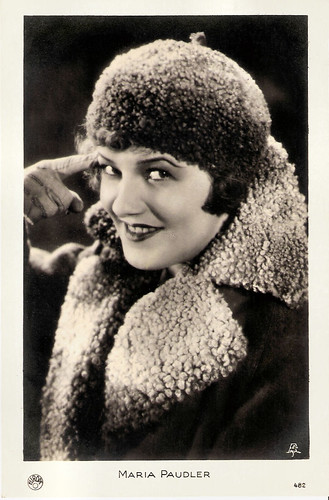
French postcard by Europe, no. 482. Photo: Aafa-Film.

German promotion card by H.C. Stöckel, Hannover-Linden, for Matador Sportwolle. Photo: Ernst Schneider, Berlin.
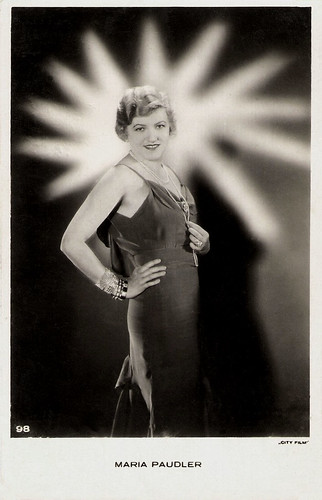
Dutch postcard by City Film, no. 98.
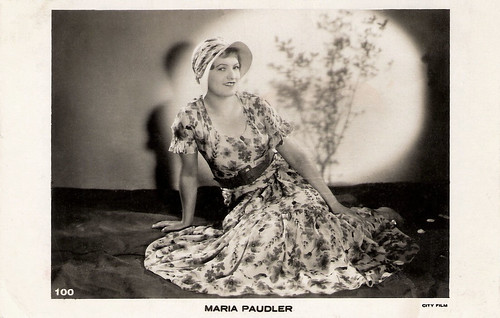
Dutch postcard by City Film, no. 100.
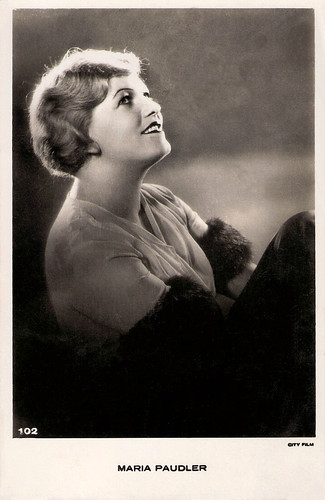
Dutch postcard by City Film, no. 102.

Vintage postcard, no. 3795. Photo: Segall-Film. Gustav Fröhlich and Maria Paudler in So lang' noch ein Walzer vom Strauß erklingt (1931).
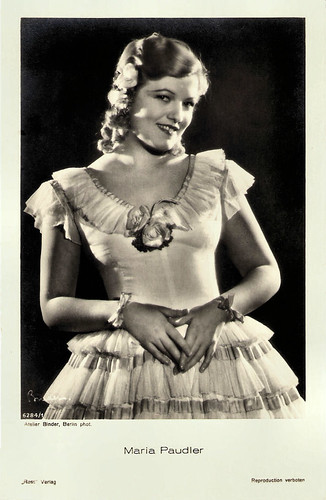
German postcard by Ross Verlag, no. 6284/1, 1931-1932. Sent by mail in the Netherlands. Photo: Alex Binder.

German postcard by Ross Verlag, no. 6311/1, 1931-1932. Photo: Atelier Schenker.
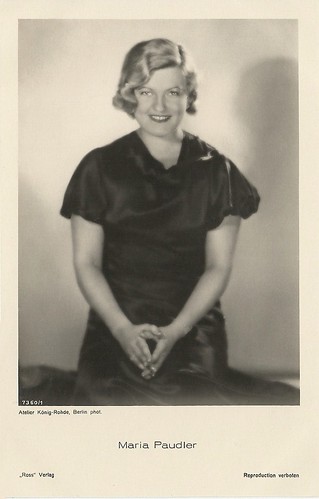
German postcard by Ross Verlag, no. 7360/1, 1932-1933. Collection: Didier Hanson.
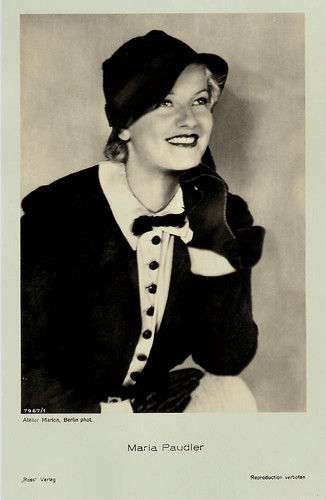
German postcard by Ross Verlag, no. 7967/1, 1932-1933. Photo: Atelier Marion, Berlin.

German collector card in the series 'Vom Werden deutscher Filmkunst - Der Tonfilm', album no. 11, picture no. 53. Photo: Terra-Film / Ross Verlag. Maria Paudler and Harry Liedtke in Wenn am Sonntagabend die Dorfmusik spielt / When the Village Band Plays on a Sunday Evening (Charles Klein, 1933).
Sources: Thomas Staedeli (Cyranos), Philippe Pelletier (CinéArtistes - Now defunct), Wikipedia (German), and IMDb.

No comments:
Post a Comment