
German postcard by Ross Verlag, no. 7492/1, 1932-1933. Photo: Paramount. Larry 'Buster' Crabbe and Frances Dee in King of the Jungle (H. Bruce Humberstone, Max Marcin, 1933). American film star Larry 'Buster' Crabbe (1908-1983) was also a two-time Olympic swimmer. He was the only actor who played Flash Gordon, Buck Rogers and Tarzan - the top three pulp heroes of the 1930s. American actress Frances Dee (1909-2004) got her big break when she was offered a leading role opposite Maurice Chevalier in The Playboy of Paris (1930) by Ludwig Berger. She also starred in Josef von Sternberg's An American Tragedy (1931) and Jacques Tourneur's psychological horror film I Walked With a Zombie (1943).

Italian postcard by ASER, Roma, no. 07. Photo: Lucchi. Trio Lescano or Lescano Trio was a trio of Dutch sisters singing Italian swing: Alexandra (1910-1987), Judith (1913-2007), and Kitty Leschan (1919-1965), whose names were Italianised into Alessandra, Giuditta and Caterinetta (Caterina) Lescano. Trio Lescano was an Italian version of American groups such as the Boswell Sisters and the Andrews Sisters and became extremely popular in Italy in the 1930s and 1940s. Their hits 'Tulipan' and 'Ciribiribin' are evergreens in Italy. In 1943, the golden career of the Jewish girls suddenly halted due to the Nazis, but after the war, two of them continued their careers in Argentina.

Italian postcard by Grafitalia già Pizzi e Pizio, Milano. Photos: Manderfilm. Eduardo De Filippo, Peppino De Filippo, Cesco Basecchio and Paolo Bonecchi in Il Sogno di Tutti / The Dream of Everything (Oreste Biancoli, Ladislao Kish, 1940). Neapolitan actor Eduardo De Filippo (1900-1984) was also a playwright, screenwriter, author and poet, best known for his plays Filumena Marturano and Napoli Milionaria. He began to direct films in 1940. During the 1950s, he turned out a string of successful light comedies, many based on his plays. In addition to writing and directing his films, he wrote or collaborated on films with such directors as Vittorio De Sica. His brother, the comic actor Peppino De Filippo (1903-1980) was a star of theatre, television and cinema. He started his career on stage with Eduardo and their sister Titina. In the 1950s and 1960s, he became the partner of Totó in very popular comedy films and appeared in two classics by Federico Fellini.

Austrian collector card by Amag. Photo: Hugo Engel Film. Dolly Haas in Scampolo, ein Kind der Straße / A Girl of the Street (Hans Steinhoff, 1932). German-born, British stage and screen actress Dolly Haas (1910-1994) was popular in the 1930s as a vivacious, red-haired gamine often wearing trousers in German and British films. Although she got a 3-year contract with Columbia and worked in Hollywood with Alfred Hitchcock, Dolly's American career mainly took place on and Off-Broadway.

Spanish postcard, no. 2341. Photo: Paramount. Hedy Lamarr and Victor Mature in Samson and Delilah (Cecil B. DeMille, 1949). Glamorous and seductive film star Hedy Lamarr (1913–2000) was born in Austria. The notorious Czechoslovak film Extase / Ecstasy (1933) made her an international sensation, and Louis B. Mayer invited her to Hollywood, where she became ‘the most beautiful woman in films’. Hunky American leading man Victor Mature (1913-1999) starred in Biblical Epics like Samson and Delilah (1949) and The Robe (1953), and was known for his dark good looks and mega-watt smile. He also appeared in the classics One Million B.C. (1940), My Darling Clementine (1946), Kiss of Death (1947), and in a large number of musicals opposite such stars as Rita Hayworth and Betty Grable.
Alexander Verlag

German postcard by Alexander Verlag, Berlin. Photo: Jean-Claude Sauer / Paris Match / Scoop. Caption: Claude Sautet and Romy Schneider, 1971. The postcard was issued to promote the book 'Claude Sautet - Regisseur der Zwischentöne'. At the film book fair, the Berlin publishing company Alexander Verlag presented several recent film publications. Some were accompanied by free cards.

German postcard by Alexander Verlag, Berlin, 2026. The card promotes the books 'Mein letzter Seufzer' (Luis Buñuel, Mon dernier soupir) by Luis Buñuel and 'Buñuels Erwachen' (Le Réveil de Buñuel) by Jean-Claude Carrière.

German postcard by Alexander Verlag, Berlin. Photo: Klaus Mettig. Caption: Jack Smith in Köln / Cologne, 1974. Promotion card for the book 'Jack Smith - What's Underground About Marshmallows? Texts by and about Jack Smith'. Jack Smith (1932–1989) was an American filmmaker, actor, and pioneer of underground cinema. He is a founding father of American performance art and has been critically recognised as a master photographer.

German postcard by Alexander Verlag, Berlin. Michael Caine in Blue Ice (Russell Mulcahy, 1992). With his spectacles and his Cockney accent, Michael Caine (1933) became an unusual but ultra-cool star of the British cinema of the 1960s. He starred in memorable films like Alfie (1966), The Italian Job (1969), and Get Carter (1971). The lean and tall Brit branched out to Hollywood, where his film choices often seemed dictated by his chequebook. Caine proved to be endurable, and a new generation of film fans love him for his mentors and father figures in blockbusters like The Dark Knight trilogy, Inception (2010) and Interstellar (2014).
Festival promotion cards

Italian card by Cineteca Bologna for Il Cinema Ritrovato Edizione XL, 2026. Photo: Catherine Spaak, Enrico Maria Salerno, Marc Michel (right) and María Fernanda Ladrón de Guevara (left) in La Bugiarda / Six Days a Week (Luigi Comencini, 1965). I loved this hilarious sixties comedy. It's so sad that Il Cinema Ritrovato stopped making programme cards for the screenings at the Piazza Maggiore. These cards were wonderful with great pictures and text only on the flip side. I miss them.

Italian promotion card for Le Giornate del Cinema Muto / Pordenone Silent Film Festival 45. Photo: Collection La Cinémathèque française. Fern Andra and Hans Heinrich von Twardowski in Genuine (Robert Wiene, 1920). Ivo Blom will attend Le Giornate to present the new website of the Museum of Dream Worlds.
Viva Varda!
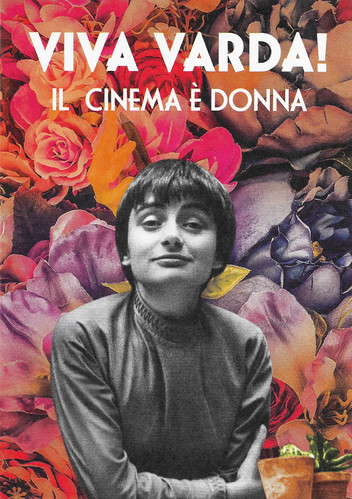
Italian promotion card by Cineteca Bologna for the exhibition 'Viva Varda! - Il Cinema è Donna'. Photo: self-portrait by Agnès Varda, circa 1950. Caption: Bologna, Galleria Modernissimo, dal 5 marzo 2026 al 10 gennaio 2027.

French postcard by Ciné-tamaris, 2022. Design: Christophe Vallaux. Caption: May 1955, I take a train in third class and arrive in Cannes. My baggage includes a sturdy canvas sack with a wooden bottom. It contains the 7 reels of my first film, La Pointe Courte. It weighs 30 kilos! Agnès Varda.

French postcard by Ciné-tamaris, 2023. Design: Christophe Vallaux. Caption: The North Sea and the sand – that’s where it all began for me. The beginning of what I more or less know about myself. All the holidays of my childhood. And when I hear the names Knokke-Heist, Blankenberge, Ostend, Mariakerke, Middelkerke, La Panne and Zeebrugge, they are music to my ears. Agnès Varda.

French poster postcard card by Ciné-tamaris, 2024. French film poster for L'Une chante, l'autre pas (Agnès Varda, 1977). Design: Patrick Tanguy / Nuit de Chine, 2018, based on the original poster by Michel Landi. Caption: ‘This feminist film, made in 1976, highlighted and set to music the struggles for the right to contraception and abortion. Other struggles continue: for equal pay, for gender parity in decision-making bodies, and so on. This will require a commitment from everyone to change their behaviour.’ Agnès Varda.

Sticker. Agnès Varda and JR.
Next week, the third and final 'souvenirs from Bologna' post will follow.

No comments:
Post a Comment