30 September 2017

The Student Prince in Old Heidelberg (1927)

We're so sad that we can't be in Italy to join Le Giornate del Cinema Muto in Pordenone this year. The 36th edition starts today and continues till 7 October. EFSP will do a festival post every day on one of the silent stars or the films than can be seen in Pordenone. We wish director Jay Weissberg good luck on his second edition which has a really delightful programme. Our series starts with a post on the closing event of the festival, Ernst Lubitsch's classic The Student Prince in Old Heidelberg (1927), featuring Ramón Novarro.
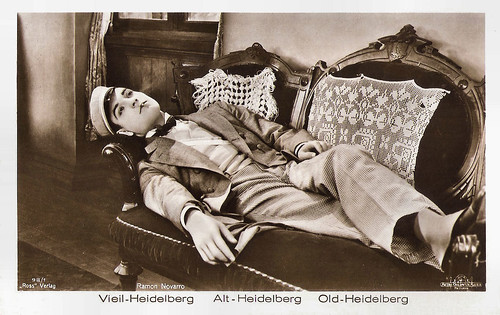
Ramon Novarro in The Student Prince of Old Heidelberg (1927), Lubitsch
German postcard by Ross Verlag, no. 98/1. Photo: Metro-Goldwyn-Mayer. Publicity still for The Student Prince in Old Heidelberg (Ernst Lubitsch, 1927).
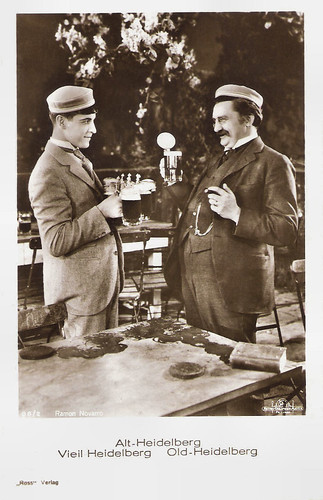
Ramon Novarro and Jean Hersholt in The Student Prince of Old Heidelberg (1927)
German postcard by Ross Verlag, no. 98/2. Photo: Metro-Goldwyn-Mayer. Publicity still for The Student Prince in Old Heidelberg (Ernst Lubitsch, 1927) with Ramon Novarro and Jean Hersholt.
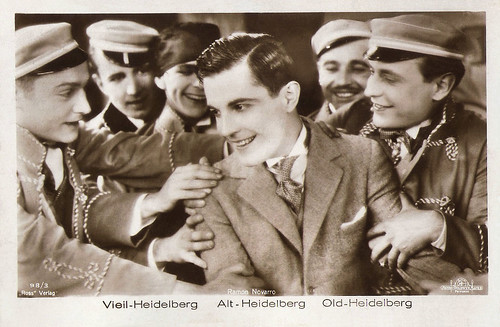
Ramon Novarro in The Student Prince of Old Heidelberg (1927)
German postcard by Ross Verlag, no. 98/3. Photo: Metro-Goldwyn-Mayer. Publicity still for The Student Prince in Old Heidelberg (Ernst Lubitsch, 1927).
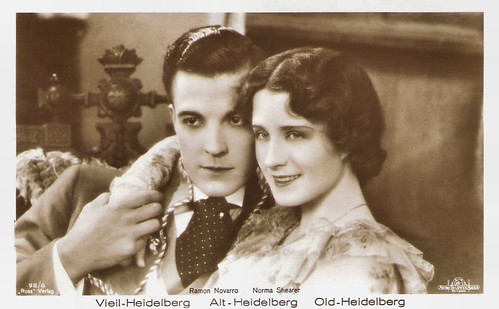
Ramon Novarro and Norma Shearer in The Student Prince in Old Heidelberg (1927)
German postcard by Ross Verlag, no. 98/6. Photo: Metro-Goldwyn-Mayer. Publicity still for The Student Prince in Old Heidelberg (Ernst Lubitsch, 1927) with Ramon Novarro and Norma Shearer.
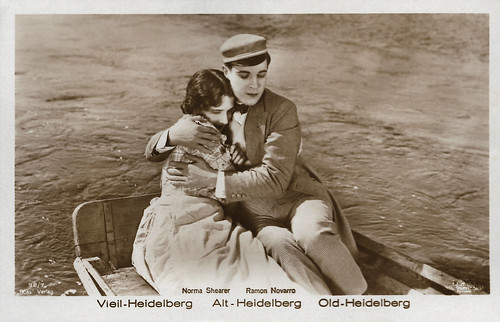
Ramon Novarro and Norma Shearer in The Student Prince in Old Heidelberg (1927)
German postcard by Ross Verlag, no. 98/7. Photo: Metro-Goldwyn-Mayer. Publicity still for The Student Prince in Old Heidelberg (Ernst Lubitsch, 1927) with Ramon Novarro and Norma Shearer.

A Viennese fairy tale


The American silent film The Student Prince in Old Heidelberg (1927), also known as The Student Prince, The Student Prince of Old Heidelberg and Old Heidelberg, is a Viennese fairy tale. The Metro-Goldwyn-Mayer production is based on the 1901 play Alt Heidelberg (Old Heidelberg) by Wilhelm Meyer-Förster. The script was written by Hanns Kräly and Karl Heinrich with titles by Marian Ainslee and Ruth Cummings.

MGM's executive producer Irving Thalberg initially planned to have Erich von Stroheim direct this film as a follow-up to the director's commercial success The Merry Widow. Stroheim declined, opting instead to leave MGM and begin work on The Wedding March (1928). Thalberg then tried to attach E.A. Dupont, and then John S. Robertson to the project, but both passed on it. He settled on thirty-four-year-old German émigré Ernst Lubitsch.

Wikipedia serves up the plot in detail: Young Crown Prince Karl Heinrich (Philippe De Lacy), heir to the kingdom of Karlsburg, is brought to live with his stern uncle, King Karl VII (Gustav von Seyffertitz). The king immediately dismisses the boy's nanny (Edythe Chapman) without telling the youngster to avoid an emotional farewell. Fortunately, Dr. Friedrich Jüttner (Jean Hersholt), his new tutor, proves to be sympathetic, and they become lifelong friends. Nonetheless, despite the commoners' belief that it must be wonderful to be him, the boy grows up lonely, without playmates his own age.

Upon passing his high school examination in 1901 with the help of Dr. Jüttner, the young prince (Ramon Novarro) is delighted to learn that both he and Jüttner are being sent to Heidelberg, where he will continue his education. When they arrive, Karl's servant is appalled at the rooms provided for the prince and Jüttner at the inn of Ruder (Otis Harlan). When Ruder's niece Kathi (Norma Shearer) stoutly defends the centuries-old family business, Karl is entranced by her, and decides to stay. He is quickly made a member of Corps Saxonia, a student society.

Later that day, Karl tries to kiss Kathi, only to learn that she is engaged. Her family approves of her fiance, but she is not so sure about him. She eventually confesses to Karl that, despite the vast social gulf between them, she has fallen in love with him. Karl feels the same about her and swears that he will let nothing separate them. When he takes her boating, their rower, Johann Kellermann (Bobby Mack), turns his back to them to give them some privacy. Karl jokingly tells him that, when he is king, he will make Kellermann his majordomo.

Then Jüttner receives a letter from the king ordering him to inform Karl that he has selected a princess for him to marry. Jüttner cannot bring himself to destroy his friend's happiness. That same day, however, Prime Minister von Haugk (Edward Connelly) arrives with the news that the king is seriously ill, and that Karl must go home and take up the reins of government. When Karl sees his uncle, he is told of the matrimonial plans. While Karl is still reeling from the shock, the old king dies, followed by Jüttner.

Later, von Haugk presses the new monarch about the marriage. The anguished Karl signs the document for the wedding. Then Kellermann shows up to take the job Karl had offered him. When Karl asks him about Kathi, he learns that she is still waiting for him. He goes to see her one last time. In the last scene, Karl is shown riding through the streets in a carriage with his bride, the princess. One onlooker remarks that it must be wonderful to be king, unaware of Karl's misery.
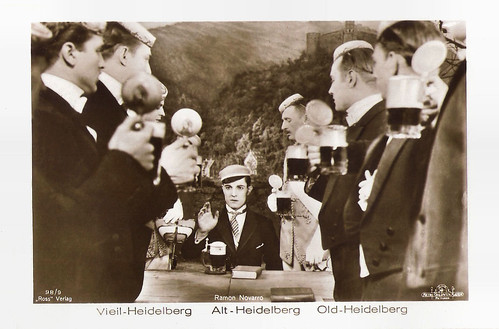
Ramon Novarro in The Student Prince of Old Heidelberg (1927)
German postcard by Ross Verlag, no. 98/9. Photo: Metro-Goldwyn-Mayer. Publicity still for The Student Prince in Old Heidelberg (Ernst Lubitsch, 1927).
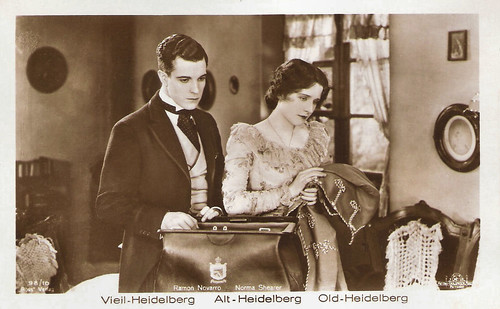
Ramon Novarro and Norma Shearer in The Student Prince in Old Heidelberg (1927)
German postcard by Ross Verlag, no. 98/10. Photo: Metro-Goldwyn-Mayer. Publicity still for The Student Prince in Old Heidelberg (Ernst Lubitsch, 1927) with Ramon Novarro and Norma Shearer.
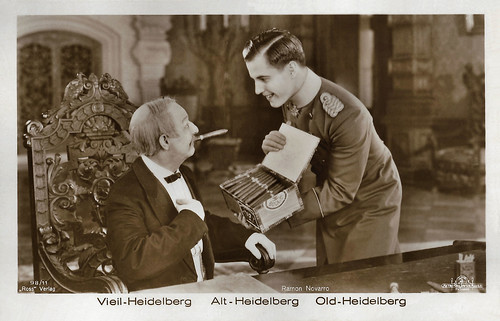
Ramon Novarro and Bobby Mack in The Student Prince in Old Heidelberg
German postcard by Ross Verlag, no. 98/11. Photo: Metro-Goldwyn-Mayer. Publicity still for The Student Prince in Old Heidelberg (Ernst Lubitsch, 1927) with Ramon Novarro and Bobby Mack.
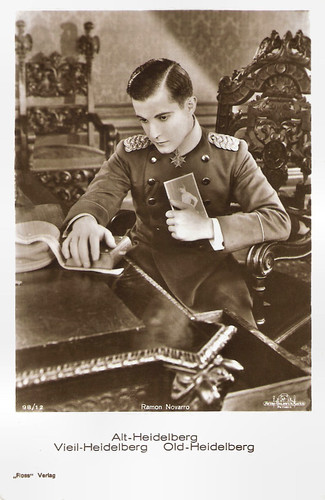
Ramon Novarro in The Student Prince of Old Heidelberg (1927)
German postcard by Ross Verlag, no. 98/12. Photo: Metro-Goldwyn-Mayer. Publicity still for The Student Prince in Old Heidelberg (Ernst Lubitsch, 1927).

A scintillating example of the artistry of Ernst Lubitsch


Ramon Novarro was cast as the Student Prince after John Gilbert was considered. Ernst Lubitsch felt that both Novarro and Shearer were miscast, but was unable to override the studio's casting decisions. According to Wikipedia, Lubitsch's insistence on multiple takes and minimal rehearsal time were hard on both leads. Shearer even complained to Thalberg, her fiance, about Lubitsch's penchant for acting out scenes for the actors before they were shot. Thalberg told her that "everyone has a lot to learn from Lubitsch."

The love scene in the beer garden, which is acclaimed as one of the best scenes in the film by modern critics, was allegedly a headache for the director, who had it reshot entirely, but was still unhappy with it. It was rumoured that the love scene in the film was reshot by John M. Stahl, but Lubitsch's assistant on the film, Andrew Marton, denied this.

The Student Prince in Old Heidelberg was in production for more than 108 days. The result is a supremely artificial and studio-built film, contrasting the voluminous sets of the Karlsburg Palace with the warmer interiors and exteriors of the Heidelberg taverns and beer gardens. Ernst Lubitsch drove up the budget significantly, infuriating the studio. For instance, he had costume designer Ali Hubert bring thirty-two trunks of wardrobe and props from Europe for use in the film.

Though now considered a classic, it was far from a unanimous critical success during its original theatrical run. In a review for The New York Times, Mordaunt Hall wrote, "Mr. Novarro is natural and earnest, but he is a little too Latin in appearance for the rôle. Norma Shearer is attractive as Kathi. She, however, does not seem to put her soul into the part. She, too, acts well, but, like Mr. Novarro, she does not respond, as other players have done, to Mr. Lubitsch's direction. The ablest acting in this piece of work is done by Jean Hersholt as Dr. Guttner (sic) and Gustav von Seyffertitz as the King. Their efforts in all their scenes reveal their sensitiveness to the direction."

Despite being a popular film with filmgoers, the exorbitant production cost of The Student Prince in Old Heidelberg (IMDb estimates it as $1.205.000) kept it from making a profit. The film lost $307,000, according to Wikipedia.

Today many viewers consider it one of Lubitsch's finest silent films. Adrian Banks at Senses of Cinema: "The Student Prince in Old Heidelberg is one of Lubitsch’s most surprising, nostalgic and emotionally engaging films. It represents a 'return to Germany' after four years in Hollywood, and can be seen as something of a watershed between his initial works for Warner Bros., then a significantly less important studio than it would soon become, and his extraordinary ten or so year tenure at Paramount."

Greg Carleton at IMDb: "I found this film an absolute delight. All of the leads put in outstanding performances. The romance between Prince Karl (Ramon Novarro) and Kathi (Norma Shearer) is wonderfully presented, and it is truly poignant." Ron Oliver at IMDb: "This wonderful, exuberant, heartbreaking film - one of the last major movies of the Silent Era - is a scintillating example of the artistry of director Ernst Lubitsch. Filled with wry humor & aching pathos, Lubitsch tells a tale which is a persuasive paean to the power of the talkless film." We totally agree.

Ramon Novarro in The Student Prince in Old Heidelberg
German postcard by Ross Verlag, no. 3608/1, 1928-1929. Photo: Metro-Goldwyn-Mayer. Novarro wears the outfit of The Student Prince in Old Heidelberg (Ernst Lubitsch, 1927) at the end of the film (though it may have been recycled for a later film, as the Ross number suggests).


Trailer The Student Prince in Old Heidelberg (1927). Source: TV Movie Trailer (Daily Motion).

Sources: Adrian Banks (Senses of Cinema), Greg Carleton (IMDb), Ron Oliver (IMDb), Wikipedia and IMDb.

29 September 2017

Dood water (1934)

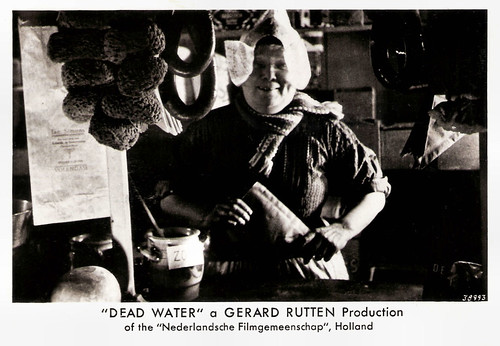
Every year during the last week of September, Utrecht is the Dutch capital of film. This is the time of the Netherlands Film Festival (NFF), and traditionally EFSP organises its own Unofficial Netherlands Film Star Postcard Festival. Today we present one of the most remarkable Dutch films of the 1930s. Dood water/Dead Water (1934) re-enacts the historical closing of the Zuiderzee (Southern Sea) between 1927 and 1932. The award-winning drama was directed and co-written by Gerard Rutten and starred renowned Dutch stage actor Jan Musch as a doomed fisherman.

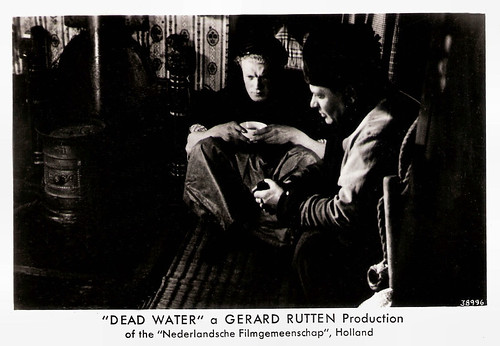
Max Croiset and Arnold Marlé in Dood water
Dutch postcard, no. 38996. Photo: Nederlandse Filmgemeenschap, Holland. Publicity still for Dood water/Dead water (1934) with Max Croiset and Arnold Marlé. Collection: Geoffrey Donaldson Institute.

Dead Water


The social drama Dood water/Dead Water (Gerard Rutten, 1934) opens with a prologue about the Netherlands' everlasting battle against the sea and the history of the Afsluitdijk ('enclosure dam'). It's accompanied by music played by the Amsterdam Concertgebouworkest led by conductor Willem Mengelberg.

Dood water/Dead Water tells about a conflict between young and old fishermen in the little village of Volendam about the fishing in the Zuiderzee (the former Southern Sea, now IJsselmeer).

In 1927, the construction of the Afsluitdijk (the enclosure dam which made a lake of the Zuiderzee) was started. In Volendam, there is talk of 'dead water' and people realise that everything will not be like it was.

Fisherman Dirk Brak (Arnold Marlé) encourages his son Jan (Max Croiset) to become a farmer, but his brother-in-law, fisherman Willem de Geus (Jan Musch), wants radical action against the Afsluitdijk while his helper Jaap (Theo de Maal) recognises the opportunities that land reclamation brings.

Jaap becomes a civil servant, an act which makes him a traitor in the eyes of the villagers. Desperately, the old Willem de Geus tries to blow up the dam, but he dies during the explosion. The 30,000-meter-long Afsluitdijk was ready on 28 May 1932.

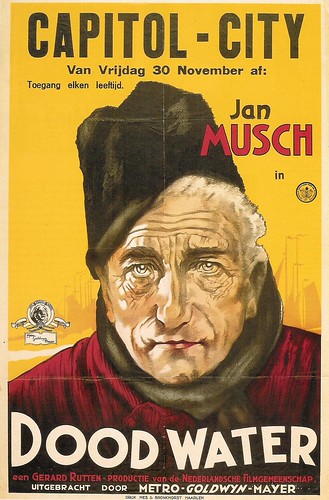
Dood water
Dutch poster for Dood water/Dead Water (Gerard Rutten, 1934). Collection: EYE Filmmuseum.

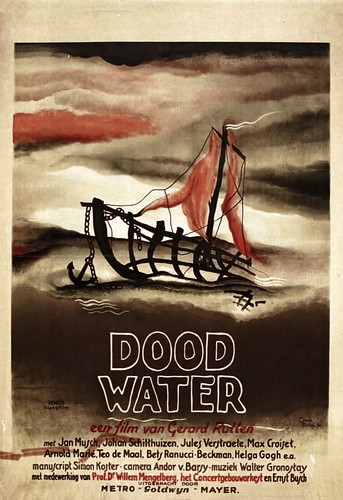
Dood water (1934)
Dutch poster for Dood water/Dead Water (Gerard Rutten, 1934). Design: Gerard Rutten. Collection: EYE Filmmuseum.

Golden Lion


Dood water/Dead Water was largely shot on location, using natural light. The cameraman was Andor von Barsy, a respected Hungarian-Austrian cinematographer who’d already been successful in the Netherlands with short avant-garde films such as Hoogstraat/High Street (Andor von Barsy, 1929) about a Rotterdam shopping street.

At the second edition of the Venice Film Festival (Mostra Internazionale d'Arte Cinematografica) in 1934, the film won a Golden Lion for Best Cinematography.

Dood water received favourable reviews in the Italian press, and later also in the Netherlands. There was a German spoken version. Totes Wasser, the only Dutch feature film from the 1930s that reached the German cinemas. The film was very well received in Germany. Goebbels reportedly used Totes Wasser as a compulsory teaching material for German film students.

Important for the artistic success of the film was the photography by Andor von Barsy and the soundtrack. German artist Ernst Busch, who was very popular in The Netherlands at the time, sang an impressive Dutch version of the song 'Solidaritätslied' (Solidarity Song), composed by Walter Gronostay and conducted by Willem Mengelberg, during the documentary prologue of the film.

Writing for the British The Spectator, Graham Greene praised this prologue as "an exciting piece of pure cinema", and commented that the story which follows "has some of the magnificent drive one felt behind the classic Russian films, behind Earth and The General Line: no tiresome 'message', but a belief in the importance of a human activity truthfully reported". Greene also noted, however, that "the photography is uneven: at moments it is painfully 'arty', deliberately out of focus". MGM distributed the low-budget production internationally. However, the film was not a commercial success.

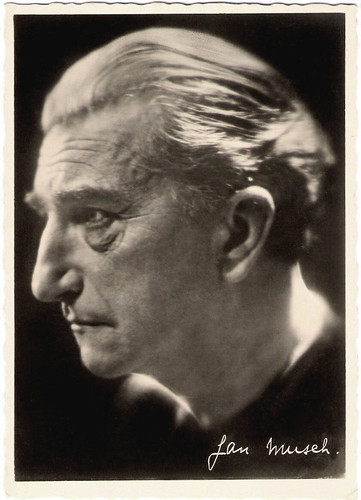
Jan Musch
Jan Musch. Dutch postcard by REB in the series Portrettengalerij, no. 105.

One of the great stars


The leading actor of Dood water, Jan Musch (1875-1960), was one of the great stars of the Dutch theatre during the first decades of the 20th Century.

In the 1930s, he starred in a few Dutch films, including De Man zonder hart/The Man Without a Heart (Leo Joannon, 1937), and the thriller De spooktrein/The Ghost Train (Carl Lamac, 1939) with Fien de la Mar.

After the war, Gerard Rutten directed successful light entertainment films like Sterren stralen overal/Stars Twinkle Everywhere (Gerard Rutten, 1953), about a struggling taxi driver (Johan Kaart) who dreams of emigrating to Australia, and Het wonderlijke leven van Willem Parel/The Wondrous life of Willem Parel (Gerard Rutten, 1955) with comedian Wim Sonneveld who has enough of his most popular character, Willem Parel the organ grinder, and tries to get rid of him.

Less successful was his biopic De vliegende Hollander/The Flying Dutchman (Gerard Rutten, 1957), about the early life of Dutch aircraft manufacturer Anthony Fokker.

Gerard Rutten could only make one more film, Wederzijds (Gerard Rutten, 1963), a documentary about Queen Wilhelmina. He died in 1982 at the age of 79.

Dood water
Dutch postcard, no. 38993. Photo: Nederlandse Filmgemeenschap, Holland. Publicity still for Dood water/Dead water (1934). Collection: Geoffrey Donaldson Institute.

Listen here to the song 'Solidaritätslied' as sung by Ernst Busch. Source: WillemMengelberg.nl.

Sources: Eye Film, Filmtotaal (Dutch), Movie Meter (Dutch), Wikipedia (Dutch and English) and IMDb.

This post was last updated on 10 November 2023.

27 September 2017

Jan Tříska (1936-2017)

Last Monday, 25 September 2017, Czech actor Jan Tříska (1936-2017) died, more than a day after falling from Prague's iconic Charles Bridge. After an impressive career in the European cinema, he was forced to leave Communist Czechoslovakia and emigrated to California. There he appeared in such films as The Karate Kid Part III (1989) and Milos Forman's The People vs Larry Flynt (1996), but he later did his most interesting film work in the Czech Republic, such as in Jan Svankmayer’s macabre, bizarre animation film Sílení/Lunacy (2005). Tříska was 80.

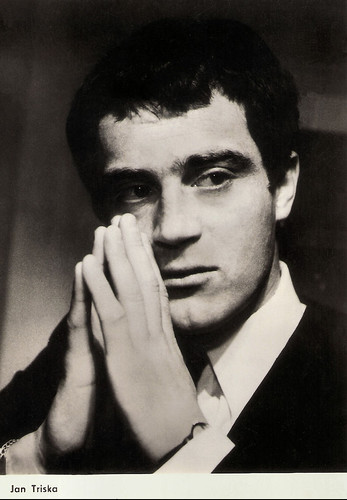
Jan Triska (1936-2017)
East-German postcard by VEB Progress Film-Vertrieb, no. 3147, 1968.

A half-wild creature from the African jungle


Jan Triska or Jan Tříska was born in Prague, Czechoslovakia (now Czech Republic), in 1936.

From 1957 on, he performed numerous roles in both the Czech theatre and cinema. He made his film debut in the lead role of the Czech comedy Váhavý strelec/The Hesitant Marksman (Ivo Toman, 1957) with Jaroslav Marvan. With Marvan, he also appeared in the romantic drama Pet z miliónu/Five Out of a Million (Zbynek Brynych, 1959).

In the following years, he mostly played small or supporting roles in Czech films, such as in Tarzanova smrt/The Death of Tarzan (Jaroslav Balík, 1963), a dark comedy about a half-wild creature from the African jungle, which has been identified as a heir of the noble family, set in Germany in the 1930s.

Other example are the comedy Komedie s Klikou/Comedy Around a Door Handle (Václav Krska, 1964), and the war drama Hvezda zvaná Pelynek/A Star Named Wormwood (Martin Fric, 1965), both starring Jirina Bohdalová. Triska also played a small part in the West-German film Das Haus in der Karpfengasse/The House in Karp Lane (Kurt Hoffmann, 1965), starring Jana Brejchová. The film won five German Film Awards.

Triska starred as an acrobat in the circus drama Lidé z maringotek/Life on Wheels (Martin Fric, 1966) and appeared in a leading role in the crime film Martin a cervené sklícko/A New Case for Master Detective Martin (Milan Vosmik, 1967), featuring Jaroslav Vízner. He also played a jewel robber in the crime film Hra bez pravidel/Jewel Robbers are Hunted (Jindrich Polák, 1967) , and a murder suspect in the thriller Ctyri v kruhu/Four in a Circle (Milos Makovec, 1968).

From then he also often worked for TV. In 1970, he co-starred in the fantasy Radúz a Mahulena/Radúz and Mahulena (Petr Weigl, 1970), with Magda Vásáryová, and in the comedy-fantasy Lucie a zazraky/Lucie and the Miracles (Ota Koval, 1970). He co-starred with Jana Brejchova in the screwball comedy Slecna Golem/Miss Golem (Jaroslav Balík, 1972), and had a supporting part in the East-German romantic drama Wie füttert man einen Esel/How to feed a Donkey (Roland Oehme, 1974) with Manfred Krug.

Tříska also played supporting parts in Jiri Menzel’s comedy-drama Na samote u lesa/Seclusion Near a Forest (1976), the award winning West-German film Der Mädchenkrieg/Maiden's War (Alf Brustellin, Bernhard Sinkel, 1977) and the East-German satire Ein irrer Duft von frischem Heu/A Terrific Scent of Fresh Hay (Roland Oehme, Karl-Heinz Lotz, 1977).

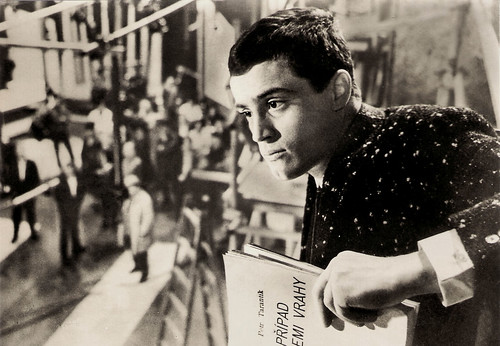
Jan Triska (1936-2017)
East-German postcard by VEB Progress Film-Vertrieb, Berlin, no. 2696, 1966. Publicity still for Pet miliónu svedku/Five Million Witnesses (Eva Sadková, 1965).

The assassin of Larry Flynt


Jan Tříska left Czechoslovakia in 1977 after signing a human rights manifesto inspired by his close friend, dissident playwright Václav Havel. He emigrated to the United States via Cyprus. He settled in Los Angeles and found work in his fellow Czech Miloš Forman's film Ragtime (1981), in which he played a small role as a special reporter.

That year, he also played Karl Radek in Warren Beatty’s Oscar winner Reds (1981). Other small parts followed in well-known films as the thriller The Osterman Weekend (Sam Peckinpah, 1983) starring Rutger Hauer, and 2010 (Peter Hyams, 1984), the sequel to Stanley Kubrick's 1968 science fiction epic 2001: A Space Odyssey.

His most notable Hollywood part was probably that of Milos, the loyal butler and personal assistant to Mr. Terry Silver (Thomas Ian Griffith), in The Karate Kid Part III (John G. Avildsen, 1989), starring Ralph Macchio. Tříska’s films were banned from Czechoslovakian cinemas and TV screens until the fall of communism in 1989.

After the anti-communist Velvet Revolution led by Havel, Tříska regularly returned home to appear in stage productions and films. He took a lead role in the comedy Obecná skola/The Elementary School (Jan Sverák, 1991), which was nominated for an Academy Award. He was again remarkable as the assassin of Larry Flynt (Woody Harrelson) in The People vs. Larry Flynt (Milos Forman, 1996).

Tříska also appeared on television, in popular series such as Quantum Leap (1990) and Highlander: The Series (1999), and in the TV film Andersonville (John Frankenheimer, 1996). On stage, he starred as the Devil in a New York Public Theater adaptation of The Master and Margarita. His later films include Hollywood productions such as Apt Pupil (Bryan Singer, 1998) with Ian McKellen, Ronin (John Frankenheimer, 1998), starring Robert De Niro, and Cahoots (Dirk Benedict, 2001).

From then on, he found his most interesting work in the Czech Republic, such as in the award winning drama Rok dábla/Year of the Devil (Petr Zelenka, 2002) with pop star Jaromir Nohavica, the romantic drama Zelary (Ondrej Trojan, 2003) and the comedy drama Horem pádem/Up and Down (Jan Hrebejk, 2004).

Tříska starred as a mysterious Marquis in Sílení/Lunacy (2005), Jan Svankmajer’s award winning animation film based on a story by Edgar Allan Poe and texts by Marquis De Sade. Craig Butler at AllMovie: “In the lead role, Pavel Liska is quite good; with his haunted, hangdog eyes, he conveys quite well the tortured, confused soul of his character. Even better is Jan Triska as the Marquis; his eyes sparkle with a devilish gleam that is both repellent and mesmerizing, and his braying cackle reveals as much about him as any of the dialogue he spouts."

Most recently, Triska appeared as a grandfather in Po strnisti bos/Barefoot (Jan Sverák, 2017) about a small boy, who is forced to move out of Prague during World War 2 to a small village of Slavonice where he meets the rest of his family. IMDb announces at the moment of writing still a new project in pre-production Na Strese (2018), to be directed by Jirí Mádl. Triska was due to begin work on the new Czech film last Monday. The project has now been postponed.

Prague theatre director Jan Hrušínský confirmed Tříska’s death on Monday. The actor died in Prague’s military hospital overnight due to injuries from the fall on Saturday, the circumstances of which remain unclear. Two passengers on a nearby boat rescued him from the Vltava river, after which he was resuscitated and hospitalised in serious condition. Prior to his identity being revealed, Prague firefighters tweeted that he had jumped from the bridge.

Jan Tříska had two daughters, Karla and Jana, with actress Karla Chadimová, and also had a grandson named Augustin.


Czech trailer for Obecná skola/The Elementary School (1991). Sorry, no subtitles. Source: Jan Svěrák (YouTube).


Trailer for Šílení/Lunacy (2005). Source: Zeitgeist Films (YouTube).

Sources: Craig Butler (AllMovie), Radio Praha,  The Guardian, Wikipedia and IMDb.

Kveta Fialová (1929-2017)

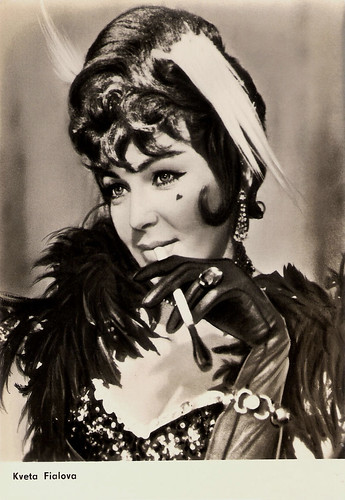
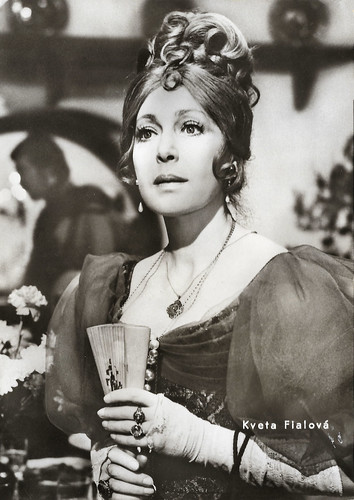
Yesterday, 26 September 2017, Czech actress Květa Fialová (1929) has passed away. In her country, she was a popular theatre, film and television diva. Internationally she is best known for her role as bar singer Tornado Lou in the Western parody Limonádový Joe aneb Konská opera/Lemonade Joe (1964).

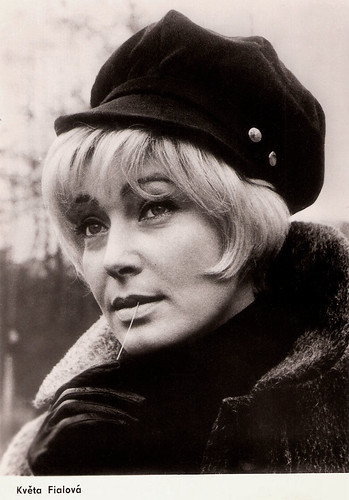
Kveta Fialová
East-German postcard by VEB Progress Film-Vertrieb, no. 3170, 1968. Retail price: 0,20 DM. Photo: Progress.

Kveta Fialova (1929-2017)
East-German postcard by VEB Progress Film-Vertrieb, no. 2.125, 1964. Photo: Limonádový Joe aneb Konská opera/Lemonade Joe (Oldrich Lipský, 1964).

Traumatic experience


Květa Fialová was born in Veľkých Dravcích (Vel’ké Dravce), Czechoslovakia (now Slovak Republic) in 1929. Her mother was the artist and sculptor Květoslava Fialová and her father was the Czech legionary Vlastimil Fiala.

The family lived in Slovakia until 1938 when the nationalists were driven to the Czech Republic. They moved to Zdar and later to Borohrádku. At the end of the war, her mother and Kveta were raped by Soviet soldiers, which was the most traumatic experience of her life.

From 1946 to 1950, she studied at the Janáček Academy in Brno. In 1950 she made her film debut with a small part in the drama Veliká prílezitost/The Great Opportunity (K.M. Wallo, 1950). The next years followed supporting roles in Czech films as Stika v rybníce/The Pike in a Fish Pond (Vladimír Cech, 1951), Plavecký mariás/Rivers 1x1 (Václav Wasserman, 1953) and Strakonický dudák/The Strakonice Bagpiper (Karel Stekly, 1955).

Meanwhile, Fialová worked at several regional theatres, in the Czech cities of Těšíně (Cieszyn), Opavě (Opava) and Budějovicích (Budejovice), in Germany in Köln (Cologne), and in Slovakia in Martině (Martin). Since 1958 she was engaged at Prague's Divadlo ABC (ABC Theatre), which at that time was directed by Jan Werich.

In Prague, she had a larger choice of film roles and she appeared in such films as Tenkrát o vánocích/At That Time, at Christmas... (Karel Kachyna, 1958) and Dum na Orechovce/A Suburban Villa (Vladislav Delong, 1959) with Jiri Vala. After the ABC Theatre had merged with the Městskými divadly (Municipal Theatre of Prague) in 1963, she worked there until 1990. In subsequent years, she was a permanent guest actor at the theatre.

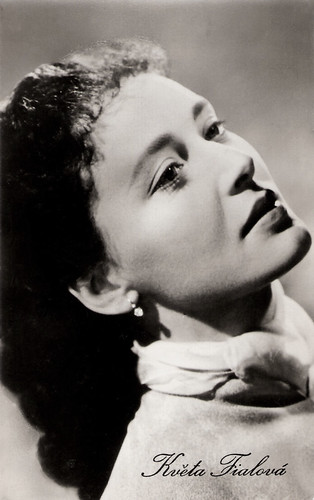
Kveta Fialova (1929-2017)
East-German postcard by VEB Progress Film-Vertrieb, Berlin, no. 727, 1958. Photo: publicity still for Zlaty pavouk/The Golden Spider (Pavel Blumenfeld, 1957).

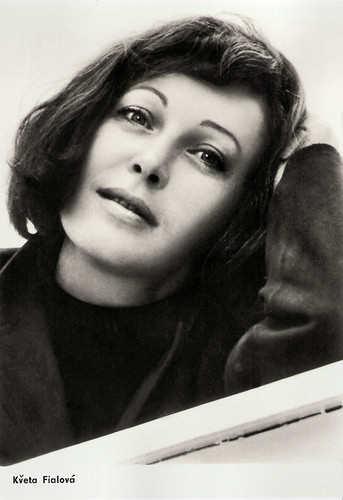
Kveta Fialova (1929-2017)
East-German postcard by VEB Progress Film-Vertrieb, no. 2.645, 1966. Photo: Balinski.

Prague springtime


During her long career, Květa Fialová played many characters in dozens of films. Some of her finest films were made during the Prague Springtime of the early 1960s.

Probably her best-known role is that of bar singer Tornado Lou in the wild and funny Western parody Limonádový Joe aneb Konská opera/Lemonade Joe (Oldrich Lipský, 1964) starring Karel Fiala.

Hal Erickson at AllMovie: "Lemonade Joe is a sweet-natured Czechoslovakian spoof of Hollywood westerns. Hero Lemonade Joe (Carl Fiala) is so named because he refuses to drink the ‘hard stuff’ when he saunters into the local saloon. The plot exaggerates all the supposedly standard cowboy clichés, including dance hall girls with golden hearts, masked rustlers, and the sundown showdown. Halfway through, director Oldrich Lipsky (a graduate of Prague's Satirical Theatre) has nowhere further to go and begins repeating himself - then finds that he has to take certain plot threads seriously to expedite a happy ending. Nonetheless, the overall cheerfulness and virtuosity of the project won Lemonade Joe plenty of critical praise".

Reportedly, the film made Fialová a kind of sex symbol in Eastern Europe. In a satire on the pulp novel, Fantom Morrisvillu/The Phantom of Morrisville (Borivoj Zeman, 1966), she played Hannibal’s fiancee. That year she also played a small part in another internationally successful comedy, Ostre sledované vlaky/Closely Watched Trains (Jirí Menzel, 1966). The film, based on Bohumil Hrabal's novel of the same name, was the recipient of the Academy Award for Best Foreign Language Film in 1967. Vaclav Neckar plays a Czech railroad worker during the Nazi occupation, who becomes attracted to the Czech underground.

Another successful satire was Konec agenta W4C prostrednictvím psa pana Foustky/The End of Agent W4C (Václav Vorlícek, 1967), which was a spoof on the James Bond films. Interesting was also the black comedy Vrazda po cesku/Murder Czech Style (Jirí Weiss, 1968).

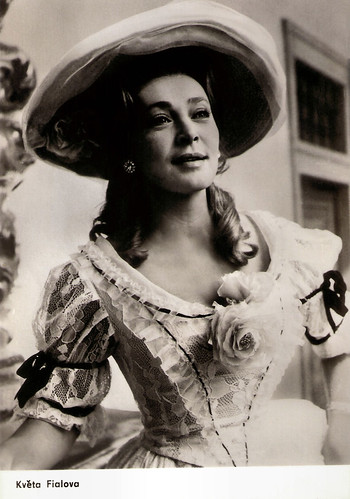
Kveta Fialova (1929-2017)
East-German postcard by VEB Progress Film-Vertrieb, no. 16/69. Photo: publicity still for Jarní vody/Spring Waters (Václav Krska, 1968).

Kveta Fialova in Do zbrane kuruci! (1974)
East-German postcard by VEB Progress Film-Vertrieb, Berlin, no. 101/75. Photo: publicity still for Do zbrane kuruci!/To the guns, rebels! (Andrej Lettrich, 1974).

Nick Carter


After the Soviets had violently broken the Prague Springtime, Květa Fialová continued to make films but the results were less interesting than before.

Her better films of the 1970s include the crime film Partie krásného dragouna/The Matches of a Beautiful Dragoon (Jirí Sequens, 1970), the comedy Slamený klobouk/Straw Hat (Oldrich Lipský, 1972), and another genre spoof, Adéla jeste nevecerela/Nick Carter in Prague (Oldrich Lipský, 1978) with Michal Docolomanský as the legendary American detective Nick Carter.

Fialová also appeared in many television films and series, and also often dubbed foreign programs. During the 1980s and 1990s, she continued to combine her TV and stage work with appearances in films.

These films include the family comedy S tebou me baví svet/Snowmen with Hearts (Marie Polednáková, 1983), the French-Czech fantasy Une trop bruyante solitude/Too Loud a Solitude (Verá Caïs, 1996) starring Philippe Noiret, and the comedy Bájecná léta pod psa/Wonderful Years That Sucked (Petr Nikolaev, 1997).

In the new century, she kept busy playing grandmothers in TV series and films, including the mild comedy Úcastníci zájezdu/Holiday Makers (Jirí Vejdelek, 2006). One of her last stage triumphs was her leading role in the play Harold and Maude.

Květa Fialová was married twice. After an early marriage at 21, she was married to director Pavla Háši from 1957 until he died in 2009. They had a daughter Zuzana (1962). Fialová was now the grandmother of Dominiky.


Trailer for Limonádový Joe aneb Koňská opera/Lemonade Joe (1964). Source: filmexporthomevideo (YouTube).


Trailer of Adéla ještě nevečeřela/Nick Carter in Prague (1978). Source: kl1138 (YouTube).

Sources: Hal Erickson (AllMovie), Milan ‘Gudaulin’ Černý (ČSFD.cz - Czech), Wikipedia (Czech), and IMDb.

This post was last updated on 13 March 2024.

Adele Sandrock

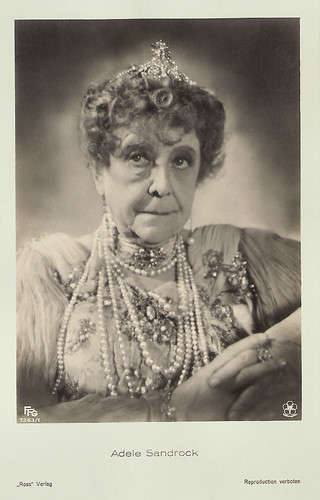
During the Netherlands Film Festival, EFSP presents the Unofficial Dutch Film Star Postcards Festival. Today's subject is Grand German-Dutch actress Adele Sandrock (1863-1937), who had a successful theatrical career all over Europe. In Vienna she had a stormy affair with the famous author Arthur Schnitzler, and enjoyed triumphs as the diva of the modern playwrights. In the 1910s she became one of the first German film stars. After the introduction of sound film, she emerged as a witty comedienne. She excelled as the intimidating elderly dragon, who could also be surprisingly funny and tactful.

Adele Sandrock
German Postcard by Ross Verlag, no. 7363/1, 1933-1934. Photo: FFG. Adele Sandrock in Liebe auf den ersten Ton/Love at First Sight (Carl Froelich, 1932).

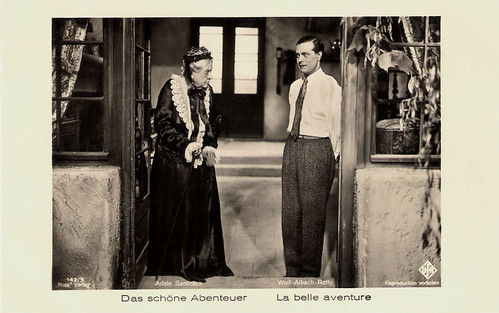
Adele Sandrock and Wolf Albach-Retty in Das schöne Abenteuer (1932)
German postcard by Ross Verlag, no. 142/3. Photo: Ufa. Publicity still for Das schöne Abenteuer/Beautiful Adventure (Reinhold Schünzel, 1932) with Wolf Albach-Retty.

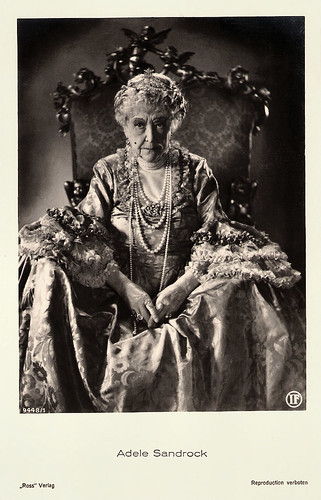
Adele Sandrock in Der Favorit der Kaiserin (1936)
German Postcard by Ross Verlag, no. 9448, 1935-1936. Photo: IF. Publicity still for Der Favorit der Kaiserin/The Favorite of the Empress (Werner Hochbaum, 1936).

Tumultuous Private Life


Adele Sandrock was born as Adele Feldern-Förster in Rotterdam in the Netherlands in 1863 (some sources say 1864). She was the youngest of three children of the German businessman Eduard Othello Sandrock and the Dutch ballet dancer and actress Nan ten Hagen. Her siblings were painter and author Christian Sandrock and actress Wilhelmine Sandrock.

In 1875 the family moved to Berlin. Three years later, Adele was discharged from school, and she tried to become an actress. Only 15, she made her debut in the comedy 'Mutter und Sohn' (Mother and Son) by Charlotte Birch-Pfeiffer at the Urania theatre in a Berlin suburb.

Later, she asked the Duke of Meiningen in a letter to engage her at the Hoftheater (Court Theatre). She chose a scene from 'Kabale und Liebe' (Intrigue and Love) by Friedrich Schiller to show off her talent. The Duchess, a former actress, was so delighted by her acting that Sandrock received a three-year contract.

When the famous actor Joseph Kainz refused to play her lover, she was deeply hurt and left Meiningen after only one year. She played in theatres in Moscow and Budapest and also worked in Spain and France. In 1889 she moved to Vienna, where she had her breakthrough in the title role of Isabella in 'The Clemenceau Case' by Alexandre Dumas and Armand d'Artois at the Theater an der Wien.

From 1889 to 1895 she played at the Deutschen Volkstheater (German National Theatre) in Vienna. In 1893 she met the poet Arthur Schnitzler and the two had a tempestuous love affair that lasted for two years. In his works 'Der Reigen' (The Dance), 'Halbzwei' (Two and Half) and 'Haus Delorme' (House Delorme), Schnitzler used his memories of Adele Sandrock. Their intimate correspondence was published in book form.

In Vienna, Sandrock became a star, and her tumultuous private life and her breach of contracts created some scandals. She became the diva of the 'Wiener Moderne’, the Austrian avant-garde movement. She created a number of major roles for such modern playwrights as Henrik Ibsen (in 'Rosmersholm') and Arthur Schnitzler (in 'Das Märchen' (Fairy Tale) and 'Liebelei' (Flirtation)).

From 1895 to 1898, she worked with her older sister Wilhelmine at the Hofburgtheater (Court Theatre), and later she went on a European tour. From 1902 to 1905 she worked again at the Deutschen Volkstheater in Vienna, but she could not repeat her previous triumphs. In 1905 she moved to Berlin, where she played at the Deutsches Theater under Max Reinhardt. In 1910 her engagement there ended and there were no new parts or engagements. Her highly theatrical style was regarded as old-fashioned now. It was a period of financial hardships.

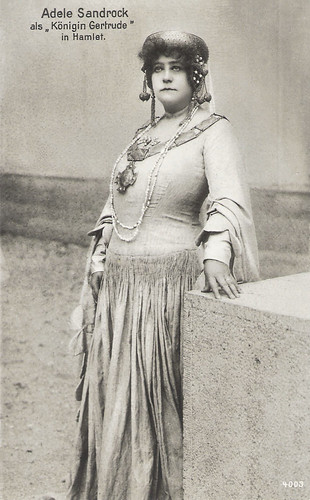
Adele Sandrock in Hamlet
German Postcard by Verl. Hermann Leiser, Berlin, no. 4003. Photo: Photo-Arbeit, München (Munich). Publicity still for a stage production of 'Hamlet' with Adele Sandrock as Queen Gertrude.

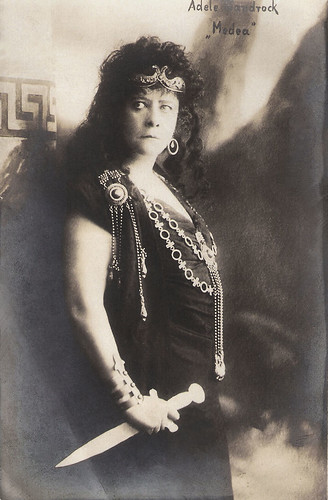
Adele Sandrock in Medea
Vintage Postcard. Publicity still for a stage production of 'Medea'.

Adele Sandrock and Carola Toelle in Die Schuld des Grafen Weronski (1921)
German collectors card by Ross Verlag in the series Vom Werden deutscher Filmkunst - Der Stumme Film, picture no. 197. Photo: Maxim-Film. Adele Sandrock and Carola Toelle in Die Schuld des Grafen Weronski/The debt of Count Weronski (Rudolf Biebrach, 1921).

Funny Old Lady


In 1911 Adele Sandrock made her silent film debut for the Messter company in the short film Marianne, ein Weib aus dem Volk/Marianne, a woman from the people, starring Henny Porten. It was followed by parts in such films as Die Beichte einer Verurteilten/The confession of a condemned (Rudolf del Zopp, 1915) and Passionels Tagebuch/Passionels diary (Louis Ralph, 1916) with Emil Jannings.

During World War I, Adele earned a small family income by giving lectures and acting lessons. After the war, she worked more and more for the cinema. To her silent films belong Manolescus Memoiren/The Memories of Manolescu (Richard Oswald, 1920) starring Conrad Veidt, Lady Hamilton (Richard Oswald, 1921), and Kinder der Finsternis/Children of the Dark (Ewald André Dupont, 1921).

In 1924 she returned to the Netherlands to film Op hoop van zegen/Die Fahrt ins Verderben (James Bauer, Henk Kleinmann, 1924), a Dutch-German coproduction, based on the play Op hoop van zegen (1900) by Herman Heijermans. Other silent films were Die Waise von Lowood/Orphan of Lowood (Curtis Bernhardt, 1926), Feme (Richard Oswald, 1927), the Schnitzler adaptation Fräulein Else/Miss Else (Paul Czinner, 1929) and Katharina Knie (Karl Grune, 1929) with Carmen Boni.

In 1920 the then 50-plus-Sandrock had also returned to the stage, where she again enjoyed great successes, this time as a funny old lady in such comedies as 'Liebestrank' (Love Poison) by Frank Wedekind and 'Bunbury' by Oscar Wilde. It was her second breakthrough, now as a comedienne. Sandrock developed a unique form of ‘unmodern’ comedy. She was hilarious as the stubborn, old-fashioned mother-in-law, or the tyrannical grandmother.

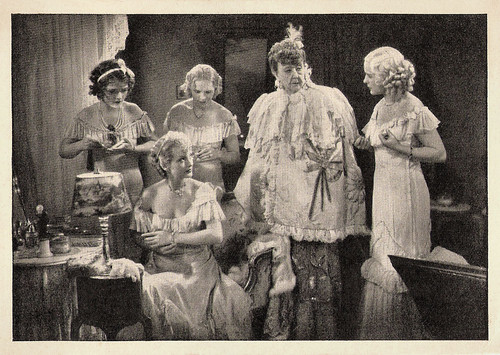
She still also took serious roles in silent films, but when the German sound film was introduced in 1930, she could use her comic talent fully in the cinema. She appeared in box-office hits as Der Kongress tanzt/The Congress Dances (Eric Charell, 1931) starring Lilian Harvey, Der tolle Bomberg/The Mad Bomberg (Georg Asagaroff, 1932), and Die englische Heirat/The English Wedding (Reinhold Schünzel, 1934).

She was a comedian who spoke out for passion. Sandrock even became better known for her film roles than for her stage career, and in 1935 and 1936 she took part in 16 films. Even today people remember her as Juno in Amphitryon (Reinhold Schünzel, 1935). Another classic was her role as a director in Alles hört auf mein Kommando/Everything hears on my command (Georg Zoch, 1935), a title that describes her principal quality. Because of her distinctive deep tinny voice, she was called ‘der General’ (the General).

During her career, Adele Sandrock acted in more than 140 films. Sandrock remained unmarried all her life. She lived with her sister, Wilhelmine in an apartment in Berlin, where she died in 1937. The cause of her death was the aftermath of an accident in 1936. Her autobiography, 'Mein Leben' (My Life), was published in 1940.

Adele Sandrock in Der Letzte Walzer (1934)
Promotion card by Ufa. Photo: publicity still for Der Letzte Walzer/The Last Waltz (Georg Jacoby, 1934).

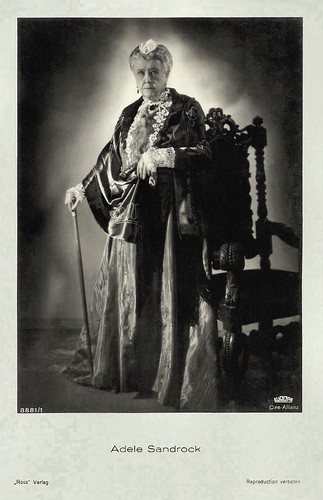
Adele Sandrock in Die englische Heirat (1934)
German Postcard by Ross Verlag, no. 8881, 1934-1935. Photo: Cine Allianz / Europa. Publicity still for Die englische Heirat/The English marriage (Reinhold Schünzel, 1934).


German coffee commercial Die kluge tante Adele/The Smart Aunt Adele. Source: CoffeeInternational (YouTube).


Scene from Rendezvous in Wien/Rendezvous in Vienna (Victor Janson, 1936) with Leo Slezak. Source: BD130 (YouTube).

Sources: Thomas Staedeli (Cyranos), Stephanie D’heil (Steffi-line) (German), Wikipedia (English and German), and IMDb.

This post was last updated on 3 November 2021.

26 September 2017

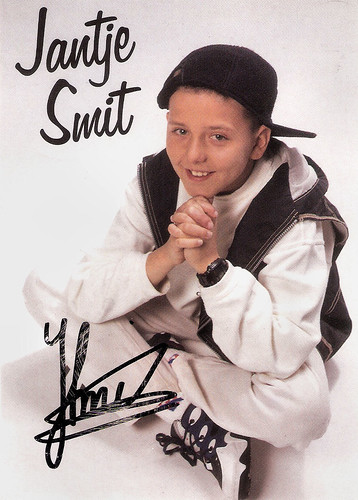
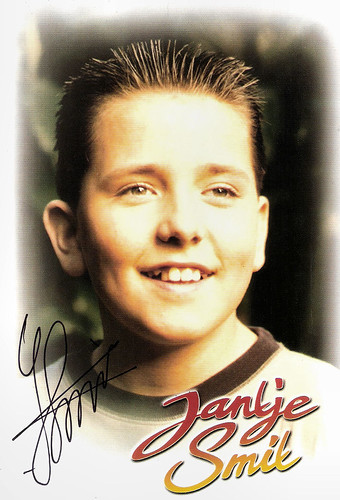
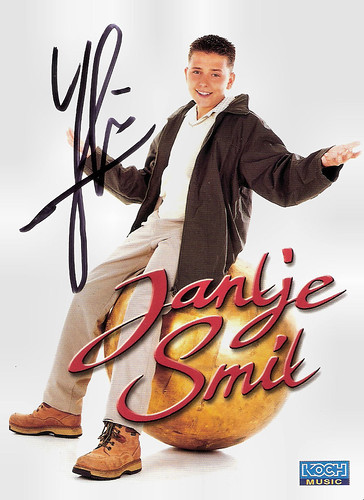
Jan Smit

Every year during the last week of September, Utrecht is the Dutch capital of film. This is the time of the Netherlands Film Festival (NFF), and traditionally EFSP organises its own Unofficial Netherlands Film Star Postcard Festival. Today we present Dutch singer, television host and incidental actor Jan Smit (1985). His songs fall under the Dutch genre known as 'Palingsound' (Volendam music). As a child, 'Jantje' Smit had success with his songs in Germany and other European countries. Smit also starred in the film Het Bombardement/The Bombardment (2014).

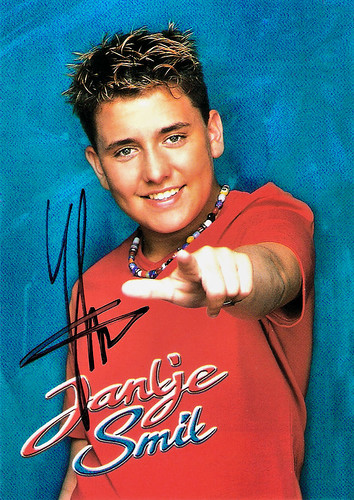
Jan Smit
German autograph card by Koch Universal, Planegg / München.

Best National Singer


Johannes Hendricus Maria (Jan) Smit was born in Volendam, The Netherlands, in 1985. His parents are Gerda and Ruud Smit. He has two sisters, Jenny Smit and pop singer Monique Smit.

As a kid, Jantje sang for four years with the boys choir De zangertjes van Volendam. At the age of ten, he was discovered when the band BZN was looking for a young local talent who could sing a duet with BZN singer Carola Smit (no relation). Jantje was chosen and their number Mama was a great success.

Following this success, he made a solo single record, Ik zing dit lied voor jou alleen (I sing this song for you alone) produced by three BZN members, Jan Keizer, Jack Veerman and Jan Tuijp. This single topped the Dutch charts.

In the following two years, Jantje Smit scored five more hits including Pappie, waar blijf je nou (Daddy, where are you now). Jantje was also successful in Belgium, Germany, Austria, Italy and France. For some time, he often performed in Germany and he recorded ten German albums. In 2001 Smit and his BZN producers received the Dutch export price for the best-selling Dutch act abroad.

At the age of 16, he left school to focus on his musical career. At 17, he changed his choice of music and started to work with the known song writers Cees Tol and Thomas Tol. A few years later he started to write by himself, together with good friend Simon Keizer, who later made name as a singer himself. Together with Nick Schilder, Simon forms a group named Nick & Simon.

In 2005, the daily life of Jan Smit could be followed in the Dutch reality show Gewoon Jan Smit (Just Jan Smit). The program received that year the Golden Televizier Ring, a major television award in The Netherlands. He also started to present TV shows like Muziekfeest op het Plein (Music Party at the Square) and he scored hit after hit with songs like Laura.

The popularity of Smit grew huge in the Netherlands. In 2006, Jan Smit was awarded the Edison Award as Best National Singer for his album Jansmit.com. In September 2006, a second series of Gewoon Jan Smit (Just Jan Smit) aired. In September 2006, C&A clothing store launched the collection J-style named after Jan Smit. Jan seemed to be everywhere.

Jan Smit
Dutch autograph card by Volendam Music, Volendam.

Jan Smit
German autograph card by Koch Music, Planegg / Munich.

Slashed by both critics and the public


In the following years, Jan Smit continued to score number one hits and to present TV shows. In 2007, he won a TMF Award for Best Dutch Pop Act. In 2009 he released a duet with the Surinamese singer Damaru, Mi Rowsu (A little garden in my heart), which reached the number 1 position in both Suriname and the Netherlands. From 2011 on, he and Cornald Maas are the Dutch commentators for the Eurovision Song Contest, one of Europe’s biggest yearly TV events.

Jan Smit starred in the film Het Bombardement/The Bombardment (Ate de Jong, 2014) with Roos van Erkel and Monic Hendrickx. The film, about the bombing of the city of Rotterdam in 1940 by the Nazis, was slashed by both critics and the public, but Smit was spared, his theme song went to no. 1 at the Dutch charts and the film still attracted more than 100,000 visitors.

Since 2012 Smit presents the TV show De beste zangers van Nederland (The finest singers of the Netherlands). He also founded with his manager Jaap Buijs the record label Vosound Records. Artists who record for this label are his sister Monique Smit, Tim Douwsma and Gerard Joling.

In 2011, he performed three nights at the Amsterdam Arena stadium during the concert series Toppers in Concert. In December 2013 Smit joined the board of soccer club FC Volendam. In 2014, he played a supporting role in the popular TV series Flikken Maastricht/Cops Maastricht (2007-) with Angela Schijf and Victor Reinier.

With the Schlager group KLUBBB3 (including German singers Florian Silbereisen and Fleming Christoff), Smit tried to conquer the German market once more. Their debut album Vorsicht unzensiert! (Attention, not censured) reached number 4 to 6 in Germany, Austria and Belgium and was also recorded in the Netherlands and Switzerland. In 2017 the trio was awarded the prize Die Eins der Besten in the category Best Band of the year. Their second album Jetzt Geht's Los Richtig (Now it's time to get it right) entered at no. 1 in Germany, number two in Austria and number three in Switzerland. Their single Life Dances Sirtaki became a no. 1 hit in The Netherlands.

In Germany Smit guest starred in the popular TV series Das Traumschiff/The Dream Boat (2017) with Heide Keller and Sascha Hehn. In 2017, Smit also joined the Dutch vocal band De Toppers, consisting of René Froger, Jeroen van der Boom and Gerard Joling. Since 2005, the band yearly gives a series of hugely successful outdoor concerts in the Amsterdam ArenA stadium. In 2011 and 2013 Smit was a guest artist during Toppers in Concert.

Jan Smit had a relation with actress and presenter Yolanthe Cabau van Kasbergen from 2007 till 2009. Since 2009, Smit has a relation with Liza Shelf. The two were married in 2011 and they have three children.

Jan Smit
German autograph card by Koch Universal, Planegg / München.

Jan Smit
German autograph card by Koch Universal, Planegg / München.


Trailer Het Bombardement/The Bombardment (Ate de Jong, 2014). Source: Dutch Film Works (YouTube).


KLUBBB3 performs Das Leben tanzt Sirtaki. Source: ICH FIND SCHLAGER TOLL! (YouTube).

Sources: Athena Dupont (IMDb), Wikipedia (English and Dutch), and IMDb.

24 September 2017

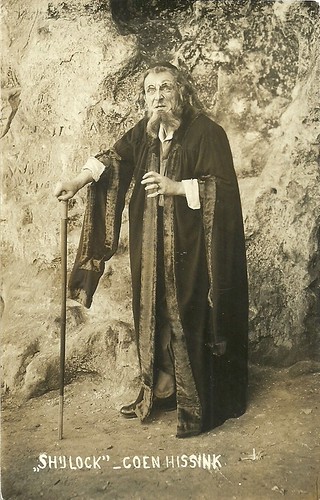
Coen Hissink

Every year in early autumn, the Dutch film industry and the public gather at the Netherlands Film Festival (NFF). Also this year, EFSP presents its own Unofficial Netherlands Film Star Postcards Festival from 20 to 29 September. Coen Hissink (1878-1942) was a Dutch stage and screen actor who acted in many silent films by Theo Frenkel Sr. First in the Netherlands in such films as Levensschaduwen (1916), Het proces Begeer (1918) and Menschenwee (1921) and afterwards in Berlin in Alexandra (1922) and other films. He also played in various silent Hollandia films. In the 1930s he acted in Dutch sound films. Hissink died in the Nazi concentration camp Neuengamme.

Coen Hissink
Dutch postcard. Coen Hissink as Shylock in 'The Merchant of Venice' by William Shakespeare. This postcard may date c. 1907-1908 when Hissink played Shylock on the Dutch stage.

A Dutch Western


Johan Coenraad ‘Coen’ Hissink was born in 1878 in Kampen, The Netherlands. After studying at the Toneelschool (Stage School) for a year, he began his acting career in the theatre in 1902. He made his stage debut in the Revue De Nieuwe Haring (The New Herring) and would have a long career on stage in both the Netherlands and Flanders. He was also known as a writer. In 1910, he published the dissertation 'Louis Bouwmeester's Shylock-creatie' When legendary Dutch actor Louis Bouwmeester starred as Shylock in Shakespeare's play 'The Merchant of Venice' - his most famous role - Hissink sat in the stalls with pen and paper and recorded everything he saw and heard.

Hissink was best known for his stage work, both on and behind the stage. Together with Albert van Dalsum and Eugene Gilhuys, he founded the stage company Het Groot Toneel (The Big Stage) in the Plantage Theater in Amsterdam. He also played many classic stage roles, such as Othello in 1918. Hissink made his film debut in the Dutch Western (!) Een telegram uit Mexico/A Telegram from Mexico (Louis H. Chrispijn Sr., 1914), a silent short film produced by Maurits Binger for his film studio Filmfabriek Hollandia. Hissink played the blind father of the Dutch colonist Willem (Willem van der Veer), who got lost in the revolution in Mexico. The home front waits eagerly for news.

Next followed the silent drama De Vloek van het Testament/The Fatal Woman (Maurits Binger, Louis H. Chrispijn Sr., 1915) starring Dutch diva Annie Bos. At the time, it was for the Netherlands a huge production with 48 copies through Europe and 12 copies crossing to America. Hissink continued to appear in a stream of silent Dutch films. In Fatum (Theo Frenkel, 1915) he again played with the legendary Louis Bouwmeester. Annie Bos was the star in Ontmaskerd/Unmasked (Mime Misu, 1915). Still existing is the seaman’s drama Het wrak van de Noordzee/The Wreck in the North Sea (Theo Frenkel, 1915).

Another relatively large-scale production was Het geheim van Delft/The Secret of Delft (Maurits Binger, 1916). The film required the construction of a 20-metre-high ruined lighthouse and a 15-metre-long pier on the coast of Zandvoort. These constructions meant high production costs and the film starred the most famous actors in the Netherlands at that time, including Willem van der Veer, Esther De Boer-van Rijk, Jan van Dommelen and Annie Bos.

Hissink often played supporting parts as the bad guy. He had a rare leading role in the silent crime film Levensschaduwen/Life's Shadows (Theo Frenkel, 1916). He was also one of the leads in another crime film, Het Proces Begeer/The Begeer Case (Theo Frenkel, 1918). He played smaller parts in the silent dramas Pro domo (Theo Frenkel, 1918) with Louis Bouwmeester, Theo Mann-Bouwmeester and Lily Bouwmeester, and Schakels/Connections (Maurits Binger, 1920) based on a play by Herman Heijermans and starring Annie Bos, Jan van Dommelen and Adelqui Migliar.

Esther de Boer van Rijk and Coen Hissink in Op hoop van zegen (1934)
Dutch postcard by M.B. & Z / M.H.D. Film. Photo: Maarseveen, Den Haag. Publicity still for Op hoop van zegen/The Good Hope (Alex Benno, 1934) with Esther de Boer van Rijk.

Decadence, homosexuality, prostitution and cocaine


During the 1920s, Coen Hissink continued to appear in such silent films as the British-Dutch silent crime film Bloedgeld/Blood Money (Fred Goodwins, 1921), with Adelqui Migliar, the adventure film De zwarte tulp/Black Tulip (Maurits Binger, Frank Richardson, 1921) based on the novel by Alexandre Dumas père, Menschenwee (Theo Frenkel, 1921) with Louis Davids, and De Bruut/The Brute (Theo Frenkel, 1922) with Willem van der Veer, Erna Morena and Bruno Decarli.

He also appeared in such international films as the German-Dutch co-productions Der Mann im Hintergrund/The Man in the Background (Ernst Winar, 1922) with Adolphe Engers, and Frauenmoral/Women's Morals (Theo Frenkel, 1923) with Olga Engl, Helena Makowska and Theo Mann-Bouwmeester. His final silent film was De cabaret-prinses/The Cabaret Princess (Theo Frenkel, 1925) with Emmy Arbous. In 1928, he wrote a volume of short stories about decadence, homosexuality, prostitution and cocaine. For inspiration, he visited a gay club in Berlin where he sniffed cocaine in a toilet. The book about his experiences was titled 'Cocaïne: Berlijnsch zedenbeeld' (Cocaine: Berlin's pictorial image).

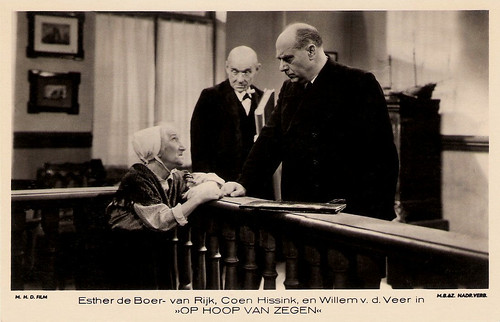
He returned to the screen in the sound film Op hoop van zegen/The Good Hope (Alex Benno, Louis Saalborn, 1934) starring Esther de Boer van Rijk and Frits van Dongen (Philip Dorn). The film was based on a 1900 play by Dutch socialist dramatist Herman Heijermans, situated in a fishing village, about the conflict between the fishermen and their employer.

It was the third filming of the play in less than twenty years. The film ends in tragedy with the unsound boat setting out to sea and sinking with all hands and the owner pocketing the insurance money. The film won an award at the Venice Film Festival in 1935 and is known as one of the most successful film productions of Dutch pre-war cinema. The success led to more small roles for Hissink in the film dramas Merijntje Gijzens Jeugd/Merijntje Gijzen's Youth (Kurt Gerron, 1936) after the popular novel of the same title by A.M. de Jong, and the Dutch-French film De Man Zonder Hart/The Man Without Heart (Léo Joannon, Louis de Bree, 1937), starring Louis de Bree and Dolly Mollinger. During the 1930s he also often worked for radio plays.

Hissink’s final film role was in De Laatste Dagen van een Eiland/The Last Days of an Island (Ernst Winar, 1942) with Max Croiset. It was already shot in 1938 but premiered in 1942. The film mixes a documentary that tells about the last days of the island of Urk and its inhabitants, and a story of a young couple. During the Second World War, Hissink, a dedicated communist, refused to join the Kulturkammer (Culture Room) of the Nazi regime and he joined the Resistance. In 1941, he and his partner Nel Hissink were caught by the Nazis and sent to the concentration camp Neuengamme in Germany. There Coen Hissink was killed in 1942. He was 64.

Esther de Boer-van Rijk, Coen Hissink, Willem v.d. Veer, Op Hoop van Zegen
Dutch postcard by M.B. & Z. (M. Bonnist & Zonen, Amsterdam). Photo: Dick van Maarseveen, Den Haag/M.H.D. Film. Publicity still for Op hoop van zegen/The Good Hope (Alex Benno, Louis Saalborn, 1934) with Esther de Boer van Rijk and Willem van der Veer. Collection Geoffrey Donaldson Institute.

Sources: Piet Hein Honig (Acteurs – en Kleinkunstenaars-Lexicon – Dutch), Eye, Wikipedia (English and Dutch) and IMDb.

This post was last updated on 9 October 2024.

23 September 2017

Theo Mann-Bouwmeester

During the Netherlands Film Festival, EFSP presents the Unofficial Dutch Film Star Postcards Festival. Today's spotlight is on Dutch stage and film actress Theo Mann-Bouwmeester (1850-1939), born in a famous Dutch stage family and sister of Louis Bouwmeester. Inspired by Sarah Bernhardt, she had her breakthrough in 1880. From then on, she was known for her wide repertoire, from classical tragedies to contemporary pieces. ’The Grand Dame of the Dutch stage’ also appeared in several Dutch silent films, often directed by her son Theo Frenkel Sr. In 1926, she said farewell to the stage after playing her most famous role, Liane Orland in Henry Bataille's 'The Child of Love', in 67 cities.

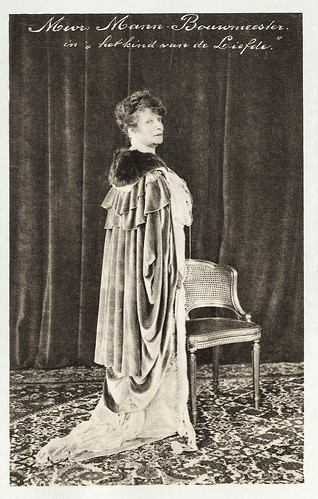
Theo Mann Bouwmeester in Het kind van de liefde
Dutch postcard by Koninkl. Nederl. Boek- en Kunsthandel M.M. Couvée, Den Haag (The Hague). Photo: publicity still for the stage production of 'Het kind van de liefde' (L'Enfant de l'amour/The Child of Love) by Henry Bataille.

Passionate, loving and suffering women


Theodora Antonia Louisa Cornelia Bouwmeester was born in Zutphen, The Netherlands, in 1850. She was the daughter of the actors Louis Frederik Johannes Rosenveldt and Louisa Francina Maria Bouwmeester, who happened to be on tour when their daughter was born. ‘Doortje’ was born into the most important Dutch actor's family, and the legendary Louis Bouwmeester was her elder brother.

Doortje made her debut as a six-year-old in the stage company of her father. She continued to play small stage parts, and at 17, she married musician Maurice Frenkel, with whom she would have four sons.

At 23, however, she was a widow, and she decided to continue earning the money for her family as an actress. Initially, her stage career was not remarkable while she performed in melodramas and farces. In 1880, she saw a stage performance by Sarah Bernhardt in Amsterdam and ‘la divine Sarah’ became her great source of inspiration.

That same year, Theo Bouwmeester experienced her breakthrough to the main public with the title role in the French comedy 'Froufrou' by Henri Meilhac and Ludovic Halévy and in the following years she became the grand Dame of the Dutch theatre. She was the Dutch performer in excellence of passionate, loving and suffering women – especially in great roles as Marguerite Gauthier, Maria Stuart and La Tosca.

She had a wide repertoire, from classical tragedies to contemporary pieces. From 1885 on, she was connected to the prestigious Koninklijke Vereeniging Het Nederlandsch Toneel (The Royal Dutch Theatre). In 1920, she participated in an actors' strike and which would trigger the end of her career. In 1926, she said farewell in one of her popular roles, Liane Orland in Henry Bataille's 'Het kind van de liefde' (The Child of Love).

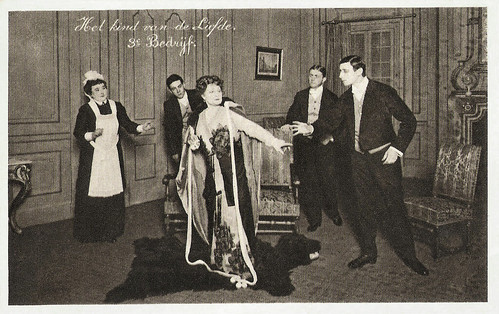
Theo Mann Bouwmeester in Het kind van de liefde
Dutch postcard by Koninkl. Nederl. Boek- en Kunsthandel M.M. Couvée, Den Haag (The Hague). Photo: publicity still for the stage production of 'Het kind van de liefde' (The Child of Love). It was a scene from the third act.

Directed by her son


Theo Mann-Bouwmeester played in five silent films of which four were directed by her son, Theo Frenkel Sr. In her first film, Koning Oedipous/King Oedipus (1912), she played Queen Jocasta opposite her brother, Louis Bouwmeester, in the title role.

Six years later, her son directed her and her brother Louis Bouwmeester in Pro domo (Theo Frenkel, 1918), also with their niece Lily Bouwmeester. She had a supporting part in Helleveeg/The She-Devil (Theo Frenkel, 1920) featuring Mien Duymaer van Twist. When her son started his own film company in Germany, she appeared in his Judith (Theo Frenkel, 1923) with Helena Makowska. Her last film was Frauenmoral/Women's Morals (Theo Frenkel, 1923), again starring Helena Makowska and Oscar Marion.

Theo Mann-Bouwmeester was married three times and thus performed under different names. Chronologically, she performed as Doortje Bouwmeester, Doortje Frenkel-Bouwmeester, Théo Brondgeest-Bouwmeester and Théo Bouwmeester. But she is best known under the name she used during her last marriage with the musician and composer Gottfried Mann.

Since 1950, the Theo d'Or prize has been awarded to the best female lead in the Dutch stage season every year. Another award named after her is the Theo Mann-Bouwmeester ring. This ring, designed by Jan Eisenloeffe, was donated to her by admirers in 1911. In 1934, Mann-Bouwmeester donated the ring to Else Mauhs, who was the most outstanding Dutch actress in her eyes. After that, the Theo Mann-Bouwmeester ring was worn by the Dutch actresses Caro van Eyck, Annet Nieuwenhuijzen, Anne Wil Blankers, Ariane Schluter and since 2017 by Halina Reijn.

Theo Mann Bouwmeester had four sons from her first marriage to Maurits Frenkel, including actor and film director Theo Frenkel sr. Actor Theo Frenkel Jr. was her grandson. There were many tragedies in her life, including the early deaths of her eldest and youngest sons. Her third son, Louis, died in 1900 at the age of 31.

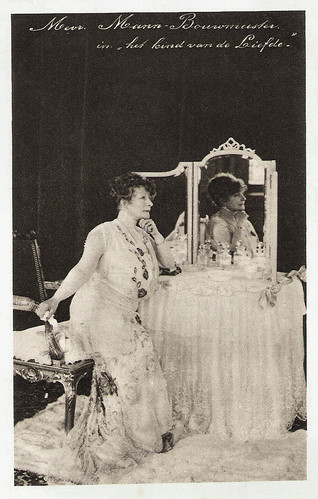
Theo Mann Bouwmeester in Het kind van de liefde
Dutch postcard by Koninkl. Nederl. Boek- en Kunsthandel M.M. Couvée, Den Haag (The Hague). Photo: publicity still for the stage production of 'Het kind van de liefde' (The Child of Love). It was a scene from the third act.

Sources: HHJ de Leeuwe (Huygens.ing – Dutch), Piet Hein Honig (Acteurs – en Kleinkunstenaars-Lexicon – Dutch), Wikipedia (Dutch) and IMDb.

This post was last updated on 29 April 2025.

22 September 2017

Henkie Klein

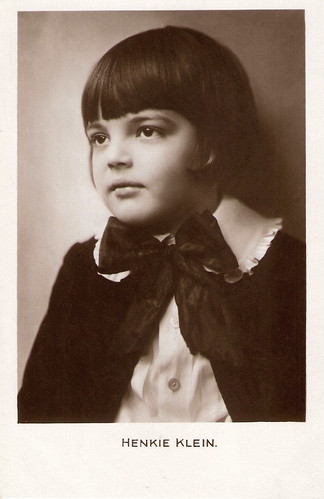
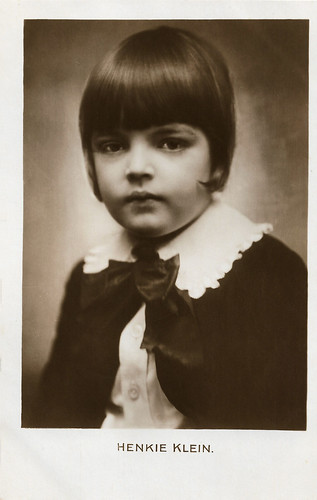
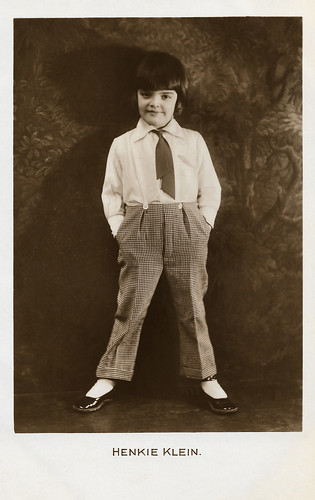
Every year in early autumn, the Dutch film industry and the public gather at the Netherlands Film Festival (NFF). Also this year, EFSP presents its own Unofficial Netherlands Film Star Postcards Festival from 20 to 29 September. Today in the spotlight: little Henkie Klein (1921-ca. 1993), who was a child actor in German and Dutch films of the silent era. He was called the 'Dutch Jackie Coogan'.

Henkie Klein
Dutch postcard by B. Brouwer, Amsterdam. Photo: Bernard Eilers, Amsterdam. Collection: Geoffrey Donaldson Institute.

Little dream king


Henkie Klein (sometimes written as Klyn or Kleinman) was born in Amsterdam, The Netherlands in 1921. He was the son of film director Henk Kleinman(n). Some sources say Kleinman senior was Dutch, other sources say he was German-born.

Kleinman sr. was the producer and co-director of the German-Dutch film Die Fahrt ins Verderben/Op hoop van zegen (Henk Kleinman, James Bauer, 1924). This was the second film version of Op Hoop van Zegen/On Hope of Blessing, a classic Dutch fisher drama written by Herman Heijermans in 1900.

The success of the production led to another film based on a play by Heijermans, Die vom Schicksal Verfolgten/Droomkoninkje/Little Dream King (Henk Kleinman, 1926) with Wilhelm Dieterle (aka William Dieterle) and Aud Egede Nissen. Little Henkie played the lead of a boy born with a clubfoot who creates his own dream world.

A year earlier, Henkie had made his film debut as the Berlin street boy Bolleken in Goldjunge/Stille Nacht, Heilige Nacht/Golden Boy (Henk Kleinman, 1925) with Grete Reinwald and Carl Auen. Both films are now presumed missing.

At the age of 9, Henkie Klein played in the melodrama Zeemansvrouwen/Seamen's Wives (Henk Kleinman, 1930), based on a play by Herman Bouber, author of popular plays like 'De Jantjes' (The Tars) and 'Bleeke Bet' (Pale Beth). Zeemansvrouwen should have been the first Dutch sound film with some songs. Possibly because of a lack of money, it became the last Dutch silent feature film.

Henkie Klein
Dutch postcard printed by B. Brouwer, Amsterdam. Photo: Bernard F. Eilers.

Glimpse


Zeemansvrouwen/Seamen's Wives was one of the most popular films of that year in the Amsterdam cinemas, but Henkie Klein would only act in one more film by his father, Hollands jeugd/Dutch Youth (Henk Kleinman, 1934). There is little known about this production. Kleinman senior also directed two other films, Zelfkant/Fag-end (Henk Kleinman, 1931), a short promotion film for the association for Help for Uninhabited, and the short Oudjes/Oldies (Henk Kleinman, 1936) with Louis van Dommelen, Riek Kloppenburg and August Kiehl.

In 1934, the Dutch film weekly Het Weekblad Cinema en Theater published a small article about Henkie: "In the last few years, we did not hear much of the young Dutch film star Henkie Klein. After his outstanding role in the Dutch film Droomkoninkje, he completely disappeared. This is probably because his father, director Henk Kleinman, does not get any more films to direct. Henkie visits the primary school in Amsterdam. He has almost become a Henk now."

In the Dutch newspaper NRC Handelsblad, Henk van Gelder wrote in 2003 about what happened to Henk Kleinman senior. Documents from film historian Egbert Barten show that Kleinman joined the NSB in 1934 and the Reichsfilmkammer in 1937 to be able to work in Germany. During the war, he worked - again as Henk Kleinmann - in Germany for a small bureau that selected suitable German films for The Netherlands. He died in 1944 (other sources say 1945) without making another film in Germany. His train was bombed by Allied forces and he died in a hospital in Berlin. And what happened to his son Henkie? Van Gelder cites theatre historian Piet Hein Honig who said that Henk Klein passed away circa 1993. Van Gelder contacted Henkie's daughter, but she just gave him information about her grandfather.

However, prints of Zeemansvrouwen have been restored by the former Dutch Filmmuseum (now Eye). Reviewer rohitnnn writes at IMDb: "Some of the shots in the film are truly exquisite, and though the story is almost entirely predictable, the film is eminently watchable as it shows us a glimpse of the society in a country that otherwise remains at the periphery of European cinema."

In 2003, the silent Zeemansvrouwen/Seamen's Wives was studied by lip readers and new film texts by Lodewijk de Boer were dubbed by actors like Huib Broos, Jeroen Krabbé, Nelly Frijda en Bram van der Vlugt. Henny Vrienten composed a new musical score for this film experiment. That same year, this final sound version was screened during the Biënnale in the Filmmuseum in Amsterdam.

Henkie Klein
Dutch postcard printed by B. Brouwer, Amsterdam. Photo: Bernard F. Eilers.

Sources: Henk van Gelder (NRC Handelsblad - Dutch), Peter Bosma (Dutch), Mariska Graveland (De Filmkrant - Page now defunct), Rohitnnn (IMDb), Dutch Film Angle (Now defunct), Wikipedia and IMDb.
This post was last updated on 27 December 2024.