
French postcard by JPB. Photo: Disques Philips.

French postcard by Editions P.I., Paris, no. 1099. Photo: Ektochrome Studeco. Georges Guétary and Jean Richard in the stage production of the operetta 'La Polka des lampions' (1961) by Marcel Achard at Théâtre du Châtelet in Paris, where it played 534 times.

French postcard by Monachrome, Beausoleil, no. 203. Caption: ZOO Jean Richard, Ermenonville (Oise). From left to right: Gertrude (gorilla), Jean Richard (man), Faston (chimpanzee), Kiki (chimpanzee), Roger Pierre (man).
A menagerie quickly reached impressive proportions
Jean François Henri Richard was born in Bessines, Deux-Sèvres, in the southwest of France in 1921. He was born on a farm named La Ménagerie. His father was Pierre Richard, a horse dealer, and his mother a homemaker, née Suzanne Boinot. His early encounters with circus performers (particularly Martha-la-Corse, a cat trainer) triggered his enduring passion for animals, especially big cats. Richard, who had a gift for drawing, began his working life as a caricaturist for local newspapers. After World War II, Richard organised German tours for French theatrical companies.
He began to make a name for himself performing in a famous postwar Parisian cabaret, L'Amiral. There, he developed a successful comic character, that of a jovial and naive peasant from the small imaginary village of Champignol. After attending the Conservatoire National Supérieur d'Art Dramatique in 1947, Jean Richard worked in the circus, cabaret, cinema and television.
His first film was the drama Six heures à perdre / Six Hours to Lose (Alex Joffé, Jean Le Vitte, 1947), starring André Luguet. His first major cinema success was Belle Mentalité / Wonderful Mentality (André Berthomieu, 1953), in which he played a valet with an extremely logical mind, who is unable to tell a lie. Jean Renoir offered him one of his best roles in Elena et les Hommes / Elena and the Men (Jean Renoir, 1955), starring Ingrid Bergman.
During his long career, he appeared in about eighty films. These included such hits as the comedies La guerre des boutons / War of the Buttons (Yves Robert, 1962), Bébert et l'omnibus / Bebert and the Train (Yves Robert, 1963) and Le viager / The Annuity (Pierre Tchernia, 1972), starring Michel Serrault and Michel Galabru.
His ever-growing popularity allowed him to purchase a vast property in Ermenonville, north of Paris, where he began to gather all sorts of wild animals. His menagerie quickly reached impressive proportions. In order to continue maintaining it, he had to open it to the public in 1956. His private zoological collection, the Zoo d'Ermenonville, became the most important in the country. In 1957, he created the Jean Richard Circus and in 1963, the La Mer de Sable theme park, northeast of Paris. Both are still owned by his family.

French promotion postcard by A. Leconte, Editeur, Paris, for Disques Ducretet-Thomson. Illustration: Lalande. Caption: Jean Richard recorded his best sketches, “Un soirée au Cabaret AMIRAL” (An Evening at the AMIRAL Cabaret), on LP no. 360 V 007.

French postcard. Photo: Jentille / Philips.

French postcard by Zoo Jean Richard, Ermenonville, Oise. Caption: Having a good friend!...
The grumbling but tender-hearted detective
Jean Richard continued to appear as a comic actor in films and on stage in successful musicals. Richard is remembered for his TV role as Commissaire Maigret, the famous detective created by Georges Simenon. Richard soon became synonymous with the grumbling but tender-hearted detective. With his trademarks, a pipe and a hat, he appeared on TV screens in 92 episodes of Les enquêtes du commissaire Maigret (1967-1990).
In 1972, he bought the Cirque Pinder, the ultimate and largest French circus. The greatest artists of the time performed under his big tops, and Richard found himself at the helm of the most important circus enterprise in France. Richard shuttled continually from TV studio to theatre boards, from his corporate offices to his circuses on the road.
To those who asked him how he could do so many things at the same time, he replied: "But I am on a vacation, since I do only things I love!" In May 1973, the machine jammed. A terrible car accident left Jean Richard on the brink of death for three weeks. After that, Richard was obliged to delegate. The company continued to expand, but became a giant with feet of clay.
After a reorganisation in 1978, the company filed for bankruptcy in 1983. The circuses Pinder and Jean Richard were bought by a former associate, Gilbert Edelstein. Jean Richard retired as an actor in 1990. He died in 2001 in Senlis, at the age of 80, after a battle with cancer. He was married to Annick Tanguy and Anne-Marie Lejard, and had two children.
Pierre Fenouillet at Circopedia: "Jean Richard died on December 12, 2001, orphaning an entire generation of circus enthusiasts to whom he soon became a cult figure. Some of these enthusiasts stand today at the helm of major French circuses. In 2021, they celebrated the hundredth anniversary of his birth with a series of manifestations and dedications in Bessines, Jean Richard's birthplace, and Ermenonville, where he lived."

French postcard by Monachrome, Cap-d'Ail, no. 150. Caption: ZOO Jean Richard, Ermenonville (Oise), Monsieur Maouzi (Léopard).

French postcard by Monachrome, Cap-d'Ail, no. 151. Caption: ZOO Jean Richard, Ermenonville (Oise), Monsieur Maouzi (Léopard).
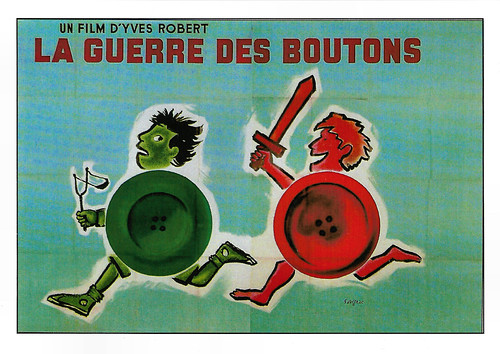
French postcard by Carterie artistique et cinématographique, Pont du Casse in the Encyclopédie du Cinéma / A.D.A.G.P, Paris, no. EDC 1859. Poster illustration: Raymond Savignac. Poster for La guerre des boutons / The War of the Buttons (Yves Robert, 1962).

French postcard by Carterie artistique et cinématographique, Pont du Casse in the Encyclopédie du Cinéma / A.D.A.G.P, Paris, no. EDC 3177. Poster illustration: Raymond Savignac. Poster for La guerre des boutons/The War of the Buttons (Yves Robert, 1962).
Sources: Pierre Fenouillet (Circopedia), BBC, Wikipedia (English, Dutch and French) and IMDb.

No comments:
Post a Comment