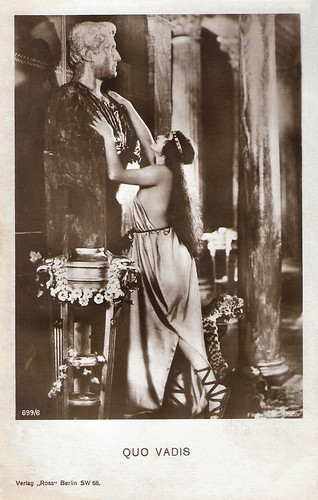
German postcard by Ross-Verlag, Berlin, no. 699/6, 1919-1924. Photo: Filmhaus Bruckmann. Rina de Liguoro as Eunice in Quo Vadis? (Gabriellino D'Annunzio, Georg Jacoby, 1924).
Eunice
In his 1896 novel 'Quo Vadis', Henryk Sienkiewicz describes the scene with Eunice as follows: "...pointing to a Mercury with a caduceus that resembled Petronius. [...] Only Eunica remained in the untiorium. For a moment, with her head bowed, she listened to the voices and laughter fading away in the laconicum; then she took the amber and ivory stool on which Petronius had been sitting and brought it before her master's statue. Standing on the stool, she wrapped her arm around the statue's neck; her hair fell over her shoulder like a golden wave; her flesh moulded itself to the marble; her mouth was pressed tightly against Petronius' cold lips."
It is clear from Sienkiewicz's words that it is not just about the statue, but above all about Eunice's behaviour. She is a slave for whom her master is unattainable, even though she is passionately in love with him. In addition to the gender barrier, there is a strong class barrier. However, slowly but surely, Petronius realises that she is truly in love with him, softens and begins to love her too. This is particularly true after Eunice's mental torment is accompanied by the physical torment of flogging, and she continues to love him all the same.
As early as 1900, a theatrical version of the novel was produced in Rome by Silvano D'Arborio and in Paris by Émile Moreau. Moreau's version, in which actress Suzanne Miéris enjoyed theatrical success as Eunice, was widely published, as here in the magazine L'Illustration, where it is suggested that Petronius is already witnessing Eunice's kiss. Looking closely, one can see that Eunice's clothes are semi-transparent and, in fact, in subsequent pictorial representations, Eunice is depicted half-naked or completely naked, shifting the viewer's attention to her instead of the statue.
This can be seen in a work by Alfons Mucha, in which Petronius again witnesses the scene. The same is true of Jan Styka's illustrations for the book 'Quo Vadis', and in illustrated postcards by Styka, Bruno, Mastroianni and Gambaldi. Some refer to Sienkiewicz's references to a statue of Petronius as Mercury; others do not, but the focus on the female body is always central.
The most chaste version in cinema is shown in Enrico Guazzoni's 1913 version of Quo Vadis. In this early film. Actress Amelia Cattaneo plays Eunice. The 1924 version includes a rather more lascivious version with Rina de Liguoro, who not only shows more of her body, but also embraces the statue of Petronius with greater passion. The scene closely follows Sienkiewicz's words.
Theatre

Cover page of a special issue of L'Illustration of 23 March 1901, dedicated to the stage play 'Quo vadis?', based on the novel by Henryk Sienkiewicz. Here, Eunice is kissing the statue of Petronius.
Suzanne Miéris (?-?) was a French stage actress who peaked in the early 1900s at the Théâtre Antoine and the Théâtre de la Gaité. She had her breakthrough as Eunice, Petronius' slave, and later also lover, in Emile Moreau's stage version of 'Quo vadis?', performed at the Théâtre de la Porte Saint-Martin in Paris in March-April 1901. Miéris played, e.g. opposite Cora Laparcerie as Lygia, Dumény as Petronius, and Gilda Darthy as Poppaea. The play was such a success that after touring the French provincial cities in Summer 1901, the troupe returned to the Théâtre de la Porte Saint-Martin in September 1901, with success, now with Édouard de Max as Petronius. Afterwards, Miéris was actively promoted by postcards, always with her headband and costume from 'Quo vadis?', even when making publicity for other plays. In October 1901, she was replaced by Mme Spindler in 'Quo vadis?' because of her obligations at the Théâtre Antoine. By October 1901, 'Quo vadis?' had been performed over 150 times.
Art

French postcard by A.N. (Armand Noyer), Paris, no. 276/3. Sculptobromure: Domenico Mastroianni, 1913. Mastroianni first created his compositions in plasticine or clay. He then captured the images both in sepia and coloured-in. Domenico Mastroianni was the brother of Marcello Mastroianni's grandfather.

French postcard by A.N. (Noyer), Paris, card 3 in a series of 18 Luxochrome postcards. Design: Domenico Mastroianni. Eunice is kissing the statue of Petronius.

Italian coloured postcard. 'The Kiss of Eunice' by Domenico Mastroianni.

German postcard by Ed. A. Raczynski, Kraków (Munich) in the series 'Quo vadis?' by the Polish artist Piotr Stachiewicz (1858-1938), No. 3 of a series of 20 or 22 (sources differ) postcards. Caption: Eunice kissing the statue of Petronius.
In 1896, Peter Stachiewicz created a series of 22 paintings illustrating 'Quo Vadis' by Henryk Sienkiewicz. The collection was well received by the audience. It was presented in 1902 and was created before the novel was finished. The artist was recognised as the favourite painter of the writer. He illustrated, among others: 'Trilogy', 'Without Dogma', and 'The Połaniecki Family'. In 1902, 'Quo Vadis' was printed for the first time with his 20 illustrations. It was done again in 1910. Thanks to the efforts of Edward Aleksander Raczyński, a folio of 22 lithographs in Chinese cardboard was also published. According to Raffaele de Berti and Elisabetta Gagetti, between 1900 and 1930, several editions of the postcard series were released, sometimes as 20 and at other times as 22 postcards.

French postcard by Ed. Lapina, Paris, no. 448. Quo vadis: The kiss of Eunice. Artwork by Jan Styka.

French postcard, no. 4435 Dl. Photo: ND. 'The Kiss of Eunice' by Jan Styka. Salon de Paris 1910.

Italian postcard by Ed. G. Sborgi, Firenze. 'The Kiss of Eunice' by A. Alessandrelli.

Vintage postcard, no. 1. The Kiss of Eunice by G.G. Bruno, 1909. Remarkable here is the statue of Petronius represented as Mercurius / Hermes.
Film

Italian postcard for the classic epic Quo vadis? (Enrico Guazzoni, Cines 1913). Caption: The devotion of the slave Eunice (Amelia Cattaneo) to Petronius (Gustavo Serena).


Screen captions from Quo Vadis (Mervyn LeRoy, 1951). Eunice (Marina Berti) kissing the statue of Petronius. This happens in this film version much later than in the novel, after being whipped for refusing her master's order to become Vinicius' slave, instead of in the book's first chapter.
Pygmalion and Galatea
The key text in the case of Pygmalion is Ovid's 'Metamorphoses'. Ovid uses sensual and erotic words: "Pygmalion is enchanted, and a flame is kindled in his heart for that artificial body. He often runs his hand over the statue to feel whether it is flesh or ivory, and cannot bring himself to say that it is ivory. He kisses her, and it seems to him that she kisses him back, and he talks to her and embraces her, and he has the sensation that his fingers sink into the limbs he touches, and he fears that the pressure will leave a bruise on her limbs."
This reminds us of Bernini's 'Rape of Proserpina' in the Borghese Gallery, with his hand pressing on the flesh or marble. Incidentally, Ovid speaks of ivory, not marble, because it is more similar to the colour of human skin. Even when the woman (Ovid does not mention Galatea's name) comes to life, his words are very sensual: “He brings his mouth close again and with his hands he also fondles her breasts. The ivory he fondles softens, and losing its hardness, it sinks and yields under his fingers, [...]”. Ovid is also quite explicit about the results of the encounter between the two lovers, as after nine months, they have a son, named Paphos.
Especially during the 19th century, a wave of Pygmalionism pervaded culture: literature, visual arts and performing arts. As Jeffrey Richards writes in his monograph 'The Ancient World on the Victorian and Edwardian Stage' (2009): 'The obsession with statues of women became a classifiable form of erotomania dubbed by Havelock Ellis ‘Pygmalionism’, after the mythical Greek sculptor. This stemmed in part from the idea that sculptures should be as realistic as possible. As John Ruskin stated, “It is the task of the best sculptor, the true Daedalus, to make immobility seem like breath and marble like living flesh”.
This also applies to the performing arts, such as the plays of W.S. Gilbert and the operettas of Franz von Suppé. Gilbert's play was staged at the Haymarket Theatre in London in 1871, starring William Kendall and his wife Madge Robertson, and was a huge success (184 performances). Other theatrical productions of 'Pygmalion' followed, including the British version based on Franz von Suppé's operetta 'Die schöne Galathée' (1865). Gilbert's play was subsequently revived with great success in the United States and the United Kingdom (1880s) with Mary Anderson and Lily Langtry. In both Gilbert's and Von Suppé's versions, Galatea eventually returns to being a statue: in Gilbert's, she herself decides to turn back into stone, while in Von Suppé's, it is Pygmalion who begs Venus to turn her to stone after discovering her cheating on him with his assistant Ganymede. Furthermore, in Ovid's version, this second metamorphosis does not take place, but according to Richards, this ending was more suited to the (male) morality of the 19th century. A series of French postcards from the early 20th century follows Von Suppé's comic version.
With his parodic versions in early cinema, Georges Méliès criticises the impotent man, for whom female statues are unattainable and always faster and stronger than he is. In general, both in minor art and in early 20th-century cinema, there is a rather distrustful attitude towards the myth of Pygmalion and the female nude in sculpture. In the film La modella, the elite mock the statue of the female nude and the model (played by Stacia Napierkowska), a nude based on an ancient original preserved in the Vatican Museums. A unique copy of the first English film Pygmalion and Galatea (1912), starring actress and national beauty Ivy Close, was recently rediscovered at the BFI. The film shows a chaste version of the myth, almost Pre-Raphaelite and close to English neoclassical painting from Albert Moore to Alma-Tadema. Ivo Blom concludes that both cases express a rather masculine view of women as objects of desire, even though Eunice adores a male statue and Pygmalion a female statue. In both cases, unattainability is overcome. Eunice will later have the real Petronius instead of the substitute (even if they then die together), while Pygmalion's ideal woman is transformed into a real woman thanks to the divine intervention of Venus.
Art

German postcard by Moderner Kunst-Verlag Berlin, no. MKB 2175. Pygmalion et Galathée by Antonin Mercié (year and location unknown).

German postcarded by Friedrich C. Rother, Berlin. 'Galathée' by Laurent-Honoré Marqueste, c. 1885. Once Musée du Luxembourg, now Musée d'Orsay.
Fantasy

French postcard by A.S. (Saint-Just), Paris, no. 743, 3. Scene from 'Pygmalion', inspired by the operetta 'Die schöne Galathée' by Franz von Suppé (1865). Caption: O Venus, that my trebling may rise up to you! That this marble by you may become a woman!

French postcard by A.S. (Saint-Just), Paris, no. 743, 8. Scene from 'Pygmalion', inspired by the operetta 'Die schöne Galathée' by Franz von Suppé (1865). Caption: Ganymedes! It is you I love!...

French postcard by A.S. (Saint-Just), Paris, no. 743, 10 (end). Scene from 'Pygmalion', inspired by the operetta 'Die schöne Galathée' by Franz von Suppé (1865). Caption: Well, now I know what I can do with this, and without regrets, I will sell it.
Plot: The Cypriot sculptor Pygmalion refuses to sell his beautiful statue of a woman to old Midas, who has bribed Pygmalion's assistant Ganymedes to show it to him. The artist chases them and implores Venus to make the statue he so adores alive. His wish is granted, but he regrets his wish as Galatea prefers the love of Ganymedes. Vexed, Pygmalion implores the goddess to turn the unfaithful woman back into stone again, and wants to destroy it, but Midas convinces him to sell the statue to him.
In the 1900s, A.S. (Saint-Just) published several staged, coloured postcard series based on operas and operettas such as 'Tosca', 'Faust', 'Manon Lescaut', 'Carmen', 'Cavalleria rusticana', 'Die schöne Galathée', 'La fille du régiment', 'Pippo et Bettina', 'La fille de Madame Angot' and 'Le passant', books such as 'Paul et Virginie', and plays such as 'Cyrano de Bergerac' and 'Madame Sans-Gène'.
Risqué

French postcard by CCCC (Charles Collas et Cie, Cognac), card 6 of the series.
Humor

French postcard by Braun & Cie Editeurs, no. 7178. Salons de Paris: 'Pygmalion' by Albert Guillaume, s.a.
Film

Caption from Pygmalion and Galathea (Elwyn Neame, 1912) starring Ivy Close. Collection: British Film Institute.
Sources: Le Ombre di Eros (AIRSC - Italian), National Museum, Poznań, and Raffaele de Berti, Elisabetta Gagetti ('La fortuna di Quo vadis in Italia nel primo quarto del Novecento: edizioni illustrate e paratesti cinematografici' - Italian)

No comments:
Post a Comment