
German postcard by Photochemie, Berlin, no. K. 1733. Photo: Wilhelm Willinger, Berlin.

German postcard by Rotophot in the Film Sterne series, no. 549/3. Photo: Decla. Emil Birron and Ressel Orla in Die Sünde / The Sin (Alwin Neuss, 1918).

German postcard by Verlag Hermann Leiser, Berlin, no. 1415. Photo: Zander & Labisch.
The Sin
Emil Birron, also Emil Biron and Emil Byron, was born in 1878 as Rudolf Wilhelm Emil Bleeke in Elberfeld (or Barmen), now part of Wuppertal, in the German Empire.
He made his stage debut in 1900 at the Potsdam City Theatre (today Hans Otto Theater). He then trained there as an actor from 1900 to 1902. In 1902, he continued his stage career in Magdeburg, in 1903/1904, he played at the Kleines Theater in Berlin, and from 1904 to 1907 at the Deutsches Volkstheater in Vienna.
Later, he acted from 1907 to 1912 as a Royal Court Actor in Munich, and from 1912 to 1914 he was active in Breslau (now Wroclaw, Poland), where he directed the Lobe Theatre. From 1915 to 1917, he appeared at the Thalia Theatre in Hamburg, after which he played in Berlin. He appeared mostly in comedies and farces, but he was also successful in classic dramas such as the title role in William Shakespeare's 'Hamlet' and as the prince in 'Die Judin von Toledo' (The Jewess of Toledo) by Franz Grillparzer.
In 1917, Emil Birron began his career as a silent film actor, debuting as one of the suitors of Hella Moja in the comedy Die gute Partie / The Good Party (Otto Rippert, 1918). He would act in some 30 films, mainly in the years 1917-1921, plus five films between 1927 and 1938.
These included films with Ressel Orla such as Die Sünde / The Sin (Alwin Neuß, 1918), Das Glück der Frau Beate / The Happiness of Mrs Berate (Alwin Neuß, Otto Rippert, 1918), and Kitsch (Lupu Pick, 1919), but also the films Der Weg der Grete Lessen / The Journey of Grete Lessen (Rudolf Biebrach, 1919) with Lotte Neumann and Katinka (Emil Birron, Paul Otto, 1918) with Rita Clermont.

German postcard in the Film Sterne series by Rotophot, no. 548/2. Photo: Decla. Ressel Orla in Das Glück der Frau Beate / The Happiness of Mrs. Beate (Alwin Neuß, Otto Rippert, 1918). The man on the right with the white tie is Emil Birron.

German postcard by Rotophot in the Film Sterne series, no. 548/4, 1919-1924. Photo: Decla. Ressel Orla in Das Glück der Frau Beate / The Happiness of Mrs. Beate (Alwin Neuß, Otto Rippert, 1918). The man left is Emil Birron, while the man in the back is Max Ruhbeck.
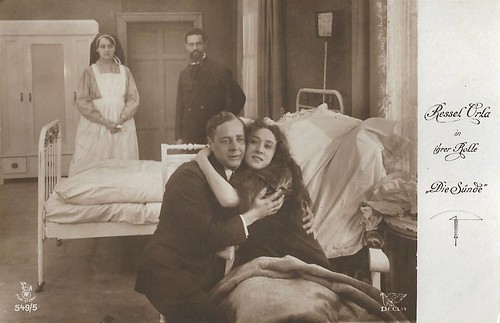
German postcard by Rotophot in the Film Sterne series, no. 549/5. Photo: Decla. Ressel Orla and Emil Birron in Die Sünde / The Sin (Alwin Neuss, 1918).

German postcard by Ross Verlag, no. 637/2. Photo: Maxim-Film. Lotte Neumann and Emil Birron in Der Weg der Grete Lessen / The Journey of Grete Lessen (Rudolf Biebrach, 1919).
When life says no
After World War I, Emil Birron appeared in such films as Wenn das Leben nein sagt / When life says no (Karl Mueller-Hagens, 1919), Alkohol / Alcohol (Ewald André Dupont, Alfred Lind, 1920), and Hundemamachen / The Little Dog Mom (Rudolf Biebrach, 1920) with Ossi Oswalda. Alkohol / Alcohol was begun by Lind but finished by Dupont. It was Dupont's first major melodrama and was one in a series of 'Aufklärungsfilme'(Enlightenment films) examining social issues, which were produced around the time.
In these films, he had the male lead, while he also played supporting parts in films like Blutrache / Vendetta (Georg Jacoby, 1919) with Pola Negri and Harry Liedtke, and King Frederick William IV in Die Weber / The Weavers (Friedrich Zelnik, 1927), starring Paul Wegener and William Dieterle.
Birron's theatre activities were limited to guest performances from 1922 to 1936. In the 1928/1929 season, he was stage manager at the Deutsches Stadttheater (today Mahen-Theater) in Brno.
During the 1930s, he only played a few small supporting parts in films. His last film appearance was as a ship's steward in the musical Mach mich glücklich / Make Me Happy (Artur Robison, 1935) alongside Else Elster and Albert Lieven. In 1936, Birron ended his career as an actor. He was later active as a stage agent and promoted young talent.
Emil Birron died in 1952 in Potsdam in East Germany. He was 74. Nothing is currently known about his private life.

German postcard by Kunstverlag Jos. Paul Böhm, München, no. 200.

German postcard by Photochemie, Berlin, no. K. 1734, Photo: Wilhelm Willinger, Berlin.

German postcard by Verlag Ross, Berlin, no. 397/2, 1919-1924. Photo: Becker & Maass, Berlin.

German postcard by Photochemie, Berlin, no. K. 3235. Photo: Kurt Lande.
Sources: Stephanie D'heil (Steffi-Line - German), Thomas Staedeli (Cyranos), Wikipedia (German and English), Filmportal, and IMDb.

No comments:
Post a Comment