
French postcard by Editions P.I. presented by Victoria, Brussels, Paris, no. 278. Photo: Paramount, 1953.
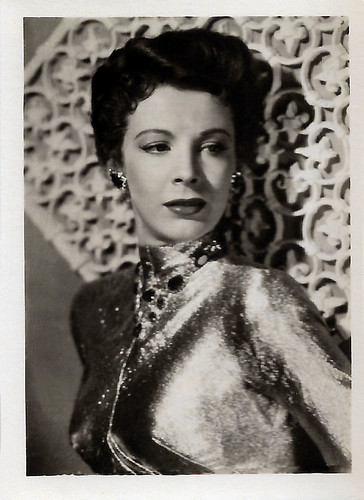
Small German collectors card in the 'Film Stars der Welt ' series by Greiling-Sammelbilder, series E, no. 153. Photo: Hamann-Meyerpress.
A difficult trip of six months to Hollywood
Signe Hasso was born Signe Eleonora Cecilia Larsson in the Kungsholmen parish of Stockholm, Sweden, in 1915. She was the daughter of Kaifas Larsson, an office manager from Dalarna, and Helfrid Elisabet Johanna Larsson (nee Lindström). Her father and her grandfather died when she was four. Her mother had financial difficulties and worked as a waffle cook to support the family. With her mother, grandmother, and two siblings, Signe shared a single room.
Hasso attended Matteusskolan, Kungsholms elementarskola för flickor (elementary school for girls) and Norrmalms enskilda läroverk. Her acting career began by accident at the age of 12. When a young actress fell ill, her mother, a former aspiring actress, was asked if she knew a little girl who could act. Signe's audition for Molière's play 'Den inbillade sjuke' (Le Malade imaginaire / The Imaginary Invalid) was successful, and she began earning money as an actress. She was noticed there by the play's director, Olof Molander.
From 1927 on, she performed in Royal Dramatic Theatre productions and enrolled as one of the youngest acting students in its history at the age of 16. One of her classmates was Ingrid Bergman. In 1933, Signe Larsson made her first film, Tystnadens hus / House of Silence (Rune Carlsten, Eric Malmberg, 1933). On the set, she met German film cinematographer Harry Hasso, whom she married the same year. They had a son, Karl Georg Harry (1934), by the time she was 19. The couple divorced in 1942.
After graduating in 1935, she joined the National Theatre and worked there until 1939. Signe appeared in other Swedish films like the dramas Häxnatten / Witches' Night (Schamyl Bauman, 1937), Karriär / Career (Schamyl Bauman, 1938), and Vi två / The Two of Us (Schamyl Bauman, 1939) starring Sture Lagerwall. Then followed a flop. In the historical drama Emilie Högquist (Gustaf Molander, 1939), she portrayed 19th-century actress Emilie Högquist. Its production company, Svensk Filmindustri, suffered its largest financial losses of the decade.
It did not hurt Hasso's career. She starred in the Norwegian-Swedish drama Vildmarkens sång / Bastard / The Song of the Wilderness (Helge Lunde, Gösta Stevens, 1940) with Georg Løkkeberg, and in the comedy Stora famnen / With Open Arms (Gustaf Edgren, 1940). She was approached by producer Howard Hughes to move to the United States and sign a contract with RKO Pictures. Her journey to the USA was very difficult with the impending Nazi war actions. She travelled by the Siberian Railroad across Russia, into China, sailed from Singapore to San Francisco, and then travelled by train to Los Angeles. After a trip of six months, she finally met with the RKO studio chiefs discussing films. The studio touted her as the 'next Garbo', but it didn't lead to any film roles. To make a living, she turned to the stage and appeared in five Broadway productions, beginning with 'Golden Wings' (1941).

British postcard in the Picturegoer Series, no. W 821. Photo: Universal International.

German postcard by Das Programm von Heute, Berlin. Photo: Nordland / Siegel.
A lusty French maid who provides the young hero with an early bedside education
In 1943, Signe Hasso signed with Metro-Goldwyn-Mayer. She made her Hollywood debut in the war film Assignment in Brittany (Jack Conway, 1943), starring with French actor Jean-Pierre Aumont, who also made his American film debut. Her first role of note was in Heaven Can Wait (Ernst Lubitsch, 1943), starring Gene Tierney, Don Ameche, and Charles Coburn. She made a humorous splash in the supernatural comedy as Mademoiselle, a lusty French maid who provides the young hero with an early bedside education.
Another highlight was the drama The Seventh Cross (Fred Zinnemann, 1944), set in Nazi Germany. Spencer Tracy played a prisoner who escaped from a concentration camp and who gradually sheds his cynical view when ordinary Germans try to save him. During the 1940s, she also appeared in the Film Noir Johnny Angel (Edwin L. Marin, 1945), the Spy film The House on 92nd Street (Henry Hathaway, 1945), the melodrama A Scandal in Paris (Douglas Sirk, 1946) with George Sanders, and the comedy-thriller Where There's Life (Sidney Lanfield, 1947) starring Bob Hope.
Her favourite role was in A Double Life (George Cukor, 1947) as the ex-wife of an actor driven mad, played by Ronald Colman. As Othello, he adopts the same rage as William Shakespeare's jealous Moor and endangers Hasso's character, who plays Desdemona. Her reaction to finding real blood on the bed during the climactic death scene of the play within the film was memorable. She longed to go back to the theatre and worked on Broadway and the West End. Hasso was also a frequent guest on Bob Hope's TV series. In 1955, she returned to Stockholm and helped to start a national repertory theatre in Sweden. She also produced the film Den underbara lögnen / The Magnificent Lie (Mike Road, 1955) and cast her second husband, William Langford, opposite her. The film is based on the 1831 short story 'La Grande Bretèche' by Honoré de Balzac and a further short story by Guy de Maupassant.
Then tragedy struck. William Langford died later that year in New York. In 1957, her 22-year-old son Karl Hasso was killed in a motorcycle accident on Santa Monica Boulevard in Los Angeles. Devastated, she returned to Hollywood. In the following decade, Hasso made guest appearances in popular TV series, including Route 66, Bonanza, and The Green Hornet. She played supporting parts in the psychological Horror film Picture Mommy Dead (Bert I. Gordon, 1966) starring Don Ameche, Martha Hyer, and Zsa Zsa Gabor, and the Horror thriller A Reflection of Fear (William Fraker, 1972) starring Sondra Locke and Robert Shaw. In the 1970s, she relocated to Park La Brea, where she remained until her death.
Her later TV appearances included guest roles in the series Cannon, Starsky and Hutch, The Streets of San Francisco, Ellery Queen, Quincy, M.E., Magnum, P.I., Hart to Hart, and The Fall Guy. She also appeared in the acclaimed psychological drama I Never Promised You a Rose Garden (Anthony Page, 1977), starring Bibi Andersson, Kathleen Quinlan and Sylvia Sidney. Her debut novel, 'Momo' (1977), depicts her childhood in interwar Stockholm. Hasso also composed music and translated Swedish folk songs into English. Her second album, 'Where the Sun Meets the Moon' (1979), contains her versions of Swedish folk tunes. She continued to act until late in her life. Her last film was One Hell of a Guy (James David Pasternak, 1998), starring Rob Lowe and Michael York. Although the romantic comedy is mediocre, according to IMDb reviewers, Hasso's role as an old actress made the film worth seeing. Sylvia Stel at IMDb: "I loved Signe Hasso as Cassie's Aunt Vivian. She is fabulous in perhaps one of her last great roles. You can tell that she was a great film actress." Signe Hasso died of pneumonia and cancer at Cedars-Sinai Medical Centre, Los Angeles, in 2002. She was 86.
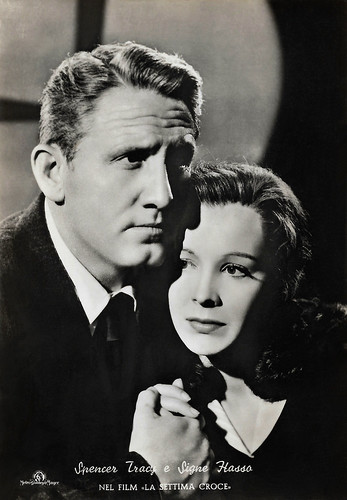
Italian postcard by Rotalfoto, Milano, no. 47. Photo: Metro-Goldwyn-Mayer. Spencer Tracy and Signe Hasso in The Seventh Cross (Fred Zinnemann, 1944).

Italian postcard, no. 1203. Photo: Metro-Goldwyn-Mayer. Spencer Tracy and Signe Hasso in The Seventh Cross (Fred Zinnemann, 1944).
Sources: Thomas E. Hilton/R.M. Sieger (IMDb), Mattias Thuresson (IMDb), Sylvia Stel (IMDb), Wikipedia (English and Swedish) and IMDb.

No comments:
Post a Comment