
German postcard by Ross Verlag, no. 7262/1, 1932-1933. Photo: Metro-Goldwyn-Mayer.
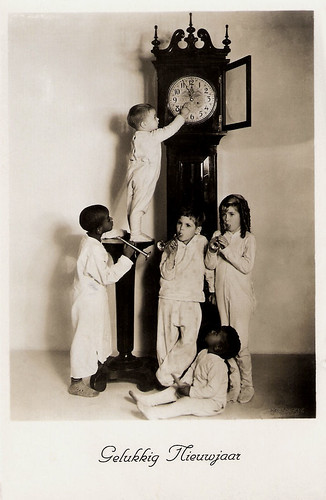
Dutch postcard. Photo: a publicity shot of the Little Rascals a.k.a. Our Gang with Dickie Moore in the middle. Caption: "Gelukkig Nieuwjaar" (Happy New Year).

German postcard by Ross Verlag, no. 149/3. Photo: Paramount. Marlene Dietrich and Dickie Moore in Blonde Venus (Josef von Sternberg, 1932).
The leader of the gang
Dickie Moore was born John Richard Moore Jr. in Los Angeles in 1925. His parents were John Richard Moore Sr., a banker, and Nora Eileen Moore née Orr.
Dickie already made his screen debut as a baby in the John Barrymore film The Beloved Rogue (Alan Crosland, 1927). Moore was discovered when Joseph Selznick's secretary was picking up his mother to take her to the studio, and impulsively decided that the infant Moore looked like John Barrymore as a child. After his debut, he soon gained notable supporting roles.
He played the little son of Marlene Dietrich in Blonde Venus (Josef von Sternberg, 1932). He also appeared with Barbara Stanwyck in So Big (William A. Wellman, 1932), with Walter Huston in Gabriel Over the White House (Gregory La Cava, 1933) and with Spencer Tracy in Man's Castle (Frank Borzage, 1933).
He was then one of the regulars in the Our Gang comedies for a year (1932-1933). In eight films, he appeared as the leader of the gang. His closest friend on the set was Stymie. He left the Rascals at age 8 to act in feature films. He is perhaps most remembered for his portrayal of the title character in Oliver Twist (William J. Cowen, 1933), based on Charles Dickens's classic novel about an orphan child whose mother died at his birth.
By the time Dickie Moore had turned 10, he was a popular child star and had appeared in 52 films. He acted in five Oscar Best Picture nominees: The Story of Louis Pasteur (William Dieterle, 1936) starring Paul Muni, The Life of Emile Zola (William Dieterle, 1937), Sergeant York (Howard Hawks, 1941) with Gary Cooper, Heaven Can Wait (Ernst Lubitsch, 1943) and The Song of Bernadette (Henry King, 1943) starring Jennifer Jones, with The Life of Emile Zola winning Best Picture.

Dutch postcard. Photo: Paramount. Marlene Dietrich and Dickie Moore in Blonde Venus (Josef von Sternberg, 1932).

Dutch postcard by JosPe, no. 327, ca. 1932. Photo: Paramount. Publicity still of Marlene Dietrich, Herbert Marshall and Dickie Moore in Blonde Venus (Josef von Sternberg, 1932).

British postcard, distributed in the Netherlands by M. Bonnist & Zonen, Amsterdam, no. 136e. Photo: Paramount. Marlene Dietrich and Dickie Moore in Blonde Venus (Josef von Sternberg, 1932).
Twinkle, Twinkle Little Star (But Don't Have Sex or Take the Car)
Dickie Moore gave 14-year-old Shirley Temple her first screen kiss - in Miss Annie Rooney (Edwin L. Marin, 1942). He recalled that this much-publicised scene was extremely embarrassing for him, since it was the first time he had ever kissed any girl. Conversely, in her autobiography, Temple cheekily pointed out that it most certainly wasn't her first time, and that she breezed through the scene with her customary professional aplomb. He served in World War II and attended college, majoring in journalism.
One of his last notable film roles was in Out of the Past (Jacques Tourneur, 1947), in which he portrayed Robert Mitchum's deaf young assistant, 'The Kid'. Moore co-produced, co-directed and acted in a two-reel short subject called The Boy and the Eagle (William Lasky, Dickie Moore, 1949) that earned an Oscar nomination. Then the roles began to dry up, and he made his last films in 1952, The Member of the Wedding (Fred Zinnemann, 1952) with Ethel Waters, Julie Harris and Brandon De Wilde, and the war drama Eight Iron Men (Edward Dmytryk, 1952) with Bonar Colleano. For a few years, he was still in the public eye with guest roles in TV series like Captain Video and His Video Rangers (Steve Previn, a.o., 1954).
At 29, he quit acting after making over 100 films and started a new career in publicity. He became involved with Actors' Equity and became editor of their magazine. In 1957, he accepted the newly designed post of public relations director of Actors' Equity. In 1966, after battling addiction to alcohol and drugs, he founded a public relations firm, Dick Moore and Associates, which he ran until 2010. He edited the journal of AFTRA, produced industrial shows and supervised other accounts.
He was the author of 'Twinkle, Twinkle Little Star (But Don't Have Sex or Take the Car)' (1984) in which he interviewed 31 ex-child actors, more than half of whom found their adult lives beset by alcoholism, nervous breakdowns, or failed first marriages. When he was researching his book in 1981, he met film actress Jane Powell for the first time. She became his third and last wife in 1988.
In 2015, Dickie Moore died at the age of 89 at a hospice in Wilton, Connecticut, from complications of dementia. He was cremated. Moore was married three times. His first marriage was to Pat Dempsey from 1948 to 1954. The couple had one child, Kevin Moore. In 1959, he married Eleanor Donhowe Fitzpatrick; they divorced in 1978. Besides his third wife, Jane Powell, Moore was survived by his son Kevin; a stepson, Gearu; two stepdaughters, Lindsay and Suzanne; a sister, Pat Kingsley; and several grandchildren and step-grandchildren.

Dutch postcard, no. 258. Photo: M.G.Mayer. Sent by mail in the Netherlands in 1933.

Dutch postcard by Croeze-Bosman, no. 509. Photo: Columbia.

Dutch postcard, no. 531. Photo: Meteor Film. Dickie Moore in Oliver Twist (William J. Cowen, 1933).

British postcard in the Picturegoer Series, London, no. 628b. Photo: Paramount.
Sources: Keith Burnage (IMDb), Wikipedia (Dutch and English) and IMDb.

No comments:
Post a Comment