
German postcard by Ross Verlag, no. 6037/1, 1931-1932. Photo: Fox.

German postcard by Ross Verlag, no. 191/3. Lilian Harvey and El Brendel in My Lips Betray (John G. Blystone, Henry King, 1933).
A good-natured, simple Swede
Elmer Goodfellow Brendel was born in Philadelphia, Pennsylvania, in 1890. 'El' was the son of Irish immigrants. Therefore, contrary to what many thought, Brendel was not Swedish, but American. He entered Vaudeville in 1913 as a German dialect comedian and married his partner, Vaudeville star Flo Bert.
Because of anti-German sentiment brought about by the sinking of the RMS Lusitania, Brendel developed a new character: a good-natured, simple Swede, often referred to simply as 'Oley', 'Ole', or 'Ollie'. The funny Swede quickly won over audiences and, because of his success on stage and in films over the years. It became the character that would forever mark Brendel's career.
During the 1910s and early 1920s, he appeared with his wife Flo, doing a married-couple routine. It was during this time that he coined his catchphrases, "Yee vizz!" and "Yumpin' yiminy!" In 1926, he signed a contract with Famous Players Film Company and appeared in eight films there over the next two years.
Memorable was his comic relief in Wings (William A. Wellman, 1927) with Clara Bow and Charles 'Buddy' Rogers. The War film won the first Academy Award for Outstanding Production, the precursor of today's Oscar for Best Picture.
Brendel played the character Herman Schwimpf, a German-American whose patriotism is first questioned when he volunteers for service in the U.S. Air Force. Brendel left Paramount in 1927 to return to the Vaudeville stage.

Spanish postcard in the Estrellas del cine series, no. 88. Photo: Fox Films.
His malaprop-ridden dialogue
In 1929, El Brendel was coaxed back to Hollywood and signed a contract with Fox Film Corporation. His star immediately rose at the studio after the advent of sound film. His 'simple Swede' character now had a voice, and his malaprop-ridden dialogue gave new appeal to his character. Between 1929 and 1933, Brendel starred in several comedies and musicals produced by Fox.
He was featured in the boisterous 'Quirt and Flagg' military comedies with Edmund Lowe and Victor McLaglen. After finishing production of Sunny Side Up (David Butler, 1929) with Janet Gaynor, Brendel was the star comedian in New Movietone Follies of 1930 (Benkamin Stoloff, 1930), The Big Trail (Raoul Walsh, 1930) with John Wayne, and the Gershwin musical Delicious (David Butler, 1931) with Janet Gaynor, which introduced the song 'New York Rhapsody' and featured Brendel's rendition of 'Blah Blah Blah'.
In 1930, Brendel starred in Just Imagine, a Science-Fiction musical directed by - again - David Butler. In 1931, Fox starred him in the dual roles of Mr. Lemon and Silent McGee in the comedy Mr. Lemon of Orange (John G. Blystone, 1931). While Mr. Lemon of Orange was publicised by Fox as Brendel's first starring role, that distinction is more accurately given to Just Imagine, released five months earlier. Brendel was one of the most popular comedians in America in the early 1930s, but the studio felt that Brendel could not carry a large production on his own, and therefore, he was only given leading roles in B-films, or supporting roles in films starring other actors.
In 1933, he left Fox and began working as an independent actor, without great success. In 1936, El Brendel debuted with Columbia Pictures in a pair of comedy shorts. Producer Jules White liked Brendel's act and signed him to a series in 1941. Brendel acted in various shorts, often paired with well-known comedians, including Shemp Howard, Harry Langdon, Tom Kennedy, and Monty Collins. Brendel also appeared in feature films for the independent studio PRC.
When his work with PRC and Columbia ended in 1945, Brendel returned to vaudeville, acting in films only occasionally. In 1949, he had a supporting role in the romantic comedy Western The Beautiful Blonde from Bashful Bend (Preston Sturges, 1949) starring Betty Grable. His final films were the Science-Fiction Horror movie The She-Creature (Edward L. Cahn, 1956), released by American International Pictures (AIP), and Laffing Time (1959), a sitcom-style comedy starring Edward Finney and Gloria Jean. In the 1950s, he would also work for television. El Brendel died of a heart attack at the Hollywood Presbyterian Hospital in Hollywood, California, in 1964. He was 74 and buried at the Hollywood Forever Cemetery, next to his wife, Flo.
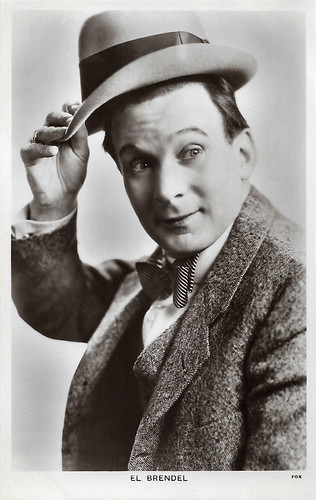
British postcard in the Picturegoer Series, London, no. 755. Photo: Fox.

German postcard by Ross Verlag, no. 6465/1, 1931-1932. Photo: Fox.
Sources: Wikipedia (English, Portuguese, and Spanish) and IMDb.

No comments:
Post a Comment