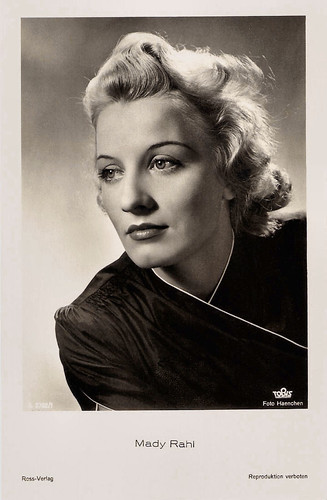
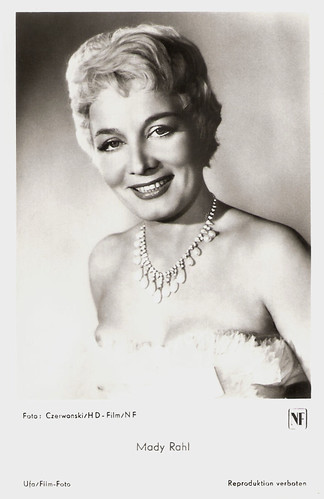
Tobis Film was a major German film production and distribution company. Founded in 1927 as a merger of several companies involved in the switch from silent to sound films, the organisation emerged as the second leading German studio of the Third Reich.
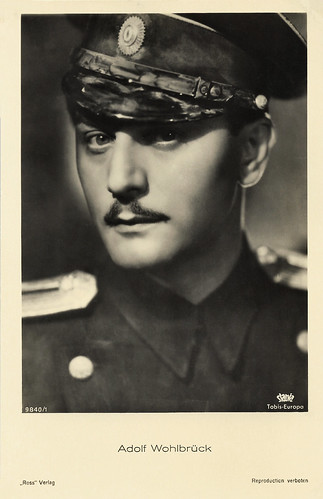 Adolph Wohlbrück
. German postcard by Ross Verlag, no. 9840/1, 1935-1936. Photo: Tobis-Europa / Stania. Publicity still for
Port Arthur (Nicolas Farkas, 1936).
 Leny Marenbach
. German postcard by Film-Foto-Verlag, no. G 138, 1941-1944. Photo: Star-Photo-Atelier.
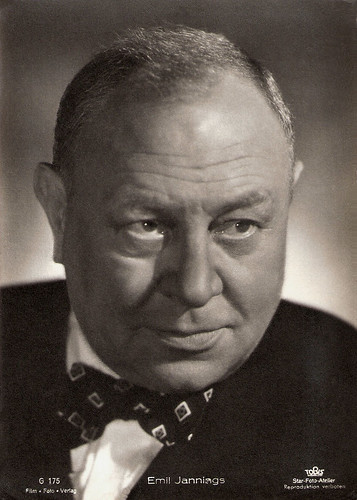 Emil Jannings
. German postcard by Film-Foto-Verlag, no. G 175, 1941-1944. Photo: Star-Foto-Atelier / Tobis.
 Monika Burg
. German Postcard by Film-Foto-Verlag, no. K 1416. Photo: Star-Foto-Atelier / Tobis.
 Fita Benkhoff.
 German postcard by Film-Foto-Verlag, no. W 51, 1941-1944. Photo: Star-Foto-Atelier / Tobis.
The Paris sound film peace treaty
Tobis was founded on 12 May 1927 as a means to capitalise on sound technology. 'Tobis' is an acronym for Ton-Bild-Syndikat (Sound-Film-Syndicate). Tobis had access to a process developed by the record and patent holding company Tri-Ergon-Musik-AG, which placed the sound directly on the filmstrip. This was technique the firm had developed in the 1920s but hadnot immediately pursued.
Tobis became a sound film company on 30 August 1928, when the Tri-Ergon Music AG (St. Gallen) with the Dutch-German H. J. Küchenmeister limited partnership (Berlin), the German Tonfilm AG (Hannover) and the Messterton AG (Berlin) merged into Tobis. The aim of the merger, as the report of the Working Committee noted, was to consolidate the different patents in one hand. Behind the struggle for its own patent was the intention to get rid of the competition by the American company Warner Bros., which used a patent of Western Electric.
Tobis then signed an agreement with Klangfilm to merge into Tobis-Klangfilm. The studio also signed an agreement with the Ufa, which led to Germany's successful entry into sound film production. Tobis-Klangfilm needed films to show to the European public, so late in 1928, it signed contracts with larger French and British film production companies to establish sound film production in Paris and London.
In Paris, at the the Epinay Studios,
René Clair made his first, now classic sound films for Tobis-Klangfilm,
Sous les toits de Paris/Under the Roofs of Paris (René Clair, 1930) with
Albert Préjean,
Le Million/The Million (René Clair, 1931) with
Annabella, and
À nous la liberté/Liberty for Us (René Clair, 1931) with
Raymond Cordy. These were lively musical comedies that mixed asynchronous sound with a bare minimum of dialogue. Clair's innovative sound features placed him as a top director in the forefront of the European cinema. And with the rise of the Tobis-Klangfilm studio, French productions increased.
In 1930, the film industries in Hollywood and Germany signed 'the Paris sound film peace treaty' and agreed to carve up the market. Tobis-Klangfilm had exclusive rights for the German-speaking countries, the Netherlands, the Balkan states and Scandinavia, and Western Electric and RCA got the USA, Canada, Australia, New Zealand, India and the Soviet Union. The rest of the world was declared an open market.
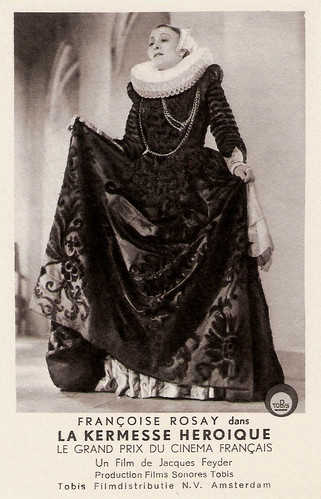 Françoise Rosay
. Dutch postcard by Tobis filmdistributie N.V. Amsterdam. Photo: Tobis. Publicity still for the French Tobis film
La Kermesse Heroique (Jacques Feyder, 1935). Collection: Geoffrey Donaldson Institute.
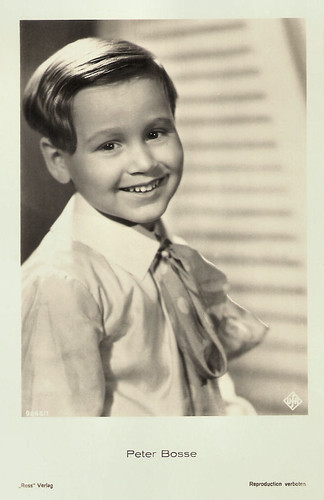
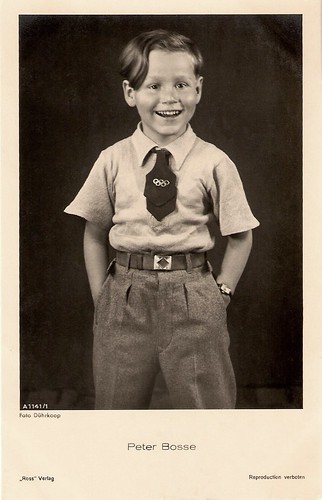
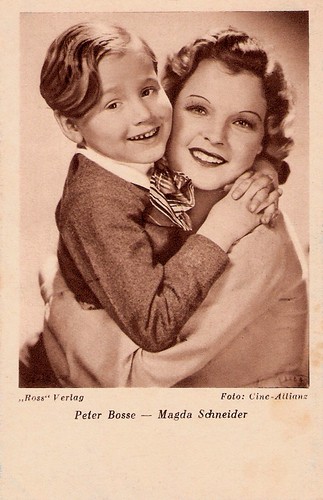
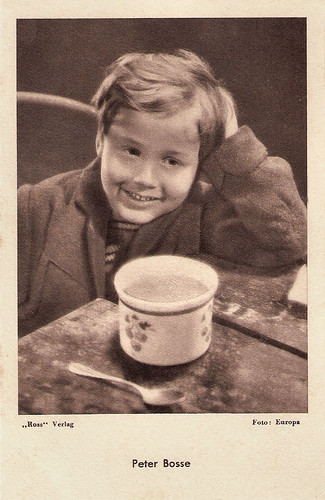
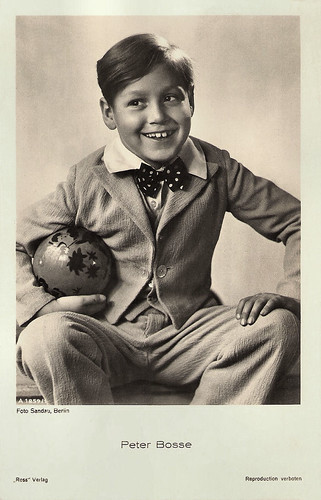
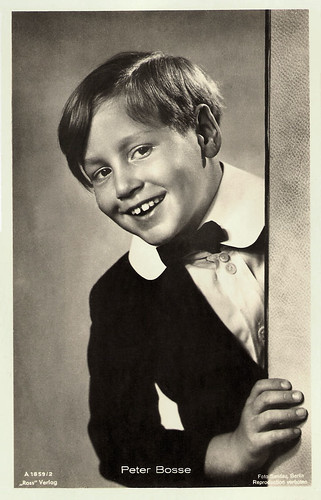
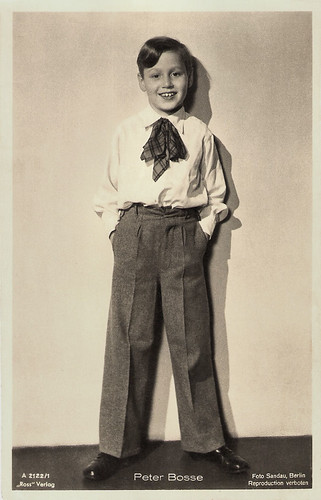
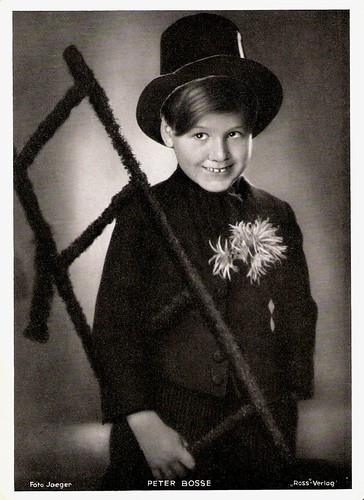
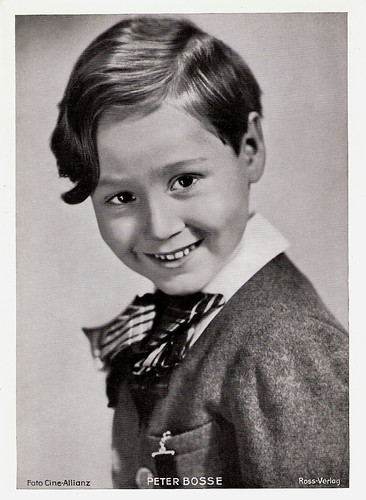
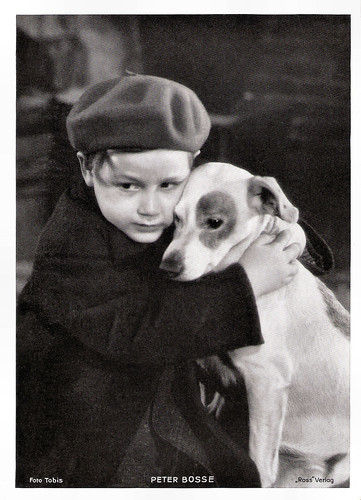 Peter Bosse
. Big German card by Ross Verlag. Photo: Tobis. Publicity still for
Das Gäßchen zum Paradies/Paradise Road (Martin Fric, 1936).
 La Jana
. German postcard by Ross Verlag, no. A 1910/2, 1937-1938. Photo: Atelier Schneider, Berlin / Tobis. Publicity still for
Es leuchten die Sterne/The Stars Shine (Hans H. Zerlett, 1938).
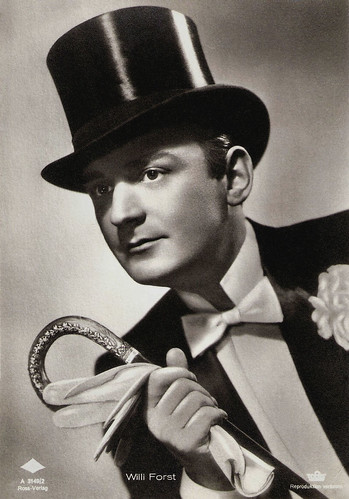 Willi Forst
. Postcard by Ross Verlag, no. A 3149/2, 1941-1944. Photo: Tobis.
 Harry Baur
. German postcard by Film-Foto-Verlag, no. A 3451/1. Photo: Star-Foto-Atelier / Tobis.
The second-in-size studio of Germany
After
Adolf Hitler took power in 1933, the German film industry gradually came under the complete control of the Nazi Ministry of Popular Enlightenment and Propaganda. During the Nazi period, Tobis-Film was the second-in-size studio of Germany, just after the Ufa. The other two major film companies were Terra Film and Bavaria Film. Tobis produced 100 films in these years. Some Tobis films were released in Germany by the subsidiary Europa Film.
Among the directors of Tobis were
Karl Anton,
Volker von Collande,
Erich Engel,
Veit Harlan,
Paul Heidemann,
Max W. Kimmich,
Werner Klingler,
Wolfgang Liebeneiner,
Wolfgang Staudte,
Paul Verhoeven and
Hans H. Zerlett.
To Tobis belonged numerous subsidiaries, including Tobis-Cinéma-Film AG, founded on 6 April 1933 in Berlin, which lent and distributed Tobis films abroad. Occasionally, this company also produced films such as the Czech-German drama
Das Gäßchen zum Paradies/Paradise Road (Martin Fric, 1936) with the young
Peter Bosse and
Hans Moser, and the Italian-German war adventure
Condottieri (Luis Trenker, Werner Klingler, 1937), starring
Luis Trenker.
Tobis also controlled from 1933 until 1938 the dominant Austrian producer Sascha-Film which was then known as Tobis-Sascha. From 1932 it also owned a majority share of one of the main Portuguese producers known as Tobis Portuguesa, a name which the company kept even after the German participation was terminated at the end of world War II.
From 1935 on, Propaganda Minister
Joseph Goebbels increased his hold over the large film companies. He was able to claim that the gradual government take-over had been motivated by purely artistic and not commercial reasons. He did not force the film industry to become National Socialists, but instead guaranteed them financial stability. The studios became increasingly the instrument of the Propaganda Ministry.
 Camilla Horn
. German postcard by Ross Verlag, no. A 1777/1, 1937-1938. Photo: Tobis. Publicity still for
Fahrendes Volk/
Traveling People (Jacques Feyder, 1938).
 Karl Martell
. German postcard by Film-Foto-Verlag, no. A 2582/2, 1939-1940. Photo: Quick / Tobis. Publicity still for
D III 88/D III 88: The New German Air Force Attacks (Herbert Maisch, Hans Bertram, 1939).
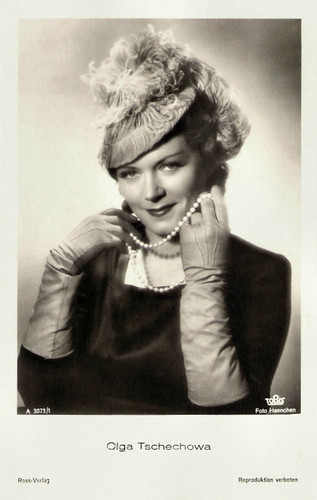 Olga Tschechowa
. German postcard by Ross-Verlag, no. A 3071/1, 1941-1944. Photo: Haenchen / Tobis.
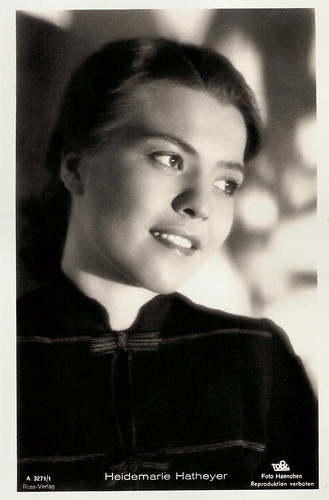 Heidemarie Hatheyer
. German postcard by Film-Foto-Verlag, no. A 3271/1, 1941-1944. Photo: Haenchen / Tobis.
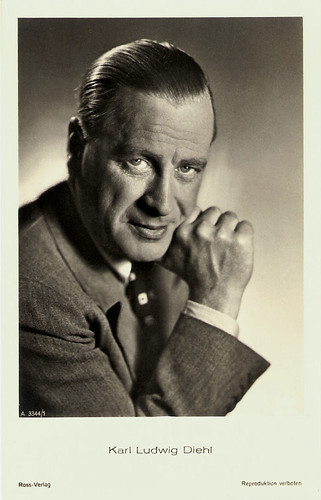 Karl Ludwig Diehl
. German postcard by Ross-Verlag, no. A 3344/1, 1941-1944. Photo: Tobis / Binz.
A Nazi Takeover in Complete Secrecy
The definitive takeover of Tobis by the Nazis was achieved in 1937 with the purchase of the majority of shares. The transactions were carried out as seperate dealings. All happened in almost complete secrecy and the film press scarcely noticedof what happened. In December 1937, Tobis was transformed and given the new title Tobis Filmkunst GmbH. The actor
Emil Jannings was appointed Chairman of the Board.
In the following years, Tobis produced several Propaganda films.
Der Fuchs von Glenarvon/The Fox of Glenarvon (Max W. Kimmich, 1940) portrays the years of the Irish fight for independence during World War I. It starred
Olga Tschechova,
Karl Ludwig Diehl and
Ferdinand Marian.
Ich klage an/I accuse (Wolfgang Liebeneiner, 1941) is a pro-euthanasia melodrama, in which a successful doctor (
Paul Hartmann) is forced to make a heart-wrenching decision after his beautiful young wife (
Heidemarie Hatheyer) is diagnosed with multiple sclerosis. Some of the cast and crew of the film would later face accusations of Crimes Against Humanity at Nuremberg Trials for contributing to the Nazi Action T-4 euthanasia program.
Another Propaganda Film by Tobis is the biographical film
Ohm Krüger (Hans Steinhoff, 1941), starring
Emil Jannings as the South African politician Paul Kruger and his eventual defeat by the British during the Boer War. The film focused on the theme of colonialism to demonstrate through Britain's history the true nature of the British character, and criticised its imperialism toward the Afrikaans-speaking Boers.
Ohm Krüger won the Mussolini Cup for best foreign film at the 1941 Venice Film Festival, at which the Italian Minister for Popular Culture,
Alessandro Pavolini, praised particularly the film's propaganda value and the role of
Emil Jannings. Within Germany, the film was the first to be given the honorary distinction 'Film of the Nation' (Film der Nation) by the Reich Propaganda Ministry Censorship Office.
Joseph Goebbels also presented
Emil Jannings with the 'Ring of Honour of the German Cinema'.
Only one in ten of the produced Nazi films were straight Propaganda, most of them were historical films celebrating an historic past and a glorious future. Tobis also produced a lot light entertainment, such as the musicals by
Paul Verhoeven like
Renate im Quartett/Renate in the Quartet (Paul Verhoeven, 1939) starring
Käthe von Nagy, and the comedies by
Kurt Hoffmann such as
Kohlhiesels Töchter/Kohlhiesel's Daughters (Kurt Hoffmann, 1942) with
Heli Finkenzeller.
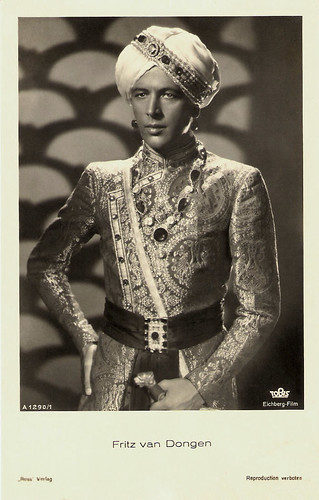 Frits van Dongen
. German postcard by Ross Verlag, Berlin, no. A 1290, 1937-1938. Photo: Tobis / Eichberg-Film. Publicity still for
Der Tiger von Eschnapur/The Tiger of Eschnapur (Richard Eichberg, 1938).
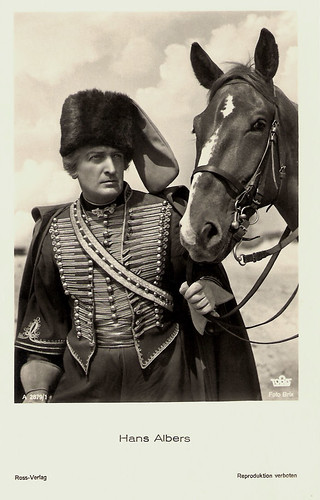 Hans Albers
. German Postcard by Ross Verlag, no. A 2879/1, 1939-1940. Photo: Brix / Tobis. Publicity still for
Trenck, der Pandur/Trenck the Pandur (Herbert Selpin, 1940).
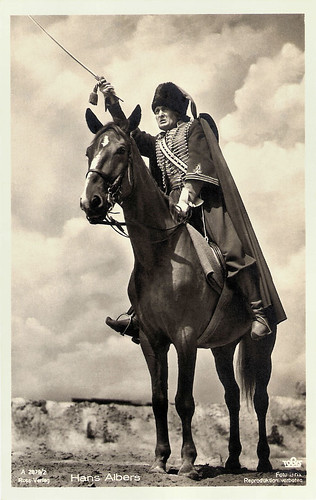 Hans Albers
. German postcard by Ross Verlag, no. A 2879/2, 1939-1940. Photo: Brix / Tobis. Publicity still for
Trenck, der Pandur/Major Trenck (Herbert Selpin, 1940).
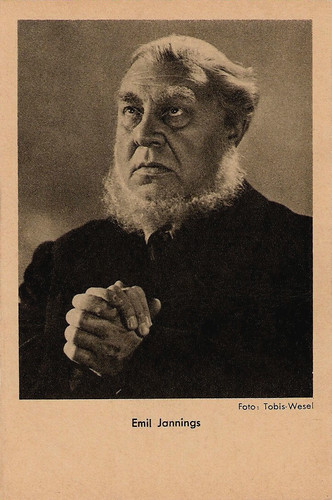 Emil Jannings
. German postcard by Das Programm von Heute, Zeitschrift für Film und Theater G.m.b.H., Berlin. Licensed by Ross Verlag, Berlin. Photo: Tobis / Wesel. Publicity still for
Ohm Krüger (Hans Steinhoff, 1941).
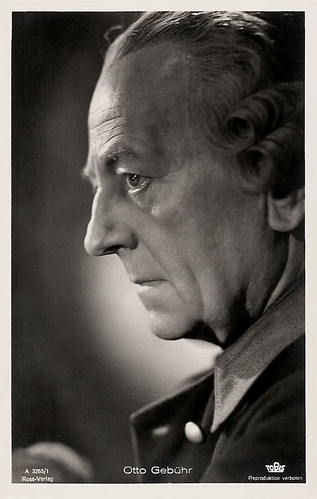 Otto Gebühr
. German postcard by Ross Verlag, no. A 3265/1, 1941-1944. Photo: Tobis. Publicity still for
Der grosse König/The Great King (Veit Harlan, 1942), one of the Frederick the Great films.
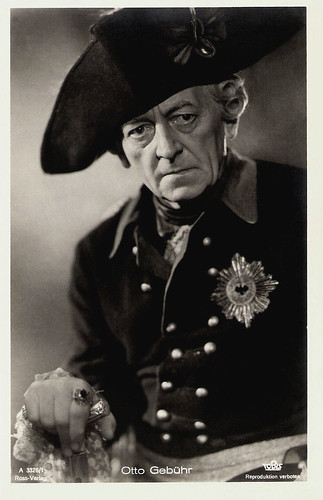 Otto Gebühr
. German postcard by Ross Verlag, no. A 3326/1, 1931-1944. Photo: Tobis. Publicity still for
Der große König/The Great King (Veit Harlan, 1942).
The Titanic of the Nazis
Joseph Goebbels loathed the Expressionist films of the 1920s, but loved comedies and musicals. He stimulated a film star culture by granting approved film stars a special status in the Nazi party and high salaries. Some stars chose leave to Hollywood, but others like
Emil Jannings,
Olga Tschechova,
Hans Albers,
Heinrich George, and
Otto Gebühr, embraced their elite status.
Actors who also often worked for the Tobis were
Fita Benkhoff,
Gustav Fröhlich,
Käthe Haack,
Heidemarie Hatheyer,
Paul Henckels,
Lucie Höflich,
La Jana,
Sybille Schmitz,
Eduard von Winterstein and the child actor
Norbert Rohringer.
In 1942 Ufa, Tobis, Bavaria and Terra were merged into a single state-controlled industry bringing an end to Tobis' independent existence. Nonetheless, films continued to be released under the Tobis banner. A famous example is
Titanic (Herbert Selpin, 1943) starring
Sybille Schmitz, depicting the catastrophic sinking of RMS Titanic in 1912.
Titanic was commissioned by
Joseph Goebbels with the intent of showing not only the superiority of German filmmaking, but also as a propaganda vehicle which would show that British and American capitalism was responsible for the disaster. The addition of an entirely fictional heroic German officer to the ship's crew was intended to demonstrate the superior bravery and selflessness of German men as compared to the British officers.
The original director of
Titanic,
Herbert Selpin, was arrested during production after speaking out against the Nazi regime. He was later found hanged in prison. The film was completed by
Werner Klingler, who was not credited. Although the film had a brief theatrical run in parts of German-occupied Europe starting in November 1943, it was not shown within Germany by order of Goebbels, who feared that it would weaken the German citizenry's morale instead of improving it. Goebbels later banned the playing of the film entirely, and it did not have a second run.
In 1945, due to increasing difficulties of film production during the later stages of the Second World War, few films released in Nazi Germany. One of them was the Tobis production
Solistin Anna Alt/Soloist Anna Alt (Werner Klingler, 1945), a drama starring
Anneliese Uhlig as a gifted pianist gives up her career to support her composer husband (
Will Quadflieg).
After the war, Tobis became a part of the Ufa, but was dissolved in 1962 along with its parent company. With the fall of the Ufa, the story of Tobis seemed completed. However, producer
Horst Wendlandt, who had worked as a cashier for Tobis Film, founded in 1971 a new distribution company which is also known as Tobis. In 2016, the present-day Tobis became an investor in Globalgate Entertainment.
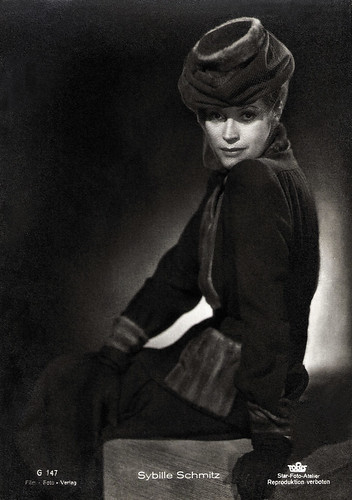 Sibylle Schmitz
. German postcard by Film-Foto-Verlag, no. G 147, 1941-1944. Photo: Star-Foto Atelier / Tobis.
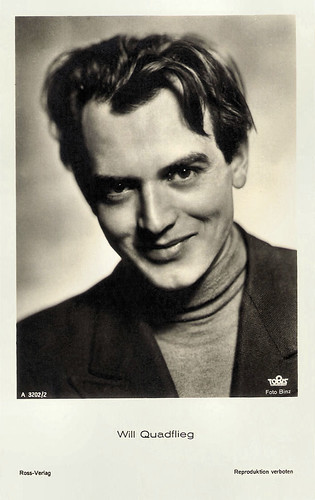 Will Quadflieg
. German postcard by Film-Foto-Verlag, no. A 3202/1, 1941-1944. Photo: Foto Binz / Tobis.
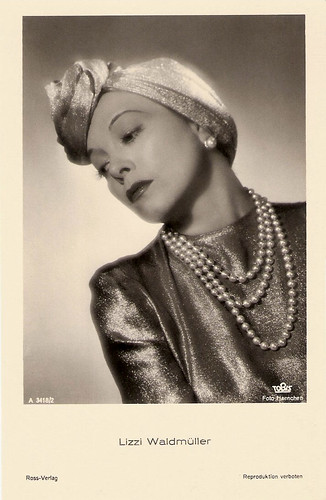 Lizzi Waldmüller
. German postcard by Ross Verlag, no. A 3418/2, 1941-1944. Photo: Haenchen / Tobis.
 Lil Dagover
. German postcard by Film-Foto-Verlag, no. A 3427/1, 1941-1944. Photo: Star-Foto-Atelier / Tobis.
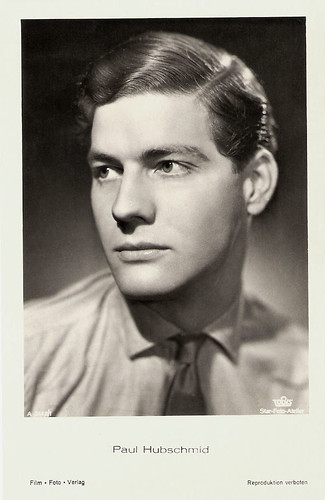 Paul Hubschmid
. German postcard by Film-Foto-Verlag, no. A 3442/1, 1941-1944. Photo: Star-Foto-Atelier / Tobis.
 Irene von Meyendorff.
 German postcard by Film-Foto-Verlag, no. A 3449/1, 1941-1944. Photo: Tobis / Star-Foto-Atelier.
 Ferdinand Marian
. German postcard by Film-Foto-Verlag, no. A 3526/2, 1941-1944. Photo: Wesel / Tobis.
 Margit Symo
. German postcard by Film-Foto-Verlag, no. A 3583/1, 1941-1944. Photo: Tobis.
 Elfie Mayerhofer
. German postcard by Film-Foto-Verlag, no. A 3748/1, 1941-1944. Photo: Star-Foto-Atelier / Tobis.
Sources:
Robert J. and Carol C. Reimer (The A to Z of German Cinema),
Klaus Kreimeier (The Ufa Story),
David Welch (Propaganda and the German Cinema (1933-1945),
Douglas Gomery and Clara Pafort-Overduin (Movie History: A Survey: Second Edition), Wikipedia (
German and
English) and
IMDb.