Showing posts sorted by relevance for query Film Weekly. Sort by date Show all posts

28 November 2020

Five New Filmshots by Film Weekly

In March this year, EFSP did two posts with five series of Filmshots cards. These b/w cards were produced as a supplement for the British magazine Film Weekly. Each series presents a Hollywood film of the early 1930s. These five Filmshots series are from the collection of Ivo Blom.
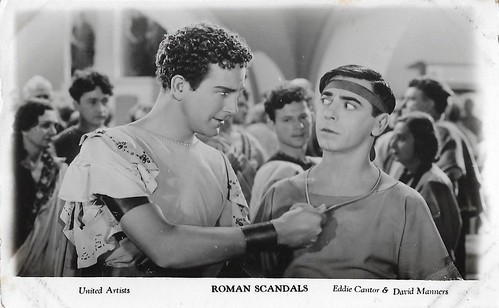
Roman Scandals (1933)


Eddie Cantor and David Manners in Roman Scandals (1933)
British postcard by Film Weekly. Eddie Cantor and David Manners in the pre-Code film comedy Roman Scandals (Frank Tuttle, 1933).
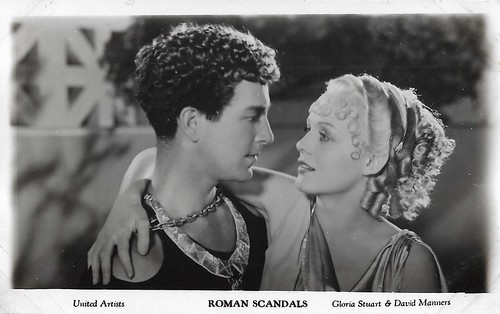
David Manners and Gloria Stuart in Roman Scandals (1933)
British postcard by Film Weekly. David Manners and Gloria Stuart in Roman Scandals (Frank Tuttle, 1933).

When the kind-hearted delivery boy and self-acclaimed authority on ancient Rome Eddie (Eddie Cantor) is thrown out of his home-town of West Rome, Oklahoma by scheming and corrupt politicians, he protests that nothing of the sort would have been allowed to happen in ancient Rome. On his way out of town, he imagines that he is back in Imperial Rome, where he is sold in a slave market to good-natured tribune Josephus (David Manners). Eddie soon discovers that Roman society was just as corrupt as in his own town and when he decides to do something about it, he becomes involved in court intrigue and a murder plot against the evil Emperor Valerius (Edward Arnold) himself.
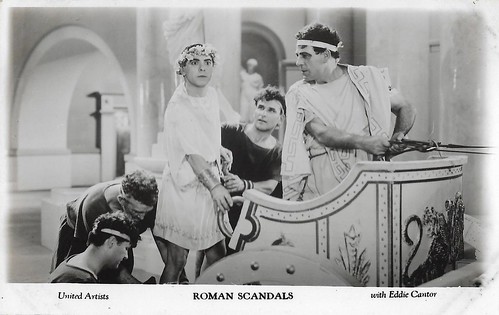
Eddie Cantor in Roman Scandals (1933)
British postcard by Film Weekly. Eddie Cantor in Roman Scandals (Frank Tuttle, 1933).

Eddie Cantor and Edward Arnold in Roman Scandals (1933)
British postcard by Film Weekly. Eddie Cantor and Edward Arnold in Roman Scandals (Frank Tuttle, 1933).

My Weakness (1933)


Lilian Harvey and Charles Butterworth in My Weakness (1933)
British postcard by Film Weekly. Photo: Fox. Lilian Harvey and Charles Butterworth in the pre-Code musical romance My Weakness (David Butler, 1933).

Lilian Harvey and Lew Ayres in My Weakness (1933)
British postcard by Film Weekly. Photo: Fox. Lilian Harvey and Lew Ayres in My Weakness (David Butler, 1933). The other woman could be Susan Fleming.

The pre-Code musical romance My Weakness (David Butler, 1933) was the second of four films made by the British-German actress Lilian Harvey in Hollywood. A wealthy, spendthrift young man, Ronnie Gregory (Lew Ayres), who always has a harem of women around him, bets his uncle Ellery (Henry Travers), owner of a bras factory, that he can transform a clumsy cleaning lady, named Looloo Blake (Lilian Harvey), into a glamorous fashion plate, then marry her off to his bachelor cousin (Charles Butterworth), the ugly uncle's son Gerald. With the help of Ronnie's harem, in particular brunette Jacqueline Wood (Susan Fleming), for whom this is all just fun, the makeover of Looloo into a classy, well-mannered lady is so complete, that Ronnie, Gerald, friend Maxie (Sid Silvers), and even uncle Ellery fall in love with her. Apparently, Cupid has shot too many arrows around. Moreover, imitating the London upper-class's caprice, Looloo has become a little diva...
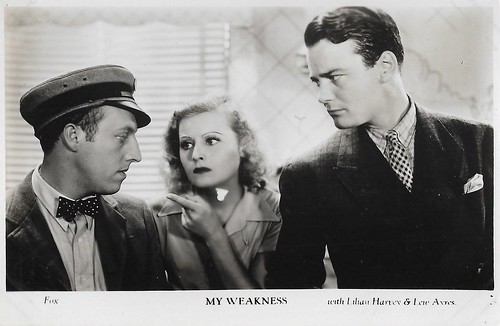
Sid Silvers, Lilian Harvey and Lew Ayres in My Weakness (1933)
British postcard by Film Weekly. Photo: Fox. Lilian Harvey, Lew Ayres, and Sid Silvers in My Weakness (David Butler, 1933).
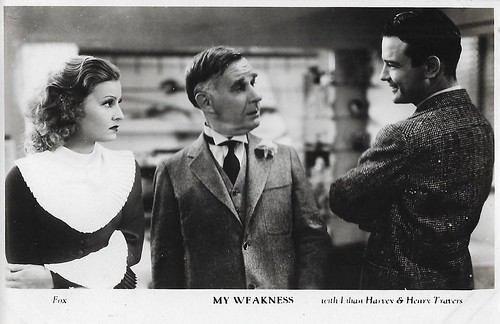
Lilian Harvey, Henry Travers and Lew Ayres in My Weakness (1933)
British postcard by Film Weekly. Photo: Fox. Lilian Harvey, Henry Travers, and Lew Ayres in My Weakness (David Butler, 1933).

Peg O'My Heart (1933)


Marion Davies and J. Farrell MacDonald in Peg O'My Heart (1933)
British postcard by Film Weekly. Photo: M.G.M. Marion Davies and J. Farrell MacDonald in Peg O'My Heart (Robert Z. Leonard, 1933).
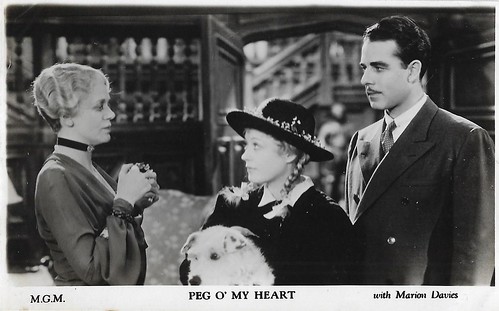
Marion Davies and Onslow Stevens in Peg O'My Heart (1933)
British postcard by Film Weekly. Photo: M.G.M. Marion Davies and Onslow Stevens in Peg O'My Heart (Robert Z. Leonard, 1933). NB. the other woman may be Irene Browne as Mrs. Chichester.

Marion Davies stars in the Pre-Code film Peg O'My Heart (Robert Z. Leonard, 1933) as a poor Irish girl who stands to inherit a fortune if she satisfies certain conditions. Peg (Davies) and her father Pat (J. Farrell MacDonald) live a simple life in an Irish fishing village. One day Sir Gerald (Onslow Stevens) arrives at the village to tell Pat that Peg is heir to the estate of her grandfather, who hated Pat. The upshot of the will is that she must go to England for 3 years to learn to be a lady and that Pat can never see her again. Pat does not tell Peg about his part of the will and sends her to live with Mrs. Chichester (Irene Browne) for her education. Peg soon finds that Alaric (Tyrell Davis) needs to marry her, but she wants Gerald who is engaged to Ethyl Chichester (Juliette Compton) who wants Brent (Alan Mowbray) whose wife (Doris Loyd) will not divorce him. The film was based on the eponymous play by J. Hartley Manners. Director Robert Z. Leonard, a renowned director from the silent era, was uncredited. According to IMDb, the film was a solid success and Davies' partner William Randolph Hearst's favourite film with her.
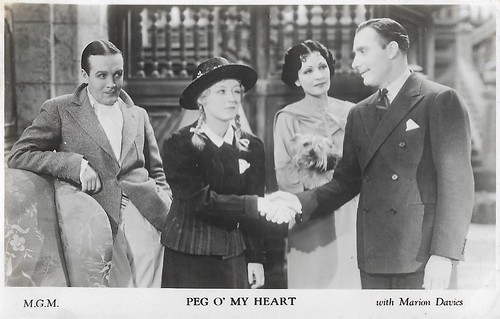
Tyrell Davis, Marion Davies, Juliette Compton, and Alan Mowbray in Peg O'My Heart (1933)
British postcard by Film Weekly. Photo: M.G.M. Tyrell Davis, Marion Davies, Juliette Compton, and Alan Mowbray in Peg O'My Heart (Robert Z. Leonard, 1933).

Marion Davies and Robert Greig in Peg O'My Heart (1933)
British postcard by Film Weekly. Photo: M.G.M. Marion Davies and Robert Greig as butler Jarvis in Peg O'My Heart (Robert Z. Leonard, 1933).

Hell Below (1933)


Robert Montgomery and Walter Huston in Hell Below (1933)
British postcard by Film Weekly. Photo: M.G.M. Robert Montgomery in the American pre-Code film Hell Below (Jack Conway, 1933).
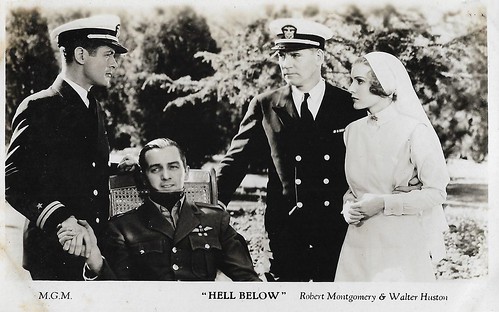
Robert Montgomery, Edwin Styles, Walter Huston and Madge Evans in Hell Below (1933)
British postcard by Film Weekly. Photo: MGM. Robert Montgomery, Edwin Styles, Walter Huston, and Madge Evans in Hell Below (Jack Conway, 1933).

Robert Montgomery was the star of the American pre-Code film Hell Below (Jack Conway, 1933). The film deals with the submarine war during World War I. Lieutenant Thomas Knowlton (Montgomery) meets and falls in love with Joan Standish (Madge Evans), but she happens to be the daughter of his superior, the ruthless commander T.J. Toler (Walter Huston), who sacrifices his men in missions, including Knowlton's best friend Brick (Robert Young). Knowlton finds out Joan is married to a war victim, Herbert Standish (Edwin Styles), but she confesses she loves Thomas. After an attack on enemy submarines, Knowlton loses six men because of his callous behavior and is court-martialed and discharged. He wants to elope with Joan but when hearing her husband will be healed he steps out and sacrifices himself during a hazardous submarine mission.
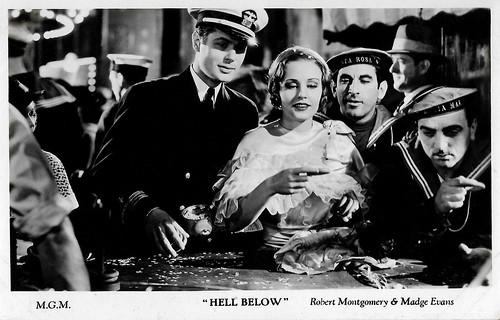
Robert Montgomery and Madge Evans in Hell Below (1933)
British postcard by Film Weekly. Photo: M.G.M. Robert Montgomery and Madge Evans in Hell Below (Jack Conway, 1933).
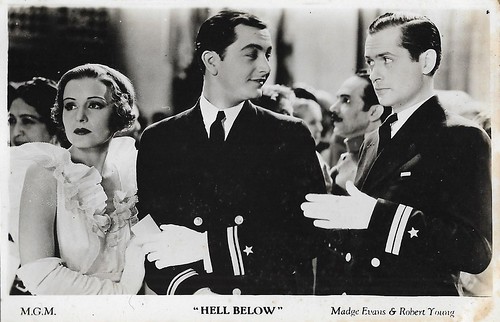
Robert Montgomery, Madge Evans, and Robert Young in Hell Below (1933)
British postcard by Film Weekly. Photo: M.G.M. Madge Evans, Robert Young, and Robert Montgomery in Hell Below (Jack Conway, 1933).

Christopher Strong (1933)


Katharine Hepburn and Colin Clive in Christopher Strong (1933)
British postcard by Film Weekly. Photo: RKO. Katharine Hepburn and Colin Clive in Christopher Strong (Dorothy Arzner, 1933). Hepburn's famous form-fitting costume in this scene was by Walter Plunkett.
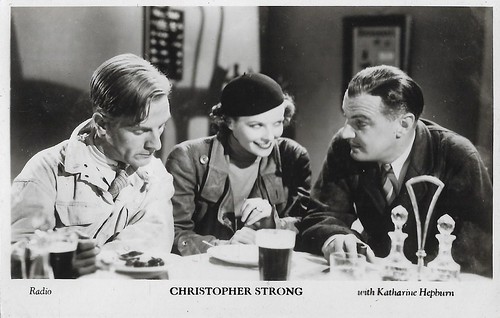
Katharine Hepburn, Ralph Forbes, and Desmond Roberts in Christopher Strong (1933)
British postcard by Film Weekly. Photo: RKO. Katharine Hepburn, Ralph Forbes, and Desmond Roberts in Christopher Strong (Dorothy Arzner, 1933).

In Christopher Strong (Dorothy Arzner, 1933), Katharine Hepburn stars as Lady Cynthia Darrington, who dreams of a career as a pilot. She falls in love with a rich, older gentleman, Christopher Strong (Colin Clive). Their secret meetings end, when the man decides to go back to his family. When Cynthia discovers she is pregnant she is afraid Strong will leave his wife to marry her instead. She first obtains a world record as a pilot and then kills herself.
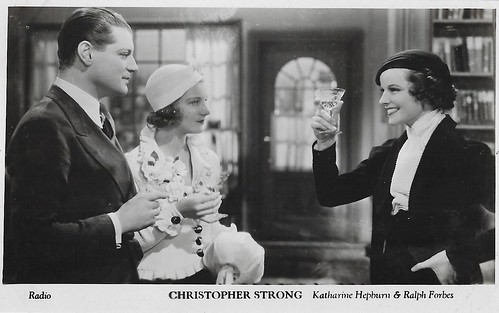
Katharine Hepburn, Helen Chandler and Ralph Forbes in Christopher Strong (1933)
British postcard by Film Weekly. Photo: RKO. Katharine Hepburn in Christopher Strong (Dorothy Arzner, 1933). Also Helen Chandler as Strong's daughter Monica and Ralph Forbes as her lover and later husband, Harry Rawlinson.

Katharine Hepburn and Colin Clive in Christopher Strong (1933)
British postcard by Film Weekly. Photo: RKO. Katharine Hepburn and Colin Clive as Christopher Strong in Christopher Strong (Dorothy Arzner, 1933).

Check out the earlier Film Weekly posts of 7 March 2020 and 14 March 2020.

Sources: a.o. Wikipedia and IMDb.

22 May 2021

Another Five Filmshots by Film Weekly

The Filmshots cards were produced as a supplement for the British magazine Film Weekly. This is our fourth post on the series. We can't get enough of them because each series presents four rare stills of a film of the early 1930s. It can be a classic of a forgotten B-film. The postcards are all in black and white and only a few basic credits were added: the (British) film title, the names of the two main actors, and the studio.

Cleopatra (1934)


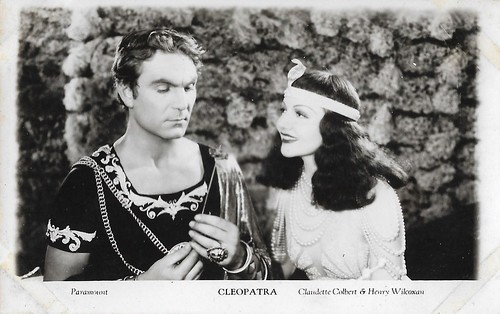
Claudette Colbert and Henry Wilcoxon in Cleopatra
British postcard in the "Filmshots" series by Film Weekly. Photo: Paramount. Henry Wilcoxon as Mark Antony and Claudette Colbert as Cleopatra in Cleopatra (Cecil B. DeMille, 1934).

Claudette Colbert and Warren William in Cleopatra
British postcard in the "Filmshots" series by Film Weekly. Photo: Paramount. Warren William as Julius Caesar and Claudette Colbert as Cleopatra in Cleopatra (Cecil B. DeMille, 1934).

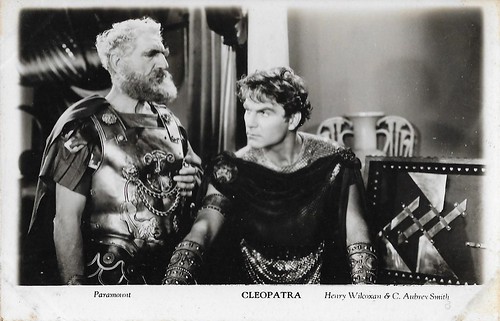
After his historical epic Sign of the Cross (1932), Cecil B. DeMille directed another ancient spectacle, Cleopatra (1934). His new star Claudette Colbert, fresh from her donkey milk bath in Sign of The Cross, played the politically shrewd, man-hungry queen of Egypt. In 48 BC, Cleopatra, facing palace revolt, welcomes the arrival of Julius Caesar (Warren William) as a way of solidifying her power under Rome. When Caesar, whom she has led astray, is killed, she transfers her affections to Marc Antony (Henry Wilcoxon) and dazzles him on a lavish barge. The film got five Oscar nominations, including one for Best Picture, and Victor Milner won the award for Best Cinematography.

Henry Wilcoxon and C. Aubrey Smith in Cleopatra
British postcard in the "Filmshots" series by Film Weekly. Photo: Paramount. Henry Wilcoxon as Mark Antony and C. Aubrey Smith as Enobarbus in Cleopatra (Cecil B. DeMille, 1934).

Claudette Colbert and Henry Wilcoxon in Cleopatra
British postcard in the "Filmshots" series by Film Weekly. Photo: Paramount. Henry Wilcoxon as Mark Antony and Claudette Colbert as Cleopatra in Cleopatra (Cecil B. DeMille, 1934).

I Cover the Waterfront (1933)


Claudette Colbert and Ernest Torrence in I Cover the Waterfront
British postcard in the "Filmshots" series by Film Weekly. Photo: United Artists. Claudette Colbert and Ernest Torrence in I Cover the Waterfront (James Cruze, 1933).

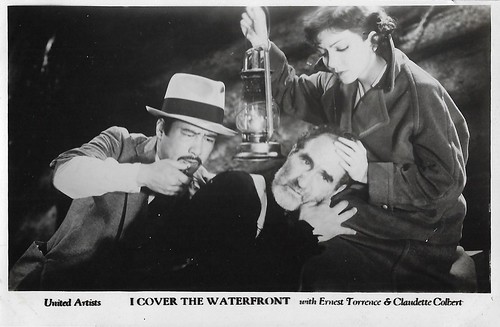
Claudette Colbert, Ernest Torrence and Ben Lyon in I Cover the Waterfront
British postcard in the "Filmshots" series by Film Weekly. Photo: United Artists. Claudette Colbert, Ernest Torrence and Ben Lyon in I Cover the Waterfront (James Cruze, 1933). The other woman could be Claudia Coleman.

I Cover the Waterfront (James Cruze, 1933) is a tough pre-code drama set at the Californian waterfront. The film deals with Kirk, an old smuggler (Ernest Torrence in his final film role), who smuggles Chinese people into the country but has no remorse to throw his living cargo overboard when the police are after him. Yet, his daughter Julie (Claudette Colbert) remains loyal to him. An investigative reporter, Miller (Ben Lyon), bored of his area (he covers the waterfront, hence the title), is set on the case. He discovers a girl (Colbert) swimming naked at night and discovers she is the smuggler's daughter, so he woes her to get closer to the smuggler. She shows him the beauties of the waterfront, inspiring him to improve a novel he has been working on for years. However, unknowingly Julie betrays Kirk's next smuggle to Miller and he warns the Coast Guard. The whole affair ends badly for Kirk (he is deadly wounded), but not before he realizes Julie's love for Miller and manages to save Miller's life whom he has wounded himself.

Claudette Colbert and Ben Lyon in I Cover the Waterfront
British postcard in the "Filmshots" series by Film Weekly. Photo: United Artists. Claudette Colbert and Ben Lyon in I Cover the Waterfront (James Cruze, 1933).

Claudette Colbert and Ernest Torrence in I Cover the Waterfront
British postcard in the "Filmshots" series by Film Weekly. Photo: United Artists. Claudette Colbert and Ernest Torrence in I Cover the Waterfront (James Cruze, 1933).

Jennie Gerhardt (1933)


Sylvia Sidney and Donald Cook in Jennie Gerhardt (1933)
British postcard in the "Filmshots" series by Film Weekly. Photo: Paramount. Sylvia Sidney and Donald Cook in Jennie Gerhardt (Marion Gering, 1933).

Sylvia Sidney in Jennie Gerhardt (1933)
British postcard in the "Filmshots" series by Film Weekly. Photo: Paramount. Sylvia Sidney and Greta Meyer in Jennie Gerhardt (Marion Gering, 1933).

Jennie Gerhardt (1933) is an American pre-Code drama film directed by Marion Gering for Paramount Pictures. It stars Sylvia Sidney, Mary Astor, Donald Cook, Edward Arnold, and H.B. Warner. The film is based on the 1911 novel 'Jennie Gerhardt' by Theodore Dreiser. Jennie Gerhardt (Sylvia Sidney) is a destitute young woman. While working in a hotel in Columbus, Ohio, Jennie meets George Brander (Edward Arnold), a United States Senator, who becomes infatuated with her. He helps her family and declares his wish to marry her. Jennie, grateful for his benevolence, agrees to sleep with him. He dies before they marry, and Jennie is pregnant. Jenny meets Lester Kane (Donald Cook), a prosperous manufacturer's son. Jennie falls in love with him, impressed by his strong will and generosity. She leaves her daughter Vesta (Cora Sue Collins) in Cleveland and travels to New York with Kane. He does not know of her illegitimate daughter and wants to marry Jennie. But because of their difference in class, he anticipates his family's disapproval and decides to take her as his mistress. Dreiser himself approved of the film, considering it to be "moving" and "beautifully interpreted". However, the film received a mixed critical reception upon release in June 1933. Motion Picture Herald said that Jennie Gerhardt is "strictly an adult picture. Selling it successfully depends upon your ability to construct campaigns that will intrigue human interest and sympathy in the character of Jennie." Mordaunt Hall of The New York Times stated that "although the film is handicapped by a lack of suspense and some choppy and trite dialogue, it possesses a laudable sincerity, which may result in its being popular with those who are partial to this genre of story."

Sylvia Sidney and Edward Arnold in Jennie Gerhardt (1933)
British postcard in the "Filmshots" series by Film Weekly. Photo: Paramount. Sylvia Sidney and Edward Arnold in Jennie Gerhardt (Marion Gering, 1933).

Sylvia Sidney and Donald Cook in Jennie Gerhardt (1933)
British postcard in the "Filmshots" series by Film Weekly. Photo: Paramount. Sylvia Sidney and Donald Cook in Jennie Gerhardt (Marion Gering, 1933).

The Bowery (1933)


Pert Kelton and Chorus in The Bowery (1933)
British postcard in the "Filmshots" series by Film Weekly. Photo: Twentieth Century. Pert Kelton as dance hall performer Trixie Odbray with the chorus in The Bowery (Raoul Walsh, 1933).

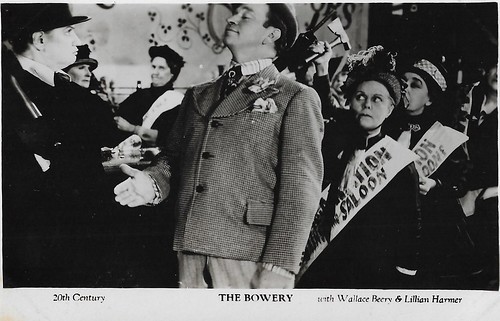
Wallace Beery and Lillian Harmer in The Bowery (1933)
British postcard in the "Filmshots" series by Film Weekly. Photo: Twentieth Century. Wallace Beery and Lillian Harmer in The Bowery (Raoul Walsh, 1933).

The Bowery (Raoul Walsh, 1933) is set in the Gay Nineties in the Bowery in New York. Saloon owner Chuck Connors (Wallace Beery) is the king of the Bowery. He adopts a boy, Swipes (Jackie Cooper), and educates him in a rough way. Connors' rival, both as an upcoming saloon owner and in the voluntary fire brigade, is Steve Brodie (George Raft). Soon, both also become rivals in the love of Lucy (Fay Wray), a homeless girl Connors has saved - causing the jealous Swipes to move in with Brodie. Connors bets his saloon against Brodie to challenge him to jump off the Brooklyn Bridge. Brodie eventually does so when his plan to use a dummy falls through. Connors then sees no problem when temperance activists destroy his saloon. Until he hears about the dummy...

Jackie Cooper and Wallace Beery in The Bowery (1933)
British postcard in the "Filmshots" series by Film Weekly. Photo: Twentieth Century. Wallace Beery and Jackie Cooper in The Bowery (Raoul Walsh, 1933).

Fay Way and George Raft in The Bowery (1933)
British postcard in the "Filmshots" series by Film Weekly. Photo: Twentieth Century. Fay Wray and George Raft in The Bowery (Raoul Walsh, 1933).

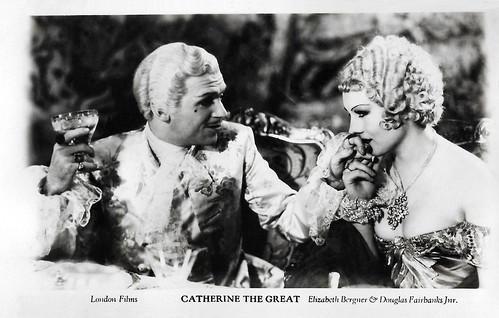
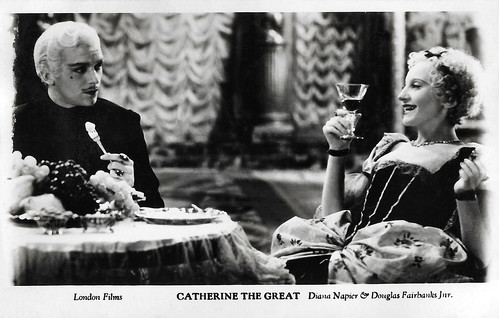
Catherine the Great (1934)


Douglas Fairbanks Jr., Flora Robson and Elisabeth Bergner in Catherine the Great (1934)
British postcard in the "Filmshots" series by Film Weekly. Photo: London Films. Douglas Fairbanks Jr., Flora Robson, and Elisabeth Bergner in Catherine the Great (Paul Czinner, 1934).

Douglas Fairbanks Jr. and Diana Napier in Catherine the Great (1934)
British postcard in the "Filmshots" series by Film Weekly. Photo: London Films. Publicity still for Catherine the Great (Paul Czinner, 1934). Although the postcard credits the kissing lady as Elisabeth Bergner, we think she is Diana Napier who portrays Countess Vorontzova, the mistress of Peter III (Douglas Fairbanks Jr.).

Catherine the Great/The Rise of Catherine the Great (1934) was the first English-language film for Vienna-born Elisabeth Bergner. She is radiant as the obscure German princess who would become the most powerful woman in Russian history. Bergner definitely makes Catherine interesting and worth caring about. The historical film was based on the play 'The Czarina' by two Hungarian writers, Lajos Bíró and Melchior Lengyel. It was directed by Bergner's husband Paul Czinner and - uncredited - by producer Alexander Korda. Grand Duke Pyotr, who later became Peter III, was played by Douglas Fairbanks Junior. He behaves like a homicidal Hamlet, all moodiness and flares of deadly temper. He makes an interesting effort to create a charmer out of a pathetic man who was obviously a maniac. The supporting cast is also excellent. Dame Flora Robson is wonderful as Empress Elizabeth: suspicious, domineering, and rather wanton. Celebrated stage actress Dame Irene Vanbrugh makes a rare screen appearance as Catherine's mother. The mid-eighteenth century was a period when clothes and furnishings favoured by the wealthy classes of Europe were particularly fanciful and elaborate, and this is reflected in the lavish sets and costumes on view in the film. Although the film was overshadowed by Josef von Sternberg's masterpiece The Scarlet Empress (1934) with Marlene Dietrich, Catherine the Great/The Rise of Catherine the Great is a good film taken on its own merits.

Irene Vanbrugh and Elisabeth Bergner in Catherine the Great (1934)
British postcard in the "Filmshots" series by Film Weekly. Photo: London Films. Irene Vanbrugh and Elisabeth Bergner in Catherine the Great (Paul Czinner, 1934).

Douglas Fairbanks Jr. and Diana Napier in Catherine the Great (1934)
British postcard in the "Filmshots" series by Film Weekly. Photo: London Films. Douglas Fairbanks Jr. and Diana Napier in Catherine the Great (Paul Czinner, 1934).

Check out the three earlier Film Weekly posts at EFSP: 7 March 2020 including The Private Life of Henry VIII (1933), 14 March 2020 including A Farewell to Arms (1932), and 28 November 2020 including Christopher Strong (1933).

14 March 2020

Five More Filmshots by Film Weekly

Today, EFSP has the second post with five series of Filmshots cards, produced as a supplement for the British magazine Film Weekly. Each series presents a Hollywood film of the early 1930s, the pictures are in black and white and a few basic credits are added: the (British) film title, the two main actors and the studio. These five Filmshots series are from the collection of Ivo Blom.

A Farewell to Arms (1932)


Gary Cooper and Helen Hayes in A Farewell to Arms (1932)
British postcard by Film Weekly. Photo: Paramount. Gary Cooper and Helen Hayes in A Farewell to Arms (Frank Borzage, 1932), based on Ernest Hemingway's homonymous novel (1929).

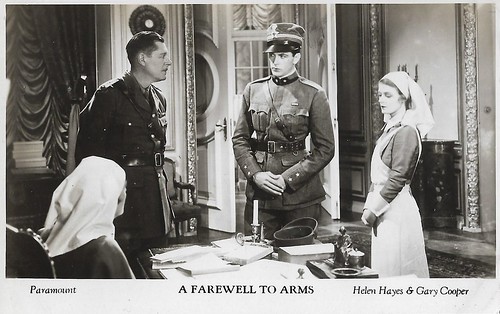
Gary Cooper in A Farewell to Arms (1932)
British postcard by Film Weekly. Photo: Paramount. Gary Cooper in A Farewell to Arms (Frank Borzage, 1932). The woman on the right is not Helen Hayes. The man on the left is Gilbert Emery (British major), the woman on the left is Blanche Friderici (Head nurse).

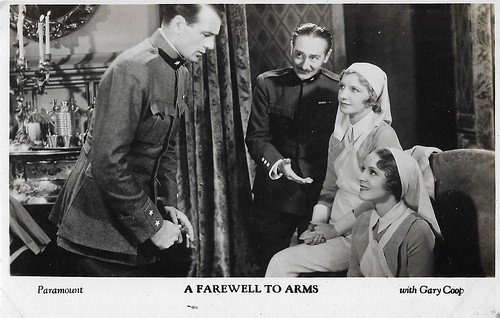
Gary Cooper in A Farewell to Arms (1932)
British postcard by Film Weekly. Photo: Paramount. Gary Cooper, Adolphe Menjou, Mary Philips, and Helen Hayes in A Farewell to Arms (Frank Borzage, 1932).

Gary Cooper, Jack La Rue and Helen Hayes in A Farewell to Arms (1932)
British postcard by Film Weekly. Photo: Paramount. Gary Cooper, Helen Hayes, and Jack La Rue in A Farewell to Arms (Frank Borzage, 1932).

A Farewell to Arms (Frank Borzage, 1932) is the first of the three screen adaptations of Ernest Hemingway's homonymous novel from 1929. Gary Cooper, and Helen Hayes star as the American ambulance driver Lt. Fredric Henry and the English nurse Catherine Barkley. The action takes place in Italy during World War I, Henry and Barkley fall in love and will stop at nothing to be together. The film also analyses Lt. Henry's feelings on war and the purpose of fighting.

Adolphe Menjou replete with Italian accent plays Cooper's friend and romantic rival, Major Rinaldi. In the supporting cast are also Mary Phillips as Helen Ferguson, a nurse and Catherine's closest friend who objects to her continued romance with the young American, Jack LaRue as the soft-spoken Italian priest, and Blanche Frederici as the stern head nurse. The film is sublimely photographed by Charles Lang who deservedly won an Oscar.

A Farewell to Arms was a highly popular war drama in its day. The film concentrates more on the relationship between the lieutenant and the nurse than on the soldiers on the battlefield. The film earned an Academy Award nomination for Best Picture of 1932-1933. Director Frank Borzage brings out the tenderness and simplicity of the young couple in love as he had done earlier in a series of classic films starring Janet Gaynor and Charles Farrell at Fox Studios.

Clear All Wires! (1933)


Lee Tracy in Clear All Wires! (1933)
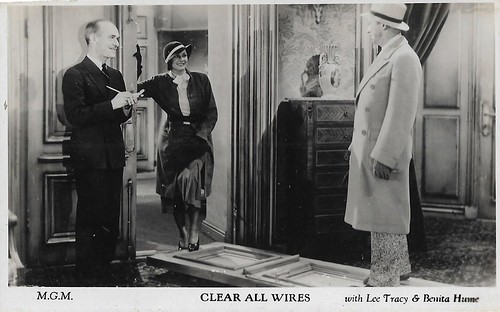
British postcard by Film Weekly. Photo: MGM. Lee Tracy and Benita Hume in Clear All Wires! (George Hill, 1933), here also with James Gleason.

Lee Tracy in Clear All Wires! (1933)
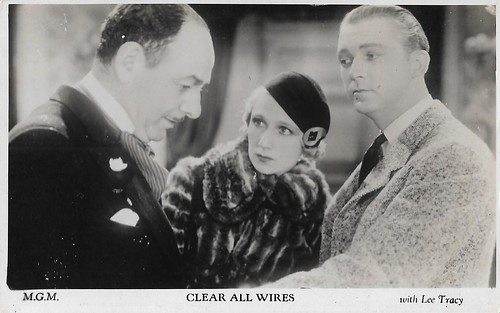
British postcard by Film Weekly. Photo: MGM. Lee Tracy in Clear All Wires! (George Hill, 1933). The woman in this card may be Una Merkel, the man on the left could be Guy Usher.

Lee Tracy in Clear All Wires! (1933)
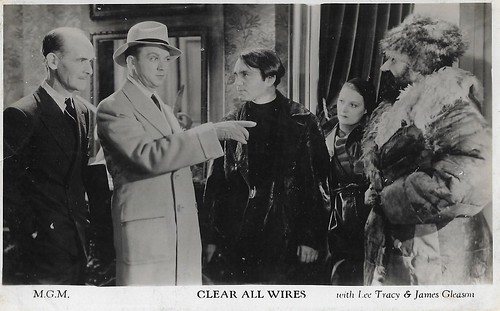
British postcard by Film Weekly. Photo: MGM. Lee Tracy in Clear All Wires! (George Hill, 1933). The man on the left here is James Gleason. The man behind the chair could C. Henry Gordon.

Lee Tracy in Clear All Wires! (1933)
British postcard by Film Weekly. Photo: MGM. Lee Tracy in Clear All Wires! (George Hill, 1933). Left of Tracy stands James Gleason. The woman is Benita Hume.

Lee Tracy plays in Clear All Wires! (George Hill, 1933) the fast-talking Buckley Joyce Thomas, an unethical reporter who manipulates the news for his own benefit as much as he reports it. When he is in Paris to get a medal for being rescued from his alleged kidnappers, he finds that his boss, Stevens (Guy Usher), at the Chicago Globe is going with his old gal Dolly (Una Merkel). When Stevens learns that Dolly is staying with Buckley in Moscow, he fires Buckley. To get his job back, Buckley and Lefty (James Gleason) stage a great news story about the shooting of the last Romanoff, Prince Alexander, played by Eugene Sigaloff. but the plan backfires and they are now in line to be shot by the Commissar (C. Henry Gordon).

The film was based on a popular Broadway play by Bella and Samuel Spewack. In Encyclopedia of Journalists on Film, Richard Ness draws an interesting relationship with Orson Welles' later film Citizen Kane (1941), referring to the subplot of the operatic ambitions of the shrill-voiced mistress Dolly, even practicing the same Aria as in Citizen Kane. While in Welles' film the character is called Susan Alexander Kane, Lefty tells Buckley Dolly got a call from Mr. Alexander. Another scene in which Buckley meets Stalin and lights the dictator's pipe foreshadows a similar scene between Kane and Hitler in the staged newsreel in the film.

Melody Cruise (1933)


Phil Harris and Helen Mack in Melody Cruise
British postcard by Film Weekly. Photo: RKO Radio. Phil Harris, and Helen Mack in Melody Cruise (Mark Sandrich, 1933).

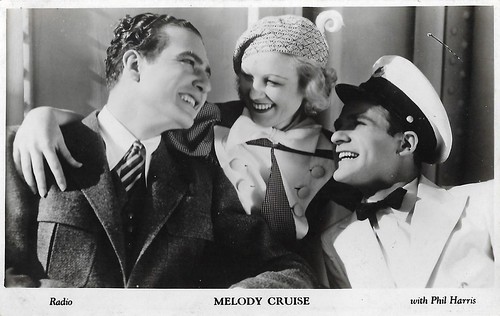
Phil Harris, prob. Greta Nissen, and Chick Chandler in Melody Cruise
British postcard by Film Weekly. Photo: RKO Radio. Phil Harris, Chick Chandler and probably Greta Nissen in Melody Cruise (Mark Sandrich, 1933).

Greta Nissen and Charles Ruggles in Melody Cruise (1933)
British postcard by Film Weekly. Photo: RKO Radio. Greta Nissen, and Charles Ruggles in Melody Cruise (Mark Sandrich, 1933).

Phil Harris, Chick Chandler and [Greta Nissen] in Melody Cruise. RKO. Film Weekly
British postcard by Film Weekly. Photo: RKO Radio. Phil Harris, Greta Nissen, and Chick Chandler in Melody Cruise (Mark Sandrich, 1933).

Melody Cruise (Mark Sandrich, 1933) is a pre-Code romantic musical comedy about a bachelor millionaire, Alan Chandler (Phil Harris), hunted by women aboard a cruise liner. Charles Ruggles plays his best friend and womanizer Pete, Greta Nissen plays Elsa von Rader, Alan's mundane friend, Chick Chandler plays the steward Hickey whom Pete has bribed to prevent Alan from marrying, and Helen Mack is Laurie Marlowe, Alan's new friend.

After "wintering" in New York, Pasadena businessman Pete Wells prepares for his ocean voyage home by throwing a wild party in his stateroom. While drunk, Pete signs a letter written by his best friend, playboy Alan Chandler, in which his various adulterous affairs are described in detail. Determined to remain a bachelor, Alan has arranged for the letter to be sent to Pete's wife Grace but has instructed that it not be opened until he marries.

The next morning, after the letter has been mailed and the ship is in mid-ocean, Pete discovers Zoe and Vera, two of his party-goers, stranded in his stateroom. To keep the women safely in his cabin, Pete bribes steward Hickey to steal their clothes. He then hires Hickey to discourage the blossoming romance between Alan and German beauty Elsa Von Rader, fearful that it may lead to marriage and, consequently, the opening of the letter. Soon after, Pete runs into a friend of his wife, Miss Potts, a principal who is traveling with teacher Laurie Marlowe. When Pete and Miss Potts encounter the half-dressed Zoe and Vera on the ship's deck, Pete tells her that the young women are his nieces. While Miss Potts and Pete's "nieces" become acquainted, Alan accidentally waltzes into Laurie's stateroom and begins to romance her. Although attracted to the polished playboy, Laurie dismisses him, and he continues his affair with Elsa until the machinations of Hickey bring him back to Laurie.

Gabriel Over the White House (1933)


Gabriel over the White House
British postcard by Film Weekly. Photo: MGM. Walter Huston, Franchot Tone, and Karen Morley in Gabriel Over the White House (Gregory La Cava, 1933).

Franchot Tone and Karen Morley in Gabriel over the White House (1933)
British postcard by Film Weekly. Photo: MGM. Franchot Tone, and Karen Morley in Gabriel Over the White House (Gregory La Cava, 1933).

Walter Huston in Gabriel over the White House (1933)
British postcard by Film Weekly. Photo: MGM. Walter Huston (left), Franchot Tone (centre), and Karen Morley (sitting) in Gabriel Over the White House (Gregory La Cava, 1933). The fourth card in this series still lacks.

Gabriel Over the White House (Gregory La Cava, 1933) was a controversial film on a corrupt new American president. Judd Hammond (Walter Huston) has taken his mistress Pendola (Karen Morley) to his office and neglects the worries of his people: hunger, unemployment, and gangsterism. Because of a car accident, he gets into a coma and when awakened, he has become a totally different person. He wants an agreement with protesting workers marching up to Washington and fires his corrupt cabinet. He manages to get plenipotentiary powers. He helps farmers and ends Prohibition. Together with his secretary Beekman (Franchot Tone), he makes a quick, drastic end to the racketing of Nick Diamond (C. Henry Gordon). He even manages other nations to pay back their war debts to the US, by threatening them with arms. After an international agreement is signed, he collapses and dies.

Gabriel Over the White House was made during a special moment in time. Producer Walter Wanger conceived of it as Rooseveltian vehicle, right from the start, against the wishes of Louis B. Mayer, a stark Republican, but backed by William Randolph Hearst, who not only was a big Roosevelt backer but supposedly also wrote part of the speech President Hammond gives in the film. Mayer was furious when during a preview he noticed that Hammond's presidency changes into dictatorship, but the film was released end of March 1933, about four weeks after Roosevelt had been inaugurated as president.

When the film came out, Mussolini, Stalin, and Hitler ruled their countries as dictators - Hitler only very recently. Of course, Roosevelt implemented his New Deal without dictatorship. In 1932 marches by WWI veterans and the unemployed were really taking place, while Al Capone went to prison - for tax evasion. In December 1933 Prohibition would be repealed.

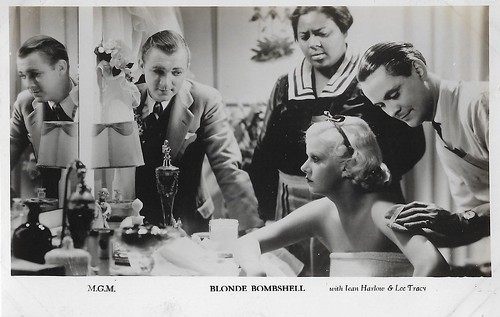
Blonde Bombshell (1933)


Jean Harlow and Lee Tracy in Bombshell (1933)
British postcard by Film Weekly. Photo: MGM. Jean Harlow and Lee Tracy in Blonde Bombshell/Bombshell (Victor Fleming, 1933).

Jean Harlow and Lee Tracy in Bombshell (1933)
British postcard by Film Weekly. Photo: MGM. Jean Harlow and Lee Tracy in Blonde Bombshell/Bombshell (Victor Fleming, 1933).

Jean Harlow and Franchot Tone in Bombshell (1933)
British postcard by Film Weekly. Photo: MGM. Franchot Tone and Jean Harlow in Blonde Bombshell/Bombshell (Victor Fleming, 1933).

Jean Harlow and Lee Tracy in Bombshell (1933)
British postcard by Film Weekly. Photo: MGM. Jean Harlow, Louise Beavers, and Lee Tracy in Blonde Bombshell/Bombshell (Victor Fleming, 1933).

In the pre-Code screwball comedy Blonde Bombshell/ Bombshell (Victor Fleming, 1933), movie star Lola Burns (Jean Harlow) is angry with her studio publicist E.J. "Space" Hanlon (Lee Tracy), who feeds the press with endless stories about her greatness. Lola's family and staff are another cause of distress for her, as everybody is always trying to get money from the actress. All Burns really wants is to live a normal life and prove to the public that she's not a sexy vamp, but a proper lady. She tries to adopt a baby, but Hanlon, who secretly loves her, thwarts all her plans.

Burns decides she can't stand any more of such a life and flees. Far from the movie fluff, she meets wealthy and romantic Gifford Middleton (Franchot Tone), who hates the movies and therefore has never heard about Lola Burns and her bad press. They soon fall in love, and Gifford proposes marriage. Burns is to meet her fiancé's parents, but everything collapses when Hanlon, together with Burns' family, finds her and tells the Middletons the truth. Burns feels hurt by the rude way Gifford and his parents dump her and accepts Hanlon's suggestion to return to Hollywood with no regrets. She does not know that the three Middletons were all actors hired by Hanlon himself.

Sources: a.o. Wikipedia and IMDb