Showing posts sorted by relevance for query Marie-France Pisier. Sort by date Show all posts

01 April 2014

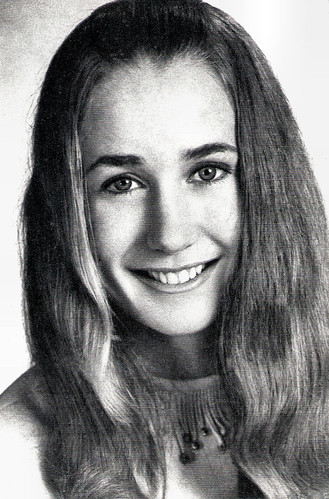
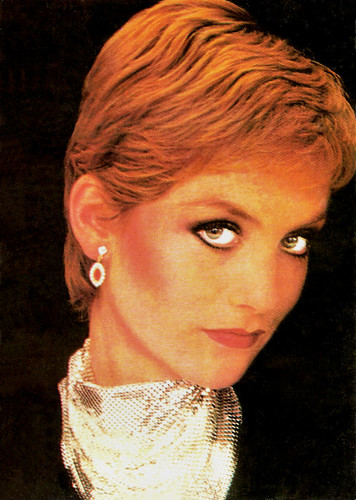
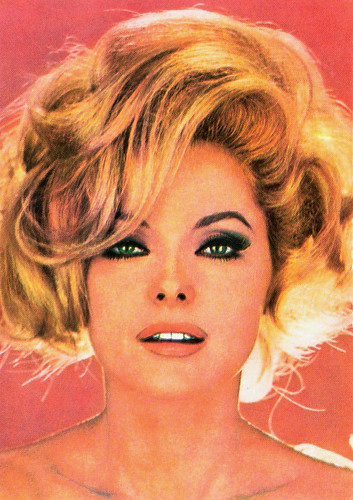
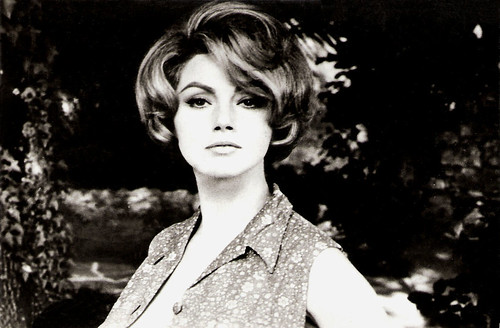
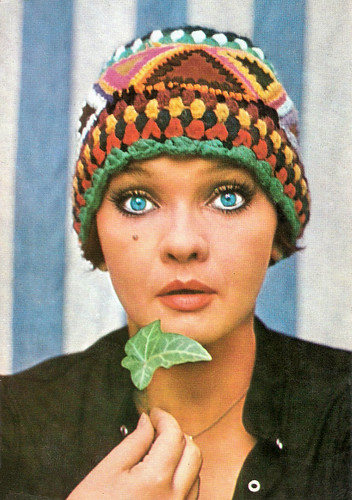
Marie-France Pisier

Refined beauty Marie-France Pisier (1944-2011) was a French actress, screenwriter, and director. She was discovered by François Truffaut and became his muse. She later also worked with such auteurs as Luis Buñuel, Jacques Rivette, Raúl Ruiz and André Techiné. Pisier twice earned the César Award for Best Supporting Actress. The international success of the comedy Cousin, Cousine (1977) brought her to Hollywood, where she had a short and unhappy detour.

Marie-France Pisier
Romanian postcard by Casa Filmului Acin.

Truffaut and the Nouvelle Vague


Marie-France Pisier was born in Dalat, French Indochina, where her father was serving as colonial governor. Her younger brother, Gilles Pisier, is a mathematician and a member of the French Academy of Sciences. Her sister, Evelyne, was the first wife of Bernard Kouchner, a French politician and the co-founder of Médecins Sans Frontières.

The family moved to Paris when Marie-France was twelve years old. As a teenager, she began acting with an amateur theatre troupe. At 17, she made her screen acting debut as Colette in the short film Antoine et Colette / Antoine and Colette (François Truffaut, 1962) with Jean-Pierre Léaud as Antoine Donel. It was the second film in which Truffaut followed the Antoine Donel character from boyhood to adulthood.

Antoine et Colette was made for the international omnibus film, L'amour à vingt ans / Love at Twenty (1962), which also featured shorts from Shintarô Ishihara, Marcel Ophüls, Renzo Rossellini and Andrzej Wajda. Pisier had a brief but incendiary romance with the older, married Truffaut. Despite its end, she later appeared twice more as Colette in Truffaut's Baiser volés / Stolen Kisses (François Truffaut, 1968) and L'Amour en fuite / Love on the Run (François Truffaut, 1979).

L'Amour en fuite was the fifth and final film in the semi-autobiographical Antoine Doinel series, and Pisier was credited as a co-writer of the screenplay. In the film, her character, now a successful lawyer, handles Antoine with the same dismissive ease as she did in their youth.

After breaking into film with Truffaut, she went on to work with other Nouvelle Vague (New Wave) directors. She starred with Jean-Louis Trintignant in the meta-thriller Trans-Europ-Express (1967), written and directed by the novelist Alain Robbe-Grillet. In the meantime, Marie-France attended Paris University, eventually attaining degrees in law and political science.

Marie France Pisier
Romanian postcard by Casa Filmului Acin, no. 207. Collection: Alina Deaconu.

Marie-France Pisier
Romanian postcard by Casa Filmului Acin.

Unforgettable, fascinating, luminous, haunting, mesmerising, and, yes, confusing


During the 1960s and 1970s, Marie-France Pisier appeared in several mediocre genre films, including thrillers directed by the actor Robert Hossein. Then, her career took a more interesting turn. She collaborated on the screenplay to Céline et Julie vont en bâteau / Celine and Julie Go Boating (Jacques Rivette, 1974). She also played a significant supporting role as the mysterious governess Sophie in the film. Craig Butler at AllMovie: “Celine and Julie Go Boating is one of those truly rare films that deserves to be called ‘unique.’ It also deserves a plethora of other adjectives: unforgettable, fascinating, luminous, haunting, mesmerising - and, yes, confusing.”

Later in the same year, she had a role in Luis Buñuel’s Le Fantôme de la liberté / Phantom of Liberty (1974). She is among the elegant guests seated on individual lavatories around a table from which they excuse themselves to go and eat in a little room behind a locked door. In 1975, Pisier gained widespread public recognition when she appeared in the popular comedy Cousin Cousine (Jean-Charles Tacchella, 1975) with Marie-Christine Barrault and Victor Lanoux. Her role as the high-strung, monumentally self-involved Karine earned her a César Award for Best Supporting Actress.

Her subsequent feature films included three with director André Téchiné, starting with Souvenirs en France / French Provincial (André Téchiné, 1975) with Jeanne Moreau. For Barocco (André Téchiné, 1976), Pisier won a second César for her performance as a prostitute with a baby in tow, alongside Isabelle Adjani and Gérard Depardieu.

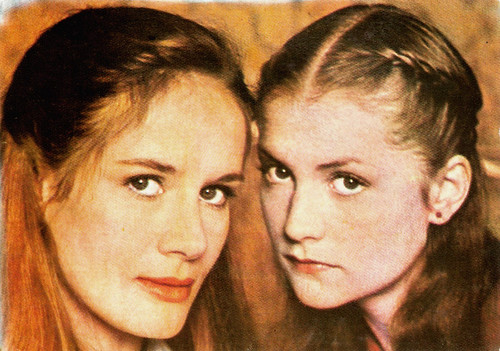
In Les Sœurs Brontë / The Brontë Sisters (André Téchiné, 1979), she portrayed Charlotte Brontë opposite Isabelle Adjani as Emily and Isabelle Huppert as Anne. Pisier attempted to crack the American film industry with The Other Side of Midnight (Charles Jarrott, 1977), a cinematic soap opera based on the Sidney Sheldon novel.

She appeared on American television in the miniseries The French Atlantic Affair (Douglas Heyes, 1979), and Scruples (Alan J. Levi, 1980). She made two more Hollywood films, French Postcards (Willard Huyck, 1979) with Debra Winger, and Chanel Solitaire (George Kaczender, 1981), in which she portrayed the designer Coco Chanel with her usual elegance opposite Timothy Dalton and Rutger Hauer.
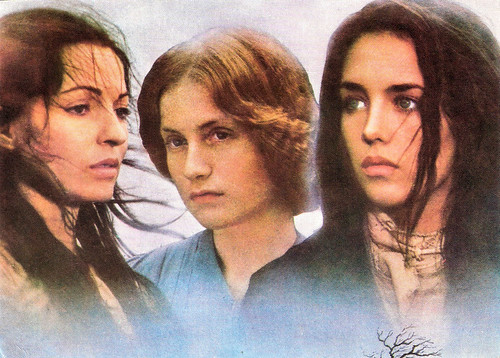
Marie-France Pisier, Isabelle Huppert and Isabelle Adjani in Les soeurs Brontë
Romanian postcard by Casa Filmului Acin. Photo: publicity still for Les soeurs Brontë / The Brontë Sisters (André Téchniné, 1979) with Marie-France Pisier as Charlotte Brontë, Isabelle Huppert as Anne Brontë, and Isabelle Adjani as Emily Brontë.

Outspoken defender of women's rights and legal abortion


Returning to France, Marie-France Pisier co-starred with Jean-Paul Belmondo in the action-comedy L'as des as / The Ace of Aces (Gérard Oury, 1982). She also appeared in the Thomas Mann adaptation Der Zauberberg / The Magic Mountain (Hans W. Geissendörfer, 1982), and co-starred with Gérard Lanvin and Michel Piccoli in the Science Fiction film Le Prix du Danger / The Price of the Danger (Yves Boisset, 1983).

An interesting experiment was Parking (Jacques Demy, 1985) starring Francis Huster, Laurent Malet, and Jean Marais. It transposed the Orpheus myth to the 20th century, and it paid tribute to Jean Cocteau's film Orphée (1950). Also remarkable was the drama L'Œuvre au noir / The Abyss (André Delvaux, 1988), based on the novel of the same name by Marguerite Yourcenar.

Pisier made her directorial debut with Le Bal du gouverneur / The Governor's Party (1990), starring Kristin Scott Thomas, which she adapted from her own best-selling novel, based on her childhood experiences in New Caledonia. She also played Madame Verdurin in the Marcel Proust adaptation Le Temps retrouvé / Time Regained (Raúl Ruiz, 1999), and the mother of Louis Garrel and Romain Duris in the chamber drama Dans Paris / Inside Paris (Christophe Honoré, 2006).

Her last film was the comedy Il Reste du Jambon? / Is There Any Ham Left? (Anne Depétrini, 2010). Pisier was an outspoken defender of women's rights and legal abortion. She overcame breast cancer in the 1990s.

Pisier's first marriage to Georges Kiejman (1973-1979) ended in divorce. Later, she married Thierry Funck-Brentano. The couple had a son, Mathieu, and a daughter, Iris. The 66-year-old actress died in 2011 at her home in Saint-Cyr-sur-Mer in the South of France. She was found dead in her swimming pool by Funck-Brentano and is believed to have drowned.

Marie-José Nat, Brigitte Fossey and Marie-France Pisier in Les Gens de Mogador (1972)
French postcard by Editions Atlas, Evreux, no. 23. Photo: Telfrance. Marie-José Nat, Brigitte Fossey and Marie-France Pisier in the TV series Les Gens de Mogador / The people of Mogador (Robert Mazoyer, 1972).

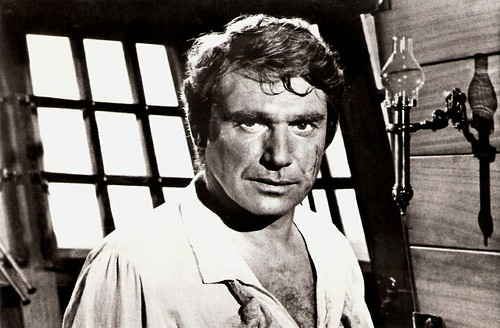
L'oeuvre au noir
French poster postcard. Eds. F. Nugeron, E 487. Gian Maria Volonté in L'Oeuvre au noir / The Abyss (André Delvaux, 1988), adapted from the novel by Marguerite Yourcenar.

Sources: William Grimes (The New York Times), Ronald Bergan (The Guardian), Craig Butler (AllMovie - Page Now Defunct), Wikipedia and IMDb.

This post was last updated on 12 April 2026.

16 October 2019

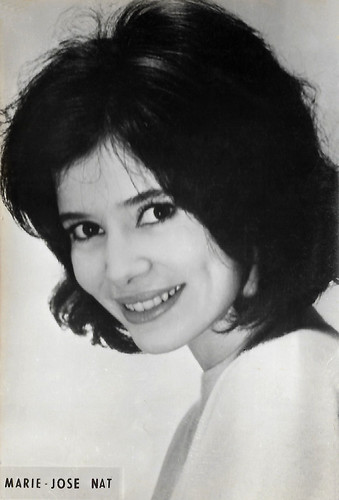
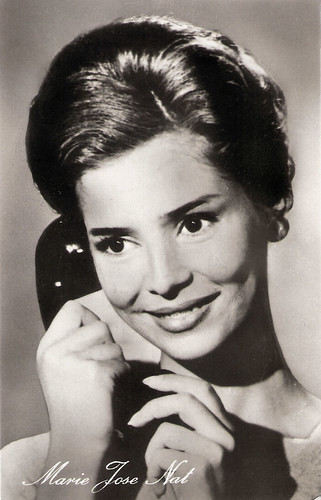
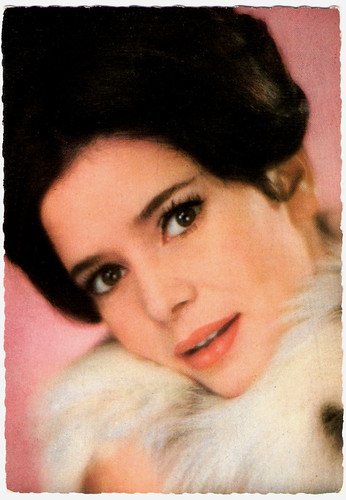
Marie-José Nat (1940-2019)

On 10 October 2019, French actress Marie-José Nat(1940) passed away. She was an acclaimed stage, film and television star, who played glamorous, exotic roles in many films of the 1960s and 1970s. Marie-José Nat was 79.

Marie-José Nat (1940-2019)
Romanian collectors card.

Marie-José Nat (1940-2019)
German postcard by VEB Progress Film-Vertrieb, Berlin. no. 2323, 1965. Photo: Unifrance Film.

Marie-José Nat
French postcard by Editions P.I., Paris, no. 1052. Photo: Sam Lévin.

Marie-José Nat
French postcard by E.D.U.G., no. 219, presented by Corvisart, Epinal. Photo: Lucienne Chevert.

Marie-José Nat
French postcard by Editions E.D.U.G., Paris, no. 245. Photo: Lucienne Chevert.

Anatomy of a marriage


Marie-José Nat was born Marie-José Benhalassa in Bonifacio, Corsica, in 1940.

In 1955, she won a photo contest to appear in a photo romance in the magazine 'Lectures d’aujourd’hui' (Today's readings). It was the photo novel 'L’amour est un songe' (Love is a dream) with Jean-Claude Pascal. Marie-José started to work as a cover girl and mannequin and had acting lessons at Le Cours Simon in Paris.

The following year, she made her film debut in the short Soir de réveillon / Evening's Eve (Gilles Margaritis, 1956) opposite Samy Frey. Later that year, she appeared in her first feature film, the Fyodor Dostoevsky adaptation Crime et châtiment / Crime and Punishment (Georges Lampin, 1956), starring Jean Gabin.

She followed it up with such notable films as Rue des Prairies / Rue de Paris (Denys de La Patellière, 1959) as Jean Gabin’s daughter, La Verité / The Truth (Henri-Georges Clouzot, 1960) as the studious sister of pretty and idle Brigitte Bardot, and La Vie Conjugale / Anatomy of a Marriage (André Cayatte, 1963).

In this domestic drama a married couple (Nat and Jacques Charrier) presents in two separate films their separate views on the state of their marriage. The films are titled Jean-Marc ou La vie conjugale / My Days with Jean-Marc and Françoise ou La vie conjugale / My Nights with Francoise.

Marie-José Nat (1940-2019)
German postcard by VEB Progress Film-Vertrieb, Berlin, no. 1303, 1960. Photo: Marie-José Nat in Rue des Prairies / Rue de Paris (Denys de La Patellière, 1959).

Marie-José Nat
French postcard by Editions Borde, Paris, no. 187. Photo: Marel.

Marie-José Nat
French postcard by St. Anne, Marseille. Photo: Sam Lévin.

Marie-José Nat
French postcard. Photo: Sam Lévin.

Marie-José Nat
French postcard by E.D.U.G., no. 372. Photo: Sam Lévin.

Golden palm nomination


Writer-director Michel Drach contacted Marie-José Nat to play in his film Amélie ou le temps d'aimer / Amelie or The Time to Love (1961). The two fell in love, and they married in 1964.

DB du Monteil writes at IMDb: "Michel Drach's second effort after a good start with On N'Enterre Pas Le Dimanche, and his first movie starring his then-wife Marie-José Nat. Today, Michel Drach has sunk into oblivion because of an uneven career, his convincing works (Amélie, Elise Ou La Vraie Vie, Les Violons Du Bal) are forever juxtaposed with his worst (Guy De Maupassant).

One should also note that most of his best films feature Marie-José Nat, who was to him what Stephane Audran was to Claude Chabrol: the actress's sensitivity was in perfect harmony with Drach's directing."

Their other films were Elise ou la Vraie Vie / Elise, or Real Life (Michel Drach, 1970) with Bernadette Lafont, Les violons du bal / Violins At The Ball (Michel Drach, 1974) with Jean-Louis Trintignant, and Passé simple / Replay (Michel Drach, 1977).

Les violons du bal concerns Michel Drach’s childhood experiences during the Second World War. For her role, Marie-José Nat was awarded Best Actress at the 1974 Cannes Film Festival, and the film was nominated for the Golden Palm award.

Marie-José Nat
East German postcard by Progress Film-Vertrieb, Berlin, no. 2.348. Retail price: 0,20 MDN. Photo: Unifrance Film.

Marie-José Nat
East German postcard by VEB Progress-Filmvertrieb, Berlin, no. 2514. Retail price: 0,20 MDN. Photo: Progress. Backside mentions Marie-José Nat as known from the film Rue de Prairies / Rue de Paris (Denys de la Patellière, 1959).

Jacques Charrier, Marie-José Nat
East German postcard by Progress Film-Vertrieb, Berlin, no. 2.625. Retail price: 0,20 MDN. Photo: Progress. Jacques Charrier and Marie-José Nat in La Vie Conjugale / Anatomy of a Marriage (André Cayatte, 1963).

Marie-José Nat (1950-2019)
East German postcard by VEB Progress Film-Vertrieb, Berlin, no. 2626, 1966.
Marie-José Nat
East German postcard by VEB Progress Film-Vertrieb, Berlin, no. 3009, 1967. Retail Price: 0,20 DM. Photo: Steffen.

The queen of Bonifacio


In 1977, during the shooting of Passé simple, Marie-José Nat met actor Victor Lanoux. He became her new amant. With Lanoux, she would often work together in the theatre, and later also on television.

Among her later films were the thriller La nuit du destin / Night of Destiny (Abdelkrim Bahloul, 1997), the war comedy Train de vie / Train of Life (Radu Mihaileanu, 1998) and the romantic drama Le cadeau d'Elena / Elena’s Gift (Frédéric Graziani, 2004) with Michel Duchaussoy.

Nat was married at first to actor Roger Dumas (1960-1961), then to Michel Drach (1964-1981). Since 2005, she has been married to painter-author Serge Rezvani. With Drach, she had three children: director David Drach, actor Julien Drach and actor Aurelien Drach.

In 2006, she published a memoir, 'Je n'ai pas oublié' (I didn’t forget). She divided her time between Paris and Bonifacio, her birthplace in Corsica. As her most prominent resident, she was known in Bonifacio as the ‘queen of the town.’

Marie-José Nat passed away in Paris in 2019.

Marie-José Nat and Alexandru Herescu in Dacii (1966)
East German collector card in the 'Neu im Kino' series by VEB Progress Film-Vertrieb, Berlin, no. 500/6/68. Marie-José Nat and Alexandru Herescu in Dacii / The Dacians (Sergiu Nicolaescu, 1966).

Marie-José Nat (1940-2019)
German postcard by VEB Progress Film-Vertrieb, Berlin, no. 241/70, 1970. Photo: Linke.

Marie-José Nat, Brigitte Fossey and Marie-France Pisier in Les Gens de Mogador (1972)
French postcard by Editions Atlas, Evreux, no. 23. Photo: Telfrance. Marie-José Nat, Brigitte Fossey and Marie-France Pisier in the TV series Les Gens de Mogador / The people of Mogador (Robert Mazoyer, 1972).

Marie-José Nat
Romanian postcard by Casa Filmului Acin. Collection: Alina Deaconu.

Marie-José Nat
Romanian postcard by Casa Filmului Acin, no. 387. Collection: Alina Deaconu.

Sources: Ciné-Ressources (French), AllMovie, Wikipedia and IMDb.

This post was last updated on 7 December 2025.

22 September 2015

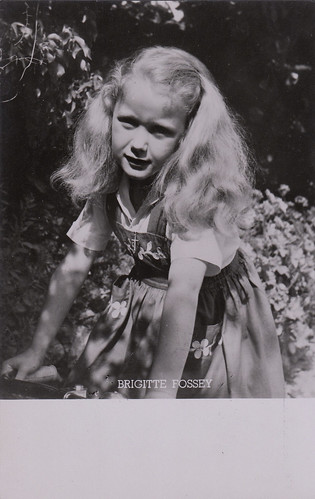
Brigitte Fossey

French actress Brigitte Fossey (1946) made her first film when she was only five, the classic Jeux interdits/Forbidden Games (1952). As an adult, the lovely, sensitive-appearing blonde actress worked with such directors as François Truffaut, Bertrand Blier and Robert Altman.

Brigitte Fossey
Romanian postcard by Casa Filmului Acin, no. 667.

Forbidden games


Brigitte Fossey was born in Tourcoing in the north of France in 1946. She was the daughter of Roger Fossey, a schoolteacher, and Marcelle Feuillade.

Fossey was five years old when she was cast by director René Clément to star in his war film, Jeux interdits/Forbidden Games (1952). After the shooting, she received a beautiful red bicycle as her wages.

Fossey played the role of Paulette, a little French girl who is orphaned in a Nazi air attack. She is befriended by the son of a poor farmer (Georges Poujouly), and together they try to come to terms with the realities of death. Mario Gauci calls it at IMDb: “One of the most poignant (and controversial) depictions of childhood innocence on film.”

While not initially successful in France, the film was a hit elsewhere. It won the Golden Lion at the Venice Film Festival, the Oscar for Best Foreign Language Film, and a BAFTA award. In Italy, she played the lead role in the drama La corda d'acciaio/The Steel Rope (Carlo Borghesio, 1953) with Fausto Tozzi and Virna Lisi.

Fossey was then hired by American actor/director Gene Kelly for his French-American comedy The Happy Road (1957) with Barbara Laage. It was filmed in the studios of Billancourt. When Fossey was ten years old her parents took her out of the film business so she could receive proper schooling. While completing her education, Fossey studied piano and dance and then went on to work briefly in Geneva, Switzerland as an interpreter and translator.

Brigitte Fossey
French or Belgian postcard, no. 353. Collection: Marlene Pilaete.

Brigitte Fossey
Romanian postcard by Casa Filmului Acin, no. 164.

Les valseuses


Brigitte Fossey returned to Paris and studied acting at the Conservatory of Dramatic Art. In 1967, at the age of twenty, Fossey was offered the female lead by director Jean-Gabriel Albicocco for his film Le Grand Meaulnes/The Great Meaulnes based on Alain-Fournier's classic novel of young love.

After the popular success of this film, new proposals began to flow. Next, she appeared in the box-office hit Adieu l’ami/Farewell Friend (Jean Herman, 1968), starring Alain Delon and Charles Bronson. A cult success was the French comedy-drama Les Valseuses/Going Places (Bertrand Blier, 1974), starring Miou-Miou, Gérard Depardieu and Patrick Dewaere. Fossey played a supporting part. She also appeared in Blier’s sex comedy Calmos/Cool, Calm and Collected (Bertrand Blier, 1976) as the wife of Jean-Pierre Marielle.

One of her best-known films is Truffaut’s comedy/drama L'Homme qui aimait les femmes/The Man Who Loved Women (François Truffaut, 1977). She interpreted an editor, wise counsellor and ultimate conquest of Charles Denner.

Twice, she was nominated for a César Award. In 1977 for Best Actress a Supporting Role for Le Bon et les méchants/The Good and the Bad (Claude Lelouch, 1976), and in 1978 for Best Actress for Les Enfants du placard/Closet Children (Benoît Jacquot, 1977).

She also played opposite Helmut Griem in the West German crime film Die gläserne Zelle/The Glass Cell (Hans W. Geißendörfer, 1978). It was nominated for the Academy Award for Best Foreign Language Film. Fluent in English, Fossey has appeared in a few Hollywood movies. She played the wife of Paul Newman in the post-apocalyptic Science-Fiction film Quintet (Robert Altman, 1979).

Brigitte Fossey
Romanian postcard by Casa Filmului Acin. Collection: Alina Deaconu.

Brigitte Fossey in Le grand Meaulnes (1967)
Romanian postcard by Casa Filmului Acin, no. 161. Brigitte Fossey in Le grand Meaulnes/The Grerat Meaulnes (Jean-Gabriel Albicocco, 1967). Collection: Alina Deaconu.

Brigitte Fossey in Le grand Meaulnes (1967)
Romanian postcard by Casa Filmului Acin, no. 162. Brigitte Fossey in Le grand Meaulnes/The Great Meaulnes (Jean-Gabriel Albicocco, 1967). Collection: Alina Deaconu.

Cinema Paradiso


As an adult, Brigitte Fossey acted both on stage (in plays by Anton Chekhov and Molière), and on screen. Very successfully, she played Sophie Marceau’s modern and gentle mother in the film comedy La Boum/The Party (Claude Pinoteau, 1980) about a thirteen-year-old French girl finding her way at a new high school and coping with domestic problems. The film was an international box-office hit, earning 4,378,500 admissions in France.

Two years later, she returned in the equally successful sequel, La Boum 2 (Claude Pinoteau, 1982). Fossey also played a former drug addict opposite Patrick Dewaere in Un mauvais fils/A Bad Son (Claude Sautet, 1980) and had a supporting part in the biography Chanel Solitaire (George Kaczender, 1981) starring Marie-France Pisier and Timothy Dalton.

In 1982, she was a member of the jury at the 32nd Berlin International Film Festival. In Germany, she played with Robert Powell in the philosophical drama Imperativ/Imperative (Krzysztof Zanussi, 1982). She next starred in the drama Au nom de tous les miens/For Those I Loved (Robert Enrico, 1983) with Michael York as a Polish Jewish Holocaust survivor who emigrated to the USA in 1946.

She played a small part in the Italian drama Nuovo Cinema Paradiso/Cinema Paradiso (Giuseppe Tornatore, 1988), but for the shorter foreign release of the film, her scenes were cut. This international version won the Special Jury Prize at the 1989 Cannes Film Festival and the 1989 Best Foreign Language Film Oscar. In 2002, the director's cut 173-minute version was released including the scenes with Fossey.

In 1992, she co-starred with legendary Jean Marais in the adventure film Les Enfants du naufrageur/Shipwrecked Children (Jérôme Foulon, 1992). During the 1990s, she began performing in television productions and some of her series became very popular in France. Her most recent TV series is Jusqu'au dernier/Until the Last (François Velle, 2014). Brigitte Fossey was married from 1966 to 1980 to director Jean-François Adam, with whom she made the film M comme Mathieu/'M' as in Mathieu (1973). They have a daughter, actress Marie Adam.

Marie-José Nat, Brigitte Fossey and Marie-France Pisier in Les Gens de Mogador (1972)
French postcard by Editions Atlas, Evreux, no. 23. Photo: Telfrance. Marie-José Nat, Brigitte Fossey and Marie-France Pisier in the TV series Les Gens de Mogador/The people of Mogador (Robert Mazoyer, 1972).

Brigitte Fossey and Jacques Perrin in Le Château des Oliviers (1983)
French postcard by Editions Atlas, Evreux, no. 47. Photo: Jacques Morell / Kipa / Corbis. Brigitte Fossey and Jacques Perrin in Le Château des Oliviers/The Oliviers Castle (Nicholas Gessner, 1993).


Trailer for Jeux interdits/Forbidden Games (1952). Source: Rialto Film (YouTube).

Source: Yvan Foucart (L’encinémathèque – French), Brigitte Baronnet (AlloCiné – French), Wikipedia, and IMDb.

This post was last updated on 3 April 2024.

26 February 2017

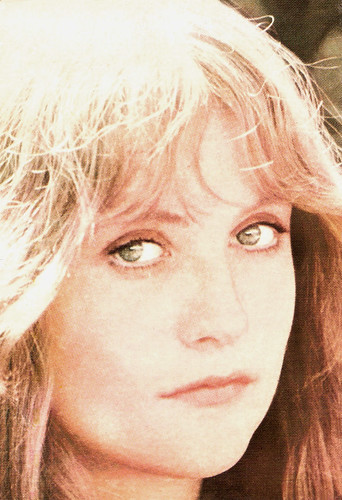
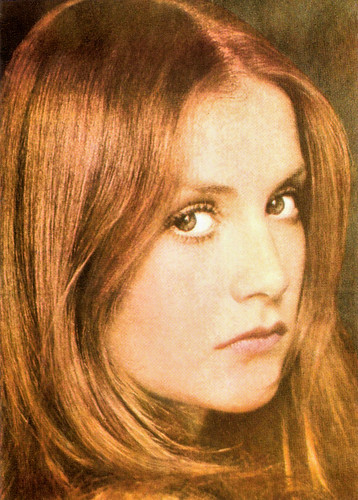
Isabelle Huppert

Tonight is the 89th Oscars show. Nominated for the Best Actress in a Leading Role award is French actress Isabelle Huppert (1953) for her amazing turn in Elle (2016). Huppert plays a top exec for a video game company who turns the tables after being raped in her own home. The versatile and brave actress has appeared in more than 90 film and television productions since 1971. She won 89 awards for her work, but the Oscar nomination for Elle is her first.

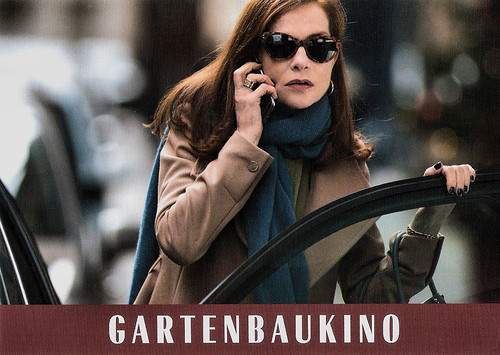
Isabelle Huppert in Elle (2016)
Austrian promotion card by Gartenbaukino, Wien. Photo; publicity still for Elle (Paul Verhoeven, 2016).

Isabelle Huppert
Romanian postcard by Casa Filmului Acin.

Isabelle Huppert
Romanian postcard by Casa Filmului Acin.

Isabelle Huppert
Romanian postcard by Casa Filmului Acin.

Casually poisoning her parents


Isabelle Anne Madeleine Huppert was born in Paris in 1953 (some sources say 1955). She is the youngest of five daughters of Annick Beau, a teacher of English, and Raymond Huppert, a safe manufacturer. At age 13, she announced her intention to be an actor and was encouraged by her mother. She studied at the Versailles Conservatoire and later attended the CNSAD (National Conservatory of Dramatic Art of Paris).

Huppert made her film debut in Faustine et le bel été/Faustine and the Beautiful Summer (Nina Companeez, 1972). Five years later, she had already appeared in 15 films and worked with major directors. She played Romy Schneider's younger sister in César et Rosalie/Cesar and Rosalie (Claude Sautet, 1972).

In Bertrand Blier’s road movie Les valseuses/Going Places (1974), she played a bored teenager who runs off with three young vagabonds (Gérard Depardieu, Patrick Dewaere and Miou-Miou). For director Otto Preminger, Huppert made her English-language debut in Rosebud (1975) starring Peter O’Toole.

Her international breakthrough came with her guileless performance as a simple, provincial girl destroyed by a summer romance with a middle-class student in La Dentelliere/The Lacemaker (Claude Goretta, 1977). For this unforgettable portrayal, she was awarded both a BAFTA (British Academy Award) and a David di Donatello (the Italian Oscar).

At the next Cannes Film Festival, she won the Best Actress award for Violette Nozière (Claude Chabrol, 1978). In this true story, she portrayed a woman who scandalized France in 1933 by casually poisoning her parents. She tied the award with Jill Clayburgh.

Marie-France Pisier, Isabelle Huppert and Isabelle Adjani in Les soeurs Brontë
Romanian postcard by Casa Filmului Acin. Photo: publicity still for Les soeurs Brontë/The Bronte Sisters (André Téchniné, 1979) with Marie-France Pisier as Charlotte Bronte, Isabelle Huppert as Anne Bronte, and Isabelle Adjani as Emily Brontë.

Dominique Sanda, Isabelle Huppert
Dominique Sanda and Isabelle Huppert. Romanian postcard by Casa Filmului Acin. Publicity still for Les ailes de la colombe/The Wings of the Dove (Benoît Jacquot, 1981).

Isabelle Huppert, Gérard Depardieu, Loulou
French postcard by Editions La Malibran, Nancy, in the collection Cinéma Couleur, no. MC 39. Publicity still for Loulou (Maurice Pialat, 1979) with Gérard Depardieu.

Isabelle Huppert and Gérard Dépardieu in Loulou (1980)
French card. Photo: publicity still for Loulou (Maurice Pialat, 1980).

Legendary disaster


Isabelle Huppert made her American film debut in the blockbuster Heaven's Gate (Michael Cimino, 1980), which proved to be a legendary disaster at the box office. In France, she continued to explore enigmatic and emotionally distant characters, such as an upper-class woman who is physically attracted by a young vagabond (Gérard Depardieu) in Loulou (Maurice Pialat, 1980), a prostitute in Sauve qui peut (la vie)/Slow Motion (Jean-Luc Godard, 1980), the mistress of Philippe Noiret’s character in Coup de torchon/Clean Slate (Bertrand Tavernier, 1981) and a Jewish refugee in Coup de foudre/Entre nous (Diane Kurys, 1983).

She used her influence to help non-commercial projects get off the ground, like Joseph Losey's La Truite/The Trout (1982) and sister Caroline Huppert's Signé Charlotte/Sincerely, Charlotte (1984).

For her role in Une Affaire de Femmes/Story of Women (Claude Chabrol, 1988), she received the Volpi Cup for Best Actress at the Venice Film Festival. This time, she tied with Shirley MacLaine. She won the Volpi Cup again for her role in La Cérémonie (Claude Chabrol, 1995) as a shy but manic and homicidal post-office mistress in a French village. This time she tied the award with her co-star in that film, Sandrine Bonnaire. For La Cérémonie, she also won her only César award.

The offspring of her cinematic relationship with director Claude Chabrol also includes the widely acclaimed literary adaptation Madame Bovary (1991), the crime comedy Rien ne va plus/The Swindle (1997), and the thriller Merci pour le chocolat/Thanks for the Chocolate (2000).

Stuart Jeffries in The Observer about their cooperation: “Huppert has excelled in the spiteful, the nasty, the unpleasant and - regularly - the murderous. More than that, she carries herself with imperious intelligence and thus seems to be self-conscious about her own wickedness. No doubt that is why Chabrol has cast her so often. He's interested in guilt, manipulativeness and shame - all of which she loves portraying.”

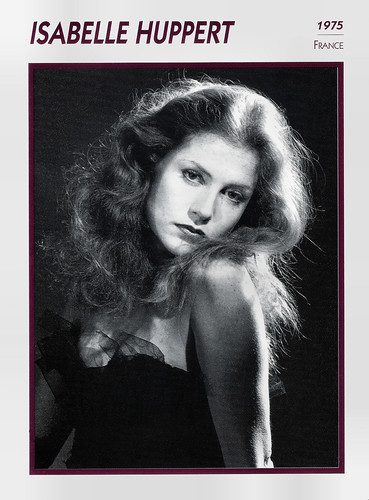
Isabelle Huppert
French collectors card in the series 'Portrait de Stars; L'encyclopédie du Cinéma' by Edito Service, 1994. Photo: Harcourt. Caption: France, 1975.

Isabelle Huppert
French postcard, no. 222.

Isabelle Huppert
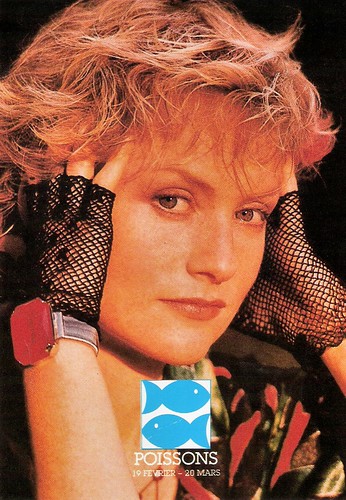
French postcard by Editions F. Nugeron in the Signes Zodiaque series, no 8, Isabelle Huppert - Poissons (Pisces).

Isabelle Huppert
French postcard by Humour a la Carte, Paris, no. ST-159.

Greeted with a mixture of boos and applause


In 2001, Isabelle Huppert started a new interesting collaboration with Austrian film director Michael Haneke. In La Pianiste/The Piano Teacher (Michael Haneke, 2001), an adaptation of the novel by Nobel prize winner Elfriede Jelinek, she plays a sexually repressed and self-destructive piano teacher, who embarks on a dark journey into sadomasochism. Regarded as one of her most impressive turns, her performance won the 2001 acting prize at the Cannes Film Festival. The film also took the Grand Prix (second prize) and was greeted with a mixture of boos and applause, provoking the main debate of the festival. Huppert continued to work hard. In 2002, the entire cast of the popular black comedy 8 femmes/8 Women (François Ozon, 2002), also including Catherine Deneuve, Danielle Darrieux and Fanny Ardant, was voted Best Actress at the European Film Awards. The same cast won a Silver Bear for Outstanding Artistic Contribution, at the 2002 Berlin film festival.

Then Huppert was back at the set with Haneke for the disturbing Le temps du loup/The Time of the Wolf (Michael Haneke, 2003) with Béatrice Dalle. In Ma mere/My Mother (Christophe Honoré, 2004) based on a novel by George Bataille, Huppert starred as an attractive middle-aged mother who has an incestuous relationship with her teenage son (Louis Garrel). Since Heaven's Gate, Huppert only made a few more American movies. In The Bedroom Window (Curtis Hanson, 1987) she played Steve Guttenberg’s mistress, and in Amateur (Hal Hartley, 1994) a former nun writing porn. In I [Heart] Huckabees (David O. Russell, 2004) she portrayed author Catherine Vauban, nemesis of existential detectives Dustin Hoffman and Lily Tomlin.

At the 2005 Venice Film Festival, Huppert received a special Lion for her role in Gabrielle (Patrice Chéreau, 2005). The following year, she reunited with Claude Chabrol for L'ivresse du pouvoir/The Comedy of Power (2006). On the Paris stage, she appeared as the suicidal Hedda Gabler, in Henrik Ibsen's play. In 1994 she was made Chevalier (Knight) of the Ordre national du Mérite and in 2005 she was promoted to Officier (Officer). She was also made Chevalier (Knight) of the Légion d'honneur in 1999 and was promoted to Officier (Officer) in 2009. With her spouse, director Ronnie Chammah, she has three children: actress Lolita Chammah (1983), Lorenzo Chammah (1986) and Angelo Chammah (1997). Huppert likes to keep her private life private though. Her work is her main issue in interviews.

In 2012, two of her films competed for the Palme d'Or at Cannes: Amour/Love (Michael Haneke, 2012) and the South Korean production Da-reun na-ra-e-seo/In Another Country (Sang-soo Hong, 2012). Her part as the daughter of Jean-Louis Trintignant and Emmanuelle Riva in Amour also got her another César nomination. In Valley of Love (Guillaume Nicloux, 2015, she reunited with Gérard Depardieu. They play two famous actors who used to be a couple and had a son 25 years ago. They reunite after the son's death and receive a letter asking them to visit five places at Death Valley, which will make the son reappear. Valley of Love was selected to compete for the Palme d'Or at the 2015 Cannes Film Festival.

Elle (Paul Verhoeven, 2016) was a provocative and disturbing comedy-thriller that divided many film fans. Elle got rave reviews in leading newspapers but was snubbed by the jury of the Cannes Film Festival and by the Academy in the 2016 Best Foreign Language Film Category. To me, it's one of the wildest and most disturbing films of this century in the disguise of a stylish thriller. Xan Brooks at The Guardian: "Turn off the lights and let the horror begin. Paul Verhoeven’s new film, Elle, is an outrageous black comedy, volatile and deadly; a film that opens up with a sexual assault and then cleans off the blood ahead of a posh restaurant dinner. (...) Huppert gives a performance of imperious fury, holding the audience at bay, almost goading us to disown her. Audaciously, Elle presents her not so much as a victim but as the casualty of a world she is very much a part of; maybe (still more troublingly) an accessory to." Isabelle Huppert's recent credits include several stage appearances and TV series and such films as Jerzy Skolimowski's IO/EO (2022) and Mrs. Harris Goes to Paris (Anthony Fabian, 2022), as well as the thriller La Syndicaliste/The Sitting Duck (Jean-Paul Salomé, 2023). In 2024, she starred in her third collaboration with Hong Sang-soo in A Traveler's Needs (2024) which won the Grand Jury Prize at the 2024 Berlin Film Festival. Huppert is the owner of the repertory cinemas Christine Cinéma Club and Ecoles Cinéma Club in Paris, which her son Lorenzo curates.


Trailer Coup de torchon/Clean Slate (1981). Source: WorleyClarence (YouTube).


Trailer Amour/Love (2012). Source: MovieclipsTrailers (YouTube).


French trailer Elle (Paul Verhoeven, 2016). Source: cinémaniak (YouTube).

Sources: Stuart Jeffries (The Observer), Xan Brooks (The Guardian) Rebecca Flint Marx (AllMovie - Page now defunct), Yahoo! Movies (Page now defunct), Wikipedia and IMDb.

This post was last updated on 3 November 2024.

12 April 2014

Casa Filmului Acin

Behind the Iron Curtain, there used to be an interesting film culture. The cinemas of Poland, Russia, East-Germany, Hungary and Czechoslovakia produced several film classics during the 1950s, 1960s and 1970s that fared very well at international film festivals. East-Germany and Romania were the specialists in film postcards. Last Saturday, we had a post on VEB Progress Filmvertrieb from East-Germany. Today, we present you the wonderful world of Casa Filmului Acin from Romania.

Emmanuelle Béart
Emmanuelle Béart. Romanian postcard by Casa Filmului Acin, no. 43033.

Virna Lisi
Virna Lisi. Romanian postcard by Casa Filmului Acin. Retail price: 2 Lei. At the backside is written: Sylva Koscina (sic).

Catherine Deneuve
Catherine Deneuve. Romanian postcard by Casa Filmului Acin, no. 568.

Sylvia Kristel
Sylvia Kristel. Romanian postcard by Casa Filmului Acin.

Marie-France Pisier
Marie-France Pisier. Romanian postcard by Casa Filmului Acin.

ABBA and more ABBA


Do you feel a bit nostalgic and need a glimpse of the 1960s, 1970s and 1980s? Surf to Flickr's new group, Casa Filmului Acin (Film House Acin).

You'll find hundreds of Romanian vintage postcards of pop artists, TV heroes and film stars, dating from the 1960s till 1989, the year Nicolae Ceaușescu's regime ended.

See ABBA, Boney M, Amanda Lear and more ABBA there - in their most eye-blinding, glittering seventies outfits.

Acin published several cards of Clint Eastwood in the Spaghetti Westerns by Sergio Leone, Ali MacGraw and Ryan O'Neal in Love Story (Arthur Hiller, 1970) and one of Sharon Tate, Patty Duke and Barbara Parkins in Valley of the Dolls (Mark Robson, 1967).

American TV classics like McCloud, Charlie's Angels, Columbo and Dynasty are present as well, and the sex symbol of the early 1970s, Raquel Welch.

All these postcards were produced behind the Iron Curtain in communist Romania, and now these colourful and a bit odd postcards finally reach the rest of the world.

Louis de Funès
Louis de Funès. Romanian postcard by Casa Filmului Acin, no. 181. Retail price: 1,50 Lei.

Daniela Bianchi
Daniela Bianchi. Romanian postcard by Casa Filmului Acin. Photo: Publicity still for Missione speciale Lady Chaplin/Operation Lady Chaplin (Alberto De Martino, Sergio Grieco, 1966).

Josephine Baker
Josephine Baker. Romanian postcard by Casa Filmului Acin, no. 5293, 1970.

Robert Hossein
Robert Hossein. Romanian postcard by Casa Filmului Acin. Publicity still for Indomptable Angelique/Untamable Angelique (Bernard Borderie, 1967).

Sylva Koscina
Sylva Koscina. Romanian postcard by Casa Filmului Acin, no. 217. Retail price: 1,50 Lei.

Immensely Popular


The Acin group at Flickr was founded by postcard collector Veronique3 from Bucharest.

Earlier she wrote at EFSP: "In the past, it used to be difficult to find these cards in my country. People bought them before we knew that they had arrived at the post office. A cousin of mine worked for the post office, so I could start my collection thanks to her."

Producer of the Acin cards was the C.P.C.S., a state owned company.

The eldest Acin cards I could trace must be from the mid-1960s, when Ceaușescu came to power.

These black and white postcards contain stills of sixties phenomena like the Eurospy films, Michèle Mercier and Robert Hossein in the sensual Angélique romances and the hilarious Louis de Funès farces.

The cards were cheaply made and cost only 1.50 lei (ca. 0.33 euro). Later, the Retail price of the colour cards - printed on thin paper and the tekst on the flip side is in blue ink - was 2 Lei (ca. 0.45 euro).

The colour procedure was not always optimal, but the result often has a special charm.

Veronique writes that the cards were also for sale at the news stands in Romania, but also at the kiosks the Acin cards were always quickly sold out.
You had to have a contact at C.P.C.S. or at one of the retail points to be able to collect them all.

Florin Piersic
Florin Piersic. Romanian postcard by Casa Filmului Acin.

Anna Széles
Anna Széles. Romanian postcard by Casa Filmului Acin.

Margareta Pislaru
Margareta Pislaru. Romanian postcard by Casa Filmului Acin.

Gojko Mitic
Gojko Mitic. Romanian postcard by Casa Filmului Acin, no. 43079.

Florin Piersic, Anna Széles
Florin Piersic, Anna Széles. Romanian postcard by Casa Filmului Acin, no. 33 150.

Often Very Beautiful


Today the postcards of Casa Filmului Acin are vintage and can be bought at sites on the net. The prices are now a bit higher than the 2 Lei they used to cost forty years ago, but still affordable.

Many stars on the Acin postcards are of course Romanian. The two major pop divas were Angela Similea and Margareta Pislaru, who both also appeared in several films.

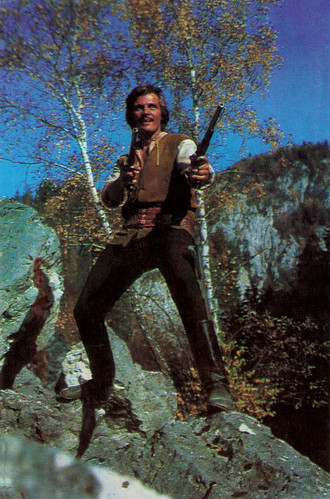
Then there was Florin Piersic, one of the most renowned Romanian film actors and a monster sacré of the National Theatre in Bucharest. During the Ceauşescu era he appeared in more than forty films, in which he often depicted heroic, masculine characters.

He was married for a while to the ravishing Anna Széles, who appeared as a princess in the popular East-European fairy tales of the 1970s.

Besides giving this unique view at the Romanian film and music culture of the Ceauşescu period, I think it is interesting that Acin continued to produce film star postcards in a period many other European publishers had stopped to do so.

Acin published dozens of postcards of French and Italian stars of the 1970s and 1980s, and their photos are often incredibly beautiful.

Who else published postcards of such actors as Dominique Sanda, Sylvia Kristel or Marc Porel?

Only Casa Filmului Acin!

Helmut Berger
Helmut Berger. Romanian postcard by Casa Filmului Acin.

Marc Porel
Marc Porel. Romanian postcard by Casa Filmului Acin, no. 33132.

Happy birthday, Jean-Louis Trintignant!
Jean-Louis Trintignant. Romanian postcard by Casa Filmului Acin.

Gérard Lanvin
Gérard Lanvin. Romanian postcard by Casa Filmului Acin.

Francis Huster
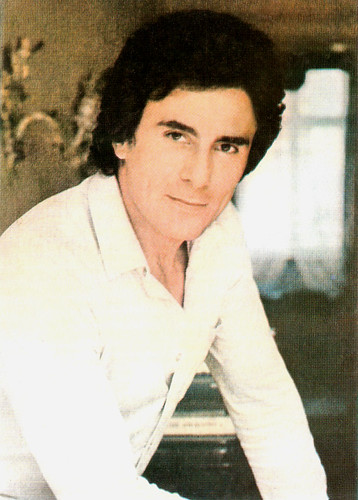
Francis Huster. Romanian postcard by Casa Filmului Acin.

Source: Veronique3 (Flickr).