Showing posts sorted by relevance for query chantecler. Sort by date Show all posts

28 December 2024

The Disney Classic That Never Was: Chanticleer

In June 1960, Walt Disney told the Los Angeles Times that, following the release of One Hundred and One Dalmatians (1961), two animated films were in development: The Sword in the Stone (1963) and Chanticleer. Earlier conceptions of Chanticleer date back to the 1940s. The Disney film was never realised but it was an interesting project based on a legendary French stage play of which many wonderful postcards remain.

Chantecler (1910). Lucien Guitry as Le Coq/ The Rooster
French postcard by ELD (Ed. Le Deley) / GPL. Photo: Bert. Lucien Guitry as Chantecler, Le coq (The Rooster) in the stage play 'Chantecler' by Edmond Rostand.

Chantecler (1910). Félix Galipaux as Le Merle/The Blackbird
French postcard by ELD (Ed. Le Deley) / GPL. Photo: Bert. Félix Galipaux as Le Merle (The Blackbird) in the stage play 'Chantecler' by Edmond Rostand. French actor, playwright, and humorist Galipaux (1860-1931) was known for his comic stage monologues, such as 'Communication Téléphonique' (1906). A few of these monologues were recorded.

Chantecler (1910). Mme Simone as La Faisane/ The Pheasant
French postcard by ELD (Ed. Le Deley) / GPL. Photo: Bert. Mme Simone as La Faisane (The Pheasant) in the stage play 'Chantecler' (1910), written by Edmond Rostand. French actress and writer Pauline Benda (1877-1985), known as Madame Simone or simply Simone, made her debut in the theatre in 1902. She acted in plays by Luigi Pirandello and Henry Bataille, among others.

Chantecler (1910). Léontine Bouchetal as La vieille Poule et les Poussins/ The Old Hen and the Chicks
French postcard by ELD (Ed. Le Deley) / GPL. Photo: Bert. Léontine Bouchetal as La vieille Poule et les Poussins (The Old Hen and the Chicks) in the stage play 'Chantecler' (1910), written by Edmond Rostand. French stage actress Léontine Bouchetal (1872-1932) played the role of mère Marguerite in the premiere of 'Cyrano de Bergerac' in 1897. At her wedding in January 1904, the witnesses were Coquelin aîné, Jean Coquelin and the police prefect Louis Lépine.

Jean Coquelin as the farmyard dog Patou in Chantecler
French postcard by ELD (Ed. Le Deley) / GPL. Photo: Bert. Jean Coquelin as the farmyard dog Patou in the stage play 'Chantecler' (1910), written by Edmond Rostand. Jean Coquelin (1865-1944) was the son of the famous stage actor Benoit Constant Coquelin. He played Raigoné in Edmond Rostand's 'Cyrano de Bergerac', the major play in which his father had performed. Coquelin and his father played together in the stage play 'La Dame de Monsoreau' (1860), after a novel by Alexandre Dumas. Between 1925 and 1943 he also appeared in several films.

The laughing stock of all domestic and wild animals


The Disney studio based the idea for Chanticleer on the stage play 'Chantecler'. Famous French auteur Edmond Rostand wrote this play in four acts in 1910. 'Chantecler' was first performed on 7 February 1910 at the Porte-Saint-Martin theatre. The lead roles were played by Lucien Guitry, Jean Coquelin, Félix Galipaux and Madame Simone.

Lucien Guitry starred as the rooster Chantecler. Guitry was considered the preeminent French actor of his day. For many years, he played opposite Sarah Bernhardt. He also appeared in silent films like Tosca (1908) and Ceux de chez nous (1915). He was married to Jeanne Desclois and Renée de Pont-Jest, and his son was the well-known actor-writer-director Sacha Guitry.

Chantecler is a coquerel who reigns over a barnyard. He is so convinced of his importance that he imagines his crowing will make the sun rise. But the arrival of a pheasant hen turns his life upside down. Love is revealed to him in such a way that he forgets to crow. So when the sun comes out, Chantecler becomes the laughingstock of all domestic and wild animals.

Especially the owls, the creatures of the night, hate him and force him to accept a public fight with another cock. The fight takes place in the guinea fowl's literary salon. After a near-death experience, Chantecler defends the barnyard against the threats of a sparrowhawk, thereby regaining some of his prestige. Unjustly neglected, but understanding that vanity is stronger than love in the cock, the pheasant nevertheless sacrifices herself for him and goes to meet a hunter in his place. A shot is fired, but it is the golden-voiced nightingale who is mortally wounded. The rooster's hoarse crow alone will continue to celebrate the dawn.

Opposite the proud cockerel Chantecler, there is the vile Merl. He represents the cynical city slicker, intrigue, jealousy and cowardry. Then there are the presumptuous Guinea Fowl, the loyal and friendly dog Patou, the Pheasant, representing female Beauty and the Modern Woman, the vain and stupid Peacock, the fragile and magic Nightingale, and the creatures of the night like the Toads (ugly and powerless, a critique by Rostand of theatre critics) and the Night Birds like the Owls, who hate the cockerel as they can only live during the night and he disturbs this.

L'auteur de Chantecler (Edmond Rostand)
French postcard by E.L.D. (Ed. Le Deley), no. 88. Caption: L'auteur de 'Chantecler' (the author of Chantecler - Edmond Rostand).

Jean Coquelin as the farmyard dog Patou in Chantecler
French postcard by ELD (Ed. Le Deley), no. 84. Jean Coquelin as the farmyard dog Patou in 'Chantecler' (1910), a play by Edmond Rostand.

Mme Simone in Chantecler
French postcard by ELD (Ed. Le Deley), no. 85. Mme Simone in the French stage play 'Chantecler' (1910), written by Edmond Rostand.

Lucien Guitry in Chantecler
French postcard by ELD (Ed. Le Deley), no. 86. Lucien Guitry was the title character in the French stage play 'Chantecler' (1910), written by Edmond Rostand.

Galipaux in Chantecler (1910)
French postcard by ELD (Ed. Le Deley), no. 87. Félix Galipaux in the French stage play 'Chantecler' (1910), written by Edmond Rostand.

Very high expectations


After his successes with 'Cyrano de Bergerac' and 'L'Aiglon', the expectations for Edmond Rostand's next play were very high. Rostand took years to finish 'Chanticler' which involved over 70 characters and 195 costumes. The author himself designed all the sets and costumes and he almost crashed during the preparations of his gigantic enterprise. The play finally premiered on 7 February 1910 at the Théâtre de la Porte Saint-Martin in Paris, with a star cast including Lucien Guitry as Chantecler and Jean Coquelin as Patou.

The premiere audience was deluded and even felt insulted, as Rostand sharply criticised the hypocrisy, jealousy, intrigues, and presumptuousness of life in the city, as opposed to the countryside. Moreover, audiences were not accustomed to seeing the famous actors dressed up as animals, and some felt Guitry's performance was not his best. A revival in 1927, with Victor Francen as Chantecler, was better received. Afterwards, the play would be revived in and outside of France several times, while the Broadway version already took place in 1911, with Maud Adams starring.

Wikipedia offers the curious afterlife of the play: "In June 1960, Disney told the Los Angeles Times that, following the release of One Hundred and One Dalmatians, two animated projects were in development, which were Chanticleer and The Sword in the Stone. Around that same time, Disney's elder brother Roy O. Disney attempted to persuade him to discontinue their feature animation division, as enough films remained to make successful re-releases. The younger Disney refused, but, because of his plans to build another theme park in the United States, he would approve only one animated film to be released every four years.

Chanticleer was developed by Ken Anderson and Marc Davis, who aimed to produce a feature animated film in a more contemporary setting. They visited the Disney archives and decided to work on adapting the satirical tale after glancing at earlier conceptions dating back to the 1940s. Anderson, Davis, Milt Kahl, and director Wolfgang Reitherman spent months preparing elaborate storyboards for Chanticleer. Following a silent response to one pitch presentation, a voice from the back of the room said, "You can't make a personality out of a chicken!" When the time came to approve either Chanticleer or The Sword in the Stone, Disney remarked that the problem with making a rooster a protagonist was, "[you] don't feel like picking a rooster up and petting it."

In 1992, Edmond Rostand's story of Chantecler was loosely adapted into the American animated film Rock-a-Doodle (Don Bluth, Gary Goldman, Dan Kuenster, 1992) and set in Tennessee in 1957. Here the Grand Duke of Owls concocts to have Chanticleer ridiculed as he forgets to crow at the rising sun after a fierce battle, so the rooster leaves for town to become a singer. Meanwhile, the night birds set their hungry eyes on the farm birds... Glen Campbell gave his voice to Chanticleer and Christopher Plummer dubbed the Grand Duke of Owls. The film was neither a critical success nor a box office hit. However, it would be more successful during its home video release.

Chantecler, Act I. L'Hymne au Soleil
French postcard by E.L.D. (Ed. Le Deley). Scene from the stage play 'Chantecler', Act I, with Lucien Guitry as the Rooster. Caption: L'Hymne au Soleil (Anthem to the Sun).

Chantecler, Act I. Chantecler et ses Poules
French postcard by E.L.D. (Ed. Le Deley). Scene from the stage play 'Chantecler', Act I, with Lucien Guitry as The Rooster. Caption: Chantecler et ses Poules (Chantecler and his hens).

Chantecler, Act I. L'Arrivée de la Faisane
French postcard by E.L.D. (Ed. Le Deley). Scene from the stage play 'Chantecler', Act I. Caption: L'Arrivée de la Faisane (The arrival of the pheasant).

Chantecler, Act II. Le Matin du Coq
French postcard by E.L.D. (Ed. Le Deley). Scene from the stage play 'Chantecler', Act II, with Lucien Guitry in the title role and Mme Simone as the Pheasant. Caption: Le Matin du Coq (The Morning of the Rooster).

Chantecler, Act II. Les Nocturnes - L'Ode à la Nuit
French postcard by E.L.D. (Ed. Le Deley). Scene from the stage play 'Chantecler', Act II. Caption: Les Nocturnes - L'Ode à la Nuit (Nocturnes - Ode to the Night).

Chantecler (1910). Act III, Le jour de la Pintade/ The Day of the Guinea Fowl
French postcard by E.L.D. (Ed. Le Deley). Photo Bert. Scene from the stage play 'Chantecler', Act III Caption: Le jour de la Pintade (The Day of the Guinea Fowl). Left to right: The Blackbird (Felix Galipaux), The Rooster (Lucien Guitry), The Old Hen & the Chicks (Léontine Bouchetal), and far right, The Pheasant (Mme Simone).

Chantecler (1910).  Acte IV. Les Crapauds/ The Toads
French postcard by E.L.D. (Ed. Le Deley). Photo Bert. Scene from the stage play 'Chantecler', Act IV. Caption: Les Crapauds (The Toads).

Chantecler (1910). Acte IV. La Nuit du Rossignol/ The Night of the Nightingale
French postcard by E.L.D. (Ed. Le Deley). Photo Bert. Scene from the stage play 'Chantecler', Act IV. Caption: La Nuit du Rossignol (The Night of the Nightingale). In the foreground, Lucien Guitry as Chantecler and Mme Simone as The Pheasant.

Dorival as Le Grand Duc in Chantecler
French postcard by ELD (Ed. Le Deley) / GPL. Photo: Bert. Dorival as Le Grand Duc (Grand Duke of Owls) in  'Chantecler' (1910).

Augustine Leriche in Chantecler (1910)
French postcard by ELD (Ed. Le Deley) / GPL. Photo: Bert. Augustine Leriche as La Pintade (The Guineafowl) in 'Chantecler' (1910). French stage actress and singer Augustine Leriche (1856-1938) performed at the Théâtre de l'Ambigu-Comique, Théâtre des Folies-Dramatiques, Théâtre du Châtelet, Gaîté-Lyrique, Théâtre de l'Athénée, and Théâtre du Palais-Royal. At the Porte-Saint-Martin, she created the role of the guinea fowl in 'Chantecler'.

Henri Harment in Chantecler (1910)
French postcard by ELD (Ed. Le Deley) / GPL. Photo: Bert. Henri Harment as Le Dindon (The Turkey) in 'Chantecler' (1910). In the 1910s, French stage actor Henri / Henry/ Harry Harment (1878-19..) alternated between the Théâtre de l'Ambigu-Comique and the Théâtre de la Porte Saint-Martin in plays such as 'La Flambée' by Henry Kistemaeckers, 'Le Mystère de la chambre jaune' by Gaston Leroux, and 'Les Flambeaux' by Henry Bataille. Onscreen, Harment debuted in La petite fonctionnaire (Georges Denola, 1912). He acted as Louis XVI opposite Diana Karenne as Marie-Antoinette in Le collier de la reine (Gaston Ravel, Tony Lekain, 1929). In the early 1930s, Harment also had supporting parts in Delphine (Roger Capellani, 1931) and in Une nuit à l'hôtel (Leo Mittler, 1932). Afterwards, he also scripted the Yvette Lebon vehicle Les mariages de Mademoiselle Lévy (André Hugon, 1936) and C'est lui que je veux (André Royet, 1937) - in the latter, he also acted.

Carmen Deraisy in Chantecler (1910)
French postcard by ELD (Ed. Le Deley) / GPL. Photo: Bert. Carmen Deraisy as La Poule Blanche (The White Chicken) in 'Chantecler' (1910). French stage and screen actress Carmen Deraisy aka Carmen de Raisy (1883-1954) played the femme fatale Gioconda Danti in Gabriele D'Annunzio's play 'La Gioconda' (1905). After that, she did several performances at the Théâtre de l'Ambigu-Comique. In 1910 she started at the company Éclair to act in such films as La jolie dame de Narbonne (Victorin-Hippolyte Jasset, 1910) in which she had the lead right away. In 1911 she stepped over to Pathé, where she could be seen in La fiancée du château maudit (Albert Capellani, 1911), a Horror film about a bride who gets trapped in a room with a skeleton. Between 1911 and 1914, she acted in eight more Pathé films. She would return to the film set only once more, as a fortuneteller in the Harry Baur film Péchés de jeunesse (Maurice Tourneur, 1941).

Paulette Lorsy and Madeleine Deréval in Chantecler (1910)
French postcard by ELD (Ed. Le Deley) / GPL. Photo: Bert. Paulette Lorsy and Madeleine Deréval as La Poule Grise and La Poule Houdan in 'Chantecler' (1910). French theatre and silent film actress Paulette Lorsy (1881-1929) performed in Paris's leading theatres, including the Porte-Saint-Martin, the Gymnase, the Ambigu, the Sarah-Bernardt and the Athénée, as well as in the provinces and abroad. She played in vaudeville and prose comedies, but also in such dramas as 'Cyrano de Bergerac. Lorsy started to act in film farces at Pathé Frères in 1909. She was matched with comedian Max Linder in 1910 and acted in numerous of his comedies. She also acted in the comedies with Rigadin (Prince), directed by Georges Denola. From 1915 to 1917, she acted in many short comedies directed by Henri Gambart.

Sources: Wikipedia (English and French) and IMDb.

10 August 2026

Published by Ed. Le Deley (ELD)

Ernest Louis Désiré Le Deley was one of the leading French postcard publishers between 1900 and 1914. His Ed. Le Deley (ELD) in Paris published many theatre and film postcards. Here's the story of Ernest Le Deley and a selection of 21 ELD postcards.

Passion et mort de Notre Seigneur Jésus-Christ (Pathé, 1913)
Spanish edition by ELD of the postcard series Passion et mort de Notre Seigneur Jésus-Christ. Photo: Films Pathé Frères. This was the fourth part of the French silent film La Vie de Notre Seigneur Jésus-Christ (Maurice André Maître, Pathé Frères, 1913), with Jacques Norman playing Christ.

Les Trois Mousquetaires, 14
French postcard by M. Le Deley, Paris. Photo: Pathé. Publicity still from Les Trois Mousquetaires / The Three Musketeers (Henri Diamant Berger, 1921), based on the famous novel by Alexandre Dumas père, and produced by Pathé Consortium Cinéma.

Gina Relly in L'empereur des pauvres (1921)
French postcard by M. Le Deley, Paris. Photo: Pathé Consortium Cinéma. Gina Relly in L'empereur des pauvres / The Emperor of the Poor (René Leprince, 1922), an adaptation of the novel by Felicien Champsaur.

A man with a keen business sense


Ernest Louis Désiré Le Deley was born in 1859 in Mont Saint-Aignan in the Seine-Maritime department of Normandy. He was given the same first name as his father, a shoemaker. His mother was Sophie Victoire Flambart. In 1886, the 27-year-old Ernest Junior lived in Paris with Josephine Petit. The unmarried couple had two sons, Maurice Ernest and Joseph Louis. Ernest was a ‘phototypeur’ (a phototype printer). In the early 1890s, he worked for Edmond Laussedat’s factory and workshops in Châteaudun, some 130 km south of Paris, and later in Cloyes, some 12 km south of Châteaudun. In 1890, Ernest and Josephine were living in Cloyes and had a third son, Edmond Alfred, named after Edmond Laussedat.

In 1898, Ernest Le Deley took over Henri Racle’s phototype business at 73 Rue Claude Bernard in Paris. In 1886, André Quinsac had been the first to set up shop there as a ‘phototypeur’. Quinsac had a reputation as the ‘best’ phototype printer in France. He won gold medals at various international exhibitions. Following his death, Louis Rouillé and then Henri Racle took over the business and the collection. Both soon found themselves in debt and were eventually forced to sell everything.

Le Deley realised there has been a new medium in which phototype can be used: the picture postcard. In 1889, to mark the World’s Fair, 300,000 cards were printed featuring an engraving of the new Eiffel Tower. In the summer of 1891, Dominique Piazza from Marseille released the first postcard(s) featuring a photograph printed using phototype. Postcards thus became increasingly popular during the 1890s, though they were certainly not yet a craze. It was not until 1898 that the Almanach du Commerce de Paris included the ‘Cartes Postales’ section for the first time, listing only Adolph Philipp. A year later, there were already five. And that number would grow rapidly in the early 1900s. Le Deley recognised that the postcard might well become a best-selling item, and that phototype is the method of choice for printing cards with a sharp image. However, he was not primarily thinking of ‘postcards’ when he took over Racle’s business. He wanted to open a phototype printing works in Paris, like his friend Edmond Laussedat from Châteaudun, for whom he had worked for almost 10 years.

The 1899 edition of the Almanach du Commerce in Paris still lists Henri Racle at 73 Rue Claude-Bernard, but Ernest only took over the business at the end of 1898, which was already too late for the Almanach’s deadline. 1900 is therefore the first year in which he could have had an advertisement for his business placed in the Almanach. Under ‘Cartes Postales’, some 20 names can already be found, and Ernest is among them, but only with his name and address and a reference to the phototype section. There, his advertisement is considerably larger and, by a strange twist of fate and, above all, of the alphabet, he is placed directly beneath his former employer, Edmond Laussedat, who also has a studio in Paris. Ernest stated that he was the successor to Quinsac, the leading name in phototypie. Racle and Rouillé were omitted. He registered for the upcoming World Exhibition in Paris, running from 15 April to 12 November.

It soon became clear that Ernest Le Deley had a keen business sense and was determined to make a success of his enterprise. A year after taking part in the World’s Fair, he published a large-format album featuring 50 large-scale images from the exhibition. He also released the first volume in the series ‘France Pittoresque et Monumentale’. In 1902, Ernest was granted a 15-year patent for his ‘Stéromobile le merveilleux’, a device for viewing stereoscopic cards. Ernest then releases sets of 12 cards, packaged in an envelope, including a couple of lovely sets of Paris. Business is going well, and Ernest is running out of space on Rue Claude Bernard. In the course of 1902, he opened a new factory at 11–13 Rue des Arquebusiers. He now needed a shop for his postcards. The postcard craze really took off with the 1900 World’s Fair in Paris. The cards could be bought in bookshops, newsagents or kiosks, and in shops selling tourist souvenirs, but soon proper ‘postcard shops’ began to open as well. Some of these shopkeepers produced their own cards, but most sold picture postcards, fantasy cards, etc., which they purchased from various publishers, including Le Deley. In 1905, Ernest took over the entire stock and the postcard shop of Charles L'Hôpital on Boulevard Sébastopol, a prime location. He named it the 'Grand Comptoir de Carte Postale Illustrée. He also had his two 'factories' in Rue Claude Bernard and Rue des Arquebusiers.

Réjane in Madame Sans-Gêne
French postcard by Ed. Le Deley, Paris. Gabrielle Réjane in the stage play 'Madame Sans-Gêne' by Victorien Sardou and Émile Moreau, performed at the Théâtre Moncey in Paris. Réjane starred as the outspoken laundress Catherine Hübscher, who later becomes the Duchess of Danzig. The play was written by Sardou and Moreau for Réjane and was first performed on 27th October 1893 at the Théâtre du Vaudeville in Paris, owned by her husband, Paul Porel. This card is for a later version, again with Réjane - even if Gallica does not indicate any staging of the play at this theatre with Réjane in the lead. After the first performances in 1893, Réjane would repeat the play several times at her own Théâtre Réjane, opened in 1906.

Georges Dorival as Louvois in L'affaire des poisons
French postcard by Ed. Le Deley, Paris. Georges Dorival in 'L'Affaire des poisons', performed in 1907, by Victorien Sardou. French stage and screen actor Dorival or Georges Dorival (1871-1939) made triumphant tours as Le Coq (the coquerel) in Edmond Rostand's 'Chantecler'. He appeared in 26 films at Pathé Frères between 1909 and 1914 and was also a painter and an important art collector.

Constant Coquelin Ainé
French postcard by ELD (Ernest Le Deley). Retirement home of the Association des Artistes Dramatiques in Pont-aux-Dames-Couilly (S.- and M.) M. Coquelin Ainé, Président. Benoît-Constant Coquelin (1841-1909), known as Coquelin aîné (Coquelin the Elder), was a French actor who was known as one of the greatest theatrical figures of the age.

Chantecler (1910). Acte II. Les nocturnes. "L'Ode à la Nuit"
French postcard by ELD (Ed. Le Deley). Scene from 'Chantecler' (1910) by Edmond Rostand. Act II. Les Nocturnes. Caption: Ode to the Night.

Galipaux in Chantecler (1910)
French postcard by Ed. Le Deley (ELD), no. 87. Félix Galipaux in the French stage play 'Chantecler' (1910), written by Edmond Rostand.

The peak of the postcard craze


Around 1905, ‘postcards’ were all the rage, particularly among the bourgeoisie, many of whose women and children began collecting them. Ernest Le Deley doesn’t just sell his cards in his shop. He has sales representatives who sell his cards all over France. He sends a card to the businesses he plans to visit. The heliotype printing business he took over from Henri Racle in Rue Claude-Bernard in late 1898 had grown into a large enterprise. In Rue des Arquebusiers alone, some 60 men were employed. On Sunday, 28 June 1908, a fire broke out in the workshop on Rue des Arquebusiers. There was particularly significant damage to the precision machinery and photographic equipment. Ernest stated that the 60 employees would not be left unemployed, but could work temporarily at the other factory on Rue Claude-Bernard.

A few years after opening his shop in Paris, Ernest also wanted to open branches, which he had run by a manager. An invoice from 1915 lists nine branches. The postcard craze reached its peak around 1907–1910. Between 1905 and 1910, the Bergeret company in Nancy produced between 90 and 100 million cards a year. Between 1900 and 1930, they are estimated to have printed a billion cards. No figures are available for Ernest Le Deley’s production, but he must undoubtedly have printed millions of cards as well. This was also necessary to be able to pay all his staff.

Ernest not only sells his maps to shopkeepers in France, but he also offers them the opportunity to publish postcards under their own name, which he prints. He can take all the hassle off their hands, enabling even shopkeepers in small villages to publish a series of picture postcards. Ernest does not limit himself to France in this regard; he also sends his sales representatives to Belgium. He usually publishes the postcards of the major cities himself.

On Friday 20 December 1913, another fire broke out at Ernest’s factory on Rue des Arquebusiers. This time, the damage amounted to 350,000 francs. The war did not dampen postcard sales. Publishers were able to print thousands of cards featuring photographs of soldiers, the front line, ruins, events, as well as propaganda and satirical cards. Many soldiers sent a card home from time to time. Ernest, too, produced a great many ‘war cards’. Ernest Le Deley would not live to see the end of the war. He died on 6 August 1917 at the age of 58 in his flat at 41 Rue Censier, some 700 metres from 73 Rue Claude-Bernard, where he had opened his printing business in late 1898.

With her sons serving in the army, Josephine Petit had to leave the day-to-day running of the shop and printing workshops in the hands of her staff until her sons returned. The eldest, Maurice Ernest, took over the management from April 1919. The golden age of the postcard was drawing to a close. Maurice, who had already been involved in the photographic side of the business before the war, now focused more on photography. In 1920, he had a stand at the 1st International Exhibition in Lille. He took photographs of all the stands and the surroundings, and inside his stand, he had a photo studio where visitors could have their photograph taken. A series of postcards was quickly printed in Paris from these photographs and sold at the exhibition.

Chantecler (1910). Mme Simone as La Faisane/ The Pheasant
French postcard by Ed. Le Deley (ELD) / GPL. Photo: Bert. Mme Simone as La Faisane (The Pheasant) in 'Chantecler' (1910), written by Edmond Rostand. French actress and writer Pauline Benda (1877- 1985) was known as Madame Simone or simply Simone. She made her debut in the theatre in 1902 and acted in plays by Luigi Pirandello and Henry Bataille. In 1898, she married stage actor Charles Le Bargy. She was 21 at the time, he 40. After divorcing Le Bargy, she took the name Madame Simone. In 1909, she married Claude Casimir-Perier, son of former president Jean Casimir-Perier. Alain-Fournier was her secretary and also her lover during this marriage, but he died as a conscript as early as 1914. In 1915, she married for the third time, this time to writer François Porché. In her younger life, she had often acted in Porché's plays. From 1930, she devoted herself to writing. Her last book was published in 1970.

Chantecler (1910). Lucien Guitry as Le Coq/ The Rooster
French postcard by Ed. Le Deley (ELD) / GPL. Photo Bert. Lucien Guitry as Le coq (The Rooster), i.e. Chantecler in the stage play 'Chantecler' by Edmond Rostand. Lucien Guitry (1860-1925) was considered the preeminent French actor of his day. For many years, he played opposite Sarah Bernhardt. He also appeared in silent films like Tosca (1908) and Ceux de chez nous (1915). He was married to Jeanne Desclois and Renée de Pont-Jest, and his son was the well-known actor-writer-director Sacha Guitry.

Passion et mort de Notre Seigneur Jésus-Christ (Pathé, 1913)
Spanish edition by ELD of the postcard series Passion et mort de Notre Seigneur Jésus-Christ. This was the fourth part of the French silent film La Vie de Notre Seigneur Jésus-Christ (Maurice André Maître, Pathé Frères, 1913), with Jacques Norman playing Christ. Caption: The Death of Jesus.

Passion et mort de Notre Seigneur Jésus-Christ (Pathé, 1913)
Spanish edition by ELD of the postcard series Passion et mort de Notre Seigneur Jésus-Christ. Photo: Pathé Frères. This was the fourth part of the French silent film La Vie de Notre Seigneur Jésus-Christ (Maurice André Maître, 1913), with Jacques Norman playing Christ. ELD also issued three postcard series on the other three parts of the films: 1. Naissance de Jésus; 2. L'Enfance de Jésus; 3. Vie publique et miracles de Notre-Seigneur Jésus-Christ. A print of this film has been preserved by the Cinémathèque française. Caption: The Grave.

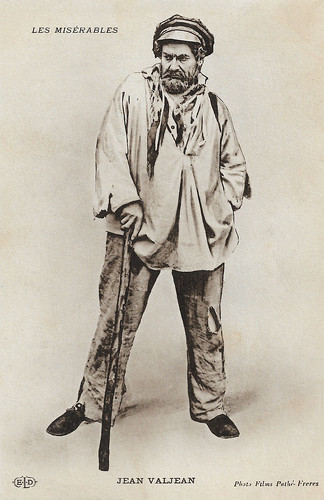
Henry Krauss in Les Misérables (1913)
French postcard by Ed. Le Deley (ELD). Photo: Films Pathé-Frères. Henry Krauss as Jean Valjean, relentlessly pursued by the Justice, in Les Misérables (Albert Capellani, 1913). Sent by mail in 1916.

Les Misérables (1913)
French postcard by Ed. Le Deley, Paris. Photo: Pathé Frères. Gaudin as Gavroche in Les Misérables (Albert Capellani, 1913), adapted from the famous novel by Victor Hugo. Caption: The Death of Gavroche. During the June Revolution of 1832, young Gavroche (Gaudin), son of the Thenardier couple, is killed while collecting bullets from deceased soldiers. On this card, he is shown as a revolutionary hero. This card is part of a booklet made by Le Deley with multiple portraits of the main actors and various scenes of the film.

Les Trois Mousquetaires, 15
French postcard by M. Le Deley, Paris. Photo: Pathé. Publicity still from Les Trois Mousquetaires / The Three Musketeers (Henri Diamant Berger, 1921), based on the famous novel by Alexandre Dumas père, and produced by Pathé Consortium Cinéma. On this card, the Three Musketeers and D'Artagnan, played by Henri Rollan as Athos, Charles Martinelli as Porthos, Pierre de Guingand as Aramis, and Aimé Simon-Girard as D'Artagnan. In the back, Armand Bernard as Planchet and Louis Pré fils as Grimaud.

Les Trois Mousquetaires, 1
French postcard by M. Le Deley, Paris. Photo: Pathé Consortium Cinéma. Still from Les Trois Mousquetaires / The Three Musketeers (Henri Diamant Berger, 1921). On the right side, Richelieu (Édouard de Max) is playing chess against, possibly, King Louis XIII. Left, Queen Anne of Austria (Jeanne Desclos). The silent super-serial Les Trois Mousquetaires / The Three Musketeers (1921) was the first film adaptation of the famous adventure novel by Alexandre Dumas père, published in 1844. It was a French twelve-hour film divided into one-hour chapters, designed to be released in consecutive weeks over a three-month period.

Hesperia in Il figlio di Madame Sans-Gêne (1921)
French postcard by Ed. Le Deley, Paris. Photo: U.C.I. / Gaumont / Tiber Film. Hesperia in Il figlio di Madame Sans-Gêne (Baldassarre Negroni, 1921), adapted from the novel by Émile Moreau. Here, Hesperia as Madame Sans-Gêne is portrayed similarly to François Gérard's portrait of Juliette Récamier.

Hesperia in Il figlio di Madame Sans-Gêne (1921)
French postcard by M. Le Deley, Paris. Photo: U.C.I. / Gaumont / Tiber Film. Hesperia and perhaps Luigi Rinaldi or Camillo de Rossi in Il figlio di Madame Sans-Gêne / The Son of Madame Sans-Gêne (Baldassarre Negroni, 1921), based on the novel by Émile Moreau.

L'Empereur des pauvres (1922)
French postcard by M. Le Deley, Paris. Photo: Pathé Consortium Cinema. Scene from the French silent film L'Empereur des pauvres (René Leprince, 1922), an adaptation of the novel by Felicien Champsaur, starring Léon Mathot, Gina Relly and Henry Krauss. The man down right on this card could be Mathot.

Gina Relly, L'empereur des pauvres
French postcard by M. Le Deley, Paris. Photo: Pathé Consortium Cinema. Gina Relly in L'Empereur des pauvres (René Leprince, 1922). The rich, young and spoiled Marc Anavan (Léon Mathot) decides to change his life, becomes a vagabond and starts doing good around him. He becomes the peaceful spokesperson for the disinherited, helped by the love of pure, young Sylvette (Gina Relly). Marc has to face revolution, anarchism and the Great War before retaking his humanitarian mission. In the end, he overcomes all the hardships on his way.

Norma Shearer
French postcard by Ets. Le Deley, Paris, for Gaumont-Metro-Goldwyn. Photo: Metro Goldwyn. Caption: a new screen star, Norma Shearer.

Source: Franki Olieu (Kortrijk in oude postkaarten - Dutch).

30 January 2024

Jean Coquelin

French stage and film actor and theatre director Jean Coquelin (1865-1944) was the son of the famous stage actor Benoit Constant Coquelin and the nephew of Coquelin Cadet. He was known for such films as L'abbé Constantin (1925), La chanson du souvenir (1937) and Café de Paris (1938).

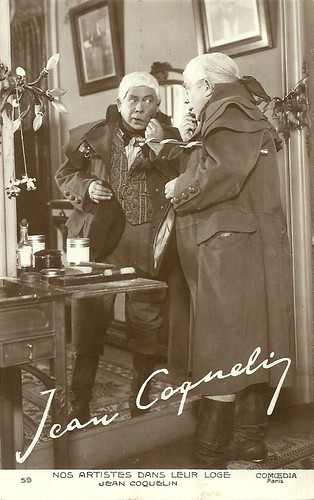
Jean Coquelin
French postcard in the 'Nos artistes dans leur loge' series, no. 59. Photo: Comoedia, Paris.
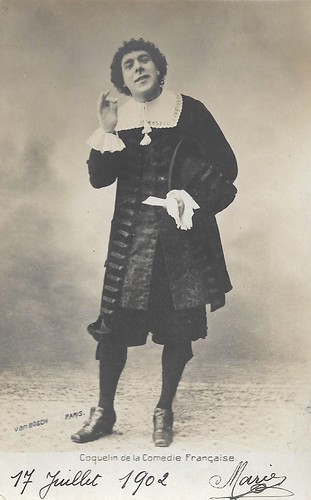
Jean Coquelin
French postcard, signed and dated 17 July 1902. Photo: Van Bosch, Paris. Caption: Coquelin de la Comédie Française.

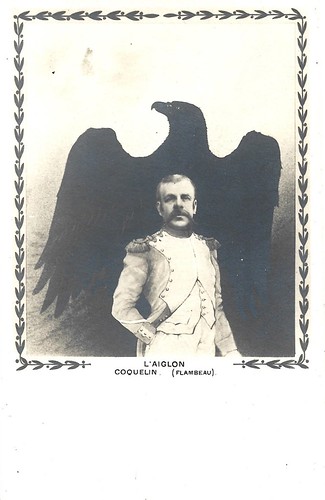
Jean Coquelin as Flambeau in L'aiglon
French postcard. Jean Coquelin as Flambeau in the play 'L'aiglon' by Edmond Rostand.

A debut at the Comédie Française


Jean Coquelin was born Camille Léon Jean Coquelin in 1865 in Paris, France. He was the son of the stage actor Benoit Constant Coquelin also known as Coquelin ainé and actress Antoine Mancy. His uncle, Coquelin Cadet, was also well-known actor.

He studied with Mme Arnould Plessy and Coquelin aîné, his father. He followed the latter on a major tour of Europe, and then entered the Comédie Française in 1890. He made his debut in 'Le Dépit amoureux', then played in 'Thermidor' and 'La Mégère apprivoisée'. He then moved on to the Renaissance Theatre.

In 1907, he became co-director of the Théâtre de la Gaité alongside Henry Hertz in 1907. In 1910, he and Hertz became the directors of the Théâtre de la Porte Saint-Martin, when Edmond Rostand's 'Chantecler' premiered there. That year, he married Blanche Miroir on 18 May 1910 in Neuilly sur Seine. His witnesses were Edmond Rostand and Albert Carré, and the bride's witnesses were Henry Hertz and Mme Michel.

At the Porte Saint-Martin, hee created the character of Raigoné in Edmond Rostand's 'Cyrano de Bergerac', the major play in which his father had performed.

Coquelin and his father played together in the stage play 'La Dame de Monsoreau', after a novel by Alexandre Dumas, turned into a stage play in 1860.

Jean Coquelin as the farmyard dog Patou in Chantecler
French postcard by ELD, no. 84. Jean Coquelin as the farmyard dog Patou in 'Chantecler', a play by Edmond Rostand.

Jean Coquelin as the farmyard dog Patou in Chantecler
French postcard by ELD / GPL. Photo: Bert. Jean Coquelin as the farmyard dog Patou in 'Chantecler', a play by Edmond Rostand.

Clergyman


In 1925, after years of theatre performances, Jean Coquelin started to appear in film too. He made his debut in the lead role of the comedy Abbé Constantin/The Abbot Constantine (Julien Duvivier, 1925) with Claude France. He often played a clergyman such as the priest in La Roche aux Mouettes (Georges Monca, 1933).

Coquelin played several times with Julien Duvivier in such films as David Golder (Julien Duvivier, 1930) starring Harry Baur and La fin du jour/The End of the Day (Julien Duvivier, 1939) with Victor Francen and Michel Simon.

He even played more often with director Sacha Guitry and appeared in his films Faisons un reve/Let's Make a Dream (Sacha Guitry, 1937), Les perles de la couronne/The Pearls of the Crown (Christian-Jaque, Sacha Guitry, 1937), Remontons Les Champs-Elysées/Let's Go Up the Champs-Élysées (Sacha Guitry, Robert Bibal, 1938) and Le destin fabuleux de Désirée Clary/Mlle. Desiree (Sacha Guitry, 1942).

After his debut in a lead role, most of his roles were secondary characters or bit parts. His last role was a bit part in Maurice Tourneur's Les mains du diable/The Devil's Hand (Maurice Tourneur, 1943) with Pierre Fresnay, after the novel by Gérard de Nerval.

Jean Coquelin died in 1944 in Couilly-Pont-aux-Dames, Seine-et-Marne, France. He was 78. Coquelin was married to 'Blanche Miroir' and actress Louise Didès. With Didès, he had a son, actor Jean-Paul Coquelin.

Jean Coquelin in the play La Dame de Monsoreau (1908)
French postcard by Eclair. Photo: Atelier Nadar. Caption: Porte St. Martin. Jean Coquelin in the play 'La Dame de Monsoreau' (1908).

Jean Coquelin as Flambeau in L'aiglon
French postcard. Jean Coquelin as Flambeau in the play 'L'aiglon' by Edmond Rostand.

Sources: Theatredatabase, Wikipedia (French and English) and IMDb.