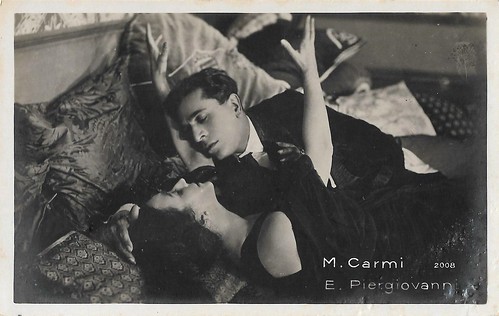
Italian postcard by Ed. Vettori, Bologna, no. 2008. Maria Carmi and Ettore Piergiovanni in Forse che sì, forse che no (Gaston Ravel, 1921).

Italian postcard by G.B. Falci, Milano, no. 35. Photo: Unione Cinematografica Italiana. Maria Carmi as Isabella Inghirami in Forse che sì, forse che no (Gaston Ravel, 1921).
A passionate and fatal love quartet
In the silent film drama Forse che sí, forse che no (1921), the noble Paolo Tarsis (Ettore Piergiovanni) is passionately in love with Isabella Inghirami (Maria Carmi).
Paolo understands the change of time, and instead of taking refuge in the current of decadence, he rides the new fashion of cars, automobiles and aeroplanes, partly embracing the current of futurism.
However, happiness does not last, because Isabella secretly betrays him with her brother Aldo (Giorgio Fini), reproaching Paolo for his betrayals with Vannina, Isabella's younger sister (Eugenia Masetti), who is madly in love with Paolo.
When the knots come to a head, Vanina goes to Paolo to reveal the relationship between her brother and her older sister. Paolo, furious, awaits the arrival of Isabella, on whom he unleashes his anger, beating and insulting her. Vanina commits suicide out of desperation.
Isabella, before so self-assured and determined, has become so maddened that her father and stepmother lock her up in an institution. Paolo, unable to help her, also attempts suicide with a desperate action, to arrive with his plane in Sardinia and return to Italy. The enterprise succeeds, and Paolo is hailed as a hero.

Italian postcard by G.B. Falci, Milano, unnumbered. Photo: Unione Cinematografica Italiana. Maria Carmi in Forse che sì, forse che no (Gaston Ravel, 1921).

Italian postcard by G.B. Falci, Milano, unnumbered. Photo: Unione Cinematografica Italiana. Maria Carmi as Isabella Inghirami in Forse che sì, forse che no (Gaston Ravel, 1921). Aldo (Giorgio Fini) spies upon Isabella, while Vanna (Eugenia Masetti) confronts her elder sister.
Ferocious opposition
Director Gaston Ravel based Forse che sì, forse che no (1921) on Gabriele d'Annunzio's eponymous novel from 1910. D'Annunzio had set his novel in Mantua, in Palazzo Gonzaga, of which the inscription, translated as "Maybe Yes, Maybe No", inspired him for the title.
Earlier, the novel had been adapted into a play and an earlier film version, Forse che sì, forse che no (1916), directed by Mario Gargiulo, with Tina Xeo in the lead.
Parts of the novel - such as in the incestuous relationship between sister and brother - would later again be used by Luchino Visconti for his film Vaghe stelle dell'orsa / Sandra (1965), starring Claudia Cardinale, Michael Craig and Jean Sorel.
Ravel's film version, Forse che sì, forse che no, had its premiere in Rome on 2 December 1921. The film wasn't liked by the Italian press (some thought it too decadent, others too sweet and unfaithful to D'Annunzio) nor by the Italian audience. The censor's suppression of intertitles at the epilogue surely didn't help the understanding of the film.
Star Maria Carmi encountered so much ferocious opposition towards her appearance in this film that she withdrew from the cinema. She returned to the stage, where she interpreted, in the following years, plays by Luigi Pirandello and Filippo Tommaso Marinetti. In 1923, she moved to the United States, where Carmi and her husband, Georges V. Matchabelli, co-founded the now-famous perfume company Prince Matchabelli in 1926.

Italian postcard by G.B. Falci, Milano, unnumbered. Photo: Unione Cinematografica Italiana. Maria Carmi and Ettore Piergiovanni as Isabella Inghirami and Paolo Tarsis in Forse che sì, forse che no (Gaston Ravel, 1921). The maddened Isabella does not understand Paolo's pleas anymore.

Italian postcard by G.B. Falci, Milano, unnumbered. Photo: Medus Film / Unione Cinematografica Italiana. Maria Carmi as Isabella Inghirami in Forse che sì, forse che no (Gaston Ravel, 1921). Caption: Isabella durante la sua pazzia (Isabella during her madness). The man on the right could be Giorgio Fini as Isabella's brother Aldo, who is in love with his own sister, and here tries to steal her engagement ring.
Sources: Wikipedia (English and Italian) and IMDb.

No comments:
Post a Comment