
Austrian postcard by Iris Verlag, no. 5199. Photo: First National Pictures.
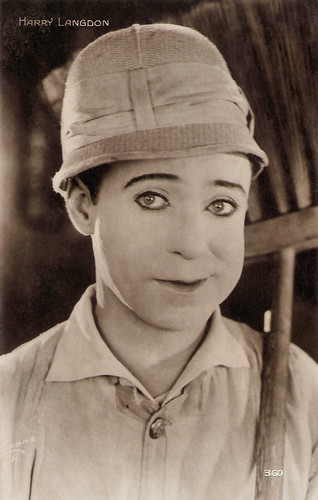
French postcard by Cinémagazine-Edition, Paris, no. 360. Photo: George Frederic Cannons, Los Angeles. Publicity still for Feet of Mud (Harry Edwards, 1924).
Still a cherubic baby face at 40
Harry Philmore Langdon was born in 1884 in Council Bluffs, Iowa. He was the son of a self-employed painter, William Langdon, and his wife, Lavinia, a Salvation Army volunteer. At the age of 12, he joined Dr. Belcher's Kickapoo Indian Medicine Show. This led to years spent doing other medicine shows, small-time circus shows and also vaudeville. Langdon had made his Broadway debut in a 1899 revival of William Shakespeare's 'The Winter's Tale'. In 1904, Langdon met and married fellow performer Rose Musolff, and the pair began a vaudeville routine.
By 1915, they had evolved their routine into a popular skit called 'Johnny's New Car.' Langdon regularly came up with variations on the sketch, which he performed to great acclaim. While he was perfecting his sketch, a new phenomenon was emerging: the film. In 1922, he signed with producer Sol Lesser of Principal Pictures as a series star, but after two films, he transferred to Keystone in October 1923 when Mack Sennett bought the contract.
Sennett gave the seasoned vaudeville veteran a great deal of artistic freedom to develop his own style. He was assigned his own production team to make his shorts. Harry was already 40 at the time, but he still had a cherubic baby face. It was perfectly suited to the pantomime style he employed in the films he made with director Harry Edwards and writer Arthur Ripley. In early 1925, Frank Capra began working with the unit as a gag writer, first credited on the short Plain Clothes (Harry Edwards, 1925). The unit slowed down the rhythm of Langdon's shorts and began focusing on Harry's character, a timid, naive soul who hesitated when confronting conflict.
Tammy Stone at Things and other stuff (now defunct): "Harry’s 'schtick' consisted primarily in playing highly hapless, innocent and indecisive characters, and for this, he became a huge star. Most of his approximately 100 films were actually made during this 'early' period; titles include Smile Please, The Cat’s Meow, The Luck of the Foolish, The Hansom Cabman (all 1924), Boobs in the Wood, Plain Clothes, The White Wing’s Bride, Lucky Stars (all 1925), and Fiddlesticks and Ella Soldier Man (both 1926)."
Langdon created a character who was essentially a childlike figure with wide-open eyes, constantly gazing at the adult world with wonder. With only providence and good luck, he manages to come out on top. His character stood out from most of the other comedians who worked for Sennett, who tended to focus more on slapstick. One of his best films from this 'Sennett era' was Saturday Afternoon (Harry Edwards, 1926), in which he played a henpecked husband who comes back after a spree with a buddy and hopes to tell his wife (Alice Ward) off.

Poster postcard, ed. Fondation Jérôme Seydoux-Pathé. American poster by Mack Sennett / Pathé for Harry Langdon in The First 100 Years (F. Richard Jones, Harry Sweet, 1924).
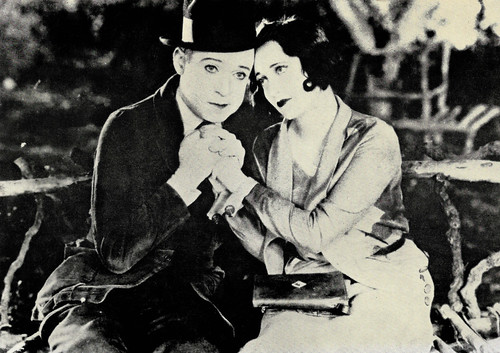
French postcard by François Nugeron, Paris. Photo: Collection Snark. Harry Langdon and Joan Crawford in Tramp, Tramp, Tramp (Harry Edwards, 1926), based on a screenplay by Frank Capra. The French film title was Plein des bottes.
Forming his own company
As Harry Langdon's career progressed at Sennett, his box-office success increased, and the unit moved from two- to three-reelers. Langdon, determined to follow the example of Chaplin, Keaton and Lloyd, then made his first feature-length comedy, His First Flame (Harry Edwards, 1927). The film was completed in July 1925, but not copyrighted until February 1926, and released in May 1927. Along the way, it was edited from 5 reels down to 3 reels. Langdon decided to form his own company, the Harry Langdon Corporation, and he immediately got a six-film deal with First National, a big studio at the time. He was able to snag Edwards, Capra and Ripley from Sennett.
His first film with his new company was the feature-length comedy Tramp, Tramp, Tramp (Harry Edwards, 1926), in which he starred opposite a very young Joan Crawford. The film, on which Landon also acted as producer, featured the child-man Harry as the ultimate manifestation of his naive persona, playing himself as his own baby. The film did well but ran over budget, and Harry Edwards was sacked. However, the film did extremely well critically and with audiences.
Langdon followed up this triumph with The Strong Man (Frank Capra, 1926) and Long Pants (Frank Capra, 1927). During the production of Long Pants (1927), Langdon and his director had a falling out. With three big successful films and an ego to match, Langdon fired Frank Capra and took over the directing duties himself. As a result, his next three films were failures. In 1928, First National did not pick up his contract. Harry Langdon Corp. was bankrupt.
Sound film gained headway, and his popularity had waned. In 1929, Hal Roach gave him a contract, and he did eight short sound films with Harry, but they were disappointments. A decade after he began making pictures, at age 50, Harry signed with Columbia. He largely made short films that were reworkings of his earlier, more popular films. He also wrote for Laurel and Hardy at the Hal Roach Studio, e.g. Block-Heads (John G. Blystone, 1938). He even subbed for Laurel in Zenobia (Gordon Douglas, 1939), as Hardy's sidekick.
Langdon remained active in Columbia shorts and Monogram features until the end of his life. A few weeks before his death, he had delivered his final short film, Pistol Packin' Nitwits (Edward Bernds, 1945), to Columbia Pictures. In 1944, Harry Langdon died in Los Angeles of a cerebral haemorrhage after working all day on a strenuous dance routine for the Republic musical Swingin' on a Rainbow (William Beaudine, 1945). He was 60. Langdon married four times. His only son is the Hollywood photographer Harry Langdon Jr.

Swiss-German-British postcard by News Productions, Baulmes / Filmwelt Berlin, Bakede / News Productions, Stroud, no. 56553. Photo: First National Pictures Inc. / Collection Cinémathèque Suisse, Lausanne. Harry Langdon in The Chaser (Harry Langdon, 1928).

Publicity still for Le Giornate del Cinema Muto 2025. Credit: AMPAS, Margaret Herrick Library, LA. Natalie Kingston and Harry Langdon in Soldier Man (Harry Edwards, 1928).
Sources: Jon C. Hopwood (IMDb), Kenneth Chisholm (IMDb), Wikipedia (Dutch and English) and IMDb.

No comments:
Post a Comment