Showing posts sorted by relevance for query Alice guy. Sort by date Show all posts

14 December 2019

New Acquisitions: Alice Guy's Faust (1905)

Ivo Blom recently bought this wonderful series of postcards published by Croissant in Paris for the film company Gaumont. The 10 postcards show scenes of the lost French 'phonoscène' Faust by pioneering film director Alice Guy. The earliest proof of a showing of the film, or rather series of short sound films, dates from 1905. So the film dates from that year or just before. The captions on the postcards refer to lines from the libretto by Jules Barbier and Michel Carré for the opera 'Faust' (1859) by Charles Gounod, which was loosely based on Goethe's classic play. The film is not to be confused with Faust et Méphistophéles (Alice Guy, 1903), which still exists and is another film.

Faust (Alice Guy,  Gaumont prob. 1905)
French postcard by Croissant, Paris, no. 3680. Postcard for Faust (Alice Guy, 1905). The card refers to no. 4, the Duet of the First Act between Faust and Mephistopheles.

Faust (Alice Guy, Gaumont prob. 1905)
French postcard by Croissant, Paris, no. 3680. Postcard for Faust (Alice Guy, 1905). This card refers to Faust's Cavatine, no. 12 of the Third Act.

Faust (Alice Guy, Gaumont prob. 1905)
French postcard by Croissant, Paris, no. 3680. Postcard for Faust (Alice Guy, 1905). This card refers to the Chanson du Roi de Thulé, no. 14 of the Third Act.
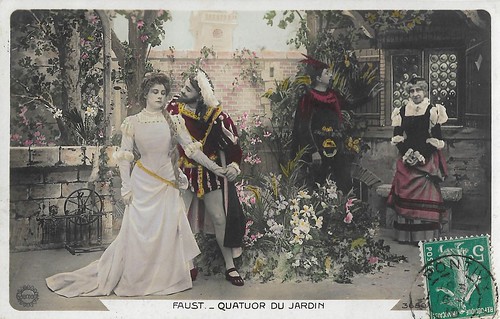
Faust (Alice Guy, Gaumont prob. 1905)
French postcard by Croissant, Paris, no. 3680. Postcard for Faust (Alice Guy, 1905). The card refers to the Quartet between Faust, Marguerite, Mephistopheles, and Marthe, no. 16 of the Third Act.

Faust (Alice Guy, Gaumont prob. 1905)
French postcard by Croissant, Paris, no. 3680. Postcard for Faust (Alice Guy, 1905). The caption refers to no. 18 of the Third Act.

A forerunner of sound cinema


Rose Theresa writes in the volume 'Between Opera and Cinema' (2002) that Faust dates from 1907 and was Alice Guy's last and most complete operatic adaptation, existing of 22 phonoscène films, referring to famous moments in the opera. Longer scenes like that in the garden were filmed in multiple phonoscènes, while others matched the length of the accompanying wax cilinders with the music. However the date is a mistake. The site Le grimh shows an original ad for a Charleroi (Belgium) screening of the film, which already took place in 1905.

The Phonoscène was a kind of a forerunner of sound cinema, combining a chronophone sound recording with a chronograph film shot with actors lip-synching to the sound recording. The recording and film were synchronised by a mechanism patented in 1902 by Léon Gaumont, who presented the first phonoscènes in the same year in France. Alice Guy, who was head of film production at Gaumont between 1896 and 1906, shot countless phonoscènes after popular French operas such as Carmen, Mireille and Faust, but also recorded popular vaudeville singers and comedians such as Félix Mayol and Dranem.

Gounod's 'Faust' was - and still is - one of the most popular and well-known French operas. In the early cinema it was adapted several times to film by Georges Méliès, Gaumont and Cines, while Friedrich Wilhelm Murnau's version of 1926 has become the most memorable one, thanks to the acting performances (e.g. by Emil Jannings as Mephisto) and the wonderful special effects. The most recent version is Aleksandr Sokoerov's Faust (2011), which won a Golden Lion in Venice.

Wikipedia describes the plot of Gounod's opera, which takes place in 16th century Germany. In the First Act, Faust, an aging scholar, determines that his studies have come to nothing and have only caused him to miss out on life and love. He curses hope and faith, and asks for infernal guidance. Méphistophélès appears and, with a tempting image of Marguerite at her spinning wheel, persuades Faust to buy the devil's services on Earth in exchange for Faust's in Hell. Faust's goblet of poison is magically transformed into an elixir of youth, making the aged doctor a handsome young gentleman. Then the strange companions set out into the world.

In the Second Act, at the city gates, a chorus of students, soldiers and villagers sings a drinking song. Valentin, leaving for war with his friend Wagner, entrusts the care of his sister Marguerite to his youthful friend Siébel. Méphistophélès appears, provides the crowd with wine, and sings a rousing, irreverent song about the Golden Calf. Méphistophélès maligns Marguerite, and Valentin tries to strike him with his sword, which shatters in the air. Valentin and friends use the cross-shaped hilts of their swords to fend off what they now know is an infernal power. Méphistophélès is joined by Faust and the villagers in a waltz. Marguerite appears and Faust declares his admiration, but she refuses Faust's arm out of modesty, a quality that makes him love her even more.

In the Third Act, the lovesick boy Siébel leaves a bouquet for Marguerite. Faust sends Méphistophélès in search of a gift for Marguerite and sings a cavatina, idealizing Marguerite as a pure child of nature. Méphistophélès brings in a decorated box containing exquisite jewelry and a hand mirror and leaves it on Marguerite's doorstep, next to Siébel's flowers. Marguerite enters, pondering her encounter with Faust at the city gates, and sings a melancholy ballad about the King of Thule. Marthe, Marguerite's neighbour, notices the jewellery and says it must be from an admirer. Marguerite tries on the jewels and is captivated by how they enhance her beauty, as she sings in the famous aria, the Jewel Song. Méphistophélès and Faust join the women in the garden and romance them. Marguerite allows Faust to kiss her, but then asks him to go away. She sings at her window for his quick return, and Faust, listening, returns to her. Under the watchful eye and malevolent laughter of Méphistophélès, it is clear that Faust's seduction of Marguerite will be successful.

In the Fourth Act, after being made pregnant and seemingly abandoned by Faust, Marguerite has given birth and has become a social outcast. She sings an aria at her spinning wheel. Siébel stands by her. The scene shifts to the square outside Marguerite's house. Valentin's company returns from the war to a military march. Siébel asks Valentin to forgive Marguerite. Valentin rushes to her cottage. While he is inside Faust and Méphistophélès appear, and the devil, knowing that Marguerite is not in there alone, sings a mocking burlesque of a lover's serenade under Marguerite's window. Valentin takes the bait and comes out of the cottage, now knowing that Faust has debauched his sister. The two men fight, but Faust is reluctant to hurt the brother of the woman he adores. Méphistophélès blocks Valentin's sword, allowing Faust to make the fatal thrust. With his dying breath Valentin blames Marguerite for his death and condemns her to Hell before the assembled townspeople. Marguerite goes to the church and tries to pray there but is stopped, first by the sadistic Méphistophélès and then by a choir of devils. She finishes her prayer but faints when she is cursed again by the devil.

In the Fifth and final act, Méphistophélès and Faust are surrounded by witches. Faust is transported to a cave of queens and courtesans, and Méphistophélès promises to provide Faust with the love of the greatest and most beautiful women in history. An orgiastic ballet suggests the revelry that continues throughout the night. As dawn approaches, Faust sees a vision of Marguerite and calls for her. Méphistophélès helps Faust enter the prison where Marguerite is being held for killing her child. They sing a love duet. Méphistophélès states that only a mortal hand can deliver Marguerite from her fate, and Faust offers to rescue her from the hangman, but she prefers to trust her fate to God and His angels. At the end she asks why Faust's hands are covered in blood, pushes him away, and falls down motionless. Méphistophélès curses, as a voice on high sings "Saved!". The bells of Easter sound and a chorus of angels sings "Christ is risen!". The walls of the prison open, and Marguerite's soul rises to heaven. In despair Faust follows it with his eyes; he falls to his knees and prays. Méphistophélès is turned away by the shining sword of the archangel.

Faust (Alice Guy, Gaumont prob. 1905)
French postcard by Croissant, Paris, no. 3680. Postcard for Faust (Alice Guy, 1905). The caption refers to no. 18 of the Third Act.

Faust (Alice Guy, Gaumont prob. 1905)
French postcard by Croissant, Paris, no. 3680. Postcard for Faust (Alice Guy, 1905). The caption refers to no. 24 of the Third Act.

Faust (Alice Guy, Gaumont prob. 1905)
French postcard by Croissant, Paris, no. 3680. Postcard for Faust (Alice Guy, 1905). The caption refers to no. 21 of the Fourth Act.

Faust (Alice Guy, Gaumont prob. 1905)
French postcard by Croissant, Paris, no. 3680. Postcard for Faust (Alice Guy, 1905). The caption refers to no. 25 of the Fourth Act, in which Valentin is killed by Faust with the help of Mephistopheles.

Faust (Alice Guy, Gaumont prob. 1905)
French postcard by Croissant, Paris, no. 3680. Postcard for Faust (Alice Guy, 1905). The caption refers to no. 30 of the Fifth Act. Faust tries to convince Marguerite to flee with him, but she'd rather die than giving up her faith.

Sources: Alison McMahon, Faust libretto by Barbier and Carré, Rose Theresa (Between Opera and Cinema),  Le Grimh and Wikipedia.

15 February 2020

Croissant, Paris

The French editor Croissant in Paris published series of coloured postcards for pre-1910 Pathé Frères films. From circa 1905 on, Croissant also published these postcards series for the other major French pioneering studio, Gaumont. These include series for three early sound films, 'Photoscènes', directed by Alice Guy(-Blaché): Faust (1905), Carmen (1906) and Mignon (1906), all three were film adaptations of famous operas.

Au pays noir (1905)
French postcard by Croissant, Paris. Photo: Film Pathé. Publicity still for Au pays noir/Tragedy in a Coal Mine (Ferdinand Zecca or Lucien Nonguet, 1905). Caption: Dans les galeries [In the mine galleries]. This refers to the 5th scene of the film.

La Fée de l'or
French postcard by Croissant, Paris, no. 3573. Photo: Film Pathé. This is the final scene from La poule aux oeufs d'or (Gaston Velle 1905), adapted from the fable of Jean de la Fontaine. Cinematography and special effects by Segundo de Chomón.

Le petit poucet (Pathé frères 1905).
French postcard by Croissant, Paris, no. 3662. Photo: Film Pathé. Publicity still for Le petit poucet/Tom Thumb (1905). Caption: From the top of a tree he saw a small glow.

Le petit poucet (Pathé frères 1905).
French postcard by Croissant, Paris, no. 3662. Photo: Film Pathé. Publicity still for Le petit poucet/Tom Thumb (1905). Caption: He put all his family at ease. Le petit poucet/Tom Thumb was an adaptation of Charles Perrault's famous story of 1697. The film by Pathé was worldwide released, in Spanish speaking countries as Pulgarito, in the US as Hop o'my thumb. The director and actors are unknown. The Spanish film scholar Juan-Gabriel Tharrats claimed the Spanish trick film maker Segundo de Chomón (1871-1929), who worked for Pathé in those years, made Le petit poucet. French Wikipedia claims the director was Vincent Lorant-Heilbronn. The Fondation Jerôme Seydoux, keeper of the Pathé heritage, lists no director at all.

Le chemineau
French postcard by Croissant, Paris, no. 3664. Photo: Film Pathé. Publicity still for Le chemineau/The Tramp (Albert Capellani, 1905), based on the first part of Victor Hugo's novel 'Les misérables'. Unclear is who the actors are, but sets were by Hugues Laurent. The film appeared in the "Scènes dramatiques et réalistes (8ème Série)" by Pathé.

Le Chemineau (1905)
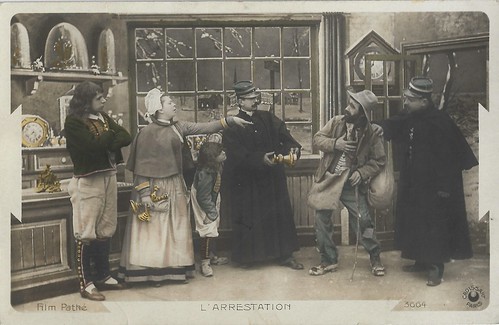
French postcard by Croissant, Paris, no. 3664. Photo: Film Pathé. Publicity still for Le chemineau/The Tramp (Albert Capellani, 1905), based on the first part of Victor Hugo's novel 'Les misérables'. Arrested at a jeweller, to whom he tries to sell his loot, the gendarmes bring the tramp back to the pastor. Despite all, the pastor wants to exonerate the miserable man's soul and tells a lie to the gendarmes: 'I gave the objects myself to him'. The thief repents.

Peau d'âne (1908)
French postcard by Croissant, Paris, no. 3666. Photo: Film Pathé. Probably publicity still for Peau d'ane/Donkey Skin (Albert Capellani, 1908). Caption: L'infante coiffée d'une peau d'âne (The princess wears a donkey skin). The film was based on a story by Charles Perrault (1697). The actors are unknown.

Le Gateau de Peau d'ane or The Cake of Donkey Skin
French postcard by Croissant, Paris, no. 3666. Photo: Film Pathé. Publicity still for Peau d'ane/Donkey Skin (Albert Capellani, 1908). Caption: Le Gateau de Peau d'ane (The Cake of Donkey Skin).

Un drame à Venise (1906)
French postcard by Croissant, Paris, no. 3672. Photo: Film Pathé. Publicity still for Un drame à Venise/Venetian Tragedy (Lucien Nonguet, 1906). Sent by mail in 1917. Caption: Au nom de l'honneur. (In the name of Honour). In this early Pathé Frères production, one of the rich palaces of Venice is the setting for a drama of smouldering love and hate. In the Middle Ages, an important lord is not loved by his wife. Despite the sumptuous wealth her husband surrounds her with, the noble dame can only think about a young and handsome Romeo. The lover is surprised by the husband, who kills him and Romeo ends in a canal. The noble lady escapes her death when her husband is stopped by her miraculous beauty... The film is partly in colour.

Les victimes de l'alcoolisme (1902)
French postcard by Croissant, Paris, no. 3678. Photo: Film Pathé. Publicity still for Les victimes de l'alcoolisme/Alcohol and Its Victims (Ferdinand Zecca, 1902). Caption: La paresse engendre la misère. (Laziness breeds misery.). Les victimes de l'alcoolisme/Alcohol and Its Victims (1902) is a four minutes short, directed and written by Ferdinand Zecca. It was based on Emile Zola's novel L'Assommoir', and the first Zola adaptation ever. Les victimes de l'alcoolisme/Alcohol and Its Victims tells a moral story on what happens to a man if he starts to drink and gamble. Bob Lipton at IMDb: "this is a very advanced film for 1902, being offered in five scenes, on elaborately painted sets. It was probably not intended solely for movie programs, but for anti-booze lectures, Chautauquas, and conferences."

Faust (Alice Guy,  Gaumont prob. 1905)
French postcard by Croissant, Paris, no. 3680. Photo: Gaumont. Publicity still for the phonoscène Faust (Alice Guy, ca. 1905). The earliest proof of a showing of the film dates from 1905, so the film dates from that year or just before. The captions refer to lines from the opera libretto by Jules Barbier and Michel Carré for the opera 'Faust' (1859) by Charles Gounod. This card refers to no. 4, the Duet between Faust and Mephistopheles in the First Act.

Faust (Alice Guy, Gaumont prob. 1905)
French postcard by Croissant, Paris, no. 3680. Photo: Gaumont. Publicity still for the phonoscène Faust (Alice Guy, ca. 1905). This card refers to the Quartet between Faust, Marguerite, Mephistopheles, and Marthe, no. 16 of the Third Act.

Mignon (1906)
French postcard by Croissant, Paris, no. 3871. Photo: Gaumont. Publicity still for Mignon (Alice Guy, 1906). Caption: Est-ce bien Mignon que voilà? (How cute is that?)

Mignon (1906)
French postcard by Croissant, Paris, no. 3871. Photo: Gaumont. Publicity still for Mignon (Alice Guy, 1906). Caption: Adieu Mignon, courage! Ne pleure pas! (Adieu Mignon, courage! Do not Cry!) Alice Guy directed nine (or seven - the sources differ) scenes from the opera 'Mignon' for a synchronised sound film, in the Gaumont Chronophone Studio, Paris, in 1906. 'Mignon' (1966) is an opéra comique in three acts by Ambroise Thomas. The original French libretto was by Jules Barbier and Michel Carré, based on Goethe's novel 'Wilhelm Meisters Lehrjahre'.

Carmen, (Alice Guy, 1906)
French postcard by Croissant, Paris, no. 3890. Photo: Gaumont. Publicity still for the phonoscène Carmen (Alice Guy, 1906). The film consisted of 12 so-called phonoscènes, an early sound-on-disc system. The film is presumed lost. Unknown is who the singers are. Carmen flirts with the toreador before his fight with the bull: "Toréador, en garde, et songe en combattant. Qu'un oeil noir te regarde et que l'amour t'attend." (Toreador, on guard, and dream of fighting. Let a black eye look at you and let love await you.)

Carmen (Alice Guy, 1906)
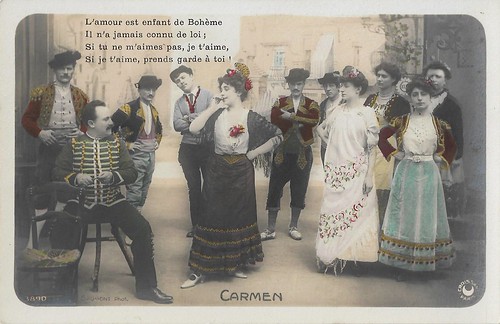
French postcard by Croissant, Paris, no. 3890. Photo: Gaumont. Publicity still for the phonoscène Carmen (Alice Guy, 1906). The gypsy girl Carmen challenges Don José: "L'amour est enfant de Bohème, Il n'a jamais connu de loi; Si tu ne m'aimes pas, je t'aime, Si je t'aime, Prends garde à toi." (Love is Bohemian's child, He never knew any law; If you don't love me, I love you, If I love you, be careful!) Mark the half visible logo Elge behind the most right woman; it it stands for L.G., the initials of Gaumont owner and founder Léon Gaumont.

Sarah Bernhardt in La dame aux camélias (1912)
French postcard by Croissant, Paris, no. 1530/8. Photo P. Boyer. Sarah Bernhardt in La dame aux camélias (André Calmettes, Louis Mercanton, 1912). The film was produced by Le Film d'Art and distributed by Pathé Freres. Caption: Sleep in peace, Marguerite! Much will be pardoned to you, because you have loved so much!

Sources: Fondation Jerome Seydoux (French), Roberta and Simone Blaché (The Memoirs of Alice Guy Blaché), Alison McMahan (Alice Guy Blaché: Lost Visionary of the Cinema), Alison McMahan (Women Film Pioneers Project), Bob Lipton (IMDb), Kinomata: la donna nel cinema, Wikipedia (English and French) and IMDb.

29 October 2020

La Collectionneuse: Alice Guy

In September our friend Marlene Pilaete informed us that the French website l’Encinémathèque doesn’t exist anymore. Webmaster Christian Grenier had decided to close l’encinémathèque down for personal reasons. It’s sad. We offered Marlene to host her sublime blog La Collectionneuse at EFSP from now on, and happily, she accepted! We will mix her old posts (from now on in English) with new posts. You can search all her posts at EFSP under La Colectionneuse in the cross-column above. We start with her last post at l’Encinémathèque on French director and film pioneer Alice Guy. Welcome, Marlene!

The documentary Be Natural: L’histoire cachée d’Alice Guy-Blaché (Be Natural: The Hidden Story of Alice Guy-Blaché) was released in French cinemas last June. This is an opportunity to pay a small tribute to this pioneer of the cinema, unjustly forgotten for several decades, through eight old postcards of actresses who worked under her direction.

Alice Guy (1873-1968)


Born in 1873, Alice Guy became a director at Gaumont in 1896 and, until 1907, she made a number of short films there. The performers were, most of the time, anonymous, except when she was filming music-hall celebrities of the time, like Polin, Mayol, or Saharet.

In 1910, she was in the United States, where she notably founded the Solax company, and from there, we can finally identify the stars of her films.

So, let us discover Blanche Cornwall, Marian Swayne, and Claire Whitney, three actresses under contract with Solax, and directed several times by Alice Guy.

Also at Solax, Sally Crute made her very first film under Alice's direction, before moving on to other horizons.

She was the famous director who also guided Olga Petrova's first steps on the screen by directing her in five consecutive films and who, together with her husband Herbert Blaché, helped to launch Catherine Calvert into the world of movie stars.

As for Bessie Love and Dolores Cassinelli, they were the last two actresses to work under Alice Guy, the first in The Great Adventure (1918) and the second in Tarnished Reputations (1920).

Blanche Cornwall (1868? 1885? - 1918? 1977?)


Blanche Cornwall
American postcard. Photo: Solax Stock Co. Collection: Marlene Pilaete.

Blanche Cornwall made her film debut in 1911 at the Solax Studios, where she became one of the main female stars.

The co-founder of the company, the French Alice Guy directed the actress on numerous occasions, notably in The Violin Maker of Nuremberg (1911), Mrs. Cranston's Jewels (1912), A Terrible Lesson (1912), Blighted Lives (1912), Child of the Tenements (1912), The Reformation of Mary (1912), The Wooing of Alice (1912), Souls in the Shadow (1912), The Girl in the Arm-Chair (1912), Burstup Homes (1913), …

We can also mention the anticipatory comedy In the Year 2000 (1912), which evokes a world ruled by women at the beginning of the 21st century, and The Pit and the Pendulum (1913), based on the work of Edgar Allan Poe.

She disappeared from the screen in 1914.

Marian Swayne (1891-1973)


Marian Swayne
American postcard by Kraus Mfg. Company, N.Y. Collection: Marlene Pilaete.

Marian Swayne (born in Philadelphia, USA) made her film debut at the Solax Company, where, from 1911 to 1913, she was the protagonist of, among others, The Interrupted Elopement (1911), Husbands Wanted (1911), Mignon (1912), Lend Me Your Wife (1912), A Question of Hair (1912), Where Love Dwells (1913), A House Divided (1913), The Hopes of Belinda (1913), The Heavenly Widow (1913), ...

During her early years of stardom, she had the opportunity to be directed several times by Alice Guy.

She then continued her career at other studios and made such films as A Discolored Romance (1914), The Adventures of Kitty Cobb (1914), The Red Cross Nurse (1914), The Winning Loser (1915), The Road Between (1915), The Turning Point (1915), The Carriage of Death (1916), Paying the Price (1916), The Adventurer (1917), with Alice Guy behind the cameras, The Deemster (1917), and The Little Samaritan (1917).

After The Transgressor (1918), a social drama produced by the Catholic Art Association and directed by Joseph Levering, her husband from 1914 until the mid-1930s, she stayed away from the film sets for some time.

From 1921 to 1924, she was still the performer of some films produced by secondary studios.

Claire Whitney (1890-1969)


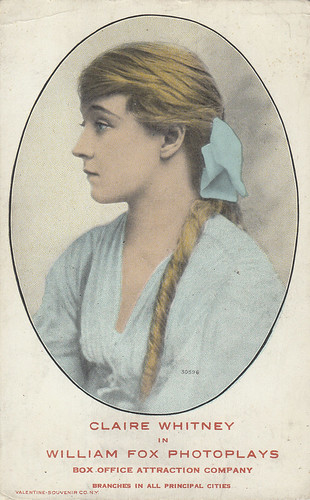
Claire Whitney
American postcard by Valentine Souvenir Co., no. 30596. Collection: Marlene Pilaete.

Claire Whitney (born in New York, USA) made her screen debut in 1912 at the Solax Studios and quickly became one of their stars.

Until 1914, she filmed, among others, The Paralytic (1912), The Star of India (1913), Shadows of the Moulin Rouge (1913), Beneath the Czar (1914), The Dream Woman (1914), The Woman of Mystery (1914), …

During her time at Solax, she had the opportunity to be directed, several times, by Alice Guy.

From 1915 to 1917, she was employed by Fox, where she was one of the protagonists of, among others, The Girl I Left Behind Me (1915), Blindness of Devotion (1915), The Ruling Passion (1916), A Wife's Sacrifice (1916), Heart and Soul (1917), When False Tongues Speak (1917), ...

Subsequently, she continued her career with films such as Kaiser's Finish (1918), The Man Who Stayed at Home (1919), Mothers of Men (1920), The Chamber Mystery (1920), A Common Level (1920), ...

After The Leech (1921), she was absent from the screens for a few years, before making a brief comeback in The Great Gatsby (1926), in which she played Catherine, the sister-in-law of George Wilson, the character played by William Powell.

From 1929 to 1949, she still appeared in some sixty productions, in small roles, sometimes uncredited.

Sally Crute (1896-1971)


Sally Crute
American postcard by Kraus Mfg. Company, N.Y. Photo: E. Crute. Collection: Marlene Pilaete.

Sally Crute (born in Chattanooga, United States) made her film debut with the Solax company in The Woman Behind the Man (1912), directed by Alice Guy. She embodied a wife whose luxury tastes lead her marriage to ruin.

The famous director would not have the opportunity to direct the actress again, who soon signed a contract with Edison Studios. Becoming one of their main stars, she was then, until 1916, the interpreter of, among others, The Price of Human Lives (1913), A Pious Undertaking (1913), A Treacherous Rival (1914), An American King (1914), The Song of Solomon (1914), The Letter That Never came Out (1914), The Voice of Conscience (1915), Seen Through the Make-Up (1915), The Widow's Breezy Suit (1915), The Matchmakers (1915), A Mix-Up in Black (1916), Helen of the Chorus (1916), …

Subsequently, she worked for various studios. She still got a few leading female roles, for example in The Avenging Trail (1917) and Perjury (1921) alongside, respectively, Harold Lockwood and William Farnum.

But, most of the time, she now instead played secondary characters in films starring artists more in vogue then such as Mabel Taliaferro, Norma Talmadge, Shirley Mason, Viola Dana, Alla Nazimova, Beverly Bayne, Sylvia Breamer, Corinne Griffith, Bebe Daniels, Doris Kenyon or Gladys Walton.

She disappeared from the screens in 1926.

Olga Petrova (1884-1977)


Olga Petrova
British postcard by Rotary, no. S 71-6. Photo: Moody, N.Y. Collection: Marlene Pilaete.

After making a name for herself on stage in her native country, Olga Petrova (born in Great Britain) moved to the United States in the early 1910s and quickly conquered American audiences.

For her career, she decided to embellish her past and to transform herself into an exotic character. While her real name was Muriel Harding, she called herself Madame Olga Petrova, made up her Slavic origins, and spoke with an accent appropriate to her new identity.

She performed in music halls with monologues, songs, and imitations. In 1914, she tried out classical theatre by playing ‘Panthea’ on Broadway. Such a personality soon became interesting for the world of the Seventh Art. She made her screen debut in 1914, directly as a star.

Alice Guy directed Petrova’s first five films: The Tigress (1914), The Heart of a Painted Woman (1915), The Vampire (1915), My Madonna (1915), and What Will People Say? (1916). Subsequently, she appeared in, among others, The Scarlet Woman (1916), Extravagance (1916), The Secret of Eve (1917), and The Soul of a Magdalen (1917). She was also directed by Maurice Tourneur in The Undying Flame (1917), The Law of the Land (1917), and Exile (1917).

At the end of her cinematographic career, a production firm in her name was created, the ‘Petrova Picture Company’, for which she was the star of Daughter of Destiny (1917), The Light Within (1918), The Life Mask (1918), Tempered Steel (1918) and The Panther Woman (1918). This concluded her filmography.

Note that IMDb adds two Russian titles, in 1912 and 1928, but ‘Petrova’ being a very common surname in Russia, this is a case of disambiguation. After leaving the world of film sets, she returned to the stage. She was then the author and performer of three Broadway plays: ‘The White Peacock’ (1921-1922), ‘Hurricane’ (1923-1924), and ‘What Do We Know?’ (1927-1928). She retired at the end of the 1920s.

Catherine Calvert (1890-1971)


Catherine Calvert
Vintage Artura postcard, no. 121. Collection: Marlene Pilaete.

Catherine Calvert (born in Baltimore, United States) began her career as an actress on stage.

In the early 1910s, she was known as the Broadway performer of ‘The Deep Purple’ and ‘The Escape’, two plays by author Paul Armstrong, whom she married in 1913.

After the death of her husband in 1915, she decided to turn to the cinema and thus appeared in her first film, Partners (1916). It was nevertheless the couple Alice Guy and Herbert Blaché who made her a star of the Seventh Art. They first directed her in House of Cards (1917) and Behind the Mask (1917) and then in The Peddler (1917) and Think It Over (1917).

Other titles in her filmography include The Uphill Path (1918), Out of the Night (1918), Marriage for Convenience (1919), The Career of Katherine Bush (1919), Dead Men Tell No Tales (1920), The Heart of Maryland (1921), and That Woman (1922). She was also the protagonist of The Green Caravan (1922), The Indian Love Lyrics (1923) and Out to Win (1923) in England.

She disappeared from the screens in 1924 and in 1925 she married Canadian millionaire George A. Carruthers.

Bessie Love (1898-1986)


Bessie Love
Scandinavian postcard by Eneret B.C. & A.H, no. 246. Photo: Vitagraph. Collection: Marlene Pilaete.

Bessie Love (born in Midland, USA) made her film debut in the mid-1910s. She became known opposite William S. Hart in The Aryan (1916) and Douglas Fairbanks in The Good Bad Man (1916), Reggie Mixes In (1916), and The Mystery of the Leaping Fish (1916).

She quickly elevated to the rank of star and, for fifteen years, she remained so. From time to time, she experienced dips in her career but she did not hesitate to work for second-rate companies or to accept to play more secondary characters, which allowed her to stay active and to be able to bounce back when new opportunities arose to relaunch her career.

Among her films, notable are Hell-to-Pay Austin (1916), A Sister of Six (1916), The Heiress at Coffee Dan’s (1916), Nina, the Flower Girl (1917), A Daughter of the Poor (1917), Wee Lady Betty (1917), Polly Ann (1917), The Great Adventure (1918), directed by Alice Guy, How Could You, Caroline? (1918), A Little Sister of Everybody (1918), The Enchanted Barn (1919), Carolyn of the Corners (1919), A Yankee Princess (1919), A Fighting Colleen (1919), Bonnie May (1920), The Midlanders (1920), Penny of Top Hill Trail (1921), Forget Me Not (1922), Deserted at the Altar (1922), Gentle Julia (1923), Torment (1924), The Lost World (1925), Soul-Fire (1925), New Brooms (1925), The Song and Dance Man (1926), Lovey Mary (1926), Young April (1926), Dress Parade (1927), The Matinee Idol (1928), Anybody Here Seen Kelly? (1928), Sally of the Scandals (1928), …

According to numerous sources, she was the first actress to dance the Charleston on screen in The King on Main Street (1925).

With the advent of sound film, she was chosen to be one of the protagonists of the musical Broadway Melody (1929), which was a triumph and earned her an Oscar nomination for Best Actress. She was later seen in, The Girl in the Show (1929), Chasing Rainbows (1930), They Learned About Women (1930), Good News (1930), See America Thirst (1930), ... Unfortunately, her come-back did not last and the Hollywood future of Bessie Love looked very uncertain. After filming Morals for Women (1931) for Tiffany, a Poverty Row studio, she was absent from the cinemas for some time.

In the mid-1930s, she moved to Britain, where she was last featured in I Live Again (1936). From 1941 to 1983, she still played secondary and small roles in some thirty productions. These include, for example, The Barefoot Contessa (1954), The Roman Spring of Mrs. Stone (1961), Isadora (1968), Sunday, Bloody Sunday (1971), The Ritz (1976), Reds (1981), and The Hunger (1983). She was also active on stage and television.

Dolores Cassinelli (1888-1984)


Dolores Cassinelli
American postcard. Photo: Essanay. Collection: Marlene Pilaete.

Dolores Cassinelli (born in Chicago, USA) made her film debut in 1911 at Essanay, where she became one of the leading female stars.

She was the leading lady of, among others, Two Men and a Girl (1911), Winning an Heiress (1911), Do Dreams Come True? (1912), Napatia, the Greek Singer (1912), The Laurel Wrath of Fame (1912), When Soul Meets Soul (1913), The Girl at the Brook (1913), The Girl in the Case (1913), A Wolf Among Lambs (1913), and A Successful Failure (1913).

After leaving Essanay, she made The Wolf and the City (1913) and Too Late (1914) for Selig and in 1916 she played Mrs. Jerry Simpson, wife of one of the two heroes of the comedy series Tom and Jerry, produced by Emerald Pictures.

She starred in Lafayette, We Come (1918), Unknown Love (1919), and Tarnished Reputations (1920), directed by Alice Guy, the only three titles from the short-lived company created by Léonce Perret.

Albert Capellani, another Frenchman who was based in the United States at the time and who also founded a production unit there, hired her for The Virtuous Model (1919) and The Right to Love (1919). Other notable titles of her filmography are The Web of Deceit (1920), Anne of Little Smoky (1921), The Challenge (1922), and Christopher Columbus (1923).

She ended her film career with a few supporting roles in 1924 and 1925, alongside Doris Kenyon, Bebe Daniels, and Lila Lee, younger and more popular actresses.

Text: Marlene Pilaete. Check out other EFSP posts by Marlene here.

23 June 2026

The Century of Cinema: 1906

Il Cinema Ritrovato turns 40 this year. We like the idea that the organisers called one of their three programmes 'The Time Machine'. The programme puts a spotlight on silent cinema, structured around two sections: 'A Hundred Years Ago', on which we post later this week, and 'Century of Cinema'. This section follows, year after year, a chronological path beginning with the birth of the Seventh Art in 1895 and revisits the milestones that shaped the cinema during its formative period. Mariann Lewinsky and Karl Wratschko curated this year's 'The Century of Cinema: 1906' with some 60 titles: 'New highlights in this year’s programme include dramas of unprecedented refinement by Albert Capellani and the very first productions of the Danish company Nordisk. The section explores cinema’s experimental vocation, the growing emotional involvement of spectators, and the ability of films to reflect social realities such as racism and the ambivalent representation of women, poised between misogyny and emancipation. Documentary footage of the San Francisco earthquake and the mining disaster at Courrières, France, brings terrible events of the past vividly into the present.' For this EFSP post, we did not follow the programme, but selected 25 (yes, 19 + 6) postcards of films and plays that were published in 1906.

Cinema in 1906


Un drame à Venise (1906)
French postcard by Croissant, Paris, no. 3672. Photo: Film Pathé. Publicity still for Un drame à Venise / Venetian Tragedy (Lucien Nonguet, 1906). Caption: In the Name of Honour.

In the early Pathé Frères production Un drame à Venise / Venetian Tragedy, one of the rich palaces of Venice is the setting for a drama of smouldering love and hate. In the Middle Ages, an important lord was not loved by his wife. Despite the sumptuous wealth her husband surrounds her with, the noble dame can only think about a young and handsome Romeo. The lover is surprised by the husband, who kills him, and Romeo ends up in a canal. The noble lady escapes her death when her husband is stopped by her miraculous beauty... The film is partly in colour.

Un drame à Venise
Reprint of original French postcard by Croissant, Paris, no. 3672. Photo: Film Pathé. Publicity still for Un drame à Venise / Venetian Tragedy (Lucien Nonguet, 1906). Caption: Public entertainment.

In the 16th century, an important lord was not loved by his wife. Despite the sumptuous wealth her husband surrounds her with, the noble dame can only think about a young and handsome Romeo. A beggar who earlier on had been rewarded by the lord betrays the adulterous couple. 

Scene from Mignon (Alice Guy, 1906)
French postcard by Croissant, Paris, no. 3871. Photo: Gaumont phot. Publicity still for Mignon (Alice Guy, 1906). Caption: [Lothario to Mignon:] Have you suffered, have you wept? Have you languished without hope?

Alice Guy directed nine (or seven - the sources differ) scenes from the opera 'Mignon' for a synchronised sound film, in the Gaumont Chronophone Studio, Paris, in 1906. 'Mignon' (1866) is an opéra comique in three acts by Ambroise Thomas. The original French libretto was by Jules Barbier and Michel Carré, based on Goethe's novel 'Wilhelm Meisters Lehrjahre'.

Mignon (1906)
French postcard by Croissant, Paris, no. 3871. Photo: Gaumont. Publicity still for Mignon (Alice Guy, 1906). Caption: Goodbye, Mignon, be brave! Don't cry!

Alice Guy (1873-1968) is generally considered to be the world's first female director. She was born in 1873 in Paris. In 1896, she entered the film business as a secretary for Léon Gaumont at Gaumont-Paris. The next year, Gaumont changed from manufacturing cameras to producing films, and Guy became one of its first directors. She averaged two two-reelers a week and impressed the company so much with the output and the quality of her productions that by 1905, she was made the company's production director, supervising the company's other directors. After her first film in 1896, she directed and produced or supervised almost six hundred silent films ranging in length from one minute to thirty minutes, the majority of which were of the single-reel length. In addition, she also directed and produced or supervised one hundred and fifty synchronised sound films for the Gaumont Chronophone. Alison McMahan at Women Film Pioneers Project: "Her Gaumont silent films are notable for their energy and risk-taking; her preference for real locations gives the extant examples of these Gaumont films a contemporary feel." In 1907, Alice Guy married Herbert Blaché, an Englishman who ran the company's British and German offices. The pair went to the U.S. in 1909 to set up the company's operations there. In 1910, she and her husband set up their own production company in New York, the Solax Film Co. (1910-1914), and built a studio in Fort Lee, New Jersey. After a period of critical and financial success, her company's fortunes declined, and she eventually shut down the studio. Although she secured work directing films for several major Hollywood studios, she returned to France in 1922 after her divorce from Blaché. She was never able to secure any directorial jobs there and never made a film again.

Carmen, (Alice Guy, 1906)
French postcard by Croissant, Paris, no. 3890. Photo: Gaumont phot. Publicity still for Carmen (Alice Guy, 1906). Caption: "Toreador, be on guard, and dream as you fight. May a dark eye watch you, and may love await you."

On this card for the 1906 film Carmen, directed by Alice Guy for Gaumont, Carmen flirts with the toreador before his fight with the bull: "Toréador, en garde, et songe en combattant. Qu'un œil noir te regarde et que l'amour t'attends." The film consisted of 12 so-called phonoscènes, an early sound-on-disc system. The film is presumed lost. It is unknown who the singers are. Allison MacMahan told us that this version of Carmen was among the earliest phonoscenes made. No performers were listed, only 'Opera Français'.

Carmen (Alice Guy, 1906)
French postcard by Croissant, Paris, no. 3890. Photo: Gaumont Phot. Scene from Carmen (Alice Guy, 1906). Caption: [The gypsy girl Carmen challenges Don José:] "Love is a Bohemian child, it has never known any law; if you do not love me, I love you, if I love you, beware."

Mark the half-visible logo Elge behind the woman on the right. It stands for L.G., the initials of Gaumont owner and founder Léon Gaumont. Croissant also released the coloured series of postcards for pre-1910 Pathé Frères movies.

Le fils du diable
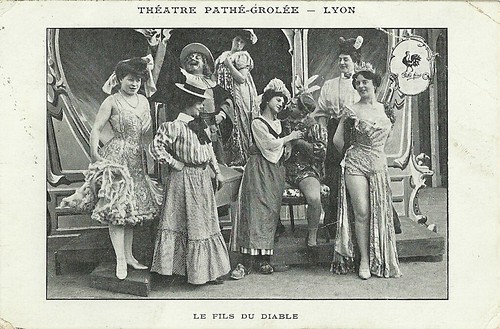
French postcard by Théâtre Pathé Grolée, Lyon. Photo: Pathé Frères. André Deed in Le fils du diable / The Devil's Son (Charles Lucien Lépine, 1906). The cinematography was by Segundo de Chomón.

Georges Vinter in Le tour du monde d'un policier (1906|)
French postcard by Théâtre Pathé Grolée, Lyon. Photo: Pathé Frères. Georges Vinter in Le tour du monde d'un policier / A Policeman's Trip Around The World (Charles Lépine, 1906). Special effects by Segundo de Chomón.

In Le tour du monde d'un policier (1906), a police detective has many adventures as he travels to Suez, Bombay, Yokohama, and the U.S.

L'espionne (1906)
French postcard by Théâtre Pathé Grolée, Lyon. Photo: Pathé Frères. Publicity still for L'espionne / The Spy (N.N., 1906), with Louis Pagliéri.

In L'espionne (1906), the daughter of a Cossack, Vera, loves a young tartar who is the enemy of her father. She betrays her father to save the life of her lover, but loses her own life instead.

La peine du talion (1906)
French postcard by Cinema Pathé Frères. Photo: Pathé Frères. Fernand Rivers as the professor in La Peine du talion / Tit-for-Tat (Gaston Velle, 1906).

In La peine du talion (1906), a professor and two students are walking in a grove, looking for rare butterflies. They capture some, which turn suddenly into pretty girls. In revenge, the girls turn him into a butterfly. After a brief examination, the teacher is sentenced to retaliation, a gigantic plug pricked with a pin. But the students ask pardon for their teacher. The scene ends in a splendid apotheosis.

Les chiens contrebandiers (1906)
French postcard by Cinema Pathé Frères. Photo: Pathé Frères. Publicity still for Chiens contrebandiers / Dogs Used As Smugglers (Georges Hatot, 1906).

The screenplay for Les chiens contrebandiers (1906) was written by André Heuzé. In a Spanish village, not far from the border, lives Manuela. She and her companions make lace, which is smuggled by the men. Manuela has a lover who has a rival, Antonio. After his advances are rejected, Antonio swears revenge. In the following scene, the smugglers are gathered in a cave known only to them. This is where they place the lace on the dogs who have to bring it safely to the other side of the border. Meanwhile, Antonio has warned customs, and under his guidance, they pursue the dogs. However, the intelligent beasts flee, crossing hills, woods, thickets, throwing themselves to swim, barely taking time to breathe, thinking only of their precious bales. Sometimes a bale falls, but it is immediately picked up by the following dog. The smugglers were warned of the treachery by one of them. Hidden in the timber, they wait for the customs passage. Shots are exchanged, and on both sides, there are wounded. This diversion allows the dogs to get ahead. The border is near, and in a final effort, they cross the post and safely recover the goods that are entrusted to them.

Theatre in 1906


Lewis Waller in Robin Hood
British postcard by Rotary Photo E.C., no. 4222F. Photo: Foulsham & Banfield. Lewis Waller in the play 'Robin Hood' (1906) by Henry Hamilton and William Devereux.

Lewis Waller (1860-1915) was best known as a matinee idol in the popular romantic plays of his day. He also worked as a playwright and a stage manager, and appeared in several films.

Evelyn Millard in Robin Hood (1906)
British postcard by Rotary Photo E.C., no. 4359 G. Photo: Foulsham & Banfield. Evelyn Millard as Lady Marian in the British play 'Robin Hood', first performed in November 1906.

Evelyn Mary Millard (1869-1941) was an English Shakespearean actress, manager of actors and ‘stage beauty’ in the late nineteenth and early twentieth centuries. She is mainly known for creating the role of Cecily Cardew for the premiere of Oscar Wilde's play 'The Importance of Being Earnest' in 1895.

Herbert Beerbohm Tree as Nero
British postcard by J. Beagles & Co., no. 354 R. Photo: F.W. Burford. Herbert Beerbohm Tree as Nero in the stage production 'Nero' (1906).

Stephen Phillips’ play 'Nero' opened at His Majesty’s Theatre, London, in 1906. In addition to Herbert Beerbohm Tree as Nero, Constance Collier played Poppaea, while Tree's wife, Helen Maud Holt, played Agrippina, mother of Nero.

Constance Collier and Herbert Beerbohm Tree in Nero (1906)
British postcard by Beagles & Co., London, no. G 407. Photo: F.W. Burford. Constance Collier as Poppaea and Herbert Beerbohm Tree as Nero in the stage production 'Nero' (1906). Constance Collier created the part of Poppaea for the stage. Stephen Phillips’ 'Nero' opened at His Majesty’s Theatre, London, in 1906.

Constance Collier (1878–1955) was an English stage and film actress and later one of Hollywood's premier drama and voice coaches. In a career that covered six decades, she evolved into one of London’s and Broadway’s finest tragediennes. Although she appeared in several silent British and American films, her career in the cinema really took off in her senior years when Collier appeared in well-regarded supporting roles in more than twenty Hollywood productions.

Herbert Beerbohm Tree and Constance Collier in Antony and Cleopatra
British postcard by Rotary Photo E.C., no. 3287B. Photo: Burford. Herbert Beerbohm Tree as Mark Antony and Constance Collier as Cleopatra in the Shakespeare play 'Antony and Cleopatra', first performed in 1906. Also with Hugh C. Buckler as Eros and Alice Crawford as Charmian.

Constance Collier in Antony and Cleopatra (1906)
British postcard by The Philco Publishing Co., London, no. 3316 E. Photo: Bassano. Constance Collier as Cleopatra in the stage production 'Antony and Cleopatra' (1906).

Just after the turn of the century (1901), Constance Collier was invited to join the theatre company of the esteemed Herbert Beerbohm Tree, who had been searching for a comparably tall leading lady to play opposite him. In 1905, Collier married handsome English actor Julian Boyle (stage name Julian L'Estrange). They performed together for many years until he died in 1918 in New York from the deadly Spanish influenza. In 1906, Beerbohm Tree's extravagant revival of 'Antony and Cleopatra' opened at His Majesty's Theatre, with Tree as Mark Antony and Constance Collier as Cleopatra, a performance for which she received much critical praise. Collier was now established as a popular and distinguished actress.

The Girl Who Lost Her Character
British postcard by Holland Rowbottom, Theatrical Printer, Bournemouth & London. Photo: publicity still for the stage play 'The Girl Who Lost Her Character'. Caption: Take her away.

The play 'The Girl Who Lost Her Character' by Walter Melville was produced in 1906. The Melville family were successful in their acting, writing and management of several theatres in London and the provinces. Perhaps the most spectacular success of the family was the partnership between Frederick and Walter Melville, who jointly ran the Lyceum, the Prince’s Theatre and other major theatres, mainly in London. Their melodramas, most notably the ‘Bad Women Dramas’, filled the Melville theatres after the pantomime season, continuing a long theatrical tradition well into the twentieth century.

Sarah Bernhardt in La Vierge d'Avila
French postcard by Croissant, Paris, no. 3312. Photo: Henri Manuel. Sarah Bernhardt in the play 'La Vierge d'Avila' (1906) by Catulle Mendès. The postcard was mailed in 1907. Caption: VIth Tableau. That lily is a Pater [nostrum], that jasmine an Ave [Maria]...

Sarah Bernhardt in La Vierge d'Avila (1906)
French postcard. Photo: Henri Manuel. Sarah Bernhardt as Soeur Therese in 'La Vierge d'Avila' in a 1906 performance at Theatre Sarah-Bernhardt. 'La Vierge d'Avila' was composed by Reynaldo Hahn and written by Catulle Mendès.

Jules César (1906)
French postcard in the Collection Photo-Programme, Paris. Publicity still for 'Jules César' (Julius Caesar) by William Shakespeare, performed at the Théâtre de l'Odéon in Paris. First night at 4-12-1906. Caption: Translated and reworked by Louis de Gramont. 10th Tableau. The Battlefield. The voluntary death of Cassius, struck on his command by Pindarus.

In this production of 'Jules César' (Julius Caesar), Edmond Duquesne played Caesar, Maxime Desjardins Brutus, Philippe Garnier Cassius, Édouard de Max Mark Antony, Ballot Pindarus, and Madeleine Barjac Calpurnia. Scenes: Lucien Jusseaume, music: Gustave Doret.

Mounet-Sully and others in Polyeucte (Cauterets)
French postcard. Mounet-Sully, Albert Lambert, Louis Delaunay, Louis Ravet and Mlle Lucie Brille in the stage play 'Polyeucte' by Pierre Corneille, staged at the Théâtre de la Nature in Cauterets on 11 or 12 August 1906.

In the stage play 'Polyeucte'(1906), Mounet-Sully played Polyeucte, Lambert Severus, and Lucie Brille Pauline. The play is based on the life of the martyr Saint Polyeuctus.

La Vestale, Béziers (1906), distribution (crew & cast)
French postcard. Staging of the opera 'La Vestale' by Gaspare Spontini and libretto by Étienne de Jouy, performed at the Théâtre des Arènes in Béziers on 26 and 28 August 1906.

In the opera 'La Vestale' (1906), the lead singers were Valentin Duc (Théâtre de l'Opéra) as Licinius and Harriet Strasy (Théâtre de la Monnaie) as Julia. The set was designed by Jambon & Bailly, de l'Opéra. General director: M. D'Herbilly, conductor: Jean Nussy-Verdié, ballet director: Céline Rozier.

Egill Rostrup in Axel og Valborg
Danish postcard by Ed. Paul Heckscher, no. 2162. Egill Rostrup as the Norwegian King Haakon Herdebred (Haakon II) in the play 'Axel og Valborg' (1808-1810) by Adam Oehlenschläger. This postcard was mailed in 1907.

Danish actor, director and theatre historian Egill Barfod Rostrup (1876-1940) was the son of barrister and master carpenter Søren Kaspar William Rostrup and Vitta Kristiane Barfod. He was admitted to the Royal Theatre's drama school in 1896 and made his debut at the Royal Theatre in 1899. He then joined the Folketeatret (1899-1900), Casino (1900-1905) and Dagmarteatret (1905-1918). Rostrup made his film debut in 1911 and did two films with August Blom at Nordisk in 1913 and 1919. Yet, it was not until the early 1920s that he frequently appeared in a series of films with A.W. Sandberg. He made a significant contribution to theatre history research before obtaining his doctorate in 1921. He also began to work as a director, staging a long series of performances at the leading theatres and occasionally playing a role himself. His performances at the Royal Theatre around 1928-1930 were particularly noteworthy. Egill Rostrup was very interested in the ideas of the Russian Konstantin Stanislavski and in 1940 translated his work ‘An Actor's Work on Himself’ into Danish.

Martinius Nielsen in Axel og Valborg
Danish postcard by Ed. Paul Heckscher. Martinius Nielsen in 'Axel og Valborg' by Adam Oehlenschläger, a tragedy in five acts written in Paris in 1806 and first printed in Copenhagen in 1810. In 1906, Martinius Nielsen produced and directed the play at the Dagmar Theatre in Copenhagen, with Adam Poulsen as Axel and Anna Larssen as Valborg. Nielsen himself played a Black Friar.

Danish actor and theatre director Martinius Nielsen (1859-1928) made his stage debut at Casino in 1880, where he remained until 1884. Then he followed his future wife, Oda Nielsen, to the Dagmar Theatre. He subsequently joined the Royal Theatre (1886–1889), returned to the Dagmar Theatre (1889–1894) and then joined the Folketeatret (1894–1897). From 1897 to 1909, he was the theatre director at the Dagmar Theatre, where he made it Copenhagen's leading theatre. From 1902 to 1905, he was also director of the Casino Theatre. Martinius made his film debut in 1910 with Nordisk Films Kompagni in Kean (Holger Rasmussen, 1910) and subsequently appeared as an actor in only one other film, Den hemmelige Traktat / The Secret Treaty (Alfred Lind, 1913). In 1914, he made his debut as a film director with the production company Dania Bio Film. Between 1914 and 1923, and with a peak in 1916-1918, he directed 17 films, mostly for Nordisk, and often with Valdemar Psilander in the lead.

Sources: Fondation Jérôme Seydoux-Pathé (French), Roberta and Simone Blaché (The Memoirs of Alice Guy Blaché), Alison McMahan (Alice Guy Blaché: Lost Visionary of the Cinema), Alison McMahan (Women Film Pioneers Project), Kinomata: la donna nel cinema, Les Archives du spectacle (French), Danskefilm, Wikipedia (Danish) and IMDb.

For the complete film La Peine du talion in full colour, see Vimeo. And check out last year's post, Back to 1905.