Showing posts sorted by relevance for query Campari. Sort by date Show all posts

30 July 2013

Campari

Campari is a dark red-coloured aperitivo, introduced in Italy in the 1860s by Gaspare Campari. A bitter, which is obtained from the infusion of herbs and fruit (including chinotto and cascarilla) in alcohol and water. In 1904, Campari's first production plant was opened in Sesto San Giovanni, near Milan, Italy. Under the direction of Davide Campari, Gaspare's son, the company began to export the beverage, first to Nice in the heart of the French Riviera, then overseas. Visual representation has been the cornerstone of the brand Campari since the late 1880s. In the 1920s, a French postcard campaign with stars of the French silent cinema linked Campari to Paris. Recently Campari had print and television collaborations with film stars like Salma Hayek, Jessica Alba and Benicio del Toro.
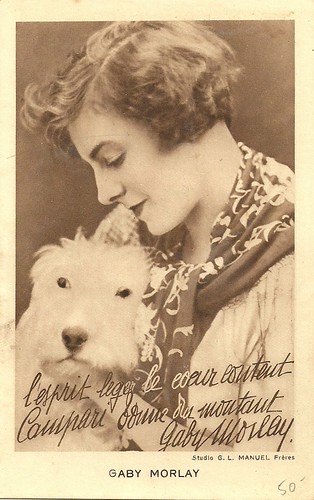
Gaby Morlay, publicity for Campari
Gaby Morlay. French postcard. Photo G.L. Manuel Frères. Caption: "L'esprit léger, le coeur content, Campari donne du montant." (The spirit is light, the heart is satisfied, and Campari gives the amount.)
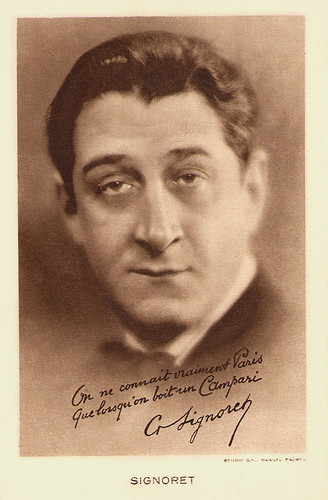
Gabriel Signoret, Campari
Gabriel Signoret. French postcard. Photo: Studio G.L. Manuel Frères. Caption: "One ne connait vraiment Paris que lorsqu'on boit un Campari." (One only really knows Paris when drinking a Campari).
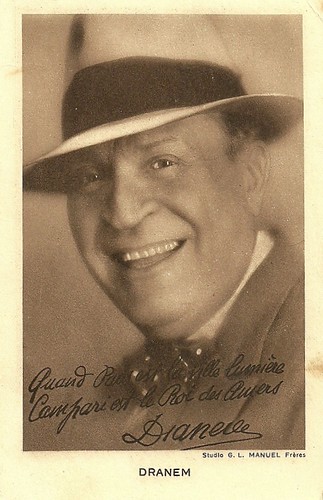
Dranem
Dranem. French postcard. Photo Studio G.L. Manuel Frères. Caption: "Quand Paris est la ville lumière, Campari est le Roi des Amers." (Paris is the City of Light, Campari is the King of Bitters.)

Dolly Davis, publicity for Campari
Dolly Davis. French postcard. Photo: Studio Lorelle. Caption: "Si Paris vous attire, Campari vous retient." (If Paris attracts you, Campari holds you back.)
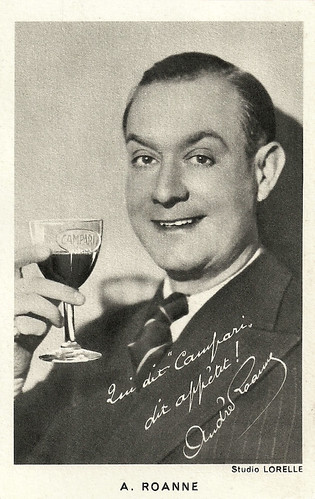
André Roanne. publicity for Campari
André Roanne. French postcard. Photo: Studio Lorelle. Caption: "Qui dit Campari, dit appétit!" ( Who says Campari says appetite! )
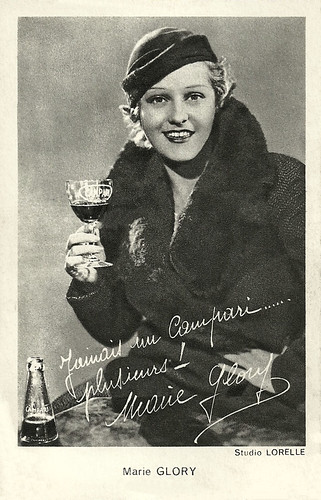
Marie Glory, publicity for Campari
Marie Glory. French postcard. Photo: Studio Lorelle. Caption: "J'aimais un Campari... plusieurs!" (I would like 'Campari'... several!)
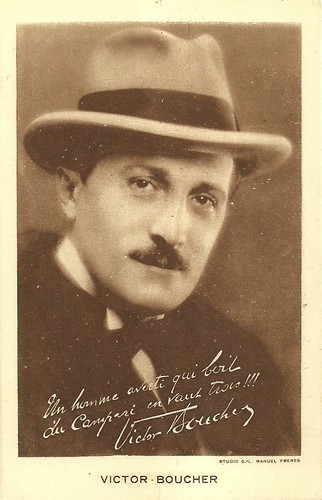
Victor Boucher
Victor Boucher. French postcard. Photo: Studio G.L. Manuel Frères. Caption: "Un homme averti qui boit du Campari en vaut trois!!!" (An informed man drinking Campari is worth three!!! )
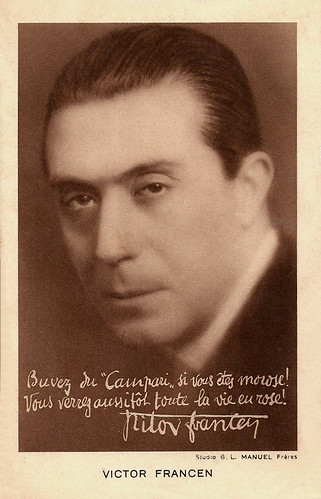
Victor Francen
Victor Francen. French postcard. Photo: Studio G.L. Manuel Frères. Caption: "Buvez du 'Campari', si vous êtes morose! Vous verrez aussitôt la vie en rose!" (Drink 'Campari', if you are depressed! You immediately see life in pink!)
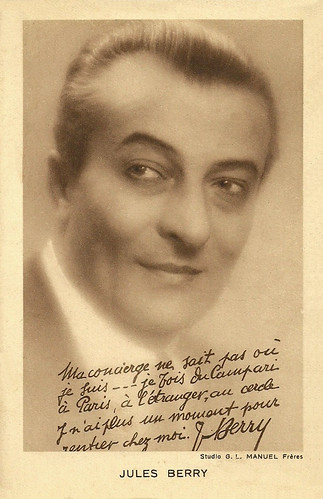
Jules Berry, publicity for Campari
Jules Berry. French postcard. Photo: Studio G.L. Manuel Frères. Caption: "Ma concierge ne sait pas où je suis... je bois du Campari à Paris, à l'étranger, au cercle. Je n'ai plus un moment pour rentrer chez moi." (My concierge does not know where I am ... I drink Campari in Paris, abroad, at the club. I do not have time to go home anymore.)
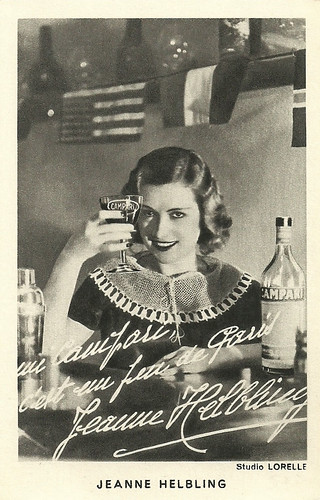
Jeanne Helbling, publicity for Campari
Jeanne Helbling. French postcard for Campari. Photo: Studio Lorelle. Caption: "Un Campari, c'est un peu de Paris." (A Campari is like a bit of Paris).

Falconetti
Maria Falconetti. French postcard. Photo: Studio G.L. Manuel Frères. Caption: "Á Campari le délicieux aperitif" (To Campari, the delicious aperitif).
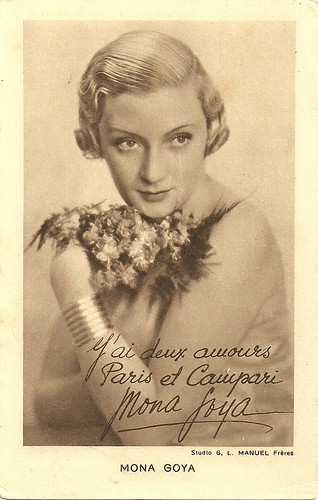
Mona Goya
Mona Goya. French postcard. Photo: Studio G.L. Manuel Frères. Caption: "J'ai deux amours Paris et Campari." (I have two loves, Paris and Campari.)
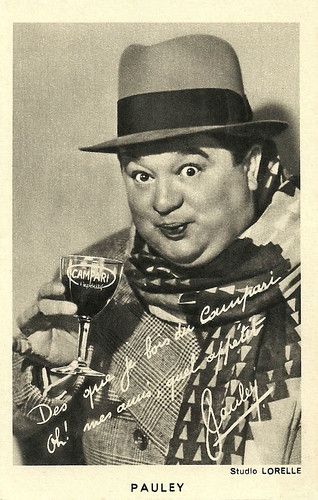
Pauley ad for Campari
Pauley. French postcard for Campari. Photo: Studio Lorelle. Caption: "Dès que je bois du Campari, Oh! mes amis, quel appetit!" (Ever since I drink Campari, oh my friends, what an appetite!).
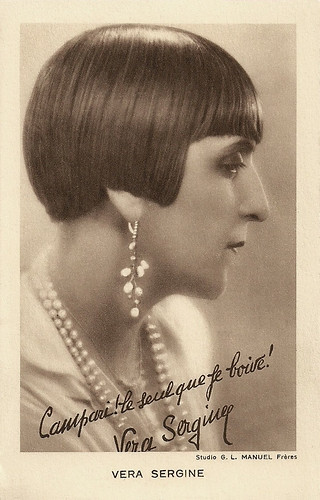
Vera Sergine
Vera Sergine. French postcard. Photo: Studio G.L. Manuel Frères. Caption: "Campari! Le seul que je boive!" (Campari! The only one I drink!)

Vera Sergine
Vera Sergine. French postcard. Photo: Studio G.L. Manuel Frères. Caption: "Campari! Le seul que je boive!" (Campari! The only one I drink!)
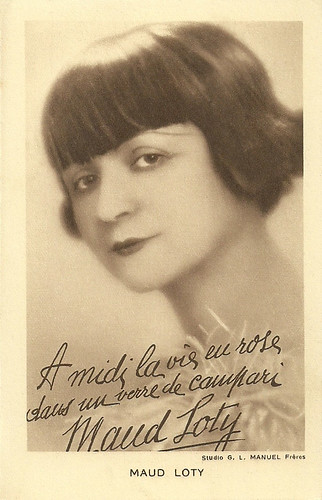
Maud Loty promoting Campari
Maud Loty. French postcard. Photo: Studio G.L. Manuel Frères. Caption: "A midi la vie en rose dans un verre de Campari." (At noon, 'la vie en rose' in a glass of Campari.)
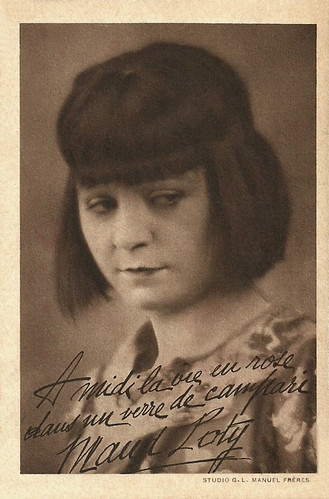
Maud Loty promoting Campari
Maud Loty. French postcard. Photo: Studio G.L. Manuel Frères. Caption: "A midi la vie en rose dans un verre de Campari." (At noon, 'la vie en rose' in a glass of Campari.)
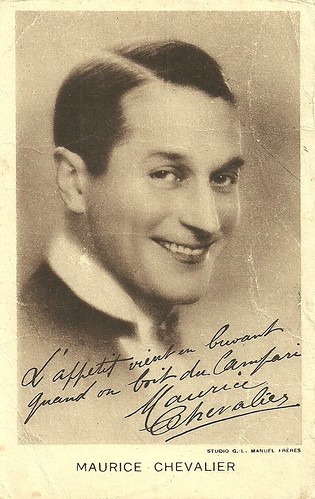
Maurice Chevalier promoting Campari
Maurice Chevalier. French postcard. Photo: G.L. Manuel Frères. Caption: "L'appetit vient en buvant, quand on boit du Campari." (When drinking Campari, the appetite comes.)
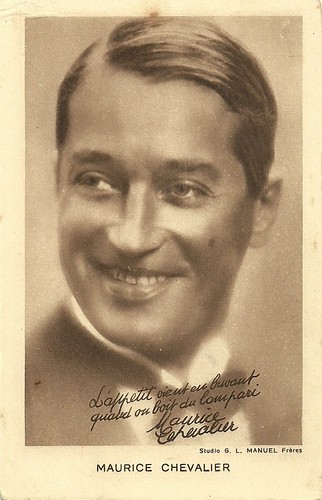
Maurice Chevalier
Maurice Chevalier. French postcard. Photo: G.L. Manuel Frères. Caption: "L'appetit vient en buvant, quand on boit du Campari." (When drinking Campari, the appetite comes.)

Sources: Tonique (now defunct) and Wikipedia. Check out the sequel post, Campari in the 1930s.

This post was last updated on 22 December 2023.

27 June 2020

Campari in the 1930s

Campari is a dark red-coloured 'aperitivo', introduced in Italy in the 1860s by Gaspare Campari. Under the direction of his son, David(e) Campari, the company began to export the bitter, first to France, then overseas. In the 1920s, a French postcard campaign with sepia portraits of stars of the French silent cinema photographed by G.L. Manuel Frères linked Campari to Paris. In the early 1930s, David did another Campari postcard campaign, this time with black and white star portraits by Studio Lorelle.

Henri Alibert
French postcard by David Campari, Paris. Photo: Studio Lorelle. Caption: Un petit Campari donne grand appètit (A small Campari gives great appetite.)

French singer, actor and librettist Henri Al(l)ibert (1889-1951), known as Alibert, was the Marseille singer par excellence. During the 1930s and 1940s, he starred in his own very popular operettas both on stage and on the screen.

Marcelle Chantal, publicity for Campari
French postcard by David Campari, Paris. Photo: Studio Lorelle. Caption: Paris sans Campari, n'est pas Paris (Paris without Campari, is not Paris).

Marcelle Chantal (1901-1960) was a French socialite who became a film actress. She peaked in the early 1930s. Marcelle Chantal symbolised French elegance.

Dolly Davis, publicity for Campari
French postcard by David Campari, Paris. Photo: Studio Lorelle. Caption: Si Paris vous attire, Campari vous retient (If Paris attracts you, Campari retains you).

French actress Dolly Davis (1896-1962) was a very popular comédienne in the 1920s, who was often paired with her then companion André Roanne. They even starred together in a film simply called Dolly (Pierre Colombier, 1928).

Florelle
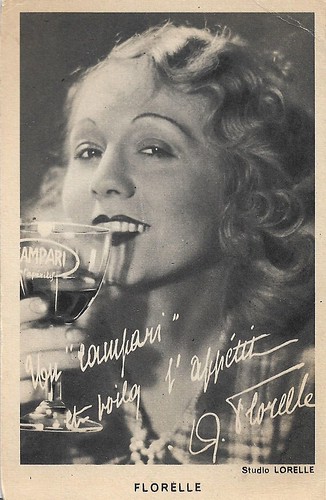
French postcard by David Campari, Paris. Photo: Studio Lorelle. Caption: Un Campari et voila l'appètit (A Campari and there's the appetite).

French music hall star Florelle (1898-1974) was one of the queens of Paris. The petite blonde appeared in 54 films between 1912 and 1956 and also toured around the world. Her most beautiful role was as Fantine in a classic version of Les Miserables (1934).

Marie Glory, publicity for Campari
French postcard by David Campari, Paris. Photo: Studio Lorelle. Caption: J'aimais un Campari... plusieurs! (I liked a Campari... several!).

For a long time, French actress Marie Glory (1905-2009) was the longest-living star of French silent cinema, but in 2009 she died at the age of 103.

Jeanne Helbling, publicity for Campari
French postcard by David Campari, Paris. Photo: Studio Lorelle. Caption: Un Campari, c'est un peu de Paris. (A Campari is like a bit of Paris).

Jeanne Helbling was an actress of the French cinema of the 1920s and 1930s, who was extremely active in early French sound film. She was also a Resistance heroine.

Georges Milton pub Campari
French postcard by David Campari, Paris. Photo: Studio Lorelle. Caption: Au travers d'un Campari, Tout est gai, tout est joli (With a Campari, all is gay, all is nice).

Georges Milton (1886-1970) was a French singer and actor, who peaked in French cinema of the 1930s as the character Bouboule.

Pauley ad for Campari
French postcard by David Campari, Paris. Photo: Studio Lorelle. Caption: Dès que je bois du Campari, Oh! mes amis, quel appetit! (Ever since I drink Campari, oh my friends, what an appetite!).

Pauley or Paul Pauley (1886-1938) was a French actor and singer, who had a prolific career in French cinema of the 1930s.

André Roanne. publicity for Campari
French postcard by David Campari, Paris. Photo: Studio Lorelle. Caption: Qui dit Campari, dit appétit! (Who says Campari, says appetite!).

André Roanne (1896-1959) had a long-standing career in French cinema. He peaked in the 1920s in comedies and dramas, often opposite Dolly Davis.

Saint-Granier
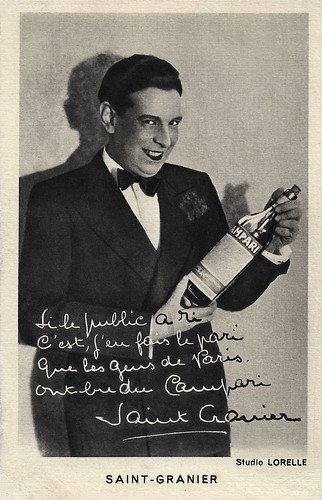
French postcard by David Campari, Paris. Photo: Studio Lorelle. Caption: Si le public a ri, c'est j'en fais le pari, que les gens de Paris, ont bu du Campari (If the public laughed, It is, I bet it, that the people of Paris drank Campari).

Saint-Granier (1890-1976) was a French journalist, singer, songwriter, actor, director, and radio star. Between the two wars, he was one of the great personalities of the French cabaret. He was also the director of Paramount Pictures in France in the early 1930s.

This post was last updated on 22 December 2023.

15 February 2014

Studio Lorelle

Lucien Lorelle (1894-1968) was one of the great photographers of the early twentieth century. In his Studio Lorelle, he portrayed all the great French artists of his time.

Brigitte Helm
Brigitte Helm. French postcard by Cine-Europe, no. 339. Photo: Studio Lorelle. Publicity still for L'Argent/The Money (Marcel L'Herbier, 1928).

Brigitte Helm
Brigitte Helm. French postcard by J.R.P.R., Paris, no. 338. Photo: Studio Lorelle, Paris. Publicity still for L'Argent/The Money (Marcel L'Herbier, 1928).

Brigitte Helm
Brigitte Helm. French postcard by J.R.P.R., Paris, no. 337. Photo: Studio Lorelle, Paris. Publicity still for L'Argent/The Money (Marcel L'Herbier, 1928).

Sought After Portraitist


Lucien Lorelle was born in Paris, France in 1894. He was a volunteer in the French infantry and aviation during World War I and later received the Croix de Guerre and the Légion d’Honneur for his bravery.

In 1920 he started to work as a photographer at the famous portrait Studio G.L. Manuel Frères.

In 1927, Lucien founded with his brother-in-law the Studio Lorelle, which focused entirely on studio portraits. Many young photographers went to work and study photography here, including Czech photographer Jaroslav Rössler, German photographer Erna Wagner-Hehmke and Rose Nadau.

Lorelle soon became a sought after portraitist. To his studio came famous artists like Jean Cocteau and Tamara de Lempicka, and international film stars like Louise Brooks, Jean Murat, Käthe von Nagy, Marie Glory and Brigitte Helm.

In 1935 he sold the Studio Lorelle and founded the Studio Lucien Lorelle. This studio did advertising campaigns for Galeries Lafayette (with Cassandre), Perrier, Philips, Cinzano, Chanel, Shell etc.

Lorelle had already done a postcard campaign with film stars for Campari at Studio Lorelle. Campari was a client which he had taken with him from Studio G.T. Manuel Frères.

Though Lorelle dreamt of becoming a painter, photography monopolized his time, and the paintings he did complete, he systematically destroyed.

Jean Murat
Jean Murat. French postcard. Photo: Studio Lorelle, Paris.

Dolly Davis
Dolly Davis. French postcard by Editions Cinemagazine, no. 515. Photo: Studio Lorelle.

Pierre Richard Willm
Pierre Richard Willm. French postcard by A.N., Paris, no. 609. Photo: Studio Lorelle.

Brigitte Helm
Brigitte Helm. French postcard in the Europe series, no. 66, ca. 1932. Photo: Studio Lorelle.

René Lefevre
René Lefèvre. French postcard by Editions A.N., Paris, no. 770. Photo: Studio Lorelle / Film Pathé-Natan.

Colour


In 1946, Lucien Lorelle was one of the 15 founders of the Groupe des XV, an association which promoted photography as art and drew attention to the preservation of French photographic heritage.

The group (also including Robert Doisneau, Willy Ronis and René Jacques) organized from 1946 to 1957 annual exhibitions in various galleries.

Lorelle continued to portray all the famous French artists of his time including Annabella, Martine Carol, Danielle Darrieux, Gérard Philipe, Jean Marais, Michel Simon and Jean Gabin.

In 1949 Lucien Lorelle published La Photographie publicitaire, co-written with Donald Langelaan. He also wrote books like Le Portrait photographique (1950) and Le Livre de la couleur directe (1951). His books were translated in many languages.

In 1952, he founded Central Color, a professional colour photography laboratory, involved with various international projects, including the Tour de France, L’Oréal and Giorgio Armani.

In 1957 he stopped with the Studio Lucien Lorelle and focused on writing. He was the author of many surreal photographic works and literary tributes combining text, drawings and photographs. He also was devoted to teaching photography. His other hobbies included painting, writing and poetry.

In the 1960s Lucien Lorelle handed over the presidency of Central Color to his daughter Françoise Gallois, who deceased in 2003. Lucien Lorelle himself died in 1968.

Pauley ad for Campari
Pauley. French postcard for Campari. Photo: Studio Lorelle. Caption: "Dès que je bois du Campari, Oh! mes amis, quel appetit!" (Ever since I drink Campari, oh my friends, what an appetite!).

Marie Glory, publicity for Campari
Marie Glory. French postcard for Campari. Photo: Studio Lorelle. Caption: "J'aimais un Campari... plusieurs!" (I would like 'Campari'... several!)

André Roanne. publicity for Campari
André Roanne. French postcard for Campari. Photo: Studio Lorelle. Caption: "Qui dit Campari, dit appétit!" (Who says Campari, says appetite!)

Marcelle Chantal, publicity for Campari
Marcelle Chantal. French postcard for Campari. Photo: Studio Lorelle. Caption: "Paris sans Campari, n'est pas Campari."  (Paris without Campari isn't Paris.)

Georges Milton pub Campari
Georges Milton. French postcard for Campari. Photo: Studio Lorelle. Caption: "Au travers d'un Campari, Tout est gai, tout est joli." (With a Campari, all is gay, all is nice).

This is the sixth post in a series on film star photographers. Earlier posts were on the Reutlinger Studio in Paris, Italian star photographer Attilio Badodi, the German photographer Ernst Schneider, Dutch photo artist Godfried de Groot and on Milanese photographers Arturo Varischi and Giovanni Artico.

Sources: LucienLorelle.com, Melissa Demiguel (Bella Online), and Wikipedia (French). See also: dovima_is_devine_II's set of Lorelle's surrealistic photos on Flickr and see an interesting surrealistic impression with two photographs of Brigitte Helm from L'Argent at Bits & Bites.

19 January 2014

Gaby Morlay

Gaby Morlay (1893-1964) was a French actress with a long-standing career who played in over 100 films. She compensated for her small size (1.53 m.) with passion and enthusiasm.

Gaby Morlay
French postcard by J.R.P.R., Paris, no. 322. Photo: Studio G.L. Manuel Frères.

Gaby Morlay
French postcard by CE, no. 969. Photo: G.L. Manuel Frères.

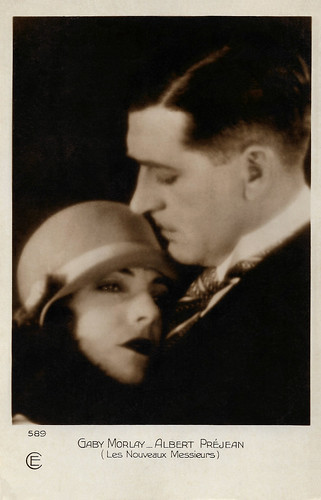
Albert Préjean and Gaby Morlay in Les nouveaux messieurs (1928)
French postcard by Cinémagazine-Edition, Paris, no. 589. Albert Préjean and Gaby Morlay in Les nouveaux messieurs / The New Gentlemen (Jacques Feyder, 1928).

Gaby Morlay
French postcard by Editions Chantal (EC), no. 45. Photo: X.

The liberated woman


Gaby Morlay was born Blanche Pauline Fumoleau in Angers, France, in 1893. By chance, she was enrolled in playing on stage.

In 1913, she started her cinema career in comic shorts with Max Linder, like La vacance de Max / Max's Vacation (Max Linder, 1913).

Later, she had her own comedy shorts with her character Gaby, including Gaby en auto / Gaby in a Car (Charles Burguet, 1917).

In the Roaring Twenties, she became the symbol of the liberated woman, being the first woman to obtain a licence for flying a Zeppelin.

Among Gaby Morlay's features were L'Agonie des aigles / The Death Agony of the Eagles (Dominique Bernard-Deschamps, Julien Duvivier, 1922) opposite Séverin-Mars, Jim la houlette, roi des voleurs / Jim the Cracksman, the King of Thieves (Pierre Colombier, Roger Lion, Nicolas Rimsky, 1926), and Les nouveaux messieurs / The New Gentlemen (Jacques Feyder, 1929) with Albert Préjean.

Gaby Morlay
French postcard by Campari. Photo G.L. Manuel Frères. Caption: "L'esprit léger, le coeur content, Campari donne du montant (The spirit light, the heart content, Campari brings you in high moods).

Gaby Morlay, publicity for Campari

French postcard by Campari. Photo G.L. Manuel Frères. Caption: "L'esprit léger, le coeur content, Campari donne du montant (The spirit light, the heart content, Campari brings you in high moods).

Gaby Morlay
French postcard by Campari. Photo G.L. Manuel Frères. Caption: L'esprit léger, le coeur content, Campari donne du montant (The spirit light, the heart content, Campari brings you in high moods).

Félix Galipaux, Gaby Morlay and others in the stage comedy Mademoiselle ma mère
Vintage French postcard. André Lefaur, Louis Verneuil, André Alerme, Denise Grey, Félix Galipaux, Darzac and Gaby Morlay in the stage comedy 'Mademoiselle ma mère', performed at the Théâtre Femina in Paris in 1920, and starring Morlay as Jacqueline.

Peaking in the sound era


While Gaby Morlay already had an active film career in the 1920s, she really peaked in the sound era. If she were not involved in big productions, she did five films a year in the 1930s.

Her first sound film was Accusée, levez-vous / Accused, Stand Up (Maurice Tourneur, 1930).

Among her best-known films were Après l'amour / When Love Is Over (Léonce Perret, 1931), Nous ne sommes plus des enfants / We Are Not Children (Augusto Genina, 1934), Jeanne (Georges Marret, 1934) - Morlay was co-producer for the latter two - La peur / The Fear (Viktor Tourjansky, 1936) with Charles Vanel, and the romantic comedy Quadrille (Sacha Guitry, 1938).

She was often paired with Victor Francen and played historical figures like Queen Victoria in Entente Cordiale (Marcel L'Herbier, 1939), Giuseppina Strepponi in Giuseppe Verdi (Carmine Gallone, 1939), and Napoleon's Désirée in Le Destin fabuleux de Désirée Clary (Sacha Guitry, 1941).

Having often played on stage in Henry Bernstein's plays, Morlay also appeared in several film adaptations of his plays: Mélo / The Dreamy Mouth (Paul Czinner, 1932), Le bonheur / Happiness (Marcel L'Herbier, 1935), Samson (Maurice Tourneur, 1936), and Le messager / The Messenger (Raymond Rouleau, 1937) with Jean Gabin.

Gaby Morlay
French postcard by PC, no. 153. Photo: Pathé-Natan.

Gaby Morlay
French postcard by PC, no. 69. Photo: Pathé-Natan.

Gaby Morlay
French postcard by Editions Chantal (EC), no. 45. Photo: Pathé Natan.

André Luguet and Gaby Morlay in Il était une fois (1933)
French postcard. Photo: Pathé-Natan. Photo: Pathé-Natan. André Luguet and Gaby Morlay in Il était une fois / Once Upon a Time (Léonce Perret, 1933). In this film, Gaby Morlay, Georges Mauloy, André Dubosc, Jean Max and Jean Bara reprised the roles they had created at the Théâtre des Ambassadeurs in Paris from 12-2-1932.

Mother superior


During the German Occupation of France, Gaby Morlay was the mistress of Max Bonnafous, Minister of Agriculture in the Marshall Pétain government.

Because of her long association with Bonnafous, she had to appear several times in front of the 'purge committees' once France was liberated. Morlay finally could marry Bonnafous in 1961, after his wife, who refused to divorce him, had died.

During the war, Morlay excelled in the popular tearjerker Le Voile bleu / The Blue Veil (Jean Stelli, 1942).

In the postwar era, Louis Jouvet treated her cruelly in Un revenant / A Lover's Return (Christian-Jacque, 1946).

Her favourite film was Les amants du pont Saint-Jean / The Lovers of the St. Jean Bridge (Henri Decoin, 1947), in which she played Michel Simon's clochard friend.

Gaby Morlay
French postcard by Editions P.I. Paris, no. 88. Photo: U.F.P.C.

Gaby Morlay in Le scandale (1934)
German postcard by Das Programm von Heute für Film und Theater G.m.b.H., Frankfurt a.M. Photo: Hammer-Tonfilm. Gaby Morlay in Le scandale / The Scandal (Marcel L'Herbier, 1934) with Mircha and Gaby Triquet.

Gaby Morlay
French postcard. Offered by Kwatta Chocolate. N Els, Bromurite.

The wife of the masked man


In the 1950s, Gaby Morlay played in some Italian films: she was Aldo Fabrizi's wife in the comedy Prima Communione / Father's Dilemma (Alessandro Blasetti, 1950), and in the melodrama Anna (1951, Alberto Lattuada), she was the Mother Superior opposite Silvana Mangano in the title role.

In 1951, Morlay was also part of the Cannes Jury. In Le Plaisir / Pleasure (Max Ophüls, 1951), she was the wife of the masked man in the first episode of the film, and in Sacha Guitry's Si Versailles m'était conté / Affairs in Versailles (1954), she was the Countess de la Motte.

She was elected president of the Syndicat national des acteurs (French Screen Actors' Guild) in 1956. Until she died in 1964, Gaby Morlay continued to play in films.

She also had an active stage career from the 1910s to the 1960s, in plays by Sacha Guitry, Marcel Achard, André Brulé and others. Just as in the cinema, she continued to play on stage until her death; for instance, in 1959-1960, she played for two years in Eugene O'Neill's 'Long Voyage to the End of the Night'.

In 1964, Gaby Morlay died of cancer in Nice, at the age of 71.

Gaby Morlay
French postcard by A.N., Paris, no. 859. Photo: Production Pathé.

Gaby Morlay
Vintage postcard by A Stefsky. Photo: Erpé.

Gaby Morlay
French postcard by Editions Chantal, Rueil, no. 45. Photo: C.C.F.C.

Sources: Cinememorial, Wikipedia (French), and IMDb.

This post was last updated on 4 November 2025.